Screener / SEC EDGAR /CIK 0000230557 /10-K filed Feb 9, 2026, compared with Feb 10, 2025 /Numbers from the XBRL of the 10-Ks
Nasdaq Financials · Property & Casualty Insurance

Selective Insurance Group Inc SIGI

Compare with peers Embed
SEC comment letters, last 20 years

4 reviews of SIGI's filings by SEC staff

UPLOAD and CORRESP
Reviews 4 latest letter Dec 18, 2020
Questions asked 12 each answered in the company's own letter
No closing letter 0 reviews without a letter saying the staff completed it

When the SEC's staff reviews a filing, it writes to the company with numbered questions, and the company answers each one in a letter. SEC publishes the exchange once the review is over, at least 20 business days later. A question is not an accusation; most reviews end with the company adding detail to its next filing.

How the reviews went

Every review on EDGAR, from the first staff letter to the letter that closes it

  1. 1. Staff letters 5 UPLOAD
  2. 2. Questions in them 12 numbered comments
  3. 3. Company replies 5 CORRESP
  4. 4. Reviews closed 4 of 4 closing letter

Half the closed reviews took 21 days or less from the first letter to the closing letter.

Form 10-K for the Fiscal Year Ended December 31, 2019

2020-12-18 to 2021-01-07 · 3 questions · 1 letter from the SEC, 1 from the company
Review closed 2021-01-07
RevenueIncome taxesGoodwill and impairmentRisk factors
SEC asked (1)
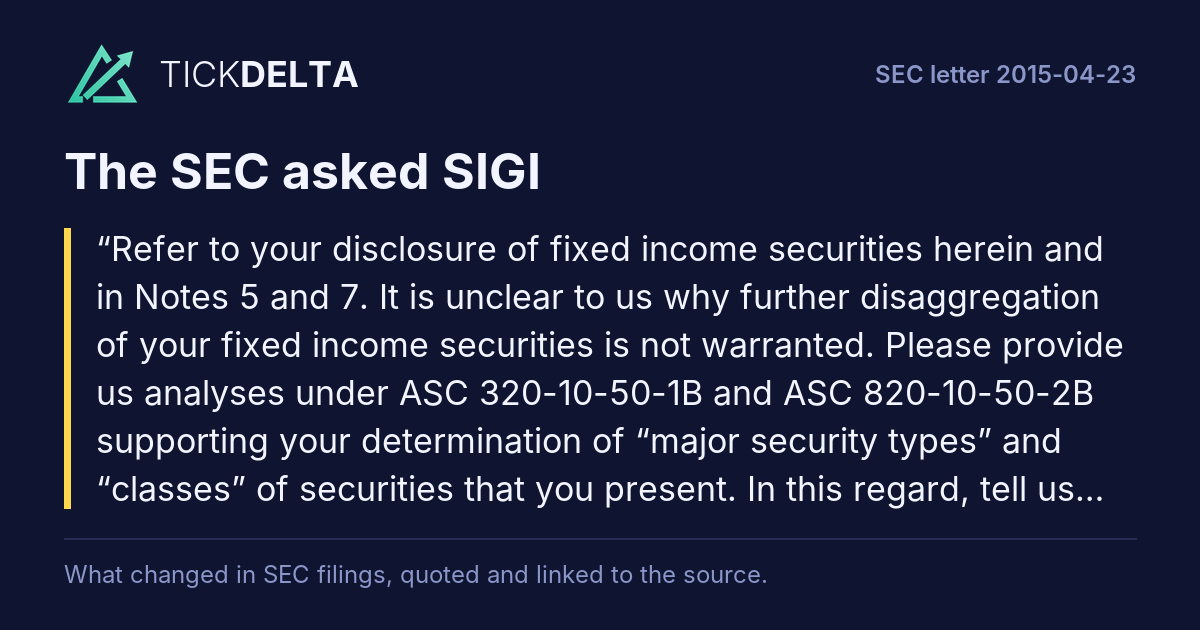
In your policy note you disclose that any interest levied by the Internal Revenue Service would be recognized in interest expense and any penalties would be recognized in either other insurance expenses or corporate expenses. In Note 13 on page 114 you disclose that any such interest and penalties will be included in income tax expense.
Rest of the question

Please represent to us that in future filings you will revise your disclosure to remove this inconsistency. Notes to Unaudited Interim Consolidated Financial Statements Note 1: Basis of Presentation and Accounting Policies (b) Accounting Policies

SIGI answered
We represent we will consistently disclose all interest and penalties levied by the Internal Revenue Service as federal income tax expense in future filings.

Form 10-Q for the Quarterly Period Ended September 30, 2020

Notes to Unaudited Interim Consolidated Financial Statements

Note 1: Basis of Presentation and Accounting Policies

(b) Accounting Policies
Read in the reply
In its next report

First report after the company's reply of Jan 5, 2021: 10-K filed Feb 12, 2021 ↗, against the 10-K filed Feb 12, 2020 ↗.

Tickdelta does not hold the text of both reports, so they are not compared here.
Investments, page 6
SEC asked (2)
Although we note that you have adopted ASU 2016-13 and that you revised your investment policy note to reflect your current expected credit losses on investment securities, you continue to refer to other than-temporary impairments ("OTTI").
Rest of the question

As both temporary impairments and OTTI were constructs of predecessor requirements and the length of time a security's fair value is below amortized cost is no longer a factor as to whether a charge to earnings for that security's impairment is warranted, please represent to us that you will revise your policy and other investment disclosures (including that on the face of your statements of income) to remove reference to OTTI for periods after January 1, 2020.

SIGI answered
We represent we will revise our policy and other investment disclosures (including on the face of our statements of income) to remove all temporary and other-than-temporary impairment references in future filings.
Read in the reply
Note 4: Investments, page 10
SEC asked (3)
In sub-note (f) on page 13 you disclose that you do not have exposure to any credit concentration risk of a single issuer greater than 10% of your stockholders' equity, other that certain U.S. government agencies.
Rest of the question

We note that on page 54 of your September 30, 2020 Form 10-Q you provided more granular information about the credit quality of your investment portfolio compared to prior practice in your annual and quarterly reports. Please tell us whether you have exposure to any significant industry sector concentrations in your corporate securities and overall investment portfolios and your consideration for disclosing the information required by ASC 825-10-50-21 in your upcoming Form 10-K. In your response, specifically tell us your exposures to the industries you identify as being negatively impacted by the COVID-19 pandemic in the first bullet of your risk factor on page 56 of your September 30, 2020 Form 10-Q.

SIGI answered
Expanded Disclosure:

We believe we do not have significant exposure to industries impacted by the COVID-19 pandemic; however, to provide our investors, creditors, and analysts with additional insight into our investment portfolio’s credit quality, we expanded our investment disclosures on page 54 of our September 30, 2020 Form 10-Q. We feel this additional disclosure was warranted in light of the economic uncertainty and market volatility created by COVID-19.
Rest of the answer

We will continue to review and evaluate our investment disclosures in light of the impact of COVID-19 and other factors, including ASC 825-10-50-21, as we prepare our upcoming 2020 Form 10-K.

Sector Concentrations:

On a quarterly basis, we review our investment portfolio for concentrations of credit risk in accordance with ASC 825-10-50-21. The following three sectors represent more than 10% of our fixed income securities portfolio, each of which are discussed more fully below:

($ in millions) September 30, 2020 December 31, 2019

Major Asset Category Sector Fair Value Net Unrealized Gain Weighted Average Credit Rating % of Fixed Income Portfolio Fair Value Net Unrealized Gain Weighted Average Credit Rating % of Fixed Income Portfolio

RMBS Agency RMBS $1,090.1 $58.2 AAA 17% $1,367.8 $40.7 AAA 22%

Corporate Securities Financials 1,045.8 70.6 A16% 925.2 42.5 A15%

State and Municipal Obligations Special Revenue Bonds 970.1 60.7 AA15% 954.0 48.5 AA16%

Agency RMBS within RMBS

Our September 30, 2020 Form 10-Q provides additional details on our RMBS portfolio on page 54. As we illustrated, agency RMBS represented 92% of our RMBS allocation as of September 30, 2020 and 94% as of December 30, 2019. These securities are “AAA” rated, so we did not believe additional disclosure was warranted.

Financials within Corporate Securities

We discuss corporate securities on page 64 of our 2019 Form 10-K, including the investment grade (90%) versus non-investment grade (10%) allocation in this portfolio and our approach to mitigating the risk of an individual issuer’s default by maintaining a diverse portfolio of holdings. No individual issuer comprised more than 1% of our fixed income securities portfolio at December 31, 2019 and September 30, 2020. Within our allocation to corporate securities, financials is our most significant industry concentration at 16% of our fixed income securities portfolio at September 30, 2020. The corporate securities portfolio allocation to financials is well diversified by issuer and its weighted average credit rating of “A-” has not changed since our 2019 Form 10-K disclosure. As shown in the corporate securities table below, the next highest sector allocation within our corporate securities allocation is consumer non-cyclicals at 4% at December 31, 2019 and 5% at September 30, 2020. Considering this and any potential changes due to COVID-19, we did not believe we had a significant concentration of credit risk within our corporate securities allocation of our investment portfolio that warranted additional disclosure. We will review this concentration again as we prepare our 2020 Form 10-K.

Special Revenue Bonds within State and Municipal Obligations

The special revenue municipal obligation category is reviewed in conjunction with our disclosure on page 64 of our 2019 Form 10-K, which we plan to disclose in our 2020 Form 10-K. This portfolio is well diversified with approximately 70% of the dedicated revenue stream at December 31, 2019 from (i) essential services (55%), which is comprised of transportation, water and sewer, and electric, and (ii) education (15%), which includes school districts and higher education, including state-wide university systems. As of September 30, 2020, we did not believe there was a significant change in the state concentration or credit quality of this sector of our portfolio compared to our 2019 Form 10-K disclosure. The weighted average credit rating of our special revenue municipal bonds allocation was “AA-” at September 30, 2020. Therefore, we did not believe it was necessary to disclose further detailed information related to this sector in our quarterly report. We will review this conclusion again as we prepare our 2020 Form 10-K.

Corporate Securities:

Aside from the financials allocation within corporate securities, no other sector within our corporate securities portfolio represents more than 10% of our fixed income securities portfolio. The sector composition of this portfolio is provided in the table below:

Sector Fair Value Weighted Average Credit Rating % of Fixed Income Portfolio Fair Value Weighted Average Credit Rating % of Fixed Income Portfolio

Financials $1,045.8 A16% $925.2 A15%

Consumer Non-Cyclicals 298.2 BBB+ 5% 259.7 BBB+ 4%

Communications 148.5 BBB+ 2% 129.8 BBB+ 2%

Consumer Cyclicals* 143.7 BBB2% 136.0 BBB 2%

Technology 115.9 BBB+ 2% 81.6 BBB+ 1%

Energy 101.7 BBB 2% 104.7 BBB 2%

Utilities 74.2 BBB+ 1% 37.6 BBB+ 1%

Bank Loans 73.1 B 1% 65.6 B 1%

Basic Materials 37.3 BBB1% 26.7 BBB- <1%

Other Industrials 196.8 BBB 3% 158.5 BBB 3%

Other 79.0 BBB+ 1% 39.2 BBB+ 1%

Total Corporate Securities $2,314.2 BBB+ 36% $1,964.6 BBB+ 32%

*Included in consumer cyclicals are travel and leisure, as well as retail exposures.

In the first bullet of the risk factor on page 56 of our September 30, 2020 Form 10-Q, we identified certain industries, namely travel, leisure, retail, energy, and real estate, as being negatively impacted by COVID-19. Travel, leisure, and retail are included in consumer cyclicals in the table above. Our exposure to these sectors within our consumer cyclicals portfolio as of September 30, 2020 was as follows:

•Travel: $24.7 million fair value, $0.4 million net unrealized loss, “BBB-” weighted average credit rating;

•Leisure: $19.7 million fair value, $0.5 million net unrealized gain, “BB” weighted average credit rating; and

•Retail: $42.6 million fair value, $3.1 million net unrealized gain, “BBB” weighted average credit rating.

Overall, our allocation to these sectors that were negatively impacted by COVID-19 is not significant, and in the aggregate, these positions were in a net unrealized gain at September 30, 2020. The net unrealized gain position of the consumer cyclical and energy sectors at September 30, 2020, was marginally higher compared to the net unrealized gain position at December 31, 2019 as follows:

($ in millions) Net Unrealized Gain

Sector September 30, 2020 December 31, 2019

Consumer Cyclicals $6.1 $4.7

Energy 6.1 3.8

As these sectors were not material to our fixed income securities portfolio, we did not separately discuss or disclose them on page 54 of our September 30, 2020 Form 10-Q. As we prepare our 2020 Form 10-K, we will evaluate these sectors and include discussion about their materiality to our portfolio.

Mortgage-backed securities represent our most significant exposure to real estate, and we have provided a further breakdown of our mortgage-backed securities on page 54 of our September 30, 2020 Form 10-Q.

We also have some modest direct and indirect exposure to travel, leisure, retail, energy, and real estate within our allocations to Equity Securities and Other Investments. Our allocation to Equity Securities and Other Investments comprise only approximately 6% of the total fair value of our overall investment portfolio. Therefore, we do not believe any further disaggregation across those components of our portfolio would change the analysis discussed herein.

In preparing our 2020 Form 10-K, we will continue to analyze all of this information to determine whether any significant concentrations within our investment portfolio exist and require further disclosure.

Read in the reply
In its next report

First report after the company's reply of Jan 5, 2021: 10-K filed Feb 12, 2021 ↗, against the 10-K filed Feb 12, 2020 ↗.

Tickdelta does not hold the text of both reports, so they are not compared here.

Also in this review: closing letter, 2021-01-07
Form 10-K for the Fiscal Year Ended December 31, 2014

2015-04-23 to 2015-07-13 · 7 questions · 2 letters from the SEC, 2 from the company
Review closed 2015-07-13
AcquisitionsSegmentsResults discussion (MD&A)Liquidity and cashLegal and contingenciesRevenue
SEC asked (1)
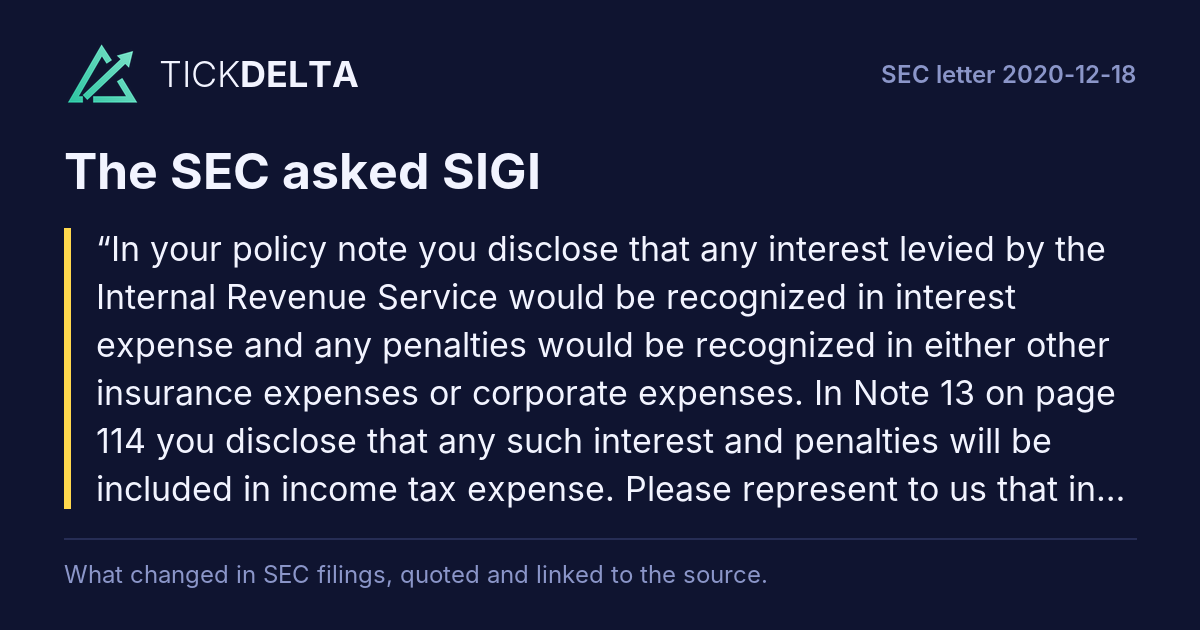
Refer to your disclosure of fixed income securities herein and in Notes 5 and 7. It is unclear to us why further disaggregation of your fixed income securities is not warranted. Please provide us analyses under ASC 320-10-50-1B and ASC 820-10-50-2B supporting your determination of “major security types” and “classes” of securities that you present.
Rest of the question

In this regard, tell us your basis for the disaggregation of fixed income securities in the table on page 75 under “Credit Risk.”

SIGI answered
The identification of the “major security types” and “classes” for disclosure mirrors our process of establishing the Company’s investment policy. The investment policy is reviewed and approved by the Finance Committee of the SIGI Board of Directors and the Management Investment Committee.

In constructing the Company’s portfolio, the Finance Committee has approved primary parameters that focus on the following: asset allocation, asset quality, duration, liquidity, maturities, and taxation.
Rest of the answer

In determining the proper asset allocations and related percentage investment ranges, emphasis is placed on the economic characteristics of the various types of investment securities available to us in the marketplace. The major security types disclosed in Notes 5 and 7 mirror those that are established and outlined within our investment policy. The only exception to this practice is the disclosure of “foreign governments.” These securities are required to be separately disclosed pursuant to the Financial Services industry specific guidance in ASC 942-320-50-2.

Within the Company’s asset allocation policy ranges by major security type, the company also establishes maximum thresholds, which focus on credit quality and geographic concentrations as well as issuer concentrations. These secondary thresholds provide a basis for our expanded discussion and analysis of credit risk within Item 7A. “Quantitative and Qualitative Disclosures About Market Risk.” As is illustrated on page 75 through 78, the subcategories within each major security type currently do not show any material deviation from that of the overall credit quality of the major security type itself. Furthermore, no sector or geographic concentrations of concern are identified within the discussion or tables on pages 75 through 78. We believe that informing the investor at the same level of aggregation as we inform our managers and the Board provides the most significant insight into our operations. In addition, since no additional material insight was obtained at a lower level of detail, we did not believe expanding the major security types within the notes to the financial statements was warranted and would only create redundancy and potential confusion.

Read in the reply
SEC asked (2)
Refer to your discussion of valuation techniques used to fair value your fixed income securities on page 91. Please provide us, for each “class” (see comment 1 above) of Level 2 and Level 3 fixed income securities, the valuation technique(s) and inputs used in your fair value measurement. Refer to ASC 820-10-50-2bbb. (j) Deferred Policy Acquisition Costs, page 92
SIGI answered
Pursuant to ASC 820-10-50-2bbb, we should have clearly indicated that the paragraph contained on page 91 is applicable to all of our seven major security types related to fixed income securities valued with Level 2 inputs. For your convenience, we are providing that paragraph below updated to reflect its applicability. For purposes of clarity, we have briefly expanded our discussion to reflect the more significant pricing model inputs. Additional language from that which was originally included on page 91 is italicized.
Rest of the answer

In future Form 10-K filings, we will include this disclosure:

For our U.S. government and government agencies, foreign government obligations, obligations of states and political subdivisions, corporate securities, and structured securities, which include ABS, CMBS, and RMBS whose fair value measurement is based on Level 2 inputs, we utilize a market approach, using primarily matrix pricing models prepared by external pricing services. Matrix pricing models use mathematical techniques to value debt securities by relying on the securities relationship to other benchmark quoted securities, and not relying exclusively on quoted prices for specific securities, as the specific securities are not always frequently traded. Management, with the assistance of our pricing service evaluates each asset class based on relevant market information, relevant credit information, perceived market movements, and sector news. The market inputs utilized in the pricing evaluation, include: benchmark yields, reported trades, broker/dealer quotes, issuer spreads, two-sided markets, benchmark securities, bids, offers, reference data, and industry and economic events. The extent of use of each market input depends on the asset class and the market conditions. Depending on the security, the priority of the use of inputs may change or some market inputs may not be relevant. For some securities, additional inputs may be necessary.

As a matter of policy, we consistently use one pricing service as our primary source and secondary pricing services if prices are not available from the primary pricing service. In conjunction with our external investment portfolio managers, fixed income securities portfolio pricing is reviewed for reasonableness in the following ways: (i) comparing our pricing to other third-party pricing services as well as benchmark indexed pricing; (ii) comparing positions traded directly by the external investment portfolio managers to prices received from the third-party pricing services; (iii) comparing market value fluctuations between months for reasonableness; and (iv) reviewing stale prices. If further analysis is needed, a challenge is sent to the pricing service for review and confirmation of the price.

In our opinion, to disclose a lower level of granularity with regard to each major security type would introduce investment concepts that are unfamiliar to the average reader.

Regarding Level 3 fixed income securities, we currently do not hold any within our portfolio. However, if we were unable to obtain Level 1 or Level 2 pricing, we would typically use non-binding broker quotes provided by our service provider. These are prices from various broker/dealers that use bid or ask prices, or benchmarks to indices, in measuring the fair value of a security. Typically, brokers do not disclose to us the quantitative unobservable inputs associated with their non-binding quotes and therefore, we would review these quotes for reasonableness, but would either not be able to, or be limited in, disclosing the techniques and inputs used in developing the fair value as discussed in ASC 820-10-50-2bbb. If we were unable to obtain non-binding broker quotes, we would be required to produce an estimate of fair value using some of the same methodologies as our pricing service, but we would have to make assumptions for any market-based inputs that were unavailable due to market conditions.

(j) Deferred Policy Acquisition Costs, page 92

Read in the reply
SEC asked (3)
You disclose that premium deficiency testing is required to be performed at the level an entity acquires, services and measures the profitability of its insurance contracts. In your December 15, 2009 response to comment 2 you indicated that none of the roles in your servicing of contracts were delineated by lines of business.
Rest of the question

Given the historical combined ratios of your workers compensation line of business being greater than 100% as disclosed on page 55, that your workers compensation claims handling is centralized in Charlotte, North Carolina and the existence of your workers compensation strategic case management unit as disclosed on page 13, please explain to us how your workers compensation contract servicing is not different from other lines in your Standard Commercial Lines segment.

SIGI answered
Despite the fact that some of our claims handling roles have been strategically positioned to handle only workers compensation claims, we continue to analyze premium deficiency testing in a manner that is directly correlated with the way our chief operating decision makers measure the profitability of our insurance operations: Standard Commercial Lines, Standard Personal Lines, and Excess and Surplus Lines.
Rest of the answer

As disclosed in our notes to the financial statements, we give consideration to the process of acquiring, servicing, and measuring the profitability of our insurance contracts; but as a matrix organization we applied more weight to the way we acquire business and measure profitability on a GAAP reporting basis.

To that end, we believe it is important to recognize that we market our standard business on a full account basis and rarely write an individual line of business for a particular customer. The average commercial lines customer has three separate policies from us, one of which may be workers compensation. In addition, our Agency Management Specialists continue to be a central focus of our field model, with responsibility for managing the growth and profitability of their territories and underwriting new Standard Lines Commercial accounts as opposed to individual lines of business.

As we cited in our letter on December 15, 2009, we do price accounts on a granular level, but this is largely a function of regulatory requirements and the competitive landscape within which we operate. Pricing and measuring profitability at a more granular level allows us to fulfill our statutory regulatory reporting requirements.

Read in the reply
Note 19. Litigation, page 136
SEC asked (4)
You disclose that from time to time you are involved in legal actions (such as putative class actions and other individual actions in which extra-contractual damages, punitive damages, or penalties are sought) that could have a material adverse effect on your consolidated results of operations or cash flows for a particular quarterly or annual period.
Rest of the question

It is unclear from this disclosure whether any such legal actions currently exist under which it is at least reasonably possible that a loss has been incurred. Please provide us proposed revised disclosure to be included in future periodic reports that clarifies whether any such legal actions are underway. To the extent there are, please disclose the nature of the contingency and an estimate of the possible loss or range of loss or a statement that such an estimate cannot be made. Please see ASC 450-20-50-1 through 50-4.

SIGI answered
We do not believe that the Company was involved in any legal action that could have a material adverse effect on our consolidated results of operations or cash flows as of December 31, 2014. In future Form 10-Q and Form 10-K filings, we will include a statement as to whether we are currently involved in any such legal actions.
Read in the reply
In its next report

First report after the company's reply of May 1, 2015: 10-Q filed Jul 30, 2015 ↗, against the 10-Q filed Oct 30, 2014 ↗.

Tickdelta does not hold the text of both reports, so they are not compared here.

Employment Agreements and Potential Payments Upon Termination or Change in Control, page
SEC asked (5)
We note your disclosure that you have entered into an employment agreement with your Executive Vice President & Chief Actuary, Mr. Zaleski, but this agreement has not been filed as an exhibit to your annual report nor has it been incorporated by reference from another filing. Please file this agreement as an exhibit to your next quarterly report on Form 10-Q and incorporate it by reference to your 2016 annual report.
SIGI answered
The Employment Agreement between Selective Insurance Company of America and Ronald J. Zaleski, dated as of December 23, 2008, was filed as Exhibit 10.23i of the Company’s Annual Report on Form 10-K for the year ended December 31, 2008. In response to your comment, we listed this agreement in the Exhibit List to the Company’s Form 10-Q filed on April 30, 2015, and we will include it on the Exhibit List to the Company’s Annual Report on Form 10-K for the year ended December 31, 2015.

The Company acknowledges that:

•

The Company is responsible for the adequacy and accuracy of the disclosure
Rest of the answer

in the filings;

Staff comments or changes to disclosure in response to staff comments do not foreclose the Commission from taking any action with respect to the filing; and

The Company may not assert the staff comments as a defense in any proceeding initiated by the Commission or any person under the federal securities laws of the United States.

Read in the reply
In its next report

First report after the company's reply of May 1, 2015: 10-Q filed Jul 30, 2015 ↗, against the 10-Q filed Oct 30, 2014 ↗.

Tickdelta does not hold the text of both reports, so they are not compared here.

SEC asked (1)
In your response to prior comment one you indicate that secondary thresholds, such as credit quality and geographic concentrations provide a basis for your expanded discussion and analysis within Item 7A. ASC 320-10-50-1B states that credit quality, business sector and geographic concentrations (among others) should be considered when determining whether it is necessary to break out a security type into greater
Rest of the question

detail in the financial statement footnotes. In this regard, your disclosure on page 65 shows that approximately 14% of your fixed maturity portfolio was rated lower medium grade or non-investment grade at December 31, 2014. Further, your disclosure on page 75 shows a significant portion of your corporate bonds within the financial sector and a significant portion of your municipal bonds as special revenue obligations. Please provide us an analysis that considers these items and supports your determination that expanding the major security types within the notes is not warranted.

SIGI answered
While the Company considers credit quality in determining whether to expand disclosures surrounding major security types within the notes, our threshold primarily focuses on those categories that have a meaningful exposure below investment grade. Per our disclosure on page 65, non-investment grade securities made up 1% or less of our fixed income securities portfolio at December 31, 2014 and December 31, 2013.
Rest of the answer

As we do not consider 1% or less of our fixed income securities portfolio to be a meaningful exposure, we did not believe expanded disclosures within the notes were warranted.

In addition, since we saw no deterioration in ratings of investment grade securities and therefore no expected market-driven increase in the below investment grade category, we determined that no additional disclosure was appropriate.

Regarding our municipal bond obligations, we initially considered disaggregating this major security type into general obligations and special revenue obligations, as illustrated on page 75; however, in our decision not to disclose in the financial statement footnotes, we considered the following: (i) during the reporting periods presented, the credit quality of the ratings for the subcategories remained unchanged and strong at AA and AA+, respectively; and (ii) the asset allocation of the municipal portfolio between subcategories did not materially change during the reporting periods presented. Likewise, the subcategories within our corporate securities portfolio were all rated investment grade and the ratings and allocation of the subcategories did not materially change during the reporting periods presented.

With that understanding, the level of detail that was provided in Item 7A was meant to provide additional transparency into our analysis and conclusions with regard to the major asset categories selected to be disclosed in the notes to the financial statements. Considering these points and the disclosures already made within Item 7A, we did not believe expanding the disclosure in the notes to the financial statements would provide additional insight that would be meaningful to investors.

Read in the reply
In its next report

First report after the company's reply of May 29, 2015: 10-Q filed Jul 30, 2015 ↗, against the 10-Q filed Oct 30, 2014 ↗.

Tickdelta does not hold the text of both reports, so they are not compared here.

SEC asked (2)
In your response to prior comment two your proposed disclosures state that depending on the security, some of the market inputs may not be relevant or additional inputs may be necessary. Therefore, it would appear that further disaggregation of these inputs by class would be more meaningful to investors. Please provide us the inputs used in your fair value measurement for each class of fixed maturity securities.
Rest of the question

Refer to ASC 820-10-502bbb.

SIGI answered
Our previously submitted disclosure summarized this same technical data in an effort to keep our filing as understandable as possible to the average investor while still providing all relevant information. The following is our valuation techniques and inputs used in the fair value measurement of our Level 2 fixed income securities for each major asset category:

U.S.
Rest of the answer

government and government agencies

Evaluations include obtaining relevant trade data, benchmark quotes and spreads and incorporating this information into either spread-based or price-based evaluations as determined by the observed market data. Spread-based evaluations include: (i) creating a range of spreads for relevant maturities of each issuer based on the new issue market, secondary trading, and dealer quotes; and (ii) incorporating option adjusted spreads for issues that have early redemption features. Based on the findings in (i) and (ii) above, final spreads are derived and added to benchmark curves. Price-based evaluations include matching each issue to its best-known market maker and contacting firms that transact in these securities.

Foreign government

Evaluations are performed using a discounted cash flow model and incorporating observed market yields of benchmarks as inputs, adjusting for varied maturities.

Obligations of states and political subdivisions

Evaluations are based on internal yield curves that are developed based on factors such as: (i) benchmarks to issues with interest rates near prevailing market rates; (ii) established trading spreads over widely-accepted market benchmarks; (iii) yields on new issues; and (iv) market information from third-party sources such as reportable trades, broker-dealers, or issuers.

Corporate securities

Similar to U.S. government and government agency obligations, evaluations of corporate securities include obtaining relevant trade data, benchmark quotes and spreads and incorporating this information into either spread-based or price-based evaluations as determined by the observed market data.

Structured securities (including ABS, CMBS, and RMBS)

Evaluations are based on a discounted cash flow model, including: (i) generating cash flows for each tranche considering tranche-specific data, market data, and other pertinent information such as historical performance of the underlying collateral, including net operating income generated by the underlying properties, conditional default rate assumptions, loan loss severity assumptions, consensus projections, prepayment projections, and actual pool and loan level collateral information; (ii) identifying applicable benchmark yields; and (iii) applying market-based tranche-specific spreads to determine an appropriate yield by incorporating collateral performance, tranche-level attributes, trades, bids, and offers.

Read in the reply

Also in this review: closing letter, 2015-07-13

Form 10-K for the Fiscal Year Ended December 31, 2012

2013-03-19 to 2013-04-02 · 1 question · 1 letter from the SEC, 1 from the company
Review closed 2013-04-02
Report of Independent Registered Public Accounting Firm, page 87 · Report of Independent Registered Public Accounting Firm, page 142
SEC asked
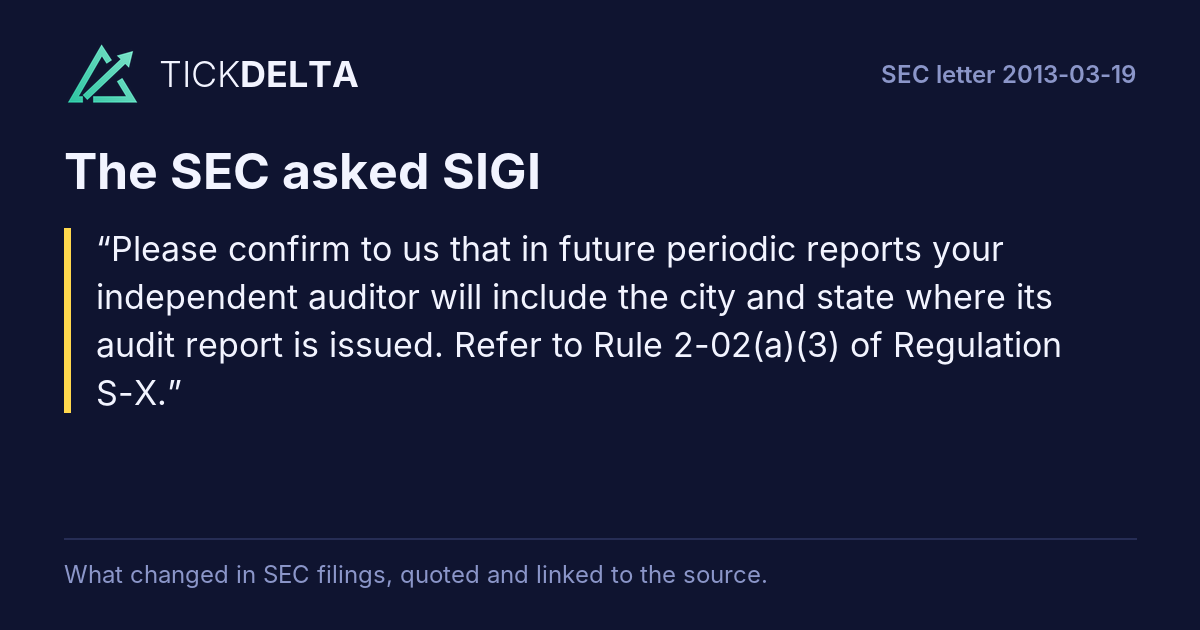
Please confirm to us that in future periodic reports your independent auditor will include the city and state where its audit report is issued. Refer to Rule 2-02(a)(3) of Regulation S-X.
SIGI answered
In response to your comment, we will ensure that future periodic reports include the city and state from which our independent auditor’s report is issued.

The Company acknowledges that:

•

The Company is responsible for the adequacy and accuracy of the disclosure in the filing;

Staff comments or changes to disclosure in response to staff comments do not foreclose the Commission from taking any action with respect to the filing; and

The Company may not assert staff comments as a defense in any proceeding initiated by the Commission or any person under the federal securities laws of the
Rest of the answer

United States.

Read in the reply
In its next report

First report after the company's reply of Mar 29, 2013: 10-Q filed Apr 25, 2013 ↗, against the 10-Q filed Oct 25, 2012 ↗.

Tickdelta does not hold the text of both reports, so they are not compared here.

Also in this review: closing letter, 2013-04-02

Form 10-K for the Fiscal Year Ended December 31, 2011

2012-09-07 to 2012-09-28 · 1 question · 1 letter from the SEC, 1 from the company
Review closed 2012-09-28
Note 6. Stockholders’ Equity and Comprehensive Income (Loss), page 115 and · Note 21. Statutory Financial Information, page 144
SEC asked
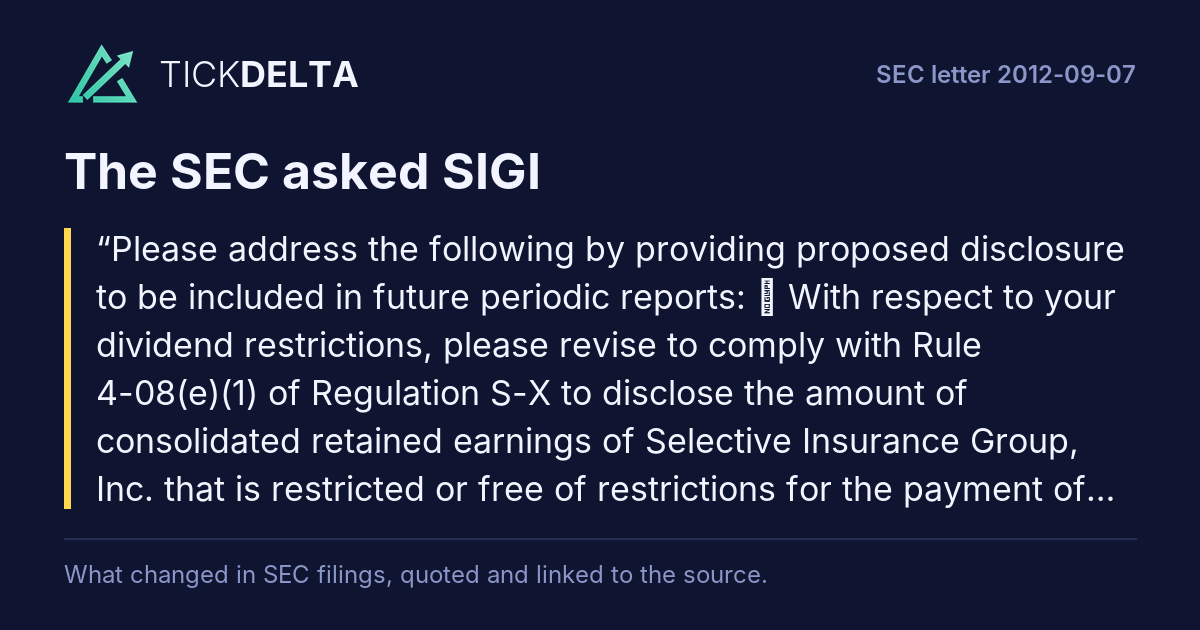
Please address the following by providing proposed disclosure to be included in future periodic reports:  With respect to your dividend restrictions, please revise to comply with Rule 4-08(e)(1) of Regulation S-X to disclose the amount of consolidated retained earnings of Selective Insurance Group, Inc. that is restricted or free of restrictions for the payment of dividends to stockholders.
Rest of the question

 Please disclose the amounts of restricted net assets for unconsolidated subsidiaries and consolidated subsidiaries as of the end of the most recently completed fiscal year which may not be transferred to Selective Insurance Group, Inc. Refer to rule 4-08(e)(3)(ii) of Regulation S-X.  We note that you provided certain data that complies with ASC 944-505-50-1a and b. Please revise to remove reference to this data as unaudited or based on unaudited statutory financial statements as it is required by GAAP. Please also consider making similar revision elsewhere in the filing such as your disclosure under insurance regulation - IRIS, RBC, and the Model Audit Rule on page 20.  Please revise your disclosure to include the amount of statutory net income or loss for each period as required by rule 7.03(a)(23)(c) of Regulation S-X.

SIGI answered
In response to your comment, we have combined the dividend restriction information previously contained in Note 6, “Stockholders’ Equity and Comprehensive Income (Loss)” with the statutory information contained in Note 21, “Statutory Financial Information.” The form of this revised proposed disclosure that will be included in our Form 10-K for the fiscal year ended December 31, 2012 (“2012 Form 10-K”) is provided below.

Expanded disclosures included in this disclosure have been italicized for your ease of reading, and information that has been removed from the note appears as strikethrough
Rest of the answer

text.

Note 21. Statutory Financial Information, Capital Requirements, and Restrictions on Dividends and Transfers of Funds

(a) Statutory Financial Information

The Insurance Subsidiaries prepare their statutory financial statements in accordance with accounting principles prescribed or permitted by the various state insurance departments of domicile.

Prescribed statutory accounting principles include state laws, regulations, and general administrative rules, as well as a variety of publications of the National Association of Insurance Commissioners (“NAIC"). Permitted statutory accounting principles encompass all accounting principles that are not prescribed; such principles differ from state to state, may differ from company to company within a state and may change in the future. The Insurance Subsidiaries do not utilize any permitted statutory accounting principles that materially affect the determination of statutory surplus, statutory net income, or risk-based capital (“RBC”).

As of December 31, 2011, the various state insurance departments of domicile have adopted the March 2011 version of the NAIC Accounting

Practices and Procedures manual in its entirety, as a component of prescribed or permitted practices.

The combined statutory capital and surplus of the Insurance

Subsidiaries was $1.1 billion (unaudited) as of December, 31, 2011 and December 31, 2010. Excluding the recently-acquired MUSIC entity, the combined statutory net income of the Insurance Subsidiaries was $26.5 million (unaudited) in 2011, $86.9 million in

2010, and $69.8 million in 2009.

The following table provides data regarding statutory surplus and net income for each of our Insurance Subsidiaries:

($ in millions)

Statutory Surplus

Statutory Net Income

2011

2010

2009

Selective Insurance Company of America

$

507.4

542.6

15.2

55.4

24.7

Selective Way Insurance Company

221.7

225.9

7.8

6.2

13.8

Selective Insurance Company of South Carolina

90.5

93.9

0.7

7.3

10.2

Selective Insurance Company of the Southeast

69.3

71.9

0.3

5.2

6.7

Selective Insurance Company of New York

73.3

75.8

1.5

6.9

7.9

Selective Insurance Company of New England

14.3

14.1

0.8

-

Selective Auto Insurance Company of New Jersey

60.1

64.0

5.1

6.5

Montpelier U.S. Insurance Company

39.9

Total

1,076.5

1,088.2

26.5

86.9

69.8

(b) Capital Requirements

The Insurance Subsidiaries are required to maintain certain minimum amounts of statutory surplus to satisfy their various state insurance departments of domicile. RBC requirements for property and casualty insurance companies are designed to assess capital adequacy and to raise the level of protection that statutory surplus provides for policyholders. Excluding MUSIC, the Insurance Subsidiaries combined total adjusted capital exceeded the authorized control level RBC, as defined by the NAIC, by 4.4:1 based on their 2011 unaudited statutory financial statements.

MUSIC, based on its 2011 unaudited statutory financial statements, exceeded the authorized control level by 7.7:1.

(c) Restrictions on Dividends and Transfers of Funds

As of December 31, 2011, the Company has stand-alone retained earnings of $1.2 billion. Of this amount, $1.1 billion is related to investments in our Insurance Subsidiaries and

Parent company debt. The Insurance Subsidiaries have the ability to provide for $104 million in annual dividends to the

Parent; however, as regulated entities these dividends are subject to certain restrictions as is further discussed below. In addition to the restrictions on the Insurance Subsidiaries, there are also restrictions in the Parent company’s debt instruments, which is further discussed in Note 10, “Indebtedness” of this 2011 Annual Report. The remaining $54 million of retained earnings is not restricted and is comprised of Parent company investments and cash that could be used to fund debt interest payments of approximately $18 million due in 2012, with the remainder available to fund dividend payments to shareholders. If necessary, the Parent company also has other potential sources of liquidity that could provide for additional funding of its stockholder dividends, which include common stock and debt issuances.

Insurance Subsidiaries Dividend and Transfer of Funds

Restrictions

As noted above, the restrictions on our net assets and retained earnings is predominantly driven by our Insurance Subsidiaries’ ability to pay dividends to the Parent under applicable laws and regulations. Under the insurance laws of the domiciliary states of the Insurance Subsidiaries, New Jersey, Indiana, and New

York, an insurer can potentially make an ordinary dividend payment if its statutory surplus following such dividend is reasonable in relation to its outstanding liabilities, is adequate to its financial needs, and the dividend does not exceed the insurer’s unassigned surplus. In general, New Jersey defines an ordinary dividend as a dividend whose fair market value, together with other dividends made within the preceding 12 months, is less than the greater of 10% of the insurer’s statutory surplus as of the preceding December 31, or the insurer’s net income (excluding capital gains) for the 12-month period ending on the preceding

December 31. Indiana’s ordinary dividend calculation is consistent with New Jersey’s, except that it does not exclude capital gains from net income. In general, New York defines an ordinary dividend as a dividend whose fair market value, together with other dividends made within the preceding 12 months, is less than the lesser of 10% of the insurer’s statutory surplus, or 100% of adjusted net investment income. New Jersey and Indiana require notice of the declaration of any ordinary dividend distribution.

During the notice period, the relevant state regulatory authority may disallow all or part of the proposed dividend if it determines that the dividend is not appropriate given the above considerations. New York does not require notice of ordinary dividends. Dividend payments exceeding ordinary dividends are referred to as extraordinary dividends and require review and approval by the applicable domiciliary insurance regulatory authority prior to payment.

The following table provides 2012 maximum ordinary dividends

(based on 2011 statutory financial statements), 2011 statutory surplus, net income, and unassigned surplus for each of the Insurance

Subsidiaries:

($ in millions)

State of Domicile

2012

Maximum Ordinary Dividend

Statutory Unassigned Surplus

New Jersey

50.7

360.7

22.2

169.1

Indiana

9.1

65.5

46.8

New York

43.0

Maine

1.4

3.8

6.0

5.6

Oklahoma

(15.4)

103.6

679.1

In addition to the Insurance Subsidiaries’ ability to provide dividends to the Parent company, our two Indiana-domiciled Insurance Subsidiaries have approved intercompany lending agreements with the Parent that provide for additional capacity of $15 million after considering that borrowings under these lending agreements are restricted to 10% of the admitted assets of these respective subsidiaries.

The form of the proposed Note 6 that will be included in our

2012 Form 10-K is provided below. As with Note 21 above, expanded disclosures have been italicized for your ease of reading and information that has been removed appears as strikethrough text.

(Loss)

(a) Stockholders’ Equity

As of December 31, 2011, we had 12.5 million shares reserved for various stock compensation and purchase plans, retirement plans and dividend reinvestment plans. As part of our ongoing capital management strategy, we repurchase the Parent's stock from time-to-time, although we have not had an authorized stock repurchase program since July 26, 2009. The following table provides information regarding the purchase of the Parent's common stock during the 2009 through 2011 reporting periods:

($ in thousands)

Shares Purchased

Cost of Shares Purchased in Connection with

Restricted Stock Vestings

Period and Stock Option

Exercises

149,997

2,741

107,425

1,686

191,858

3,010

Our ability to declare and pay dividends on the Parent's common stock is dependent on liquidity at the Parent coupled with the ability of the Insurance Subsidiaries to declare and pay dividends, if necessary, and/or the availability of other sources of liquidity to the Parent. See Note 21. “Statutory Financial Information,

Capital Requirements, and Restrictions on Dividends and Transfers of Funds” for information regarding these dividend restrictions.

Restrictions on the ability of the Insurance Subsidiaries to pay dividends, without alternative liquidity options, could materially affect our ability to pay dividends on common stock. The dividends from the Insurance Subsidiaries are subject to the regulatory limitations of the states in which the Insurance Subsidiaries are domiciled: New Jersey, New York, Indiana, or Maine.

Based on the unaudited 2011 statutory financial statements, the maximum ordinary dividends that can be paid to the Parent by the Insurance Subsidiaries in 2012 are as follows:

The statutory capital and surplus of the Insurance Subsidiaries in excess of these ordinary dividend amounts must remain with the Insurance Subsidiaries in the absence of approval of an “extraordinary dividend” from the Insurance Subsidiaries’ states of domicile. In each such jurisdiction, domestic insurers are prohibited from paying extraordinary dividends without approval of the insurance commissioner of the respective state. Additionally, New Jersey,

Indiana, and Maine require notice of the declaration of any ordinary or extraordinary dividend distribution. During the notice period, the relevant state regulatory authority may disallow all or part of the proposed dividend if it determines that the insurer's surplus, with regard to policyholders, is not reasonable in relation to the insurer's outstanding liabilities and adequate for its financial needs.

(b) The components of comprehensive income (loss), both gross and net of tax, for 2011, 2010, and 2009 were as follows:

Gross

Tax

Net

Net income

7,065

(12,800)

19,865

Components of OCI:

Unrealized gains on securities:

Unrealized holding gains during the period

70,140

24,548

45,592

Portion of OTTI recognized in OCI

1,682

589

1,093

Amortization of net unrealized gains on HTM securities

(3,097)

(1,084)

(2,013)

Reclassification adjustment for gains included in net income

(1,987)

(695)

(1,292)

Net unrealized gains

66,738

23,358

43,380

Defined benefit pension and post-retirement plans:

Net actuarial loss

(16,799)

(5,880)

(10,919)

Reversal of amortization items:

4,172

1,460

2,712

Prior service cost

150

Defined benefit pension and post-retirement plans

(12,477)

(4,367)

(8,110)

Comprehensive income

61,326

6,191

55,135

76,141

10,600

65,541

44,643

15,625

29,018

5,256

1,840

3,416

(11,708)

(4,098)

(7,610)

(454)

(159)

(295)

37,737

13,208

24,529

(12,045)

(4,216)

(7,829)

4,134

1,447

2,687

(7,761)

(2,716)

(5,045)

106,117

21,092

85,025

26,253

(10,145)

36,398

102,514

35,880

66,634

(8,659)

(3,030)

(5,629)

914

320

594

Reclassification adjustment for losses included in net

38,392

13,437

24,955

133,161

46,607

86,554

Net actuarial gain

2,824

988

1,836

5,274

1,846

3,428

Curtailment gain

(1,387)

(485)

(902)

Prior service credit

(508)

(178)

(330)

6,203

2,171

4,032

165,617

38,633

126,984

(c) The balances of, and changes in, each component of AOCI

(net of taxes) as of December 31, 2011 and 2010 were as follows:

Defined

Benefit

Pension

Net Unrealized Gain (Loss) and Post-

OTTI

HTM

All retirement

Related

Other

Plans

AOCI

Balance, December 31, 2009

(8,009)

11,937

25,410

(41,798)

(12,460)

Changes in component during period

(793)

21,906

19,484

Balance, December 31, 2010

(4,593)

11,144

47,316

(46,843)

7,024

(6,522)

48,809

35,270

Balance, December 31, 2011

(3,500)

4,622

96,125

(54,953)

42,294

In addition to the above proposed footnotes, we have also revised our “IRIS, RBC, and Model Audit Rule” discussion to eliminate reference to “unaudited” financial information.

This proposed disclosure is as follows, in Item 1. “Business” with the language removed appearing as strikethrough text:

IRIS, RBC, and the Model Audit Rule

Among the various financial regulatory initiatives of the NAIC that are material to the regulators in which our Insurance Subsidiaries are organized are the following:

· The Insurance Regulatory Information System (“IRIS”). IRIS identifies 13 industry financial ratios and specifies

“usual values” for each ratio. Departure from the usual values on four or more of the financial ratios can lead to inquiries from individual state insurance departments about certain aspects of the insurer’s business. Our Insurance Subsidiaries have consistently met the majority of the IRIS ratio tests.

· Risk-Based Capital. Risk-based capital is measured by the four major areas of risk to which property and casualty insurers are exposed: (i) asset risk; (ii) credit risk; (iii) underwriting risk; and (iv) off-balance sheet risk. Insurers with total adjusted capital that is two times or less than their calculated “Authorized Control Level,” are subject to different levels of regulatory intervention and action. Based upon the unaudited 2011 statutory financial statements, which have been prepared in accordance with NAIC statutory accounting principles, the total adjusted capital for each of our Insurance

Subsidiaries substantially exceeded two times their Authorized Control Level.

· Annual Financial Reporting Regulation (referred to as the “Model Audit Rule”). Effective January 1, 2010, the regulators of our Insurance Subsidiaries adopted the Model Audit Rule, modeled closely on the Sarbanes-Oxley Act of 2002, concerning: (i) auditor independence; (ii) corporate governance; and (iii) internal control over financial reporting. As permitted under the regulation, the Audit Committee of the Board of Directors (the “Board”) of the Parent also serves as the audit committee of each of our Insurance Subsidiaries.

The Company acknowledges that:

· The Company is responsible for the adequacy and accuracy of the disclosure in the filing;

· Staff comments or changes to disclosure in response to staff comments do not foreclose the Commission from taking any action with respect to the filing; and

· The Company may not assert staff comments as a defense in any proceeding initiated by the Commission or any person under the federal securities laws of the United States.

Read in the reply
In its next report

First report after the company's reply of Sep 20, 2012: 10-Q filed Oct 25, 2012 ↗, against the 10-Q filed Jul 26, 2012 ↗.

Tickdelta does not hold the text of both reports, so they are not compared here.

Also in this review: closing letter, 2012-09-28

From the SEC's correspondence on EDGAR: staff letters (form UPLOAD) and company letters (form CORRESP), 14 letters filed since 2012-09-07. Questions and answers are matched by their numbers; topics come from words in each question. The reports are compared word for word (same form, before the first SEC letter against the first report after the company's reply). No AI.

Sources

The SEC's correspondence on EDGAR: staff letters (form UPLOAD) and company letters (form CORRESP), matched question by question. No AI.

Also

Filings: the letters in the filing list.

Work with it

Excel workbook · CSV. Google Sheet that stays up to date: paste =IMPORTDATA("https://tickdelta.com/company/SIGI/export.csv") into a cell.

Next in Owners and insiders:Insider trades
Esc

Type a ticker such as AAPL, a name, an investor such as Buffett, or a topic such as tariffs. ↑ ↓ to move, Enter to open.