Screener / SEC EDGAR /CIK 0000899715 /10-K filed Feb 26, 2026, compared with Feb 21, 2025 /Numbers from the XBRL of the 10-Ks
NYSE Real estate · REIT

Tanger Inc. SKT

Compare with peers Embed
SEC comment letters, last 20 years

5 reviews of SKT's filings by SEC staff

UPLOAD and CORRESP
Reviews 5 latest letter Apr 24, 2024
Questions asked 22 each answered in the company's own letter
No closing letter 0 reviews without a letter saying the staff completed it

When the SEC's staff reviews a filing, it writes to the company with numbered questions, and the company answers each one in a letter. SEC publishes the exchange once the review is over, at least 20 business days later. A question is not an accusation; most reviews end with the company adding detail to its next filing.

How the reviews went

Every review on EDGAR, from the first staff letter to the letter that closes it

  1. 1. Staff letters 7 UPLOAD
  2. 2. Questions in them 22 numbered comments
  3. 3. Company replies 7 CORRESP
  4. 4. Reviews closed 5 of 5 closing letter

Half the closed reviews took 27 days or less from the first letter to the closing letter.

Form 10-K for the fiscal year ended December 31, 2023

2024-04-24 to 2024-07-12 · 2 questions · 2 letters from the SEC, 2 from the company
Review closed 2024-07-12
Results discussion (MD&A)Goodwill and impairmentLiquidity and cash
Item 7. Management's Discussion and Analysis of Financial Condition and Results of Operations · Evaluation of Impairment of long-lived assets, page 60
SEC asked
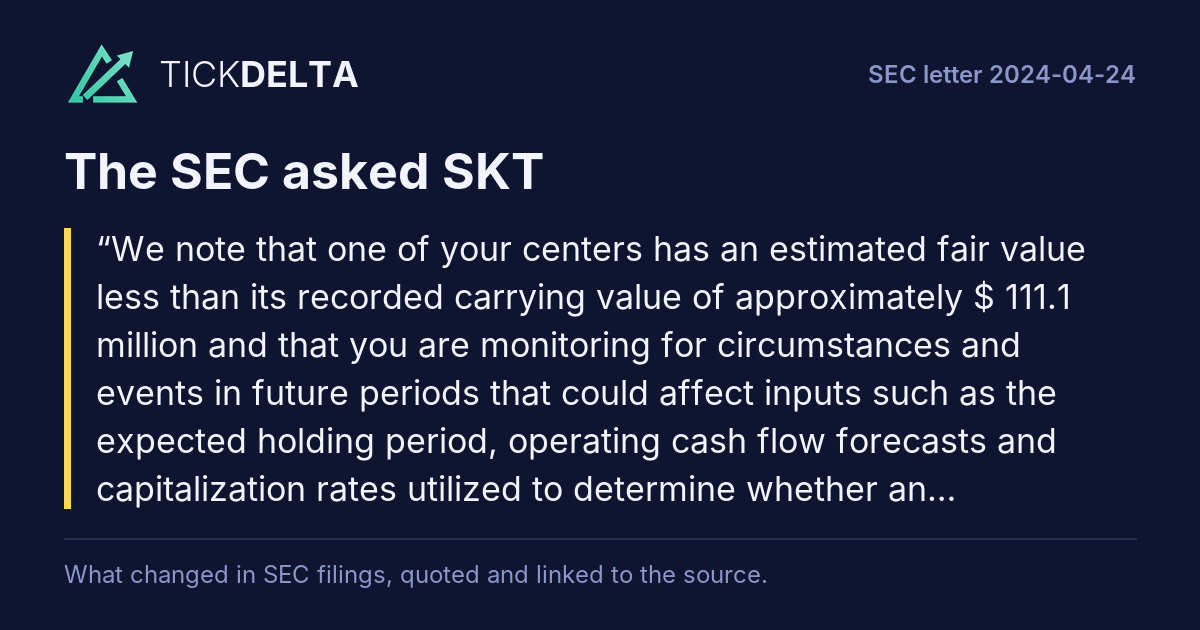
We note that one of your centers has an estimated fair value less than its recorded carrying value of approximately $ 111.1 million and that you are monitoring for circumstances and events in future periods that could affect inputs such as the expected holding period, operating cash flow forecasts and capitalization rates utilized to determine whether an impairment charge is necessary.
Rest of the question

Please tell us, and consider disclosing in future filings: • the identity of the center in question • how you applied the guidance in ASC 360-10-35-29 to 35 and the Interpretative Response to Question 3 of ASC 360-10-S99-2 in your impairment analysis • how you determined that the carrying value of the center is recoverable, and • how you considered the disclosure guidance in Item 303(b)(3) of Regulation S-K.

SKT answered
We acknowledge the Staff’s comments regarding the evaluation of Impairment of long-lived assets.

the identity of the center in question

•The center in question is our Atlantic City, New Jersey property (the “Center”), which we acquired in 2011 and as of December 31, 2023 had a carrying value of $111.1 million. We determined that the carrying value of the Center is recoverable because the undiscounted cash flows as calculated in accordance with ASC 360 were in excess of the carrying value of $111.1 million by $39.6 million or 36%.
Rest of the answer

The disclosure of this property and the results of our impairment evaluation first appeared in our 2020 Form 10-K, filed on February 23, 2021. With the onset of the COVID pandemic, the occupancy rate fell below 80%, significantly lower than our overall portfolio average. However, as shown in the table below, the center’s occupancy percentage has recovered to higher levels in the post COVID years and net operating income has also increased 12% since 2020.

12/31/23 12/31/22 12/31/21 12/31/20

Occupancy 89% 90% 80% 79% how you applied the guidance in ASC 360-10-35-29 to 35 and the Interpretative Response to Question 3 of ASC 360-10-S99-2 in your impairment analysis

•In conducting our impairment analysis, we applied the guidance in ASC 360-10-35-29 through 35 by estimating future cash flows of the Center based on the existing service potential of the Center in multiple scenarios and then used a probability-weighted approach to consider the likelihood of the probable outcomes. These estimates were based on our internal budgets and the business plans and strategies for the Center. The weighted average hold period between the scenarios was 9.75 years which is consistent for a core property of this caliber within our portfolio. We have a long history of developing or acquiring properties and holding them for long periods of time. We utilized conservative scenarios and a reasonable hold period and changes to either of those two aspects would not materially impact the excess above the carrying value. With respect to the Interpretive Response to Question 3 of ASC 360-10-S99-2, the assumptions that underly our cash flow estimates are internally consistent with our projections and other forward-looking information and externally consistent with our financial statements and other public disclosures.

how you determined that the carrying value of the center is recoverable

•We determined that the carrying value of the Center is recoverable because the undiscounted cash flows as calculated in accordance with ASC 360 were in excess of the carrying value of $111.1 million by $39.6 million or 36%.

how you considered the disclosure guidance in Item 303(b)(3) of Regulation S-K

•We began disclosure related to the Center in 2020 as an early warning that there could be an impairment in the future if the facts and circumstances of the Center deteriorated. However, since then the Center’s performance has improved as detailed above. We believe this disclosure considered the disclosure guidance in Item 303(b)(3) of Regulation S-K and respectfully submit that the disclosure in the “Evaluation of Impairment of long-lived assets” section of the Form 10-K contains all information (qualitative and quantitative) necessary for investors to understand the estimation uncertainty and the impact such critical accounting estimate has had or is reasonably likely to have on our financial condition or results of operations.

Read in the reply
In its next report

First report after the company's reply of May 17, 2024: 10-Q filed Aug 5, 2024 ↗, against the 10-Q filed Nov 7, 2023 ↗.

Tickdelta does not hold the text of both reports, so they are not compared here.
Item 7. Management's Discussion and Analysis of Financial Condition and Results of Operations · Evaluation of Impairment of long-lived assets, page 60
SEC asked
We note your response to comment 1. We continue to believe it would be beneficial to investors to provide a more fulsome discussion of how you determined that the carrying value of the Atlantic City Center is recoverable, despite the fact that the carrying value exceeds fair value.
Rest of the question

Please also explain to us why the carrying value of $111.1 million disclosed on page 60 does not agree to the $88.4 million carrying value calculated from Schedule III.

SKT answered
The Company respectfully acknowledges the Staff’s comment and advises as follows:

1.(a)

In accordance with ASC 360, we determined that the carrying value of the Atlantic City Center ($111.1 million at December 31, 2023) is recoverable because the sum of the estimated future undiscounted cash flows from operations and the estimated potential disposition of the Center (in aggregate totaling $151.5 million at December 31, 2023) exceeds the carrying value by $39.6 million, or 36%.
Rest of the answer

Based on the assumptions and discussion described below, we estimated future undiscounted cash flows over the holding period of $64.5 million and disposition value of approximately $87.0 million, or $151.5 million in aggregate.

As part of our evaluation process, and consistent with ASC 360, management estimates future undiscounted cash flows expected to result from the use and eventual disposition of the Center. This incorporates management’s projection of cash flows from leasing of the Center and future expenditures necessary to maintain the existing service potential of the Center, including estimated expenditures for re-tenanting of vacant space and space subject to expiring leases. Management projections reflect judgment as to economic and market uncertainties, including demand for comparable space, competition for tenants, current market rental rates and expected changes in market rental rates, operating costs, capitalization rates and holding periods.

In respect to the Atlantic City center, management evaluated different holding period scenarios and applied probabilities to those scenarios to determine an average holding period of 9.75 years. At the time of testing, management had the intent, and the Company had the ability, to hold the Center for at least this period, and management believes this period is reasonable based on the Center’s performance and the Company’s history of being a long-term owner and operator of its centers.

Management then estimated the cash flow amount from the disposition of the Center by applying a capitalization rate to projected net operating income. Management based its estimates on its knowledge and experience of its properties and markets. As disclosed in the 2023 Form 10-K, terminal capitalization rates are difficult to predict and subject to future events that may alter our estimates.

When we tested the Center for recoverability at December 31, 2023 pursuant to ASC 360, we determined that the sum of the estimated future undiscounted cash flows expected to result from the operation of the Center for 9.75 years and the eventual disposition of the Center totaled $151.5 million, comprised of $64.5 million of future undiscounted cash flows and disposition value of approximately $87.0 million. Based on this calculation, management concluded that the carrying value of the Center, $111.1 million, is recoverable as of December 31, 2023.

1. (b)

The carrying value of the Center, $111.1 million, disclosed on page 60 of the 2023 Form 10-K does not agree to the $88.4 million carrying value calculated from Schedule III because Schedule III excludes deferred lease costs and lease cost intangibles accounted for in accordance with ASC 805. The Center was acquired in 2011. The carrying value disclosed on page 60 for impairment testing purposes includes all rental property and deferred and intangible lease costs, which we include when determining the net book value of a center that is evaluated for recoverability.

Schedule III is required by Rule 5-04 and 12-28 of Regulation S-X to disclose Real Estate and Accumulated Depreciation in tabular format with column headings of Land, Building and Improvements and Accumulated Depreciation. Our consolidated balance sheet within the section “Rental Property” contains the following line items:

•Land

•Buildings, improvements and fixtures

•Construction in progress

•Accumulated depreciation

•Total rental property, net

In following the guidance referenced above for Schedule III, we do not believe that deferred lease costs and values allocated in accordance with ASC 805 to in-place lease cost intangibles should be included in Schedule III. They are recorded on the consolidated balance sheet outside of Rental property in separate line items - “Deferred lease costs and other intangibles, net”, and as it relates to purchase price allocated to below market lease intangibles, “Other liabilities”.

Read in the reply
In its next report

First report after the company's reply of Jun 21, 2024: 10-Q filed Aug 5, 2024 ↗, against the 10-Q filed Nov 7, 2023 ↗.

Tickdelta does not hold the text of both reports, so they are not compared here.

Also in this review: closing letter, 2024-07-12
Form 8-K

2016-09-28 to 2016-10-25 · 1 question · 1 letter from the SEC, 1 from the company
Review closed 2016-10-25
Non-GAAP measures
FORM 8-K FILED ON JULY 26, 2016 · Exhibit 99.2
SEC asked
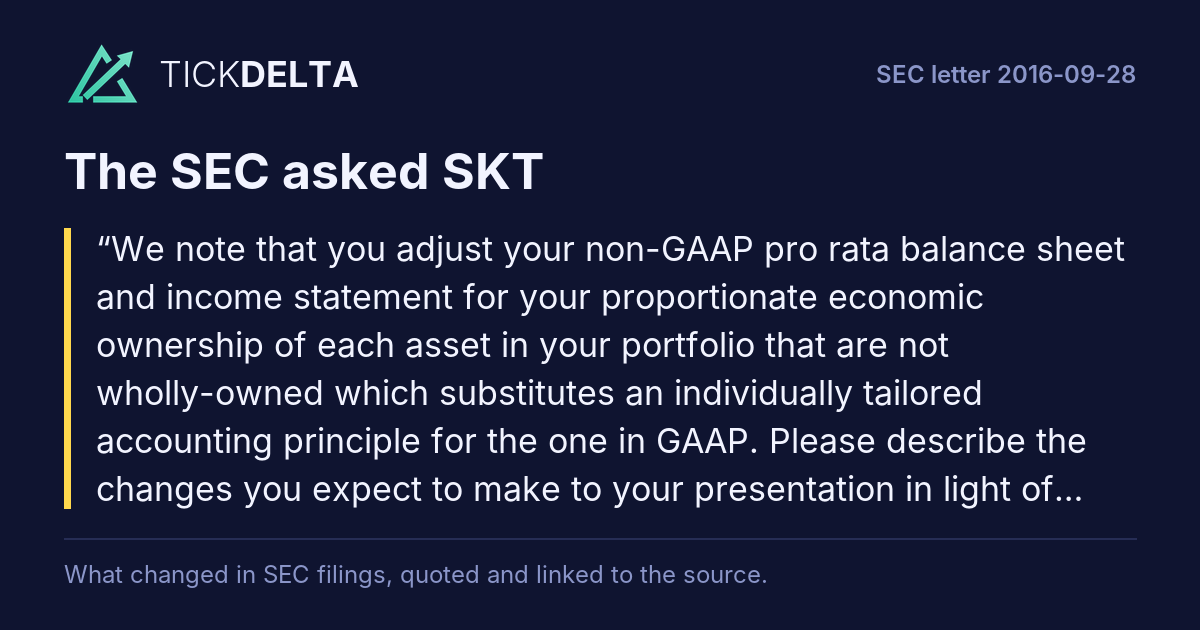
We note that you adjust your non-GAAP pro rata balance sheet and income statement for your proportionate economic ownership of each asset in your portfolio that are not wholly-owned which substitutes an individually tailored accounting principle for the one in GAAP.
Rest of the question

Please describe the changes you expect to make to your presentation in light of the new guidance in Question 100.04 of the updated Non-GAAP Compliance and Disclosure Interpretations issued on May 17, 2016.

SKT answered
In future filings, we propose to revise our non-GAAP pro rata balance sheet and income statement disclosures to eliminate the GAAP basis columns, as well as the column that totals the GAAP and non-GAAP pro rata amounts. We will retain our introductory disclosure that explains how the non-GAAP pro rata information was derived, why we believe it is useful to analysts and investors and the limitations of using the non-GAAP pro rata information as an analytical tool.
Rest of the answer

An example of such presentation is as follows:

Non-GAAP Pro Rata Balance Sheet and Income Statement Information

The pro rata balance sheet and pro rata income statement information is not, and is not intended to be, a presentation in accordance with GAAP. The pro rata balance sheet and pro rata income statement information reflect our proportionate economic ownership of each asset in our portfolio that we do not wholly own. These assets may be found in the table found earlier in this report entitled, “Unconsolidated Joint Venture Information.” The amounts in the column labeled “Pro Rata Portion Unconsolidated Joint Ventures” were derived on a property-by-property basis by applying to each financial statement line item the ownership percentage interest used to arrive at our share of net income or loss during the period when applying the equity method of accounting. A similar calculation was performed for the amounts in the column labeled “Pro Rata Portion Noncontrolling Interests.”

We do not control the unconsolidated joint ventures and the presentations of the assets and liabilities and revenues and expenses do not represent our legal claim to such items. The operating agreements of the unconsolidated joint ventures generally provide that partners may receive cash distributions (1) quarterly, to the extent there is available cash from operations, (2) upon a capital event, such as a refinancing or sale or (3) upon liquidation of the venture. The amount of cash each partner receives is based upon specific provisions of each operating agreement and vary depending on factors including the amount of capital contributed by each partner and whether any contributions are entitled to priority distributions. Upon liquidation of the joint venture and after all liabilities, priority distributions and initial equity contributions have been repaid, the partners generally would be entitled to any residual cash remaining based on the legal ownership percentage shown in the table found earlier in this report entitled “Unconsolidated Joint Venture Information”.

We provide the pro rata balance sheet and income statement information because we believe it assists investors and analysts in estimating our economic interest in our unconsolidated joint ventures when read in conjunction with the Company’s reported results under GAAP. The presentation of pro rata financial information has limitations as an analytical tool. Some of these limitations include:

•

The amounts shown on the individual line items were derived by applying our overall economic ownership interest percentage determined when applying the equity method of accounting and do not necessarily represent our legal claim to the assets and liabilities, or the revenues and expenses; and

Other companies in our industry may calculate their pro rata interest differently than we do, limiting the usefulness as a comparative measure.

Because of these limitations, the pro rata balance sheet and income statement information should not be considered in isolation or as a substitute for our financial statements as reported under GAAP. We compensate for these limitations by relying primarily on our GAAP results and using the pro rata balance sheet and income statement information only supplementally.

Non-GAAP Pro Rata Balance Sheet Information as of _________ (dollars in thousands)

Non-GAAP Pro Rata Information

Pro Rata Portion Noncontrolling Interests

Pro Rata Portion Unconsolidated Joint Ventures (1)

Assets

Rental property

Land

Buildings, improvements and fixtures

Construction in progress

Accumulated depreciation

Total rental property, net

Cash and cash equivalents

Deferred lease costs and other intangibles, net

Prepaids and other assets

Total assets

Liabilities and Owners' Equity

Liabilities

Mortgages payable, net

Accounts payable and accruals

Total liabilities

Owners' equity

Total liabilities and owners' equity

(1)

The carrying value of our investments in unconsolidated joint ventures as reported in our Consolidated Balance Sheet differs from our pro rata share of the net assets shown above due to adjustments to the book basis, including intercompany profits on sales of services that are capitalized by the unconsolidated joint ventures. The differences in basis totaled ____as of ______and are being amortized over the various useful lives of the related assets.

Non-GAAP Pro Rata Statement of Operations Information year to date __________ (dollars in thousands)

Pro Rata Portion Unconsolidated Joint Ventures

Revenues

Base rentals

Percentage rentals

Expense reimbursements

Other income

Total revenues

Expense

Property operating

General and administrative

Impairment charge

Depreciation and amortization

Total expenses

Operating income

Other income/(expense)

Interest expense

Net income

We hope the foregoing answer is responsive to your comment and look forward to resolving any outstanding issues as quickly as possible. If you have any questions in connection with our response to your comment, please feel free to call me at (336) 834-6800.

Best regards,

/s/ James F. Williams

Senior Vice President and Chief Financial Officer

Tanger Factory Outlet Centers, Inc.

Read in the reply

Also in this review: closing letter, 2016-10-25

Form 10-K

2015-05-22 to 2015-08-04 · 6 questions · 2 letters from the SEC, 2 from the company
Review closed 2015-08-04
Non-GAAP measuresRevenue
Operations · Contractual Obligations and Commercial Commitments, page 52
SEC asked (1)
We note your disclosure of commitments related to construction and development activity as of December 31, 2014. Please reconcile the disclosed amounts to your table on page 48 which shows projected total net cost of Foxwoods, Grand Rapids and Southhaven of $270.9 million and costs incurred to date of $93.1 million.
Rest of the question

Based upon this table, it appears that you are expecting to incur approximately $177.8 million in development costs for these three centers alone.

SKT answered
The purpose of our table on page 48 is to provide information regarding the estimated total net costs associated with our consolidated development projects. The $177.8 million represents an estimate of the projected total net costs remaining to complete the construction and leasing of the outlet centers. The projected total net cost of Foxwoods, Grand Rapids and Southaven includes projected expenditures for land, building, permits, professional services such as engineering and architects fees, tenant allowances, capitalized interest, and other miscellaneous costs.
Rest of the answer

Many of these expenditures listed above are not, or will not, be subject to contracts which are legal binding agreements; thus, as of December 31, 2014, we had entered into legally binding agreements committing us to pay only a portion of these total net costs.

As a result, the disclosure on page 48 differs from our disclosure of commitments on page 52, which is intended to disclose only commitments related to construction and development activity that are enforceable and legally binding, as required under Item 303(a)(5) of Regulation S-K. At December 31, 2014, our legally binding contractual commitments included $54.6 million related to construction contracts and $25.7 million related to tenant improvement allowances associated with executed lease agreements for which the tenant improvements had not been constructed.

Read in the reply
In its next report

First report after the company's reply of Jun 5, 2015: 10-Q filed Aug 5, 2015 ↗, against the 10-Q filed May 6, 2015 ↗.

Tickdelta does not hold the text of both reports, so they are not compared here.

Notes to Consolidated Financial Statements · Note 6. Investments in Unconsolidated Real Estate Joint Ventures, page F-28
SEC asked (2)
Please provide to us additional details regarding your Savannah joint venture. In this regard, we note that your ownership interest is only 50% yet your equity contribution was significantly higher than that of your joint venture partner.
SKT answered
Our ownership interest is stated in terms of our legal interest, which is generally based on our voting rights and/or our portion of the proceeds to be received upon a liquidation event after all partner contributions and required returns on those contributions have been paid. Please refer to footnote 1 to the table on page F-28 of our Notes to Consolidated Financial Statements where we state that we expect our economic interest in the joint venture to be greater than our legal interest due to the capital contribution and distribution provisions in the joint venture agreement.
Rest of the answer

Further, please refer to our disclosure on Page F-30 of our Notes to Consolidated Financial Statements under the caption "Savannah, Georgia", where we state that contributions we make in excess of our partner's equity contributions earn a preferred rate of return of 8% from the date the contributions are made until the outlet center's grand opening date, and then 10% annually thereafter.

Read in the reply
In its next report

First report after the company's reply of Jun 5, 2015: 10-Q filed Aug 5, 2015 ↗, against the 10-Q filed May 6, 2015 ↗.

Tickdelta does not hold the text of both reports, so they are not compared here.

Notes to Consolidated Financial Statements · Note 6. Investments in Unconsolidated Real Estate Joint Ventures, page F-28
SEC asked (3)
We note your disclosure on page 53 that indicates your joint venture agreements contain provisions by which a partner can force the other partners to either buy or sell their investment in the joint venture. Please describe to us the terms of these put and call options as they relate to each of the individual joint ventures.
SKT answered
Our joint ventures are generally subject to buy-sell provisions which are customary for joint venture agreements in the real estate industry. Either partner may initiate these provisions (subject to any applicable lock up period), which could result in either the sale of our interest or the use of available cash or additional borrowings to acquire the other party's interest.
Rest of the answer

Under these provisions, one partner sets a price for the property, then the other partner has the option to either (1) purchase their partner's interest based on that price or (2) sell its interest to the other partner based on that price. Since the partner other than the partner who triggers the provision has the option to be the buyer or seller, we don't consider this arrangement to be a mandatory redeemable obligation. In future filings, we will expand our disclosure to include the discussion above.

Read in the reply
In its next report

First report after the company's reply of Jun 5, 2015: 10-Q filed Aug 5, 2015 ↗, against the 10-Q filed May 6, 2015 ↗.

Tickdelta does not hold the text of both reports, so they are not compared here.

Exhibit 99.2 · Pro Rata Balance Sheet as of December 31, 2014, page 15
SEC asked (4)
We note the Pro Rata Balance Sheet and Pro Rata Statement of Operations included on pages 15 and 16. As the pro rata information appears to include non-GAAP measures, please revise your presentation in future filings to include the disclosures required by Regulation G and Item 10(e)(1)(i) of Regulation S-K including identifying the Pro Rata Balance Sheet and Pro Rata Statement of Operations as non-GAAP.
Rest of the question

Provide us with a draft of the disclosure you intend to include.

SKT answered
We will revise our presentation in future filings to clearly identify the Pro Rata Balance Sheet and Pro Rata Statement of Operations as non-GAAP within the headings and columns of each statement. We will also provide an introduction that will provide explanatory and cautionary language similar to the example below:

"The following pro rata information is not, and is not intended to be, a presentation in accordance with GAAP. The pro rata balance sheet and income statement data reflect our proportionate economic ownership of each asset in our portfolio that we do not wholly own.
Rest of the answer

These assets may be found in the table above entitled, “Unconsolidated Joint Venture Information.” The amounts shown in the column labeled “Consolidated” were derived from the Company’s consolidated financial statements as filed with the SEC on Form 10-Q or 10-K, as applicable. The amounts in the columns labeled “Prorata” were derived on a property-by-property basis by applying to each financial statement line item the ownership percentage interest used to arrive at our share of net income during the period when applying the equity method of accounting. A similar calculation was performed for the amounts in the columns labeled “Noncontrolling interests” and “Company.”

We provide pro rata balance sheet and income statement information because we believe it assists investors and analysts in estimating our economic interest in our unconsolidated joint ventures when read in conjunction with the Company’s reported results under GAAP. The presentation of pro rata financial statements has limitations as an analytical tool. Some of these limitations include:

•

The amounts shown on the individual line items were derived by applying our overall ownership interest percentage determined when applying the equity method of accounting and do not necessarily represent our actual claim to the individual assets and liabilities; and

Other companies in our industry may calculate their pro rata interest differently than we do, limiting the usefulness as a comparative measure.

Because of these limitations, the pro rata balance sheet and income statement should not be considered in isolation or as a substitute for our financial statements as reported under GAAP, We compensate for these limitations by relying primarily on our GAAP results and using the pro rata balance sheet and income statement only supplementally.”

Read in the reply
In its next report

First report after the company's reply of Jun 5, 2015: 10-Q filed Aug 5, 2015 ↗, against the 10-Q filed May 6, 2015 ↗.

Tickdelta does not hold the text of both reports, so they are not compared here.

Exhibit 99.2 · Pro Rata Balance Sheet as of December 31, 2014, page 15
SEC asked (5)
Further, this presentation may attach undue prominence to the non-GAAP information and may give investors the impression that the non-GAAP information represents a comprehensive basis of accounting. Please tell us the consideration you gave to Question 102.10 of the Compliance and Disclosure Interpretations on Non-GAAP Financial Measures.
SKT answered
We respectfully acknowledge the Staff’s comment. We note that Exhibit 99.2, which contained the pro rata balance sheet and income statement as well as other supplemental operating and financial data, was furnished pursuant to Item 7.01 of the Current Report on Form 8-K filed on February 10, 2015 (the “Form 8-K”).
Rest of the answer

The Company believes that Item 7.01 is appropriate because it considers the information contained in Exhibit 99.2 to be supplemental to its reported GAAP financial results and key non-GAAP financial measures (Funds from Operations and Adjusted Funds from Operations) for the year ended December 31, 2014, which were furnished in Exhibit 99.1 pursuant to Item 2.02 of the Form 8-K.

As a result, we respectfully believe that Regulation G, and not Item 10(e)(1)(i) of Regulation S-K, applies to Exhibit 99.2 and the pro rata balance sheet and income statement contained therein. We note that unlike Item 10(e)(1)(i) of Regulation S-K, Regulation G does not contain the “equal or greater prominence” requirement when presenting the most directly comparable GAAP measure, and therefore we believe that Question 102.10 of the Compliance and Disclosure Interpretations on Non-GAAP Financial Measures does not apply to the pro rata balance sheet and income statement contained in Exhibit 99.2, and that the Company’s presentation of the pro rata balance sheet and income statement, as modified by the proposed additional disclosure contained in our response to Comment 4 above, is appropriate.

The Company acknowledges that in connection with this response:

The Company is responsible for the adequacy and accuracy of the disclosure in the filing;

Staff comments or changes to disclosure in response to Staff comments do not foreclose the Commission from taking any action with respect to the filing; and

The Company may not assert Staff comments as a defense in any proceeding initiated by the Commission or any person under the federal securities laws of the United States.

We hope the foregoing answers are responsive to your comments and look forward to resolving any outstanding issues as quickly as possible. If you have any questions in connection with our responses to your comments, please feel free to call me at (336) 834-6834.

Best regards,

/s/ Frank C. Marchisello, Jr.

Executive Vice President and Chief Financial Officer

Tanger Factory Outlet Centers, Inc.

Read in the reply
In its next report

First report after the company's reply of Jun 5, 2015: 10-Q filed Aug 5, 2015 ↗, against the 10-Q filed May 6, 2015 ↗.

Tickdelta does not hold the text of both reports, so they are not compared here.

Exhibit 99.2 · Pro Rata Balance Sheet as of December 31, 2014, page 15
SEC asked
We note your response to comment 4 and the proposed revisions. In the introductory paragraph to your Pro Rata Balance Sheet and Pro Rata Statement of Operations please also include language indicating that you do not control, nor do you have any legal claim to the revenues and expenses of the unconsolidated joint ventures.
Rest of the question

Additionally, expand your disclosure to provide details regarding your ownership and claims to the operations of the joint ventures.

SKT answered
The introductory paragraph provided in our original response to comment 4 has been restated below in its entirety to incorporate the staff comment above.

"The following pro rata information is not, and is not intended to be, a presentation in accordance with GAAP. The pro rata balance sheet and income statement data reflect our proportionate economic ownership of each asset in our portfolio that we do not wholly own.
Rest of the answer

These assets may be found in the table above entitled, “Unconsolidated Joint Venture Information.” The amounts shown in the column labeled “Consolidated” were prepared on a basis consistent with the Company’s consolidated financial statements as filed with the SEC on the most recent Form 10-Q or 10-K, as applicable. The amounts in the columns labeled “Pro rata” were derived on a property-by-property basis by applying to each financial statement line item the ownership percentage interest used to arrive at our share of net income during the period when applying the equity method of accounting. A similar calculation was performed for the amounts in the columns labeled “Noncontrolling interests” and “Company.”

We do not control the unconsolidated joint ventures and the presentations of the assets and liabilities and revenues and expenses do not represent our legal claim to such items. The operating agreements of the unconsolidated joint ventures generally provide that partners may receive cash distributions (1) quarterly, to the extent there is available cash from operations, (2) upon a capital event, such as a refinancing or sale or (3) upon liquidation of the venture. The amount of cash each partner receives is based upon specific provisions of each operating agreement and vary depending on factors including the amount of capital contributed by each partner and whether any contributions are entitled to priority distributions. Upon liquidation of the joint venture and after all liabilities, priority distributions and initial equity contributions have been repaid, the partners generally would be entitled to any residual cash remaining based on the legal ownership percentage shown in the table above entitled “Unconsolidated Joint Venture Information”.

We provide pro rata balance sheet and income statement information because we believe it assists investors and analysts in estimating our economic interest in our unconsolidated joint ventures when read in conjunction with the Company’s reported results under GAAP. The presentation of pro rata financial statements has limitations as an analytical tool. Some of these limitations include:

•The amounts shown on the individual line items were derived by applying our overall economic ownership interest percentage determined when applying the equity method of accounting and do not necessarily represent our legal claim to the assets and liabilities, or the revenues and expenses; and

•Other companies in our industry may calculate their pro rata interest differently than we do, limiting the usefulness as a comparative measure.

Because of these limitations, the pro rata balance sheet and income statement should not be considered in isolation or as a substitute for our financial statements as reported under GAAP, We compensate for these limitations by relying primarily on our GAAP results and using the pro rata balance sheet and income statement only supplementally.”

The Company acknowledges that in connection with this response:

•

The Company is responsible for the adequacy and accuracy of the disclosure in the filing;

Staff comments or changes to disclosure in response to Staff comments do not foreclose the Commission from taking any action with respect to the filing; and

The Company may not assert Staff comments as a defense in any proceeding initiated by the Commission or any person under the federal securities laws of the United States.

We hope the foregoing answer is responsive to your comment and look forward to resolving any outstanding issues as quickly as possible. If you have any questions in connection with our response to your comment, please feel free to call me at (336) 834-6834.

Best regards,

/s/ Frank C. Marchisello, Jr.

Executive Vice President and Chief Financial Officer

Tanger Factory Outlet Centers, Inc.

Read in the reply
In its next report

First report after the company's reply of Jul 16, 2015: 10-Q filed Aug 5, 2015 ↗, against the 10-Q filed May 6, 2015 ↗.

Tickdelta does not hold the text of both reports, so they are not compared here.

Also in this review: closing letter, 2015-08-04

Form 10-K for the Fiscal Year Ended December 31, 2013

2014-05-22 to 2014-06-17 · 10 questions · 1 letter from the SEC, 1 from the company
Review closed 2014-06-17
AcquisitionsResults discussion (MD&A)Critical estimatesLeasesNon-GAAP measures
Item 2. Properties, page 18
SEC asked (1)
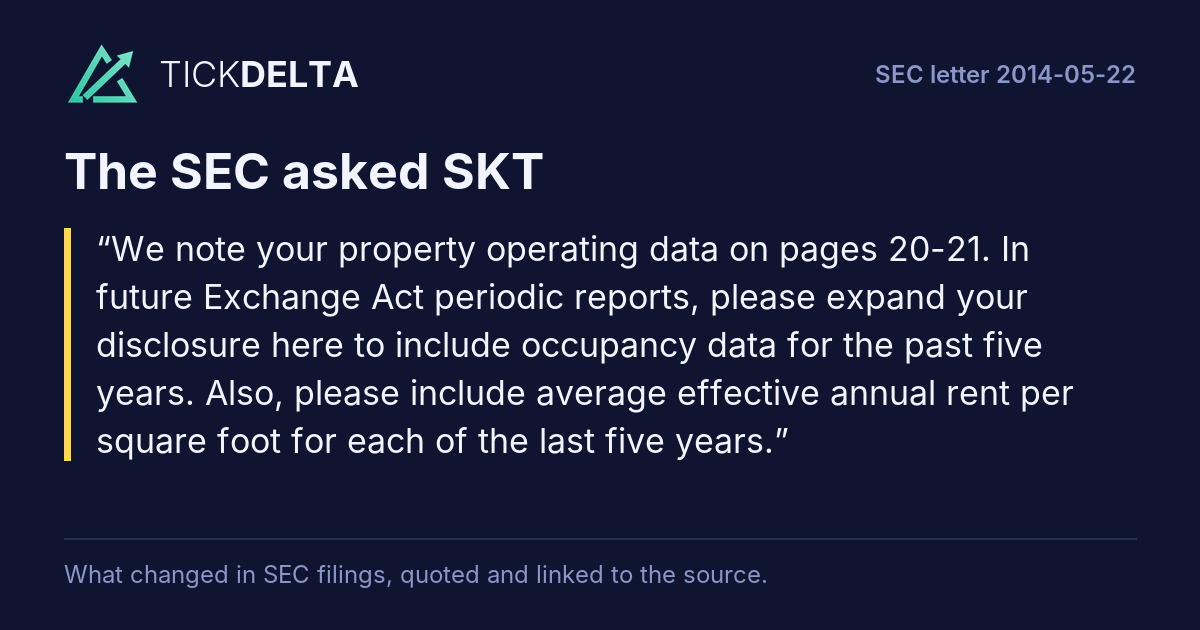
We note your property operating data on pages 20-21. In future Exchange Act periodic reports, please expand your disclosure here to include occupancy data for the past five years. Also, please include average effective annual rent per square foot for each of the last five years.
SKT answered
In our future Exchange Act periodic reports, under Item 2. Properties, we will, on a consolidated basis, include occupancy data as well as average annual rent per square foot, which rent will be computed on a straight-line basis and will include the effects of inducements and rent concessions, for each of the past five years.
Read in the reply
In its next report

First report after the company's reply of Jun 9, 2014: 10-Q filed Aug 6, 2014 ↗, against the 10-Q filed May 8, 2014 ↗.

Tickdelta does not hold the text of both reports, so they are not compared here.

Lease Expirations · Rental and Occupancy Rates, page 22
SEC asked (2)
We note your summary of expirations in this section. In addition to base rents of expiring rents, with respect to leases expiring in the next 12 months, please discuss any known trends regarding the relationship between contractual rents on these expiring leases and market rents.
SKT answered
In our future Exchange Act periodic reports, under Item 2. Properties, in addition to the table of scheduled lease expirations, we will discuss any known trends regarding the relationship between contractual rents on expiring leases and market rents for leases expiring in the next 12 months.
Read in the reply
In its next report

First report after the company's reply of Jun 9, 2014: 10-Q filed Aug 6, 2014 ↗, against the 10-Q filed May 8, 2014 ↗.

Tickdelta does not hold the text of both reports, so they are not compared here.

Operations · Current Development Activities, page 44
SEC asked (3)
Please confirm that, in future Exchange Act periodic reports, you will supplement your current disclosure in this section to include the current scope of development, which will also feature disclosure regarding development expenditures on a per square foot basis. Additionally, please discuss the amount of development that could be supported on the unimproved land in your portfolio.
SKT answered
In future Exchange Act periodic reports, we will supplement our current disclosure in this section to include information on our estimated development expenditures, which will also include a disclosure regarding our estimated development expenditures on a per square foot basis.

In our business model, we generally do not buy unimproved land until we have obtained lease commitments on a significant portion of the project, and expect to begin construction soon thereafter.
Rest of the answer

While we have a certain amount of unimproved land for the development of outparcels and expansions, the amount of such unimproved land is not material to the Company.

Read in the reply
In its next report

First report after the company's reply of Jun 9, 2014: 10-Q filed Aug 6, 2014 ↗, against the 10-Q filed May 8, 2014 ↗.

Tickdelta does not hold the text of both reports, so they are not compared here.

Critical Accounting Estimates · Cost Capitalization, page 53
SEC asked (4)
In future filings, please expand your disclosure to clearly describe your capitalization policy as it relates to construction/development costs including interest, salaries and G&A, real estate taxes and any other significant amounts that are capitalized during the pre-acquisition phase and the construction phase including a discussion of when the capitalization period ends.
SKT answered
In future filings, we will expand our disclosure describing our capitalization policy as it relates to construction/development costs including interest, salaries and G&A, real estate taxes and any other significant amounts that are capitalized during the pre-acquisition phase and the construction phase including a discussion of when the capitalization period ends.
Read in the reply
In its next report

First report after the company's reply of Jun 9, 2014: 10-Q filed Aug 6, 2014 ↗, against the 10-Q filed May 8, 2014 ↗.

Tickdelta does not hold the text of both reports, so they are not compared here.

Critical Accounting Estimates · Cost Capitalization, page 53
SEC asked (5)
Related to the comment above, please tell us the amount of indirect soft costs, such as payroll and other G&A costs, capitalized during 2013. To the extent that these amounts are material to earnings provide disclosure in future filings.
SKT answered
In Note 2 to the financial statements under the caption "Rental Property", we disclosed that we capitalized internal development costs totaling approximately $2.2 million for the year ended December 31, 2013. Also under Note 2 to the financial statements under the caption "Deferred Charges", we disclosed that we capitalized approximately $4.0 million in deferred lease costs for the year ended December 31, 2013, including internal lease costs and amounts paid to third party brokers. Of the $4.0 million in capitalized deferred lease costs, approximately $2.9 was internal lease costs.
Rest of the answer

In both instances, our "internal development costs" and "internal lease costs" were comprised of indirect soft costs, such as payroll and other G&A costs. In future filings, we will revise our disclosure in Note 2 to clarify that these internal costs are meant to describe the capitalization of indirect soft costs, such as payroll and other G&A costs.

As described in the response to Item 4 above, in future filings we will revise our description of our capitalization policies in the Critical Accounting Estimates section to clarify that our capitalization of costs includes the capitalization of indirect soft costs, such as payroll and other G&A costs. Since we disclosed the amounts capitalized for these costs in Note 2 to the financial statements, we do not believe it is necessary to disclose the capitalized amounts in the section "Critical Accounting Estimates".

Read in the reply
In its next report

First report after the company's reply of Jun 9, 2014: 10-Q filed Aug 6, 2014 ↗, against the 10-Q filed May 8, 2014 ↗.

Tickdelta does not hold the text of both reports, so they are not compared here.

Supplemental Earnings Measures · Funds from Operations, page 54
SEC asked (6)
Please explain to us and clarify in future filings what is meant by depreciation and amortization “uniquely significant” to real estate.
SKT answered
The discussion of Funds from Operations (or "FFO") on page 54 explains that FFO is intended to exclude historical cost depreciation and amortization of real estate, included in net income under United States Generally Accepted Accounting Principles, which assumes that the fair value of real estate assets diminishes over time.
Rest of the answer

Historically, however, real estate values have risen or fallen with market conditions.

In our tabular calculation of FFO where we add back depreciation and amortization to net income, we have historically used the term depreciation and amortization uniquely significant to real estate to mean the depreciation and amortization of real estate assets, including real property depreciation, amortization of capitalized leasing expenses, and tenant allowances or improvements. Excluded from the add back of depreciation and amortization are items not related to real estate such as the amortization of deferred financing costs, and depreciation of computer software, company office improvements, and other items commonly found in other industries and required to be recognized as expenses in the calculation of net income.

In our future filings, we intend to use the term "depreciation and amortization of real estate assets" in our tabular calculation of FFO in place of the term "depreciation and amortization uniquely significant to real estate" to more appropriately match the narrative discussion of FFO.

Read in the reply
In its next report

First report after the company's reply of Jun 9, 2014: 10-Q filed Aug 6, 2014 ↗, against the 10-Q filed May 8, 2014 ↗.

Tickdelta does not hold the text of both reports, so they are not compared here.

Same Center Net Operating Income, page 58
SEC asked (7)
We note that you have made further adjustments to property net operating income to arrive at “property net operating income – cash basis” and “total same center NOI – cash basis.” Please expand your disclosure in future filings to explain the reasons why you believe these additional non-GAAP measures provide useful information to investors. Refer to Item 10(e)(1)(i)(C) of Regulation S-K.
SKT answered
In our future filings, we will revise our disclosure and tabular presentation under this section to clearly present only one supplemental earnings measure and that supplemental measure is Same Center Net Operating Income - Cash Basis. We will also expand our disclosure to explain the reasons why we believe this additional non-GAAP measure provides useful information to investors.
Read in the reply
In its next report

First report after the company's reply of Jun 9, 2014: 10-Q filed Aug 6, 2014 ↗, against the 10-Q filed May 8, 2014 ↗.

Tickdelta does not hold the text of both reports, so they are not compared here.

Note 3. Acquisition of Rental Property · 2013 Acquisitions, page F-21
SEC asked (8)
We note that upon acquisition of the controlling interest in Deer Park, the fair value of the noncontrolling interest was $27.9 million. Please clarify how you accounted for the noncontrolling interest upon acquisition and subsequently, citing relevant accounting literature.
SKT answered
The noncontrolling interest was recorded to the liabilities section of the balance sheet under the caption "Deferred financing obligation" upon the acquisition. We respectfully note that in the last paragraph on page F-22, we explained that, following the acquisition of the additional one-third interest, we and the holder of the noncontrolling interest entered into an agreement where the holder of the noncontrolling interest could require us to purchase their interest on the second anniversary of the acquisition date for a fixed price, and thus we recorded the obligation to redeem their
Rest of the answer

interest as a deferred financing obligation. Our conclusion to record the noncontrolling interest as a liability, reflected as a deferred financing obligation, was based on applying the guidance of EITF 00-04 - Issue Summary No. 1, Majority Owner's Accounting for the Minority Interest in a Subsidiary and a Derivative. Given the put/call feature for the noncontrolling party's one-third interest, we determined this arrangement was more similar to a financing model and we should apply the concepts discussed in EITF 00-04 whereby the noncontrolling interest and the derivative should be accounted for on a combined basis as debt classified on the balance sheet as a liability (deferred financing obligation). Under this approach, we recognize 100 percent of the Deer Park property's earnings or losses and recognize debt measured at fair value. We estimated the fair value of the deferred financing obligation upon acquisition to be approximately equal to the redemption value of $28.4 million after considering the present value of the amount due to the noncontrolling interest (both the monthly distributions and the fixed price of the future redemption value at the put date). The fair value of this obligation will be assessed each reporting period through the date of redemption. Distributions to the holder of the noncontrolling interest are being recorded as interest expense.

Read in the reply
In its next report

First report after the company's reply of Jun 9, 2014: 10-Q filed Aug 6, 2014 ↗, against the 10-Q filed May 8, 2014 ↗.

Tickdelta does not hold the text of both reports, so they are not compared here.

Note 3. Acquisition of Rental Property · 2013 Acquisitions, page F-21
SEC asked (9)
Please tell us how you determined to record a gain on consolidation of Deer Park in the amount of $26 million. Refer to the appropriate accounting literature in your response.
SKT answered
The initial transaction acquiring the additional one-third interest was treated as a business combination, and more specifically, as a step acquisition, applying the concepts of ASC-805-10-25. A step acquisition exists when a company obtains an additional ownership interest in a previously held equity investment and obtains control as a result.
Rest of the answer

Based on the acquisition agreement and other transaction documents which amended our rights with respect to the property and our obligations with respect to the additional one-third interest, we concluded that the property constituted a business, we controlled the property's assets and directed the property's significant activities.

In applying the concepts of ASC 805-10 under the step acquisition approach, the Company determined that it should, among other things, consolidate the property as of the date control was obtained, recognize 100 percent of the assets and liabilities of the property, and, per ASC-805-10-25-10, re-measure the previously held equity interest to fair value and recognize, when the fair value of the net assets acquired is greater than the carrying value of the consideration given up, a gain in the income statement. Based on the application of this guidance, we recorded a gain of $26 million. As described on page F-22 of our Form 10-K, this gain resulted from the remeasurement of our previously held equity interest in the property from its carrying value to its fair value.

We previously accounted for our 33 1/3% investment under the equity method of accounting because we had significant influence but not control over the property. The carrying value of our original investment in the property had been reduced over time as a result of recognizing our share of the lossses generated by the property under the equity method of accounting. The losses were generally the result of depreciation and amortization expense exceeding earnings before depreciation. In addition, a significant portion of our original investment was returned during the period in which we held the investment due to distributions made to the owners from (1) proceeds received when permanent financing was put in place, (2) proceeds received from the settlement of a lawsuit, and (3) cash on hand immediately prior to our acquisition. Accordingly, a substantial portion of the fair value of our equity interest was recognized as a gain due to the low cost basis of our equity investment balance in the property.

Read in the reply
In its next report

First report after the company's reply of Jun 9, 2014: 10-Q filed Aug 6, 2014 ↗, against the 10-Q filed May 8, 2014 ↗.

Tickdelta does not hold the text of both reports, so they are not compared here.

Note 3. Acquisition of Rental Property · 2013 Acquisitions, page F-21
SEC asked (10)
In addition, please provide more robust disclosure within the MD&A explaining how the gain on consolidation was derived as this amount had a significant impact on your earnings.
SKT answered
In future filings where the gain on consolidation appears in our financial statements, we will expand our disclosure describing how the gain was derived similar to the discussion included in the last paragraph above in response to Question 9.

The Company acknowledges that in connection with this response:

•

The Company is responsible for the adequacy and accuracy of the disclosure in the filing;

Staff comments or changes to disclosure in response to Staff comments do not foreclose the Commission from taking any action with respect to the filing; and

The Company may not assert Staff
Rest of the answer

comments as a defense in any proceeding initiated by the Commission or any person under the federal securities laws of the United States.

We hope the foregoing answers are responsive to your comments and look forward to resolving any outstanding issues as quickly as possible. If you have any questions in connection with our responses to your comments, please feel free to call me at (336) 834-6834.

Best regards,

/s/ Frank C. Marchisello, Jr.

Executive Vice President and Chief Financial Officer

Tanger Factory Outlet Centers, Inc.

Read in the reply
In its next report

First report after the company's reply of Jun 9, 2014: 10-Q filed Aug 6, 2014 ↗, against the 10-Q filed May 8, 2014 ↗.

Tickdelta does not hold the text of both reports, so they are not compared here.

Also in this review: closing letter, 2014-06-17

Form 10-K for the Fiscal Year Ended December 31, 2012

2013-04-12 to 2013-05-08 · 3 questions · 1 letter from the SEC, 1 from the company
Review closed 2013-05-08
Results discussion (MD&A)China
Item 7. Management’s Discussion and Analysis of Financial Condition… · Same Center Net Operating Income, page 55
SEC asked (1)
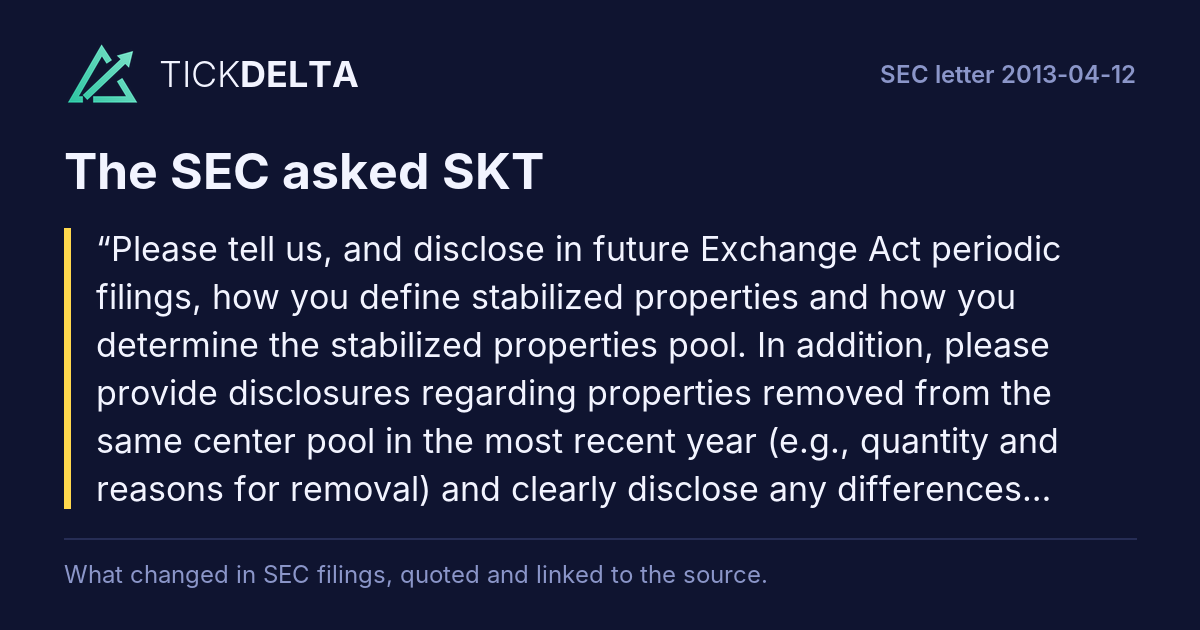
Please tell us, and disclose in future Exchange Act periodic filings, how you define stabilized properties and how you determine the stabilized properties pool. In addition, please provide disclosures regarding properties removed from the same center pool in the most recent year (e.g., quantity and reasons for removal) and clearly disclose any differences between the same center pool and the existing properties
Rest of the question

pool, as defined on page 32.

SKT answered
The Company has historically used the term “stabilized” to refer to new developments which have reached a certain initial occupancy rate. These properties will remain in the stabilized pool from that point forward even if occupancy declines below that rate in the future. The Company defines “same center” properties as outlet centers that are operational for the entire portion of both comparable periods being analyzed and which were not acquired, expanded, renovated or subject to a material, non-recurring event, such as a natural disaster, during the comparable periods.
Rest of the answer

In future periodic filings, the Company will remove the term “stabilized” from our disclosure of the same center definition, to avoid confusion as that term in not necessary in defining the term “same center”.

As a general rule, the properties excluded from the same center pool on page 55 will consist of the same properties listed in the property rollforward for the comparative periods in the General Overview table on page 32, as they have been developed, redeveloped, acquired, sold, or expanded, all which affect their comparability. Additional properties may be excluded for the reasons described in our same center definition above. The properties excluded from the same center Net Operating Income (“NOI”) on page 55 are listed below and include the reason for the exclusion:

•

Hilton Head 1 - redeveloped and re-opened in March 2011

Jeffersonville - acquired in June 2011

Atlantic City - acquired in July 2011

Ocean City - acquired in July 2011

Hershey - acquired in September 2011

Locust Grove - expanded in second quarter 2012

Note that the Mebane, North Carolina and Commerce, Georgia outlet centers included in the General Overview table on page 32 are included in the calculation because the events that affected their comparability did not occur during the comparable periods presented in the table on page 55.

In future periodic filings, the Company will provide a footnote disclosure for the same center NOI table, which will list the properties excluded for the comparable periods, as well as the reason for the property's exclusion.

Read in the reply
In its next report

First report after the company's reply of May 3, 2013: 10-Q filed May 9, 2013 ↗.

No earlier 10-Q before the SEC's letter is in Tickdelta, so there is nothing to compare with.

Item 7. Management’s Discussion and Analysis of Financial Condition… · Same Center Net Operating Income, page 55
SEC asked (2)
We note that you do not present net operating income (NOI) for the year ended December 31, 2010. In future Exchange Act periodic filings, in your presentation of NOI, please include the periods covered in the consolidated statements of operations.
SKT answered
As discussed with the Staff, the Company considers property level net operating income on a same center basis to be a key performance measure, but the Company does not consider property level net operating income (NOI) on a consolidated basis to be a key performance measure and therefore believes it is not necessary to provide a three year presentation on that metric. Note consolidated net operating income for the Company is provided on the face of the consolidated statements of operations. The presentation of NOI in the table on page 55 is presented in order to reconcile to same center NOI.
Read in the reply
In its next report

First report after the company's reply of May 3, 2013: 10-Q filed May 9, 2013 ↗.

No earlier 10-Q before the SEC's letter is in Tickdelta, so there is nothing to compare with.

Note 2. Summary of Significant Accounting Policies · Principles of Consolidation, page F-15
SEC asked (3)
We note that certain joint ventures that are considered variable interest entities are being accounted for using the equity method when it is determined that no single member has the power to direct the significant activities that affect the economic performance of the ventures.
Rest of the question

Please provide us with your analysis regarding members’ power to direct the activities of the ventures, and tell us the rights that the other partners have that would preclude you from having the power to direct the activities of the VIE that most significantly impact the VIE’s economic performance.

SKT answered
The joint ventures formed to develop and operate outlet centers in Glendale, Arizona (“Westgate”) and in Deer Park, New York (“Deer Park”) are considered to be variable interest entities (“VIEs”). In each of the ventures, the Company's other unrelated partners have significant participating rights that lead the Company to conclude that it lacks the power to direct the activities that significantly impact the economic performance of the joint ventures.

The Westgate joint venture, has two members, one controlled by the Company and one controlled by unrelated third parties.
Rest of the answer

The Company's economic interest in the Westgate joint venture is approximately 58% and the Company serves as the venture's managing member.

The Deer Park joint venture has three members, including one controlled by the Company, who each have a one-third ownership interest in the joint venture, and in essence a one-third voting interest. The Company does not serve as the managing member of Deer Park.

The operating agreements of both joint ventures describe in detail the authority of the managing member and other members in carrying out the significant activities on behalf of the venture. While each managing member has authority to conduct certain aspects of the business on behalf of the respective ventures, the activities that most significantly impact the economic performance of the ventures require either unanimous consent or, for certain activities related to the Deer Park joint venture, majority consent. The Company believes the most significant of these activities include, but are not limited to, approval of annual capital and operating budgets, approval of the sale, dissolution, termination or liquidation of the joint venture, approval to incur, modify or refinance indebtedness, approval to enter into or amend certain leases, approval to sell assets of the joint venture, approval of certain expenditures over a certain dollar amount even if budgeted, admitting new members into the joint venture, acquiring real property, and filing voluntary petitions for protection under applicable bankruptcy or similar laws.

While the Company serves as the property manager for each of the joint ventures, the property management agreements require the Company to operate the joint venture within the guidelines established by the operating agreements and also require the Company to operate within the capital and operating budgets that have been approved unanimously by all members.

Since the Company cannot perform any of these aforementioned significant activities without the consent of another member, the Company has concluded that it does not have the power to direct the significant activities that affect the economic performance of the joint ventures.

The Company acknowledges that in connection with this response:

The Company is responsible for the adequacy and accuracy of the disclosure in the filing;

Staff comments or changes to disclosure in response to Staff comments do not foreclose the Commission from taking any action with respect to the filing; and

The Company may not assert Staff comments as a defense in any proceeding initiated by the Commission or any person under the federal securities laws of the United States.

We hope the foregoing answers are responsive to your comments and look forward to resolving any outstanding issues as quickly as possible. If you have any questions in connection with our responses to your comments, please feel free to call me at (336) 834-6834.

Best regards,

/s/ Frank C. Marchisello Jr.

Read in the reply
In its next report

First report after the company's reply of May 3, 2013: 10-Q filed May 9, 2013 ↗.

No earlier 10-Q before the SEC's letter is in Tickdelta, so there is nothing to compare with.

Also in this review: closing letter, 2013-05-08

From the SEC's correspondence on EDGAR: staff letters (form UPLOAD) and company letters (form CORRESP), 19 letters filed since 2013-04-12. Questions and answers are matched by their numbers; topics come from words in each question. The reports are compared word for word (same form, before the first SEC letter against the first report after the company's reply). No AI.

Sources

The SEC's correspondence on EDGAR: staff letters (form UPLOAD) and company letters (form CORRESP), matched question by question. No AI.

Also

Filings: the letters in the filing list.

Work with it

Excel workbook · CSV. Google Sheet that stays up to date: paste =IMPORTDATA("https://tickdelta.com/company/SKT/export.csv") into a cell.

Next in Owners and insiders:Insider trades
Esc

Type a ticker such as AAPL, a name, an investor such as Buffett, or a topic such as tariffs. ↑ ↓ to move, Enter to open.