Form 10-K for the fiscal year ended December 31, 2023
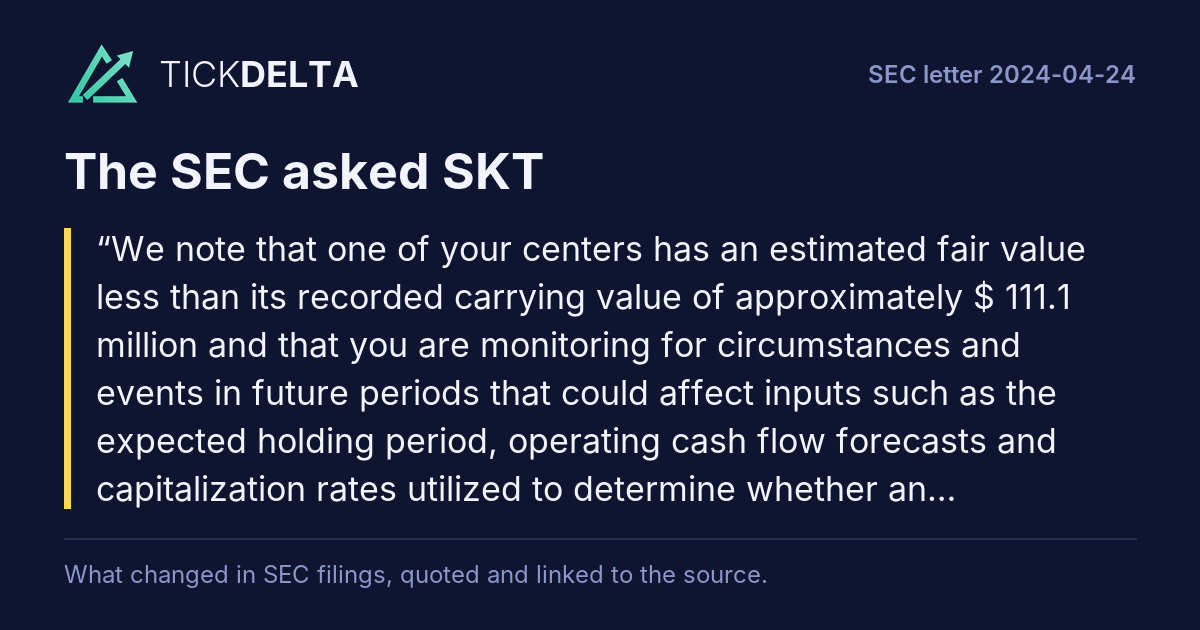
We note that one of your centers has an estimated fair value less than its recorded carrying value of approximately $ 111.1 million and that you are monitoring for circumstances and events in future periods that could affect inputs such as the expected holding period, operating cash flow forecasts and capitalization rates utilized to determine whether an impairment charge is necessary.Rest of the question
Please tell us, and consider disclosing in future filings: • the identity of the center in question • how you applied the guidance in ASC 360-10-35-29 to 35 and the Interpretative Response to Question 3 of ASC 360-10-S99-2 in your impairment analysis • how you determined that the carrying value of the center is recoverable, and • how you considered the disclosure guidance in Item 303(b)(3) of Regulation S-K.
We acknowledge the Staff’s comments regarding the evaluation of Impairment of long-lived assets.Read in the reply
the identity of the center in question
•The center in question is our Atlantic City, New Jersey property (the “Center”), which we acquired in 2011 and as of December 31, 2023 had a carrying value of $111.1 million. We determined that the carrying value of the Center is recoverable because the undiscounted cash flows as calculated in accordance with ASC 360 were in excess of the carrying value of $111.1 million by $39.6 million or 36%.Rest of the answer
The disclosure of this property and the results of our impairment evaluation first appeared in our 2020 Form 10-K, filed on February 23, 2021. With the onset of the COVID pandemic, the occupancy rate fell below 80%, significantly lower than our overall portfolio average. However, as shown in the table below, the center’s occupancy percentage has recovered to higher levels in the post COVID years and net operating income has also increased 12% since 2020.
12/31/23 12/31/22 12/31/21 12/31/20
Occupancy 89% 90% 80% 79% how you applied the guidance in ASC 360-10-35-29 to 35 and the Interpretative Response to Question 3 of ASC 360-10-S99-2 in your impairment analysis
•In conducting our impairment analysis, we applied the guidance in ASC 360-10-35-29 through 35 by estimating future cash flows of the Center based on the existing service potential of the Center in multiple scenarios and then used a probability-weighted approach to consider the likelihood of the probable outcomes. These estimates were based on our internal budgets and the business plans and strategies for the Center. The weighted average hold period between the scenarios was 9.75 years which is consistent for a core property of this caliber within our portfolio. We have a long history of developing or acquiring properties and holding them for long periods of time. We utilized conservative scenarios and a reasonable hold period and changes to either of those two aspects would not materially impact the excess above the carrying value. With respect to the Interpretive Response to Question 3 of ASC 360-10-S99-2, the assumptions that underly our cash flow estimates are internally consistent with our projections and other forward-looking information and externally consistent with our financial statements and other public disclosures.
how you determined that the carrying value of the center is recoverable
•We determined that the carrying value of the Center is recoverable because the undiscounted cash flows as calculated in accordance with ASC 360 were in excess of the carrying value of $111.1 million by $39.6 million or 36%.
how you considered the disclosure guidance in Item 303(b)(3) of Regulation S-K
•We began disclosure related to the Center in 2020 as an early warning that there could be an impairment in the future if the facts and circumstances of the Center deteriorated. However, since then the Center’s performance has improved as detailed above. We believe this disclosure considered the disclosure guidance in Item 303(b)(3) of Regulation S-K and respectfully submit that the disclosure in the “Evaluation of Impairment of long-lived assets” section of the Form 10-K contains all information (qualitative and quantitative) necessary for investors to understand the estimation uncertainty and the impact such critical accounting estimate has had or is reasonably likely to have on our financial condition or results of operations.
First report after the company's reply of May 17, 2024: 10-Q filed Aug 5, 2024 ↗, against the 10-Q filed Nov 7, 2023 ↗.
Tickdelta does not hold the text of both reports, so they are not compared here.
We note your response to comment 1. We continue to believe it would be beneficial to investors to provide a more fulsome discussion of how you determined that the carrying value of the Atlantic City Center is recoverable, despite the fact that the carrying value exceeds fair value.Rest of the question
Please also explain to us why the carrying value of $111.1 million disclosed on page 60 does not agree to the $88.4 million carrying value calculated from Schedule III.
The Company respectfully acknowledges the Staff’s comment and advises as follows:Read in the reply
1.(a)
In accordance with ASC 360, we determined that the carrying value of the Atlantic City Center ($111.1 million at December 31, 2023) is recoverable because the sum of the estimated future undiscounted cash flows from operations and the estimated potential disposition of the Center (in aggregate totaling $151.5 million at December 31, 2023) exceeds the carrying value by $39.6 million, or 36%.Rest of the answer
Based on the assumptions and discussion described below, we estimated future undiscounted cash flows over the holding period of $64.5 million and disposition value of approximately $87.0 million, or $151.5 million in aggregate.
As part of our evaluation process, and consistent with ASC 360, management estimates future undiscounted cash flows expected to result from the use and eventual disposition of the Center. This incorporates management’s projection of cash flows from leasing of the Center and future expenditures necessary to maintain the existing service potential of the Center, including estimated expenditures for re-tenanting of vacant space and space subject to expiring leases. Management projections reflect judgment as to economic and market uncertainties, including demand for comparable space, competition for tenants, current market rental rates and expected changes in market rental rates, operating costs, capitalization rates and holding periods.
In respect to the Atlantic City center, management evaluated different holding period scenarios and applied probabilities to those scenarios to determine an average holding period of 9.75 years. At the time of testing, management had the intent, and the Company had the ability, to hold the Center for at least this period, and management believes this period is reasonable based on the Center’s performance and the Company’s history of being a long-term owner and operator of its centers.
Management then estimated the cash flow amount from the disposition of the Center by applying a capitalization rate to projected net operating income. Management based its estimates on its knowledge and experience of its properties and markets. As disclosed in the 2023 Form 10-K, terminal capitalization rates are difficult to predict and subject to future events that may alter our estimates.
When we tested the Center for recoverability at December 31, 2023 pursuant to ASC 360, we determined that the sum of the estimated future undiscounted cash flows expected to result from the operation of the Center for 9.75 years and the eventual disposition of the Center totaled $151.5 million, comprised of $64.5 million of future undiscounted cash flows and disposition value of approximately $87.0 million. Based on this calculation, management concluded that the carrying value of the Center, $111.1 million, is recoverable as of December 31, 2023.
1. (b)
The carrying value of the Center, $111.1 million, disclosed on page 60 of the 2023 Form 10-K does not agree to the $88.4 million carrying value calculated from Schedule III because Schedule III excludes deferred lease costs and lease cost intangibles accounted for in accordance with ASC 805. The Center was acquired in 2011. The carrying value disclosed on page 60 for impairment testing purposes includes all rental property and deferred and intangible lease costs, which we include when determining the net book value of a center that is evaluated for recoverability.
Schedule III is required by Rule 5-04 and 12-28 of Regulation S-X to disclose Real Estate and Accumulated Depreciation in tabular format with column headings of Land, Building and Improvements and Accumulated Depreciation. Our consolidated balance sheet within the section “Rental Property” contains the following line items:
•Land
•Buildings, improvements and fixtures
•Construction in progress
•Accumulated depreciation
•Total rental property, net
In following the guidance referenced above for Schedule III, we do not believe that deferred lease costs and values allocated in accordance with ASC 805 to in-place lease cost intangibles should be included in Schedule III. They are recorded on the consolidated balance sheet outside of Rental property in separate line items - “Deferred lease costs and other intangibles, net”, and as it relates to purchase price allocated to below market lease intangibles, “Other liabilities”.
First report after the company's reply of Jun 21, 2024: 10-Q filed Aug 5, 2024 ↗, against the 10-Q filed Nov 7, 2023 ↗.
Tickdelta does not hold the text of both reports, so they are not compared here.
Also in this review: closing letter, 2024-07-12