Screener / SEC EDGAR /CIK 0001519449 /10-K filed Mar 2, 2026, compared with Mar 3, 2025 /Numbers from the XBRL of the 10-Ks
Nasdaq Financials · Property & Casualty Insurance

Skyward Specialty Insurance Group, Inc. SKWD

Compare with peers Embed
New in the 10-K 28 paragraphs with nothing like them in the 10-K filed Mar 3, 2025 New in the 10-Q 4 paragraphs not in the 10-Q filed Aug 7, 2026 10-Q against the 10-K 1 risk factor paragraphs and sentences added or reworded

New risk paragraphs, branching off last year

Each branch is a paragraph in Risk Factors with nothing like it in the 10-K filed Mar 3, 2025. A box jumps to the paragraph as filed, below.

28 new

Paragraphs with nothing like them in last year's 10-K

Quoted exactly

28 paragraphs in Risk Factors of the 10-K filed Mar 2, 2026 with nothing like them in the 10-K filed Mar 3, 2025. Quoted exactly. Paragraphs that were only edited are under 10-K change.

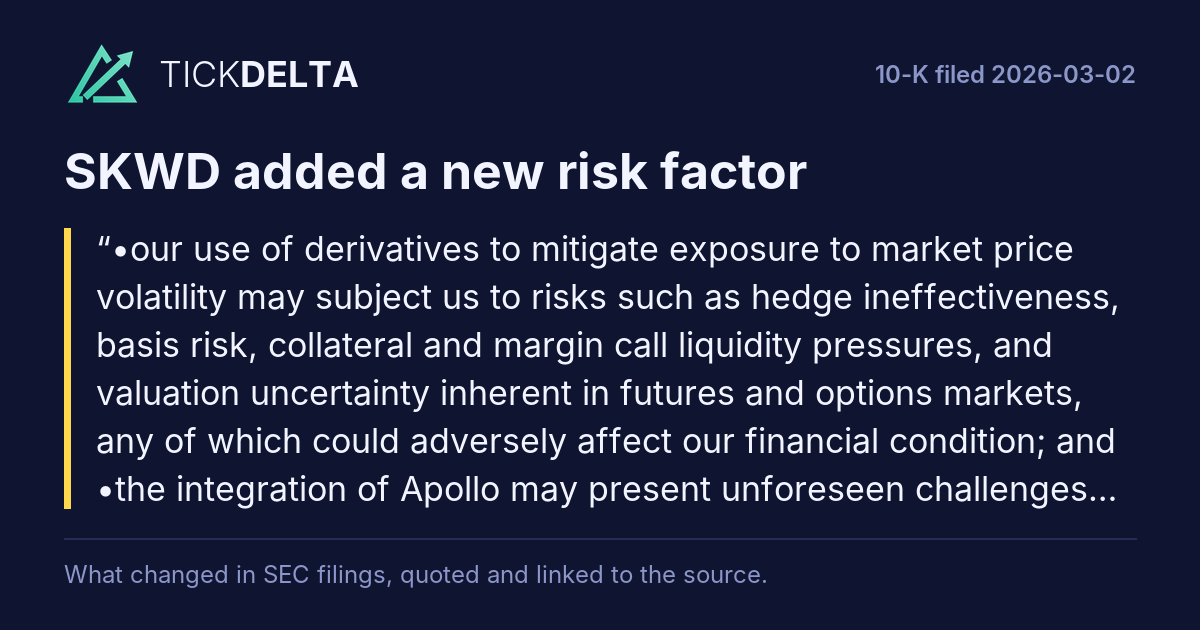
•our use of derivatives to mitigate exposure to market price volatility may subject us to risks such as hedge ineffectiveness, basis risk, collateral and margin call liquidity pressures, and valuation uncertainty inherent in futures and options markets, any of which could adversely affect our financial condition; and

•the integration of Apollo may present unforeseen challenges, including potential difficulties in integrating technology systems, business processes, and risk management frameworks, which could result in operational disruptions, increased costs, or delays in realizing anticipated strategic benefits from the acquisition.

Read in the 10-K

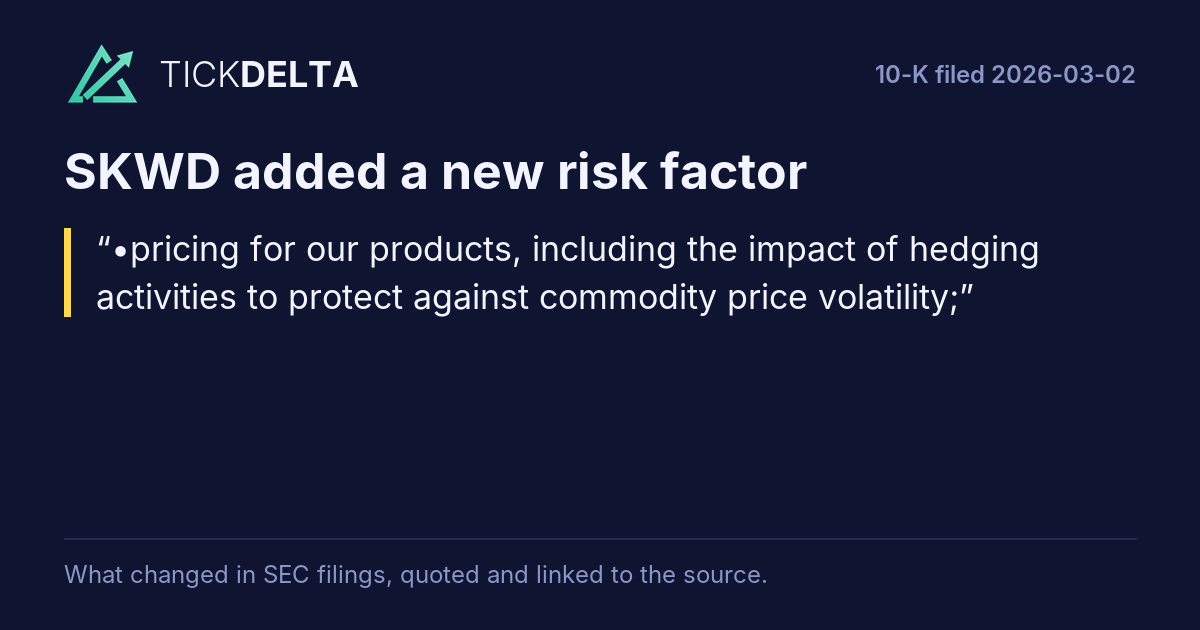
•pricing for our products, including the impact of hedging activities to protect against commodity price volatility;

Read in the 10-K

Additionally, changes in domestic and international programs and initiatives with respect to climate policy as well as federal, state, and local legislation and regulation based on concerns about climate change cannot be predicted but could have a material adverse effect on our business, operational results and financial results.

Read in the 10-K

Our use of derivatives to mitigate exposure to market price volatility may subject us to risks such as hedge ineffectiveness, basis risk, collateral and margin call liquidity pressures, and valuation uncertainty inherent in futures and options markets, any of which could adversely affect our financial condition.

Our use of derivatives to mitigate exposure to market price volatility subjects us to risks that could adversely affect our financial condition and results of operations. These risks include hedge ineffectiveness due to imperfect correlation between derivatives and the underlying exposures, a recognized limitation in commodity market hedge theory; basis risk, where futures prices do not move in line with cash market prices relevant to our business; and liquidity pressures arising from margin call or collateral requirements associated with futures positions during adverse market movements. Additionally, reliance on market based models introduces valuation uncertainty that may cause hedges to perform differently than expected. Together, these factors may prevent our hedging strategies from effectively reducing volatility and could materially adversely impact our financial results.

Read in the 10-K

For example, on July 4, 2025, H.R. 1, the “One Big Beautiful Bill Act” (the “OBBBA”) was signed into law in the United States. Among other changes, the OBBBA modifies key business tax provisions, including the restoration of 100% bonus depreciation under Section 168(k) of the United States Internal Revenue Code of 1986, as amended (the “IRC”), the restoration of the immediate deduction of U.S. domestic research and experimental expenditures under Section 174A of the IRC, the restoration of the EBITDA-based business interest expense limitation under Section 163(j) of the IRC, and changes to the computation of taxes related to international operations. Based on our current analysis of these provisions, we do not believe these provisions will have a material impact on our business and our results of operations. However, regulations and other U.S. Internal Revenue Service guidance implementing the OBBBA may give rise to new issues that we did not foresee, and further changes to tax laws may be implemented. Therefore, there can be no assurance that our business will not be adversely affected by the OBBBA or any other tax law changes.

Read in the 10-K
Show the other 5

The availability of credit under the Revolving Credit Facility is subject to conditions that may limit our access.

Our access to credit under the Revolving Credit Facility is subject to the satisfaction of certain conditions. If we are unable to satisfy these conditions, we would be unable to borrow under the Revolving Credit Facility. The inability to borrow under the Revolving Credit Facility may adversely affect our liquidity, financial position and results of operations.

The failure to meet certain financial covenants required by our credit agreements may materially and adversely affect our assets, financial position, and cash flows.

A breach of any of the covenants under the Term Loan Facility and Revolving Credit Facility could result in an event of default under the credit agreements. Upon the occurrence of an event of default under the credit agreements, all amounts outstanding, together with accrued interest, could be declared immediately due and payable by our lenders. If this happens, our assets may not be sufficient to repay in full the payments due under the credit agreements. The current credit market environment and other macro-economic challenges affecting the global economy may adversely impact our ability to borrow sufficient funds or sell assets or equity in order to pay existing debt.

Read in the 10-K

Artificial intelligence is an evolving and rapidly growing technology which may impact our business and operations.

The rapid growth and development of artificial intelligence and machine learning may alter the competitive landscape in which we operate. Our employees utilize artificial intelligence for risk selection, pricing and claims handling to aid in their effectiveness and efficiency and we continue to research and implement artificial intelligence-based solutions in an effort to improve our business. Notwithstanding this, our competitive position may be harmed if competitors are able to leverage artificial intelligence solutions more quickly or more effectively. In addition, while we do not rely solely on information and analysis production through artificial intelligence in our decision making, if the content, analyses or recommendations that artificial intelligence applications assist in producing are, or are alleged to be, deficient, inaccurate or biased, such as due to limitations in algorithms, insufficient or biased base data or flawed training methodologies, our business, financial condition, results of operations and reputation may be adversely affected. Further, as artificial intelligence technology and products are continuously evolving, we may incur costs to adopt and deploy technologies that could become obsolete earlier than expected. There can be no assurance that we will realize the desired or anticipated benefits from artificial intelligence.

There is also uncertainty in the legal and regulatory landscape at the federal and state levels for the use of artificial intelligence, which is not fully developed. Any laws, regulations or industry standards adopted in response to the emergence of artificial intelligence may be burdensome, could entail significant costs, and may restrict or impede our ability to successfully develop, adopt and deploy artificial intelligence technologies efficiently and effectively.

Read in the 10-K

On January 1, 2026, we completed the acquisition of Apollo. While the acquisition is expected to provide strategic benefits, expand our specialty insurance capabilities, and enhance our presence in the Lloyd’s market, the integration of Apollo into our business involves a number of risks and uncertainties, the occurrence of which could adversely affect our business, financial condition, and operating results. These risks include, but are not limited to:

•Integration Risks: The successful integration of Apollo’s operations, systems, technology platforms, and personnel with our own is subject to significant challenges. Difficulties in integrating Apollo may result in the diversion of management’s attention and resources, disruption of ongoing business, and the incurrence of unexpected costs or delays.

•Realization of Anticipated Benefits: There can be no assurance that we will realize the growth opportunities or other benefits from the acquisition within the expected time frame, or at all. Failure to achieve these benefits could adversely affect our results of operations and financial condition.

•Retention of Key Personnel and Customers: The success of the acquisition depends in part on our ability to retain key Apollo employees, partners, and customers. The loss of key personnel or business relationships could negatively impact the value of the acquired business and our overall operations.

•Cultural and Operational Differences: Apollo operates in the Lloyd’s market and has a distinct business culture and regulatory environment. Differences in business practices, risk appetite, and compliance requirements may create challenges in harmonizing policies and procedures across the combined organization.

•Financial and Accounting Risks: The acquisition may result in significant changes to our financial statements, including the recognition of goodwill and other intangible assets, which could be subject to future impairment. In addition, the acquired business may have undisclosed liabilities or risks that could adversely affect our financial results. Furthermore, as Apollo’s financial statements are currently prepared under U.K. GAAP, which will need to be converted to U.S. GAAP, which may require adjustments to accounting policies, estimates, and disclosures, potentially impacting reported balances and comparability with prior periods.

•Regulatory and Compliance Risks: The expansion of our operations into new jurisdictions and markets, including the Lloyd’s market, increases our exposure to regulatory scrutiny and compliance requirements. Failure to comply with applicable laws and regulations could result in fines, penalties, or other adverse consequences.

•Indebtedness and Financial Flexibility: In connection with the acquisition, we incurred additional indebtedness. Our ability to service this debt and comply with related covenants may be affected by events beyond our control, and could limit our financial flexibility or increase our cost of capital.

•Distraction from Ongoing Operations: The integration process may divert management’s attention from our existing business, which could negatively impact our ongoing operations and financial performance.

If we are unable to successfully integrate Apollo, realize the anticipated benefits of the acquisition, or manage the risks associated with the expanded business, our business, financial condition, and results of operations could be materially and adversely affected.

Read in the 10-K

policies or procedures. Accordingly, because of the inherent limitations in our control system, misstatements due to error or fraud may occur and not be detected.

Read in the 10-K

With the participation of our Chief Executive Officer, our Chief Financial Officer and our Chief Information and Technology Officer, management identified control deficiencies over ITGCs during the fiscal year ended December 31, 2024, that constituted a material weakness as described within “ITEM 9A. CONTROLS & PROCEDURES” of the Annual Report on Form 10-K for the fiscal year ended December 31, 2024.

We have taken measures to remediate the material weakness described herein and believe that it has been remediated. However, if management identifies additional material weaknesses or significant deficiencies in our internal controls or disclosure controls, we may be unable to provide required financial information in a timely and reliable manner and we may incorrectly report financial information. If the financial statements are not filed on a timely basis, we could be subject to adverse action by shareholders, Nasdaq, the SEC or other regulatory authorities. The existence of material weaknesses or significant deficiencies in internal controls could adversely affect our reputation or investor perceptions, which could have a negative effect on the trading price of our common shares. In addition, we may incur additional costs to remediate material weaknesses or significant deficiencies in our internal controls.

We cannot make assurances that any additional material weaknesses or restatements of financial results will not arise in the future due to a failure to implement and maintain adequate internal controls. In the future, current controls and procedures may not be adequate to prevent or identify irregularities or errors or to facilitate the fair presentation of the financial statements.
Read in the 10-K

Paragraphs in the 10-Q filed Nov 6, 2026 that were not in the one before

New in the latest 10-Q

4 paragraphs in the 10-Q filed Nov 6, 2026 with nothing like them in the 10-Q filed Aug 7, 2026 (at least half the words must differ; new numbers alone do not count). Quoted exactly, grouped by the item heading above them. This is text that changed, not a judgement of how serious it is.

Financial statements and notes

syndicates include Syndicate 1969, which underwrites a diversified specialty portfolio; Syndicate 1971, which focuses on digital-economy and technology-enabled risks; and Syndicate 1972, which serves as a quota share reinsurance vehicle for Syndicates 1969 and 1971, assuming a proportional share of their underwriting risks and results.

Read in the 10-Q

The Mortgage loan portfolio now holds a single loan, following a foreclosure and the transfer out of another loan. The spread factor on this remaining loan was 8.09 % as of September 30, 2026. The portfolio carried a weighted average spread of 7.74 %, with a high of 8.09 % and low of 6.54 % as of December 31, 2025.

Read in the 10-Q

Net written premiums for the third quarter of 2026 were $403.9 million compared to $441.2 million for the same 2025 period, a decrease of $37.3 million or 8.4%. Net earned premiums for the third quarter of 2026 were $330.0 million compared to $351.8 million for the same 2025 period, a decrease of $21.8 million or 6.2%. During the third quarter of 2026, net written and earned premiums were impacted by (i) lower-than-expected demand in our dairy and livestock business, reported in the global agriculture division, as higher input costs continued to pressure farmer cash flows and margins, and (ii) the new dairy and livestock reinsurance placement.

Read in the 10-Q

Other information

On August 26, 2026, John Burkhart, President, US Property & Casualty, entered into a new Rule 10b5-1 Trading Arrangement. On August 28, 2026, Mark Haushill, Chief Financial Officer, entered into a new Rule 10b5-1 Trading Arrangement. On August 31, 2026, Sandip Kapadia, President, Reinsurance and Head of Actuarial, entered into a new Rule 10b5-1 Trading Arrangement. On September 14, 2026, Shakoor Khan, Chief Strategy & Corporate Development Officer, and Andrew Robinson, Chief Executive Officer, entered into new Rule 10b5-1 Trading Arrangements. The material terms of these trading plans are set forth in the table below.

Read in the 10-Q

The 10-Q's risk factors against the 10-K

Item 1A of the 10-Q filed Nov 6, 2026 against Item 1A of the 10-K filed Mar 2, 2026. A 10-Q repeats only the risks that changed, so a 10-K paragraph that is missing from it is not counted as removed. Added is a paragraph with nothing like it in the 10-K, Reworded a sentence that is in both with several words changed, Quiet changes a sentence in both where one to four words changed and one is a hedge or a modal (cut words struck through, new words highlighted). Text on the page, not a score; each links to the filing at sec.gov.

Added10-Q Nov 6, 2026 vs 10-K Mar 2, 2026
In addition to the other information set forth in this Quarterly Report on Form 10-Q, you should carefully consider the risks and uncertainties described under the heading “Risk Factors” in Part I, Item 1A of our Annual Report on Form 10-K for the year ended December 31, 2025 (our “2025 Form 10-K”), as supplemented by the risk factor updates set forth in our Quarterly Report on Form 10-Q for the period ended March 31, 2026 (our “Q1 10-Q”). There have been no other material changes in our risk factors in the nine months ended September 30, 2026 from those disclosed in our 2025 Form 10-K and our Q1 10-Q.

Read it in the 10-Q at sec.gov

Phrases used for the first time

Two-word phrases in Risk Factors of the 10-K filed Mar 2, 2026 that are in none of the 1 earlier 10-Ks stored, back to Mar 3, 2025

artificial intelligence ×11revolving credit ×5credit facility ×5price volatility ×4credit agreements ×4mitigate exposure ×3hedge ineffectiveness ×3basis risk ×3margin call ×3liquidity pressures ×3valuation uncertainty ×3lloyd’s market ×3ineffectiveness basis ×2risk collateral ×2call liquidity ×2uncertainty inherent ×2
Where each one is used
  • artificial intelligence: Artificial intelligence is an evolving and rapidly growing technology which may impact our business and operations.
  • revolving credit: The availability of credit under the Revolving Credit Facility is subject to conditions that may limit our access.
  • credit facility: The availability of credit under the Revolving Credit Facility is subject to conditions that may limit our access.
  • price volatility: •our use of derivatives to mitigate exposure to market price volatility may subject us to risks such as hedge ineffectiveness, basis risk, collateral and margin call liquidity pressures, and valuation uncertainty inherent in futures and options markets, any of which could adversely affect our financial condition; and
  • credit agreements: The failure to meet certain financial covenants required by our credit agreements may materially and adversely affect our assets, financial position, and cash flows.
  • mitigate exposure: •our use of derivatives to mitigate exposure to market price volatility may subject us to risks such as hedge ineffectiveness, basis risk, collateral and margin call liquidity pressures, and valuation uncertainty inherent in futures and options markets, any of which could adversely affect our financial condition; and
  • hedge ineffectiveness: •our use of derivatives to mitigate exposure to market price volatility may subject us to risks such as hedge ineffectiveness, basis risk, collateral and margin call liquidity pressures, and valuation uncertainty inherent in futures and options markets, any of which could adversely affect our financial condition; and
  • basis risk: •our use of derivatives to mitigate exposure to market price volatility may subject us to risks such as hedge ineffectiveness, basis risk, collateral and margin call liquidity pressures, and valuation uncertainty inherent in futures and options markets, any of which could adversely affect our financial condition; and

The 10-K at sec.gov

Used at least twice, small words left out. Counted, not picked: a phrase can be new because the company renamed something.

What was taken out

6 paragraphs of last year's Risk Factors with nothing like them now. The longest are quoted.

Across all companies
In addition to the impacts that environmental incidents have on our business, changes to law and regulation related to climate change could also directly affect our business. The current administration made comments during their election campaign suggesting that it was not supportive of various clean energy programs and initiatives, including the United Nations (“U.N.”) Framework Convention on Climate Change, designed to curtail global warming. On January 20, 2025, President Trump signed an executive order to withdraw the U.S. from the Paris Agreement, marking a significant shift in U.S....
In the 10-K filed Mar 3, 2025
With the participation of our Chief Executive Officer, our Chief Financial Officer and our Chief Information and Technology Officer, management evaluated the effectiveness of our internal control over financial reporting as of December 31, 2024 using criteria established in the Internal Control - Integrated Framework (2013) issued by the Committee of Sponsoring Organizations of the Treadway Commission (“COSO”). Our management concluded that a material weakness existed as of December 31, 2024 related to the ineffective implementation of information technology general controls (“ITGCs”) in...
In the 10-K filed Mar 3, 2025
Furthermore, the current administration has included as part of its agenda a potential reform of U.S. tax laws. The details of the potential reform have not yet emerged, but several intended reforms have been outlined, including reducing the corporate tax rate, extending certain provisions of the Tax Cuts and Jobs Act of 2017 (“TCJA”), and imposing new tariffs. The combined impact of extending certain tax benefits pursuant to the TCJA and the implementation of new tariffs could potentially lead to increases in the U.S. deficit, inflation, and interest rates, all of which could contribute...
In the 10-K filed Mar 3, 2025
If we fail to remediate the material weakness in a timely manner or at all, or are otherwise unable to maintain effective internal control over ITGCs and the related process-level IT dependent manual and automated controls, management could be required to expend significant resources and be subject to fines, penalties, investigations or judgments, all of which could negatively affect investor confidence and adversely impact our stock price.
In the 10-K filed Mar 3, 2025

Sources

Item 1A of each 10-K and 10-Q on EDGAR, quoted exactly. Each paragraph links to the filing at sec.gov.

Also

10-K change: what was reworded or cut, section by section.

Work with it

Excel workbook · CSV. Google Sheet that stays up to date: paste =IMPORTDATA("https://tickdelta.com/company/SKWD/export.csv") into a cell.

Next:10-K change
Esc

Type a ticker such as AAPL, a name, an investor such as Buffett, or a topic such as tariffs. ↑ ↓ to move, Enter to open.