Form 10-K
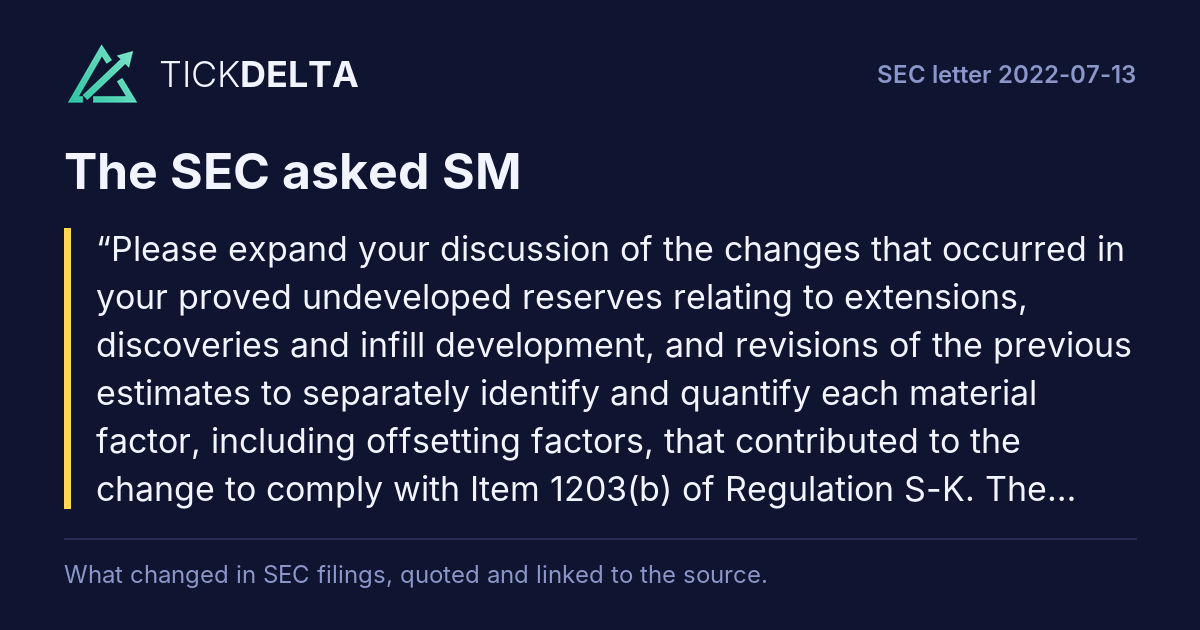
Please expand your discussion of the changes that occurred in your proved undeveloped reserves relating to extensions, discoveries and infill development, and revisions of the previous estimates to separately identify and quantify each material factor, including offsetting factors, that contributed to the change to comply with Item 1203(b) of Regulation S-K.Rest of the question
The disclosure of revisions in previous estimates of your proved undeveloped reserves in particular should identify the changes associated with individual factors, such as changes caused by commodity prices, costs, interest adjustments, well performance, unsuccessful and/or uneconomic proved undeveloped locations. Your disclosure should clearly identify the source of the change and include an explanation relating to each of the items you identify. If two or more unrelated factors are combined to arrive at the overall change for an item, please separately identify and quantify each material factor so that the change in net reserve quantities between periods is fully explained.
Our 2021 Form 10-K disclosures on pages 13 and 14 discuss material changes to our estimated proved undeveloped (“PUD”) reserves volumes by factor, as required by Item 1203(b) of Regulation S-K. Additionally, as it relates to additions from extensions, discoveries, and infill (which totaled 125.2 MMBOE in the aggregate), we disclosed the components of this change by operating area.Read in the replyRest of the answer
For the Staff’s perspective, of the 81.0 MMBOE of estimated PUD reserves additions disclosed for our South Texas asset, 71.5 MMBOE (88%) related to additions as a result of successful development of the Austin Chalk formation, which we discuss in summary form in our disclosures. Further, 51.2 MMBOE of the 71.5 MMBOE (72%) of the Austin Chalk additions resulted from extensions. Of the 44.2 MMBOE estimated PUD reserves additions recorded for our Midland Basin asset, 41.7 MMBOE (94%) related to infill development, which is disclosed in summary form in our disclosures. We believe that the discussion of 2021 PUD additions from extensions, discoveries, and infill, as disclosed in our 2021 Form 10-K, comply with the requirements of Item 1203(b) of Regulation S-K.
Volumes associated with 2021 revisions of previous estimates are immaterial, both by individual factor and in the aggregate, in relation to our reported total estimated PUD reserves volumes and estimated PUD reserves volume changes between periods. Total revisions of previous estimates are approximately 1.2% of total year-end 2020 estimated PUD reserves volumes and none of the individual factors comprising the total revisions of previous estimates amount of 2.1 MMBOE were greater than 1.5% of total year-end 2020 estimated PUD reserves volumes. As both the total revisions of previous estimates and each of the individual components are immaterial, it was determined that no disclosure was necessary.
First report after the company's reply of Jul 22, 2022: 10-Q filed Aug 4, 2022 ↗, against the 10-Q filed Apr 29, 2022 ↗.
Tickdelta does not hold the text of both reports, so they are not compared here.
Please expand the presentation of the standardized measure to clarify, if true, that future cash flows take into account the estimated abandonment costs for the proved properties to comply with FASB ASC 932-235-50-36. If the abandonment costs, including such costs related to proved undeveloped locations, have not been included for each of the periods presented, e.g.Rest of the question
as of December 31, 2021, 2020 and 2019, please explain to us the rationale for excluding these costs from the calculation of the standardized measure.
As required by FASB ASC 932-235-50-36, the Company includes the estimated abandonment costs for its estimated proved developed and estimated proved undeveloped properties for all years presented. In future filings, the Company will include a statement indicating that estimated abandonment costs are included in this calculation.Read in the reply
First report after the company's reply of Jul 22, 2022: 10-Q filed Aug 4, 2022 ↗, against the 10-Q filed Apr 29, 2022 ↗.
Tickdelta does not hold the text of both reports, so they are not compared here.
We note you identified Adjusted operating margin (before the effects of derivative settlements) and Adjusted operating margin (including the effect of derivative settlements) as non-GAAP measures and reconciled these measures to your oil, gas and NGL revenues and also to income (loss) from operations for the three months ended December 31, 2021 and December 31, 2020.Rest of the question
Please tell us how you considered reconciling these measures to the most directly comparable GAAP measure, fully-loaded GAAP gross margin. Refer to Item 10(e)(1)(i)(B) of Regulation S-K.
The term “gross margin” is defined in the master glossary of the accounting standards codification as, "[T]he excess of sales over cost of goods sold. Gross margin does not consider all operating expenses." We recognize that our industry does not report a gross margin value similar to other industries, as we do not record "Cost of Goods Sold" in our Consolidated Statement of Operations.Read in the replyRest of the answer
As such, we believe the reconciliation from oil, gas and NGL revenues to income (loss) from operations directs users of our financial data to the most directly comparable GAAP measures, as our adjusted operating margin measures closely align with financial results from recurring operations. We believe our adjusted operating margin measures provide management and the investment community an understanding of the Company's recurring operating margin and are helpful when comparing period-over-period financial results and to peer company financial results.
Because our financial statements do not include the traditional “Costs of Goods Sold” financial statement line item, we are unable to calculate and reconcile to gross margin. Reconciling to other GAAP measures, such as net income, would not be as useful as the reconciliation would include items such as interest expense and income tax expense, which are considered non-operating costs rather than operating costs. We believe that oil, gas and NGL revenues and income (loss) from operations are the most directly comparable GAAP measures and are consistent with the guidance provided in footnote 26 of the Staff’s adopting release for Regulation G (SEC Release No. 33-8176/34-47226), which states: “[We] believe that it is most appropriate to provide registrants with the flexibility to best make the determination as to which is the most directly comparable financial measure calculated and presented in accordance with GAAP.”
First report after the company's reply of Jul 22, 2022: 10-Q filed Aug 4, 2022 ↗, against the 10-Q filed Apr 29, 2022 ↗.
Tickdelta does not hold the text of both reports, so they are not compared here.
We have reviewed your response to prior comment 1. Please address the following: • Disclose how adjusted operating margin before the effects of derivative settlements is used by management and is useful to investors; • Disclose how adjusted operating margin including the effects of derivative settlements is used by management and is useful to investors; • Disclose why you reconcile to an adjusted operating marginRest of the question
before the effects of derivative settlements and to adjusted operating margin including the effects of derivative settlements; and • Reconcile from your GAAP measure to your non-GAAP measures of adjusted operating margin. Your current presentation places greater prominence on the non- GAAP measure and is inconsistent with Question 102.10 of the C&DI's on Non- GAAP Financial Measures.
In the future, beginning with our 3rd quarter 2022 earnings press release and related Form 8-K, we do not plan to present adjusted operating margin before the effects of derivative settlements or adjusted operating margin including the effects of derivative settlements.Read in the reply
However, to the extent such measures are included in future disclosures, we will revise our presentation to reconcile from income (loss) from operations (GAAP) to the non-GAAP measures of adjusted operating margin, in order to place greater prominence on the most directly comparable GAAP measure and expand our disclosure asRest of the answer
substantially reflected as follows:
“We present adjusted operating margin before the effect of derivative settlements because including the effects of derivative settlements reflects a measure that is most directly comparable to a traditional gross margin calculation, and we believe this measure provides management and the investment community an understanding of the Company’s recurring financial results of operations. We present adjusted operating margin including the effects of derivative settlements because we believe this is useful to management and the investment community in understanding how commodity derivative settlements impact our average net price realized from recurring operations.”
First report after the company's reply of Sep 14, 2022: 10-Q filed Nov 4, 2022 ↗, against the 10-Q filed Apr 29, 2022 ↗.
Tickdelta does not hold the text of both reports, so they are not compared here.
Adjusted operating margin before the effects of derivative settlements and including the effects of derivative settlements appears to be a performance measure. Please tell us the following: • How you view an adjusted operating margin that excludes operating expenses, such as, DD&A and asset retirement obligation accretions; and • Why you exclude exploration costs and other operating expense, net from your non- GAAPRest of the question
measures of adjusted operating margin.
In the future, beginning with our 3rd quarter 2022 earnings press release and related Form 8-K, we do not plan to present adjusted operating margin before the effects of derivative settlements or adjusted operating margin including the effects of derivative settlements.Read in the reply
When we have provided these measures historically, it’s because our industry does not report a gross margin calculation similar to other industries, due to the fact that our industry does not record “Cost of Goods Sold” in our Consolidated Statement of Operations.Rest of the answer
Accordingly, our intent in disclosing an adjusted operating margin is to align as closely as possible to “gross margin” as defined in the accounting standards codification. The term “gross margin” is defined in the master glossary of the accounting standards codification as, "[T]he excess of sales over cost of goods sold. Gross margin does not consider all operating expenses." DD&A and asset retirement obligation accretions are expense estimates included within the calculation of income (loss) from operations which can, at times, be unpredictable. These line items are excluded from the traditional gross margin calculation. We believe that providing an adjusted operating margin that excludes these estimates is helpful to both management and investors as it increases comparability of our recurring operating results period-over-period and with peers.
We exclude exploration costs and other operating expense, net, from our non-GAAP measures of adjusted operating margin with the intent of aligning closely to gross margin because these expenses are not directly related to production volumes, are inherently unpredictable, and can impact comparability of our operating results period-over-period and with peers.
First report after the company's reply of Sep 14, 2022: 10-Q filed Nov 4, 2022 ↗, against the 10-Q filed Apr 29, 2022 ↗.
Tickdelta does not hold the text of both reports, so they are not compared here.
Also in this review: closing letter, 2022-09-22