Paragraph 18 · 42% changed
Every version of it
Screener
/
SEC EDGAR
/CIK 0001640147
/10-K filed Mar 20, 2026, compared with Mar 21, 2025
/Numbers from the XBRL of the 10-Ks
NYSE
Technology · Software
Snowflake Inc. SNOW
The 10-K against last year's
167 changes: 13 added, 2 removed, 147 reworded, 5 quiet changes
10-K Mar 20, 2026 vs Mar 21, 2025
Risk Factors
6.7%
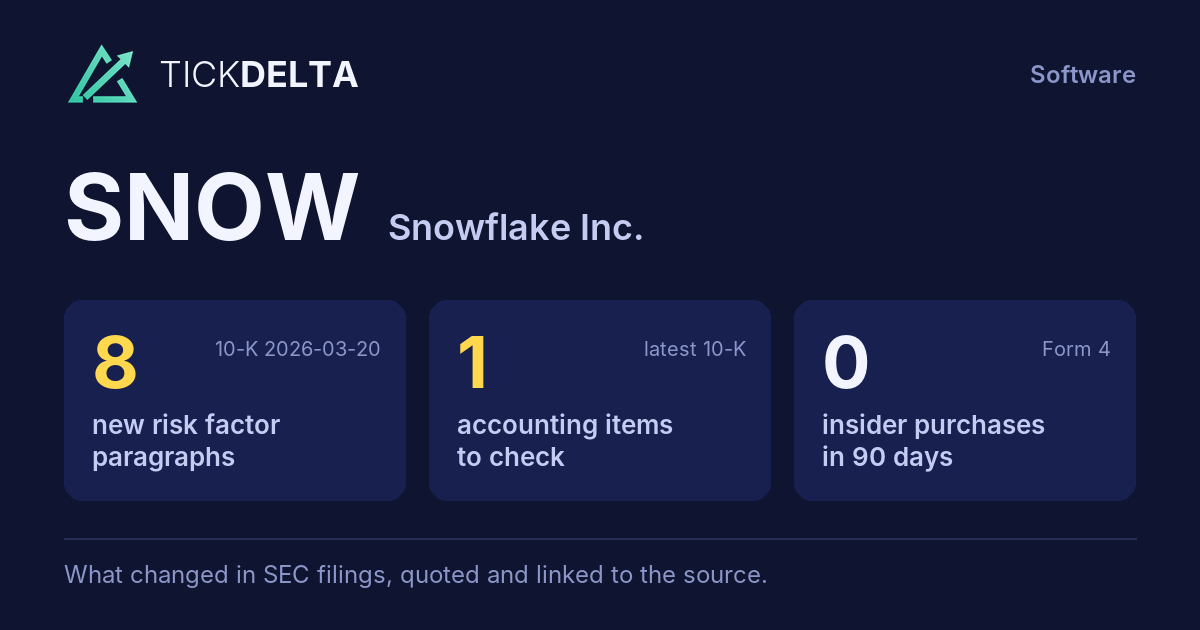
of the text changed · 24,246 words now · 8 new paragraphs, 1 gone
MD&A
13.8%
of the text changed · 11,705 words now · 5 new paragraphs, 1 gone
Legal Proceedings
33.8%
of the text changed · 891 words now
Accounting Policies
10.4%
of the text changed · 7,572 words now
10-K 0001640147-26-000008 (Mar 20, 2026) vs 10-K 0001640147-25-000052 (Mar 21, 2025)
Every paragraph, and how much of it changed
One bar per paragraph, in the order of the 10-K. Height and colour show the share of its words not in the closest paragraph a year earlier; the tallest bars are new paragraphs.
Risk Factors
267 paragraphs · 8 new · 75 reworded · 1 gone · 10-K Mar 20, 2026 against Mar 21, 2025
New paragraph
Reworded (5% of its words or more)
Same or nearly
Paragraph 180 · 33% changed
Every version of it
•India’s Digital Personal Data Protection Act (DPDP Act), which was passed in August 2023, Act) imposes strict rules regarding the collection, use, processing and storage of personal data in India. The phased implementation of the DPDP Act will not come into effect until the Indian government provides notice of an effective date, began in November 2025, which is expected in 2025. to become fully effective on May 14, 2027.
Paragraph 116 · 29% changed
Every version of it
Paragraph 28 · 25% changed
Every version of it
Paragraph 209 · 24% changed
Every version of it
The tax regimes we are subject to or operate under, including income and non-income taxes, are unsettled and may be subject to significant change. Changes in tax laws, regulations, or rulings, or changes in interpretations of existing laws and regulations, could materially affect our financial position and results of operations. Legislation informally titled the The Tax Cuts and Jobs Act and the Inflation Reduction Act (Inflation Act) made many significant changes to U.S. tax laws. For example, the Inflation Act includes provisions that will impact the U.S. federal income taxation of certain corporations, including a minimum tax equal to 15% of the adjusted financial statement income of certain large corporations, as well as imposes a 1% excise tax applicable to corporations traded on an established securities market (which includes the New York Stock Exchange) on the fair market value of certain stock repurchases in excess of the fair market value of stock issuances in the same taxable year. In February 2023, our board of directors authorized the repurchase of up to $2.0 billion of our common stock through a stock repurchase program. In August 2024, our board of directors authorized the repurchase of an additional $2.5 billion of our outstanding common stock under the stock purchase program and extended the expiration date of the stock repurchase program from March 2025 to March 2027. Repurchases of our common stock under current or future stock repurchase programs could result in an excise tax liability, and we are continuing to evaluate the impact that such excise tax liability, if any, may have on our aggregate tax liability. Additionally, the One Big Beautiful Bill Act (OBBBA), enacted on July 4, 2025, modifies existing U.S. tax laws. The OBBBA includes permanent extensions of certain expiring provisions of the Tax Cuts and Jobs Act, including 100% bonus depreciation for certain qualified property, and reverses the requirement under the Tax Cuts and Jobs Act to capitalize and amortize domestic research and experimentation expenses, allowing taxpayers to deduct such expenses in the year incurred for tax years beginning after December 31, 2024. The OBBBA also includes modifications to the international tax framework. Future guidance from the Internal Revenue Service and other tax authorities with respect to such legislation may affect us, and certain aspects thereof could be repealed or modified in future legislation.
Paragraph 31 · 23% changed
Every version of it
There can be no assurance that security measures designed to protect against security incidents will be effective, and our efforts to investigate, mitigate, contain, and remediate any security incidents that do occur may not we will be successful. Even though we may not control the security measures of third-party providers or environments, we may incur liability or suffer reputational harm if such measures are breached. Actions taken by us, third-party cloud providers, or the other third parties with whom we work to detect, investigate, mitigate, contain, and remediate security incidents could result in outages, data losses, and disruptions of our business. We may be unable able to detect, mitigate, or remediate vulnerabilities in our products and information security systems (such as our hardware and software, including that of third parties upon which we rely) on a timely basis. basis, or that our efforts to investigate, mitigate, contain, and remediate any security or data incidents that do occur will be successful. In general, cybersecurity incidents or security vulnerabilities (both in our internal environment and third-party environments we may not control), as well as actions taken by us or third parties to detect, investigate, mitigate, contain, and remediate them, could lead to significant interruptions in our operations, outages, loss of data and income, reputational harm, diversion of funds, increased insurance costs, and other harm to our business, reputation, and competitive position. We also may be unwilling or unable to make ransom payments due to, for example, applicable laws or regulations prohibiting such payments, the negative precedent such payments would set, or uncertainty over whether such payments would result in the threat actor deleting stolen data or otherwise delivering on their promised course of action. In general, cybersecurity incidents or security vulnerabilities could lead to significant interruptions in our operations, loss of data and income, reputational harm, diversion of funds, increased insurance costs, and other harm to our business, reputation, and competitive position. In addition, customers’ use of our platform in violation of our terms of service, including by granting access to a single Snowflake account to various third-party entities, could amplify the impact of any cybersecurity or product incidents. Security incidents and their resulting consequences, including negative publicity, may also cause customers to stop using our platform, deter existing or prospective customers from using our platform, and negatively impact our ability to grow and operate our business.
Paragraph 36 · 22% changed
Every version of it
Our insurance coverage may not be adequate for liability arising from data security breaches involving us or our customers or other third parties, indemnification obligations, or other liabilities. The successful assertion of one or more large claims against us that exceeds our available insurance coverage or results in changes to our insurance policies (including premium increases or the imposition of large deductible or co-insurance requirements) could have an adverse effect on our business. In addition, we cannot be sure that our existing insurance coverage and coverage for errors and omissions will continue to be available on acceptable terms or that our insurers will not deny coverage as to any future claim. Risks related to our systems and security breaches are likely to increase claim, particularly as we continue to expand our platform and geographic footprint, grow our customer and partner base, acquire operating companies, begin to operate in environments outside of our platform and over which we exercise significantly less or no control, and process, store, and transmit increasingly large amounts of data. product offerings with different security risk profiles.
Paragraph 183 · 20% changed
Every version of it
•In the United States, federal, state, and local governments have enacted or proposed data privacy and security laws, laws and regulations, including data breach notification laws, personal data privacy laws, cross-border data transfer regimes, and consumer protection laws. Numerous For example, the U.S. Department of Justice issued a rule entitled “Preventing Access to U.S. Sensitive Personal Data and Government-Related Data by Countries of Concern or Covered Persons,” which places prohibitions or restrictions on certain data transactions involving the transfer of certain personal information to countries of concern (e.g., China, Russia, Iran) or individuals/entities located in or subject to the control of those jurisdictions. This rule impacts certain business activities such as vendor engagements, employment of certain individuals, and investor agreements. Violations of the rule could lead to significant civil and criminal fines and penalties. Additionally, numerous U.S. states have enacted comprehensive privacy laws that impose certain obligations on covered businesses, including providing specific disclosures in privacy notices and affording residents with certain rights concerning their personal data. Such rights may include the right to access, correct, or delete certain personal data, and to opt-out of certain data processing activities, such as targeted advertising, profiling, and automated decision-making and, if exercised, may adversely impact our business and ability to provide our products and services. Certain states also impose stricter requirements for processing certain personal data, including sensitive information, such as conducting data privacy impact assessments. These state laws allow for statutory fines for noncompliance. For example, the California Consumer Privacy Act (CCPA), Act, as amended by the California Privacy Rights Act of 2020 (CPRA), (CCPA), provides increased privacy rights and protections, including the ability of individuals to opt out of specific disclosures of their personal information, and provides for fines of up to $7,988 per intentional violation and allows private litigants affected by certain data breaches to recover significant statutory damages. Other U.S. states have adopted, or are considering adopting, similar laws.
Paragraph 18 · 42% changed
Every version of it
10-K Mar 21, 2025Some of our customers use drivers and/or connectors to connect our platform to third-party applications or databases. Attempts by third-party application or database providers to restrict the use of drivers and connectors may make it more difficult for customers to use our platform, which could lead to reduced sales and consumption.
10-K Mar 20, 2026
Companies with which we have strategic partnerships and alliances in some areas may be competitors in other areas, and this trend may increase, particularly as we expand our product offerings. Additionally, companies that are strategic partners in some areas of our business may acquire or form alliances with our competitors, thereby reducing their business with us. We also face competition from some of our customers and vendors. Further, some customers use drivers and/or connectors to connect our platform to third-party applications or databases. Attempts by third-party application or database providers to restrict the use of drivers and connectors may make it more difficult for customers to use our platform, which could lead to reduced sales and consumption. Any inability to effectively manage these complex relationships could materially harm our business, results of operations, and financial condition.
Paragraph 180 · 33% changed
Every version of it
10-K Mar 21, 2025
•India’s Digital Personal Data Protection Act (DPDP Act), which was passed in August 2023, imposes strict rules regarding the collection, use, processing and storage of personal data in India. The DPDP Act will not come into effect until the Indian government provides notice of an effective date, which is expected in 2025.
10-K Mar 20, 2026
•India’s Digital Personal Data Protection Act (DPDP Act) imposes strict rules regarding the collection, use, processing and storage of personal data in India. The phased implementation of the DPDP Act began in November 2025, which is expected to become fully effective on May 14, 2027.
Paragraph 116 · 29% changed
Every version of it
10-K Mar 21, 2025•new, evolving, and more stringent regulations relating to privacy and data security, data localization, and the unauthorized use of, or access to, commercial and personal information;
10-K Mar 20, 2026
•differing and potentially more onerous regulations compared to the United States, including relating to data privacy and security, including the unauthorized use of, or access to, commercial and personal information, and data localization;
Paragraph 28 · 25% changed
Every version of it
10-K Mar 21, 2025If we, our customers, or third-party service providers experience an actual or perceived security breach or unauthorized parties otherwise obtain access to our customers’ data, our data, or our platform, our platform may be perceived as not being secure, our reputation may be harmed, demand for our platform may be reduced, and we may incur significant liabilities.
10-K Mar 20, 2026
We, our customers, or third-party service providers have in the past and may in the future experience an actual or perceived security breach, unauthorized access to data, or unintended operation of our products. If any such event occurs, our products may be perceived as not being secure, our reputation may be harmed, demand for our products may be reduced, and we may incur significant liabilities.
Paragraph 209 · 24% changed
Every version of it
10-K Mar 21, 2025
The tax regimes we are subject to or operate under, including income and non-income taxes, are unsettled and may be subject to significant change. Changes in tax laws, regulations, or rulings, or changes in interpretations of existing laws and regulations, could materially affect our financial position and results of operations. Legislation informally titled the Tax Cuts and Jobs Act and the Inflation Reduction Act (Inflation Act) made many significant changes to U.S. tax laws. For example, the Inflation Act includes provisions that will impact the U.S. federal income taxation of certain corporations, including a minimum tax equal to 15% of the adjusted financial statement income of certain large corporations, as well as a 1% excise tax applicable to corporations traded on an established securities market (which includes the New York Stock Exchange) on the fair market value of certain stock repurchases in excess of the fair market value of stock issuances in the same taxable year. In February 2023, our board of directors authorized the repurchase of up to $2.0 billion of our common stock through a stock repurchase program. In August 2024, our board of directors authorized the repurchase of an additional $2.5 billion of our outstanding common stock under the stock purchase program and extended the expiration date of the stock repurchase program from March 2025 to March 2027. Repurchases of our common stock under current or future stock repurchase programs could result in an excise tax liability, and we are continuing to evaluate the impact that such excise tax liability, if any, may have on our aggregate tax liability. Future guidance from the Internal Revenue Service and other tax authorities with respect to such legislation may affect us, and certain aspects thereof could be repealed or modified in future legislation.
10-K Mar 20, 2026
The tax regimes we are subject to or operate under, including income and non-income taxes, are unsettled and may be subject to significant change. Changes in tax laws, regulations, or rulings, or changes in interpretations of existing laws and regulations, could materially affect our financial position and results of operations. The Tax Cuts and Jobs Act and the Inflation Reduction Act (Inflation Act) made many significant changes to U.S. tax laws. For example, the Inflation Act imposes a 1% excise tax applicable to corporations traded on an established securities market (which includes the New York Stock Exchange) on the fair market value of certain stock repurchases in excess of the fair market value of stock issuances in the same taxable year. Repurchases of our common stock under current or future stock repurchase programs could result in an excise tax liability, and we are continuing to evaluate the impact that such excise tax liability, if any, may have on our aggregate tax liability. Additionally, the One Big Beautiful Bill Act (OBBBA), enacted on July 4, 2025, modifies existing U.S. tax laws. The OBBBA includes permanent extensions of certain expiring provisions of the Tax Cuts and Jobs Act, including 100% bonus depreciation for certain qualified property, and reverses the requirement under the Tax Cuts and Jobs Act to capitalize and amortize domestic research and experimentation expenses, allowing taxpayers to deduct such expenses in the year incurred for tax years beginning after December 31, 2024. The OBBBA also includes modifications to the international tax framework. Future guidance from the Internal Revenue Service and other tax authorities with respect to such legislation may affect us, and certain aspects thereof could be repealed or modified in future legislation.
Paragraph 31 · 23% changed
Every version of it
10-K Mar 21, 2025
There can be no assurance that security measures designed to protect against security incidents will be effective, and our efforts to investigate, mitigate, contain, and remediate any security incidents that do occur may not be successful. Even though we may not control the security measures of third-party providers or environments, we may incur liability or suffer reputational harm if such measures are breached. Actions taken by us, third-party cloud providers, or the other third parties with whom we work to detect, investigate, mitigate, contain, and remediate security incidents could result in outages, data losses, and disruptions of our business. We may be unable to detect, mitigate, or remediate vulnerabilities in our information security systems (such as our hardware and software, including that of third parties upon which we rely) on a timely basis. We may be unwilling or unable to make ransom payments due to, for example, applicable laws or regulations prohibiting such payments, the negative precedent such payments would set, or uncertainty over whether such payments would result in the threat actor deleting stolen data or otherwise delivering on their promised course of action. In general, cybersecurity incidents or security vulnerabilities could lead to significant interruptions in our operations, loss of data and income, reputational harm, diversion of funds, increased insurance costs, and other harm to our business, reputation, and competitive position. In addition, customers’ use of our platform in violation of our terms of service, including by granting access to a single Snowflake account to various third-party entities, could amplify the impact of any cybersecurity or product incidents. Security incidents and their resulting consequences, including negative publicity, may also cause customers to stop using our platform, deter existing or prospective customers from using our platform, and negatively impact our ability to grow and operate our business.
10-K Mar 20, 2026
There can be no assurance that security measures designed to protect against security incidents will be effective, that we will be able to detect, mitigate, or remediate vulnerabilities in our products and information security systems (such as our hardware and software, including that of third parties upon which we rely) on a timely basis, or that our efforts to investigate, mitigate, contain, and remediate any security or data incidents that do occur will be successful. In general, cybersecurity incidents or security vulnerabilities (both in our internal environment and third-party environments we may not control), as well as actions taken by us or third parties to detect, investigate, mitigate, contain, and remediate them, could lead to significant interruptions in our operations, outages, loss of data and income, reputational harm, diversion of funds, increased insurance costs, and other harm to our business, reputation, and competitive position. We also may be unwilling or unable to make ransom payments due to, for example, applicable laws or regulations prohibiting such payments, the negative precedent such payments would set, or uncertainty over whether such payments would result in the threat actor deleting stolen data or otherwise delivering on their promised course of action.
Paragraph 36 · 22% changed
Every version of it
10-K Mar 21, 2025
Our insurance coverage may not be adequate for liability arising from data security breaches involving us or our customers or other third parties, indemnification obligations, or other liabilities. The successful assertion of one or more large claims against us that exceeds our available insurance coverage or results in changes to our insurance policies (including premium increases or the imposition of large deductible or co-insurance requirements) could have an adverse effect on our business. In addition, we cannot be sure that our existing insurance coverage and coverage for errors and omissions will continue to be available on acceptable terms or that our insurers will not deny coverage as to any future claim. Risks related to our systems and security breaches are likely to increase as we continue to expand our platform and geographic footprint, grow our customer and partner base, acquire operating companies, begin to operate in environments outside of our platform and over which we exercise significantly less or no control, and process, store, and transmit increasingly large amounts of data.
10-K Mar 20, 2026
Our insurance coverage may not be adequate for liability arising from data security breaches involving us or our customers or other third parties, indemnification obligations, or other liabilities. The successful assertion of one or more large claims against us that exceeds our available insurance coverage or results in changes to our insurance policies (including premium increases or the imposition of large deductible or co-insurance requirements) could have an adverse effect on our business. In addition, we cannot be sure that our existing insurance coverage and coverage for errors and omissions will continue to be available on acceptable terms or that our insurers will not deny coverage as to any future claim, particularly as we continue to expand our product offerings with different security risk profiles.
Paragraph 183 · 20% changed
Every version of it
10-K Mar 21, 2025
•In the United States, federal, state, and local governments have enacted or proposed data privacy and security laws, including data breach notification laws, personal data privacy laws, and consumer protection laws. Numerous U.S. states have enacted comprehensive privacy laws that impose certain obligations on covered businesses, including providing specific disclosures in privacy notices and affording residents with certain rights concerning their personal data. Such rights may include the right to access, correct, or delete certain personal data, and to opt-out of certain data processing activities, such as targeted advertising, profiling, and automated decision-making and, if exercised, may adversely impact our business and ability to provide our products and services. Certain states also impose stricter requirements for processing certain personal data, including sensitive information, such as conducting data privacy impact assessments. These state laws allow for statutory fines for noncompliance. For example, the California Consumer Privacy Act (CCPA), as amended by the California Privacy Rights Act of 2020 (CPRA), provides increased privacy rights and protections, including the ability of individuals to opt out of specific disclosures of their personal information, and provides for fines of up to $7,988 per intentional violation and allows private litigants affected by certain data breaches to recover significant statutory damages. Other U.S. states have adopted, or are considering adopting, similar laws.
10-K Mar 20, 2026
•In the United States, federal, state, and local governments have enacted or proposed data privacy and security laws and regulations, including data breach notification laws, personal data privacy laws, cross-border data transfer regimes, and consumer protection laws. For example, the U.S. Department of Justice issued a rule entitled “Preventing Access to U.S. Sensitive Personal Data and Government-Related Data by Countries of Concern or Covered Persons,” which places prohibitions or restrictions on certain data transactions involving the transfer of certain personal information to countries of concern (e.g., China, Russia, Iran) or individuals/entities located in or subject to the control of those jurisdictions. This rule impacts certain business activities such as vendor engagements, employment of certain individuals, and investor agreements. Violations of the rule could lead to significant civil and criminal fines and penalties. Additionally, numerous U.S. states have enacted comprehensive privacy laws that impose certain obligations on covered businesses, including providing specific disclosures in privacy notices and affording residents with certain rights concerning their personal data. Such rights may include the right to access, correct, or delete certain personal data, and to opt-out of certain data processing activities, such as targeted advertising, profiling, and automated decision-making and, if exercised, may adversely impact our business and ability to provide our products and services. Certain states also impose stricter requirements for processing certain personal data, including sensitive information, such as conducting data privacy impact assessments. These state laws allow for statutory fines for noncompliance. For example, the California Consumer Privacy Act, as amended (CCPA), provides increased privacy rights and protections, including the ability of individuals to opt out of specific disclosures of their personal information, and provides for fines and allows private litigants affected by certain data breaches to recover significant statutory damages. Other U.S. states have adopted, or are considering adopting, similar laws.
MD&A
123 paragraphs · 5 new · 54 reworded · 1 gone · 10-K Mar 20, 2026 against Mar 21, 2025
New paragraph
Reworded (5% of its words or more)
Same or nearly
Paragraph 17 · 49% changed
On November 25, 2024, February 2, 2026, we acquired all of the outstanding capital stock of Datavolo, Observe, Inc. (Datavolo), (Observe), a privately-held company that built a dataflow infrastructure to support the creation, management, and an AI-powered observability of multimodal data pipelines for enterprise AI. platform. The acquisition date fair value of the preliminary purchase consideration was $106.8 approximately $596.2 million, which was comprised primarily of 0.5 $286.2 million in cash and approximately 1.5 million shares of our common stock valued at $87.7 $285.3 million as of the acquisition date and $19.1 million in cash. In addition, we issued to certain of Datavolo’s employees a total of 0.4 million shares of our common stock in exchange for a portion of their Datavolo stock. These shares are subject to vesting agreements pursuant to which the shares will vest over four years, subject to each of these employees’ continued employment with us or our affiliates. The $64.6 million fair value of these shares is accounted for as post-combination stock-based compensation over the requisite service period of four years. date.
Paragraph 16 · 46% changed
On June 6, 2025, we acquired all of the outstanding capital stock of Crunchy Data Solutions, Inc. (Crunchy Data), a privately-held company that provided PostgreSQL technology, for $164.5 million in cash. The results of operations of this business combination have been included in our consolidated financial statements from the date of acquisition. See Note 7, “Business Combinations,” to our consolidated financial statements included elsewhere in this Annual Report on Form 10-K for details regarding this business combination.
Paragraph 96 · 41% changed
Paragraph 103 · 39% changed
In September 2024, we issued an aggregate principal amount of $2.3 billion of the Notes convertible senior notes in a private placement to qualified institutional buyers, comprising of (i) $1.15 billion aggregate principal amount of the 0% convertible senior notes due 2027 Notes (2027 Notes) and (ii) $1.15 billion aggregate principal amount of 0% convertible senior notes due 2029 (2029 Notes, and together with the 2029 Notes. Each series of Notes was issued pursuant to separate indentures, as supplemented (each an Indenture and together, 2027 Notes, the Indentures), between us and U.S. Bank Trust Company, National Association, as trustee. Notes). The Notes are general, senior unsecured obligations. The 2027 Notes will mature on October 1, 2027 and the 2029 Notes will mature on October 1, 2029, in each case unless earlier converted, redeemed, or repurchased. Neither the 2027 Notes nor the 2029 Notes bear regular interest, and the principal amount Upon conversion of the Notes will not accrete. We Notes, we may elect satisfy our conversion obligation by paying or be required to pay special interest on delivering, as the Notes under certain circumstances in accordance with the terms case may be, cash, shares of the applicable Indenture. Special interest, if any, will be payable semiannually in arrears on April 1 and October 1 our common stock or a combination of each year, beginning on April 1, 2025. both, at our election. The total proceeds from the issuance of the Notes were approximately $2.27 billion, net of $31.2 million of debt issuance costs. The outstanding principal of the 2027 Notes and the 2029 Notes was $1.15 billion each as of January 31, 2026 and January 31, 2025.
Paragraph 57 · 39% changed
Research and development expenses consist primarily of personnel-related expenses associated with our research and development staff, including salaries, benefits, bonuses, and stock-based compensation. Research and development expenses also include contractor or professional services fees, third-party cloud infrastructure expenses incurred primarily in developing our platform (including with respect those related to GPUs to develop AI Technology), amortization of acquired intangible assets, and expenses associated with software and subscription services dedicated for use by our research and development organization. Prior to fiscal 2026, research and development expenses related to our cloud platform that qualified as internal-use software development costs were capitalized under Accounting Standards Codification (ASC) Topic 350-40, Internal-use Software (ASC 350-40). During fiscal 2026, we began marketing the Snowflake platform to selected public sector customers who will have contractual rights to take possession of our software and who will contract with third parties to host our software. As a result, our ongoing and future software development costs related to the Snowflake platform must be accounted for under ASC 985-20, Costs of Software to be Sold, Leased or Marketed (ASC 985-20). Costs that meet the criteria for capitalization under ASC 985-20 were not material for the fiscal year ended January 31, 2026. Software development costs capitalized prior to fiscal 2026 in connection with the Snowflake platform will be amortized over their remaining useful life and recognized as cost of product revenue. See Note 2, “Basis of Presentation and Summary of Significant Accounting Policies,” to our consolidated financial statements included elsewhere in this Annual Report on Form 10-K for further details. We expect that our research and development expenses will increase in absolute dollars as our due to business grows, particularly as we incur additional costs related to growth, continued investments in our platform. platform, and a decrease in the amount of software development costs eligible for capitalization. However, we expect that our research and development expenses will decrease as a percentage of our revenue over time, time due to improved spend efficiency, although the percentage may fluctuate from period to period depending on the timing and the extent of these expenses. In addition, research and development expenses that qualify as internal-use software development costs are capitalized.
Paragraph 88 · 38% changed
Paragraph 18 · 26% changed
Paragraph 4 · 25% changed
Unless the context otherwise requires, all references in this report to “Snowflake,” the “Company,” “we,” “our,” “us,” or similar terms refer to Snowflake Inc. and its consolidated subsidiaries. Unless otherwise noted, all references in this report to our common stock refer to our Class A common stock. stock, which was renamed to “common stock” pursuant to our amended and restated certificate of incorporation filed with the Secretary of State of the State of Delaware on July 3, 2025.
Paragraph 17 · 49% changed
10-K Mar 21, 2025
On November 25, 2024, we acquired all of the outstanding capital stock of Datavolo, Inc. (Datavolo), a privately-held company that built a dataflow infrastructure to support the creation, management, and observability of multimodal data pipelines for enterprise AI. The acquisition date fair value of the preliminary purchase consideration was $106.8 million, which was comprised of 0.5 million shares of our common stock valued at $87.7 million as of the acquisition date and $19.1 million in cash. In addition, we issued to certain of Datavolo’s employees a total of 0.4 million shares of our common stock in exchange for a portion of their Datavolo stock. These shares are subject to vesting agreements pursuant to which the shares will vest over four years, subject to each of these employees’ continued employment with us or our affiliates. The $64.6 million fair value of these shares is accounted for as post-combination stock-based compensation over the requisite service period of four years.
10-K Mar 20, 2026
On February 2, 2026, we acquired all the outstanding capital stock of Observe, Inc. (Observe), a privately-held company that built an AI-powered observability platform. The preliminary purchase consideration was approximately $596.2 million, which was comprised primarily of $286.2 million in cash and approximately 1.5 million shares of our common stock valued at $285.3 million as of the acquisition date.
Paragraph 16 · 46% changed
10-K Mar 21, 2025
The results of operations of this business combination have been included in our consolidated financial statements from the date of acquisition. See Note 7, “Business Combinations,” to our consolidated financial statements included elsewhere in this Annual Report on Form 10-K for details regarding this business combination.
10-K Mar 20, 2026
On June 6, 2025, we acquired all of the outstanding capital stock of Crunchy Data Solutions, Inc. (Crunchy Data), a privately-held company that provided PostgreSQL technology, for $164.5 million in cash. The results of operations of this business combination have been included in our consolidated financial statements from the date of acquisition.
Paragraph 96 · 41% changed
10-K Mar 21, 2025General and administrative expenses increased $89.3 million for the fiscal year ended January 31, 2025, compared to the prior fiscal year, primarily due to an increase in personnel-related costs and allocated overhead costs, as a result of increased stock-based compensation, headcount, and overall costs to support the growth in our business.
10-K Mar 20, 2026
Our provision for income taxes increased $13.0 million for the fiscal year ended January 31, 2026, compared to the prior fiscal year, primarily due to higher tax provisions in foreign jurisdictions and an increase in our unrecognized tax benefits.
Paragraph 103 · 39% changed
10-K Mar 21, 2025
In September 2024, we issued an aggregate principal amount of $2.3 billion of the Notes in a private placement to qualified institutional buyers, comprising of (i) $1.15 billion aggregate principal amount of the 2027 Notes and (ii) $1.15 billion aggregate principal amount of the 2029 Notes. Each series of Notes was issued pursuant to separate indentures, as supplemented (each an Indenture and together, the Indentures), between us and U.S. Bank Trust Company, National Association, as trustee. The Notes are general, senior unsecured obligations. The 2027 Notes will mature on October 1, 2027 and the 2029 Notes will mature on October 1, 2029, in each case unless earlier converted, redeemed, or repurchased. Neither the 2027 Notes nor the 2029 Notes bear regular interest, and the principal amount of the Notes will not accrete. We may elect or be required to pay special interest on the Notes under certain circumstances in accordance with the terms of the applicable Indenture. Special interest, if any, will be payable semiannually in arrears on April 1 and October 1 of each year, beginning on April 1, 2025. The total proceeds from the issuance of the Notes were approximately $2.27 billion, net of $31.2 million of debt issuance costs.
10-K Mar 20, 2026
In September 2024, we issued an aggregate principal amount of $2.3 billion of convertible senior notes in a private placement to qualified institutional buyers, comprising of (i) $1.15 billion aggregate principal amount of 0% convertible senior notes due 2027 (2027 Notes) and (ii) $1.15 billion aggregate principal amount of 0% convertible senior notes due 2029 (2029 Notes, and together with the 2027 Notes, the Notes). The Notes are general, senior unsecured obligations. The 2027 Notes will mature on October 1, 2027 and the 2029 Notes will mature on October 1, 2029, in each case unless earlier converted, redeemed, or repurchased. Upon conversion of the Notes, we may satisfy our conversion obligation by paying or delivering, as the case may be, cash, shares of our common stock or a combination of both, at our election. The total proceeds from the issuance of the Notes were approximately $2.27 billion, net of $31.2 million of debt issuance costs. The outstanding principal of the 2027 Notes and the 2029 Notes was $1.15 billion each as of January 31, 2026 and January 31, 2025.
Paragraph 57 · 39% changed
10-K Mar 21, 2025
Research and development expenses consist primarily of personnel-related expenses associated with our research and development staff, including salaries, benefits, bonuses, and stock-based compensation. Research and development expenses also include contractor or professional services fees, third-party cloud infrastructure expenses incurred primarily in developing our platform (including with respect to GPUs to develop AI Technology), amortization of acquired intangible assets, and software and subscription services dedicated for use by our research and development organization. We expect that our research and development expenses will increase in absolute dollars as our business grows, particularly as we incur additional costs related to continued investments in our platform. However, we expect that our research and development expenses will decrease as a percentage of our revenue over time, although the percentage may fluctuate from period to period depending on the timing and the extent of these expenses. In addition, research and development expenses that qualify as internal-use software development costs are capitalized.
10-K Mar 20, 2026
Research and development expenses consist primarily of personnel-related expenses associated with our research and development staff, including salaries, benefits, bonuses, and stock-based compensation. Research and development expenses also include contractor or professional services fees, third-party cloud infrastructure expenses incurred in developing our platform (including those related to GPUs to develop AI Technology), amortization of acquired intangible assets, and expenses associated with software and subscription services dedicated for use by our research and development organization. Prior to fiscal 2026, research and development expenses related to our cloud platform that qualified as internal-use software development costs were capitalized under Accounting Standards Codification (ASC) Topic 350-40, Internal-use Software (ASC 350-40). During fiscal 2026, we began marketing the Snowflake platform to selected public sector customers who will have contractual rights to take possession of our software and who will contract with third parties to host our software. As a result, our ongoing and future software development costs related to the Snowflake platform must be accounted for under ASC 985-20, Costs of Software to be Sold, Leased or Marketed (ASC 985-20). Costs that meet the criteria for capitalization under ASC 985-20 were not material for the fiscal year ended January 31, 2026. Software development costs capitalized prior to fiscal 2026 in connection with the Snowflake platform will be amortized over their remaining useful life and recognized as cost of product revenue. See Note 2, “Basis of Presentation and Summary of Significant Accounting Policies,” to our consolidated financial statements included elsewhere in this Annual Report on Form 10-K for further details. We expect that our research and development expenses will increase in absolute dollars due to business growth, continued investments in our platform, and a decrease in the amount of software development costs eligible for capitalization. However, we expect that our research and development expenses will decrease as a percentage of our revenue over time due to improved spend efficiency, although the percentage may fluctuate from period to period depending on the timing and the extent of these expenses.
Paragraph 88 · 38% changed
10-K Mar 21, 2025Interest income increased $8.3 million for the fiscal year ended January 31, 2025, compared to the prior fiscal year, primarily due to higher yields on our cash equivalents and investments in available-for-sale marketable debt securities. See Note 4, “Cash Equivalents and Investments,” to our consolidated financial statements included elsewhere in this Annual Report on Form 10-K for further details on our cash equivalents and investments.
10-K Mar 20, 2026
General and administrative expenses increased $137.4 million for the fiscal year ended January 31, 2026, compared to the prior fiscal year. During the fiscal year ended January 31, 2026, we recognized asset impairment charges of $108.7 million, primarily relating to the cease-use of our San Mateo office facility. See Note 11, “Commitments and Contingencies,” to our consolidated financial statements included elsewhere in this Annual Report on Form 10-K for further details.
Paragraph 18 · 26% changed
10-K Mar 21, 2025The results of operations of this business combination have been included in our consolidated financial statements from the date of acquisition. See Note 7, “Business Combinations,” to our consolidated financial statements included elsewhere in this Annual Report on Form 10-K for details regarding this business combination.
10-K Mar 20, 2026
See Note 7, “Business Combinations,” and Note 16, “Subsequent Events,” to our consolidated financial statements included elsewhere in this Annual Report on Form 10-K for details regarding these business combinations.
Paragraph 4 · 25% changed
10-K Mar 21, 2025
Unless the context otherwise requires, all references in this report to “Snowflake,” the “Company,” “we,” “our,” “us,” or similar terms refer to Snowflake Inc. and its consolidated subsidiaries. Unless otherwise noted, all references in this report to our common stock refer to our Class A common stock.
10-K Mar 20, 2026
Unless the context otherwise requires, all references in this report to “Snowflake,” the “Company,” “we,” “our,” “us,” or similar terms refer to Snowflake Inc. and its consolidated subsidiaries. Unless otherwise noted, all references in this report to our common stock refer to our Class A common stock, which was renamed to “common stock” pursuant to our amended and restated certificate of incorporation filed with the Secretary of State of the State of Delaware on July 3, 2025.
A paragraph is matched with the one last year that shares the most of its words; under half in common makes it new. The paragraphs shown are the 8 reworded the most in each section.
The paragraph that changed most in each section
The redline
Marked against last year's 10-K: cut words struck through, new words highlighted.
Risk Factors295 words changed in this paragraph; it is 40% similar to last year's version.
There can be no assurance that security measures designed to protect against security incidents will be effective, and our efforts to investigate, mitigate, contain, and remediate any security incidents that do occur may not we will be successful. Even though we may not control the security measures of third-party providers or environments, we may incur liability or suffer reputational harm if such measures are breached. Actions taken by us, third-party cloud providers, or the other third parties with whom we work to detect, investigate, mitigate, contain, and remediate security incidents could result in outages, data losses, and disruptions of our business. We may be unable able to detect, mitigate, or remediate vulnerabilities in our products and information security systems (such as our hardware and software, including that of third parties upon which we rely) on a timely basis. basis, or that our efforts to investigate, mitigate, contain, and remediate any security or data incidents that do occur will be successful. In general, cybersecurity incidents or security vulnerabilities (both in our internal environment and third-party environments we may not control), as well as actions taken by us or third parties to detect, investigate, mitigate, contain, and remediate them, could lead to significant interruptions in our operations, outages, loss of data and income, reputational harm, diversion of funds, increased insurance costs, and other harm to our business, reputation, and competitive position. We also may be unwilling or unable to make ransom payments due to, for example, applicable laws or regulations prohibiting such payments, the negative precedent such payments would set, or uncertainty over whether such payments would result in the threat actor deleting stolen data or otherwise delivering on their promised course of action. In general, cybersecurity incidents or security vulnerabilities could lead to significant interruptions in our operations, loss of data and income, reputational harm, diversion of funds, increased insurance costs, and other harm to our business, reputation, and competitive position. In addition, customers’ use of our platform in violation of our terms of service, including by granting access to a single Snowflake account to various third-party entities, could amplify the impact of any cybersecurity or product incidents. Security incidents and their resulting consequences, including negative publicity, may also cause customers to stop using our platform, deter existing or prospective customers from using our platform, and negatively impact our ability to grow and operate our business.
Source: Item 1A, 10-K 0001640147-26-000008 vs Item 1A, 10-K 0001640147-25-000052
MD&A240 words changed in this paragraph; it is 51% similar to last year's version.
Research and development expenses consist primarily of personnel-related expenses associated with our research and development staff, including salaries, benefits, bonuses, and stock-based compensation. Research and development expenses also include contractor or professional services fees, third-party cloud infrastructure expenses incurred primarily in developing our platform (including with respect those related to GPUs to develop AI Technology), amortization of acquired intangible assets, and expenses associated with software and subscription services dedicated for use by our research and development organization. Prior to fiscal 2026, research and development expenses related to our cloud platform that qualified as internal-use software development costs were capitalized under Accounting Standards Codification (ASC) Topic 350-40, Internal-use Software (ASC 350-40). During fiscal 2026, we began marketing the Snowflake platform to selected public sector customers who will have contractual rights to take possession of our software and who will contract with third parties to host our software. As a result, our ongoing and future software development costs related to the Snowflake platform must be accounted for under ASC 985-20, Costs of Software to be Sold, Leased or Marketed (ASC 985-20). Costs that meet the criteria for capitalization under ASC 985-20 were not material for the fiscal year ended January 31, 2026. Software development costs capitalized prior to fiscal 2026 in connection with the Snowflake platform will be amortized over their remaining useful life and recognized as cost of product revenue. See Note 2, “Basis of Presentation and Summary of Significant Accounting Policies,” to our consolidated financial statements included elsewhere in this Annual Report on Form 10-K for further details. We expect that our research and development expenses will increase in absolute dollars as our due to business grows, particularly as we incur additional costs related to growth, continued investments in our platform. platform, and a decrease in the amount of software development costs eligible for capitalization. However, we expect that our research and development expenses will decrease as a percentage of our revenue over time, time due to improved spend efficiency, although the percentage may fluctuate from period to period depending on the timing and the extent of these expenses. In addition, research and development expenses that qualify as internal-use software development costs are capitalized.
Source: Item 7, 10-K 0001640147-26-000008 vs Item 7, 10-K 0001640147-25-000052
Legal Proceedings170 words changed in this paragraph; it is 61% similar to last year's version.
On February 29, 2024, a stockholder class action lawsuit was filed against us, our former Chief Executive Officer, and our former Chief Financial Officer in the United States District Court in for the Northern District of California, alleging violations under Sections 10(b) and 20(a) of the Exchange Act. The On April 7, 2025, the lead plaintiff filed a second amended complaint seeks seeking an unspecified amount of damages, attorneys’ fees, expert fees, and other costs. On October 28, 2024, an amended complaint was filed by the lead plaintiff. On December 23, 2024, we filed a motion to dismiss the amended complaint. On January 29, 2025, the lead plaintiff informed us that it would seek leave to file a second amended complaint rather than respond to the motion to dismiss. On February 7, 2025, 17, 2026, the Court ordered the lead plaintiff to file a second amended complaint by April 7, 2025. We plan to file a granted our motion to dismiss the second amended complaint on or before complaint, but granted the responsive pleading deadline. lead plaintiff leave to file a third amended complaint. In addition, since the filing of the class action lawsuit, four five additional complaints containing securities derivative claims have been filed in the Chancery Court of the State of Delaware, United States District Court for the District of Delaware, and United States District Court for the Northern District of California, respectively, against us and certain of our directors and executive officers alleging similar violations. The derivative claims have had been stayed pending resolution of the motion to dismiss the class action lawsuit and the parties have agreed to extend the stays through the resolution of the anticipated motion to dismiss the class action lawsuit. third amended complaint. We and the other defendants intend to vigorously defend against the claims in these actions.
Source: Item 3, 10-K 0001640147-26-000008 vs Item 3, 10-K 0001640147-25-000052
Accounting Policies139 words changed in this paragraph; it is 53% similar to last year's version.
The Company records deferred revenue when the Company receives customer payments in advance of satisfying the performance obligations on the Company’s contracts. Capacity arrangements are generally billed and paid in advance of satisfaction of performance obligations, and the Company’s on-demand arrangements are billed in arrears generally on a monthly basis. Deferred revenue also includes amounts that have been invoiced but not yet collected, classified as accounts receivable, when the Company has an enforceable right to consideration for capacity arrangements. Deferred revenue relating to the Company’s capacity arrangements that have a contractual expiration date of less than 12 months are classified as current. For capacity arrangements that have a contractual expiration date of greater than 12 months, the Company apportions deferred revenue between current and non-current based upon an assumed ratable consumption of these capacity arrangements over the entire term of the arrangement, even though it does not recognize revenue ratably over the term of the contract as customers have flexibility in their consumption and revenue is generally recognized on consumption. In addition, in many cases, the Company’s customer contracts also permit customers to roll over any unused capacity to a subsequent order, generally on the purchase of additional capacity. As such, the current or non-current classification of deferred revenue may not reflect the actual timing of revenue recognition.
Source: Item 8, Note 2 – Basis of Presentation and Summary of Significant Accounting Policies, 10-K 0001640147-26-000008 vs Item 8, Note 2 – Basis of Presentation and Summary of Significant Accounting Policies, 10-K 0001640147-25-000052
Sentences and paragraphs added, removed or reworded
Every change, by type
Sentences and paragraphs of SNOW's Risk Factors and MD&A, 10-K Mar 20, 2026 against 10-K Mar 21, 2025. Each links to the text at sec.gov.
Quiet changes are sentences kept from last year with one to four words changed, at least one of them a hedge, a modal or a qualifier (may, could, will, not, significant, material…). A year or date rolling forward is not counted.
The full word list
adverse, adversely, all, although, anticipate, anticipates, any, approximately, believe, believes, can, cannot, certain, could, expect, expects, generally, however, if, intend, intends, largely, likely, many, material, materially, may, might, most, must, never, no, not, possible, primarily, probable, should, significant, significantly, some, substantial, substantially, unlikely, will, would
AddedRisk Factors
•existing observability solution providers, particularly those with strong technological, marketing, and sales positions; and
Read it in 10-K Mar 20, 2026 at sec.gov
AddedRisk Factors
In addition, enterprise adoption of AI may significantly transform our competitive landscape. Frontier AI model providers may seek to vertically integrate their offerings by expanding into the data storage and management layers and developing their own database solutions. In addition, companies may use AI to develop their own software, reducing their need to purchase third-party solutions. If this occurs, our market share could decline and our business could be harmed.
Read it in 10-K Mar 20, 2026 at sec.gov
AddedRisk Factors
In addition, we are increasingly using AI Technology as part of our internal operations. For example, we use AI Technology to enhance research and development, sales and marketing, services delivery, and compliance activities. If we are unable to effectively leverage AI Technology in our internal operations, or if we fail to use AI Technology responsibly, our productivity, operational efficiency, or effectiveness may suffer. Any of the foregoing could have a material adverse effect on our business, financial condition, results of operations, or prospects.
Read it in 10-K Mar 20, 2026 at sec.gov
AddedRisk Factors
In addition, the risk of cybersecurity and data incidents will increase as we continue to expand our product offerings and geographic footprint, grow our customer and partner base, expand our AI Technology offerings, acquire operating companies, begin to operate in and integrate with environments outside of our platform and over which we exercise significantly less or no control, and process, store, and transmit increasingly large amounts and increasingly sensitive and highly regulated types of data. In particular, certain new product offerings, including through both internal development and strategic acquisitions, may pose different or greater data and security risks than our traditional offerings. These products include, for example, features and functionality that access, take instructions from, and operate on large amounts of data inside and outside our platform, or that are accessible from external environments where we have no or limited visibility or control, such as distributed endpoints (e.g., a user’s local device) and publicly accessible networks, which increase the potential attack surface for threat actors. If our security measures designed to mitigate and defend against these risks are not effective or if our customers fail to effectively implement them, we or customers may experience unintended access to or actions taken with respect to our or their systems or data.
Read it in 10-K Mar 20, 2026 at sec.gov
AddedRisk Factors
•fluctuations in demand for our platform or changes in our pricing model, including in response to significant price discounts by our competitors;
Read it in 10-K Mar 20, 2026 at sec.gov
AddedRisk Factors
•the speed and ease with which customers are able to migrate data onto our platform;
Read it in 10-K Mar 20, 2026 at sec.gov
AddedRisk Factors
•changes in government budgets and uncertainty relating to the appropriations process;
Read it in 10-K Mar 20, 2026 at sec.gov
AddedRisk Factors
•the amount and timing of legal expenses, including settlements, judgments, fines, legal fees, and other charges associated with litigation, governmental investigations or inquiries, regulatory investigations or inquiries, or other legal proceedings;
Read it in 10-K Mar 20, 2026 at sec.gov
Show the other 36
RemovedRisk Factors
RewordedRisk Factors
For example, the existing tariffs and continued threats of new or increased tariffs, sanctions, trade restrictions and trade barriers, ongoing changes in the United States and foreign government trade policies, various ongoing military conflicts and rising geopolitical tensions globally, including the ongoing military conflicts in the Middle East and between Russia and Ukraine and in the Middle East, as well as the rising tensions between China and Taiwan, have created volatility in the global capital markets markets, have had and may continue to have disruptive impact on the global economy, and could have further global economic consequences, including disruptions of the global supply chain.
Read it in 10-K Mar 20, 2026 at sec.gov
RewordedRisk Factors
RewordedRisk Factors
There can be no assurance that security measures designed to protect against security incidents will be effective, that we will be able to detect, mitigate, or remediate vulnerabilities in our products and information security systems (such as our hardware and software, including that of third parties upon which we rely) on a timely basis, or that our efforts to investigate, mitigate, contain, and remediate any security or data incidents that do occur may not will be successful.
Read it in 10-K Mar 20, 2026 at sec.gov
RewordedRisk Factors
If we, any such event occurs, our customers, or third-party service providers experience an actual or perceived security breach or unauthorized parties otherwise obtain access to our customers’ data, our data, or our platform, our platform products may be perceived as not being secure, our reputation may be harmed, demand for our platform products may be reduced, and we may incur significant liabilities.
Read it in 10-K Mar 20, 2026 at sec.gov
RewordedRisk Factors
For example, the Inflation Act includes provisions that will impact the U.S. federal income taxation of certain corporations, including a minimum tax equal to 15% of the adjusted financial statement income of certain large corporations, as well as imposes a 1% excise tax applicable to corporations traded on an established securities market (which includes the New York Stock Exchange) on the fair market value of certain stock repurchases in excess of the fair market value of stock issuances in the same taxable year.
Read it in 10-K Mar 20, 2026 at sec.gov
RewordedRisk Factors
In general, cybersecurity incidents or security vulnerabilities (both in our internal environment and third-party environments we may not control), as well as actions taken by us or third parties to detect, investigate, mitigate, contain, and remediate them, could lead to significant interruptions in our operations, outages, loss of data and income, reputational harm, diversion of funds, increased insurance costs, and other harm to our business, reputation, and competitive position.
Read it in 10-K Mar 20, 2026 at sec.gov
RewordedRisk Factors
GDPR, we may be subject to fines of up to (i) 20.0 million Euros or 17.5 million British pounds, as applicable, or (ii) 4% of our worldwide annual revenue, whichever is greater, significant fines, as well as potential data processing restrictions and penalties.
Read it in 10-K Mar 20, 2026 at sec.gov
RewordedRisk Factors
A number of factors also influence the length and variability of our sales cycle, including the need to educate potential customers about the uses and benefits of our platform, the renegotiation of finalized terms or existing agreements to cover increased spend, additional product categories, categories (e.g., our AI features), changing laws, laws and regulations, different use cases or workloads, or heightened security, privacy, or operational expectations, the discretionary nature of purchasing and budget cycles, and the competitive nature of evaluation and purchasing approval processes.
Read it in 10-K Mar 20, 2026 at sec.gov
RewordedRisk Factors
If we are unable to meet these commitments, including with respect to newly introduced products that are initially covered under an existing service-level commitment but may eventually require a different level of availability, we may be obligated to provide customers with additional capacity at no cost, which could significantly affect our revenue.
Read it in 10-K Mar 20, 2026 at sec.gov
RewordedRisk Factors
RewordedRisk Factors
For example, we are named in a securities class action lawsuit in federal court alleging federal securities law violations, as well as a class action lawsuit in federal court alleging copyright infringement in connection with our large language model training, and numerous class action lawsuits alleging common law and statutory claims in connection with cybersecurity matters.
Read it in 10-K Mar 20, 2026 at sec.gov
RewordedRisk Factors
We price our professional services based on the anticipated cost of those services and, as a result, we expect to improve the gross profit percentage of our professional services business over time. time; however, if actual delivery costs exceed our estimates, our ability to achieve expected margin improvement may be adversely affected.
Read it in 10-K Mar 20, 2026 at sec.gov
Quiet changesRisk Factors
We will need to continue to innovate to optimize our offerings for these and other public clouds that our customers require, particularly as we expand internationally.
Read it in 10-K Mar 20, 2026 at sec.gov
Quiet changesRisk Factors
We are unable to predict the outcome or timeline of these matters or if whether any additional requests, inquiries, lawsuits, investigations or other government actions may arise.
Read it in 10-K Mar 20, 2026 at sec.gov
Quiet changesRisk Factors
If those any such events occur, demand for our platform may decrease.
Read it in 10-K Mar 20, 2026 at sec.gov
Quiet changesRisk Factors
For example, we may become are subject to certain parts of the EU’s Data Act, which imposes certain data and cloud service interoperability and switching obligations to enable users to switch between cloud service providers without undue delay or cost, as well as certain requirements concerning cross-border international transfers of, and governmental access to, non-personal data outside the European Economic Area.
Read it in 10-K Mar 20, 2026 at sec.gov
AddedMD&A
On July 3, 2025, we filed an amended and restated certificate of incorporation with the Secretary of State of the State of Delaware effecting (i) the elimination of our Class B common stock, and (ii) the renaming of our Class A common stock to “common stock”. This amendment had no impact on our issued and outstanding shares, additional paid-in capital, or accumulated deficit.
Read it in 10-K Mar 20, 2026 at sec.gov
AddedMD&A
(1)Represents the difference between the sale proceeds and the carrying value of the securities at the beginning of the period or the purchase date, if later.
Read it in 10-K Mar 20, 2026 at sec.gov
AddedMD&A
On February 2, 2026, we acquired all the outstanding capital stock of Observe, Inc., a privately-held company that built an AI-powered observability platform. The preliminary purchase consideration was approximately $596.2 million, which was comprised primarily of $286.2 million in cash and approximately 1.5 million shares of our common stock valued at $285.3 million as of the acquisition date.
Read it in 10-K Mar 20, 2026 at sec.gov
AddedMD&A
In February 2026, we entered into agreements for new office facilities located in the United States and Germany, with a total commitment of $85 million, net of tenant incentives expected to be received. These leases will commence on various dates starting in fiscal 2027 with lease terms ranging from 7.2 years to 12.3 years.
Read it in 10-K Mar 20, 2026 at sec.gov
AddedMD&A
The Sale Price Trigger, as discussed in Note 10, “Convertible Senior Notes,” to our consolidated financial statements included elsewhere in this Annual Report on Form 10-K, was met during each of the three months ended July 31, 2025, October 31, 2025, and January 31, 2026, and as a result, holders may convert the Notes at any time during each of the three months ending October 31, 2025, January 31, 2026, and April 30, 2026. To the extent we receive notices of conversion, we may choose to pay or deliver, as the case may be, cash, shares of our common stock or a combination of cash and shares of our common stock, at our election. See Note 10, “Convertible Senior Notes,” to our consolidated financial statements included elsewhere in this Annual Report on Form 10-K for additional details.
Read it in 10-K Mar 20, 2026 at sec.gov
RemovedMD&A
RewordedMD&A
The main drivers of the changes in operating assets and liabilities during fiscal 2025 2026 were (i) a $382.8 $755.2 million increase in deferred revenue due to invoicing for prepaid capacity agreements outpacing revenue recognition, recognition and (ii) a $108.9 million increase in accounts payable due to timing of invoices and payments, (iii) a $70.9 $393.3 million increase in accrued expenses and other liabilities primarily due to the timing of accruals and payments, payments and (iv) growth in our business, partially offset by (a) a $29.9 $380.0 million decrease increase in accounts receivable primarily due to growth in our business, (b) a $305.1 million increase in deferred commissions earned primarily by our sales force upon the origination, expansion, or renewal of customer contracts, (c) a $44.5 million increase in prepaid expenses and other assets primarily driven by prepayments related to our sales, marketing and business development programs, including our user conferences, and (d) a decrease in prepaid third-party cloud infrastructure expenses, partially offset by (a) a $101.6 million increase in deferred commissions earned upon the origination of customer contracts, and (b) a $47.7 $26.9 million decrease in operating lease liabilities due to payments related to our operating lease obligations. obligations, net of tenant incentives received.
Read it in 10-K Mar 20, 2026 at sec.gov
RewordedMD&A
Our ability to attract new customers will depend on a number of factors, including the productivity of our sales organization, competitive dynamics in our target markets, changes in our customers’ spending and platform consumption in response to market uncertainty, our ability to promote, maintain, and enhance our brand and reputation, our ability to mitigate reputational damage following cybersecurity threat activity directed at our customers, and our ability to build and maintain partner relationships, including with global system integrators, resellers, technology partners, and third-party providers of native applications on the Snowflake Marketplace. Marketplace, and our ability to meet the heightened needs of customers in regulated markets, such as the public sector, financial services, and countries with data localization requirements.
Read it in 10-K Mar 20, 2026 at sec.gov
RewordedMD&A
RewordedMD&A
In addition, during the fiscal year ended January 31, 2026, we expect our recognized asset impairment charges of $108.7 million as general and administrative expenses expenses, primarily relating to increase during fiscal 2026 due to anticipated asset impairment charges upon the cease-use of our San Mateo office facility.
Read it in 10-K Mar 20, 2026 at sec.gov
RewordedMD&A
RewordedMD&A
Unless otherwise noted, all references in this report to our common stock refer to our Class A common stock. stock, which was renamed to “common stock” pursuant to our amended and restated certificate of incorporation filed with the Secretary of State of the State of Delaware on July 3, 2025.
Read it in 10-K Mar 20, 2026 at sec.gov
RewordedMD&A
Fiscal Year Ended January 31, 2026 2025 2024 % Change (dollars in thousands) Impairments related to strategic investments in non-marketable equity securities $ (53,852) $ (11,578) $ (3,101) 273% 365% Net unrealized gains (losses) losses on strategic investments in marketable equity securities (7,569) (2,428) 15,197 (116%) 212% Net realized gains (losses) on strategic investments in equity securities(1) 1,526 (17,414) 34,713 (150%) (109%) Other 892 (3,919) (1,922) 104% (123%) Other income (expense), expense, net $ (59,003) $ (35,339) $ 44,887 (179%) 67%
Read it in 10-K Mar 20, 2026 at sec.gov
RewordedMD&A
RewordedMD&A
In September 2024, we issued an aggregate principal amount of $2.3 billion of the Notes convertible senior notes in a private placement to qualified institutional buyers, comprising of (i) $1.15 billion aggregate principal amount of the 0% convertible senior notes due 2027 Notes (2027 Notes) and (ii) $1.15 billion aggregate principal amount of 0% convertible senior notes due 2029 (2029 Notes, and together with the 2029 Notes. 2027 Notes, the Notes).
Read it in 10-K Mar 20, 2026 at sec.gov
RewordedMD&A
Net cash provided by operating activities mainly consists of our net loss adjusted for certain non-cash items, primarily consisting of (i) stock-based compensation, net of amounts capitalized, (ii) depreciation and amortization of property and equipment and amortization of acquired intangible assets, (iii) amortization of deferred commissions, (iv) asset impairment related to office facility exit, (v) amortization of operating lease right-of-use assets, (v) net amortization (accretion) of premiums (discounts) on investments, (vi) net realized and unrealized gains and losses on strategic investments in equity securities, and (vii) deferred income tax benefit or expense, net amortization (accretion) of premiums (discounts) on investments, and changes in operating assets and liabilities during each period.
Read it in 10-K Mar 20, 2026 at sec.gov
RewordedMD&A
We expect that our research and development expenses will increase in absolute dollars as our due to business grows, particularly as we incur additional costs related to growth, continued investments in our platform. platform, and a decrease in the amount of software development costs eligible for capitalization.
Read it in 10-K Mar 20, 2026 at sec.gov
RewordedMD&A
Quiet changesMD&A
Net cash used in financing activities for the fiscal year ended January 31, 2025 was $226.5 million, primarily driven by (i) approximately $1.9 billion in repurchases of our common stock under our authorized stock repurchase program, (ii) $489.1 million in taxes paid related to net share settlement of equity awards, and (iii) $195.5 million in purchases of the Capped Calls, partially offset by (a) proceeds of approximately $2.27 billion from the issuance of the Notes, net of $31.2 million in cash paid for issuance costs, and (b) proceeds of $121.9 million from the issuance of equity securities under our equity incentive plans.
Read it in 10-K Mar 20, 2026 at sec.gov
Sources
The two latest 10-Ks on EDGAR, section by section. Each change links to the text at sec.gov.
Also
New risk factors: paragraphs with nothing like them last year, quoted in full.
Work with it
Excel workbook · CSV. Google Sheet that stays up to date: paste =IMPORTDATA("https://tickdelta.com/company/SNOW/export.csv") into a cell.