Snowflake Inc. SNOW
New risk paragraphs, branching off last year
Each branch is a paragraph in Risk Factors with nothing like it in the 10-K filed Mar 21, 2025. A box jumps to the paragraph as filed, below.
Paragraphs with nothing like them in last year's 10-K
8 paragraphs in Risk Factors of the 10-K filed Mar 20, 2026 with nothing like them in the 10-K filed Mar 21, 2025. Quoted exactly. Paragraphs that were only edited are under 10-K change.
•existing observability solution providers, particularly those with strong technological, marketing, and sales positions; and
In addition, enterprise adoption of AI may significantly transform our competitive landscape. Frontier AI model providers may seek to vertically integrate their offerings by expanding into the data storage and management layers and developing their own database solutions. In addition, companies may use AI to develop their own software, reducing their need to purchase third-party solutions. If this occurs, our market share could decline and our business could be harmed.
In addition, we are increasingly using AI Technology as part of our internal operations. For example, we use AI Technology to enhance research and development, sales and marketing, services delivery, and compliance activities. If we are unable to effectively leverage AI Technology in our internal operations, or if we fail to use AI Technology responsibly, our productivity, operational efficiency, or effectiveness may suffer. Any of the foregoing could have a material adverse effect on our business, financial condition, results of operations, or prospects.
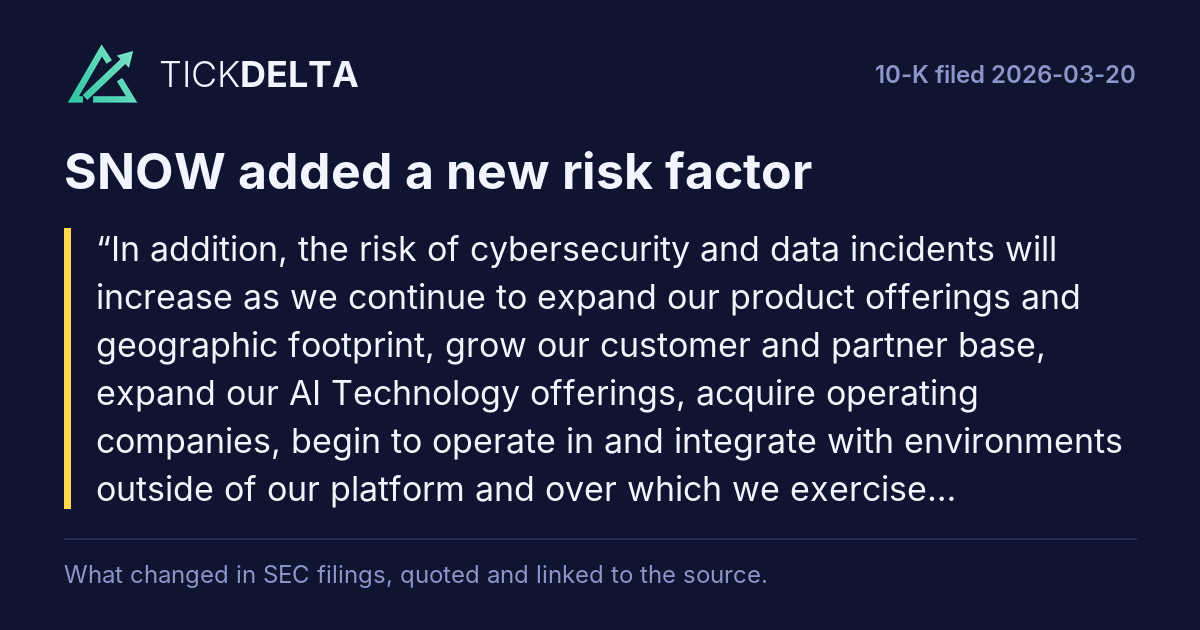
In addition, the risk of cybersecurity and data incidents will increase as we continue to expand our product offerings and geographic footprint, grow our customer and partner base, expand our AI Technology offerings, acquire operating companies, begin to operate in and integrate with environments outside of our platform and over which we exercise significantly less or no control, and process, store, and transmit increasingly large amounts and increasingly sensitive and highly regulated types of data. In particular, certain new product offerings, including through both internal development and strategic acquisitions, may pose different or greater data and security risks than our traditional offerings. These products include, for example, features and functionality that access, take instructions from, and operate on large amounts of data inside and outside our platform, or that are accessible from external environments where we have no or limited visibility or control, such as distributed endpoints (e.g., a user’s local device) and publicly accessible networks, which increase the potential attack surface for threat actors. If our security measures designed to mitigate and defend against these risks are not effective or if our customers fail to effectively implement them, we or customers may experience unintended access to or actions taken with respect to our or their systems or data.
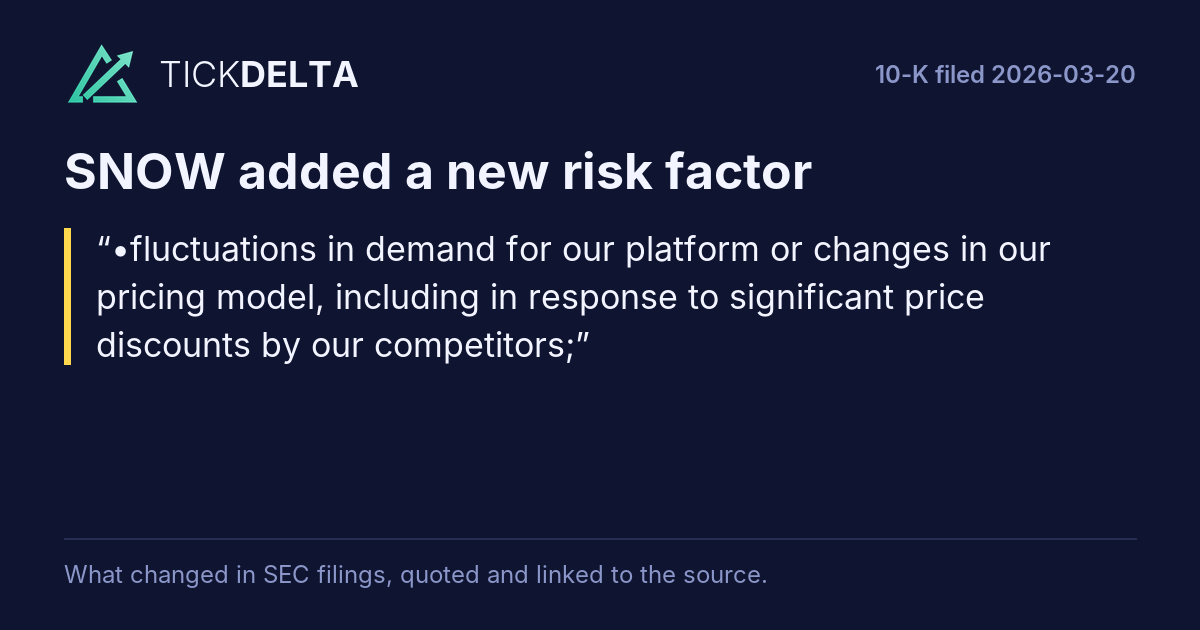
•fluctuations in demand for our platform or changes in our pricing model, including in response to significant price discounts by our competitors;
Show the other 3
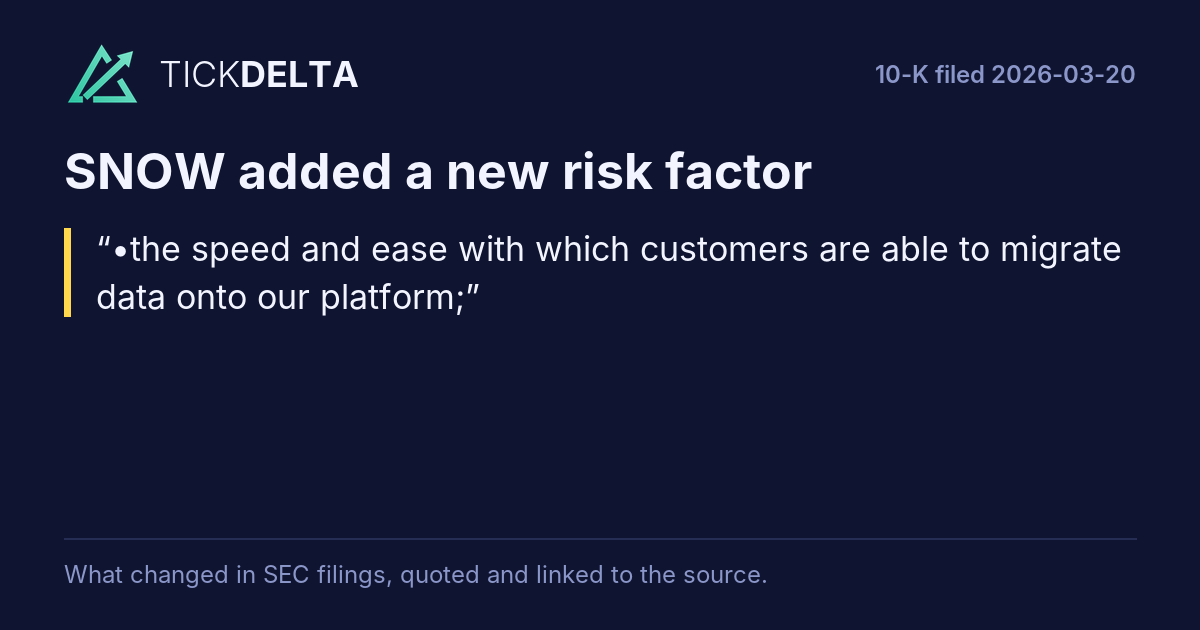
•the speed and ease with which customers are able to migrate data onto our platform;
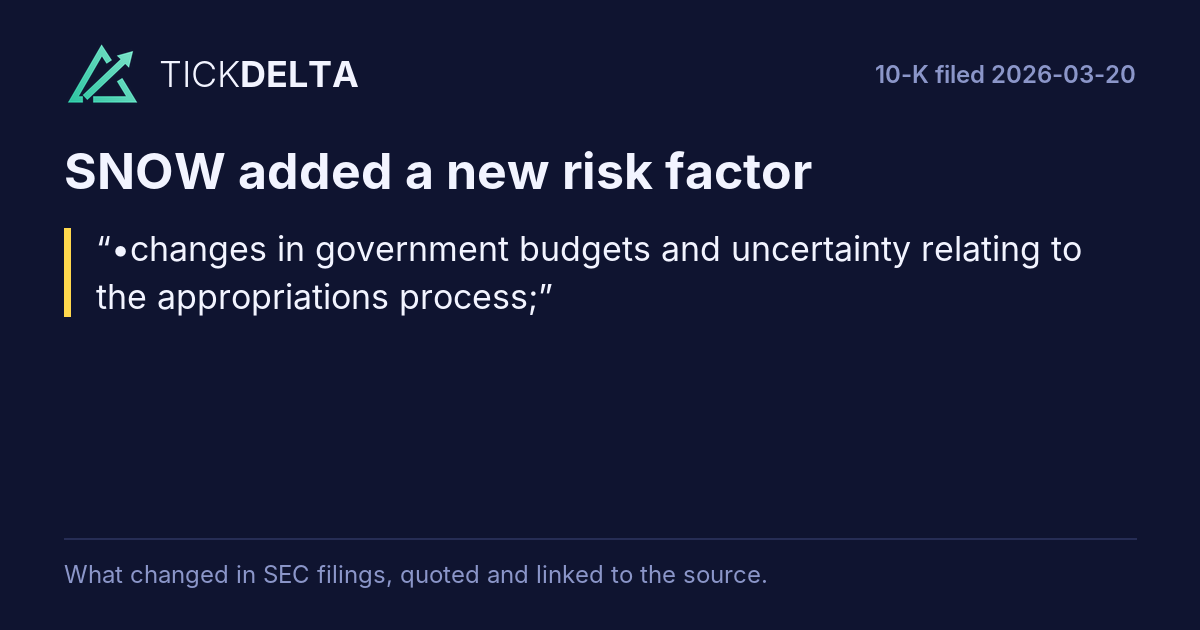
•changes in government budgets and uncertainty relating to the appropriations process;
•the amount and timing of legal expenses, including settlements, judgments, fines, legal fees, and other charges associated with litigation, governmental investigations or inquiries, regulatory investigations or inquiries, or other legal proceedings;
Paragraphs in the 10-Q filed Sep 4, 2026 that were not in the one before
New in the latest 10-Q
29 paragraphs in the 10-Q filed Sep 4, 2026 with nothing like them in the 10-Q filed May 29, 2026 (at least half the words must differ; new numbers alone do not count). Quoted exactly, grouped by the item heading above them. This is text that changed, not a judgement of how serious it is.
10-Q
• Successful execution of our AI strategy depends on effective product development, partner relationships, and use of AI in internal operations, as well as favorable customer demand and competitive dynamics. Failure to successfully execute our AI strategy could materially harm our business, financial condition, and results of operations.
Read in the 10-Q
Financial statements and notes
Changes in operating assets and liabilities, net of effects of business combinations:
Read in the 10-Q
Cash paid for business combinations, net of cash, cash equivalents and restricted cash acquired (254,449) (164,230)
Read in the 10-Q
Proceeds from issuance of common stock under employee stock purchase plan 66,987 53,193
Read in the 10-Q
Payments of deferred purchase consideration for business combinations (2,250) (600)
Read in the 10-Q
Show the other 24
The Company’s equity awards include stock options, restricted stock unit awards (RSUs), restricted common stock granted to employees, non-employee directors, and other service providers, and stock purchase rights granted under the Employee Stock Purchase Plan (ESPP Rights) to employees. RSUs may include awards that are subject to (i) only a service condition (Service-Based RSUs), (ii) both performance and service conditions (Performance-Based RSUs), and (iii) both market and service conditions (Market-Based RSUs). Equity awards are reviewed in determining whether such awards are equity-classified or liability-classified.
Read in the 10-Q
Stock-based compensation related to equity-classified awards is measured based on the estimated fair value of the awards on the date of grant and generally recognized on a straight-line basis over the requisite service period. The grant-date fair value of each stock option granted and ESPP Rights is estimated using the Black-Scholes option-pricing model. The determination of the grant-date fair value using an option-pricing model is affected by the fair value of the Company’s common stock as well as assumptions regarding a number of other complex and subjective variables. These variables include expected stock price volatility over an expected term, the expected term based on actual and projected employee stock option exercise behaviors, the risk-free interest rate for an expected term, and expected dividends. The grant-date fair value of each Market-Based RSU is estimated using a Monte Carlo simulation model that takes into account similar input assumptions as the Black-Scholes option-pricing model as well as the possibility that the market condition may not be satisfied and a post-vest delivery deferral or holding period discount, if any. The grant-date fair value of each Service-Based RSU or Performance-Based RSU is determined based on the fair value of the Company’s common stock on the date of grant. For equity-classified Performance-Based RSUs, the stock-based compensation is recognized using an accelerated attribution method over the requisite service period, based on the Company’s periodic assessment of the probability that the performance condition will be achieved. For equity-classified Market-Based RSUs, the stock-based compensation is recognized using an accelerated attribution method over the requisite service period. Stock-based compensation that was previously recognized is not reversed if the market condition is ultimately not met, provided the requisite service is rendered.
Read in the 10-Q
If an award contains a provision whereby vesting is accelerated upon a change in control, such a change in control is considered to be outside of the Company’s control and is not considered probable until it occurs. Forfeitures are accounted for in the period in which they occur.
Read in the 10-Q
The Company funds withholding taxes due upon the vesting of employee RSUs in certain jurisdictions by net share settlement. The amount of withholding taxes related to net share settlement of employee RSUs is reflected as (i) a reduction to additional paid-in-capital, and (ii) cash outflows for financing activities when the payments are made. The shares withheld by the Company as a result of the net share settlement of RSUs are not considered issued and outstanding, and do not impact the calculation of basic net income (loss) per share attributable to Snowflake Inc. common stockholders.
Read in the 10-Q
Fair Value Due within 1 year $ 637,508 Due in 1 year to 3 years 1,165,145 Due in 3 years to 5 years 679,530 No single maturity date(1) 139,807 Total $ 2,621,990
Read in the 10-Q
In connection with this business combination, the Company also issued to certain of Natoma’s employees a total of approximately 0.2 million shares of the Company’s common stock in exchange for a portion of their Natoma stock. These shares are subject to vesting agreements pursuant to which the shares will vest over three years, subject to each of these employees’ continued employment with the Company or its affiliates. The $ 54.4 million fair value of these shares is accounted for as post-combination stock-based compensation over the requisite service period of three years. See Note 12, “Equity”, for further discussion.
Read in the 10-Q
The fair value of the developed technology intangible asset was estimated using the replacement cost method, which utilizes assumptions for the cost to replace it, such as time and resources required, as well as a theoretical profit margin and opportunity cost.
Read in the 10-Q
From the date of acquisition through July 31, 2026, revenue attributable to Natoma, included in the Company’s condensed consolidated statements of operations for the three and six months ended July 31, 2026, was not material. It was impracticable to determine the effect on the Company’s net loss attributable to Natoma as its operations have been integrated into the Company’s ongoing operations since the date of acquisition. Pro forma financial information for Natoma has not been presented, as the effects were not material to the Company’s condensed consolidated financial statements.
Read in the 10-Q
In June 2026, the Company amended an existing third-party cloud infrastructure agreement that provides for a total purchase commitment of $ 6.0 billion over a five-year contract term ending March 2031. Under the amended agreement, the Company has committed to utilize incremental exabytes of storage at certain contracted rates over a 10-year contract term that extends the term for such storage from March 2031 to May 2036. The incremental exabytes of storage may be subject to adjustments based on our actual usage. The Company estimates the aggregate minimum purchase obligation for the incremental exabytes of storage to be approximately $ 58 million as of July 31, 2026.
Read in the 10-Q
In addition, during the three months ended July 31, 2026, the Company awarded 1.0 million shares to its CEO, contingent upon meeting both service-based and market-based vesting conditions (Fiscal 2027 CEO PRSU). The market-based conditions include five vesting tranches measured over respective performance periods ranging from two - to seven-years, requiring the average closing price per share of the Company’s common stock for 90 consecutive calendar days prior to the end of the applicable performance period to equal or exceed certain stock price targets ranging from $ 324 to $ 531, as certified by the compensation committee of the Company’s board of directors. Except under certain specified circumstances, the number of shares earned, if any, less shares sold to cover certain tax withholding obligations, will be subject to a one-year delivery deferral. The grant date fair values per share for each of the five tranches range from $ 182.58 to $ 199.96.
Read in the 10-Q
Total stock-based compensation of $ 192.8 million associated with the Fiscal 2027 CEO PRSU is recognized using an accelerated attribution method over the estimated requisite service period for each tranche, which ranges from approximately three to four years and is not reversed if the market-based vesting conditions are not ultimately met, provided the requisite service is rendered. Stock-based compensation recognized was $ 2.2 million for the three months ended July 31, 2026.
Read in the 10-Q
(2) Includes an immaterial number of RSUs that were vested but unissued as of July 31, 2026.
Read in the 10-Q
Expected award term - The expected award term represents the period from the grant date to the end of the longest performance period.
Read in the 10-Q
In addition, the vested shares are subject to a post-vest, one-year delivery deferral period. As such, the Company applied a 17.25 % discount for lack of marketability to the fair values estimated using the Monte Carlo simulation method. Such discount was determined using a combination of two estimation methods with expected volatility and risk-free rate assumptions as described in the table above over a one-year term.
Read in the 10-Q
General and administrative expenses remained relatively flat for the three months ended July 31, 2026, compared to the three months ended July 31, 2025.
Read in the 10-Q
Risk Factors
Successful execution of our AI strategy depends on effective product development, partner relationships, and use of AI in internal operations, as well as favorable customer demand and competitive dynamics. Failure to successfully execute our AI strategy could materially harm our business, financial condition, and results of operations.
Read in the 10-Q
Our success is dependent on our ability to succeed in a rapidly changing technology environment dominated by AI. We have made and expect to continue to make significant capital and operational investments in AI, including investments in time, people, and infrastructure to internally develop AI technologies, and we have acquired companies with complementary AI technologies. Our competitors are pursuing similar opportunities and may, as a result of greater resources, branding, or otherwise, develop, adopt, and implement AI faster or more successfully than we do, which could impair our ability to compete effectively.
Read in the 10-Q
A core component of our AI strategy includes incorporating third-party AI technologies, including frontier AI models (both proprietary and open-source), into our products and services. As a result, we are subject to a number of risks arising from our dependence on partner relationships and AI models. Frontier proprietary AI model providers have a strong market position and, as a result, enjoy substantial leverage over the prices of their technology and the commercial and product terms and conditions governing their use. In order to gain and retain access to frontier AI models and remain competitive, we have accepted and may continue to accept pricing and other terms that deviate from our standard commercial terms, introduce increased risk related to operational complexities and liability exposure, and contribute to margin compression from our AI offerings. Even if we do accept the model providers’ terms, we still may not be given access to their models, in which case our attractiveness to customers will suffer. On the other hand, incorporating open-source AI models into our products may require us to host and operate those models, which requires significant infrastructure investment and creates additional operational and performance responsibilities without product features or commitments that proprietary AI model providers offer. In addition, customers may be reluctant to use our AI offerings due to any actual or perceived heightened security risk associated with certain third-party and/or open-source AI models, particularly those from other countries. Further, AI is constantly evolving and may not be as reliable as traditional software. If third-party AI models produce flawed results, fail to execute, or introduce or amplify security vulnerabilities, we may face liability to our customers and may not have corresponding indemnification from the AI model providers or insurance coverage. Access to frontier AI models or other technologies may also be subject to sudden suspension or restriction by AI model providers or by governments due to safety concerns, national security concerns, regulatory mandates, or shifting priorities among cloud platforms. Any loss of the ability to use such AI models or other technologies could significantly increase our expenses and disrupt or delay the provision of our services until equivalent technology is either developed internally or obtained from third parties and integrated into our systems.
Read in the 10-Q
In addition, our successful development and deployment of AI depends in part on our access to GPUs and ability to recruit and retain AI-skilled personnel, both of which are currently in high demand. We have experienced and may continue to experience difficulties sourcing GPUs to support our AI offerings, and we are required to make long-term commitments in an unpredictable market which may lead to GPU spending in excess of actual utilization.
Read in the 10-Q
Other information
On August 31, 2026, the Company’s board of directors (Board), upon the recommendation of the nominating and governance committee of the Board, approved and adopted an amendment and restatement of the Company’s bylaws (Amended and Restated Bylaws), effective as of such date, to:
Read in the 10-Q
• implement a majority vote standard for uncontested director elections under which a director nominee will be elected to the Board only if the votes cast “for” such nominee’s election exceed the votes cast “against” such nominee’s election, with “abstentions” and “broker non-votes” not counted as votes cast,” with the plurality vote standard continuing to apply to contested elections (as defined in the Amended and Restated Bylaws);
Read in the 10-Q
• update the advance notice provision to require submission of a completed questionnaire with respect to director nominees proposed by stockholders; and
Read in the 10-Q
The foregoing description of the Amended and Restated Bylaws does not purport to be complete and is qualified in its entirety by reference to the full text of the Amended and Restated Bylaws, which are attached hereto as Exhibit 3.2 and are incorporated herein by reference.
Read in the 10-Q
In connection with the adoption of the Amended and Restated Bylaws, the Board also approved an amendment to the Board’s corporate governance guidelines to, among other things, adopt a director resignation policy in connection with the majority vote standard for director elections.
Read in the 10-Q
The 10-Q's risk factors against the 10-K
Item 1A of the 10-Q filed Sep 4, 2026 against Item 1A of the 10-K filed Mar 20, 2026.
A 10-Q repeats only the risks that changed, so a 10-K paragraph that is missing from it is not counted as removed.
Added is a paragraph with nothing like it in the 10-K, Reworded a sentence that is in both with several words changed,
Quiet changes a sentence in both where one to four words changed and one is a hedge or a modal
(cut words struck through, new words highlighted).
Text on the page, not a score; each links to the filing at sec.gov.
Show the other 15
The first 20 of 64 are shown (at most 12 of each type).
Phrases used for the first time
Two-word phrases in Risk Factors of the 10-K filed Mar 20, 2026 that are in none of the 1 earlier 10-Ks stored, back to Mar 21, 2025
Where each one is used
- product offerings: Companies with which we have strategic partnerships and alliances in some areas may be competitors in other areas, and this trend may increase, particularly as we expand our product offerings. Additionally, companies that are strategic partners in some areas of our business may acquire or form alliances with our...
- data incidents: There can be no assurance that security measures designed to protect against security incidents will be effective, that we will be able to detect, mitigate, or remediate vulnerabilities in our products and information security systems (such as our hardware and software, including that of third parties upon which we...
- chain restrictions: Our revenue growth is also dependent on our ability to increase our penetration into existing markets, and to successfully enter and grow new markets, including highly-regulated markets such as financial services, healthcare, and the public sector. Sales to highly-regulated entities are subject to substantial...
- large language: We are investing significantly in AI Technology. Our investments include internally developing AI Technology, acquiring companies with complementary AI Technology, and partnering with companies to bring AI Technology to our platform. Our competitors are pursuing similar opportunities and may, as a result of greater...
- deployments supply: Our revenue growth is also dependent on our ability to increase our penetration into existing markets, and to successfully enter and grow new markets, including highly-regulated markets such as financial services, healthcare, and the public sector. Sales to highly-regulated entities are subject to substantial...
- product areas: We have experienced net losses in each period since inception. We generated net losses of $1.3 billion, $1.3 billion and $838.0 million for the fiscal years ended January 31, 2026, 2025 and 2024, respectively. As of January 31, 2026 and 2025, we had an accumulated deficit of $9.5 billion and $7.3 billion,...
- unintended access: In addition, the risk of cybersecurity and data incidents will increase as we continue to expand our product offerings and geographic footprint, grow our customer and partner base, expand our AI Technology offerings, acquire operating companies, begin to operate in and integrate with environments outside of our...
- alleging copyright: From time to time, we may become subject to legal proceedings and claims, such as claims brought by our customers in connection with commercial disputes, cybersecurity incidents, employment claims, including claims related to the loss of employee equity grants upon termination, intellectual property claims, or...
Used at least twice, small words left out. Counted, not picked: a phrase can be new because the company renamed something.
What was taken out
1 paragraph of last year's Risk Factors with nothing like them now. The longest are quoted.
Sources
Item 1A of each 10-K and 10-Q on EDGAR, quoted exactly. Each paragraph links to the filing at sec.gov.
Also
10-K change: what was reworded or cut, section by section.
Work with it
Excel workbook · CSV. Google Sheet that stays up to date: paste =IMPORTDATA("https://tickdelta.com/company/SNOW/export.csv") into a cell.