Added10-Q Nov 5, 2026 vs 10-K Mar 2, 2026
• the frequency of administering our products, including weekly dosing of our PMO Products; and
Each branch is a paragraph in Risk Factors with nothing like it in the 10-K filed Feb 28, 2025. A box jumps to the paragraph as filed, below.
40 paragraphs in Risk Factors of the 10-K filed Mar 2, 2026 with nothing like them in the 10-K filed Feb 28, 2025. Quoted exactly. Paragraphs that were only edited are under 10-K change.
•executive, legislative or regulatory action that restricts pricing, coverage or reimbursement of our current or future products;
Further, the current administration has also undertaken significant efforts to reduce the size and spending of the federal government, including at the FDA. A significant reduction in FDA’s workforce or FDA’s budget, or other disruptions at FDA, including any government shutdown, could materially impact FDA’s ability to engage in a variety of activities that may affect our business, including routine regulatory and oversight activities. For example, any reduction in FDA’s workforce could lead to disruptions and delays in FDA’s review and oversight of our post-approval confirmatory trials.
the first 120 days following marketing approval. If we or the manufacturing facilities for our products fail to comply with applicable regulatory requirements, a regulatory agency may:
If we or a regulatory agency discover previously unknown adverse events or events of unanticipated severity or frequency, a regulatory agency may establish additional regulatory requirements including, among other things, labeling changes, implementation of risk evaluation and mitigation strategy program, or additional post-marketing studies or clinical trials. For example, following two patient deaths due to ALF in non-ambulatory patients associated with the use of ELEVIDYS, the FDA proposed, and we agreed to, a safety label supplement for ELEVIDYS to include a boxed warning for ALI and ALF. Subsequently, on July 18, 2025, we announced a reported case of ALF resulting in death in a patient following dosing in the Company's Phase 1/2 LGMD trial for SRP-9004. The Company recently announced the conclusion of the label supplement for ELEVIDYS, including the addition of a boxed warning for risk of ALI and ALF and the removal of the non-ambulatory population from the Indication and Usage section. We are in the process of conducting various clinical trials for ELEVIDYS, including to evaluate the use of an enhanced immunosuppressive regimen as part of treatment with ELEVIDYS for non-ambulant individuals living with Duchenne. We intend to discuss with the FDA the results of this study and a potential pathway forward to resume commercial dosing in the non-ambulatory population. Regardless of the outcome of the study, however, it is unclear if or when we will be able to resume shipments to non-ambulatory patients.
•increases in, or elimination of caps on, rebates paid on products under government healthcare programs;
•requirements for substitution of generic products for branded prescription drugs;
Workforce reductions in and restructuring of the U.S. Department of Health and Human Services, including at the FDA, may also create regulatory uncertainty, potentially impacting drug and biologic development programs and approvals.
For example, in March and June 2025, we announced two reported cases of ALF resulting in death in non-ambulatory patients following treatment with ELEVIDYS. Following these announcements, the FDA proposed, and we agreed to, a safety label supplement for ELEVIDYS to include a boxed warning for ALI and ALF. Subsequently, on July 18, 2025 we announced a reported case of ALF resulting in death in a patient following dosing in our Phase 1/2 LGMD trial for SRP-9004. These announcements have impacted, and may continue to, impact the market adoption of our products and create uncertainty among patients, providers, and payers. Although we have resumed shipments to ambulatory patients in the U.S., we may continue to experience hesitation from patients, payers and healthcare providers, which could adversely impact our business. The degree to which such hesitation continues, and the degree to which it could adversely impact our business, is uncertain and difficult to predict.
Additionally, on November 3, 2025, we announced topline results from our ESSENCE trial, a confirmatory trial intended to verify the clinical benefits of VYONDYS 53 and AMONDYS 45, which primary endpoint did not meet statistical significance. Our analysis of the trial results is ongoing. However, these topline results could lead to regulatory actions from the FDA, including changes to our drug labels or revocation of accelerated approvals and directives to remove these products from the market altogether, negatively impact patient demand for these products or result in changes to reimbursement and coverage of these products by payors. Such outcomes could adversely impact our business, financial condition, results of operations, financial guidance, ability to accurately forecast key financial metrics, and prospects.
•an inability to retain an adequate number of effective commercial personnel. For example, a number of commercial personnel have departed from the Company in connection with and following our Restructuring, which has resulted in the need for additional hiring and training efforts, which may continue in the future;
In the siRNA field, we face competition by third parties who are also developing product candidates targeting the same disease states as our product candidates, including but not limited to Avidity (DM1, FSHD), Dyne (DM1, FSHD), Arthex Biotech (DM1), PepGen (DM1), Vertex Pharmaceuticals (DM1), Entrada (FSHD), Celularity (FSHD), Novartis (FSHD), Biohaven (SCA), Vico Therapeutics (SCA, Huntington’s), Skyhawk Therapeutics (SCA, Huntington’s), uniQure (Huntington’s), Roche Ionis (Huntington’s), Wave (Huntington’s), and PTC (Huntington’s). Some, but not all, of these entities’ product candidates use RNA technologies. Several of these companies’ product candidates are further along in development and may obtain regulatory approval in advance of our product candidates. These and other competitors may have greater financial, scientific, and commercial resources than us, which may impact our ability to secure the technologies we desire or to otherwise effectively compete in these disease states.
Further, any reduction in the FDA’s workforce could delay or materially impact the FDA’s feedback on our development programs, including through meetings and other informal interactions, and affect the FDA’s review and oversight of our product candidates. Additionally, changes in the FDA personnel under the new presidential administration may lead to changes in the regulations, policies and operations of the FDA, which may impact our clinical development plans. Any of these actions could adversely affect the development and approval of our product candidates. In addition, as a result of any government shutdown, the FDA staff may be unable to process and review regulatory submissions in a timely manner or at all.
We have seen, and may continue to see, new safety signals for our products or product candidates. For example, we reported new safety signals in the non-ambulatory population for ELEVIDYS and for our LGMD product candidate SRP-9004 in 2025. On March 18, 2025, Sarepta announced that a non-ambulatory patient with Duchenne passed away following treatment with ELEVIDYS after having suffered from ALF. On June 15, 2025, Sarepta announced a second reported case of ALF resulting in death in a non-ambulatory patient following treatment with ELEVIDYS. Such adverse events have resulted in the FDA's proposal of, and our agreement to, a label supplement for ELEVIDYS to include a boxed warning for ALI and ALF. On July 18, 2025, Sarepta announced a reported case of ALF resulting in death in a patient following dosing in the our Phase 1/2 LGMD trial for SRP-9004. Occurrences of undesirable side effects and new safety signals could impact the adoption of our products and may harm our business, financial condition, prospects and ability to accurately forecast revenues.
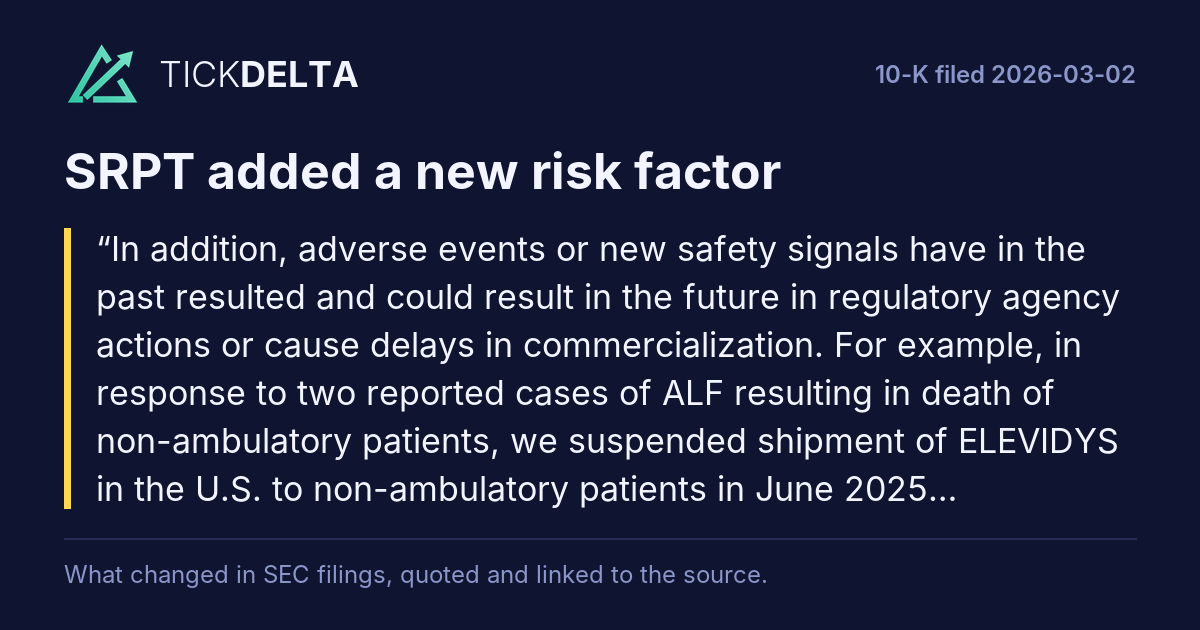
In addition, adverse events or new safety signals have in the past resulted and could result in the future in regulatory agency actions or cause delays in commercialization. For example, in response to two reported cases of ALF resulting in death of non-ambulatory patients, we suspended shipment of ELEVIDYS in the U.S. to non-ambulatory patients in June 2025. Additionally, in July 2025, we disclosed a reported case of ALF in a non-ambulatory patient participating in our Stage 1/2 LGMD trial for SRP-9004, who was not treated with ELEVIDYS. Thereafter, in response to a request from FDA that we voluntary stop all shipments of ELEVIDYS in the U.S., we suspended shipment of ELEVIDYS in the U.S. to ambulatory patients effective July 22, 2025. On July 28, 2025, the FDA informed us that it recommended the removal of the voluntary hold for ambulatory patients. In response, we resumed commercial shipments of ELEVIDYS for ambulatory patients in the U.S. Further, the Company has agreed with FDA to a boxed warning for ALI and ALF and the removal of non-ambulatory population from the Indication and Usage section of the Prescribing
Information. In November 2025, we announced the FDA's approval of dosing in a clinical trial for ELEVIDYS to evaluate the use of an enhanced immunosuppressive regime as part of treatment with ELEVIDYS for non-ambulatory patients. It is currently unclear whether the FDA will pursue further actions related to ELEVIDYS, such as additional studies, additional product modifications, label supplements or controls, in the future.
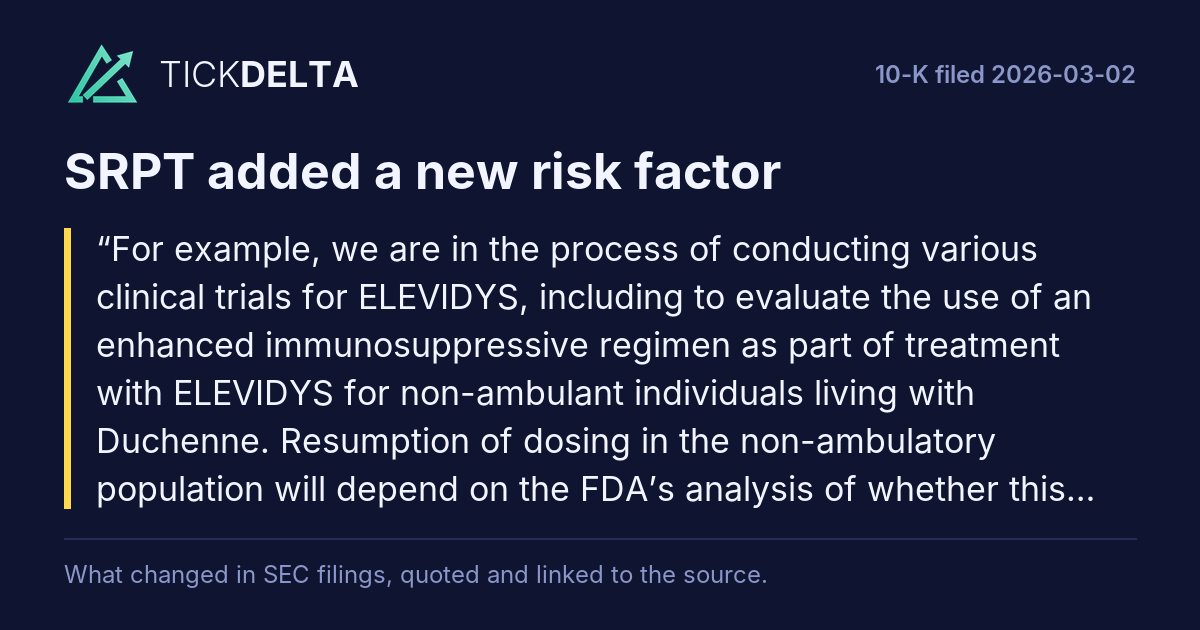
For example, we are in the process of conducting various clinical trials for ELEVIDYS, including to evaluate the use of an enhanced immunosuppressive regimen as part of treatment with ELEVIDYS for non-ambulant individuals living with Duchenne. Resumption of dosing in the non-ambulatory population will depend on the FDA’s analysis of whether this data positively changes ELEVIDYS’s risk/benefit profile. We intend to discuss with the FDA the results of this study and a potential pathway forward to resume commercial dosing in the non-ambulatory population. The FDA may interpret the data from these trials differently than us and, regardless of the trial results, not permit us to resume shipments to non-ambulatory patients.
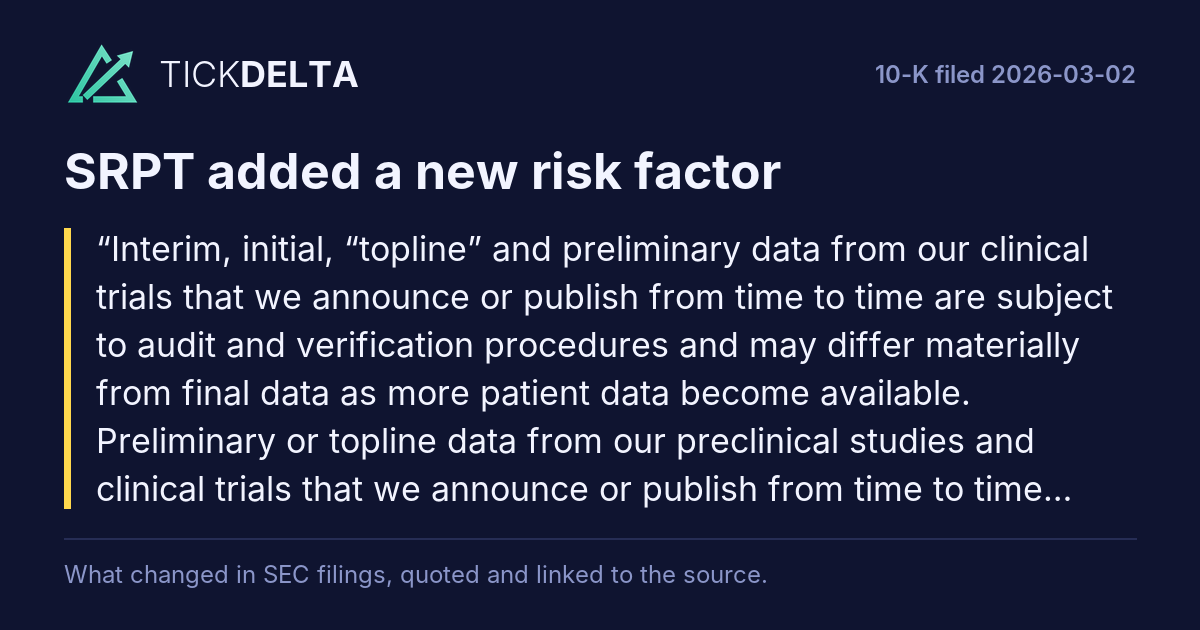
Interim, initial, “topline” and preliminary data from our clinical trials that we announce or publish from time to time are subject to audit and verification procedures and may differ materially from final data as more patient data become available.
Preliminary or topline data from our preclinical studies and clinical trials that we announce or publish from time to time are based on preliminary analyses of then-available data, and the results, related findings and conclusions are subject to change following a more comprehensive review of the data related to the particular preclinical study or clinical trial. We also make assumptions, estimations, calculations and conclusions as part of our analyses of data, and we may not have received or had the opportunity to fully and carefully evaluate all data. As a result, the topline or preliminary results may differ from future results of the same studies or trials, or different conclusions or considerations may qualify such results once additional data have been received and fully evaluated. Topline data also remain subject to audit and verification procedures that may result in the final data being materially different from the preliminary data. As a result, topline data should be viewed with caution until the final data are available. For example, we announced topline results from our ESSENCE trial, a confirmatory trial intended to verify the clinical benefits of VYONDYS 53 and AMONDYS 45. Our analysis of the trial results is ongoing.
From time to time, we also may disclose interim data from our preclinical studies and clinical trials. Interim data from clinical trials are subject to the risk that one or more of the clinical outcomes may materially change as participant enrollment continues and more participant data become available or as participants from our clinical trials continue other treatments for their disease.
Furthermore, third parties, including regulatory authorities, may not accept or agree with our assumptions, estimates, calculations, conclusions or analyses or may interpret or weigh the importance of data differently, which could delay or prevent regulatory approval of, or limit commercial prospects for, the particular product candidate. In addition, the information we choose to
publicly disclose regarding a particular study or clinical trial is based on what is typically extensive information, and investors or others may not agree with what we determine to disclose.
If the interim, top-line or preliminary data that we report differ from final results, or if others, including regulatory authorities, disagree with the conclusions reached, our ability to obtain approval for, and commercialize, our product candidates may be harmed, which could harm our business, financial condition, results of operations and prospects. Further, disclosure of interim, top-line or preliminary data by us or by our competitors could result in volatility in the price of our common stock.
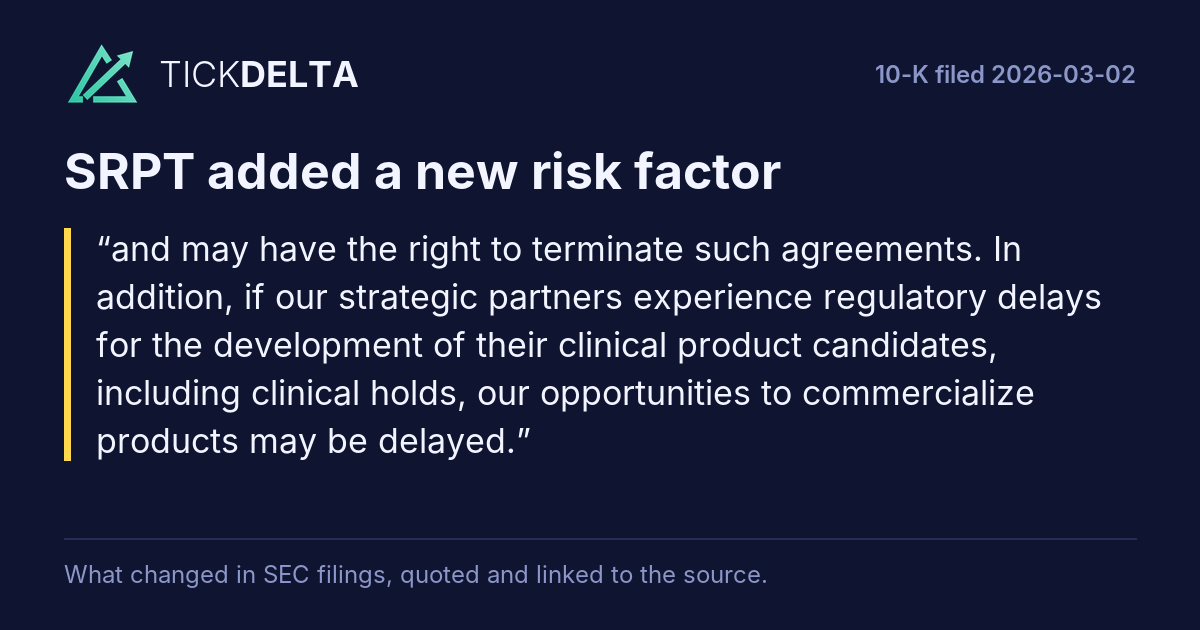
and may have the right to terminate such agreements. In addition, if our strategic partners experience regulatory delays for the development of their clinical product candidates, including clinical holds, our opportunities to commercialize products may be delayed.
In addition, several of the components used in our testing are currently from single-source suppliers. If these single-source suppliers fail to satisfy the Company's requirements on a timely basis, or if the Company is forced to change suppliers, the Company could suffer delays, a possible loss of revenue, or incur higher costs, any of which could adversely affect its operating results.
From time to time, we may need to add new manufacturing capacity to meet increased product demand. The process for adding new manufacturing capacity is lengthy and often causes delays in development efforts. Further, there may be circumstances in which we cease or temporarily suspend manufacturing for our products or product candidates altogether, which could impair the development of our product candidates and ability to meet commercial demand. For example, in June 2025, we suspended shipments of ELEVIDYS to non-ambulatory patients, and in July 2025 we temporarily suspended the shipments of ELEVIDYS to ambulatory patients. While the Company has resumed shipments of ELEVIDYS to ambulatory patients, the non-ambulatory population has since been removed from the Indications and Usages section of the ELEVIDYS Prescribing Information. Generally, any interruption or delay of the development of manufacturing facilities, or any suspension of manufacturing at our existing third-party manufacturing facilities, could result in our inability to meet commercial or clinical product demand, which could result in the loss of potential revenues, adversely affect our ability to meet product development or regulatory milestones on anticipated timelines, or otherwise adversely affect our business, financial conditions and prospects. Moreover, should shipments of ELEVIDYS to the non-ambulatory population resume in the future, our CMOs may experience delays associated with increasing manufacturing output for unpredictable reasons that may be outside their or our control, which could adversely impact our ability to predict production timelines and meet commercial demand.
Our commercial products and product candidates in development—including our PMOs, gene therapies, and siRNA therapies—are novel and complex technologies that are or may be difficult to manufacture. The novelty of these therapies, in addition to the regulatory oversight and review they face, may lead to production issues or volatility in both supply and demand.
Our ability to accurately predict commercial demand may also be impacted by regulatory decisions. For instance, following a safety label update process, the non-ambulatory population has been removed from the Indications and Usages section of the ELEVIDYS Prescribing Information. This removal has impacted our previously forecasted demand for ELEVIDYS, which increases the risk of products and portions of our products’ supply expiring before sale or having excess materials on hand, which could have a material impact on our financial operations. To date, this has resulted in recorded reserves related to excess inventory. These types of events may continue to cause volatility in demand for ELEVIDYS, which could result in our inability to accurately forecast commercial demand for ELEVIDYS.
for prosecuting corporate and white collar crime which includes health care fraud. Similarly, the DOJ-HHS False Claims Act Working Group enforcement priorities include drug pricing and kickbacks related to drugs paid for by federal healthcare programs.
Our announced strategic restructuring plan may not result in anticipated reductions in our annual combined research and development and selling, general and administrative expenses and may disrupt our business in unexpected ways.
In July 2025, we announced a strategic restructuring plan, which included a revised cost structure and program portfolio and a reduction in force. The workforce reduction represented approximately 36% of our workforce at the time it was implemented. We may not realize, in full or in part, the anticipated benefits, savings and improvements in our cost structure from these efforts due to unforeseen difficulties, delays or unexpected costs. If we are unable to realize the potential cost savings from the strategic restructuring plan, our business strategy, operating results and financial condition would be adversely affected. Our workforce reductions could yield unanticipated consequences, such as disruptions in our day-to-day operations. The restructuring and reduction in force has resulted, and may continue to result, in an increase in the turnover of our employees. Our strategic restructuring plan, including our revised cost structure and reduction in force, could also harm our ability to attract and retain qualified management and development personnel who are critical to our business. If we are unable to realize the expected benefits from the strategic restructuring plan, we may decide to undertake additional workforce reductions.
We are unable to predict what tax reform may be proposed or enacted in the future by the U.S. and other countries in which we currently or may in the future operate in or what effect such changes would have on our business and results of operations. Changes in tax rates, laws, practices, treaties, policies or regulations, or the change in interpretation thereof, could increase our effective tax rate or otherwise affect our financial position, results of operations and financial condition and/or increase the complexity, burden and cost of tax compliance.
Further, on July 4, 2025, the One Big Beautiful Bill Act (“OBBBA”) was enacted in the U.S. The OBBBA contains, among other provisions, changes to the U.S. corporate income tax system, including allowing immediate expensing of U.S. qualifying research and development expenses and allowing taxpayers an election to accelerate the deduction for previously capitalized U.S. research and development costs. The favorable U.S. research and development expenditure provisions will reduce taxable income but will not have a material impact on the Company’s net deferred tax assets.
These and other tax law changes and anti-avoidance initiative increase uncertainty and may adversely affect our tax provision, cash tax liability and effective tax rate.
If we fail to maintain effective internal controls, we may not be able to accurately report our financial condition or results of operations, which may adversely affect investor confidence in us and, as a result, the value of our common stock.
We are required, pursuant to Section 404 of the Sarbanes-Oxley Act of 2002 to furnish a report by management on, among other things, the effectiveness of our internal control over financial reporting for the fiscal year ended December 31, 2025. In addition, our independent registered public accounting firm is required to attest to the effectiveness of our internal control over financial reporting for the fiscal year ended December 31, 2025.
We cannot assure you that the measures we have taken to date, and actions we may take in the future, will prevent or avoid potential material weaknesses in our internal control over financial reporting in the future. Any failure to maintain internal control over financial reporting, including as a result of impacts to our financial reporting team in light of our July 2025 restructuring, could severely inhibit our ability to accurately report our financial condition or results of operations and may result in a restatement of our financial statements for prior periods. If we are unable to conclude that our internal control over financial reporting are effective, or if management or our independent registered public accounting firm determines we have a material weakness or significant deficiency in our internal control over financial reporting, we could lose investor confidence in the accuracy and completeness of our financial reports, the market price of our common stock could decline, and we could be subject to sanctions or investigations by the SEC or other regulatory authorities. Failure to remedy any material weakness in our internal control over financial reporting, or to implement or maintain other effective control systems required of public companies, could also restrict our future access to the capital markets.
•the timing of our submissions to regulatory authorities and regulatory decisions, as well as regulatory interactions and decision-making, which could be impacted by changes in FDA priorities, practices or leadership;
•developments in existing litigation in which we are a party and new lawsuits filed against us;
cash. As of December 31, 2025, the aggregate principal amount of 2027 Notes totaled approximately $158.6 million and the aggregate principal amount of 2030 Notes totaled approximately $893.4 million.
sanctions, the prosecution of executives overseeing our international operations and damage to our reputation. Any significant impairment of our ability to sell products outside of the U.S. could adversely impact our business and financial results.
New in the latest 10-Q
36 paragraphs in the 10-Q filed Nov 5, 2026 with nothing like them in the 10-Q filed Aug 5, 2026 (at least half the words must differ; new numbers alone do not count). Quoted exactly, grouped by the item heading above them. This is text that changed, not a judgement of how serious it is.
public entities to provide disaggregated disclosure of income statement expenses. Public entities are required to disaggregate, in a tabular presentation, each relevant expense caption on the face of the consolidated statements of comprehensive (loss) income such as the following expenses: purchases of inventory, employee compensation, intangible asset amortization, and depreciation. ASU 2024-03 is effective for annual reporting periods beginning after December 15, 2026 and interim periods beginning after December 15, 2027, with early adoption permitted. The Company is currently evaluating the impact of this guidance and does not expect its adoption to have a material impact on its consolidated financial statements and related disclosures.
Read in the 10-Q
Value Value Value Value ────────────────────────────────────────────────────────────────────────────────────────────────────────────────────────────────────────────────────────────────────────────────────────────────────────────────────────────────────────────────────────────────────────────────────────────────────────── Stock options 2,224,342 (1) $10.48 - $ - 2,224,342 (1) $10.48 488,192 $46.93 Restricted stock units 967,174 (1) $16.04 3,496,155 (2) $18.95 1,755,359 (1) $17.00 5,191,278 (2) $39.73 Performance stock units - $ - 225,000 (3) $18.95 - $ - 345,378 (4) $47.09 (1) On July 28, 2026 (the "Grant Date"), the Company granted its Chief Executive Officer, Dr. Michael Severino, approximately 2.2 million premium-priced stock options that vest 25 % on the first anniversary of the Grant Date, with the remainder vesting monthly over the following three years and approximately 0.8 million restricted stock units (“RSUs”) that vest in equal annual installments over four years, in each case generally subject to continued employment. (2) In September 2025, approximately 3.4 million RSUs were granted, which will vest over two years while the remaining vest over four years. (3) In September 2025, RSUs with performance conditions (“PSUs”) were granted (the "September 2025 PSUs"). The performance condition is related to the achievement of a certain financial performance goal. The September 2025 PSUs have a three-year cliff vesting schedule. As of September 30, 2026, the performance condition associated with the September 2025 PSUs has been achieved. (4) In addition to the September 2025 PSUs, included in PSUs for the nine months ended September 30, 2025 are approximately 0.1 million shares with performance conditions which are related to the achievement of certain financial performance goals, regulatory development and approval of certain of the Company's product candidates and certain manufacturing achievements (the “March 2025 PSUs”). As of September 30, 2026, none of the performance conditions for the March 2025 PSUs were probable of being achieved. Stock-based Compensation Expense For the three months ended September 30, 2026 and 2025, total stock-based compensation expense included in total expenses was $26.7 million and $14.9 million, respectively. For the nine months ended September 30, 2026 and 2025, total stock-based compensation expense included in total expenses was $80.6 million and $93.4 million, respectively. The following table summarizes stock-based compensation expense by grant type and by function included within the unaudited condensed consolidated statements of comprehensive (loss) income: For the Three Months Ended For the Nine Months Ended
Read in the 10-Q
Add: interest expense, net of tax, on the Company's convertible debt - - 1,865 (1) -
Read in the 10-Q
Weighted-average common shares outstanding, basic 105,930 100,237 105,453 98,545
Read in the 10-Q
Weighted-average common shares outstanding, diluted 105,930 100,237 107,646 98,545
Read in the 10-Q
Common stock issuable under the Company's convertible debt 16,007 13,203 14,890 (1) 13,203
Read in the 10-Q
For the nine months ended September 30, 2026, the interest expense, net of tax, and potential share settlement of the 2030 Convertible Notes were excluded from diluted net income and diluted weighted-average common stock outstanding, respectively, as the inclusion of such shares was anti-dilutive during the period.
Read in the 10-Q
fees and costs, and such other relief as the court deems just and proper. On January 5, 2024, the Court granted Sarepta’s motion for summary judgment on the grounds that the asserted claims of Regenx’s ’617 Patent are invalid because they cover patent ineligible subject matter under 35 U.S.C. § 101. On January 12, 2024, the Court entered judgment and closed the case. Plaintiffs appealed to the U.S. Court of Appeals for the Federal Circuit (the “Federal Circuit”), which reversed the district court's decision on February 20, 2026, and remanded the case for further proceedings. On March 23, 2026, the Company filed a petition for rehearing en banc before the Federal Circuit, which the Federal Circuit denied on April 22, 2026. The Federal Circuit issued a mandate on April 29, 2026.
Read in the 10-Q
On September 23, 2026 (the “Settlement Effective Date”), Sarepta, Regenx, U-Penn and Catalent entered into a settlement agreement (the “Settlement Agreement”) regarding, among other matters, the resolution of certain patent infringement litigations and an appeal from inter partes review proceedings relating to the '274 Patent and the '617 Patent (collectively, the “Litigations”).
Read in the 10-Q
Under the terms of the Settlement Agreement, Sarepta paid Regenx a lump sum of $39.0 million within ten days of the Settlement Effective Date of the Settlement Agreement. Regenx and U-Penn released Sarepta, Catalent and their affiliates from any claims relating to any Sarepta gene therapy product that uses the AAVrh74-based capsid, including ELEVIDYS, that are claims of infringement of the ‘274 Patent, the ‘617 Patent and U.S. Patent No. 9,198,984 and certain related patents (collectively, the “U-Penn Patents”), arising at any time up to and including the Effective Date.
Read in the 10-Q
In addition, Regenx and U-Penn agreed not to sue Sarepta, Catalent or their current affiliates, licensees, commercial partners, successors and permitted assigns with respect to any claims of patent infringement of the U-Penn Patents to the extent that infringement arises from or relates to any Sarepta gene therapy product that uses an AAVrh74-based capsid, including ELEVIDYS. Regenx further agreed not to sue Sarepta or its licensees, commercial partners, successors and permitted assigns with respect to claims of patent infringement of any Regenx-controlled or owned patents or patent applications that cover the existing form of ELEVIDYS or the AAVrh74 capsid sequence.
Read in the 10-Q
The Settlement Agreement provides for the dismissal, withdrawal or other disposal of the Litigations with prejudice. Each party will continue to bear its own costs, expenses and attorneys’ fees in connection with the Litigations and the negotiation and execution of the Settlement Agreement. The Settlement Agreement does not include any admission of liability or wrongdoing by any party. During the nine months ended September 30, 2026, the Company recorded a litigation settlement charge of $39.0 million related to the settlement of the Litigations.
Read in the 10-Q
On July 15, 2025, a shareholder derivative lawsuit concerning certain of the same disclosures underlying the first complaint in the Securities Action was filed in the U.S. District Court for the Southern District of New York, naming Company directors M.
Read in the 10-Q
Results of Operations for the Three and Nine Months Ended September 30, 2026 and 2025
Read in the 10-Q
• $100.0 million decrease in up-front and collaboration license fees due to our $100.0 million milestone payment to Arrowhead, triggered by Arrowhead's achievement of the first of two predetermined enrollment targets and subsequent authorization to dose escalate in a Phase 1/2 study for the DM1 program (the "First Arrowhead DM1 Milestone"), during the three months ended September 30, 2025, which did not recur in the three months ended September 30, 2026; and
Read in the 10-Q
former CEO in December 2025 and our current CEO in July 2026, grants of RSUs to employees in September 2025 that vest over two years and the reversal of previously recognized expense related to our ESPP Suspension during the three months ended September 30, 2025.
Read in the 10-Q
During the nine months ended September 30, 2026, we recorded a litigation settlement charge of $39.0 million related to a settlement agreement entered into in September 2026 between Sarepta Therapeutics, Inc., Sarepta Therapeutics Three, LLC, REGENXBIO, INC, the Trustees of the University of Pennsylvania and Catalent regarding, among other matters, the resolution of certain patent infringement litigations and an appeal from inter partes review proceedings relating to the '274 Patent and the '617 Patent (collectively, the “Litigations”). Refer to Note 16, Commitments and Contingencies for further discussion regarding the Litigations.
Read in the 10-Q
The Restructuring, announced in July 2025, was designed to reduce operating expenses and align our cost structure with strategic priorities, aiming to enhance financial flexibility and meet our 2027 financial obligations. We recorded a restructuring charge of $40.5 million during the three and nine months ended September 30, 2025, primarily related to employee termination benefits, including severance, along with accelerated depreciation for assets impacted by the restructuring plan, with no similar activity during the three and nine months ended September 30, 2026.
Read in the 10-Q
In August 2025, we completed a partial refinancing of the 2027 Notes (the "August 2025 Exchange") and exchanged $700.0 million in aggregate principal amount of 2027 Notes for $602.0 million in aggregate principal amount of 2030 Notes, cash payments of $127.3 million, including $4.0 million of accrued interest of the 2027 Notes and 5.9 million shares of our common stock with a fair market value of approximately $104.9 million, net of issuance costs of $2.4 million.
Read in the 10-Q
As a result of the August 2025 Exchange, we recognized a gain on debt extinguishment for the three and nine months ended September 30, 2025 of $3.8 million. No similar activity occurred during the three and nine months ended September 30, 2026.
Read in the 10-Q
• $50.0 million in-kind milestone payment to Arrowhead as a result of an agreement with Arrowhead to transfer approximately 2.7 million shares of Arrowhead common stock pursuant to the achievement of the First Arrowhead DM1 Milestone;
Read in the 10-Q
• $17.3 million loss on strategic investments, primarily as a result of our disposition of the remainder of Arrowhead common stock previously classified as strategic investments;
Read in the 10-Q
• $17.0 million in impairments associated with prepaid deposits associated with our manufacturing collaboration agreement and manufacturing and supply agreement with Catalent;
Read in the 10-Q
• $11.3 million reduction in the carrying amount of the right of use assets; and
Read in the 10-Q
• the frequency of administering our products, including weekly dosing of our PMO Products; and
Read in the 10-Q
advanced stages of U.S. regulatory review, and, in some cases, could receive approval in the near term. For example, we face competition in the fields of Duchenne, gene therapy and siRNA by third parties who are developing or who had once developed:
Read in the 10-Q
Certain of these competing product candidates have received FDA designations intended to expedite development and review and their sponsors have publicly disclosed near-term regulatory submission or decision timelines, in some cases in 2026 and 2027. If one or more of these competing product candidates is approved, particularly in disease areas or exon populations that overlap with our products, such approvals could occur before we are able to expand or defend our current market position, which could result in a rapid loss of market share, increased pricing pressure, and reduced revenues for our affected products.
Read in the 10-Q
of operations. In addition, to the extent we rely on Roche to commercialize any products for which we obtain regulatory approval, we will receive less revenues than if we commercialized these products ourselves.
Read in the 10-Q
For example, in November 2026, we announced that we would not resume enrollment of our ENVISION study of ELEVIDYS.
Read in the 10-Q
condition, prospects and ability to accurately forecast revenues. In addition to side effects caused by our product candidates or products, the administration process or related procedures also can cause adverse side effects.
Read in the 10-Q
We are currently evaluating an enhanced immunosuppressive regimen incorporating sirolimus intended to mitigate the risk of ALI and ALF in non-ambulatory patients, including through Cohort 8 of our ENDEAVOR study. We cannot be certain that this approach will succeed or that it will be free of its own adverse effects. Sirolimus is itself associated with known and potentially serious adverse reactions, any of which could occur in patients receiving sirolimus in combination with ELEVIDYS and could delay treatment or result in discontinuation of the use of sirolimus. Further, resumption of commercial dosing in the non-ambulatory population will depend in part on the FDA's analysis of whether sirolimus data positively changes ELEVIDYS' risk/benefit profile. If our sirolimus-based approach does not perform as anticipated, or if it introduces new safety signals of its own, our ability to resume commercial dosing in the non-ambulatory population, and the perception of ELEVIDYS more generally, could be further adversely affected. Further, such an outcome could also negatively impact the development and commercialization of our other product candidates.
Read in the 10-Q
FDA postmarketing study requirement for EXONDYS 51, we are conducting a Phase 3 clinical trial, MIS51ON, comparing the safety and efficacy of higher doses of eteplirsen to the approved dose.
Read in the 10-Q
Some of the third parties on which we rely for early-stage research and pre-clinical development are located in China. There has been increased governmental focus in the U.S. on the role of Chinese companies in the life sciences industry. This focus has
Read in the 10-Q
changes in our commercial relationships, including pricing, that are difficult to predict and could have a negative impact on our business.
Read in the 10-Q
state level, there may also be periods during which the use of net operating loss carryforwards or other attributes is suspended or otherwise limited, which could accelerate or permanently increase state taxes owed. The U.S. net operating losses have been fully offset by a valuation allowance due to uncertainties surrounding our ability to realize these tax benefits.
Read in the 10-Q
^ Certain identified information has been excluded from the exhibit because it is both (i) not material and (ii) the type of information the registrant treats as private or confidential.
Read in the 10-Q
Item 1A of the 10-Q filed Nov 5, 2026 against Item 1A of the 10-K filed Mar 2, 2026.
A 10-Q repeats only the risks that changed, so a 10-K paragraph that is missing from it is not counted as removed.
Added is a paragraph with nothing like it in the 10-K, Reworded a sentence that is in both with several words changed,
Quiet changes a sentence in both where one to four words changed and one is a hedge or a modal
(cut words struck through, new words highlighted).
Text on the page, not a score; each links to the filing at sec.gov.
The first 24 of 86 are shown (at most 12 of each type).
Two-word phrases in Risk Factors of the 10-K filed Mar 2, 2026 that are in none of the 1 earlier 10-Ks stored, back to Feb 28, 2025
Used at least twice, small words left out. Counted, not picked: a phrase can be new because the company renamed something.
16 paragraphs of last year's Risk Factors with nothing like them now. The longest are quoted.
Item 1A of each 10-K and 10-Q on EDGAR, quoted exactly. Each paragraph links to the filing at sec.gov.
10-K change: what was reworded or cut, section by section.
Excel workbook · CSV. Google Sheet that stays up to date: paste =IMPORTDATA("https://tickdelta.com/company/SRPT/export.csv") into a cell.