Screener / SEC EDGAR /CIK 0001013934 /10-K filed Feb 27, 2026, compared with Feb 27, 2025 /Numbers from the XBRL of the 10-Ks
Nasdaq Consumer discretionary · Educational Services

Strategic Education, Inc. STRA

Compare with peers Embed
SEC comment letters, last 20 years

9 reviews of STRA's filings by SEC staff

UPLOAD and CORRESP
Reviews 9 latest letter May 14, 2025
Questions asked 27 each answered in the company's own letter
No closing letter 1 reviews without a letter saying the staff completed it

When the SEC's staff reviews a filing, it writes to the company with numbered questions, and the company answers each one in a letter. SEC publishes the exchange once the review is over, at least 20 business days later. A question is not an accusation; most reviews end with the company adding detail to its next filing.

How the reviews went

Every review on EDGAR, from the first staff letter to the letter that closes it

  1. 1. Staff letters 11 UPLOAD
  2. 2. Questions in them 27 numbered comments
  3. 3. Company replies 13 CORRESP
  4. 4. Reviews closed 8 of 9 closing letter

Half the closed reviews took 25 days or less from the first letter to the closing letter.

Form 10-K

2025-05-14 to 2025-05-29 · 2 questions · 1 letter from the SEC, 1 from the company
Review closed 2025-05-29
Non-GAAP measuresResults discussion (MD&A)Revenue
Operations · Non-GAAP Financial Measures, page 66
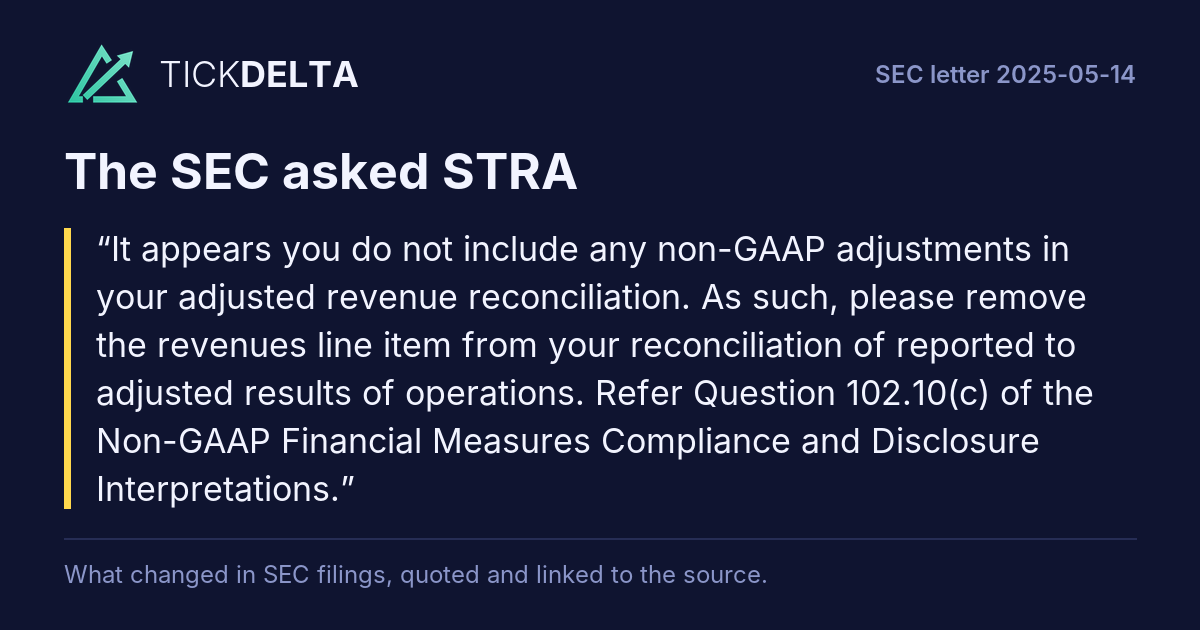
SEC asked (1)
It appears you do not include any non-GAAP adjustments in your adjusted revenue reconciliation. As such, please remove the revenues line item from your reconciliation of reported to adjusted results of operations. Refer Question 102.10(c) of the Non-GAAP Financial Measures Compliance and Disclosure Interpretations.
STRA answered
We acknowledge the Staff’s comment and undertake that in future filings, commencing with the Q2 2025 Form 10-Q and earnings release, we will exclude any line items that do not have a corresponding non-GAAP adjustment for the periods presented.
Read in the reply
In its next report

First report after the company's reply of May 23, 2025: 10-Q filed Jul 30, 2025 ↗, against the 10-Q filed Apr 24, 2025 ↗.

Tickdelta does not hold the text of both reports, so they are not compared here.

Operations · Non-GAAP Financial Measures, page 66
SEC asked (2)
Please revise your reconciliation of the adjusted results of operations on a constant currency basis on page 68 to begin with the most comparable GAAP measures. Refer to Item 10(e)(1)(i)(B) of Regulation S-K and Question 102.10(b) of the Non-GAAP Financial Measures Compliance and Disclosure Interpretations.
STRA answered
We acknowledge the Staff’s comment and undertake that in future filings, commencing with the Q2 2025 Form 10-Q and earnings release, we will revise our reconciliation of adjusted results of operations on a constant currency basis to begin with the most comparable GAAP measures.

* * *

Should any member of the Staff have any questions or comments concerning this letter, please do not hesitate to call me at 703-713-1862. Thank you.
Read in the reply
In its next report

First report after the company's reply of May 23, 2025: 10-Q filed Jul 30, 2025 ↗, against the 10-Q filed Apr 24, 2025 ↗.

Tickdelta does not hold the text of both reports, so they are not compared here.

Also in this review: closing letter, 2025-05-29

Form 10-K for the Fiscal Year Ended December 31, 2018

2019-12-12 to 2020-01-06 · 2 questions · 1 letter from the SEC, 1 from the company
Review closed 2020-01-06
Non-GAAP measures
Consolidated Financial Statements · Consolidated Balance Sheets, page 77
SEC asked (1)
Please separately disclose accounts payable and accrued expenses. Also, disclose the significant components of accrued expenses, as required. Refer to Rules 5-02.19 and .20 of Regulation S-X.
STRA answered
We acknowledge the Staff’s comment and undertake that in future filings we will separately disclose accounts payable and accrued expenses, as well as significant components of accrued expenses as required.
Read in the reply
In its next report

First report after the company's reply of Dec 20, 2019: 10-K filed Mar 2, 2020 ↗, against the 10-K filed Mar 1, 2019 ↗.

Tickdelta does not hold the text of both reports, so they are not compared here.

Unaudited Reconciliation of Non-GAAP Financial Measures · Adjusted Income From Operations, Adjusted Net Income, and Adjusted EPS, page 9
SEC asked (2)
In reconciling non-GAAP amounts to GAAP amounts, you present a full non-GAAP income statement. Please tell us how you considered the guidance in Question 102.10 of the Non-GAAP Financial Measures Compliance and Disclosure Interpretations.
Rest of the question

We remind you that the company and its management are responsible for the accuracy and adequacy of their disclosures, notwithstanding any review, comments, action or absence of action by the staff.

STRA answered
We acknowledge the Staff’s comment and undertake that in future filings with the Securities and Exchange Commission and earnings releases we will reconcile our non-GAAP measures to the most directly comparable GAAP measures without presenting a full non-GAAP income statement.

* * *

Should any member of the Staff have any questions or comments concerning this letter, please do not hesitate to call me at 703-713-1862. Thank you.
Read in the reply
In its next report

First report after the company's reply of Dec 20, 2019: 10-K filed Mar 2, 2020 ↗, against the 10-K filed Mar 1, 2019 ↗.

Tickdelta does not hold the text of both reports, so they are not compared here.

Also in this review: closing letter, 2020-01-06

Form S-4

2017-11-30 to 2017-12-04 · 3 questions · 1 letter from the SEC, 1 from the company
No closing letter
Acquisitions
Comparative Historical and Unaudited Pro Forma Per Share Data, page 32
SEC asked (1)
Please provide equivalent pro forma per share data for Capella as required by Item 3(f) of Form S-4.
STRA answered
The Company respectfully acknowledges the Staff’s comment and has revised the disclosure on pages 32-33 to include equivalent pro forma per share data as required by Item 3(f) of Form S-4.
Read in the reply
Comparative Historical and Unaudited Pro Forma Per Share Data, page 32
SEC asked (2)
Refer to the per share data disclosed on page 33. Please explain to us how you calculated pro forma cash dividends paid per share and tell us why you believe the amounts reported are appropriate.
STRA answered
The pro forma cash dividends paid per share has been revised in response to this comment. The pro forma cash dividends paid per share now reflects Strayer’s historical dividend per share declared and paid in the respective period assuming no change in the dividend policy following the merger. Assuming a continuation of the $1.00 per year dividend policy on the pro forma shares outstanding at September 30, 2017, the total annual cash commitment for dividends would be approximately $22 million.
Read in the reply
Strayer and Capella Unaudited Pro Forma Condensed Combined Financial Statements
SEC asked (3)
Estimation of Consideration Transferred and Assets to be Acquired and Liabilities to be Assumed, page 147 3. We note your preliminary allocation of the purchase consideration to identified intangible assets. Please explain to us your consideration of whether or not additional intangible assets should be identified and valued in your pro forma information, such as those arising from accreditations, designations,
Rest of the question

licensing, Title IV and affiliate or similar agreements, in accordance with ASC 805-20-25-10.

STRA answered
We considered these and other intangible assets to be identified and valued in accordance with ASC 805-20-25-10 in our preliminary pro forma information, but believe any value is materially subsumed in the existing valuation of the Student Relationships intangible asset which was valued on an excess earnings approach and was not reduced for a contributory asset charge related to these additional intangible assets.
Rest of the answer

Further, given the value and useful life assigned to the Student Relationships asset, management concluded that the impact of separately identifying and amortizing any additional assets apart from the Student Relationships would not be material to the pro forma financial statements. As more information becomes available and is evaluated by management, the Company will further refine this preliminary estimate in the recording of the opening balance sheet upon closing.

Read in the reply

Form 10-K

2016-09-21 to 2016-10-13 · 3 questions · 1 letter from the SEC, 1 from the company
Review closed 2016-10-13
Results discussion (MD&A)
Management’s Discussion and Analysis of Financial Condition and Results of Operations, page · Three Months Ended June 30, 2016 Compared to Three Months Ended June 30, 2015, page 27
SEC asked (1)
Tell us how new student enrollments decreased by 7% but total enrollments increased.
STRA answered
Changes in total student enrollments result from changes in the number of new students and continuing students. New students represent approximately

20% of our total student enrollment each year, while the other 80% are continuing students. Therefore, increases in our continuing student enrollment have a larger impact on total enrollment and can result in total enrollment increases, even when new student enrollments are decreasing.

Form 10-K for Fiscal Year Ended December 31, 2015

Item 1.
Rest of the answer

Business,

Industry

Background, page 2

2303 Dulles Station

Boulevard • Herndon, VA 20171

Phone 703-247-2500

• www.strayereducation.com

Read in the reply
In its next report

First report after the company's reply of Sep 28, 2016: 10-Q filed Oct 27, 2016 ↗, against the 10-Q filed Jul 28, 2016 ↗.

Tickdelta does not hold the text of both reports, so they are not compared here.

Item 1. Business, page 1 · Industry Background, page 2
SEC asked (2)
We note your inclusion of statistics for college enrollments for 2014 and 2015. You should also provide comparable statistics for for-profit-only colleges.
STRA answered
In future filings we will provide comparable statistics for for-profit-only colleges. An example of our proposed disclosure is as follows:

“According to the National Student Clearinghouse Research Center, college enrollment in all sectors declined 1.3% and 1.7% in fall 2014 and

2015, respectively. Enrollment at investor-funded colleges declined 0.4% and 13.7% in fall 2014 and 2015, respectively.”

Regulation,

Gainful Employment,
Read in the reply
In its next report

First report after the company's reply of Sep 28, 2016: 10-Q filed Oct 27, 2016 ↗, against the 10-Q filed Jul 28, 2016 ↗.

Tickdelta does not hold the text of both reports, so they are not compared here.

Regulation, page 10 · Gainful Employment, page 17
SEC asked (3)
We note that the new regulations went into effect on July 1, 2015 and that you have provided the required information to the Department of Education. Disclose your current annual income rate and discretionary income rate ratios.
STRA answered
Employment regulations that went into effect on July 1, 2015 required institutions each year to report to the Department of Education certain information for each student enrolled in a Gainful Employment program who received Title IV funding. The Department of

Education then combines that information with proprietary government data, such as Social Security Administration income data, to calculate and report back to the institutions their annual income rates and their discretionary income rate ratios. Institutions do not have the ability to calculate these rates on their own.
Rest of the answer

To date, the Department of Education has not released the annual income rate and discretionary income rate ratios for any institution, and it remains unclear when that release will be made.

* * *

Pursuant to your comment letter, on behalf of Strayer, we hereby acknowledge that:

· Strayer is responsible for the adequacy and accuracy of the disclosure in the filing;

· staff comments or changes to disclosure in response to Staff comments do not foreclose the

Commission from taking any action with respect to the filing; and may not assert Staff comments as a defense in any proceeding initiated by the Commission or any person under federal securities laws of the United States.

Should any member of the Staff have any questions or comments concerning this letter, please do not hesitate to call me at 703-713-1862. Thank you.

Read in the reply
In its next report

First report after the company's reply of Sep 28, 2016: 10-Q filed Oct 27, 2016 ↗, against the 10-Q filed Jul 28, 2016 ↗.

Tickdelta does not hold the text of both reports, so they are not compared here.

Also in this review: closing letter, 2016-10-13

Form 10-K

2014-09-03 to 2014-11-10 · 7 questions · 3 letters from the SEC, 3 from the company
Review closed 2014-11-10
RevenueCritical estimatesResults discussion (MD&A)
Management’s Discussion and Analysis of Financial Condition and Results of Operations · Critical Accounting Policies, Revenue Recognition, page 39
SEC asked (1)
Please tell us and disclose in future filings how you account for the credits earned from your Graduation Fund. If material, please quantify the amounts and where classified on the Balance Sheet. Please also comply in your Significant Accounting Policies section of your notes to the financial statements.
STRA answered
In future filings we will disclose the information requested and we will include similar disclosures in the Significant Accounting Policies section of the notes to the financial statements. An example of our proposed disclosure is as follows:

“In the third quarter of 2013, we introduced the Graduation Fund, which allows new undergraduate students to earn tuition credits that are redeemable in the final year of a student’s course of study if he or she successfully remains in the program.
Rest of the answer

In their final academic year, students will be provided one free course for every three courses that were previously completed. In order to receive this benefit, students must remain enrolled in their program over time, and students will lose any benefit if their enrollment ceases for more than one consecutive academic term.

2303 Dulles Station Boulevard • Herndon,

VA 20171

Phone 703-247-2500 • www.strayereducation.com

We record Deferred revenue for the value of free courses that are expected to be provided, which is based on the price per credit hour for courses completed to date. We estimate the number of free courses that will be provided by analyzing the historical rates at which students have progressed through their academic careers, and based on the student’s level of academic experience. Our estimates of continuation are adjusted for actual results on a quarterly basis, but such variation has not been material. The portion of Deferred revenue expected to be realized within twelve months is included in Current liabilities and the portion of Deferred revenue expected to be realized beyond the next twelve months is included in Other long-term liabilities.

As of December 31, 2013, the total liability for the Graduation Fund was approximately $1.9 million and was included entirely in Other long-term liabilities since none of the benefit was expected to be realized within the next twelve months. As of June 30, 2014, the total liability for the Graduation Fund was approximately $5.1 million, of which approximately $0.9 million was included in Current liabilities, and approximately $4.2 million was included in Other long-term liabilities.”

Read in the reply
In its next report

First report after the company's reply of Sep 15, 2014: 10-Q filed Nov 3, 2014 ↗, against the 10-Q filed Aug 1, 2014 ↗.

Tickdelta does not hold the text of both reports, so they are not compared here.

Revenues, Income from Operations, and Net Income, pages 16 and 18
SEC asked (2)
Please disclose in greater quantified detail the correlation between declining revenue, average student enrollment, and the impact of your new pricing structure for undergraduates. Consider breaking out your explanation of variances between your graduate and undergraduate programs.
STRA answered
In future filings, we will disclose in greater quantified detail the correlation between declining revenue, average student enrollment, and the impact of our new pricing structure for undergraduates. An example of our proposed disclosure is as follows:

“For the third quarter of 2014, our revenues decreased X% to $X.X million from $X.X million in the third quarter of 2013, principally due to an enrollment decline of X% and a decline in revenue per student of X%.
Rest of the answer

The decline in revenue per student is largely attributable to a new pricing structure which reduced tuition for new undergraduate students by X%, and made them eligible for our Graduation Fund. In the third quarter of 2014, revenues for undergraduate students declined X%, driven by a decrease in enrollment of X% and a decline of X% in revenue per student, resulting mostly from the new pricing structure for new undergraduate students. We expect this decline in revenue per student to continue at the undergraduate level as we enroll more new undergraduate students over time. For graduate students, revenues were flat in the third quarter of 2014 driven by an enrollment decline of X% and an increase in revenue per student of X%. The increase in graduate revenue per student was due primarily to lower scholarships compared to the same period in 2013.”

* * *

Pursuant to your comment letter, on behalf of Strayer, we hereby acknowledge that:

· Strayer is responsible for the adequacy and accuracy of the disclosure in the filing;

· Staff comments or changes to disclosure in response to Staff comments do not foreclose the Commission from taking any action with respect to the filing; and

· Strayer may not assert Staff comments as a defense in any proceeding initiated by the Commission or any person under Federal securities laws of the United States.

Should any member of the Staff have any questions or comments concerning this letter, please do not hesitate to call me at (703) 247-2514. Thank you.
Read in the reply
In its next report

First report after the company's reply of Sep 15, 2014: 10-Q filed Nov 3, 2014 ↗, against the 10-Q filed Aug 1, 2014 ↗.

Tickdelta does not hold the text of both reports, so they are not compared here.

Management’s Discussion and Analysis of Financial Condition and Results of Operations · Critical Accounting Policies, Revenue Recognition, page 39
SEC asked
We have considered your response to comment 1 and we note that your new Graduation Fund program is offered “as an extra incentive to encourage your students to continue their studies through to graduation. It therefore appears as though the Graduation Fund was designed to change undergraduate student behavior and it is consequently unclear to us how pre-program historic student behavior can provide a company
Rest of the question

specific basis for revenue recognition under the new program. In this regard, please tell us the following:  The eligibility criteria for this program and the numbers of eligible and of participating students (if different),  The amount of revenues received from Graduation Fund eligible and participating students in each reporting period to date,  Your forecasted Graduate Fund utilization amounts for future reporting periods, if material,  The practical methodologies you used to recognize Graduation Fund deferred revenues. For example, tell us whether you recognize such deferred revenues upon a student’s completion of each third undergraduate course or whether such deferred revenues are recognized on a pro-rata basis as each eligible undergraduate course is completed,  Your rationale for using pre-Graduation Fund historical continuation rates as a basis for estimating future continuation rates and deferred revenues under this new program,  Why variations between your “estimates of continuation” to date and actual results have not been material to date, and  Whether participants in the Graduation Fund are also eligible to receive the 20% discount offered to new undergraduate enrollees effective for the 2014-2015 academic year.

STRA answered
In the third quarter of 2013, we introduced the Graduation Fund, which allows new undergraduate students to earn tuition credits that are redeemable in the final year of a student’s course of study if he or she successfully remains in the program. In their final academic year, students will be provided one free course for every three courses that were successfully completed.

In order to receive this benefit, students must remain enrolled in their program over time, and students will lose any benefit if their enrollment ceases for more than one consecutive academic term.

2303 Dulles Station
Rest of the answer

Boulevard ●

Herndon, VA 20171

Phone 703-247-2500 ● www.strayereducation.com

We primarily serve non-traditional students, most of whom are working adults. Our students know they would benefit from a college degree, which is why they enroll at Strayer, but many do not complete their degree program for a variety of reasons. These reasons include challenges in meeting the requirements of a post-secondary higher education program, given that most have been out of school for an extended period of time, together with other life responsibilities such as career and family. Most of the students who do not complete their degree program withdraw from Strayer within the first four quarters of enrollment. Given this behavior, it has been our experience that persistence rates (defined as percentage of students continuing from one academic quarter to the next through to graduation) by cohort of new students have been predictable and relatively consistent, even with various scholarship programs and changes in tuition.

determining the appropriate accounting for the Graduation Fund benefit, we concluded that we could reasonably estimate the expected value of free courses that students would receive as part of this program each quarter and, in accordance with ASC 605-50-25-7, we recorded deferred revenue for that amount. We believe we have been able to reasonably estimate the amount of benefit to be realized based on the predictability of the persistence rate for our students over time.

deriving our estimates, we segregated our student population by number of incoming transfer credits since those with a higher number of credits have a shorter period of remaining terms before being able to realize the Graduation Fund benefit. We analyzed historical experience of students at different levels of transfer credits and applied such persistence rates to the corresponding levels within the current population. We believe that analyzing our data in this level of detail supports the comparability of our historical populations and further improves the precision of our estimates.

also had historical experience with similar types of scholarship programs which enabled us to reasonably estimate the impact the

Graduation Fund would have. One program in particular, our Bachelor’s Completion Scholarship, offered a tuition discount of $1,000 per quarter for up to 17 quarters for eligible students. This was the equivalent of a 29% discount per quarter since a student was required to take at least two courses paying $1,725 per course or $3,450 total tuition in a given quarter. This program was available to qualifying new undergraduate students, similar to the Graduation Fund, and we noted that students enrolled in this program continued their courses of study at slightly higher rates than those who were not part of this program. The slight improvement in persistence that we observed from this scholarship was used in our Graduation Fund assumptions.

addition, we had the benefit of observing actual persistence rates in the first quarter of the program before reporting financial results for that quarter. We launched the Graduation Fund in our 2013 summer academic quarter which aligns with our fiscal 2013 third quarter. Therefore, we knew how many students that had been eligible for the Graduation Fund in the summer term were registered for classes in the ensuing fall academic quarter, in order to validate our persistence rate assumptions. Our experience shows that the largest amount of term-to-term student attrition occurs between the first and second term of attendance. Therefore, the continuation of students participating in the Graduation Fund from summer to fall provided significant insight into student behaviors under the program. Such rates were consistent with our initial estimates.

have continued to monitor the actual experience of each cohort of students as compared to anticipated continuation to refine our estimates of persistence. This monitoring has provided significant evidence as to the reasonableness of our estimates over time.

Student attrition is significantly concentrated in the first year after enrollment. Now, a year after introduction of the program, adjustments to our estimates of persistence rate for eligible students have not been material, representing less than 1.3% of

Revenue from Eligible and Participating Students in any given quarter, and less than 0.2% of our quarterly tuition revenue.

future filings we propose the following example disclosure:

the third quarter of 2013, we introduced the Graduation Fund, which allows new undergraduate students to earn tuition credits that are redeemable in the final year of a student’s course of study if he or she successfully remains in the program. In their final academic year, students will be provided one free course for every three courses that were successfully completed.

In order to receive this benefit, students must remain enrolled in their program over time, and students will lose any benefit

Revenue from students participating in the Graduation Fund is recorded in accordance with the Revenue Recognition Topic, ASC 605. In accordance with ASC 605-50-25-7, our estimates are based on a systematic and rational allocation of the cost of honoring the benefit earned and claimed to each of the underlying revenue transactions that result in progress by the student toward earning the benefit.

The estimated value of awards under the Graduation Fund that will be recognized in the future is based on historical experience of a student’s persistence in completing his or her course of study and earning a degree. Each quarter we assess our methodologies and assumptions underlying our estimates and to date any adjustments to our estimates have not been material.

The table below presents activity in the Graduation Fund for the periods indicated (in 000’s):

Balance as of July 1, 2013

$ –

Revenue deferred

678

Benefit redeemed

–

Balance as of September 30, 2013

1,220

Balance as of December 31, 2013

1,898

1,418

(36 )

Balance as of March 31, 2014

3,280

2,083

(311 )

Balance as of June 30, 2014

$ 5,052

* * * further respond to each of the Staff’s bullet points reproduced below in the order presented.

● The eligibility criteria for this program and the numbers of eligible and of participating students (if different),

New students registering in credit-bearing courses in any undergraduate program for the summer 2013 term (fiscal third quarter) and subsequent terms qualify for the Graduation Fund. Students must meet all of the University’s admission requirements and not be eligible for any previously offered scholarship program. Our employees and their dependents are not eligible for the program. To maintain eligibility, students must be enrolled in a bachelor’s degree program and take at least two courses each quarter. A student becomes ineligible to participate in the Graduation Fund if he or she has more than one consecutive term of non-attendance or by taking less than two courses. For the four academic terms beginning in summer 2013, a total of 23,873 students were eligible, of which 14,722 participated in the program as of September 2014.

amount of revenues received from Graduation Fund eligible and participating students in each reporting period to date,

All new undergraduate students are eligible (with the few exceptions described above) and automatically participate in the Graduation

Fund program. Students lose their eligibility to participate if they are not enrolled for more than one consecutive term.

Because of the commercially sensitive nature of the information contained therein, Strayer has included the amount of revenues received from Graduation Fund eligible and participating students in each reporting period in a separate Exhibit A to this letter, for which, pursuant to 17 C.F.R. § 200.83, Strayer requests confidential treatment under the Freedom of Information Act,

5 U.S.C. § 552. Please promptly inform the undersigned of any request for disclosure of the material included in Exhibit

A made pursuant to the Freedom of Information and Privacy Act or otherwise so that the undersigned may substantiate the foregoing request for confidential treatment in accordance with Rule 83.

● Your forecasted Graduate Fund utilization amounts for future reporting periods, if material,

As of June 30, 2014, the total liability for the Graduation Fund, representing the value of the future benefit expected to be redeemed by participants in the Graduation Fund, was approximately $5.1 million. Of this amount, approximately $0.9 million was included in Current Liabilities because it is expected to be realized in the next twelve months, and approximately $4.2 million was included in Other Long-term Liabilities representing the amount expected to be realized after twelve months.

practical methodologies you used to recognize Graduation Fund deferred revenues. For example, tell us whether you recognize such deferred revenues upon a student’s completion of each third undergraduate course or whether such deferred revenues are recognized on a pro-rata basis as each eligible undergraduate course is completed,

For the number of students that we anticipate will persist in the program until the final year of instruction, we defer revenue on a pro-rata basis as each eligible undergraduate course is successfully completed. As previously discussed, our estimates are based upon relevant historical experience. Further, each academic term (and corresponding fiscal quarter), we have the benefit of observing actual persistence rates before reporting financial results for that quarter and can incorporate such experience into our estimates. Students lose their eligibility to participate in the Graduation Fund program if they are not enrolled for more than one consecutive quarter.

rationale for using pre-Graduation Fund historical continuation rates as a basis for estimating future continuation rates and deferred revenues under this new program, follow accounting guidance prescribed by ASC 605 with respect to revenue recognition and contingent sales incentives. Specifically,

ASC 605-50-25-7 states a “vendor shall recognize [benefits] as a reduction of revenue based on a systematic and rational allocation of the cost of honoring [the benefit] earned and claimed to each of the underlying revenue transactions that result in progress by the customer toward earning the [benefit].” In the case of the Graduation Fund, a student earns pro-rata benefits as each course is successfully completed but cannot realize these benefits until the student has completed 75% of his or her degree program. Because student persistence rate is not 100% and thus the full benefit of the Graduation Fund will not be realized, the amount that ultimately will be realized “should be considered if it can be reasonably estimated.”

Further, “the ability to make a reasonable estimate of the amount of future [benefits] depends on many factors and circumstances that will vary from case to case.” our case, we believe the value of the award provided under the Graduation Fund program that ultimately will be realized could be reasonably estimated at the time we introduced the Graduation Fund and we continue to be able to reasonably estimate the value of the award. As discussed above, we know from actual experience and based on the nature of our non-traditional students that not all of them will complete their course of study. In order to estimate deferred revenues under the Graduation Fund, we used actual historical persistence rates for students not receiving a tuition benefit, plus a small increment based on our experience with students who participated in a comparable tuition benefit program that we introduced in 2012. We believe it is reasonable to use persistence rates from the prior program because the financial benefit to students was similar to the benefit offered under the Graduation Fund. For instance, the benefit available under the Bachelor’s Completion Scholarship in 2012 provided for a tuition discount of approximately 29% for new students who remained enrolled at Strayer University, which is comparable to the benefit available under the Graduation Fund, i.e. a student receives one free course after successfully completing three courses.

observed slightly higher persistence rates for students who participated in the prior program, therefore our estimate of expected persistence rates for students participating in the Graduation Fund incorporated a higher persistence rate than the rates for new students who were not enrolled in a tuition benefit program. Our experience to date with the Graduation Fund is consistent with our experience under the prior program.

● Why variations between your “estimates of continuation” to date and actual results have not been material to date, and noted above, adjustments to our estimates of persistence rate for eligible students have been less than 1.3% of Revenue from Eligible and Participating Students in any given quarter, and less than 0.2% of our quarterly tuition revenue as reported. We believe variations between our estimates and actual results have been minimal because we performed a systematic and rational analysis of the amount of the Graduation Fund benefit to be realized. In addition, with each passing fiscal quarter, we use actual eligibility and participation data to further refine our persistence rate estimates. The immaterial variations between our estimates and actual results confirm our belief that we can reasonably estimate the value of the award in accordance with ASC 605-50-25-7. For sensitivity purposes, if the number of students who ultimately realized the benefit under the Graduation Fund were to exceed our estimate by 10%, deferred revenue as of June 30, 2014 would have increased by approximately 10% or $0.6 million. The predictability of our persistence rates over time and the generally small impact on the Graduation Fund of changes in persistence rates support our ability to make a reasonable estimate in relation to this program.

● Whether participants in the Graduation Fund are also eligible to receive the 20% discount offered to new undergraduate enrollees effective for the 2014-2015 academic year.

Only new students who started taking classes at Strayer after 2013 are eligible for both the Graduation Fund and the 20% lower tuition.

Participants in the Graduation Fund in 2013 are not eligible for the 20% lower tuition. Our estimate of the value of the Graduation

Fund award includes slightly higher persistence rates for students who enrolled in 2014, which incorporates our experience with changes in rates of tuition.

On behalf of Strayer, we hereby acknowledge that:

● Strayer is responsible for the adequacy and accuracy of the disclosure in the filing;

● Staff comments or changes to disclosure in response to Staff comments do not foreclose the

Commission from taking any action with respect to the filing; and may not assert Staff comments as a defense in any proceeding initiated by the Commission or any person under Federal securities laws of the United States.

Should any member of the Staff have any questions or comments concerning this letter, please do not hesitate to call me at (703) 247-2514.

Thank you.
Read in the reply
In its next report

First report after the company's reply of Oct 8, 2014: 10-Q filed Nov 3, 2014 ↗, against the 10-Q filed Aug 1, 2014 ↗.

Tickdelta does not hold the text of both reports, so they are not compared here.

Operations · Critical Accounting Policies, Revenue Recognition, page 39
SEC asked (1)
We note your response to comment 1. Please disclose the criteria for initial and continuing eligibility in the Graduation Fund program.
STRA answered
The following disclosure about the criteria for initial and continuing eligibility in the Graduation Fund program is included in our Form 10-Q for the quarterly period ended September 30, 2014 and will be included in future filings where appropriate:

“New students registering in credit-bearing courses in any undergraduate program for the summer 2013 term (fiscal third quarter) and subsequent terms qualify for the Graduation Fund. Students must meet all of the University’s admission requirements and not be eligible for any previously offered scholarship program.
Rest of the answer

Our employees and their dependents are not eligible for the program. To maintain eligibility, students must be enrolled in a bachelor’s degree program, and they become ineligible to participate in the Graduation Fund if they have more than one consecutive term of non-attendance. In their final academic year, students will receive one free course for every three courses that were successfully completed.”

Read in the reply
In its next report

First report after the company's reply of Nov 5, 2014: 10-K filed Feb 20, 2015 ↗, against the 10-K filed Feb 26, 2014 ↗.

Tickdelta does not hold the text of both reports, so they are not compared here.

Note 2. Significant Accounting Policies · Revenue Recognition, page 52
SEC asked (2)
Revise to disclose your refund policy for all services provided.
STRA answered
We have disclosed our refund policy for all services in our Form 10-Q for the quarterly period ended September 30, 2014 as follows:

“Our refund policy typically permits students who complete less than half of a course to receive a partial refund of tuition for that course. Refunds reduce the tuition revenue that would have otherwise been recognized for that student. Since our academic terms coincide with our financial reporting periods, all refunds are processed and recorded in the same quarter as the corresponding revenue.
Rest of the answer

The amount of tuition revenue refundable to students may vary based on the student’s state of residence. Unused books and related academic materials may be returned for a full refund within 21 days of the start of class, but purchases of electronic content are not refundable once downloaded. Revenues derived from fees are not eligible for a refund.”

Read in the reply
In its next report

First report after the company's reply of Nov 5, 2014: 10-K filed Feb 20, 2015 ↗, against the 10-K filed Feb 26, 2014 ↗.

Tickdelta does not hold the text of both reports, so they are not compared here.

Note 2. Significant Accounting Policies · Revenue Recognition, page 52
SEC asked (3)
With respect to the education services provided by Strayer Education, please tell us if you reassess collectability of tuition and fees after a student withdraws from a course, the institution, or otherwise loses Title IV eligibility.
Rest of the question

To help us better understand your accounting policy, please provide us with the following information:  tell us about the academic terms for online and campus-based institutions and if classes are taken simultaneously or consecutively;  tell us how you are notified when a student withdraws from a course and/or the institution and how you determine that a student has officially withdrawn from the institution;  tell us how revenue is recognized for a particular course if a student withdraws from the institution before and after the institution’s refund period elapses, if any; the institution before earning 100% of the Federal Student Aid funds he or she was scheduled to receive during the perio d; and  tell us about your historical collections experience with students who become responsible for tuition and related fees due to withdrawal or loss of financial aid eligibility.

STRA answered
Strayer Education, Inc. conducts its operations through its wholly owned subsidiary, Strayer University (the “University), which is an accredited institution of higher education providing undergraduate and graduate degrees in various fields of study. Like many traditional institutions, the University operates on a quarter system having four academic terms, which coincide with our quarterly financial reporting periods.

A typical class is offered in weekly increments over a ten-week period and is followed by an exam.
Rest of the answer

Tuition revenue is recognized ratably in the quarter of instruction as we provide academic services in a given term.

Our students finance their education in a variety of ways, and historically about three quarters of our students participated in one or more Title IV programs. In addition, many of our working adult students finance their own education or receive full or partial tuition reimbursement from their employers.

Those students who are veterans or active duty military have access to various government-funded educational benefit programs.

After providing evidence of an acceptable method of payment, a student is able to complete his or her registration and attend class.

Students who withdraw from a course may be eligible for a refund of tuition charges based on the timing of the withdrawal. We use the student’s last date of attendance for this purpose. Student attendance is based on physical presence in class for on ground classes, and for online classes attendance consists of logging into one’s course shell and performing an academically related activity (e.g., engaging in a discussion post or taking a quiz).

For undergraduate students who withdraw from all their courses during the quarter of instruction, we reassess collectibility of tuition and fees for revenue recognition purposes. We began this practice in the second quarter of 2014 when we modified our accounting policy for these circumstances.

For accounting purposes, we cease revenue recognition when the student fully withdraws from all of his or her courses in the academic term. Tuition charges billed in accordance with our billing schedule may be greater than the pro rata revenue amount, but the additional amount is not recognized as revenue unless it is collected in cash.

Prior to the second quarter of 2014, we did not reassess the collectibility of student tuition and fees for revenue recognition purposes after the student withdrew from all of his or her courses. However, when we modified this accounting policy, we calculated the impact this change would have had on revenues and income before income taxes for the years ended December 31, 2013, 2012 and 2011, assuming the reassessment of collectibility occurred during these financial years. Given our practice of reserving for student balances based on historical collection experience, the impact to the Company’s financial statements was immaterial, representing 0.3% of revenue in each period, and 0.3%, 0.1%, and 0.3% of income before income taxes in each respective period.

For students who remain enrolled in Strayer University throughout an academic term, even if they withdraw from some of their courses, revenue is recognized, net of refunds, because collectibility of the student’s revenue is reasonably assured based on our historical experience.

For students who receive funding under Title IV, funds are subject to return provisions as defined by the Department of Education. If Title IV funds are returned to the Department of Education, the student is responsible for paying the amount of prorated tuition charged to him or her. Loss of financial aid eligibility during an academic term is rare and would normally coincide with the student’s withdrawal from the institution. As discussed above, we cease revenue recognition upon an undergraduate student’s withdrawal from all of his or her classes in an academic term.

Additional responses are provided below in the order presented.

● tell us about the academic terms for online and campus-based institutions and if classes are taken simultaneously or consecutively;

Similar to traditional institutions,

Strayer University operates on a quarter system with four academic terms -- Fall, Winter, Spring, and Summer. An academic term is typically 10-weeks of class followed by an exam. We also offer 5-week undergraduate mini-sessions during a quarter. These four academic terms coincide with our quarterly financial reporting periods.

Our courses are offered “on-ground” at our physical campus locations and online. Courses generally start and stop at the same time during a given term regardless of whether they are on-ground or online classes. All our courses, including the 5-week undergraduate mini-sessions, are offered within academic terms which coincide with our quarterly financial reporting periods. Our students may take more than one course in a given term (i.e., simultaneously), and on average take approximately two courses per term.

● tell us how you are notified when a student withdraws from a course and/or the institution and how you determine that a student has officially withdrawn from the institution;

A student’s withdrawal from a course is determined in one of two ways. A withdrawal can occur when a student informs us of his or her intention to withdraw from a course. In this instance, a withdrawal request is processed typically within one week of notification. More often, a withdrawal from a course occurs administratively (i.e., without formal notification from the student) after four consecutive, unexcused absences.

Students are considered withdrawn from the institution after more than three consecutive terms of non-attendance. After this point, a student would have to reapply for admission. However, for purposes of our accounting analysis, a student is considered withdrawn from the institution within any term that he or she withdraws from all of his or her classes in the academic term.

When a student withdraws from a course, whether we are notified or whether in the form of an administrative withdrawal, the student’s last date of attendance is used to determine the prorated tuition refund amount for which the student is eligible. Attendance may be in the form of a student’s physical presence in a campus-based course or, for an online course, login plus participation in academically related activities. Student attendance is tracked in our student information system for each class in which a student is enrolled.

us how revenue is recognized for a particular course if a student withdraws from the institution before and after the institution’s refund period elapses, if any;

During a given academic term, revenue for a student is recognized over the period of instruction using the University’s policy for tuition charges and refunds. However, for undergraduate students who withdraw during an academic term, the amount of revenue recognized is adjusted to reflect only the academic services delivered on a pro-rata basis up to the withdrawal date and not the amount billable to the student under the University’s tuition policies, which is always the same or greater. Any additional amounts owed to the University are recorded as revenue only upon collection. The withdrawal date is the earlier of the date the student requested an official withdrawal or, for administrative withdrawals, after four consecutive absences from classes.

Since we recognize revenue on a pro-rata basis as academic services are being provided for students who withdraw during the academic term, the elapsing of the refund period does not affect the amount of revenue recognized. The elapsing of the refund period would however affect the amount of tuition billed to the student which is always the same or greater than the revenue recognized.

institution before earning 100% of the Federal Student Aid funds he or she was scheduled to receive during the period; and

As described above, for an undergraduate student who withdraws from all of his or her classes, revenue is recognized ratably from the start of the academic term through the date it is determined the student has withdrawn from all of his or her classes. The amount of revenue recognized is not affected by the percentage of the Federal Student Aid funds earned by the student at the student’s withdrawal date. We have addressed separately in this letter the accounting treatment if Title IV funds are returned to the Department of

Education.

us about your historical collections experience with students who become responsible for tuition and related fees due to withdrawal or loss of financial aid eligibility.

Our collections experience for undergraduate students who become responsible for tuition and related fees due to withdrawal from the institution or loss of financial aid eligibility is that less than half of such amounts due are ultimately collected. Given this experience, we cease further revenue recognition on undergraduate students upon full withdrawal from the institution. Loss of financial aid eligibility during an academic term is rare and would normally coincide with the student’s withdrawal from the institution.

For tuition receivable from students at the time of withdrawal, we establish an adequate allowance for doubtful accounts in accordance with our reserve methodology. At the end of each academic term (which coincides with our quarterly financial reporting schedule), we apply an allowance against outstanding receivables based upon historical collection rates. Our experience is that payment of such balances is significantly influenced by whether the student returns to the institution as we require students to make payment arrangements for their outstanding balances prior to enrollment. Therefore, we monitor outstanding tuition receivable balances through subsequent terms, increasing the reserve on such balances over time as the likelihood of returning to the institution diminishes and our historical experience indicates collection is less likely. Our bad debt expense as a percentage of net revenue was 4.4%, 4.2%, and 4.0% for the twelve months ended December 31, 2013, 2012 and 2011, respectively.

Note

5. Restricted Cash, page 52

Read in the reply
In its next report

First report after the company's reply of Nov 5, 2014: 10-K filed Feb 20, 2015 ↗, against the 10-K filed Feb 26, 2014 ↗.

Tickdelta does not hold the text of both reports, so they are not compared here.

Note 5. Restricted Cash, page 52
SEC asked (4)
Please tell us and disclose the amounts of any funds restricted for return of Title IV funds to the Department of Education. If not considered restricted funds, plea se advise us of the rationale.
STRA answered
Because we provide services during academic terms which coincide with our quarterly financial reporting periods, we typically do not have any amounts restricted for return of Title IV funds to the Department of Education as of our reporting period dates. The following disclosure was included in our Form 10-Q for the quarterly period ended September 30, 2014, and we will continue to include this disclosure in future filings:

“A significant portion of our revenues are funded by various federal and state government programs.
Rest of the answer

We generally do not receive funds from these programs prior to the start of the corresponding academic term. We may be required to return certain funds for students who withdraw from the University during the academic term. Unpaid obligations are included in restricted cash in our balance sheet.

There were no amounts payable for these obligations at December 31, 2013 or September 30, 2014.”

* * *

On behalf of Strayer, we hereby acknowledge that:

● Strayer is responsible for the adequacy and accuracy of the disclosure in the filing;

● Staff comments or changes to disclosure in response to Staff comments do not foreclose the

Commission from taking any action with respect to the filing; and may not assert Staff comments as a defense in any proceeding initiated by the Commission or any person under Federal securities laws of the United States.

Should any member of the Staff have any questions or comments concerning this letter, please do not hesitate to call me at (703) 247-2514.

Thank you.
Read in the reply
In its next report

First report after the company's reply of Nov 5, 2014: 10-K filed Feb 20, 2015 ↗, against the 10-K filed Feb 26, 2014 ↗.

Tickdelta does not hold the text of both reports, so they are not compared here.

Also in this review: closing letter, 2014-11-10

Form 10-K for the Year Ended December 31, 2013

2013-07-01 to 2013-07-12 · 4 questions · 1 letter from the SEC, 1 from the company
Review closed 2013-07-12
Liquidity and cashResults discussion (MD&A)
Regulation, page 13 · Title IV Programs, page 16
SEC asked (1)
If material, disclose how changes to the availability of Pell Grant awards and Federal Direct Student Loans will impact your operations. We note the disclosure on page 43 that you experienced a continued mix shift toward graduate and corporate sponsored students during the reported financial periods.
STRA answered
In future filings, to the extent material, the Company will provide a discussion of how changes in the availability of Pell Grant awards and Federal Direct Student Loans will impact our enrollment, financial condition, results of operations and cash flows. We note that prior eligibility changes in April 2011 and July 2012 did not have a material impact on our business and that we are unable to predict what future policy changes may be, what effect they may have, and how material those effects may be.
Rest of the answer

However, we plan to disclose more information in future filings about these programs, and that prior changes did not (but future changes could) have a material impact on our operations.

Read in the reply
In its next report

First report after the company's reply of Jul 9, 2013: 10-Q filed Jul 26, 2013 ↗, against the 10-Q filed May 3, 2013 ↗.

Tickdelta does not hold the text of both reports, so they are not compared here.

Provisional Certification, page 17
SEC asked (2)
We note that on December 22, 2011 the Department of Education approved your Program Participation Agreement on a provisional basis. In your response, please confirm that obtaining Department of Education approval for substantial changes, including the addition of any new location, level of academic offering or non-degree program, is the only material additional condition you must comply with as a result of your
Rest of the question

provisional certification.

STRA answered
The Company confirms that obtaining Department of Education approval for substantial changes, including the addition of any new location, level of academic offering or non-degree program, is the only material additional condition the Company must comply with as a result of the Company’s provisional certification. The Company will include this clarification in future filings.
Read in the reply
In its next report

First report after the company's reply of Jul 9, 2013: 10-Q filed Jul 26, 2013 ↗, against the 10-Q filed May 3, 2013 ↗.

Tickdelta does not hold the text of both reports, so they are not compared here.

Operations, page 41 · Liquidity and Capital Resources, page 46
SEC asked (3)
Disclose the material terms of your second amended and restating revolving credit and term loan agreement.
STRA answered
In future filings the Company will describe in the Liquidity and Capital Resources section of the Management Discussion and Analysis the material terms of the second amended and restated revolving credit and term loan agreement, in language similar to those contained in Note 6 of our consolidated financial statements and first disclosed in our Form 8-K filed November 9, 2012, http://www.sec.gov/Archives/edgar/data/1013934/000115752312005936/a50468448.htm.
Read in the reply
In its next report

First report after the company's reply of Jul 9, 2013: 10-Q filed Jul 26, 2013 ↗, against the 10-Q filed May 3, 2013 ↗.

Tickdelta does not hold the text of both reports, so they are not compared here.

Operations, page 41 · Liquidity and Capital Resources, page 46
SEC asked (4)
Please expand your discussion of cash flows to more fully address material trends, including the decline in cash flow from operations over the reported periods. Refer to Item 303(a)(2)(ii) of Regulation S-K.
STRA answered
In future filings we will expand our discussion of cash flows to more fully address material changes in, and key factors that affect, cash flow from operations, as described in Item 303(a)(2)(ii) of Regulation S-K. Although we are unable at this time to determine whether the recent changes in cash flow from operations constitute material trends that will continue, we will provide additional disclosure concerning material changes in our cash flow and, as appropriate, its constituent parts.

* * *

Pursuant to your comment letter, on behalf of Strayer, we hereby acknowledge that:

· Strayer is
Rest of the answer

responsible for the adequacy and accuracy of the disclosure in the filing;

· Staff comments or changes to disclosure in response to Staff comments do not foreclose the Commission from taking any action with respect to the filing; and

· Strayer may not assert Staff comments as a defense in any proceeding initiated by the Commission or any person under Federal securities laws of the United States.

Should any member of the Staff have any questions or comments concerning this letter, please do not hesitate to call me at 703-247-2514. Thank you.

Read in the reply
In its next report

First report after the company's reply of Jul 9, 2013: 10-Q filed Jul 26, 2013 ↗, against the 10-Q filed May 3, 2013 ↗.

Tickdelta does not hold the text of both reports, so they are not compared here.

Also in this review: closing letter, 2013-07-12

Form 10-K for the Year Ended December 31, 2010

2011-12-16 to 2012-01-11 · 1 question · 1 letter from the SEC, 1 from the company
Review closed 2012-01-11
RevenueResults discussion (MD&A)
Management’s Discussion and Analysis, page 46
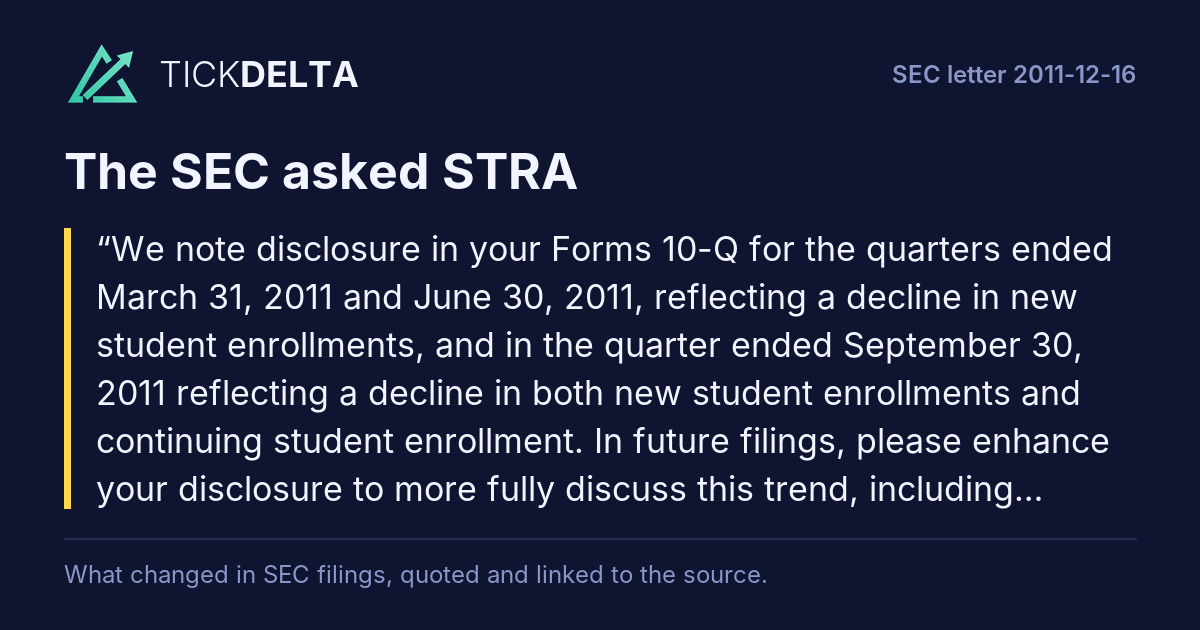
SEC asked
We note disclosure in your Forms 10-Q for the quarters ended March 31, 2011 and June 30, 2011, reflecting a decline in new student enrollments, and in the quarter ended September 30, 2011 reflecting a decline in both new student enrollments and continuing student enrollment.
Rest of the question

In future filings, please enhance your disclosure to more fully discuss this trend, including outlining steps management may take or has taken to address and reverse it, and the effect on your results of operations, including revenues and marketing expenses. Please refer to Item 303(a)(3)(ii) of Regulation S- K.

STRA answered
In future filings the Company will provide a more detailed discussion of enrollment figures. However, it should be noted that we are unable to determine whether the recent decline in enrollment is in fact a trend and something that will continue. Furthermore, we cannot predict future enrollments. Nevertheless, in future filings Strayer will discuss factors that it believes to contribute to recent enrollment levels.

Strayer’s future filings will also include a more robust discussion of the effect of various levels of enrollment on our results of operations.

Pursuant to your comment letter,
Rest of the answer

on behalf of Strayer, we hereby acknowledge that:

·

Strayer is responsible for the adequacy and accuracy of the disclosure in the filing;

Staff comments or changes to disclosure in response to Staff comments do not foreclose the Commission from taking any action with respect to the filing; and

Strayer may not assert Staff comments as a defense in any proceeding initiated by the Commission or any person under Federal securities laws of the United States.

Should any member of the Staff have any questions or comments concerning this letter, please do not hesitate to call me at 703 247-2514. Thank you.

Read in the reply
In its next report

First report after the company's reply of Dec 27, 2011: 10-K filed Feb 21, 2012 ↗, against the 10-K filed Feb 22, 2011 ↗.

Tickdelta does not hold the text of both reports, so they are not compared here.

Also in this review: closing letter, 2012-01-11

Schedule 14A

2009-04-09 to 2009-04-21 · 1 question · 1 letter from the SEC, 1 from the company
Review closed 2009-04-21
Executive pay
Narrative Disclosure to Summary Compensation Table and Grants of Plan-based Awards · Table, page 17
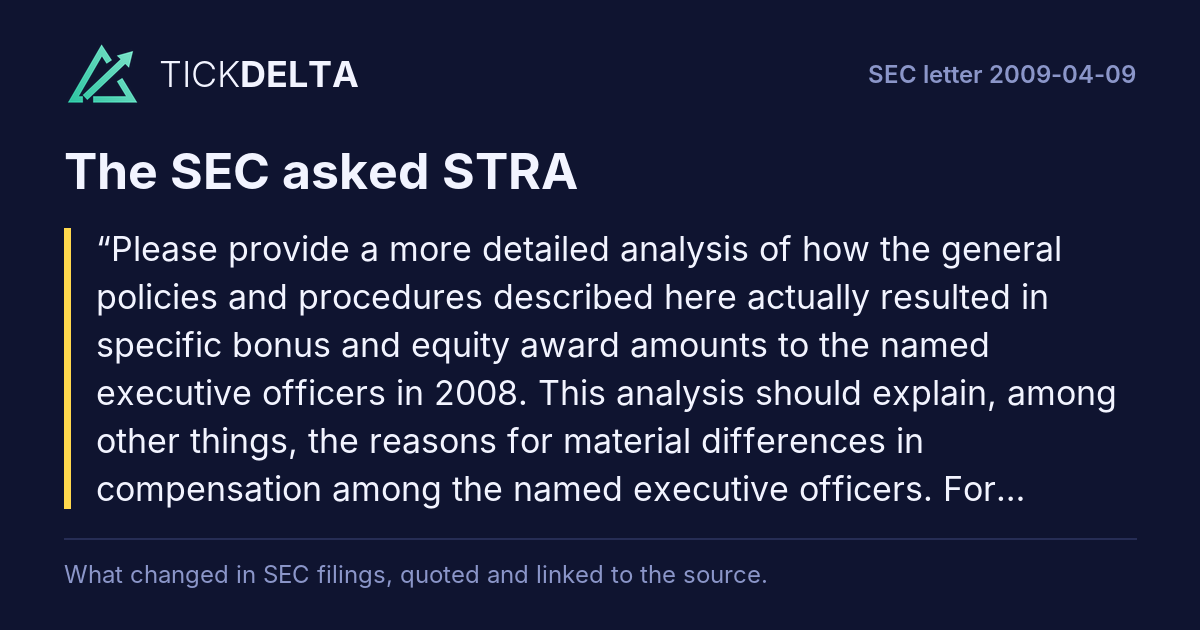
SEC asked
Please provide a more detailed analysis of how the general policies and procedures described here actually resulted in specific bonus and equity award amounts to the named executive officers in 2008. This analysis should explain, among other things, the reasons for material differences in compensation among the named executive officers.
Rest of the question

For example, we note that cash bonuses for named executive officers ranged from 75% of base salary to 120% of base salary. We also note that two named executive officers received additional substantial stock awards in 2008 and other named executive officers did not receive such awards. In your response letter, please confirm that you will comply with this comment in future filings and demonstrate how you intend to comply. * * * * Please respond to these comments through correspondence over EDGAR within 10 business days or tell us when you will provide us with a response. Please furnish a letter that keys your responses to our comments and provides any requested information. Detailed letters greatly facilitate our review. Please understand that we may have additional comments after reviewing your responses to our comments.

STRA answered
You requested further detail on how Strayer’s compensation policies and procedures described in the Proxy Statement were applied in 2008 with respect to material differences in cash bonus amounts and equity awards made to the named executive officers (NEOs).

In the case of 2008 cash bonus awards, as disclosed in the Summary Compensation Table, the material difference from target amounts among NEOs was the bonus payment to Mr. McDonnell, President and COO, at

120% of base salary and the bonus payment to Mr. Brown, Executive VP and CFO, at 100% of base salary.
Rest of the answer

The other NEOs (including the CEO) were paid consistent with the target bonus amount applicable to Senior Vice Presidents and above, which is 75% of such executive’s base salary, as described on page 17 of the Proxy Statement. The Compensation Committee determined to pay bonuses in excess of the target bonus amounts to Messrs. McDonnell and Brown, upon the recommendation of the CEO, in recognition of their individual contributions to the success of the Company in 2008 relative to the other executives. Specifically,

Mr. McDonnell’s role in Strayer’s operational achievements and Mr.

Brown’s role in the financial success of Strayer in 2008 were determined by the Committee to merit an additional bonus amount.

In the case of 2008 equity awards, the material difference in equity awards among NEOs was an additional grant of restricted stock to each of Mr. Brown and Ms. Hlavinka. Those additional grants were valued at $1,000,000 at the time of the grant as indicated in the Grants of Plan-based Awards table. The Compensation Committee determined to make additional grants to these two individuals, upon the recommendation of the CEO, because they are long-term members of the senior management team that was appointed in 2001 who each have made a disproportionate contribution to the success of the Company over this timeframe. The extraordinary performance of Strayer over the last eight years is disclosed in the Company’s annual report on Form 10-K. (During that period, revenue increased from $78.2 million to $396.3 million, operating income rose from $30.9 million to $126.9 million, and net income went from $21.7 million to $80.8 million. Diluted earnings per share rose from $1.41 to $5.67, resulting in a significant increase in shareholder value.) These grants, each with a five-year vesting period, reflect the Compensation Committee’s determination of the long term importance of these individuals to the Company and coincide with their respective promotions to Executive Vice President.

As noted in the Compensation, Discussion and Analysis section of the Proxy Statement, the Compensation Committee reviews all elements of compensation each year, and makes compensation decisions after reviewing a number of factors, including the short term and long term performance of Strayer. The Compensation Committee, consistent with its charter, maintains the flexibility to make extraordinary equity awards or bonus payments in its discretion.

Strayer hereby confirms that it will comply with this comment in future filings. Strayer confirms that it intends to provide more detailed analysis similar to the explanation above in future filings.

Pursuant to your letter, on behalf of the Company, I hereby acknowledge that:

• the

Company is responsible for the adequacy and accuracy of the disclosure in the Proxy Statement;

staff comments or changes to disclosure in response to staff comments in the filings reviewed by the staff do not foreclose the Commission from taking any action with respect to the Proxy Statement; and the company may not assert staff comments as a defense in any proceeding initiated by the Commission or any person under the federal securities laws of the United States.

Should any member of the Staff have any questions or comments concerning this letter, please do not hesitate to call me at (703) 247-2500 or John Beckman, at Hogan & Hartson LLP at (202) 637-5464.

Read in the reply

Also in this review: closing letter, 2009-04-21

Form 10-K

2008-11-25 to 2009-01-06 · 4 questions · 1 letter from the SEC, 3 from the company
Review closed 2009-01-06
Executive payResults discussion (MD&A)
Compensation Discussion and Analysis, page 11 of Proxy Statement · Identification and Analysis of 2007 Compensation Programs, page 13 of Proxy Statement
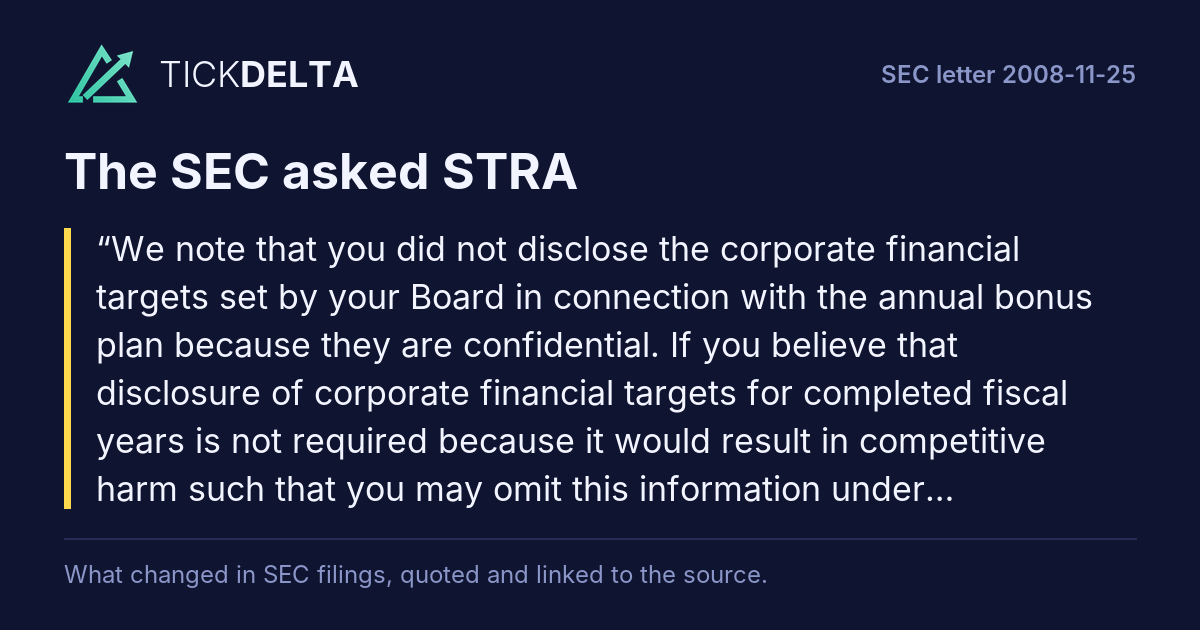
SEC asked (1)
We note that you did not disclose the corporate financial targets set by your Board in connection with the annual bonus plan because they are confidential. If you believe that disclosure of corporate financial targets for completed fiscal years is not required because it would result in competitive harm such that you may omit this information under Instruction 4 to Item 402(b) of Regulation S-K, please provide in
Rest of the question

your response letter a detailed explanation of such conclusion. If you believe you have a sufficient basis to keep the information confidential, disclose in future filings how difficult it would be for the executive or how likely it would be for you or a business unit to achieve the undisclosed targets. General statements regarding the level of difficulty or ease associated with achieving the goals are not sufficient. In discussing how difficult it will be for an executive or how likely it will be for you or a business unit to achieve the performance goals, provide as much detail as necessary without providing information that would result in competitive harm. Refer to Regulation S-K Compliance and Disclosure Interpretations, Question and Answer 118.04, available at www.sec.gov/divisions/corpfin/guidance/regs-kinterp.htm.

STRA answered
Although we continue to believe that certain corporate financial targets considered by the Compensation Committee should be treated as confidential, as the disclosure of such targets would result in competitive harm to the

Company, the principal reason for non-disclosure of such financial targets is that no single financial target is itself material to the Compensation

Committee's determination of bonus amounts.

As discussed in the disclosure incorporated in the 2007 Form 10-K, the bonus determination with respect to our named executive officers is made on a discretionary basis by the
Rest of the answer

Compensation Committee, subject to the further approval of the Board. While the Compensation Committee considers various factors in determining the level of any bonus payable, including the achievement of certain corporate financial targets, ultimately, no one factor is dispositive, or even material, to the determination process. For

2007, the Compensation Committee considered a wide variety of factors in its discretionary determination, including five separate financial targets

(revenue, operating margin, EBIT, net income and earnings per share), and numerous other non-financial targets, including targets relating to new campus openings, operations in new states, compliance, regulatory approvals, performance of the Company's online business, increases in corporate and institutional customers, academic improvement measures and other operational performance measures, as well as capital redeployment steps. While the Compensation Committee believes that each of the various targets is itself relevant to its determination of bonus amounts, the achievement of any one target, or for that matter, any particular combination of factors, would not result in a specific bonus amount being paid to the Company's named executive officers.

Once the Compensation Committee has evaluated the Company's relative performance with respect to each of the targets listed above, to the extent that it believes that such performance warrants bonus amounts to be paid to the named executive officers generally, the Compensation Committee then evaluates each named executive officer's individual performance for the year, and specifically with respect to relative contribution each executive made toward the achievement of the Company goals described above, or to the extent such goals were not achieved, whether any executive disproportionally contributed to such non-achievement. The Compensation

Committee generally sets target bonus amounts for Senior Vice Presidents and above at 75% of such executive's base salary, and for Vice Presidents, at 40% of base salary, which the Compensation Committee believes provides a good framework for establishing internal pay equity among its executives, while maintaining the discretion to pay a higher bonus when the

Compensation Committee believes either or both corporate or individual performance warrants. As provided in the Summary Compensation Table contained in the 2007 Form 10-K, actual bonus amounts for the named executive officers ranged from approximately 75% of base salary to 120% of base salary, with differences in relative amounts, as discussed above, resulting from an executive's relative contribution to the success of the

Company for 2007.

With respect to confidential treatment and the possibility of competitive harm, even if any one performance target were deemed to be material, we continue to believe that the disclosure of many these targets would allow the Company's competitors to discern the strategic direction, internal forecasts and key business objectives for both current year and future years. More specifically, because many of the performance targets discussed above relate to specific business lines of the Company and geographical operational results, we believe disclosure of such targets would provide our competitors with a roadmap to our strategic plans and operating objectives, and as such, disclosure of such information would result in substantial competitive harm to the Company. The Company, therefore, believes that such information constitutes "commercial and financial information obtained from a person and privileged or confidential" under the provisions of Section (b)(4) of Rule 80 of the Freedom of Information

Act and may be excluded under Instruction 4 to Item 402(b).

Read in the reply
In its next report

First report after the company's reply of Dec 23, 2008: 10-K filed Feb 17, 2009 ↗, against the 10-K filed Feb 14, 2008 ↗.

Tickdelta does not hold the text of both reports, so they are not compared here.

Compensation Discussion and Analysis, page 11 of Proxy Statement · Identification and Analysis of 2007 Compensation Programs, page 13 of Proxy Statement
SEC asked (2)
In future filings, please provide a more detailed discussion of how actual bonus awards and equity awards for each named executive officer were determined for your most recently completed fiscal year. Please compare actual performance during the year against the relevant targets. Also discuss the significance of individual assessments and any other qualitative factors. Tabular disclosure may be helpful.
Rest of the question

If there are material differences in bonus or equity awards to different named executive officers, your disclosure should explain why.

STRA answered
As requested, in future filings the Company will provide a more detailed discussion of the Compensation Committee's determination process similar to the discussion provided above with respect to the 2007 bonus determination

(modified to reflect any differences in the 2008 determination process).

However, as indicated above, given the numerous financial and operational targets that are part of the Compensation Committee's discretionary determination process, the Company does not expect to include any detailed discussion of the specific target amounts; such targets do not reflect
Rest of the answer

the

Company's overall decision-making process and are immaterial to an understanding of executive compensation at the Company. The Company will also include a discussion of any material differences in bonus or equity awards among named executive officers, to the extent applicable.

Potential Payments upon Termination or Change in Control, page 20 of Proxy

--------------------------------------------------------------------------

Read in the reply
In its next report

First report after the company's reply of Dec 23, 2008: 10-K filed Feb 17, 2009 ↗, against the 10-K filed Feb 14, 2008 ↗.

Tickdelta does not hold the text of both reports, so they are not compared here.

Potential Payments upon Termination or Change in Control, page 20 of Proxy Statement
SEC asked (3)
In future filings, please quantify the value of the three years of medical benefits and potential gross-up payment to Mr. Silberman. Refer to Regulation S-K Item 402(j), Instructions 1 and 2. If you disagree that you are required to provide this disclosure, please explain to us the reasons why.
STRA answered
As requested, in future filings we will disclose the value of the three years of medical benefits and potential gross-up payments to Mr. Silberman in connection with a termination of his employment.
Read in the reply
In its next report

First report after the company's reply of Dec 23, 2008: 10-K filed Feb 17, 2009 ↗, against the 10-K filed Feb 14, 2008 ↗.

Tickdelta does not hold the text of both reports, so they are not compared here.

Potential Payments upon Termination or Change in Control, page 20 of Proxy Statement
SEC asked (4)
We note that you cross-reference your Outstanding Equity Awards tables for disclosure of the value that would be realized upon vesting due to a change in control. In future filings, please provide footnote disclosure to the tables so that the value that would have been realized assuming a change in control at year-end is clearly disclosed. Also, define “change in control” for these purposes.
Rest of the question

* * * * Please respond to these comments through correspondence over EDGAR within 10 business days or tell us when you will provide us with a response. Please furnish a letter that keys your responses to our comments and provides any requested information. Detailed letters greatly facilitate our review. Please understand that we may have additional comments after reviewing your responses to our comments.

STRA answered
As requested, in future filings we will add footnotes in our Outstanding

Equity Awards tables disclosing the value that would have been realized assuming a change in control at year-end. We will also provide in this section a definition of "change in control" for these purposes.

Pursuant to your comment letter, on behalf of Strayer, we hereby acknowledge that:

o Strayer is responsible for the adequacy and accuracy of the disclosure in its 2007 Form 10-K;

o Staff comments or changes to disclosure in response to Staff comments do not foreclose the Commission from taking any action with
Rest of the answer

respect to

Strayer's 2007 Form 10-K; and o Strayer may not assert Staff comments as a defense in any proceeding initiated by the Commission or any person under the Federal securities laws of the United States.

Should any member of the Staff have any questions or comments concerning this letter, please do not hesitate to call me at (212) 728-8592.

Read in the reply
In its next report

First report after the company's reply of Dec 23, 2008: 10-K filed Feb 17, 2009 ↗, against the 10-K filed Feb 14, 2008 ↗.

Tickdelta does not hold the text of both reports, so they are not compared here.

Also in this review: company letter, Dec 9, 2008, company letter, Jan 5, 2009, closing letter, 2009-01-06

Letters without questions

Other letters

UPLOAD and CORRESP
1 other letter: notices that a filing will not be reviewed, requests to declare a registration effective, and the like

From the SEC's correspondence on EDGAR: staff letters (form UPLOAD) and company letters (form CORRESP), 33 letters filed since 2008-11-25. Questions and answers are matched by their numbers; topics come from words in each question. The reports are compared word for word (same form, before the first SEC letter against the first report after the company's reply). No AI.

Sources

The SEC's correspondence on EDGAR: staff letters (form UPLOAD) and company letters (form CORRESP), matched question by question. No AI.

Also

Filings: the letters in the filing list.

Work with it

Excel workbook · CSV. Google Sheet that stays up to date: paste =IMPORTDATA("https://tickdelta.com/company/STRA/export.csv") into a cell.

Next in Owners and insiders:Insider trades
Esc

Type a ticker such as AAPL, a name, an investor such as Buffett, or a topic such as tariffs. ↑ ↓ to move, Enter to open.