Screener / SEC EDGAR /CIK 0000310142 /Numbers from the XBRL of the 10-Ks
NYSE Materials · Chemicals

Sensient Technologies Corp SXT

Compare with peers Embed
SEC comment letters, last 20 years

2 reviews of SXT's filings by SEC staff

UPLOAD and CORRESP
Reviews 2 latest letter Jun 24, 2015
Questions asked 28 each answered in the company's own letter
No closing letter 1 reviews without a letter saying the staff completed it

When the SEC's staff reviews a filing, it writes to the company with numbered questions, and the company answers each one in a letter. SEC publishes the exchange once the review is over, at least 20 business days later. A question is not an accusation; most reviews end with the company adding detail to its next filing.

How the reviews went

Every review on EDGAR, from the first staff letter to the letter that closes it

  1. 1. Staff letters 7 UPLOAD
  2. 2. Questions in them 28 numbered comments
  3. 3. Company replies 4 CORRESP
  4. 4. Reviews closed 1 of 2 closing letter

Half the closed reviews took 116 days or less from the first letter to the closing letter.

Form 10-K

2015-06-24 to 2015-08-18 · 12 questions · 2 letters from the SEC, 2 from the company
No closing letter
Results discussion (MD&A)Non-GAAP measuresRevenueGoodwill and impairmentSegmentsLiquidity and cashPensions
Annual Report to Shareholders · Financial Highlights
SEC asked (1)
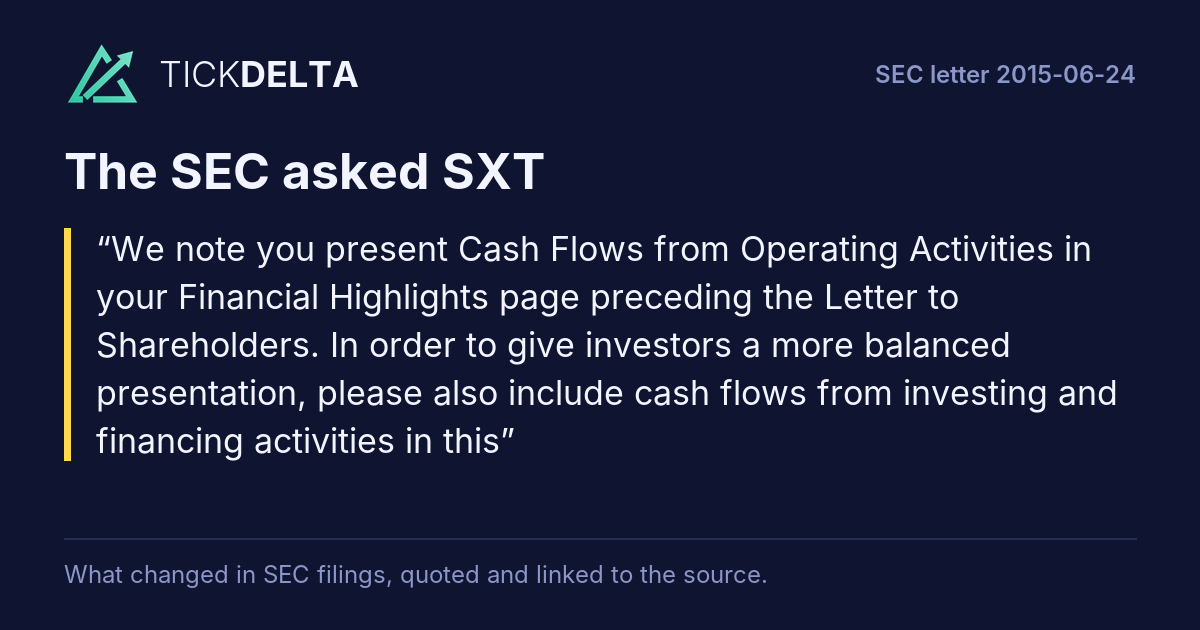
We note you present Cash Flows from Operating Activities in your Financial Highlights page preceding the Letter to Shareholders. In order to give investors a more balanced presentation, please also include cash flows from investing and financing activities in this
SXT answered
The following table includes the cash flows from investing and financing activities in the “Cash Flow Activity” table in the “Financial Highlights” section:

Cash Flow Activity

2014

2013

% Change

Cash Flows from Operating Activities

189,188

153,553

%

Cash Flows from Investing Activities

(79,149

)

(98,229

(19

%)

Cash Flows from Financing Activities

(98,553

(48,219

104

Capital Expenditures

79,398

104,246

(24

Free Cash Flow

109,790

49,307

123

Total Debt

466,899

355,174

Dividends per share

0.98

0.91

Each year we evaluate which financial measures are most important
Rest of the answer

to our investors and in future filings we will include the requested items if we include cash flows from operating activities.

Read in the reply
In its next report

First report after the company's reply of Jul 8, 2015: 10-Q filed Aug 7, 2015 ↗, against the 10-Q filed May 5, 2015 ↗.

Tickdelta does not hold the text of both reports, so they are not compared here.
Letter to Shareholders, page 1
SEC asked (2)
We note that in your Chief Executive Officer’s Letter to Shareholders he presents and discusses Non-GAAP measures using terminology that is consistent with the related GAAP measures. For instance, we note he uses terms such as “Earnings per Share” and “Operating Margins” for amounts calculated on a Non-GAAP basis.
Rest of the question

We note similar potentially misleading graphics on page two, where you depict “2014 Net Income” within a red up-arrow; however, the amount you presented is actually “Adjusted Net Earnings.” We also note additional prolific use of Non-GAAP measures in your document without giving equal or greater prominence to GAAP measures. Please revise your Annual Report to Shareholders to present and discuss GAAP measures using amounts determined in accordance with GAAP. In addition please provide greater or equal prominence to GAAP measures throughout your document whenever you present and discuss Non- GAAP measures. Please refer to Item 10(e)(1) of Regulation S-K as well as the SEC’s Compliance and Disclosure Interpretation for Non-GAAP Financial Measures located at http://www.sec.gov/divisions/corpfin/guidance/nongaapinterp.htm.

SXT answered
In future filings, we will take the additional measures noted below to ensure that GAAP financial measures are presented with greater or equal prominence than non-GAAP financial measures. We believe that our Annual Report appropriately presented and discussed non-GAAP financial measures because we presented a table (page 15) in Management’s Discussion & Analysis of Operations and Financial Condition (“MD&A”) that provided a clear reconciliation of the non-GAAP financial results to the GAAP financial results, and we directed readers to that table on the inside front cover of the Annual Report.
Rest of the answer

The MD&A table presenting both the GAAP and non-GAAP financial results gave more prominence to the GAAP results, presenting them first. The table disclosed the impact of restructuring and other costs and presented the results excluding those items as non-GAAP financial measures.

The “Financial Highlights” table is on the inside front cover of the Annual Report and contains the first presentation of the Company’s financial results. This table includes both GAAP and non-GAAP financial measures, with the GAAP results reported above the non-GAAP results. The table also includes a footnote that clearly labeled the non-GAAP financial measures and referred readers to the more detailed MD&A discussion on page 15. The “Letter to Shareholders” begins on the page opposite to the front cover and we believe the disclosure in the “Financial Highlights” table provides an appropriate reference to readers, in understanding that the results discussed in the “Letter to Shareholders” are non-GAAP financial measures, given the proximity of the “Financial Highlights” table to the “Letter to Shareholders”.

In future filings, the Company will enhance the presentation in the “Letter to Shareholders,” including any related graphics, by clearly labeling any non-GAAP financial measures and directing readers to the reconciliation of non-GAAP financial measures to GAAP financial results in the MD&A section of the Annual Report.

The following is an example of the first paragraph of the “Letters to Shareholders” to illustrate how we would intend to enhance our future filings:

Performance and Progress*

Sensient’s 2014 adjusted earnings per share increased 11% over last year’s performance to $3.02 per share. Adjusted operating margin increased 120 basis points to 15.3% as each of our operating groups delivered higher margins this year. Overall we had a very positive year that exceeded our performance objectives.

*Included in the “Letter to Shareholders” are non-GAAP financial measures. Please see page 15 of this report (reference to Non-GAAP Financial Measures in MD&A section) for a reconciliation of these measures to GAAP and a discussion of why the Company is presenting this information.

Read in the reply
In its next report

First report after the company's reply of Jul 8, 2015: 10-Q filed Aug 7, 2015 ↗, against the 10-Q filed May 5, 2015 ↗.

Tickdelta does not hold the text of both reports, so they are not compared here.

Letter to Shareholders, page 1
SEC asked (3)
We note in your Letter to Shareholders and MD&A you discuss revenues in terms of local currency and also excluding the impact of “rationalized business.” When you disclose revenues in local currency terms, please also disclose revenues in reporting currency terms. In addition, in all instances where discussed in your document, please quantify the impact of rationalized businesses on revenues.
Rest of the question

If necessary, please provide a reconciliation of revenues after rationalization, as it appears this may be a Non-GAAP measure.

SXT answered
In future filings, the Company will also include the change in reporting currency terms when local currency and rationalized business changes are discussed.

As an example, on page 16 of the Company’s Annual Report, the first paragraph under the Results of Continuing Operations would read as follows:

Sensient’s revenue was approximately $1.4 billion in 2014 and $1.5 billion in 2013. Sensient continues to shift to value added and technology driven products in each of our Groups while actively rationalizing non-strategic and low margin business.
Rest of the answer

Consolidated revenue, as reported, decreased 1.0% in 2014. Removing the impact of our rationalization efforts, our consolidated revenue increased 1.5% in 2014. Foreign currency translation did not have a material impact on consolidated revenue in 2014. Additional information on group results can be found in the Segment Information section.

Read in the reply
In its next report

First report after the company's reply of Jul 8, 2015: 10-Q filed Aug 7, 2015 ↗, against the 10-Q filed May 5, 2015 ↗.

Tickdelta does not hold the text of both reports, so they are not compared here.

Management’s Discussion and Analysis of Operations & Financial Condition · Restructuring Activities, page 16
SEC asked (4)
Please modify your disclosure to include the amount of impairment charges you recognized in 2014 for certain long-lived assets associated with underperforming operations, in addition to presenting the post-impairment fair values. Since it appears that the amount of impairment was material, please more robustly describe the nature of the underperforming operations where you recognized asset impairments.
SXT answered
In future filings, the Company will enhance its MD&A to address the additional items noted. The following illustrates the form of this additional disclosure if such revision had been incorporated into the Company’s Annual Report:

In 2014, the Company announced that it was initiating its 2014 Restructuring Plan to eliminate underperforming operations, consolidate manufacturing facilities and improve efficiencies within the Company.
Rest of the answer

The Company determined that it had redundant manufacturing capabilities in both North America and Europe, and that it could lower costs and operate more efficiently by consolidating into fewer facilities. The Company also discontinued one of the businesses in the Color Group because it did not fit with the Company’s long term strategic plan and it had generated losses for several years. The Company expects this plan to cost between $120 million and $130 million, and upon completion is anticipated to reduce annual operating costs by approximately $30 million per year. Incremental savings will be achieved over the next few years and the full benefit is expected to be achieved after 2016. Based on this plan, the Company determined that certain long-lived assets associated with the underperforming operations were impaired. The Company reduced the carrying amounts of these assets to their aggregate respective fair values of approximately $35 million, which were determined based on independent market values for these assets. Certain machinery and equipment has been identified to be disposed of at the time of the facility closures and the associated depreciation for these assets has been accelerated. In 2014, the Company recorded long-lived asset impairments of $70.2 million. In addition, certain intangible assets and inventory were determined to be impaired and were written down. Employee separation and other restructuring costs were also incurred during 2014. The Company will reduce headcount by approximately 300 positions at impacted facilities primarily in the Flavors & Fragrances Group, related to direct and indirect labor at manufacturing sites. As of December 31, 2014, approximately 100 employees have been terminated. The Company recorded $101.5 million of restructuring and other costs in 2014, in accordance with GAAP and based on internal review of affected facilities and consultation with legal and other advisors. The Company expects to incur approximately $21 million to $31 million of additional restructuring costs by the end of 2016.

Read in the reply
In its next report

First report after the company's reply of Jul 8, 2015: 10-Q filed Aug 7, 2015 ↗, against the 10-Q filed May 5, 2015 ↗.

Tickdelta does not hold the text of both reports, so they are not compared here.

Results of Continuing Operations · Segment Information, page 17
SEC asked (5)
We note you disclose “Operating Income” determined in accordance with ASC 280. To avoid investor confusion, please modify your captions of segment profitability to characterize the amounts as “Segment Operating Income” or “Operating Income before restructuring charges.”
SXT answered
We believe that the first paragraph under “Segment Information” on page 17 defines how the Company determines its operating segments and how the Company reports operating income for its segments. Within this paragraph, it is noted that Group performance is reported before restructuring charges which are reported in the Corporate & Other segment.
Rest of the answer

In future filings we will add prominent language within the section discussing the Corporate & Other segment results to make it clear that all of the restructuring charges are included in this segment, and not in the results of the other operating segments.

Read in the reply
In its next report

First report after the company's reply of Jul 8, 2015: 10-Q filed Aug 7, 2015 ↗, against the 10-Q filed May 5, 2015 ↗.

Tickdelta does not hold the text of both reports, so they are not compared here.

Flavors & Fragrances, page 17
SEC asked (6)
Please modify your disclosure to quantify the impact of items effecting Operating Income, including the impact of higher selling prices in North America and also the impact of savings associated with your restructuring program.
SXT answered
In future filings, the Company will modify its MD&A to address the noted item. The following illustrates the form of this disclosure if such revision had been incorporated into the Company’s Annual Report:

Operating income for the Flavors & Fragrances Group was $119.1 million in 2014 and $120.3 million in 2013. The decrease was primarily due to the impact of unfavorable exchange rates ($0.9 million). Higher profit in North America ($1.1 million) and Mexico ($0.4 million) was offset by lower profit in Europe ($1.8 million).
Rest of the answer

The higher profit in North America was primarily due to savings associated with the restructuring program ($1.5 million), and higher selling prices, which were more than offset by lower volumes and other items. The lower profit in Europe was primarily due to higher employee costs.

Read in the reply
In its next report

First report after the company's reply of Jul 8, 2015: 10-Q filed Aug 7, 2015 ↗, against the 10-Q filed May 5, 2015 ↗.

Tickdelta does not hold the text of both reports, so they are not compared here.

Flavors & Fragrances, page 17
SEC asked (7)
As noted in our prior comment above regarding revenues, please also modify your disclosure to quantify the change in Operating Income in Europe, expressed in terms of your reporting currency.
SXT answered
The change in Operating Income, expressed in terms of local currency, is for the entire Flavors & Fragrances Group, not solely Europe. In future filings, the Company will modify its MD&A to state this more clearly and express the results in our reporting currency. The following illustrates the form of a revised presentation of this disclosure if such revision had been incorporated into the Company’s Annual Report:

As reported, operating income for the Flavors & Fragrances Group decreased 1.0 % in 2014. In local currency, operating income for the Flavors & Fragrances Group decreased 0.3%.
Rest of the answer

Operating margin for the Flavors & Fragrances Group increased 40 basis points to 14.1% in 2014 from 13.7% in 2013, primarily due to the Group’s focus on higher margin, value-added products.

Read in the reply
In its next report

First report after the company's reply of Jul 8, 2015: 10-Q filed Aug 7, 2015 ↗, against the 10-Q filed May 5, 2015 ↗.

Tickdelta does not hold the text of both reports, so they are not compared here.

Financial Statements · Note 6 – Retirement Plans, page 34
SEC asked (8)
It appears, based on your footnote, that pension benefit payments increased substantially in 2014 and you also recognized a curtailment gain. We are unable to locate any disclosure in MD&A or the footnote regarding changes to your benefit plans. Please disclose and discuss changes to your pension plans, including the scope of any curtailment and the expected impact.
SXT answered
In future filings, the Company will enhance its disclosure to address the items noted. The following illustrates the form of this additional disclosure if such revision had been incorporated into the Company’s Annual Report:

During the year, two of the Company’s defined benefit plans were frozen resulting in the recognition of a curtailment gain. The changes to these plans will limit the plans to the current participants as well as freeze their respective benefits. In addition, a curtailment loss was recognized for a certain defined benefit plan associated with a closure of a facility.
Rest of the answer

These changes did not have a material impact on the Company’s 2014 results, and they are not expected to have a material impact on future years’ results.

There was no relationship between the increase in benefit payments and the changes in the Company’s defined benefit plans.

Read in the reply
In its next report

First report after the company's reply of Jul 8, 2015: 10-Q filed Aug 7, 2015 ↗, against the 10-Q filed May 5, 2015 ↗.

Tickdelta does not hold the text of both reports, so they are not compared here.

Note 11 – Restructuring charges, page 39
SEC asked (9)
We note your tabular presentation of restructuring charges and note that you recorded employee separation costs and long-lived asset impairment charges as a component of Selling & Administrative expenses. We note elsewhere in your document that you will reduce headcount by approximately 300 positions at impacted facilities related to direct and indirect labor at manufacturing sites.
Rest of the question

Please tell us the nature of the assets that were impaired and why you have included impairment and employee separation charges as an element of Selling & Administrative expenses. We also note you present and discuss gross profits in your document that appear to exclude the impact of restructuring related charges at your manufacturing operations. Please see the Interpretive Response to Question 2 of SAB Topic 5:P.

SXT answered
The asset impairments that were recorded in 2014 are a result of the consolidation of facilities with redundant manufacturing capabilities in both North America and Europe. The Company believes that these costs are more accurately reported in Selling & Administrative expense as the cost of these actions did not impact the cost of making the Company’s products. The Company does report the write down of inventory associated with the Company’s restructuring activities in Cost of Products Sold, as this cost is directly associated with cost of the Company’s products.
Rest of the answer

The classification of these costs in operating income, as described above, has been our customary practice.

Management has reviewed the Interpretive Response to Question 2 of SAB Topic 5:P, and believes that the interpretation is focused on the presentation of the face of the income statement. Our disclosure clearly details where these costs are classified in the income statement and such charges are not presented below operating income in accordance with SAB Topic 5:P.

Read in the reply
In its next report

First report after the company's reply of Jul 8, 2015: 10-Q filed Aug 7, 2015 ↗, against the 10-Q filed May 5, 2015 ↗.

Tickdelta does not hold the text of both reports, so they are not compared here.

Management’s Discussion and Analysis of Operations & Financial Condition · Restructuring Activities, page 16
SEC asked (1)
We note your response to our prior comment number four. Please further enhance your proposed disclosures to provide more detailed information regarding your redundant manufacturing capabilities. Please include a discussion of the Group(s) where such redundancies existed, along with the number of facilities impacted and the specific locations of redundant operations within North America and Europe.
SXT answered
In future filings, the Company will enhance its MD&A to address the additional items noted. The following illustrates the form of this additional disclosure if such revision had been incorporated into the Company’s Annual Report:

In 2014, the Company announced that it was initiating its 2014 Restructuring Plan to eliminate underperforming operations, consolidate manufacturing facilities and improve efficiencies within the Company.
Rest of the answer

The Company determined that it had redundant manufacturing capabilities in both North America and Europe, and that it could lower costs and operate more efficiently by consolidating into fewer facilities. Eight facilities were identified for consolidation in the Flavors & Fragrances segment, four in North America and four in Europe. To date, closures have been announced in Indianapolis, Indiana, United States; Cornwall, Mississauga and Halton Hills, Canada; Bremen, Germany; and Milan, Italy. The Company also discontinued one of the businesses in the Color Group, located near Leipzig, Germany, because it did not fit with the Company’s long term strategic plan and it had generated losses for several years. The Company expects this plan to cost between $120 million and $130 million, and upon completion is anticipated to reduce annual operating costs by approximately $30 million per year. Incremental savings will be achieved over the next few years and the full benefit is expected to be achieved after 2016. Based on this plan, the Company determined that certain long-lived assets associated with the underperforming operations were impaired. The Company reduced the carrying amounts of these assets to their aggregate respective fair values of approximately $35 million, which were determined based on independent market values for these assets. Certain machinery and equipment has been identified to be disposed of at the time of the facility closures and the associated depreciation for these assets has been accelerated. In 2014, the Company recorded long-lived asset impairments of $70.2 million. In addition, certain intangible assets and inventory were determined to be impaired and were written down. Employee separation and other restructuring costs were also incurred during 2014. The Company will reduce headcount by approximately 300 positions at impacted facilities primarily in the Flavors & Fragrances Group, related to direct and indirect labor at manufacturing sites. As of December 31, 2014, approximately 100 employees have been terminated. The Company recorded $101.5 million of restructuring and other costs in 2014, in accordance with GAAP and based on internal review of affected facilities and consultation with legal and other advisors. The Company expects to incur approximately $21 million to $31 million of additional restructuring costs by the end of 2016.

Read in the reply
In its next report

First report after the company's reply of Aug 18, 2015: 10-Q filed Nov 6, 2015 ↗, against the 10-Q filed May 5, 2015 ↗.

Tickdelta does not hold the text of both reports, so they are not compared here.

Results of Continuing Operations · Segment Information, page 17
SEC asked (2)
We note your response to our prior comment number five. As previously requested, please revise the caption of your segment profitability measure to avoid investor confusion.
SXT answered
In future filings we will revise the name of our segment profitability measure and refer to “segment operating income.” The following illustrates the form of this disclosure if such revision had been incorporated into the Company’s Annual Report:

Segment operating income for the Color segment increased 6.5% to $114.9 million in 2014 from $107.9 million in 2013. The increase was primarily due to non-food colors ($5.5 million) and food and beverage colors ($2.3 million) partially offset by the unfavorable impact of exchange rates ($0.8 million).
Rest of the answer

The higher profit for non-food colors was primarily due to the higher volumes and favorable product mix. The higher profit for food and beverage colors was primarily due to higher selling prices. Segment operating margin for the Color segment increased 80 basis points to 22.6% in 2014 from 21.8% in 2013.

Read in the reply
In its next report

First report after the company's reply of Aug 18, 2015: 10-Q filed Nov 6, 2015 ↗, against the 10-Q filed May 5, 2015 ↗.

Tickdelta does not hold the text of both reports, so they are not compared here.

Financial Statements · Note 6 – Retirement Plans, page 34
SEC asked (3)
We note your response to our prior comment number eight. We note from your filing, benefit payments increased from $5.2 million in 2013 to $23.7 million in 2014. We further note benefit payments in 2015 are expected to decrease to $9.6 million. Please explain to us and disclose the reason(s) for the increase in benefit payments in 2014.
SXT answered
The increase in the benefit payments in 2014 was primarily a result of the 2014 retirement of the Company’s former Chief Executive Officer and the payment of his defined benefit pension during the year. In future filings, the Company will enhance its disclosure to address the items noted. The following illustrates the form of this additional disclosure if such revision had been incorporated into the Company’s Annual Report:

During the year, two of the Company’s defined benefit plans were frozen resulting in the recognition of a curtailment gain.
Rest of the answer

The changes to these plans will limit the plans to the current participants as well as freeze their respective benefits. In addition, a curtailment loss was recognized for a certain defined benefit plan associated with a closure of a facility. These changes did not have a material impact on the Company’s 2014 results, and they are not expected to have a material impact on future years’ results. The increase in benefit payments in 2014 was primarily due to the retirement of the Company’s former Chief Executive Officer, who received his defined benefit pension in a lump sum payment during the year.

Read in the reply
In its next report

First report after the company's reply of Aug 18, 2015: 10-Q filed Nov 6, 2015 ↗, against the 10-Q filed May 5, 2015 ↗.

Tickdelta does not hold the text of both reports, so they are not compared here.

Form 10-K

2014-03-21 to 2014-07-15 · 16 questions · 5 letters from the SEC, 2 from the company
Review closed 2014-07-15
Non-GAAP measuresResults discussion (MD&A)Derivatives and hedgingRevenue
SEC letter of Mar 21, 2014 ↗ no reply letter on EDGAR
SEC asked (1)
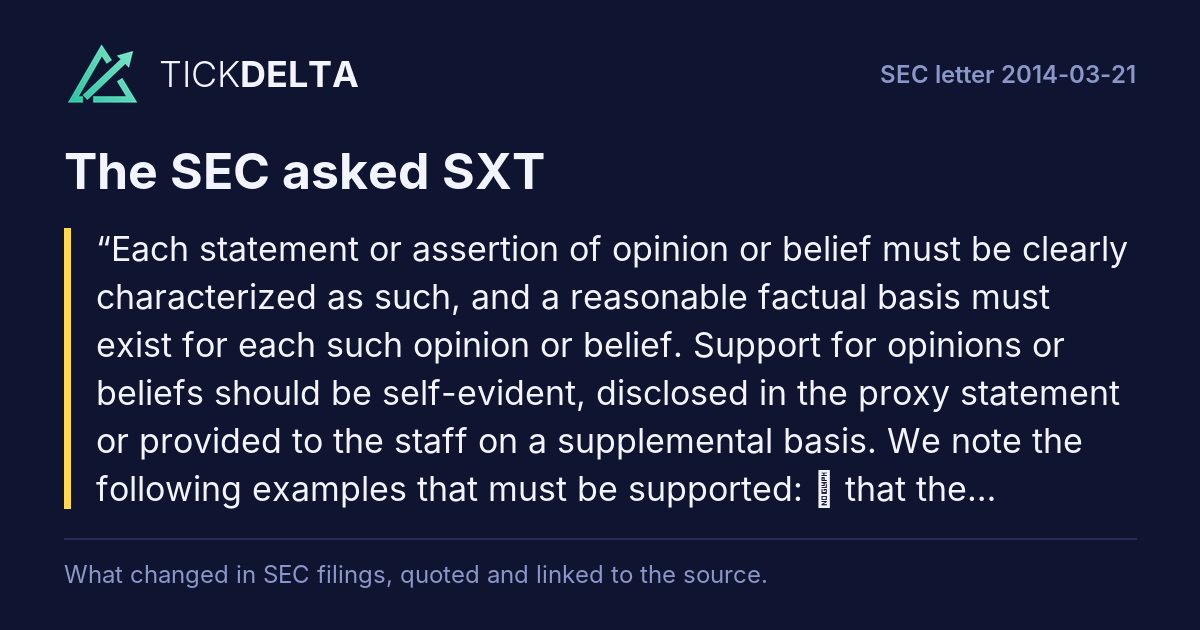
Each statement or assertion of opinion or belief must be clearly characterized as such, and a reasonable factual basis must exist for each such opinion or belief. Support for opinions or beliefs should be self-evident, disclosed in the proxy statement or provided to the staff on a supplemental basis.
Rest of the question

We note the following examples that must be supported:  that the company has failed to earn its cost of capital in 6 out of the last 10 years .  that based on your analysis, you believe that the company can buy back $350 million of common stock without impacting its credit rating.

SXT answered

No reply letter found.

SEC asked (2)
We note your disclosure that one key criterion to serve on the board should be “direct investment in Sensient that secures close alignment with the interests of all shareholders.” We also note in your proxy statement that some of your nominees do not own any shares in the company. Please make sure to include the latter information when stating the former to provide the proper context for your assertions .
SXT answered

No reply letter found.

SEC letter of Mar 21, 2014 ↗ no reply letter on EDGAR
SEC asked (1)
Please provide us support for your statement that “Sensient has admitted fault in its poor return on its capital metrics” (slide 16).
SXT answered

No reply letter found.

SEC asked (2)
Each statement or assertion of opinion or belief must be clearly characterized as such, and a reasonable factual basis must exist for each such opinion or belief. Support for opinions or beliefs should be self-evident, disclosed in the proxy statement or provided to the staff on a supplemental basis.
Rest of the question

We note the following examples that must be supported:  your belief that the company “never ran an unbiased search process for a new CEO, as Ken [Manning] had for years hand-chosen Paul [Manning] to succeed him” (slide 30).  that “Investors and sell-side analysts have been less than impressed with new CEO hire” (slide 30).

SXT answered

No reply letter found.

SEC asked (3)
We note your disclosure on slide 34 under the heading “Are the interests of the current Board truly aligned with all shareholders.” We also note your response to our comment 2 in our letter dated March 21, 2014. It is unclear how you have provide the context we had previously requested in this slide, given that some of your nominees own no shares in the company. Revise your disclosure. Refer to Rule 14a-9.
SXT answered

No reply letter found.

SEC asked (4)
We note the fourth disclaimer on slide 53. You may not disclaim your disclosure in your own soliciting materials. Please confirm your understanding and confirm that you will not disclaim your disclosure in future soliciting materials.
SXT answered

No reply letter found.

SEC asked
You state your belief that the FrontFour nominees are “beholden to the hedge fund” which appears to imply that the nominees, if elected, would not comply with their fiduciary duties to the company’s security holders but would instead favor FrontFour’s interests.
Rest of the question

Avoid issuing statements in your proxy statement that directly or indirectly impugn the character, integrity or personal reputation or make charges of illegal, improper or immoral conduct without factual foundation. Disclose the factual foundation for such assertions or delete the statements. In this regard, note that the factual foundation for such assertions must be reasonable. Refer to Rule 14a-9. Please provide us supplementally the factual foundation for your disclosure.

SXT answered
As the Staff has noted, in our March 26, 2014 filing, we stated that the nominees put forward by an affiliate of FrontFour Capital Partners LLC (“FrontFour”) are individuals “whom we believe are beholden to the hedge fund.” It was our intent to, consistent with prior Staff comments, clearly characterize this statement of belief as an opinion. Our reasonable factual foundation for this belief with respect to each nominee is as follows:

Stephen E. Loukas

Mr.
Rest of the answer

Loukas is a principal at FrontFour, which on its own leads us to believe he may have one or more personal loyalties, financial interests, contractual obligations or fiduciary duties that could lead him to favor his hedge fund and its investors over all of the Company’s shareholders. On March 25, 2014, we filed a revised set of shareholder discussion materials as definitive additional soliciting materials (the “Presentation”). On pages 28, A-1, A-2 and A-4 of the Presentation, we disclose additional publicly available facts that lead us to believe that FrontFour is primarily interested in what is best for FrontFour, not what is best for all of the Company’s shareholders. Mr. Loukas has been a party to actions at both FrontFour and Pirate Capital, LLC (“Pirate”) that lead us to believe he endorses the activities described on the referenced pages. For additional detail, we refer the Staff to the referenced pages in the Presentation and the third-party sources referenced in the associated footnotes.

William E. Redmond, Jr.

As noted on page 26 of the Presentation, Mr. Redmond has a history of behavior that has been described as fraudulent and dishonest. Separately, in 2011, Mr. Redmond noisily resigned from the board of Visteon Corporation (“Visteon”) over that company’s response to an approach by noted activist hedge fund, Alden Global Distressed Opportunities Master Fund LP (“Alden”). Mr. Redmond’s resignation letter1 suggests a philosophical objection to resisting Alden’s overtures generally, not any particular information regarding the views of Visteon shareholders. With respect to his possible allegiance to FrontFour, we note that Mr. Redmond was a special advisor, shareholder and promoter of Doubloon Corporation, a “blank check” company owned by Pirate in 2006. As discussed on page A-1 of the Presentation, the current FrontFour principals were actively involved at Pirate and may well have gotten to know Mr. Redmond during this period. It is reasonable to suspect that, if he were elected to our Board, Mr. Redmond’s high-profile dispute with PepsiCo would raise significant concern with a major company in one of our principal target markets. Given this unsuitability as a candidate for our Board when compared with the multitude of individuals with professional experience in our industry, we believe that FrontFour selected Mr. Redmond for his past connections to FrontFour’s principals and the associated inference of loyalty to that hedge fund.

Visteon Corp., Ex. 17-1 to Form 8-K, filed May 12, 2011.

James R. Henderson

In connection with the bankruptcy of Point Blank Solutions, Inc. (“Point Blank”), Mr. Henderson was accused of operating the company for the benefit of his own shareholding hedge fund (“Steel Partners”) rather than in the best interest of all shareholders. The most notable case in this regard is the New York state action filed against Mr. Henderson by Jeffrey R. Brooks in March 2011.2 This complaint alleges that Mr. Henderson used a settlement with the Commission as an opportunity to deregister Point Blank, leaving it no alternative but to accept a going-private acquisition by Steel Partners. Mr. Brooks alleges that this deregistration was unnecessary and significantly reduced the value of Point Blank’s stock. He now seeks in excess of $5,000,000 for this alleged breach of fiduciary duty. This litigation is currently pending in New York state court, but it has been stayed by the Delaware district court in connection with Point Blank’s bankruptcy.3

Mr. Henderson’s actions have also been criticized by D. David Cohen, a Point Blank creditor and party to the bankruptcy. In court filings, Mr. Cohen has complained that, after Steel Partners took control of Point Blank, Steel Partners “was not operating the publicly-owned Debtor [Point Blank] in the best interests of the publicly-owned shareholders” and that this conduct resulted in the resignation of “the only two clearly independent directors” from the board, neither of whom was replaced.4 Rather, “the Steel directors of the publicly-owned Debtor stopped the audit of Debtor’s financial statements and ceased all required public reporting required by the Securities & Exchange Act of 1934, while abusively increasing the compensation of a steel executive of [Point Blank] at the aggressive rate of $77,000 per month. None of this would have occurred if the fiduciaries for the publicly-owned Debtor were mindful of their responsibilities to the public interest.”5 Mr. Cohen further questioned the Point Blank board’s support for a settlement of class-action and derivative claims that indemnified prior company management for $183 million in civil liability related to prior management’s accounting fraud. Mr. Cohen subsequently appealed the approval of this settlement to the Second Circuit, which held that the settlement’s Section-304 indemnification provision was unlawful.6

We also note that Mr. Henderson has served on the Board at GenCorp Inc. (“GenCorp”) alongside FrontFour principal David A. Lorber for the past six years. Both men ascended to the GenCorp board through the sponsorship of activist hedge funds. To the best of our knowledge, Mr. Henderson is no longer affiliated with Steel Partners. Based on his alleged behavior following his nomination to the Point Blank board, his departure from Steel Partners and his longstanding acquaintance with Mr. Lorber, we reasonably believe that Mr. Henderson is apt to act in favor of the hedge fund that has nominated him as a candidate for our Board rather than in the best interest of all of our shareholders.

Verified Complaint, Brooks Indiv. Ret. Account v. Henderson, Index No. 650781/2011, (N.Y.S. March 23, 2011).

Order Re: Motion to Stay, In re Point Blank Solutions Inc., et al., No. 1:11-cv-00064 (D. Del. Oct. 8, 2013), Bloomberg Law Docket No. 28.

Objections to Joint Chapter 11 Plan of Reorganization at ¶ 4, In re SS Body Armor I, Inc, Ch. 11 Case No. 10-11255 (Bnkr. D. Del. Feb. 8, 2011), ECF No. 1105.

Objections to Joint Chapter 11 Plan of Reorganization at ¶ 6, In re SS Body Armor I, Inc, Ch. 11 Case No. 10-11255 (Bnkr. D. Del. Feb. 8, 2011), ECF No. 1105.

Cohen v. Viray et al. (In re DHB Indus., Inc. Deriv. Litig.), Docket No. 08-3860-cv (2d Cir. Sept. 30, 2010).

James E. Hyman

On pages 28 and A-2 of the Presentation, we summarize the events at Cornell Companies (“Cornell”), in which Mr. Hyman took actions that were favored by a future FrontFour principal and his then-colleagues at Pirate, but that allegedly were at the expense of other shareholders. We also note that Mr. Hyman appears to have been placed in his position at Cornell by the same future FrontFour principal. For additional detail, we refer the Staff to the referenced pages in the Presentation and the third-party sources referenced in the associated footnotes.

We also note for the Staff’s consideration that Mr. Hyman was nominated in 2013 to the board of a public company called Mac-Gray Corporation by another activist hedge fund, Moab Capital Partners, LLC (“Moab”). Within months of his election, the Mac-Gray board approved an agreement by which Mac-Gray was merged into a competing company. Mr. Hyman and others were sued by Star Partners Fund—a Mac-Gray shareholder—for, among other things, alleged breach of “their fiduciary duties to Mac-Gray’s public shareholders by acting to cause or facilitate the Sale Agreement because it is not in the best interests of those shareholders, but is in the best interests of the [defendants].”7 Some Moab employees during this period formerly held significant roles at FrontFour and Pirate.

Read in the reply
SEC letter of Apr 2, 2014 ↗ no reply letter on EDGAR
Definitive Additional Soliciting Materials filed March 25, 2014
SEC asked (1)
Please provide the substance of your response to the first bullet point in our prior comment 2 in any future soliciting materials that address the company’s selection of Paul Manning as its CEO.
SXT answered

No reply letter found.

In its next report

First report after the SEC's letter of Apr 2, 2014: 10-Q filed May 7, 2014 ↗.

No earlier 10-Q before the SEC's letter is in Tickdelta, so there is nothing to compare with.

Definitive Additional Soliciting Materials filed March 25, 2014
SEC asked (2)
Please provide us with additional supplemental support for the statement referenced in the second bullet point in our prior comment 2. Tell us which “Investors and sell-side analysts” you have communicated with and the dates of those communications.
SXT answered

No reply letter found.

In its next report

First report after the SEC's letter of Apr 2, 2014: 10-Q filed May 7, 2014 ↗.

No earlier 10-Q before the SEC's letter is in Tickdelta, so there is nothing to compare with.

Definitive Additional Soliciting Materials filed March 31, 2014
SEC asked (3)
We note your disclosure that you believe the company “could see additional earnings per share of over $1.00, which could result in the Company trading at a multiple to earnings closer to its peers.” The inclusion of valuations in proxy materials is only appropriate and consonant with Rule 14a-9 when made in good faith and on a reasonable basis.
Rest of the question

Valuation information must therefore be accompanied by disclosure which facilitates securityholders’ understanding of the basis for and limitations of the valuation information. If you choose to continue using similar language in your soliciting materials, you must include supporting disclosure of the kind described in Exchange Act Release No. 16833 (May 23, 1980). In addition, supplementally explain why your valuation is not so qualified and subject to such material limitations and qualifications as to make its inclusion unreasonable.

SXT answered

No reply letter found.

In its next report

First report after the SEC's letter of Apr 2, 2014: 10-Q filed May 7, 2014 ↗.

No earlier 10-Q before the SEC's letter is in Tickdelta, so there is nothing to compare with.

Definitive Additional Soliciting Materials filed March 31, 2014
SEC asked (4)
Please provide us support for your disclosure that the company has “the lowest consensus analyst forecasted revenue and EPS growth for the period 2014-2016.”
SXT answered

No reply letter found.

In its next report

First report after the SEC's letter of Apr 2, 2014: 10-Q filed May 7, 2014 ↗.

No earlier 10-Q before the SEC's letter is in Tickdelta, so there is nothing to compare with.

Definitive Additional Soliciting Materials filed March 31, 2014
SEC asked (5)
We note your disclosure in the bullet point captioned “Relevant Experience is Lacking.” You state that neither of Mr. Brown and Dr. Wedral have “technical food or science background” and that Mr. Croft, Ms. Whitelaw and Mr. Brown and have “no financial or restructuring experience.” We note that the biography for Mr.
Rest of the question

Brown in the company’s soliciting materials indicate he served as a vice president of Monfort of Colorado for 11 years and that he earned degrees in tax and accounting and was a certified public accountant. We note that the biography for Dr. Wedral indicates she earned degrees in food biochemistry, food microbiology and biochemistry and that she served as the president of Nestle R&D, among other positions during a 34-year period working at Nestle. We note that the biography for Mr. Croft indicates that he served as general partner at Richard Ellis for over 30 years. We note that the biography for Ms. Whitelaw indicates that she served as president and chief operating officer of Blue Cross Blue Shield of Wisconsin and that she served on the audit committee of WICOR Corporation. Please provide us support for your disclosure referenced above in light of the company’s disclosure described above; alternatively, revise your soliciting materials to provide additional information to present a more complete description of the company’s nominees’ backgrounds or to remove your original disclosure.

SXT answered

No reply letter found.

In its next report

First report after the SEC's letter of Apr 2, 2014: 10-Q filed May 7, 2014 ↗.

No earlier 10-Q before the SEC's letter is in Tickdelta, so there is nothing to compare with.

Definitive Additional Soliciting Materials filed March 31, 2014
SEC asked (6)
We reissue prior comment 3 from our March 26, 2014 comment letter. Despite your repeated responses that your disclosure would clarify that some of your nominees do not own any shares in the company, your disclosure in this filing does not include such clarification.
Rest of the question

Instead, your disclosures on this topic are limited to statements that “The Board Has No Investment Risk at Stake” while referring to FrontFour’s investment of $40 million and that Mr. Loukas “can bring an owners-perspective to the Board,” without mention of the shares owned by your nominees. We also note your continued references to Mr. Loukas being a significant shareholder without clarifying whether FrontFour is the beneficial owner of shares acquired for the benefit of its clients. Revise your materials with corrective disclosure.

SXT answered

No reply letter found.

In its next report

First report after the SEC's letter of Apr 2, 2014: 10-Q filed May 7, 2014 ↗.

No earlier 10-Q before the SEC's letter is in Tickdelta, so there is nothing to compare with.

Management’s Discussion and Analysis of Operations and Financial Condition, page 15 · Non-GAAP Financial Measures, page 15
SEC asked (1)
Your reconciliations of non-GAAP financial measures to the most directly comparable GAAP measure essentially result in you presenting a full non-GAAP statement of earnings. As noted in our answer to question 102.10 of the C&DI regarding Non-GAAP Financial Measures, it appears to us this places undue prominence on your non-GAAP information.
Rest of the question

Please tell us how you intend to revise your non-GAAP reconciliations in future annual and quarterly filings to comply with question 102.10 and Item 10(e) of Regulation S-K. Consolidated Financial Statements 12. Restructuring Charges, page 38

SXT answered
We believe that our table, with accompanying explanatory language, reconciling Reported 2013 results to Reported 2012 results (each a GAAP financial measure) by adjusting Reported 2013 results to account for Restructuring Impact to arrive at Adjusted 2013 results (a non-GAAP financial measure) presented a comparison of GAAP financial measures with equal or greater prominence than the table’s comparison of a non-GAAP financial measure to a GAAP financial measure.
Rest of the answer

However, in response to this comment, we will revise our disclosure such that it does not include a full non-GAAP statement of earnings in future annual and quarterly filings. Any disclosure of non-GAAP measures will be presented in a separate table or comment.

Consolidated Financial Statements

12. Restructuring Charges, page 38

Read in the reply
In its next report

First report after the company's reply of Jun 30, 2014: 10-Q filed Aug 6, 2014 ↗.

No earlier 10-Q before the SEC's letter is in Tickdelta, so there is nothing to compare with.

Management’s Discussion and Analysis of Operations and Financial Condition, page 15 · Non-GAAP Financial Measures, page 15
SEC asked (2)
Please revise future filings to more fully disclose and discuss the specific nature of your restructuring activities and their impact and expected impact on future operations. In regard to your 2013 restructuring activities, please revise MD&A in future filings to address these activities and to disclose: the number and nature of the employees to be terminated; the actual number of employees terminated at the most
Rest of the question

recent balance sheet date; the nature of the other costs; the amount of any annual savings anticipated and when they are expected to be realized; and the amount of any savings actually achieved during the periods presented. Refer to SAB Topic 5P. Please show us your proposed revisions in your response. 10. Restructuring, page 8

SXT answered
In future filings, the Company will amend its MD&A to address the noted items. The following illustrates the form of a revised presentation of these disclosures if such revisions had been incorporated into the Company’s Form 10-K for Fiscal Year Ended December 31, 2013:

In 2013, the Company successfully completed its 2013 restructuring program related to relocating the Flavors & Fragrances Group headquarters to Chicago, and to generating operating efficiencies across all segments of the Company by consolidating multiple facilities throughout Europe and North America.
Rest of the answer

The Company recorded total costs of $31.7 million in 2013 related to the 2013 restructuring program, which included employee separation costs of $18.1 million, long-lived asset impairment of $4.2 million, gain on asset sale of $3.0 million, inventory write-down of $1.8 million, and other costs of $10.7 million. The other costs mainly consisted of personnel (other than employee separations) and moving related costs. The plan resulted in the reduction of global headcount of approximately 280 employees performing various functions as of December 31, 2013. The restructuring plan is expected to reduce annual operating costs by more than $12 million. Operating costs were reduced by more than $7 million as of December 31, 2013.

In future filings, the Company will enhance its relevant Restructuring Charges note to its consolidated financial statements to address the noted items. The following illustrates the form of a revised presentation of these disclosures if such revisions had been incorporated into Exhibit 13.1 to the Company’s Form 10-K for Fiscal Year Ended December 31, 2013:

12. RESTRUCTURING CHARGES

The Company recorded restructuring costs of $31.7 million ($22.0 million after tax) in 2013 related to the 2013 restructuring program to relocate the Flavors & Fragrances Group headquarters to Chicago, as well as a profit improvement plan across all segments of the Company.

Detail of the 2013 Restructuring costs and the line items in which it was recorded in the Corporate & Other segment are as follows:

(in thousands)

Selling &

Administrative

Cost of

Products Sold

Total

Employee separations

$

18,081

—

Long-lived asset impairment

4,176

Gain on asset sales

(3,019

)

Write-down of inventory

1,840

Other costs1

10,657

29,895

31,735

1 Other costs include personnel (other than employee separations) and moving related costs.

The following table summarizes the 2013 Restructuring costs by segment:

2013

Flavors

22,284

Color

7,065

Corporate & Other

2,386

The plan resulted in the reduction of global headcount of approximately 280 employees as of December 31, 2013. The Company does not expect costs related to the 2013 Restructuring in 2014 to be material.

10. Restructuring, page 8

Read in the reply
In its next report

First report after the company's reply of Jun 30, 2014: 10-Q filed Aug 6, 2014 ↗.

No earlier 10-Q before the SEC's letter is in Tickdelta, so there is nothing to compare with.

Management’s Discussion and Analysis of Operations and Financial Condition, page 15 · Non-GAAP Financial Measures, page 15
SEC asked (3)
Please revise future filings to more fully disclose and discuss the specific nature of your regard to your 2014 restructuring activities, please revise MD&A in future filings to address the specific nature of the actions being taken and to explain the facts and circumstances that resulted in you disclosing, as of February 28, 2014, that you did not expect restructuring costs in 2014 to be material and in you
Rest of the question

announcing material restructuring activities as of March 4, 2014. Please specifically address how you determined the amount you recorded during the interim period was appropriate. Please also revise MD&A in future filings to disclose: the number and nature of employees to be date; the nature of the impaired assets; the remaining carrying value of the impaired assets; the nature of the additional restructuring costs expected in 2014; the amount of any annual savings anticipated and when they are expected to be realized; and the amount of any savings actually achieved during the periods presented. Refer to SAB Topic 5P. Please show us your proposed revisions in your response.

SXT answered
On February 28, 2014, the Company disclosed that “The Company does not expect restructuring costs in 2014 to be material.” That comment was referring to the restructuring costs related to the 2013 Restructuring, as the 2014 Restructuring had not yet been approved. On March 4, 2014, partially in response to feedback from our shareholders related to shareholder appetite for acceleration of additional restructuring previously contemplated by management to occur subsequent to 2014 and following the successful completion of our 2013 Restructuring, our Board approved a further restructuring program
Rest of the answer

(2014 Restructuring) related to eliminating underperforming operations, consolidating manufacturing facilities and improving efficiencies within the Company and to be completed in 2014 and 2015. In future filings, we will clarify the disclosure noted in this paragraph to explain that “The Company does not expect any costs related to the 2013 Restructuring in 2014 to be material.”

In future filings, the Company will also enhance its MD&A to address the additional items noted. The following illustrates the form of a revised presentation of these disclosures if such revisions had been incorporated into the Company’s Form 10-Q for Fiscal Quarter Ended March 31, 2014:

In March of this year, the Company announced that it was initiating a further restructuring plan to eliminate underperforming operations, consolidate manufacturing facilities and improve efficiencies within the Company. Based on this plan, the Company determined that certain long-lived assets associated with the underperforming operations were impaired, resulting in a write-down of the carrying amounts of these assets. In addition, certain intangible assets were also determined to be impaired and were written down. Employee separation and other restructuring costs were incurred during the first quarter of 2014 as the Company will reduce headcount at impacted facilities in all business functions; primarily direct and indirect labor at manufacturing sites (none of which have been terminated as of the balance sheet date). For the three months ended March 31, 2014, the Company recorded total restructuring and other costs of $52.7 million. The Company determined that this was the appropriate amount of 2014 Restructuring and other costs to record in the period in accordance with the Accounting Standards Codification (ASC) and based on an internal review of the affected facilities and consultation with legal and other advisors. In 2013, the Company had restructuring costs to relocate the Flavors & Fragrances Group headquarters and consolidate manufacturing facilities resulting in the recording of $12.8 million of restructuring costs in the first quarter of 2013.

In future filings, the Company will also amend its relevant Restructuring note to its consolidated condensed financial statements to address the additional items noted. The following illustrates our planned revision of future filings using the disclosures from Form 10-Q as of March 31, 2014:

10. Restructuring

On March 4, 2014, the Company announced a further restructuring plan (2014 Restructuring) related to eliminating underperforming operations, consolidating manufacturing facilities and improving efficiencies within the Company. The Company anticipates that the 2014 Restructuring will impact several facilities and will generate cost savings preliminarily estimated to be between $20 million and $25 million per year upon completion, which is expected to be in 2015. The Company also anticipates that the 2014 Restructuring will include a reduction in headcount by approximately 250 employees, primarily direct and indirect manufacturing labor, pre-tax charges of approximately $90 million and a reduction in its annual operating costs by approximately $20 million to $25 million, with incremental savings expected to be achieved over the next 2 to 3 years and with the full benefit expected to be achieved after 2015. In connection with the 2014 Restructuring, no employees were terminated as of March 31, 2014 and no savings were recognized by March 31, 2014.

In connection with the 2014 Restructuring, the Company determined that certain long-lived assets, including land, buildings and certain pieces of equipment, associated with the identified underperforming operations, were impaired. As a result, the carrying amount of these assets was reduced to approximately $16 million, their aggregate respective fair values, which were based on independent market valuations for these assets. Certain intangible assets were also determined to be impaired and were written down in the current quarter. The Company also incurred $0.9 million during the current quarter related to the 2014 proxy contest. These costs are included in Other costs in the table below and mainly relate to proxy solicitation, public relations, technical consulting and legal services.

For the three months ended March 31, 2014, the Company recorded 2014 Restructuring and other costs of $52.7 million ($37.4 million after-tax). The Company determined that this was the appropriate amount of 2014 Restructuring and other costs to record in the period in accordance with the Accounting Standards Codification (ASC) and based on an internal review of the affected facilities and consultation with legal and other advisors. Detail of the restructuring and other costs recorded in selling and administrative expenses in the Corporate & Other segment during the three month period ended March 31, 2014 is as follows:

(In thousands)

Three Months

Ended,

March 31, 2014

12,322

38,660

Intangibles impairment

1,049

(602

1,293

52,722

1 Other costs include decommissioning costs, professional services, personnel moving costs, other related costs and 2014 proxy contest costs.

As of the balance sheet date, the Company expects to incur approximately $20 million to $25 million of additional 2014 Restructuring costs by the end of December 2014 and $12 million to $17 million of additional 2014 Restructuring costs in 2015, consisting primarily of employee separations, asset impairments and inventory write-downs.

For the quarter ended March 31, 2013, the Company recorded restructuring costs of $12.8 million ($9.4 million after-tax), related to the 2013 restructuring plan (2013 Restructuring) to relocate the Flavors & Fragrances Group headquarters to Chicago, as well as a profit improvement plan across all segments of the Company. Detail of the 2013 Restructuring expenses recorded in Corporate & Other segment during the three month period ended March 31, 2013 is as follows:

Employee separation

8,912

-

2,526

595

Other

740

12,178

12,773

The Company evaluates performance based on operating income of each segment before restructuring costs. The restructuring and other costs are recorded in the Corporate & Other segment. The following table summarizes the restructuring and other costs by the segments that the costs relate to for the periods ended March 31, 2014 and 2013:

Three Months Ended,

March 31, 2013

Flavors & Fragrances

44,983

8,539

6,539

3,709

1,200

525

The following table summarizes the accrual for the restructuring and other charges for the three month period ended March 31, 2014:

Employee

Separations

Asset Related and Other

Balance as of December 31, 2013

4,562

1,588

6,150

Restructuring and other costs

40,400

Gain on sale of assets

602

Cash spent

(2,287

(1,147

(3,434

Reduction of assets

(39,709

Translation adjustment

(35

Read in the reply
In its next report

First report after the company's reply of Jun 30, 2014: 10-Q filed Aug 6, 2014 ↗.

No earlier 10-Q before the SEC's letter is in Tickdelta, so there is nothing to compare with.

Also in this review: closing letter, 2014-07-15

Letters without questions

Other letters

UPLOAD and CORRESP
1 other letter: notices that a filing will not be reviewed, requests to declare a registration effective, and the like
  • Mar 14, 2014 · SXT: letter to the SEC · Sensient Technologies Corporation · Soliciting Materials filed pursuant to Rule 14a-12...

From the SEC's correspondence on EDGAR: staff letters (form UPLOAD) and company letters (form CORRESP), 13 letters filed since 2014-03-14. Questions and answers are matched by their numbers; topics come from words in each question. The reports are compared word for word (same form, before the first SEC letter against the first report after the company's reply). No AI.

Sources

The SEC's correspondence on EDGAR: staff letters (form UPLOAD) and company letters (form CORRESP), matched question by question. No AI.

Also

Filings: the letters in the filing list.

Work with it

Excel workbook · CSV. Google Sheet that stays up to date: paste =IMPORTDATA("https://tickdelta.com/company/SXT/export.csv") into a cell.

Next in Owners and insiders:Insider trades
Esc

Type a ticker such as AAPL, a name, an investor such as Buffett, or a topic such as tariffs. ↑ ↓ to move, Enter to open.