Form 10-K
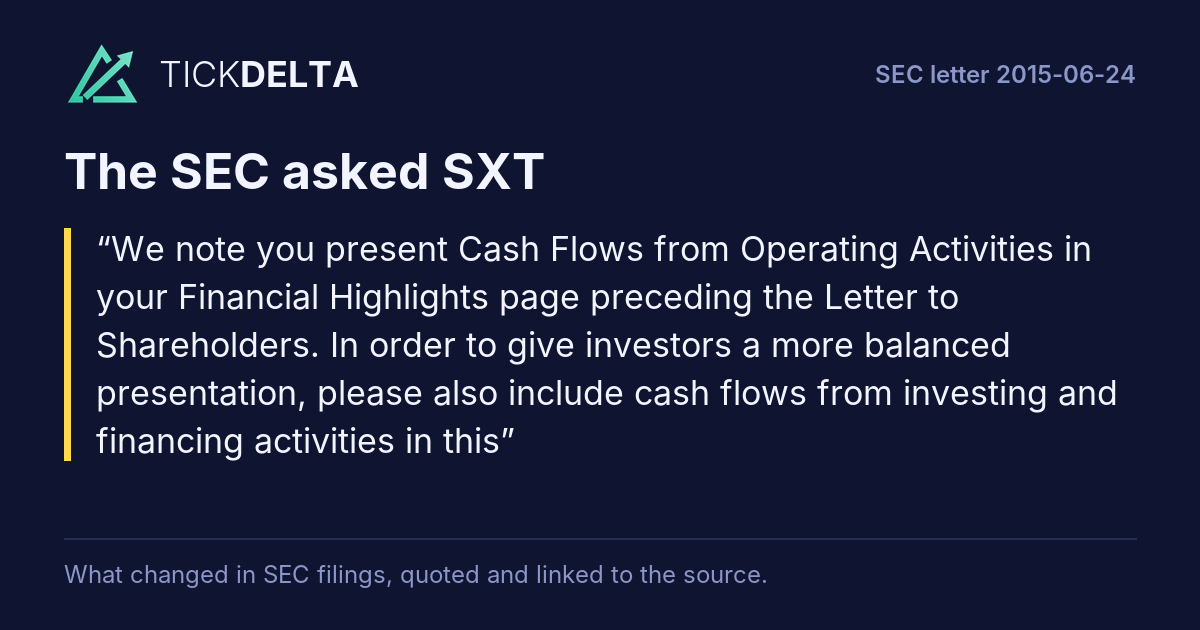
We note you present Cash Flows from Operating Activities in your Financial Highlights page preceding the Letter to Shareholders. In order to give investors a more balanced presentation, please also include cash flows from investing and financing activities in this
The following table includes the cash flows from investing and financing activities in the “Cash Flow Activity” table in the “Financial Highlights” section:Read in the reply
Cash Flow Activity
2014
2013
% Change
Cash Flows from Operating Activities
189,188
153,553
%
Cash Flows from Investing Activities
(79,149
)
(98,229
(19
%)
Cash Flows from Financing Activities
(98,553
(48,219
104
Capital Expenditures
79,398
104,246
(24
Free Cash Flow
109,790
49,307
123
Total Debt
466,899
355,174
Dividends per share
0.98
0.91
Each year we evaluate which financial measures are most importantRest of the answer
to our investors and in future filings we will include the requested items if we include cash flows from operating activities.
First report after the company's reply of Jul 8, 2015: 10-Q filed Aug 7, 2015 ↗, against the 10-Q filed May 5, 2015 ↗.
Tickdelta does not hold the text of both reports, so they are not compared here.
We note that in your Chief Executive Officer’s Letter to Shareholders he presents and discusses Non-GAAP measures using terminology that is consistent with the related GAAP measures. For instance, we note he uses terms such as “Earnings per Share” and “Operating Margins” for amounts calculated on a Non-GAAP basis.Rest of the question
We note similar potentially misleading graphics on page two, where you depict “2014 Net Income” within a red up-arrow; however, the amount you presented is actually “Adjusted Net Earnings.” We also note additional prolific use of Non-GAAP measures in your document without giving equal or greater prominence to GAAP measures. Please revise your Annual Report to Shareholders to present and discuss GAAP measures using amounts determined in accordance with GAAP. In addition please provide greater or equal prominence to GAAP measures throughout your document whenever you present and discuss Non- GAAP measures. Please refer to Item 10(e)(1) of Regulation S-K as well as the SEC’s Compliance and Disclosure Interpretation for Non-GAAP Financial Measures located at http://www.sec.gov/divisions/corpfin/guidance/nongaapinterp.htm.
In future filings, we will take the additional measures noted below to ensure that GAAP financial measures are presented with greater or equal prominence than non-GAAP financial measures. We believe that our Annual Report appropriately presented and discussed non-GAAP financial measures because we presented a table (page 15) in Management’s Discussion & Analysis of Operations and Financial Condition (“MD&A”) that provided a clear reconciliation of the non-GAAP financial results to the GAAP financial results, and we directed readers to that table on the inside front cover of the Annual Report.Read in the replyRest of the answer
The MD&A table presenting both the GAAP and non-GAAP financial results gave more prominence to the GAAP results, presenting them first. The table disclosed the impact of restructuring and other costs and presented the results excluding those items as non-GAAP financial measures.
The “Financial Highlights” table is on the inside front cover of the Annual Report and contains the first presentation of the Company’s financial results. This table includes both GAAP and non-GAAP financial measures, with the GAAP results reported above the non-GAAP results. The table also includes a footnote that clearly labeled the non-GAAP financial measures and referred readers to the more detailed MD&A discussion on page 15. The “Letter to Shareholders” begins on the page opposite to the front cover and we believe the disclosure in the “Financial Highlights” table provides an appropriate reference to readers, in understanding that the results discussed in the “Letter to Shareholders” are non-GAAP financial measures, given the proximity of the “Financial Highlights” table to the “Letter to Shareholders”.
In future filings, the Company will enhance the presentation in the “Letter to Shareholders,” including any related graphics, by clearly labeling any non-GAAP financial measures and directing readers to the reconciliation of non-GAAP financial measures to GAAP financial results in the MD&A section of the Annual Report.
The following is an example of the first paragraph of the “Letters to Shareholders” to illustrate how we would intend to enhance our future filings:
Performance and Progress*
Sensient’s 2014 adjusted earnings per share increased 11% over last year’s performance to $3.02 per share. Adjusted operating margin increased 120 basis points to 15.3% as each of our operating groups delivered higher margins this year. Overall we had a very positive year that exceeded our performance objectives.
*Included in the “Letter to Shareholders” are non-GAAP financial measures. Please see page 15 of this report (reference to Non-GAAP Financial Measures in MD&A section) for a reconciliation of these measures to GAAP and a discussion of why the Company is presenting this information.
First report after the company's reply of Jul 8, 2015: 10-Q filed Aug 7, 2015 ↗, against the 10-Q filed May 5, 2015 ↗.
Tickdelta does not hold the text of both reports, so they are not compared here.
We note in your Letter to Shareholders and MD&A you discuss revenues in terms of local currency and also excluding the impact of “rationalized business.” When you disclose revenues in local currency terms, please also disclose revenues in reporting currency terms. In addition, in all instances where discussed in your document, please quantify the impact of rationalized businesses on revenues.Rest of the question
If necessary, please provide a reconciliation of revenues after rationalization, as it appears this may be a Non-GAAP measure.
In future filings, the Company will also include the change in reporting currency terms when local currency and rationalized business changes are discussed.Read in the reply
As an example, on page 16 of the Company’s Annual Report, the first paragraph under the Results of Continuing Operations would read as follows:
Sensient’s revenue was approximately $1.4 billion in 2014 and $1.5 billion in 2013. Sensient continues to shift to value added and technology driven products in each of our Groups while actively rationalizing non-strategic and low margin business.Rest of the answer
Consolidated revenue, as reported, decreased 1.0% in 2014. Removing the impact of our rationalization efforts, our consolidated revenue increased 1.5% in 2014. Foreign currency translation did not have a material impact on consolidated revenue in 2014. Additional information on group results can be found in the Segment Information section.
First report after the company's reply of Jul 8, 2015: 10-Q filed Aug 7, 2015 ↗, against the 10-Q filed May 5, 2015 ↗.
Tickdelta does not hold the text of both reports, so they are not compared here.
Please modify your disclosure to include the amount of impairment charges you recognized in 2014 for certain long-lived assets associated with underperforming operations, in addition to presenting the post-impairment fair values. Since it appears that the amount of impairment was material, please more robustly describe the nature of the underperforming operations where you recognized asset impairments.
In future filings, the Company will enhance its MD&A to address the additional items noted. The following illustrates the form of this additional disclosure if such revision had been incorporated into the Company’s Annual Report:Read in the reply
In 2014, the Company announced that it was initiating its 2014 Restructuring Plan to eliminate underperforming operations, consolidate manufacturing facilities and improve efficiencies within the Company.Rest of the answer
The Company determined that it had redundant manufacturing capabilities in both North America and Europe, and that it could lower costs and operate more efficiently by consolidating into fewer facilities. The Company also discontinued one of the businesses in the Color Group because it did not fit with the Company’s long term strategic plan and it had generated losses for several years. The Company expects this plan to cost between $120 million and $130 million, and upon completion is anticipated to reduce annual operating costs by approximately $30 million per year. Incremental savings will be achieved over the next few years and the full benefit is expected to be achieved after 2016. Based on this plan, the Company determined that certain long-lived assets associated with the underperforming operations were impaired. The Company reduced the carrying amounts of these assets to their aggregate respective fair values of approximately $35 million, which were determined based on independent market values for these assets. Certain machinery and equipment has been identified to be disposed of at the time of the facility closures and the associated depreciation for these assets has been accelerated. In 2014, the Company recorded long-lived asset impairments of $70.2 million. In addition, certain intangible assets and inventory were determined to be impaired and were written down. Employee separation and other restructuring costs were also incurred during 2014. The Company will reduce headcount by approximately 300 positions at impacted facilities primarily in the Flavors & Fragrances Group, related to direct and indirect labor at manufacturing sites. As of December 31, 2014, approximately 100 employees have been terminated. The Company recorded $101.5 million of restructuring and other costs in 2014, in accordance with GAAP and based on internal review of affected facilities and consultation with legal and other advisors. The Company expects to incur approximately $21 million to $31 million of additional restructuring costs by the end of 2016.
First report after the company's reply of Jul 8, 2015: 10-Q filed Aug 7, 2015 ↗, against the 10-Q filed May 5, 2015 ↗.
Tickdelta does not hold the text of both reports, so they are not compared here.
We note you disclose “Operating Income” determined in accordance with ASC 280. To avoid investor confusion, please modify your captions of segment profitability to characterize the amounts as “Segment Operating Income” or “Operating Income before restructuring charges.”
We believe that the first paragraph under “Segment Information” on page 17 defines how the Company determines its operating segments and how the Company reports operating income for its segments. Within this paragraph, it is noted that Group performance is reported before restructuring charges which are reported in the Corporate & Other segment.Read in the replyRest of the answer
In future filings we will add prominent language within the section discussing the Corporate & Other segment results to make it clear that all of the restructuring charges are included in this segment, and not in the results of the other operating segments.
First report after the company's reply of Jul 8, 2015: 10-Q filed Aug 7, 2015 ↗, against the 10-Q filed May 5, 2015 ↗.
Tickdelta does not hold the text of both reports, so they are not compared here.
Please modify your disclosure to quantify the impact of items effecting Operating Income, including the impact of higher selling prices in North America and also the impact of savings associated with your restructuring program.
In future filings, the Company will modify its MD&A to address the noted item. The following illustrates the form of this disclosure if such revision had been incorporated into the Company’s Annual Report:Read in the reply
Operating income for the Flavors & Fragrances Group was $119.1 million in 2014 and $120.3 million in 2013. The decrease was primarily due to the impact of unfavorable exchange rates ($0.9 million). Higher profit in North America ($1.1 million) and Mexico ($0.4 million) was offset by lower profit in Europe ($1.8 million).Rest of the answer
The higher profit in North America was primarily due to savings associated with the restructuring program ($1.5 million), and higher selling prices, which were more than offset by lower volumes and other items. The lower profit in Europe was primarily due to higher employee costs.
First report after the company's reply of Jul 8, 2015: 10-Q filed Aug 7, 2015 ↗, against the 10-Q filed May 5, 2015 ↗.
Tickdelta does not hold the text of both reports, so they are not compared here.
As noted in our prior comment above regarding revenues, please also modify your disclosure to quantify the change in Operating Income in Europe, expressed in terms of your reporting currency.
The change in Operating Income, expressed in terms of local currency, is for the entire Flavors & Fragrances Group, not solely Europe. In future filings, the Company will modify its MD&A to state this more clearly and express the results in our reporting currency. The following illustrates the form of a revised presentation of this disclosure if such revision had been incorporated into the Company’s Annual Report:Read in the reply
As reported, operating income for the Flavors & Fragrances Group decreased 1.0 % in 2014. In local currency, operating income for the Flavors & Fragrances Group decreased 0.3%.Rest of the answer
Operating margin for the Flavors & Fragrances Group increased 40 basis points to 14.1% in 2014 from 13.7% in 2013, primarily due to the Group’s focus on higher margin, value-added products.
First report after the company's reply of Jul 8, 2015: 10-Q filed Aug 7, 2015 ↗, against the 10-Q filed May 5, 2015 ↗.
Tickdelta does not hold the text of both reports, so they are not compared here.
It appears, based on your footnote, that pension benefit payments increased substantially in 2014 and you also recognized a curtailment gain. We are unable to locate any disclosure in MD&A or the footnote regarding changes to your benefit plans. Please disclose and discuss changes to your pension plans, including the scope of any curtailment and the expected impact.
In future filings, the Company will enhance its disclosure to address the items noted. The following illustrates the form of this additional disclosure if such revision had been incorporated into the Company’s Annual Report:Read in the reply
During the year, two of the Company’s defined benefit plans were frozen resulting in the recognition of a curtailment gain. The changes to these plans will limit the plans to the current participants as well as freeze their respective benefits. In addition, a curtailment loss was recognized for a certain defined benefit plan associated with a closure of a facility.Rest of the answer
These changes did not have a material impact on the Company’s 2014 results, and they are not expected to have a material impact on future years’ results.
There was no relationship between the increase in benefit payments and the changes in the Company’s defined benefit plans.
First report after the company's reply of Jul 8, 2015: 10-Q filed Aug 7, 2015 ↗, against the 10-Q filed May 5, 2015 ↗.
Tickdelta does not hold the text of both reports, so they are not compared here.
We note your tabular presentation of restructuring charges and note that you recorded employee separation costs and long-lived asset impairment charges as a component of Selling & Administrative expenses. We note elsewhere in your document that you will reduce headcount by approximately 300 positions at impacted facilities related to direct and indirect labor at manufacturing sites.Rest of the question
Please tell us the nature of the assets that were impaired and why you have included impairment and employee separation charges as an element of Selling & Administrative expenses. We also note you present and discuss gross profits in your document that appear to exclude the impact of restructuring related charges at your manufacturing operations. Please see the Interpretive Response to Question 2 of SAB Topic 5:P.
The asset impairments that were recorded in 2014 are a result of the consolidation of facilities with redundant manufacturing capabilities in both North America and Europe. The Company believes that these costs are more accurately reported in Selling & Administrative expense as the cost of these actions did not impact the cost of making the Company’s products. The Company does report the write down of inventory associated with the Company’s restructuring activities in Cost of Products Sold, as this cost is directly associated with cost of the Company’s products.Read in the replyRest of the answer
The classification of these costs in operating income, as described above, has been our customary practice.
Management has reviewed the Interpretive Response to Question 2 of SAB Topic 5:P, and believes that the interpretation is focused on the presentation of the face of the income statement. Our disclosure clearly details where these costs are classified in the income statement and such charges are not presented below operating income in accordance with SAB Topic 5:P.
First report after the company's reply of Jul 8, 2015: 10-Q filed Aug 7, 2015 ↗, against the 10-Q filed May 5, 2015 ↗.
Tickdelta does not hold the text of both reports, so they are not compared here.
We note your response to our prior comment number four. Please further enhance your proposed disclosures to provide more detailed information regarding your redundant manufacturing capabilities. Please include a discussion of the Group(s) where such redundancies existed, along with the number of facilities impacted and the specific locations of redundant operations within North America and Europe.
In future filings, the Company will enhance its MD&A to address the additional items noted. The following illustrates the form of this additional disclosure if such revision had been incorporated into the Company’s Annual Report:Read in the reply
In 2014, the Company announced that it was initiating its 2014 Restructuring Plan to eliminate underperforming operations, consolidate manufacturing facilities and improve efficiencies within the Company.Rest of the answer
The Company determined that it had redundant manufacturing capabilities in both North America and Europe, and that it could lower costs and operate more efficiently by consolidating into fewer facilities. Eight facilities were identified for consolidation in the Flavors & Fragrances segment, four in North America and four in Europe. To date, closures have been announced in Indianapolis, Indiana, United States; Cornwall, Mississauga and Halton Hills, Canada; Bremen, Germany; and Milan, Italy. The Company also discontinued one of the businesses in the Color Group, located near Leipzig, Germany, because it did not fit with the Company’s long term strategic plan and it had generated losses for several years. The Company expects this plan to cost between $120 million and $130 million, and upon completion is anticipated to reduce annual operating costs by approximately $30 million per year. Incremental savings will be achieved over the next few years and the full benefit is expected to be achieved after 2016. Based on this plan, the Company determined that certain long-lived assets associated with the underperforming operations were impaired. The Company reduced the carrying amounts of these assets to their aggregate respective fair values of approximately $35 million, which were determined based on independent market values for these assets. Certain machinery and equipment has been identified to be disposed of at the time of the facility closures and the associated depreciation for these assets has been accelerated. In 2014, the Company recorded long-lived asset impairments of $70.2 million. In addition, certain intangible assets and inventory were determined to be impaired and were written down. Employee separation and other restructuring costs were also incurred during 2014. The Company will reduce headcount by approximately 300 positions at impacted facilities primarily in the Flavors & Fragrances Group, related to direct and indirect labor at manufacturing sites. As of December 31, 2014, approximately 100 employees have been terminated. The Company recorded $101.5 million of restructuring and other costs in 2014, in accordance with GAAP and based on internal review of affected facilities and consultation with legal and other advisors. The Company expects to incur approximately $21 million to $31 million of additional restructuring costs by the end of 2016.
First report after the company's reply of Aug 18, 2015: 10-Q filed Nov 6, 2015 ↗, against the 10-Q filed May 5, 2015 ↗.
Tickdelta does not hold the text of both reports, so they are not compared here.
We note your response to our prior comment number five. As previously requested, please revise the caption of your segment profitability measure to avoid investor confusion.
In future filings we will revise the name of our segment profitability measure and refer to “segment operating income.” The following illustrates the form of this disclosure if such revision had been incorporated into the Company’s Annual Report:Read in the reply
Segment operating income for the Color segment increased 6.5% to $114.9 million in 2014 from $107.9 million in 2013. The increase was primarily due to non-food colors ($5.5 million) and food and beverage colors ($2.3 million) partially offset by the unfavorable impact of exchange rates ($0.8 million).Rest of the answer
The higher profit for non-food colors was primarily due to the higher volumes and favorable product mix. The higher profit for food and beverage colors was primarily due to higher selling prices. Segment operating margin for the Color segment increased 80 basis points to 22.6% in 2014 from 21.8% in 2013.
First report after the company's reply of Aug 18, 2015: 10-Q filed Nov 6, 2015 ↗, against the 10-Q filed May 5, 2015 ↗.
Tickdelta does not hold the text of both reports, so they are not compared here.
We note your response to our prior comment number eight. We note from your filing, benefit payments increased from $5.2 million in 2013 to $23.7 million in 2014. We further note benefit payments in 2015 are expected to decrease to $9.6 million. Please explain to us and disclose the reason(s) for the increase in benefit payments in 2014.
The increase in the benefit payments in 2014 was primarily a result of the 2014 retirement of the Company’s former Chief Executive Officer and the payment of his defined benefit pension during the year. In future filings, the Company will enhance its disclosure to address the items noted. The following illustrates the form of this additional disclosure if such revision had been incorporated into the Company’s Annual Report:Read in the reply
During the year, two of the Company’s defined benefit plans were frozen resulting in the recognition of a curtailment gain.Rest of the answer
The changes to these plans will limit the plans to the current participants as well as freeze their respective benefits. In addition, a curtailment loss was recognized for a certain defined benefit plan associated with a closure of a facility. These changes did not have a material impact on the Company’s 2014 results, and they are not expected to have a material impact on future years’ results. The increase in benefit payments in 2014 was primarily due to the retirement of the Company’s former Chief Executive Officer, who received his defined benefit pension in a lump sum payment during the year.
First report after the company's reply of Aug 18, 2015: 10-Q filed Nov 6, 2015 ↗, against the 10-Q filed May 5, 2015 ↗.
Tickdelta does not hold the text of both reports, so they are not compared here.