Form 10-K for the Fiscal Year Ended December 31, 2022
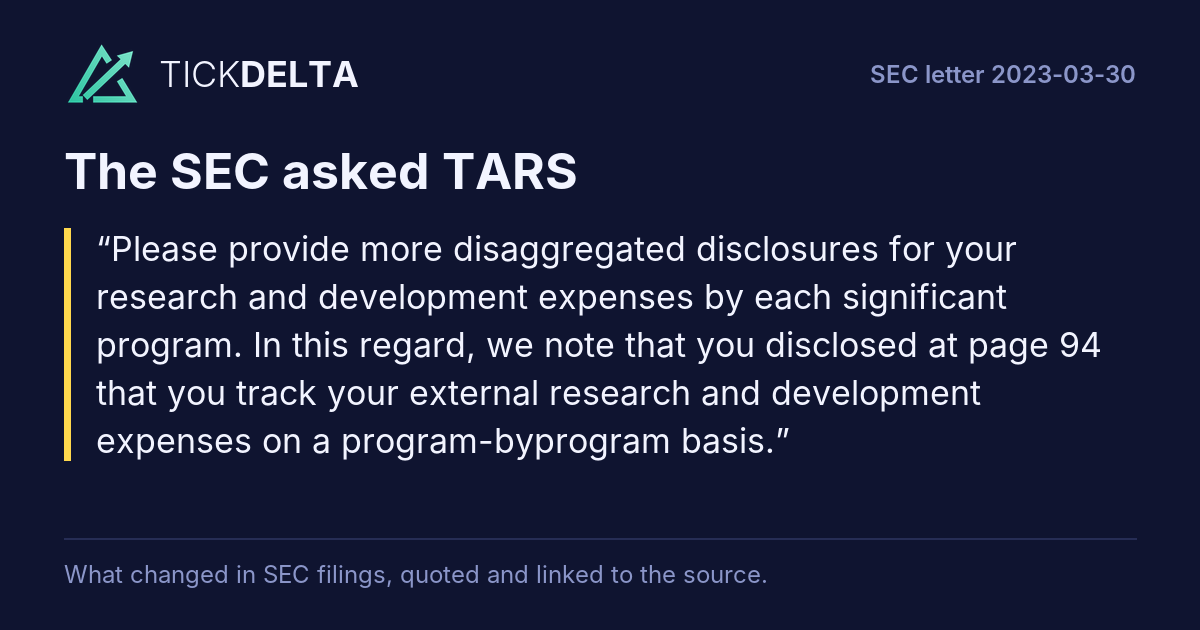
Please provide more disaggregated disclosures for your research and development expenses by each significant program. In this regard, we note that you disclosed at page 94 that you track your external research and development expenses on a program-byprogram basis.
TheRead in the reply
Company respectfully acknowledges the Staff’s comment and confirms that it will provide disaggregated disclosure for significant external research and development costs by program in its future annual and quarter filings under the Securities
Exchange Act of 1934, as amended, beginning with the Company’s upcoming filing on Form 10-Q for the quarter ended March 31, 2023.
First report after the company's reply of Apr 13, 2023: 10-Q filed May 9, 2023 ↗, against the 10-Q filed Nov 9, 2022 ↗.
Tickdelta does not hold the text of both reports, so they are not compared here.
Please address the following comments with regard to your accounting and disclosures for your Out-License of TP-03 Commercial Rights in Greater China with LianBio Ophthalmology Limited. • Describe all material terms of the agreement, including the material rights and obligations of each party.Rest of the question
• Provide us an analysis of your revenue recognition under ASC 606, including your determination of the performance obligations, the transaction price, the amount allocated to each performance obligation, and your revenue recognition method (i.e. over time or point in time) for each performance obligation. • Tell us who is responsible for the achievement of additional TP-03 events discussed on page 22 which may result in additional consideration and clarify that the additional consideration is not included in the transaction price, if such is the case. Confirm that you have no further performance obligations including any clinical work with respect to either TP-03 for the treatment of Demodex blepharitis or MGD. • Tell us if the license was determined to be distinct and your basis for it. • Clarify how you are accounting for the drug supply agreement discussed on page 93 and provide references within ASC 606 to support your accounting treatment. • Lastly, clarify what is included in the line item "collaboration revenue" in your statement of operations. Please provide us your proposed future disclosures, as necessary.
•Read in the reply
Describe all material terms of the agreement, including the material rights and obligations of each party.
On March 26, 2021, the Company entered into a development and license agreement (the “LianBio
Agreement”) with LianBio Ophthalmology Limited (“LianBio”), pursuant to which, the Company licensed the product rights for the development and commercialization of TP-03 (lotilaner ophthalmic solution, 0.25%) in the People’s Republic of China, Hong Kong, Macau, and Taiwan (the “Territory”) for the treatment of Demodex blepharitis and Meibomian Gland Disease (“MGD”).Rest of the answer
Under the terms of the LianBio
Agreement, the Company is entitled to (i) aggregate upfront payments of $25.0 million by June 2021, (ii) development and commercial milestone payments of up to an aggregate of $75.0 million and $100.0 million, respectively,
(iii) tiered low-to-high teen royalties on the sale of TP-03 in the Territory; and an equity warrant exercisable for the purchase of LianBio ordinary shares, the receipt of which are discussed below, as applicable.
The LianBio Agreement established a
Joint Steering Committee with an equal number of representatives from the Company and LianBio to serve as a forum for communication with regards to (a) the overall state of the alliance; (b) progress of the Company and LianBio’s development and commercialization activities; (c) the Territory-specific development plan; and (d) clinical trials for Demodex blepharitis or MGD that support development or regulatory approval of any compound or licensed product inside or outside the Territory (this excludes Saturn-1 and Saturn-2 trials, as described further below).
CONFIDENTIAL TREATMENT
REQUESTED
BY TARSUS PHARMACEUTICALS, INC.
Pursuant to the terms of the LianBio Agreement, LianBio may extend the Phase 3 Milestone by an additional 12 months by paying the Company $[***] creditable against the amount payable for a specified development milestone payment, if such development milestone payment becomes due. LianBio may also extend the regulatory approval milestone by an additional 12 months by paying the Company $[***], creditable against the amount payable for a specified development milestone payment, if such development milestone payment becomes due.
The Company’s responsibility pursuant to the LianBio Agreement included completion of clinical study data for TP-03 Phase 2b/3 (Saturn-1) and Phase 3 (Saturn-2) trials. At any point during the clinical trial activity through completion, LianBio is able to request and access the clinical trial data. Pursuant to the LianBio Agreement, LianBio is contractually responsible for all clinical development and commercialization activities and costs incurred within the Territory.
Under the terms of the LianBio Agreement, the specific development and commercial milestone events and related payments are as follows:
Milestone Event
Payment
Amount
(000’s)
Development Milestones:
(i)
[***]
$
[***
]
(ii)
(iii)
(iv)
(v)
(vi)
Total Development Milestones
75,000
Commercial Milestones:
Total Commercial Milestones
100,000
Total Milestones
175,000
The warrant to purchase ordinary shares of LianBio represents a minority interest in LianBio upon issuance, which vests upon the achievement of certain development and regulatory milestones. The warrant will be exercisable at the fair market value at the time of issuance. The warrant shall vest and be exercisable upon achievement of the following milestones: [***].
The LianBio Agreement includes conditions for supply agreements (collectively, the “Drug Supply
Agreement”) to be negotiated in good faith and executed between the Company and LianBio. The Company will supply Licensed Product, as defined in the LianBio Agreement, (the “Licensed Product”), to LianBio for development and commercialization purposes in the Territory, in accordance with separate written agreements, one for supply in clinical trials (“Clinical Supply Agreement”) and another for commercialization (“Commercial Supply Agreement”).
In December 2021, the Company and LianBio entered into a binding term sheet outlining the principal terms and conditions and basis to negotiate the Drug Supply Agreement. The binding term sheet specified that the Company would be paid one-time payments of $[***] upon execution of the respective
Clinical Supply Agreement and Commercial Supply Agreement aggregating to a total of up to $[***].
Provide us an analysis of your revenue recognition under ASC 606, including your determination of the performance obligations, the transaction price, the amount allocated to each performance obligation, and your revenue recognition method (i.e. over time or point in time) for each performance obligation.
The Company evaluated and concluded that the arrangement reflected a transaction with a customer. The Company is receiving consideration in exchange for delivering an out-license, in addition to access to clinical trial research and development activities and results. These activities fall within the scope and accounting of ASC 606 contracts with customers. The following summarized the Company’s analysis of revenue recognition under ASC 606:
Determination of the performance obligations
In accordance with
ASC 606-10-25-14 the Company identified the following performance obligations in the arrangement at contract inception:
(1) an exclusive license to research, develop, manufacture, commercialize, make, offer for sale, sell and import the licensed products in the Territory; and (2) research and development services in the form of completed clinical study materials for the respective Saturn-1 and Saturn-2 trials. The promises to provide research and development services for Saturn-1 and Saturn-2 clinical trials were evaluated and determined to be distinct promises in the contract and each of the two clinical trials are separate performance obligations apart from the promise to provide the license.
The Company also considered whether the Joint Steering Committee represented a distinct performance obligation and determined that it was formed only as a governance activity to provide the Company protectionary rights that was not meant to be a separate service that would provide benefit to the customer. The Company further evaluated that the Joint Steering Committee is not material to the overall promises in the agreement.
Transaction Price
The transaction price includes nonrefundable upfront payments, development milestones, commercialization milestones, equity warrants, and royalties.
Under ASC 606-10-32-8, the Company used the most likely amount method to determine the transaction price for development milestones. The Company evaluated at contract inception whether the achievement of the development milestones were within the control of the Company. Based on this evaluation, the Company included the $10.0 million milestone amount in the transaction price related to milestones within the control of the Company. Given the high degree of inherent uncertainty around the occurrence of the remaining contingent development milestones, the Company determined these milestone amounts were outside of the control of the Company and milestone receipts were at-risk at contract inception. Therefore, the Company constrained the consideration associated with these milestones until resolution of the uncertainty associated with these payments. As the variability around the development milestones are resolved, the Company allocated the consideration to each of the performance obligations, as discussed further below. Subsequent to execution of the LianBio Agreement, the Company met certain development milestone performance obligations and at that time adjusted the transaction price and amount allocated to each of the performance obligations in accordance with ASC 606-10-32-43 at each reporting period.
The Company applied the accounting in ASC 606-10-55-65 to account for the commercial milestones and royalties. The Company evaluated that the license is the predominant promise in the contract as it is the provision that allows LianBio to generate future revenues. Therefore, under the sales-or-usage-based royalty exception, the Company recognizes revenue based on the contractual percentage of LianBio’s sale of products to its customers at the later of (i) the occurrence of the related product sales or (ii) the date upon which the performance obligation to which some or all of the royalty has been allocated has been satisfied or partially satisfied. There have been no TP-03 product sales in the Territory and therefore, the commercial milestone and royalty amounts were not included in the transaction price at contract inception.
The warrant to purchase ordinary shares of LianBio represented noncash consideration under ASC 606. In accordance with ASC 606-10-32-21 through 32-24, the
Company included the estimated fair value of the warrants in the transaction price at contract inception.
Allocation of the
Transaction Price to each Performance Obligation
In accordance with ASC 606-10-32-29, to meet the allocation objective, an entity shall allocate the transaction price to each performance obligation identified in the contract on a relative standalone selling price basis in accordance with paragraphs 606-10-32-31 through
32-35, except as specified in paragraphs 606-10-32-36 through 32-38 (for allocating discounts) and paragraphs 606-10-32-39 through 32-41 (for allocating consideration that includes variable amounts).
In order to estimate the standalone selling price for license performance obligation, the Company considered ASC 606-10-32-34 and utilized an adjusted market assessment approach. The Company determined the standalone selling price by using a discounted projected sales model that included estimated product sales attributable to the license and discounted the sales using a present value factor. The Company believes this approach approximates the standalone selling price of the license as it represents the present value of all expected benefit for LianBio, its customer.
In order to estimate the standalone selling price for the respective research and development service performance obligations for Saturn-1 and Saturn-2, the Company considered ASC
606-10-32-34 and utilized the adjusted market assessment approach. The Company analyzed costs expected to be incurred for each of the clinical trials through completion to estimate the price that a customer would be willing to pay for these services in order to benefit from the clinical trials.
Based on the Company’s application of ASC 606, the Company determined that the amount of the transaction price allocated to each performance obligation is as follows:
Performance Obligation
Allocated
(i) License for exclusive development and commercialization of TP-03 in the Territory for the treatment of Demodex blepharitis and MGD
$[***
(ii) Research and development services related to Saturn-1, including delivery of the clinical trial results
(iii) Research and development services related to Saturn-2, including delivery of the clinical trial results
Total
36,233
Revenue Recognition Method
In accordance with ASC
606-10-55-62 through 55-63, the Company determined that the license provides the right to use intellectual property as it exists at the point in time at which the license is granted as the license was sufficiently developed for LianBio to benefit from it. Therefore, the amount initially allocated to the license performance obligation was recognized as revenue at contract inception, upon delivery of the license.
In accordance with ASC 606-10-25-27, the Company determined that LianBio simultaneously benefits from the research and development services that are satisfied over time, as they are able to request and access the clinical trial data at any point through the trial completion. Therefore, the Company recognized the amounts allocated to the respective research and development performance obligations for
Saturn-1 and Saturn-2 over the expected period of time that each clinical trial is ongoing, based on an input method as the related costs are incurred. The Company monitored the expected completion dates for each clinical trial and updated its estimated time to completion at each reporting period, as necessary.
Tell us who is responsible for the achievement of additional TP-03 events discussed on page 22 which may result in additional consideration and clarify that the additional consideration is not included in the transaction price, if such is the case.Confirm that you have no further performance obligations including any clinical work with respect to either TP-03 for the treatment of Demodex blepharitis or MGD.
The Company disclosed in its Form 10-K on page 22 that “We will be eligible to receive further consideration from LianBio upon the achievement of additional TP-03 events, including: (i) additional development milestone payments of up to an aggregate of $25.0 million (includes $2.5 million for a milestone triggered in February 2023), (ii) China-based TP-03 sales threshold milestone payments of up to an aggregate of $100.0 million,
(iii) tiered low-to-high-teen royalties for the Territory TP-03 product sales, and (iv) vesting of a LianBio equity warrant upon certain regulatory milestones.”
LianBio is responsible for the achievement of remaining development milestones, as well as the commercial milestones, Territory TP-03 product sale thresholds, and regulatory milestones. The additional consideration for these milestone events is not included in the transaction price at contract inception.
Apart from the promises in separately executed Clinical Supply Agreement in February 2023 and the Commercial Supply Agreement that is to be executed, as discussed below, the Company has no further performance obligations pursuant to the LianBio Agreement, including any clinical work with respect to TP-03 for the treatment of Demodex blepharitis. The Company is in control of the initiation and completion of any MGD clinical trial activities, and therefore, assessed that this is not a performance obligation in the LianBio Agreement. The Company will, however, deliver clinical data to LianBio if it completes a pivotal trial for MGD.
Pursuant to the LianBio Agreement, the Company and LianBio shall negotiate in good faith and enter into a Commercial Supply Agreement by which LianBio will source from the Company, and the Company will supply LianBio, the Licensed Product. The Company and LianBio are responsible for executing the mutually satisfactory
Commercial Supply Agreement. The additional consideration for this achievement is not included in the transaction price at contract inception.
Tell us if the license was determined to be distinct and your basis for it.
The Company determined that the license is distinct from other promises in the arrangement. The Company assessed the LianBio Agreement in accordance with ASC 606-10-25-14 and ASC 606-10-25-19 and identified the following to be considered: (1) an exclusive license to research, develop, manufacture, commercialize, make, offer for sale, sell and import the licensed products in the Territory; and (2) research and development services in the form of completed clinical study materials for the respective Saturn-1 and Saturn-2 trials.
The Saturn-1 and
Saturn-2 trials were initiated to evaluate the safety and efficacy of the Licensed Product. The Company believes the nature of the research and development services, explicitly promised in the arrangement, indicate that the license is distinct within the context of the contract. In assessing that the license is capable of being distinct from other promises, the Company considered that LianBio has the research and development capabilities to benefit from the functional intellectual property given their robust pipeline of product candidates in therapeutic areas and the availability of the associated expertise in the general marketplace. In addition, the Company considered whether LianBio can benefit from a promise for its intended purpose without the receipt of the remaining promise, whether the value of the promise is dependent on the unsatisfied promise, whether there are other vendors that could provide the remaining promise, and whether it is separately identifiable from the remaining promise.
Clarify how you are accounting for the drug supply agreement discussed on page 93 and provide references within ASC 606 to support your accounting treatment.
The Drug Supply Agreement on page 93 refers to the binding term sheet entered into in December 2021, as referred to above in the description of the material terms of the LianBio Agreement. The binding term sheet provides the basis to negotiate definitive agreements in good faith. As of December 31,
2022, no Clinical Supply Agreement or Commercial Supply Agreement had been executed. In accordance with ASC 606-10-25-2, the binding term sheet did not create an enforceable right beyond negotiating specific terms in definitive agreements.
In accordance with ASC 606-10-32-8, the Company utilized the most likely amount method to estimate the amount of consideration to which it will be entitled.
Given the high degree of uncertainty around the occurrence of these events, the Company determined the amounts to be constrained at contract inception and until the uncertainty associated with these payments is resolved. [***].
Lastly, clarify what is included in the line item “collaboration revenue” in your statement of operations.
Collaboration revenue in the statement of operations and comprehensive loss consists of the revenue recognized for research and development services performed pursuant to the LianBio Agreement. Specifically, this line item includes the proportion of allocated transaction price recognized over time, as the
TP-03 Saturn-1 and Saturn-2 clinical trials are completed, and the associated clinical data and reports are delivered to LianBio.
License revenue recognized from the LianBio Agreement was disclosed in the license fees line in the statement of operations and comprehensive loss.
The Company respectfully acknowledges the Staff’s comment and in response, advises the Staff that it will supplement its existing disclosures included in the notes to the financial statements to provide additional detail regarding its revenue recognition and related accounting policies for out-license arrangements. For the convenience of the Staff, we attach the relevant paragraphs from our footnotes as Appendix A.
First report after the company's reply of Apr 13, 2023: 10-Q filed May 9, 2023 ↗, against the 10-Q filed Nov 9, 2022 ↗.
Tickdelta does not hold the text of both reports, so they are not compared here.
Also in this review: closing letter, 2023-04-18