Screener / SEC EDGAR /CIK 0000816761 /10-K filed Feb 27, 2026, compared with Feb 21, 2025 /Numbers from the XBRL of the 10-Ks
NYSE Technology · Software

Teradata Corp TDC

Compare with peers Embed
SEC comment letters, last 20 years

3 reviews of TDC's filings by SEC staff

UPLOAD and CORRESP
Reviews 3 latest letter Sep 21, 2022
Questions asked 12 each answered in the company's own letter
No closing letter 0 reviews without a letter saying the staff completed it

When the SEC's staff reviews a filing, it writes to the company with numbered questions, and the company answers each one in a letter. SEC publishes the exchange once the review is over, at least 20 business days later. A question is not an accusation; most reviews end with the company adding detail to its next filing.

How the reviews went

Every review on EDGAR, from the first staff letter to the letter that closes it

  1. 1. Staff letters 3 UPLOAD
  2. 2. Questions in them 12 numbered comments
  3. 3. Company replies 3 CORRESP
  4. 4. Reviews closed 3 of 3 closing letter

Half the closed reviews took 29 days or less from the first letter to the closing letter.

Form 10-K

2022-09-21 to 2022-10-20 · 4 questions · 1 letter from the SEC, 1 from the company
Review closed 2022-10-20
Results discussion (MD&A)Revenue
Management's Discussion and Analysis of Financial Condition and Results of Operations · Overview, page 27
SEC asked (1)
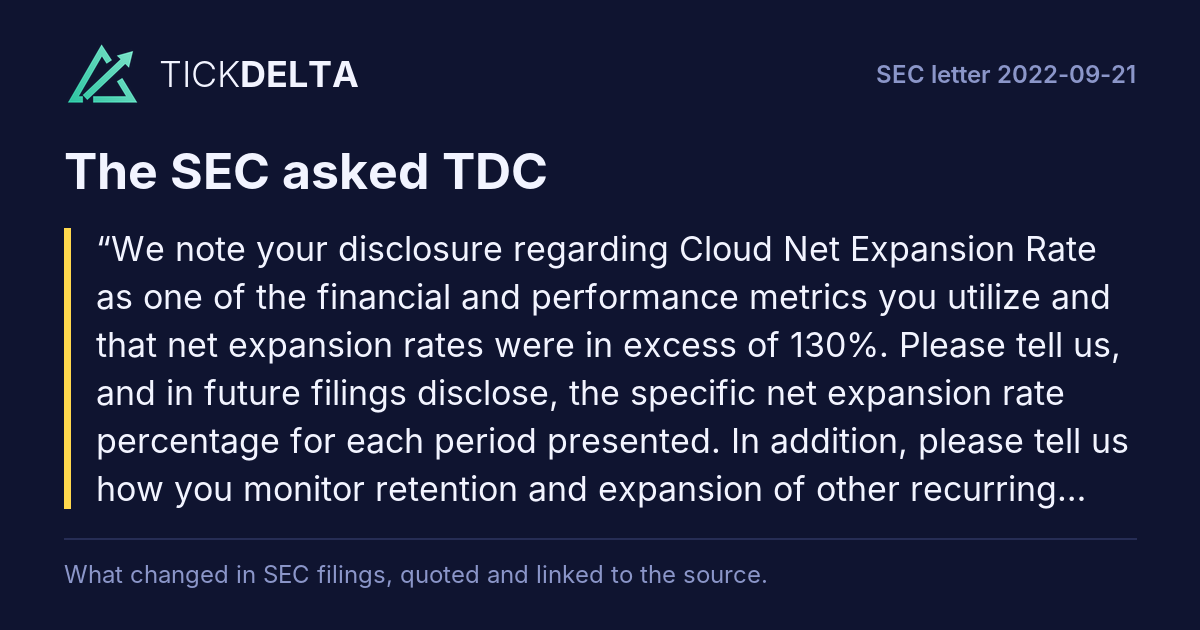
We note your disclosure regarding Cloud Net Expansion Rate as one of the financial and performance metrics you utilize and that net expansion rates were in excess of 130%. Please tell us, and in future filings disclose, the specific net expansion rate percentage for each period presented.
Rest of the question

In addition, please tell us how you monitor retention and expansion of other recurring revenues, such as subscription arrangements and maintenance and software upgrade rights, considering the relative significance of the related revenues and Annual Recurring Revenue (ARR). Refer to Item 303(a) of Regulation S-K and SEC Release No. 33-10751.

TDC answered
As disclosed in its periodic filings, the Company is in a period of transformation. Its transition to a subscription-based business model is largely complete and the Company has shifted its focus to its strategy to transform into a cloud-first company. Part of this strategy includes transitioning on-premises customers to the cloud.

The Company considered Item 303(a) of Regulation S-K and SEC Release No. 33-10751 when preparing its MD&A disclosures.
Rest of the answer

Given the Company’s focus on cloud growth during this transformation stage, the Company’s management currently monitors its Cloud Net Expansion Rate as they manage the Company’s transformation and business. In addition, because the Company expects that on-premises subscriptions and maintenance and software upgrade rights will continue to shift from on-premises to the cloud, the Company does not consider the retention and expansion metrics related to the individual components of other recurring revenue to be important or material and, as such, does not regularly monitor the retention or expansion rate for such items.

The Company’s Cloud Net Expansion Rate percentage was as follows:

Cloud Net Expansion Rate

As of Dec. 31 Percentage

2021 133%

2020 138%

The Company will disclose the specific Cloud Net Expansion Rate for each period presented in its future filings as the Company continues its transformation to a cloud-first company.

Read in the reply
In its next report

First report after the company's reply of Oct 5, 2022: 10-Q filed Nov 8, 2022 ↗, against the 10-Q filed Aug 5, 2022 ↗.

Tickdelta does not hold the text of both reports, so they are not compared here.

Consolidated Financial Statements · Consolidated Statements of Income (Loss), page 43
SEC asked (2)
It appears based on your disclosure on page 49 that on-premises subscription revenue that is not cancellable is recognized upfront at a point in time and that such revenue is included within the recurring subscription line item. Please explain your basis for characterizing on-premise subscription licenses recognized at a point in time as recurring and quantify the amount of such revenues for each period presented.
TDC answered
As described in more detail in response to comment 3, the vast majority of the Company’s on-premises subscription licenses are cancellable by its customers either monthly or annually. The amount of revenue associated with noncancellable on-premises subscription licenses that is included in the recurring subscription revenue line item was less than 1% of consolidated revenue for each of the fiscal years ended December 31, 2020 and 2021.
Rest of the answer

Because of the immaterial nature of noncancellable on-premises subscription licenses to the Company’s consolidated results, such agreements were not excluded from recurring revenue.

Read in the reply
In its next report

First report after the company's reply of Oct 5, 2022: 10-Q filed Nov 8, 2022 ↗, against the 10-Q filed Aug 5, 2022 ↗.

Tickdelta does not hold the text of both reports, so they are not compared here.

Note 1 Description of Business, Basis of Presentation and Significant Accounting Policies · Revenue Recognition, page 48
SEC asked (3)
We note your disclosure on page 30 that on-premise customer transactions involving substantive long-term commitments are recognized on a recurring annual basis rather than a recurring quarterly basis resulting in a $30 million net positive impact in 2021 compared to 2020.
Rest of the question

Please tell us the following related to such transactions: • Describe the nature of the arrangements and terms of the long-term commitments, including any cancellation provisions. • Describe how the arrangements you recognize on an upfront annual basis differ from those that are recognized on a quarterly or monthly basis. • Explain why recognizing on an annual basis rather than quarterly basis resulted in a net positive impact on revenues for 2021. • Quantify the total amount of revenues from arrangements recognized on an annual basis for each period presented.

TDC answered
The Company notes the following:

•On-Premises Subscription Arrangements: The Company has on-premises term-based software licenses with contractual terms that are primarily three years that the Company refers to as subscriptions. The vast majority of the Company’s on-premises subscription licenses include a contractual right for the customer to cancel on either a monthly or annual basis.

•Annual Recognition: As a result of the cancellation provisions included in the Company’s on-premises arrangements, subscription license revenue from such arrangements is recognized at a point in time each
Rest of the answer

month or a point in time each year, as applicable. The terms of the on-premises subscription arrangements where the Company recognizes subscription license revenue at a point time once a year are substantially similar to the terms of the on-premises arrangements where the Company recognizes subscription license revenue at a point in time each month, with the primary difference being whether the cancellation clause is annual or monthly as noted above.

•Impact to 2021 and Total Revenues for Annual Arrangements: In 2021, an increasing number of the Company’s customers transitioned to annual cancellation notice provisions for its on-premises subscription licenses, as compared to monthly notice periods in 2020. As a result, the mix of contracts in 2021 reflected a larger number of on-premises subscription arrangements with annual cancellation provisions where the annual license fee revenue is recognized at a point in time on an annual basis, as compared to a point in time on a monthly basis. The change in the mix of contracts, and the timing of those agreements during the year, contributed to a higher amount of on-premises subscription license revenue in 2021 as compared to 2020. The total amount of license revenue recognized from on-premises subscription license arrangements recognized on an annual basis in 2021 was $95 million (5% of total consolidated revenue). In 2020, the total amount of license revenue recognized from on-premises subscription license arrangements recognized on an annual basis was less than 1% of total consolidated revenue. To the extent the mix and timing of on-premises subscription licenses has a material impact on the Company’s consolidated financial results in future periods, the Company will provide clarifying disclosure on the impact consistent with the commentary above.

Read in the reply
In its next report

First report after the company's reply of Oct 5, 2022: 10-Q filed Nov 8, 2022 ↗, against the 10-Q filed Aug 5, 2022 ↗.

Tickdelta does not hold the text of both reports, so they are not compared here.

Overview, page 19
SEC asked (4)
Please explain to us why you no longer disclose subscription ARR and maintenance and software upgrade rights ARR in your 2022 Forms 10-Q. In this regard, we note that these two ARR measures comprised over 85% of total ARR at December 31, 2021. Please quantify for us the amount of subscription ARR and maintenance and software upgrade rights ARR at March 31, 2022 and June 30, 2022.
TDC answered
The Company has historically provided (i) a breakout of Total ARR by revenue stream on an annual basis within the Form 10-K and (ii) Total ARR and, given the Company’s strategic cloud-first focus as discussed within the response to comment 1, Cloud ARR amounts within its Form 10-Q filings for 2022. As both Total ARR and Cloud ARR were disclosed, ARR for the non-cloud revenue streams is the mathematical difference between these two metrics.

Following are the individual components of ARR:

•Q1 2022:

oCloud ARR: $209 million oSubscriptions: $876 million oMaintenance and Upgrade: $342
Rest of the answer

million

•Q2 2022:

oCloud ARR: $234 million oSubscriptions: $833 million oMaintenance and Upgrade: $323 million

In future filings, the Company will disclose subscription ARR and maintenance and software upgrade rights ARR on a quarterly basis.

* * * * *

The Company acknowledges that it is responsible for the accuracy and adequacy of its disclosures, notwithstanding any review, comments, action or absence of action by the staff. Please do not hesitate to contact me at (858)-485-2993 or [email protected] if there are any comments or questions concerning the foregoing or if we can be of assistance in any way.
Read in the reply

Also in this review: closing letter, 2022-10-20
Form 10-K

2018-10-17 to 2018-11-19 · 4 questions · 1 letter from the SEC, 1 from the company
Review closed 2018-11-19
RevenueResults discussion (MD&A)
Condensed Consolidated Statements of Income (Loss), page 3
SEC asked (1)
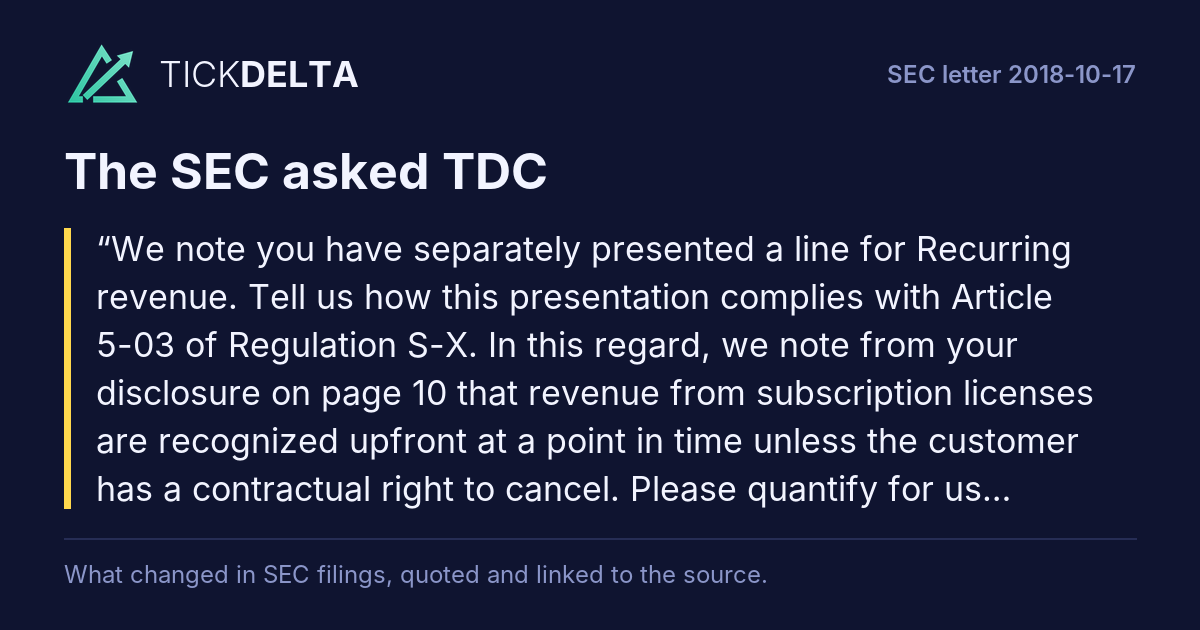
We note you have separately presented a line for Recurring revenue. Tell us how this presentation complies with Article 5-03 of Regulation S-X. In this regard, we note from your disclosure on page 10 that revenue from subscription licenses are recognized upfront at a point in time unless the customer has a contractual right to cancel.
Rest of the question

Please quantify for us amounts related to subscription licenses that are recognized upfront and amounts that are recognized on a month-to-month basis.

TDC answered
As part of the Company’s business transformation, the Company is transitioning from perpetual software licenses to term-based software licenses that the Company refers to as subscriptions. To better reflect this shift in the business and align the reporting with the way management discusses and evaluates the performance of the business, the Company revised its presentation in the first quarter of 2018 to include a separate caption called recurring revenue.
Rest of the answer

Recurring revenue generally consists of recurring services revenue, hardware rentals, and subscription licenses that include a contractual right for the customer to cancel and are recognized on a month-to-month basis. Subscription license revenue recognized on a month-to-month basis (i.e., other revenue) and rental revenue have been aggregated with other recurring revenue amounts (which are otherwise services-related revenue) as the amounts are not more than 10% of our total consolidated revenue (individually and in the aggregate). The Company respectfully concluded that it is in compliance with Rule 5-03 and believes that the additional presentation of recurring revenue as a separate revenue stream from perpetual software licenses and hardware revenue and consulting services revenue is useful to the readers of the financial statements and the related management’s discussion and analysis of the statements of income.

Subscription licenses without customer cancellation rights are recognized upfront and are not included within the recurring revenue caption. The amounts are reported within the perpetual software licenses and hardware caption and were less than 1% of total consolidated revenue for the six months ended June 30, 2018. Subscription licenses that include a contractual right for the customer to cancel are recognized on a month-to-month basis and are presented within the recurring revenue caption. These transactions amounted to less than 3% of total consolidated revenue for the six months ended June 30, 2018.

While we believe that an aggregated presentation of recurring revenue better reflects the key revenue streams and revenue recognition patterns from a subscription business, the Company will continue to monitor such arrangements. If any such revenue stream as defined by Rule 5-03 becomes a material component of our consolidated revenue in the future, the Company will update its disclosures as appropriate so that it continues to comply with Rule 5-03.

The Company will also, in future filings, beginning with the Form 10-Q for the nine months ended September 30, 2018 (the "2018 Q3 Form 10-Q”), clarify that subscription licenses where the customer has a contractual right to cancel and revenue is recognized on a month-to-month basis are included in the recurring revenue caption while subscription licenses recognized upfront are included in the perpetual software licenses and hardware caption. For the convenience of the Staff, revised disclosure has been set forth below compared to the disclosure which appeared on page 10 of the Company’s June 30, 2018 Form 10-Q (the “2018 Q2 Form 10-Q”). In this regard, please note that the proposed disclosures which have been added in response to the Staff's Comment have been noted in underlined bold italics.

Subscriptions - The Company sells on and off-premises subscriptions to our customers through our subscription licenses, cloud, service model, and rental offerings. Teradata’s subscription licenses include a right-to-use license and revenue is recognized upfront at a point in time unless the customer has a contractual right to cancel, where revenue is recognized on a month-to-month basis and is included within the recurring revenue caption. Subscription licenses recognized upfront are reported within the perpetual software licenses and hardware caption. Cloud and service model arrangements include a right-to-access software license on Teradata owned or third party owned hardware such as the public cloud. Revenue is recognized ratably over the contract term and is included within the recurring revenue caption. Service models typically include a minimum fixed amount that is recognized ratably over the contract term and may include an elastic amount for usage above the minimum, which is recognized monthly based on actual utilization. For our rental offering, the Company owns the hardware and may or may not provide managed services. The revenue for these arrangements is generally recognized straight-line over the term of the contract and is included within the recurring revenue caption. Hardware rentals are generally accounted for as an operating lease and considered outside the scope of Topic 606. Hardware rental revenue was $x million and $x million for the three and nine months ended September 30, 2018, and $x million and $x million for the three and nine months ended September 30, 2017.

Read in the reply
In its next report

First report after the company's reply of Oct 31, 2018: 10-Q filed Nov 5, 2018 ↗, against the 10-Q filed Aug 6, 2018 ↗.

Tickdelta does not hold the text of both reports, so they are not compared here.

Note 3. Revenue from Contracts with Customers, page 9
SEC asked (2)
Please describe for us the nature of the services being provided in your service model arrangements and how these services differ from your cloud offerings. Also, refer to the authoritative guidance that supports your accounting for these arrangements.
TDC answered
The nature of the services being provided in our service model arrangements and cloud offerings is substantially the same and consists of maintenance support and includes a hosted software license on Teradata owned or third party owned hardware (e.g., public cloud). Based on the Company’s go-to-market strategy, we have defined the service model offering as a transaction in which the customer has access to Teradata owned hardware only versus the cloud model that is offered on third-party or Teradata-owned hardware.

Within both models, the service and cloud hardware offered to our customers is
Rest of the answer

not specified, and fulfillment of the arrangement is not dependent on the use of specified hardware. Therefore, in accordance with ASC 840-10-15-10 & 11 and 840-10-55-26, the service and cloud offerings are not within the scope of the leasing guidance and therefore fall within the scope of ASC 606-10-25-27.

The Company has also concluded that a software license does not exist within the scope of ASC 606-10-55-54 (a), which specifically excludes software subject to a hosting arrangement that does not meet both of the criteria outlined in ASC 985-20-15-5, which states the following:

•

The customer has the contractual right to take possession of the software at any time during the hosting period without significant penalty,

It is feasible for the customer to either run the software on its own hardware or contract with another party unrelated to the vendor to host the software.

The Company has concluded that the customer does not have the ability to run the software on its own hardware without significant penalty. As a result, our service and cloud model arrangements are accounted for as service transactions (rather than a licensing transaction) in accordance with ASC 606-10-25-27 since the Company is providing functionality of the software through a hosting arrangement rather than through a licensing arrangement.

Read in the reply
In its next report

First report after the company's reply of Oct 31, 2018: 10-Q filed Nov 5, 2018 ↗, against the 10-Q filed Aug 6, 2018 ↗.

Tickdelta does not hold the text of both reports, so they are not compared here.

Note 3. Revenue from Contracts with Customers, page 9
SEC asked (3)
We note your subscription amounts include revenue from your rental offering, which is accounted for outside the scope of ASC 606. Please quantify these amounts for us. Refer to ASC 606-10-50-4(a).
TDC answered
The Company’s rental revenue as a percent of consolidated revenue was less than 2% for the six months ended June 30, 2018. The Company will, in future filings beginning with the 2018 Q3 Form 10-Q, provide additional disclosure in in accordance with ASC 606-10-50-4(a). For the convenience of the Staff, our proposed disclosure in response to the Staff's Comment, which will be added at the end of the description of subscriptions, is disclosed above under the response to comment number 1.
Read in the reply
In its next report

First report after the company's reply of Oct 31, 2018: 10-Q filed Nov 5, 2018 ↗, against the 10-Q filed Aug 6, 2018 ↗.

Tickdelta does not hold the text of both reports, so they are not compared here.

Note 3. Revenue from Contracts with Customers, page 9
SEC asked (4)
Revise to disclose the methods used to recognize revenue from consulting services and explain why such methods provide a faithful depiction of the transfer of the services. Refer to ASC 606-10-50-18.
TDC answered
Consulting services revenues are generally recognized over time as the services are performed, with the customer simultaneously receiving and consuming the benefits as the Company satisfies its performance obligations. Revenue is recognized by measuring progress toward the complete satisfaction of the Company’s obligation. Progress for services that are contracted for at a fixed price is generally measured by applying input methods based on hours incurred as a portion of total estimated hours.
Rest of the answer

Progress for services that are contracted for on a time and materials basis is generally based on hours expended. These input methods (e.g., hours incurred or expended) of revenue recognition are considered a faithful depiction of our efforts to satisfy services contracts and therefore reflect the transfer of services to a customer under such contracts.

The Company will, in future filings, beginning with the 2018 Q3 Form 10-Q, clarify how revenues from consulting services are recognized and why the methods used provide a faithful depiction of the transfer of the services. For the convenience of the Staff, revised disclosure has been set forth below compared to the disclosure which appeared on page 11 of the Company’s 2018 Q2 Form 10-Q. In this regard, please note that the proposed disclosures, which have been added in response to the Staff's Comment, are in underlined bold italics.

Consulting services - The Company accounts for individual services as separate performance obligations if a service is separately identifiable from other items in a combined arrangement and if a customer can benefit from it on its own or with other resources that are readily available to the customer. Revenue for consulting, implementation and installation services is recognized as services are provided by measuring progress toward the complete satisfaction of the Company’s obligation. Progress for services that are contracted for at a fixed price is generally measured based on hours incurred as a portion of total estimated hours. Progress for services that are contracted for on a time and materials basis is generally based on hours expended. These input methods (e.g. hours incurred or expended) of revenue recognition are considered a faithful depiction of our efforts to satisfy services contracts and therefore reflect the transfer of services to a customer under such contracts.

* * * * *

The Company acknowledges that it is responsible for the accuracy and adequacy of its disclosures, notwithstanding any review, comments, action or absence of action by the staff. Please do not hesitate to contact me at (858) 485-2466 if there are any comments or questions concerning the forgoing or if we can be of assistance in any way.

Read in the reply
In its next report

First report after the company's reply of Oct 31, 2018: 10-Q filed Nov 5, 2018 ↗, against the 10-Q filed Aug 6, 2018 ↗.

Tickdelta does not hold the text of both reports, so they are not compared here.

Also in this review: closing letter, 2018-11-19

Form 10-K for the Fiscal Year Ended December 31, 2016

2017-03-16 to 2017-04-05 · 4 questions · 1 letter from the SEC, 1 from the company
Review closed 2017-04-05
RevenueResults discussion (MD&A)Non-GAAP measuresIncome taxes
Business, page 4
SEC asked (1)
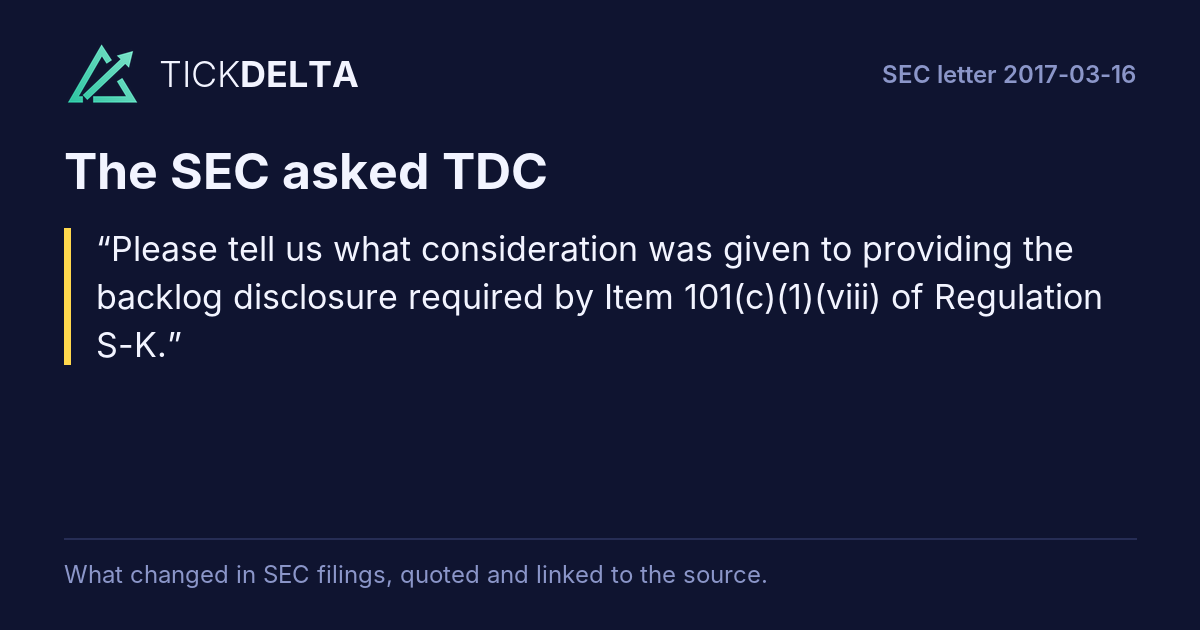
Please tell us what consideration was given to providing the backlog disclosure required by Item 101(c)(1)(viii) of Regulation S-K.
TDC answered
The Company does not believe that total backlog is material to an understanding of the our business taken as a whole, as contemplated by Item 101(c)(1)(viii) of Regulation S-K. The level of backlog and the trend in backlog at any particular time has not been indicative of future revenue, since historically a large portion of our business each quarter is generated by orders that are sold and fulfilled within the same reporting period.
Rest of the answer

Therefore, the amount of backlog that is not already recorded in deferred revenue has not been material for an understanding of our business and is not a meaningful indicator of future financial results. However, as the Company continues to execute on its business transformation strategy, we expect revenue to shift from upfront revenue that is sold and recognized in the same reporting period to longer-term contracts, such as subscription-based licenses, rentals of hardware/software, and cloud services that are recognized as revenue over time. As a result of this expected shift in the business and the new disclosure requirements under Accounting Standards Codification 606 – Revenue from Contracts with Customers (“Topic 606”) that will be effective January 1, 2018, the Company confirms that it will disclose total backlog in its next annual filing along with qualifying information to explain that backlog may not be indicative of revenue for any future period.

Read in the reply
Management’s Discussion and Analysis of Financial Condition and Results of Operations
SEC asked (2)
We note that on slide 20 of your November 17, 2016 Investor Day Presentation you indicate that renewal rates are a quarterly metric used to track success. On page 14 you discuss the importance of renewals for your maintenance and upgrade revenues as well as subscription licenses, hosting arrangements and software as a service arrangements.
Rest of the question

Please tell us how you monitor renewals and customer retention in managing your business and tell us what consideration was given to quantifying your renewal or customer retention metrics, if available. Refer to Item 303(a)(3) of Regulation S-K and Section III.B.1 of SEC Release 33-8350.

TDC answered
Among other metrics, for purposes of gauging the success of our business, the Company has historically monitored renewal rates and customer retention, including annual contract renewals at the contractually prescribed rate along with customer erosion, expansions and cancellations. The Company has historically considered disclosing renewal rates; however, because the numbers of customers that fail to renew at the contractual rate have not historically varied, the Company has not previously disclosed renewal rate information.
Rest of the answer

At the Investor Day Presentation, we provided a summary of potential metrics that we were considering providing to investors to track our transformation progress, and indicated at that time that the actual metrics that we eventually provide may evolve as we get more experience as to how our new strategic business model is progressing. Since that time, and through the date of filing of our 2016 Form 10-K, the Company has been building the necessary requirements, processes, and procedures to report on various new financial and performance measures. The Company disclosed and defined the key financial and performance measures in “Management’s Discussion and Analysis of Financial Condition and Results of Operations – Business Transformation” in its 2016 Form 10-K that management currently believes will be the most meaningful for tracking the Company’s progress toward achieving our strategic business transformation objectives. The Company is still in the process of determining what financial and performance measures will be reported on a quarterly or annual basis going forward and also which additional measures may be helpful to investors in providing greater transparency regarding the progress we are making in our business transformation. Once these determinations are made, the Company will disclose those financial and performance measures in future periodic filings in order to provide additional information to investors regarding our transformation initiatives and to help investors better understand the Company’s results of operations.

Read in the reply
In its next report

First report after the company's reply of Mar 30, 2017: 10-Q filed May 5, 2017 ↗, against the 10-Q filed Nov 3, 2016 ↗.

Tickdelta does not hold the text of both reports, so they are not compared here.

Results from Operations for the Years Ended December 31, 2016, 2015 and 2014 · Revenue, page 32
SEC asked (3)
As part of your business transformation discussion, you refer to increasing your recurring revenue over time. On your fourth quarter earnings call, management states that recurring revenues were 43% of 2016 revenues and that these revenues are expected to be “in the high 40s” in 2017.
Rest of the question

Considering the importance of increasing recurring revenues as part of your business transformation plan, please tell us what consideration was given to quantify the percentage of recurring revenues for the periods presented. Such disclosure should be accompanied by an explanation of what revenues you consider to be recurring and information to understand the typical length of such arrangements.

TDC answered
The Company is in the early stages of its transformation strategy and is just now starting to see customers shift to the new deployment offerings that recognize revenue over time (recurring revenue). As a result, the Company did not believe this information was meaningful at the time of its 2016 Form 10-K filing to the understanding of our business or measuring the success of our transformation strategy, considering that most of our recurring revenue related to traditional software maintenance and upgrades and not to our new deployment offerings.
Rest of the answer

Going forward, the Company will define which revenues are considered recurring revenue for purposes of measuring the progress we are making in our business transformation and anticipates that it will begin reporting on certain financial and performance measures, including Annual Recurring Revenue and Recurring Revenue as a percent of Total Revenue or similar measures, in its next periodic filing. In addition, the Company is also considering the impact that Topic 606 may have on these financial and performance measures, such as subscription-based licenses being recognized upfront instead of over time, and will make any adjustments to our metrics after the adoption of Topic 606 in order to continue to have disclosures that are meaningful to investors.

Read in the reply
Results from Operations for the Years Ended December 31, 2016, 2015 and 2014 · Revenue, page 32
SEC asked (4)
We note that you separately adjust for the change in U.S. Tax Law in your non-GAAP reconciliations but appear to show all other adjustments net of tax. Please present the income tax effects of your non-GAAP adjustments as a separate adjustment and explain how you calculated the income tax effects related to these adjustments in your next earnings release.
Rest of the question

Refer to Question 102.11 of the Non-GAAP Compliance and Disclosure Interpretations.

TDC answered
The Company will undertake in applicable future earnings releases to present the income tax effects of its non-GAAP adjustments as a separate line item adjustment and provide an explanation of how taxes on non-GAAP adjustments are calculated.

* * * * *

The Company acknowledges that it is responsible for the accuracy and adequacy of its disclosures, notwithstanding any review, comments, action or absence of action by the staff. Please do not hesitate to contact me at (678) 577-5902 if there are any comments or questions concerning the forgoing or if we can be of assistance in any way.
Read in the reply

Also in this review: closing letter, 2017-04-05

From the SEC's correspondence on EDGAR: staff letters (form UPLOAD) and company letters (form CORRESP), 9 letters filed since 2017-03-16. Questions and answers are matched by their numbers; topics come from words in each question. The reports are compared word for word (same form, before the first SEC letter against the first report after the company's reply). No AI.

Sources

The SEC's correspondence on EDGAR: staff letters (form UPLOAD) and company letters (form CORRESP), matched question by question. No AI.

Also

Filings: the letters in the filing list.

Work with it

Excel workbook · CSV. Google Sheet that stays up to date: paste =IMPORTDATA("https://tickdelta.com/company/TDC/export.csv") into a cell.

Next in Owners and insiders:Insider trades
Esc

Type a ticker such as AAPL, a name, an investor such as Buffett, or a topic such as tariffs. ↑ ↓ to move, Enter to open.