Paragraph 60 · 48% changed
Every version of it
Screener
/
SEC EDGAR
/CIK 0000818686
/10-K filed Feb 3, 2026, compared with Feb 5, 2025
/Numbers from the XBRL of the 10-Ks
NYSE
Health care · Pharmaceuticals
Teva Pharmaceutical Industries Ltd TEVA
The 10-K against last year's
280 changes: 29 added, 61 removed, 185 reworded, 5 quiet changes
10-K Feb 3, 2026 vs Feb 5, 2025
Risk Factors
25.7%
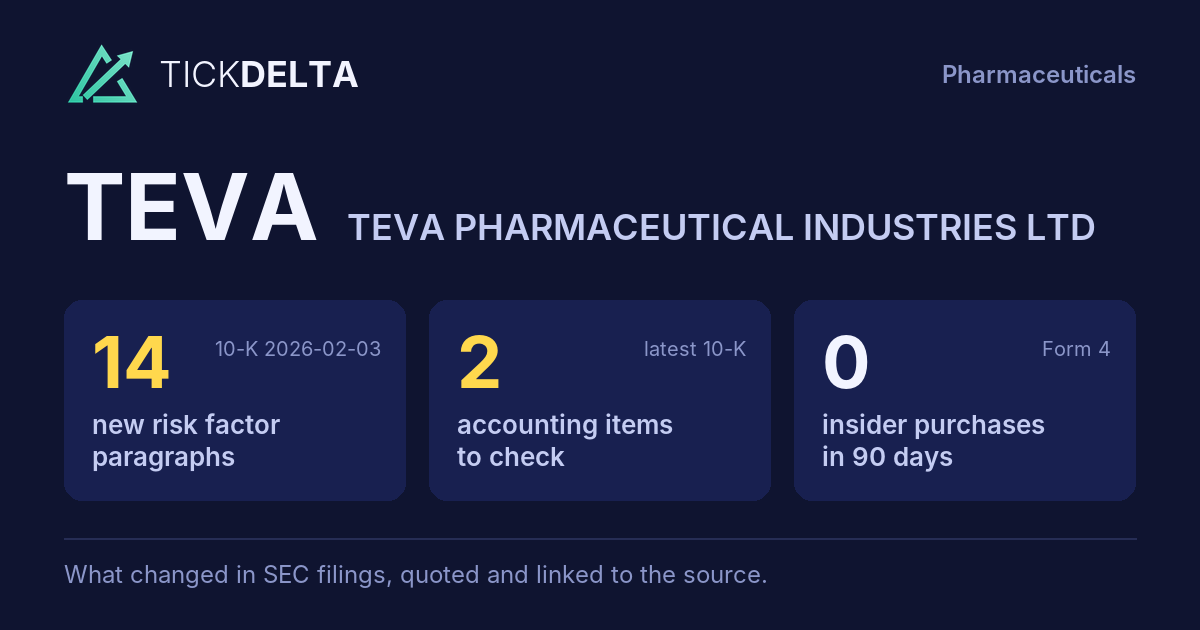
of the text changed · 17,423 words now · 14 new paragraphs, 18 gone
MD&A
32.0%
of the text changed · 11,018 words now · 15 new paragraphs, 43 gone
Legal Proceedings
31.8%
of the text changed · 280 words now
Accounting Policies
52.5%
of the text changed · 9,210 words now
10-K 0001193125-26-034532 (Feb 3, 2026) vs 10-K 0001193125-25-020826 (Feb 5, 2025)
Every paragraph, and how much of it changed
One bar per paragraph, in the order of the 10-K. Height and colour show the share of its words not in the closest paragraph a year earlier; the tallest bars are new paragraphs.
Risk Factors
157 paragraphs · 14 new · 78 reworded · 18 gone · 10-K Feb 3, 2026 against Feb 5, 2025
New paragraph
Reworded (5% of its words or more)
Same or nearly
Paragraph 45 · 46% changed
Every version of it
Paragraph 131 · 44% changed
Every version of it
Furthermore, there are a number of evolving sustainability-related regulatory disclosure regulations with which Teva may have to comply. For example, in October 2023, California enacted the Climate Corporate Data Accountability Act (“SB 253”) and Climate-Related Financial Risk Act (“SB 261”) that will require certain companies that (i) do business in California to publicly disclose their Scopes 1, 2 and 3 greenhouse gas emissions, with third party assurance of such data, and issue public reports on their climate-related financial risk and related mitigation measures and (ii) operate in California and make certain climate-related claims to provide disclosures around the achievement of climate-related claims, including the use of voluntary carbon credits to achieve such claims. SB 253 and SB 261 are subject to litigation, and, in one of the lawsuits, an injunction was issued in November 2025 barring enforcement of SB 261 while the litigation proceeds; the law could be reinstated. In addition, in December 2022, the European Union adopted Directive No 2464/2022 on Corporate Sustainability Reporting (“CSRD”). The CSRD introduces detailed sustainability reporting obligations, requiring in-scope companies to make sustainability reports in accordance with the European Sustainability Reporting Standards (“ESRS”), which include certain mandatory disclosures and other voluntary disclosures on impacts, risks, and opportunities in relation to sustainability matters identified as material by the relevant entity. In addition to assessing the financial effects of a sustainability matter on a company, materiality assessments will require the relevant company to take into account non-financial considerations as to the materiality of a sustainability matter from an impact perspective when it pertains to the undertaking’s actual or potential, positive or negative impacts on people or the environment over the short-, medium-or long-term. Impacts may include those connected with the company’s own operations and upstream and downstream value chain, including through its products and services, as well as through its business relationships. entity under applicable rules. Teva expects to first have to disclose pursuant to the CSRD, in accordance with the ESRS, in 2026. 2028. Furthermore, Article 8 of Regulation (EU) 2020/852 (EU Taxonomy) requires those in-scope companies to report how and to what extent their activities are associated with economic activities that qualify as environmentally sustainable defined herein. This These disclosure obligation obligations may lead to increased compliance burdens and costs. Additionally, could lead to costs and result in the disclosure of information which that may have a negative impact on our operations and reputation, reputation; however, under the EU’s omnibus simplification initiative, the CSRD, ESRS and which Taxonomy Regulation are currently under revision to simplify applicable obligations, and this process may lead to additional exposure. Failure to accurately comply with any ESG obligations may result in enforcement actions, sanctions, reputational harm or private litigation. reduce compliance burdens, although the final outcome of the legislative process remains uncertain.
Paragraph 103 · 43% changed
Every version of it
The incoming current U.S. administration may propose policy changes that create additional uncertainty for Teva’s business. These may include changes to the level of scrutiny applied by HRSA to enforce 340B program non-compliance, new price restrictions restrictions, such as efforts to reduce prescription drug prices by encouraging manufacturers to voluntarily adopt “Most Favored Nation” (MFN) pricing models on products Teva sells to Medicaid, Medicare or other government purchasers, or other regulatory changes impacting reimbursement or competitive dynamics in multisource markets. Additionally, in its June 2024 decision in Loper Bright Enterprises v. Raimondo (the “Loper decision”), the U.S. Supreme Court overturned the longstanding Chevron doctrine, under which courts were required to give deference to regulatory agencies’ reasonable interpretations of ambiguous federal statutes. The Loper decision could result in additional legal challenges to regulations and guidance issued by federal agencies applicable to our operations, including those issued by the FDA. Additionally, the Loper decision may result in increased regulatory uncertainty, inconsistent judicial interpretations and other impacts to the agency rulemaking process. We cannot predict which additional measures may be adopted or the impact of current and additional measures on the marketing, pricing and demand for our products, which could have a material adverse effect on our business, financial condition and results of operations.
Paragraph 9 · 42% changed
Every version of it
Our generic drugs products face intense competition. Prices of generic drugs products may, and often do, decline, sometimes dramatically, especially as additional generic pharmaceutical companies receive approvals and enter the market for a given product and competition intensifies. Consequently, our ability to sustain our sales and profitability on any given product over time is affected by the number of companies selling competitive products, including new market entrants, and the timing of their approvals. For example, although in 2024, the majority of the increase in revenues in our U.S. generics business were driven by higher revenues from lenalidomide capsules (the generic version of Revlimid®), this trend may is not expected to continue due to the intense competition expected in the coming years. The goals established under the Generic Drug User Fee Act, and increased funding of the FDA’s Office of Generic Drugs, have led to more and faster generic approvals, and consequently increased competition for some of our products. The FDA has stated that it has established new steps to enhance competition, promote access and lower drug prices and is approving increasing numbers of generic applications. While these FDA initiatives are expected to benefit our generic product pipeline, they will also benefit competitors that seek to launch products in established generic markets where we currently offer products. In recent years, there has also been an increase in the number of generic manufacturers targeting significant new generic opportunities with exclusivity under the Hatch-Waxman Act, or which are complex to develop. Many of the smaller generic manufacturers have increased their capabilities, level of sophistication and development resources in recent years. The FDA has also been limiting the availability of exclusivity periods for new products, which reduces the economic benefit from being first-to-file for generic approvals. For example, the 180-day market exclusivity period under the Hatch-Waxman Act for a new product can be forfeited by failure to obtain approval or to launch a product within a specified time or if certain conditions exist, some of which may be outside our control. The failure to maintain our industry-leading performance in the United States on first-to-file opportunities and to develop and commercialize high complexity generic products could adversely affect our sales and profitability.
Paragraph 65 · 42% changed
Every version of it
In the ordinary course of our business, we collect and store sensitive data, including intellectual property, proprietary business information and personally identifiable information (including of our employees, customers, suppliers and business partners). Any data breach may subject us to civil fines and penalties, or regulatory orders, fines or sanctions such as under the EU GDPR or EU NIS2, or equivalent under relevant national laws, the federal Health Insurance Portability and Accountability Act of 1996 (“HIPAA”) as amended, and other relevant state and federal privacy laws in the United States, including the California Consumer Privacy Act (“CCPA”) and other laws and regulations including across our International Markets. Our failure, or the failure of our third-party vendors, to comply with applicable laws and regulations relating to data security and our involvement or the involvement of any of our third-party vendors in any data security incidents could result in legal claims and liability, obligations to report incidents to governmental agencies, regulatory investigations and penalties, and reputational damage, which could have a material adverse effect on our business, financial condition and results of operations.
Paragraph 138 · 40% changed
Every version of it
We regularly review our long-lived assets, including identifiable intangible assets, goodwill and property, plant and equipment, for impairment. Goodwill and acquired indefinite life intangible assets are subject to impairment review on an annual basis and whenever potential impairment indicators are present. Other long-lived assets are reviewed when there is an indication that impairment may have occurred. The amount of goodwill, identifiable intangible assets and property, plant and equipment on our consolidated balance sheet may increase following acquisitions or other collaboration agreements. Changes in market conditions, including further increases in discount rates, exchange rate fluctuations, or other changes in the future outlook of value may lead to further impairments in the future. In addition, the potential divestment of assets, including the closure or divestment of manufacturing plants and R&D facilities, headquarters and other office locations, may lead to additional impairments. Future events or decisions may lead to asset impairments and/or related charges. For assets that are not impaired, we may adjust the remaining useful lives. Certain non-cash impairments may result from a change in our strategic goals, business direction or other factors relating to the overall business environment. Any significant impairment could have a material adverse effect on our results of operations. See notes 6 and 7 in to our consolidated financial statements, for descriptions of impairments of intangible assets and goodwill in recent periods.
Paragraph 94 · 40% changed
Every version of it
Additionally, the incoming U.S. administration may propose policy changes that create additional uncertainty for Teva’s business. business, such as its executive order from May 2025 titled “Delivering Most-Favored-Nation Prescription Drug Pricing to American Patients”, see “Item 1—Business—Regulation” for more information. These may include new price restrictions on products Teva sells to Medicaid, Medicare or other government purchasers, or other regulatory changes impacting reimbursement or competitive dynamics in multisource markets.
Paragraph 60 · 48% changed
Every version of it
10-K Feb 5, 2025We rely extensively on information technology systems (including cloud services) in order to conduct business, including systems managed by third-party service providers. These systems include programs and processes relating to internal and external communications, ordering and managing materials from suppliers, converting materials to finished products, shipping products to customers, processing transactions, summarizing and reporting results of operations, processing payments to employees and vendors, calculating sales receivables, generating our financial results, and complying with information technology security compliance and other regulatory, legal or tax requirements. These information technology systems could be damaged or cease to function properly due to the poor performance or failure of third-party service providers, catastrophic events, power outages, network outages, failed upgrades or other similar events. If our business continuity plans do not effectively resolve such issues on a timely basis, we may suffer significant interruptions in conducting our business, which may adversely impact our business, financial condition and results of operations.
10-K Feb 3, 2026
power outages, network outages, failed upgrades and other events. If our business continuity plans do not effectively resolve such issues on a timely basis, we may suffer significant interruptions in conducting our business, which may adversely impact our business, financial condition and results of operations.
Paragraph 45 · 46% changed
Every version of it
10-K Feb 5, 2025Our unsecured syndicated sustainability-linked revolving credit facility (“RCF”) contains certain covenants, including certain limitations on incurring liens and indebtedness and maintenance of certain financial ratios, including a maximum leverage ratio, which becomes more restrictive over time. Non-compliance with such covenants, under certain circumstances, may result in our inability to borrow under the RCF or an event of default in all borrowings under the RCF. Additionally, non-compliance with such covenants, when greater than a specified threshold amount as set forth in each series of senior notes and when sustainability-linked senior notes is outstanding, could lead to an event of default under our senior notes and sustainability-linked senior notes due to cross acceleration provisions.
10-K Feb 3, 2026
specified threshold amount as set forth in each series of senior notes and when sustainability-linked senior notes are outstanding, could lead to an event of default under our senior notes and sustainability-linked senior notes due to cross acceleration provisions.
Paragraph 131 · 44% changed
Every version of it
10-K Feb 5, 2025
adopted Directive No 2464/2022 on Corporate Sustainability Reporting (“CSRD”). The CSRD introduces detailed sustainability reporting obligations, requiring in-scope companies to make sustainability reports in accordance with the European Sustainability Reporting Standards (“ESRS”), which include certain mandatory disclosures and other voluntary disclosures on impacts, risks, and opportunities in relation to sustainability matters identified as material by the relevant entity. In addition to assessing the financial effects of a sustainability matter on a company, materiality assessments will require the relevant company to take into account non-financial considerations as to the materiality of a sustainability matter from an impact perspective when it pertains to the undertaking’s actual or potential, positive or negative impacts on people or the environment over the short-, medium-or long-term. Impacts may include those connected with the company’s own operations and upstream and downstream value chain, including through its products and services, as well as through its business relationships. Teva expects to first have to disclose pursuant to the CSRD, in accordance with the ESRS, in 2026. Furthermore, Article 8 of Regulation (EU) 2020/852 (EU Taxonomy) requires those in-scope companies to report how and to what extent their activities are associated with economic activities that qualify as environmentally sustainable defined herein. This disclosure obligation may lead to increased compliance burdens and costs. Additionally, could lead to the disclosure of information which may have a negative impact on our operations and reputation, and which may lead to additional exposure. Failure to accurately comply with any ESG obligations may result in enforcement actions, sanctions, reputational harm or private litigation.
10-K Feb 3, 2026
Furthermore, there are a number of evolving sustainability-related regulatory disclosure regulations with which Teva may have to comply. For example, in October 2023, California enacted the Climate Corporate Data Accountability Act (“SB 253”) and Climate-Related Financial Risk Act (“SB 261”) that will require certain companies that (i) do business in California to publicly disclose their Scopes 1, 2 and 3 greenhouse gas emissions, with third party assurance of such data, and issue public reports on their climate-related financial risk and related mitigation measures and (ii) operate in California and make certain climate-related claims to provide disclosures around the achievement of climate-related claims, including the use of voluntary carbon credits to achieve such claims. SB 253 and SB 261 are subject to litigation, and, in one of the lawsuits, an injunction was issued in November 2025 barring enforcement of SB 261 while the litigation proceeds; the law could be reinstated. In addition, in December 2022, the European Union adopted Directive No 2464/2022 on Corporate Sustainability Reporting (“CSRD”). The CSRD introduces detailed sustainability reporting obligations, requiring in-scope companies to make sustainability reports in accordance with the European Sustainability Reporting Standards (“ESRS”), which include certain mandatory disclosures and other voluntary disclosures on impacts, risks, and opportunities in relation to sustainability matters identified as material by the relevant entity under applicable rules. Teva expects to first have to disclose pursuant to the CSRD, in accordance with the ESRS, in 2028. Furthermore, Article 8 of Regulation (EU) 2020/852 (EU Taxonomy) requires those in-scope companies to report how and to what extent their activities are associated with economic activities that qualify as environmentally sustainable defined herein. These disclosure obligations may lead to increased compliance burdens and costs and result in the disclosure of information that may have a negative impact on our operations and reputation; however, under the EU’s omnibus simplification initiative, the CSRD, ESRS and Taxonomy Regulation are currently under revision to simplify applicable obligations, and this process may reduce compliance burdens, although the final outcome of the legislative process remains uncertain.
Paragraph 103 · 43% changed
Every version of it
10-K Feb 5, 2025
The incoming U.S. administration may propose policy changes that create additional uncertainty for Teva’s business. These may include changes to the level of scrutiny applied by HRSA to enforce 340B program non-compliance, new price restrictions on products Teva sells to Medicaid, Medicare or other government purchasers, or other regulatory changes impacting reimbursement or competitive dynamics in multisource markets. Additionally, in its June 2024 decision in Loper Bright Enterprises v. Raimondo (the “Loper decision”), the U.S. Supreme Court overturned the longstanding Chevron doctrine, under which courts were required to give deference to regulatory agencies’ reasonable interpretations of ambiguous federal statutes. The Loper decision could result in additional legal challenges to regulations and guidance issued by federal agencies applicable to our operations, including those issued by the FDA. Additionally, the Loper decision may result in increased regulatory uncertainty, inconsistent judicial interpretations and other impacts to the agency rulemaking process. We cannot predict which additional measures may be adopted or the impact of current and additional measures on the marketing, pricing and demand for our products, which could have a material adverse effect on our business, financial condition and results of operations.
10-K Feb 3, 2026
The current U.S. administration may propose policy changes that create additional uncertainty for Teva’s business. These may include changes to the level of scrutiny applied by HRSA to enforce 340B program non-compliance, new price restrictions, such as efforts to reduce prescription drug prices by encouraging manufacturers to voluntarily adopt “Most Favored Nation” (MFN) pricing models on products Teva sells to Medicaid, Medicare or other government purchasers, or other regulatory changes impacting reimbursement or competitive dynamics in multisource markets. Additionally, in its June 2024 decision in Loper Bright Enterprises
Paragraph 9 · 42% changed
Every version of it
10-K Feb 5, 2025
Our generic drugs face intense competition. Prices of generic drugs may, and often do, decline, sometimes dramatically, especially as additional generic pharmaceutical companies receive approvals and enter the market for a given product and competition intensifies. Consequently, our ability to sustain our sales and profitability on any given product over time is affected by the number of companies selling competitive products, including new market entrants, and the timing of their approvals. For example, although in 2024, the majority of the increase in revenues in our U.S. generics business were driven by higher revenues from lenalidomide capsules (the generic version of Revlimid®), this trend may not continue due to the intense competition expected in the coming years. The goals established under the Generic Drug User Fee Act, and increased funding of the FDA’s Office of Generic Drugs, have led to more and faster generic approvals, and consequently increased competition for some of our products. The FDA has stated that it has established new steps to enhance competition, promote access and lower drug prices and is approving increasing numbers of generic applications. While these FDA initiatives are expected to benefit our generic product pipeline, they will also benefit competitors that seek to launch products in established generic markets where we currently offer products. In recent years, there has also been an increase in the number of generic manufacturers targeting significant new generic opportunities with exclusivity under the Hatch-Waxman Act, or which are complex to develop. Many of the smaller generic manufacturers have increased their capabilities, level of sophistication and development resources in recent years. The FDA has also been limiting the availability of exclusivity periods for new products, which reduces the economic benefit from being first-to-file for generic approvals. For example, the 180-day market exclusivity period under the Hatch-Waxman Act for a new product can be forfeited by failure to obtain approval or to launch a product within a specified time or if certain conditions exist, some of which may be outside our control. The failure to maintain our industry-leading performance in the United States on first-to-file opportunities and to develop and commercialize high complexity generic products could adversely affect our sales and profitability.
10-K Feb 3, 2026
Our generic products face intense competition. Prices of generic products may, and often do, decline, sometimes dramatically, especially as additional generic pharmaceutical companies receive approvals and enter the market for a given product and competition intensifies. Consequently, our ability to sustain our sales and profitability on any given product over time is affected by the number of companies selling competitive products, including new market entrants, and the timing of their approvals. For example, although in 2024, the majority of the increase in revenues in our U.S. generics business were driven by higher revenues from lenalidomide capsules (the generic version of Revlimid®), this trend is not expected to continue due to the intense competition
Paragraph 65 · 42% changed
Every version of it
10-K Feb 5, 2025
suppliers and business partners). Any data breach may subject us to civil fines and penalties, or regulatory orders, fines or sanctions such as under the EU GDPR or EU NIS2, or equivalent under relevant national laws, the federal Health Insurance Portability and Accountability Act of 1996 (“HIPAA”) as amended, and other relevant state and federal privacy laws in the United States, including the California Consumer Privacy Act (“CCPA”) and other laws and regulations including across our International Markets. Our failure, or the failure of our third-party vendors, to comply with applicable laws and regulations relating to data security and our involvement or the involvement of any of our third-party vendors in any data security incidents could result in legal claims and liability, obligations to report incidents to governmental agencies, regulatory investigations and penalties, and reputational damage, which could have a material adverse effect on our business, financial condition and results of operations.
10-K Feb 3, 2026
In the ordinary course of our business, we collect and store sensitive data, including intellectual property, proprietary business information and personally identifiable information (including of our employees, customers, suppliers and business partners). Any data breach may subject us to civil fines and penalties, or regulatory orders, fines or sanctions such as under the EU GDPR or EU NIS2, or equivalent under relevant national laws, the federal Health Insurance Portability and Accountability Act of 1996 (“HIPAA”) as amended, and other relevant
Paragraph 138 · 40% changed
Every version of it
10-K Feb 5, 2025
We regularly review our long-lived assets, including identifiable intangible assets, goodwill and property, plant and equipment, for impairment. Goodwill and acquired indefinite life intangible assets are subject to impairment review on an annual basis and whenever potential impairment indicators are present. Other long-lived assets are reviewed when there is an indication that impairment may have occurred. The amount of goodwill, identifiable intangible assets and property, plant and equipment on our consolidated balance sheet may increase following acquisitions or other collaboration agreements. Changes in market conditions, including further increases in discount rates, exchange rate fluctuations, or other changes in the future outlook of value may lead to further impairments in the future. In addition, the potential divestment of assets, including the closure or divestment of manufacturing plants and R&D facilities, headquarters and other office locations, may lead to additional impairments. Future events or decisions may lead to asset impairments and/or related charges. For assets that are not impaired, we may adjust the remaining useful lives. Certain non-cash impairments may result from a change in our strategic goals, business direction or other factors relating to the overall business environment. Any significant impairment could have a material adverse effect on our results of operations. See notes 6 and 7 in our consolidated financial statements, for descriptions of impairments of intangible assets and goodwill in recent periods.
10-K Feb 3, 2026
We regularly review our long-lived assets, including identifiable intangible assets, goodwill and property, plant and equipment, for impairment. Goodwill and acquired indefinite life intangible assets are subject to impairment review on an annual basis and whenever potential impairment indicators are present. Other long-lived assets are reviewed when there is an indication that impairment may have occurred. See notes 6 and 7 to our consolidated financial statements, for descriptions of impairments of intangible assets and goodwill in recent periods.
Paragraph 94 · 40% changed
Every version of it
10-K Feb 5, 2025
Additionally, the incoming U.S. administration may propose policy changes that create additional uncertainty for Teva’s business. These may include new price restrictions on products Teva sells to Medicare or
10-K Feb 3, 2026
Additionally, the U.S. administration may propose policy changes that create additional uncertainty for Teva’s business, such as its executive order from May 2025 titled “Delivering Most-Favored-Nation Prescription Drug Pricing to American Patients”, see “Item 1—Business—Regulation” for more information. These may include new price restrictions on products Teva sells to Medicaid, Medicare or other government purchasers, or other regulatory changes impacting reimbursement or competitive dynamics in multisource markets.
MD&A
228 paragraphs · 15 new · 119 reworded · 43 gone · 10-K Feb 3, 2026 against Feb 5, 2025
New paragraph
Reworded (5% of its words or more)
Same or nearly
Paragraph 7 · 49% changed
In recent years, the global economy has been impacted by fluctuating foreign exchange rates. In 2024, approximately 47% A significant portion of our revenues were is denominated in currencies other than the U.S. dollar and we manufacture many of our products largely outside of the United States. Fluctuations As a result, fluctuations in the U.S. dollar versus relative to other currencies in which we operate have in the past and may in the future materially impact our revenues, results of operations, profits profitability and cash flows. Additionally, in recent years, In addition, in many of the markets in which we operate operate, we have experienced higher levels of elevated inflation resulting in recent years, contributing to higher interest rates, though in certain rates. In other markets, such as the EU, we inflation has recently experienced a decrease in inflation which resulted declined, resulting in lower interests interest rates. The global economy has also been impacted by geopolitical tensions which have resulted in disruptions to global supply chains, including our internal supply chain. In October 2023, Israel was attacked by a terrorist organization and entered a state of war on several fronts, which as of the date of this Annual Report on Form 10-K is ongoing. Our global headquarters as well as several of our manufacturing and R&D facilities are located in Israel and, while operations there currently remain largely unaffected, the impact of this war on our operations may increase, which could be material, as a result of the continuation, escalation or expansion of this war. In light of the above, supply chain disruptions could continue to result in delays in our production and distribution processes, R&D initiatives and our ability to timely respond to consumer demand. We have implemented certain measures in response to such events and are continually considering various initiatives, including price adjustments where we are not restricted contractually or regulatorily, enhanced inventory management, alternative sourcing strategies for our raw material supply and backup production plans for key products, to allow us to partially mitigate and offset the impact of these macroeconomic and geopolitical factors. However, although Although inflationary and other macroeconomic pressures have and may continue to ease, the higher costs we have experienced during incurred in recent periods have already impacted affected our operations and will are likely to continue to have an effect on influencing our financial results. Recent U.S. tariffs imposed or threatened to be imposed on materials and products from countries where we do business and any responsive or reciprocal actions taken by such countries could impact our costs and our global operations. The countries subject to tariffs and the tariff rate imposed on each country is uncertain and dynamic, and we continue to monitor and assess the potential impact on our supply chain and global operations.
Paragraph 157 · 48% changed
Paragraph 125 · 47% changed
Paragraph 46 · 46% changed
Product Name Brand Name Launch Total Annual U.S. Date Branded Sales at Time of Launch (U.S. $ in millions (IQVIA))* Mifepristone Tablets Korlym® January $2 ALVAIZ™ (eltrombopag choline tablets) 505(b)(2) Promacta® SELARSDI (Ustekinumab-aekn) injection** N/A February $1,145 Fingolimod Capsules Gilenya® February $483 SIMLANDI Injection** N/A May No Data Liraglutide injection Victoza® June $1,759 Paclitaxel Protein-Bound Particles for Injectable Suspension (albumin-bound) Abraxane® July $809 Mesalamine Delayed-Release Tablets, USP N/A August $167 Sulfamethoxazole and Trimethoprim Injection, USP in the PREMIERProRx® Label N/A August $1 Lisdexamfetamine Dimesylate Chewable Tablets CII - USA Vyvanse® September $200 Naloxone Hydrochloride Nasal Spray (OTC) Narcan® September $66 *** Metoclopramide Injection, USP N/A September $12 Octreotide Acetate for Injectable Suspension Suspension, 10mg/Vial Sandostatin® LAR Depot March $21 EPYSQLI (eculizumab-aagh) Soliris® April $367 Ticagrelor Tablets Brilinta® tablets May $1,305 Hydroxyzine Hydrochloride Tablets, USP*** N/A June $17 Fidaxomicin Tablets Dificid® tablets July $410 Liraglutide Injection Saxenda® injection August $164 Dasatinib Tablets Sprycel® Tablets September $1,366 Azelastine Hydrochloride and Fluticasone Propionate Nasal Spray Dymista® Nasal Spray September $69 Cyclosporine Ophthalmic Emulsion Restasis® October $802 Tiopronin Tablets, 100 mg Thiola® $1,866 Dalbavancin for Injection Dalvance® for injection October $0 Lisdexamfetamine Dimesylate Capsules, 20 mg, 30 mg, 40 mg, 50 mg, 60 mg and 70 mg Vyvanse® $260 Amphetamine Extended-Release Orally Disintegrating Tablets CII Adzenys XR-ODT® CII December $4,108 Lapatinib Tablets, 250 mg Tykerb® December $17 $172
Paragraph 182 · 45% changed
Paragraph 26 · 42% changed
Revenues from our United States segment in 2024 2025 were $8,034 $9,186 million, an increase of $303 $1,152 million, or 4%, 14%, compared to 2023, 2024, mainly due to higher revenues from generic products, including from lenalidomide capsules (the generic version of Revlimid®) and our key innovative products AUSTEDO AUSTEDO, AJOVY, and UZEDY, development milestone payments received in connection with the initiation of Phase 3 studies for duvakitug (anti-TL1A), as well as higher revenues from the sale of certain product rights, partially offset by an upfront payment received in 2023 related to the collaboration on our duvakitug (anti-TL1A) asset, lower revenues from certain innovative products, primarily BENDEKA and TREANDA and COPAXONE, as well as from Anda, our distribution business. generic products (including biosimilars).
Paragraph 160 · 42% changed
As of December 31, 2024, 2025, our debt was $17,783 $16,807 million, compared to $19,833 $17,783 million as of December 31, 2023. 2024. This decrease was mainly due to the repayment at maturity of $1,641 $1,812 million of our senior notes and $429 (as detailed below), partially offset by an increase of $803 million of due to exchange rate fluctuations. Additionally, during the second quarter of 2025, we repurchased $2,290 million aggregate principal amount of notes upon consummation of a cash tender offer, and issued $2,298 million of senior notes, net of discount and issuance costs. For further information, see note 9 to our consolidated financial statements.
Paragraph 94 · 40% changed
Generic products revenues (including OTC and biosimilar products) in our International Markets segment in 2024 2025 were flat, $1,721, a decrease of 11% in both U.S. dollars and local currency terms compared to 2023. In local currency terms, revenues increased by 15%, 2024. This decrease was mainly due to the divestment of our business venture in Japan, partially offset by higher revenues in most markets, as well as price increases, largely as a result of higher costs due to inflationary pressure, partially offset by regulatory price reductions and generic competition to off-patented products in Japan. other markets.
Paragraph 7 · 49% changed
10-K Feb 5, 2025
In recent years, the global economy has been impacted by fluctuating foreign exchange rates. In 2024, approximately 47% of our revenues were denominated in currencies other than the U.S. dollar and we manufacture our products largely outside of the United States. Fluctuations in the U.S. dollar versus other currencies in which we operate may materially impact our revenues, results of operations, profits and cash flows. Additionally, in recent years, in many of the markets in which we operate we experienced higher levels of inflation resulting in higher interest rates, though in certain other markets, such as the EU, we recently experienced a decrease in inflation which resulted in lower interests rates. The global economy has also been impacted by geopolitical tensions which have resulted in disruptions to global supply chains, including our internal supply chain. In October 2023, Israel was attacked by a terrorist organization and entered a state of war on several fronts, which as of the date of this Annual Report on Form 10-K is ongoing. Our global headquarters as well as several of our manufacturing and R&D facilities are located in Israel and, while operations there currently remain largely unaffected, the impact of this war on our operations may increase, which could be material, as a result of the continuation, escalation or expansion of this war. In light of the above, supply chain disruptions could continue to result in delays in our production and distribution processes, R&D initiatives and our ability to timely respond to consumer demand. We have implemented certain measures in response to such events and are continually considering various initiatives, including price adjustments where we are not restricted contractually or regulatorily, enhanced inventory management, alternative sourcing strategies for our raw material supply and backup production plans for key products, to allow us to partially mitigate and offset the impact of these macroeconomic and geopolitical factors. However, although inflationary and other macroeconomic pressures have and may continue to ease, the higher costs we have experienced during recent periods have already impacted our operations and will likely continue to have an effect on our financial results.
10-K Feb 3, 2026
In recent years, the global economy has been impacted by fluctuating foreign exchange rates. A significant portion of our revenues is denominated in currencies other than the U.S. dollar and we manufacture many of our products outside of the United States. As a result, fluctuations in the U.S. dollar relative to other currencies in which we operate have in the past and may in the future materially impact our revenues, results of operations, profitability and cash flows. In addition, in many of the markets in which we operate, we have experienced elevated inflation in recent years, contributing to higher interest rates. In other markets, such as the EU, inflation has recently declined, resulting in lower interest rates. Although inflationary and other macroeconomic pressures have and may continue to ease, the higher costs we have incurred in recent periods have already affected our operations and are likely to continue influencing our financial results. Recent U.S. tariffs imposed or threatened to be imposed on materials and products from countries where we do business and any responsive or reciprocal actions taken by such countries could impact our costs and our global operations. The countries subject to tariffs and the tariff rate imposed on each country is uncertain and dynamic, and we continue to monitor and assess the potential impact on our supply chain and global operations.
Paragraph 157 · 48% changed
10-K Feb 5, 2025Total equity was $5,380 million as of December 31, 2024, compared to $8,126 million as of December 31, 2023. This decrease was mainly due to a net loss of $1,959 million, a negative impact of $530 million from exchange rate fluctuations and the reclassification of $340 million from our non-controlling interests to redeemable non-controlling interests, related to our business venture in Japan.
10-K Feb 3, 2026
In the first quarter of 2025, we paid a dividend of $340 million to redeemable non-controlling interests in our business venture in Japan.
Paragraph 125 · 47% changed
10-K Feb 5, 2025S&M expenses relating to our United States segment in 2024 were $1,049 million, an increase of 12% compared to $938 million in 2023. This increase was mainly due to promotional activities related to AUSTEDO, primarily consisting of a direct-to-consumer advertising campaign and our patient support programs.
10-K Feb 3, 2026
G&A expenses in 2025 were $1,287 million, an increase of 11% compared to 2024. This increase was mainly due to costs related to optimization activities of Teva’s global organization and operations in connection with Teva’s Transformation programs, as well as a negative impact from exchange rate fluctuations.
Paragraph 46 · 46% changed
10-K Feb 5, 2025
Product Name Brand Name Launch Total Annual U.S. Date Branded Sales at Time of Launch (U.S. $ in millions (IQVIA))* Mifepristone Tablets Korlym® January $2 ALVAIZ™ (eltrombopag choline tablets) 505(b)(2) Promacta® February $1,145 Fingolimod Capsules Gilenya® February $483 SIMLANDI Injection** N/A May No Data Liraglutide injection Victoza® June $1,759 Paclitaxel Protein-Bound Particles for Injectable Suspension (albumin-bound) Abraxane® July $809 Mesalamine Delayed-Release Tablets, USP N/A August $167 Sulfamethoxazole and Trimethoprim Injection, USP in the PREMIERProRx® Label N/A August $1 Lisdexamfetamine Dimesylate Chewable Tablets CII - USA Vyvanse® September $200 Naloxone Hydrochloride Nasal Spray (OTC) Narcan® September $66 *** Metoclopramide Injection, USP N/A September $12 Octreotide Acetate for Injectable Suspension Sandostatin® October $802 Tiopronin Tablets, 100 mg Thiola® October $0 Lisdexamfetamine Dimesylate Capsules, 20 mg, 30 mg, 40 mg, 50 mg, 60 mg and 70 mg Vyvanse® December $4,108 Lapatinib Tablets, 250 mg Tykerb® December $17
10-K Feb 3, 2026
Product Name Brand Name Launch Total Annual U.S. Date Branded Sales at Time of Launch (U.S. $ in millions (IQVIA))* Mifepristone Tablets Korlym® January $2 SELARSDI (Ustekinumab-aekn) injection** N/A February No Data Octreotide Acetate for Injectable Suspension, 10mg/Vial Sandostatin® LAR Depot March $21 EPYSQLI (eculizumab-aagh) Soliris® April $367 Ticagrelor Tablets Brilinta® tablets May $1,305 Hydroxyzine Hydrochloride Tablets, USP*** N/A June $17 Fidaxomicin Tablets Dificid® tablets July $410 Liraglutide Injection Saxenda® injection August $164 Dasatinib Tablets Sprycel® Tablets September $1,366 Azelastine Hydrochloride and Fluticasone Propionate Nasal Spray Dymista® Nasal Spray September $69 Cyclosporine Ophthalmic Emulsion Restasis® October $1,866 Dalbavancin for Injection Dalvance® for injection October $260 Amphetamine Extended-Release Orally Disintegrating Tablets CII Adzenys XR-ODT® CII December $172
Paragraph 182 · 45% changed
10-K Feb 5, 2025Except for securitization transactions, which are disclosed in note 10f to our consolidated financial statements, we do not have any material off-balance sheet arrangements.
10-K Feb 3, 2026
We do not have any material off-balance sheet arrangements, except for: (i) surety underwritten guarantees Teva has provided the European Commission in an amount of 462.2 million euros, together with specified post-decision interest, which remain in force for three years, and which includes substantially similar covenants as our RCF, as disclosed in note 12b to our consolidated financial statements, and (ii) securitization transactions, which are disclosed in note 10f to our consolidated financial statements.
Paragraph 26 · 42% changed
10-K Feb 5, 2025
Revenues from our United States segment in 2024 were $8,034 million, an increase of $303 million, or 4%, compared to 2023, mainly due to higher revenues from generic products, including from lenalidomide capsules (the generic version of Revlimid®) and our innovative products AUSTEDO and UZEDY, as well as revenues from the sale of certain product rights, partially offset by an upfront payment received in 2023 related to the collaboration on our duvakitug (anti-TL1A) asset, lower revenues from certain innovative products, primarily BENDEKA and TREANDA and COPAXONE, as well as from Anda, our distribution business.
10-K Feb 3, 2026
Revenues from our United States segment in 2025 were $9,186 million, an increase of $1,152 million, or 14%, compared to 2024, mainly due to higher revenues from our key innovative products AUSTEDO, AJOVY, and UZEDY, development milestone payments received in connection with the initiation of Phase 3 studies for duvakitug (anti-TL1A), as well as higher revenues from generic products (including biosimilars).
Paragraph 160 · 42% changed
10-K Feb 5, 2025
As of December 31, 2024, our debt was $17,783 million, compared to $19,833 million as of December 31, 2023. This decrease was mainly due to the repayment at maturity of $1,641 million of our senior notes and $429 million of exchange rate fluctuations.
10-K Feb 3, 2026
As of December 31, 2025, our debt was $16,807 million, compared to $17,783 million as of December 31, 2024. This decrease was mainly due to repayment at maturity of $1,812 million of our senior notes (as detailed below), partially offset by an increase of $803 million due to exchange rate fluctuations. Additionally, during the second quarter of 2025, we repurchased $2,290 million aggregate principal amount of notes upon consummation of a cash tender offer, and issued $2,298 million of senior notes, net of discount and issuance costs. For further information, see note 9 to our consolidated financial statements.
Paragraph 94 · 40% changed
10-K Feb 5, 2025
Generic products revenues (including OTC and biosimilar products) in our International Markets segment in 2024 were flat, compared to 2023. In local currency terms, revenues increased by 15%, mainly due to higher revenues in most markets, as well as price increases, largely as a result of higher costs due to inflationary pressure, partially offset by regulatory price reductions and generic competition to off-patented products in Japan.
10-K Feb 3, 2026
Generic products revenues (including OTC and biosimilar products) in our International Markets segment in 2025 were $1,721, a decrease of 11% in both U.S. dollars and local currency terms compared to 2024. This decrease was mainly due to the divestment of our business venture in Japan, partially offset by higher revenues in other markets.
A paragraph is matched with the one last year that shares the most of its words; under half in common makes it new. The paragraphs shown are the 8 reworded the most in each section.
The paragraph that changed most in each section
The redline
Marked against last year's 10-K: cut words struck through, new words highlighted.
MD&A349 words changed in this paragraph; it is 39% similar to last year's version.
In recent years, the global economy has been impacted by fluctuating foreign exchange rates. In 2024, approximately 47% A significant portion of our revenues were is denominated in currencies other than the U.S. dollar and we manufacture many of our products largely outside of the United States. Fluctuations As a result, fluctuations in the U.S. dollar versus relative to other currencies in which we operate have in the past and may in the future materially impact our revenues, results of operations, profits profitability and cash flows. Additionally, in recent years, In addition, in many of the markets in which we operate operate, we have experienced higher levels of elevated inflation resulting in recent years, contributing to higher interest rates, though in certain rates. In other markets, such as the EU, we inflation has recently experienced a decrease in inflation which resulted declined, resulting in lower interests interest rates. The global economy has also been impacted by geopolitical tensions which have resulted in disruptions to global supply chains, including our internal supply chain. In October 2023, Israel was attacked by a terrorist organization and entered a state of war on several fronts, which as of the date of this Annual Report on Form 10-K is ongoing. Our global headquarters as well as several of our manufacturing and R&D facilities are located in Israel and, while operations there currently remain largely unaffected, the impact of this war on our operations may increase, which could be material, as a result of the continuation, escalation or expansion of this war. In light of the above, supply chain disruptions could continue to result in delays in our production and distribution processes, R&D initiatives and our ability to timely respond to consumer demand. We have implemented certain measures in response to such events and are continually considering various initiatives, including price adjustments where we are not restricted contractually or regulatorily, enhanced inventory management, alternative sourcing strategies for our raw material supply and backup production plans for key products, to allow us to partially mitigate and offset the impact of these macroeconomic and geopolitical factors. However, although Although inflationary and other macroeconomic pressures have and may continue to ease, the higher costs we have experienced during incurred in recent periods have already impacted affected our operations and will are likely to continue to have an effect on influencing our financial results. Recent U.S. tariffs imposed or threatened to be imposed on materials and products from countries where we do business and any responsive or reciprocal actions taken by such countries could impact our costs and our global operations. The countries subject to tariffs and the tariff rate imposed on each country is uncertain and dynamic, and we continue to monitor and assess the potential impact on our supply chain and global operations.
Source: Item 7, 10-K 0001193125-26-034532 vs Item 7, 10-K 0001193125-25-020826
Risk Factors273 words changed in this paragraph; it is 46% similar to last year's version.
Source: Item 1A, 10-K 0001193125-26-034532 vs Item 1A, 10-K 0001193125-25-020826
Accounting Policies124 words changed in this paragraph; it is 54% similar to last year's version.
The Company measures equity investments securities at fair value value, with changes in fair value recognized in net income. The Company accounts for income, in accordance with ASC 321, Investments—Equity Securities. For equity investments that do not have a readily determinable fair value as cost method investments and are not accounted for under the equity method or consolidated, the Company elects the measurement alternative to the extent alternative. Under this approach, such investments are not subject to consolidation or the equity method. Under the measurement alternative, these financial instruments are carried at cost, less any impairment (assessed quarterly for triggering events), impairment, and adjusted for changes resulting from observable price changes in orderly transactions for an identical or similar investment of the same issuer. In addition, Impairment assessments are performed each reporting period when indicators of impairment exist. Dividend income is recognized when dividends are received only as earned, to the extent they are distributed from net accumulated earnings it represents a distribution of the investee. Otherwise, such investee’s accumulated earnings; other distributions are considered returns treated as a return of investment and are recorded as a reduction of reduce the cost carrying amount of the investment.
Source: Item 8, Note 1 – Significant accounting policies:, 10-K 0001193125-26-034532 vs Item 8, Note 1 – Significant accounting policies:, 10-K 0001193125-25-020826
Legal Proceedings93 words changed in this paragraph; it is 43% similar to last year's version.
Legal settlements and loss contingencies in 2023 2025 were mainly related to an estimated provision for the DOJ patient assistance program litigation, an update to the estimated settlement provision for the opioid cases (mainly the effect of the opioid cases, passage of time on the net present value of the discounted payments), an update to the provision recorded for the settlement of carvedilol patent litigation, an update to the U.S. DOJ criminal estimated provision recorded for the claims brought by attorneys general representing states and territories throughout the United States in the generic drug antitrust charges on the marketing and pricing of certain Teva USA generic products, litigation, as well as the a provision recorded for the settlement of the reverse-payment antitrust litigation over certain HIV medicines. related to QVAR.
Source: Item 3, via Note 11 – Legal settlements and loss contingencies:, 10-K 0001193125-26-034532 vs Item 3, via Note 11 – Legal settlements and loss contingencies:, 10-K 0001193125-25-020826
Sentences and paragraphs added, removed or reworded
Every change, by type
Sentences and paragraphs of TEVA's Risk Factors and MD&A, 10-K Feb 3, 2026 against 10-K Feb 5, 2025. Each links to the text at sec.gov.
Quiet changes are sentences kept from last year with one to four words changed, at least one of them a hedge, a modal or a qualifier (may, could, will, not, significant, material…). A year or date rolling forward is not counted.
The full word list
adverse, adversely, all, although, anticipate, anticipates, any, approximately, believe, believes, can, cannot, certain, could, expect, expects, generally, however, if, intend, intends, largely, likely, many, material, materially, may, might, most, must, never, no, not, possible, primarily, probable, should, significant, significantly, some, substantial, substantially, unlikely, will, would
AddedRisk Factors
We also expect to continue to experience significant challenges to our global generics business. Governments worldwide continue to implement healthcare regulatory reforms aimed at reducing drug costs, including but not limited to, imposing price caps and other limits on generic medicine pricing and reimbursement policies, including as a result of inquiries into drug pricing at federal, state and international levels. Additional challenges include changes to tendering systems, a decrease in value from future launches and growth, quality and supply chain challenges, trade restrictions and tariff volatility. Failure to anticipate or adapt to these evolving changes could materially impact our operations and financial performance.
Read it in 10-K Feb 3, 2026 at sec.gov
AddedRisk Factors
which may result in changes to the duration of and criteria for obtaining data and market exclusivity once the new legislation comes into force. See “Item 1—Business—Regulation” for more information.
Read it in 10-K Feb 3, 2026 at sec.gov
AddedRisk Factors
Intense competition may adversely affect our ability to successfully develop and commercialize innovative medicines.
Read it in 10-K Feb 3, 2026 at sec.gov
AddedRisk Factors
may in the future introduce new products or new variations on their existing products, our marketed products, or even those protected by patents, which have in the past and may in the future be replaced in the marketplace or we may be required to lower our prices.
Read it in 10-K Feb 3, 2026 at sec.gov
AddedRisk Factors
For example, the following may have a significant effect on our financial results and cash flow:
Read it in 10-K Feb 3, 2026 at sec.gov
AddedRisk Factors
We have and will continue to implement changes to optimize our business operations and reallocate resources towards growth opportunities. As part of our Pivot to Growth strategy, in May 2025, we announced the Teva Transformation programs which are expected to generate cost savings for the Company, including by examining practices and efficiencies in methods of working, reduction in headcount and optimizing external spend. In connection with these programs, we may not be able to achieve the cost savings that we expect to realize in the expected time frame due to unforeseen risks, which could impact our financial condition and ability to invest in our innovative pipeline and growth drivers.
Read it in 10-K Feb 3, 2026 at sec.gov
AddedRisk Factors
Our adoption of artificial intelligence (“AI”) technologies introduces new risks and uncertainties
Read it in 10-K Feb 3, 2026 at sec.gov
AddedRisk Factors
Our adoption of AI technologies introduces new risks and uncertainties. These include potential inaccuracies or biases in AI outputs, cybersecurity vulnerabilities, and evolving global regulatory requirements governing AI use. Misuse or malfunction of AI systems could adversely impact our operations, reputation, or compliance. For example, use of AI technologies can lead to unintended consequences, including generating content that appears correct but is factually inaccurate, misleading or otherwise flawed, or that results in unintended biases and discriminatory outcomes, which could negatively impact individuals, harm our reputation and business, and expose us to liability. Additionally, rapid technological changes and competitive pressures may require significant ongoing investment to maintain effective and responsible AI capabilities.
Read it in 10-K Feb 3, 2026 at sec.gov
Show the other 69
AddedRisk Factors
In the ordinary course of our business, we are exposed to lawsuits, claims, proceedings and government investigations that could preclude or delay the commercialization of our products or disrupt our business
Read it in 10-K Feb 3, 2026 at sec.gov
AddedRisk Factors
State has appealed that injunction, and such legislation still creates a risk of significant potential exposure for settling patent litigations and, in turn, makes it more difficult to settle in the first place, which could have a material adverse effect on our business.
Read it in 10-K Feb 3, 2026 at sec.gov
AddedRisk Factors
We are subject to changes in governmental, investor and societal responses to climate change and sustainability-related issues, which may result in scrutiny or adverse impacts on our business.
Read it in 10-K Feb 3, 2026 at sec.gov
AddedRisk Factors
Recent changes to investor and governmental approaches to climate change and sustainability-related issues have led to evolving and sometimes conflicting expectations and standards. From time to time, we announce certain initiatives, including goals or commitments, regarding our sustainability focus areas, which include environmental matters, sustainable procurement, health equity and access to medicines, compliance and integrity and I&D. We could be criticized for the scope of such initiatives or goals or commitments, or perceived as not
Read it in 10-K Feb 3, 2026 at sec.gov
RemovedRisk Factors
RemovedRisk Factors
RemovedRisk Factors
RemovedRisk Factors
RemovedRisk Factors
RemovedRisk Factors
RemovedRisk Factors
RemovedRisk Factors
RemovedRisk Factors
RemovedRisk Factors
RemovedRisk Factors
RemovedRisk Factors
RewordedRisk Factors
RewordedRisk Factors
For example, a number of jurisdictions have passed or proposed mandatory due diligence requirements in relation to forced labor and human rights matters across corporate groups as well as entity levels and supply chains, including the EU’s Directive (EU) 2024/1760 on corporate sustainability due diligence some of which have been subject to simplification and Regulation (EU) 2023/1115 on the making available in the EU and the export from the EU of certain commodities and products associated with deforestation and forest degradation. postponement.
Read it in 10-K Feb 3, 2026 at sec.gov
RewordedRisk Factors
RewordedRisk Factors
RewordedRisk Factors
In addition, we may not be successful in our efforts from time to time seek to obtain additional patent protection for our innovative medicines through the development and commercialization of covering proprietary product improvements and and/or new and enhanced dosage forms. forms, but there are no guarantees those efforts will succeed.
Read it in 10-K Feb 3, 2026 at sec.gov
RewordedRisk Factors
Certain of the regions in which we operate may be more susceptible to political and economic instability, such as the state of war declared in Israel in October 2023 and the ongoing military activity in the region, as well as the conflict between Russia and Ukraine, Ukraine and in the Middle East, that could result in a loss of sales in such regions.
Read it in 10-K Feb 3, 2026 at sec.gov
RewordedRisk Factors
Following an inspection, an agency inspection or other inquiry by or interaction with the regulator, regulatory agencies have in the past and may in the future issue a notice listing conditions that are believed to violate cGMP or other laboratory, clinical, or manufacturing regulations, or take other regulatory action, including issuing a warning letter for violations of “regulatory significance” that may result in enforcement action actions if not promptly and adequately corrected.
Read it in 10-K Feb 3, 2026 at sec.gov
RewordedRisk Factors
We are currently subject to several governmental and civil proceedings and (including civil litigations brought by governmental agencies and/or private plaintiffs) relating to our pricing pricing, marketing, and research and development and manufacturing practices, employment matters, intellectual property, product liability, competition matters, opioids, securities disclosures, financial reporting and accounting practices, corporate governance governance, contractual relationships with third parties (e.g. customers and suppliers), and environmental matters.
Read it in 10-K Feb 3, 2026 at sec.gov
RewordedRisk Factors
RewordedRisk Factors
Problems may arise during manufacturing for a variety of reasons, including equipment malfunction, failure to follow specific protocols and procedures, procedures including cGMPs, problems with or shortages of raw materials, widespread outbreaks of disease or other public health crises, natural disasters, extreme weather events such as floods, heatwaves, blizzards, hurricanes, wildfires, the rise of sea level, and water stress, and other environmental factors. factors, which could have a material adverse impact on our operations and financial condition.
Read it in 10-K Feb 3, 2026 at sec.gov
RewordedRisk Factors
The consequences of climate change, such as extreme weather and water scarcity, could pose risks to our facilities and disruption of our activities. activities, and any failure to respond to risks regarding climate change may have a material adverse effect on our business, financial condition, results of operations and reputation.
Read it in 10-K Feb 3, 2026 at sec.gov
RewordedRisk Factors
Any data breach may subject us to civil fines and penalties, or regulatory orders, fines or sanctions such as under the EU GDPR or EU NIS2, or equivalent under relevant national laws, the federal Health Insurance Portability and Accountability Act of 1996 (“HIPAA”) as amended, and other relevant state and federal privacy laws in the United States, including the California Consumer Privacy Act (“CCPA”) and other laws and regulations including across our International Markets.
Read it in 10-K Feb 3, 2026 at sec.gov
Quiet changesRisk Factors
Additionally, pharmaceutical pricing reforms in the United States have also been introduced through the enactment of the Inflation Reduction Act of 2022 (the “IRA”), which could lead has led to greater pricing pressures on our products.
Read it in 10-K Feb 3, 2026 at sec.gov
Quiet changesRisk Factors
Cybersecurity attacks may have become increasingly complex as they are enhanced or facilitated by the emergence of new technologies such as artificial intelligence (“AI”) that are used to identify and target new vulnerabilities in our information technology systems or those of our customers, third-party vendors and other business partners.
Read it in 10-K Feb 3, 2026 at sec.gov
Quiet changesRisk Factors
If we are unable to complete our planned divestitures in a timely and cost-effective manner, or if we do not realize the anticipated cost savings or other benefits of such transactions, our prospects and opportunities for growth may be negatively materially adversely impacted.
Read it in 10-K Feb 3, 2026 at sec.gov
Quiet changesRisk Factors
The process of obtaining regulatory approvals to market a drug or medical device can be costly and time-consuming, and approvals might not be granted for future products, or additional indications or uses of existing products, on a timely basis, if at all.
Read it in 10-K Feb 3, 2026 at sec.gov
AddedMD&A
We are a biopharmaceutical company, enabled by a world-class generics business. For over 120 years, our commitment to bettering health has never wavered. From innovating in the fields of neuroscience and immunology to providing complex generic medicines, biosimilars and pharmacy brands worldwide, we are dedicated to addressing patients’ needs, now and in the future.
Read it in 10-K Feb 3, 2026 at sec.gov
AddedMD&A
In 2025, we continued to execute on the four key pillars of our “Pivot to Growth” strategy, announced in May 2023. As part of this strategy, in 2025, we entered the strategy’s “Accelerate Growth” phase, during which we focus on growing our innovative portfolio, aligning capital allocation to invest in activities we expect to have the highest value, and modernizing our organization and operations to drive both efficiency and cost savings. For additional information on our Pivot to Growth strategy, see “Item 1—Business—Pivot to Growth Strategy.”
Read it in 10-K Feb 3, 2026 at sec.gov
AddedMD&A
The pharmaceutical industry has also experienced disruptions in global supply chains, including our own supply chain, due to geopolitical tensions and other factors. In some cases, such disruptions have resulted in and may continue to result in delays in our production and distribution processes, impacting product availability and our ability to timely respond to consumer demand. We have taken measures and are continually considering various initiatives, including, enhanced inventory management, alternative sourcing strategies, and backup production plans for key products, to allow us to partially mitigate and offset the impact of these factors.
Read it in 10-K Feb 3, 2026 at sec.gov
AddedMD&A
Cash flow generated from operating activities in 2025 was $1,649 million, compared to $1,247 million in 2024. The increase in 2025 resulted mainly from development milestone payments received in connection with the initiation of Phase 3 studies for duvakitug (anti-TL1A), partially offset by higher legal settlement payments. Net changes in working capital items were neutral.
Read it in 10-K Feb 3, 2026 at sec.gov
AddedMD&A
To align with our Pivot to Growth strategy, commencing January 1, 2026, Anda will no longer be reported under our United States segment. This shift will allow the United States segment to continue to manage its entire product portfolio in the region, while strengthening focus on its biopharmaceutical business, growth engines and innovation. As a result, from that date, Anda will be reported as part of the Company’s Other Activities. We will align our internal financial and segment reporting in coordination with this shift effective January 1, 2026.
Read it in 10-K Feb 3, 2026 at sec.gov
AddedMD&A
Generic Name Brand Name Total U.S. Annual Branded Market (U.S. $ in millions (IQVIA))* Rimegepant Orally Disintegrating Tablets, 75mg Nurtec ODT® $4,100 Prucalopride Tablets, 1 mg and 2 mg Motegrity® $173 Elagolix Tablets, 150 mg and 200 mg Orilissa® $150 Azacitidine Tablets, 200 mg and 300 mg Onureg® $141 Octreotide Delayed-release Capsules, 20 mg Mycapssa® No Data Nintedanib Capsules, 100 mg and 150 mg Ofev® $3,280 Macitentan Tablets Opsumit® $1,181 Elagolix, Estradiol and Norethindrone Acetate Capsules, 300 mg / 1 mg / 0.5 mg; Elagolix Capsules, 300 mg Oriahnn® $11
Read it in 10-K Feb 3, 2026 at sec.gov
AddedMD&A
On March 31, 2025, we divested our Teva-Takeda business venture in Japan, which included generic products and legacy products. Since the establishment of the business venture and until the completion of its sale, Teva held 51% of the outstanding common stock of the business venture. On March 31, 2025, we deconsolidated the business venture from our financial statements. For additional information, see notes 2 and 22 to our consolidated financial statements.
Read it in 10-K Feb 3, 2026 at sec.gov
AddedMD&A
Net Income (Loss) Attributable to redeemable and non-redeemable non-controlling interests
Read it in 10-K Feb 3, 2026 at sec.gov
AddedMD&A
In January 2025, we repaid $426 million of the 6% senior notes at maturity and $427 million of the 7.13% senior notes at maturity.
Read it in 10-K Feb 3, 2026 at sec.gov
AddedMD&A
In February 2026, we repaid $23 million of the 0.25% convertible senior debentures at maturity.
Read it in 10-K Feb 3, 2026 at sec.gov
AddedMD&A
Cash flow generated from operating activities in 2025 was $1,649 million, compared to $1,247 million in 2024. The increase in 2025 resulted mainly from development milestone payments received in connection with the initiation of Phase 3 studies for duvakitug (anti-TL1A), partially offset by higher legal settlement payments. Net changes in working capital items were neutral.
Read it in 10-K Feb 3, 2026 at sec.gov
AddedMD&A
(4) In 2025, Teva recorded $225 million of restructuring expenses primarily related to optimization activities in connection with Teva’s Transformation programs related to Teva’s global organization and operations, mainly through headcount reduction.
Read it in 10-K Feb 3, 2026 at sec.gov
RemovedMD&A
RemovedMD&A
RemovedMD&A
RemovedMD&A
RemovedMD&A
RemovedMD&A
RemovedMD&A
RemovedMD&A
RemovedMD&A
RemovedMD&A
RemovedMD&A
RemovedMD&A
RewordedMD&A
(1) Adjustments for legal settlements and loss contingencies in 2024 2025 were mainly related to legal expenses of $357 million recorded in connection with a decision by the European Commission in its antitrust investigation into COPAXONE, and an update to the estimated settlement provision of $278 $220 million for the opioid cases (mainly the effect of the passage of time on the net present value of the discounted payments payments), an update of $56 million related to the provision recorded for the carvedilol patent litigation, an update of $55 million related to the estimated provision recorded for the claims brought by attorneys general representing states and territories throughout the settlement agreement with United States in the city generic drug antitrust litigation, as well as a provision of Baltimore). $35 million recorded for the antitrust litigation related to QVAR.
Read it in 10-K Feb 3, 2026 at sec.gov
RewordedMD&A
Amortization of purchased intangible assets 581 588 616 Legal settlements and loss contingencies(1) 473 761 1,043 Goodwill impairment(2) — 1,280 700 Impairment of long-lived assets(3) 1,029 1,275 378 Restructuring costs costs(4) 225 74 111 Equity compensation 157 123 121 Contingent consideration(4) consideration(5) 54 303 548 Loss (Gain) on sale of business 22 (15) (3) Accelerated depreciation 21 13 80 Financial expenses 69 49 66 Items attributable to non-controlling interests(3) 2 (339) (92) Other non-GAAP items(5) items(6) 186 229 335 Corresponding tax effects and unusual tax items(6) items(7) (819) 157 (446) Non-GAAP net income attributable to Teva ($) ($) 3,411 2,860 2,898 Non-GAAP tax rate(7) rate(8) 15.8% 15.3% 13.0% GAAP diluted earnings (loss) per share attributable to Teva ($) ($) 1.21 (1.45) (0.50) EPS difference(8) difference(9) 1.72 3.94 3.06 Non-GAAP diluted EPS attributable to Teva(8) Teva(9) ($) ($) 2.93 2.49 2.56 Non-GAAP average number of shares (in millions)(8) millions)(9) 1,163 1,150 1,131
Read it in 10-K Feb 3, 2026 at sec.gov
RewordedMD&A
This increase decrease was mainly due to lower proceeds from the sale of certain product rights, price increases largely as a result of higher costs due to inflationary pressure, a favorable mix of products sold, rights and a positive negative hedging impact, partially offset by regulatory price reductions increases due to inflationary pressure in certain markets and generic competition to off-patented products in Japan. a favorable mix of products.
Read it in 10-K Feb 3, 2026 at sec.gov
RewordedMD&A
This increase in gross profit margin was mainly due to a favorable mix of products, primarily driven by higher revenues from AUSTEDO AUSTEDO, and lenalidomide capsules (the generic version development milestone payments received in connection with the initiation of Revlimid®), and Phase 3 studies for duvakitug (anti-TL1A), partially offset by lower proceeds from the sale of certain product rights, partially offset by an upfront payment received in 2023 related to the collaboration on our duvakitug (anti-TL1A) asset. rights.
Read it in 10-K Feb 3, 2026 at sec.gov
RewordedMD&A
The following main currencies relevant to our operations increased in value against the U.S. dollar: the Polish zloty Russian ruble by 11%, the Swedish krona by 8%, the new Israeli shekel by 7%, the Swiss franc by 6%, the Polish złoty by 6%, the euro by 4%, the Bulgarian lev by 4% and the British pound by 3% and the Swiss franc by 2%. 3%.
Read it in 10-K Feb 3, 2026 at sec.gov
RewordedMD&A
This decrease increase was mainly due to an upfront payment the development milestone payments received in 2023 related to connection with the collaboration on our initiation of Phase 3 studies for duvakitug (anti-TL1A) asset, partially offset by (anti-TL1A), and a favorable mix of products primarily driven by higher revenues from AUSTEDO and lenalidomide capsules (the generic version of Revlimid®). AUSTEDO.
Read it in 10-K Feb 3, 2026 at sec.gov
RewordedMD&A
API sales to third parties in 2024 2025 were $553 million, reflecting an increase $526 million a decrease of 3% 5% in both U.S. dollars and local currency terms compared to 2023, following a reallocation of an immaterial business within our other activities, in line with our intention 2024, mainly due to divest our API business. lower demand.
Read it in 10-K Feb 3, 2026 at sec.gov
RewordedMD&A
During 2024, 2025, the following main currencies relevant to our operations decreased in value against the U.S. dollar (each on an annual average compared to annual average basis): the Argentinian peso by 68%, 26%, the Turkish lira by 28%, 17%, the Chilean Mexican peso by 11%, 5%, the Brazilian real by 4%, Indian rupee by 4% and the Ukraine hryvna by 8%, the Russian ruble by 8%, the Brazilian real by 7% and the Japanese yen by 7%. 4%.
Read it in 10-K Feb 3, 2026 at sec.gov
RewordedMD&A
RewordedMD&A
In local currency terms, revenues increased decreased by 4%, 5%, mainly due to higher the year-over-year impact from the sale of certain product rights, lower revenues from generic and OTC products products, as well as COPAXONE, partially offset by higher revenues from AJOVY, partially offset by lower revenues from COPAXONE, respiratory products and other products. AJOVY.
Read it in 10-K Feb 3, 2026 at sec.gov
RewordedMD&A
Our higher R&D expenses, net in 2024, 2025, compared to 2023, 2024, were mainly due to an increase in immunology and in immuno-oncology, our late-stage innovative pipeline as well as in neuroscience (mainly neuropsychiatry), and our biosimilars pipeline, neurodegeneration), partially offset by a decline in various the non-recurrence of milestone payments related to certain biosimilar projects, and lower expenses related to generics projects.
Read it in 10-K Feb 3, 2026 at sec.gov
RewordedMD&A
In local currency terms, revenues increased decreased by 6%, 2%, mainly due to lower volumes and price increases reductions as a result of market conditions such as inflationary pressures in certain markets, as well as dynamics, and lower sales of seasonal OTC products, partially offset by higher revenues from recently launched products.
Read it in 10-K Feb 3, 2026 at sec.gov
Quiet changesMD&A
Profit of our International Markets segment consists of revenues less cost of sales, R&D expenses, S&M expenses, G&A expenses and any other loss expenses (income) related to this segment.
Read it in 10-K Feb 3, 2026 at sec.gov
Sources
The two latest 10-Ks on EDGAR, section by section. Each change links to the text at sec.gov.
Also
New risk factors: paragraphs with nothing like them last year, quoted in full.
Work with it
Excel workbook · CSV. Google Sheet that stays up to date: paste =IMPORTDATA("https://tickdelta.com/company/TEVA/export.csv") into a cell.