Screener / SEC EDGAR /CIK 0000818686 /10-K filed Feb 3, 2026, compared with Feb 5, 2025 /Numbers from the XBRL of the 10-Ks
NYSE Health care · Pharmaceuticals

Teva Pharmaceutical Industries Ltd TEVA

Compare with peers Embed
SEC comment letters, last 20 years

6 reviews of TEVA's filings by SEC staff

UPLOAD and CORRESP
Reviews 6 latest letter Apr 7, 2025
Questions asked 12 each answered in the company's own letter
No closing letter 1 reviews without a letter saying the staff completed it

When the SEC's staff reviews a filing, it writes to the company with numbered questions, and the company answers each one in a letter. SEC publishes the exchange once the review is over, at least 20 business days later. A question is not an accusation; most reviews end with the company adding detail to its next filing.

How the reviews went

Every review on EDGAR, from the first staff letter to the letter that closes it

  1. 1. Staff letters 7 UPLOAD
  2. 2. Questions in them 12 numbered comments
  3. 3. Company replies 9 CORRESP
  4. 4. Reviews closed 5 of 6 closing letter

Half the closed reviews took 37 days or less from the first letter to the closing letter.

Form 10-K for the Fiscal Year Ended December 31, 2024

2025-04-07 to 2025-04-28 · 1 question · 1 letter from the SEC, 1 from the company
Review closed 2025-04-28
Non-GAAP measuresLiquidity and cash
After reviewing your response to this letter, we may have additional comments. Exhibit 99.1 · 2025 Outlook, page 1
SEC asked
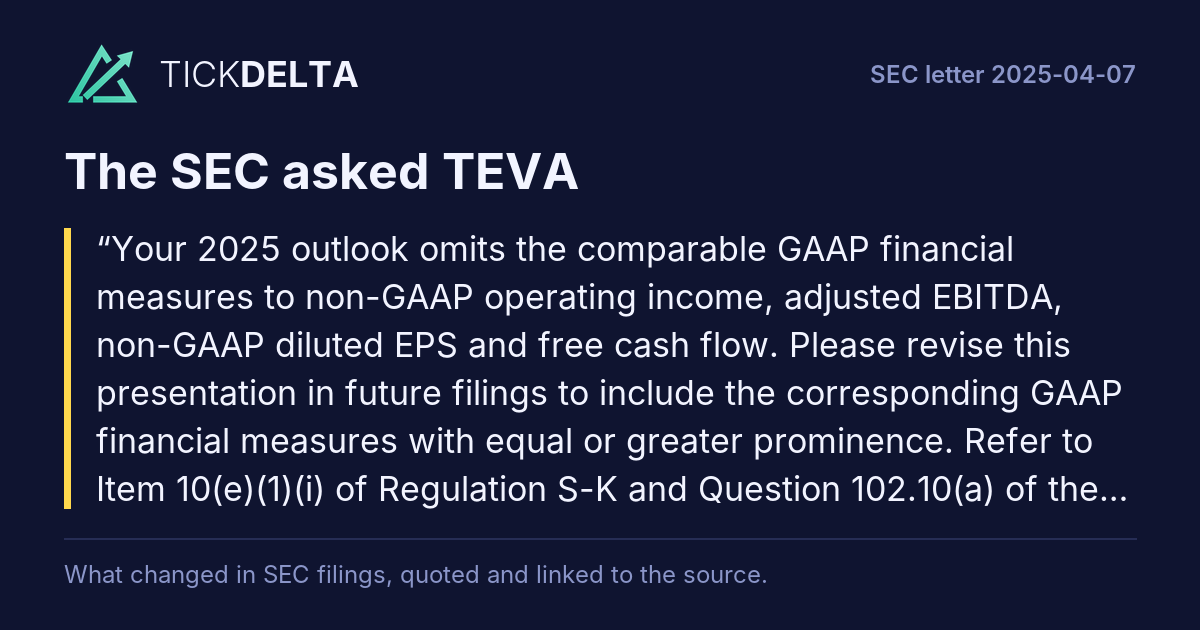
Your 2025 outlook omits the comparable GAAP financial measures to non-GAAP operating income, adjusted EBITDA, non-GAAP diluted EPS and free cash flow. Please revise this presentation in future filings to include the corresponding GAAP financial measures with equal or greater prominence.
Rest of the question

Refer to Item 10(e)(1)(i) of Regulation S-K and Question 102.10(a) of the staff's Compliance and Disclosure Interpretations on Non-GAAP Financial Measures.

TEVA answered
The Company acknowledges the

Staff’s comment and respectfully advises the Staff that, pursuant to the “unreasonable efforts” exception in Item 10(e)(1)(i)(B) of Regulation S-K, the Company historically has not provided comparable GAAP outlook financial measures or quantitative reconciliations of the Company’s non-GAAP outlook financial measures, including non-GAAP operating income, adjusted EBITDA, non-GAAP diluted EPS and free cash flow, to the most directly comparable GAAP outlook financial measures.
Rest of the answer

The Company is unable to predict with reasonable certainty the ultimate outcome of certain significant line items that would affect the computation of such GAAP outlook financial measures and reconciliations including, but not limited to, the amortization of purchased intangible assets, legal settlements and loss contingencies, impairment of long-lived assets and goodwill impairment, without unreasonable effort. The foregoing explanation was also set forth in a disclaimer included in the Company’s earnings press releases for its prior reporting periods that referenced non-GAAP outlook financial measures, as well as the Company’s earnings presentation for the fiscal year ended December 31, 2024, but was inadvertently omitted from the earnings press release for the fiscal year ended December 31, 2024. In response to the Staff’s comment, the Company will ensure such disclaimer is included whenever the computation of such information cannot be completed without unreasonable efforts in its future earnings press releases and other relevant public earnings-related materials that include disclosures of the Company’s non-GAAP outlook financial measures.

We hope that the foregoing has been responsive to the Staff’s comments. If you have any questions related to this letter, please do not hesitate to call me.

Read in the reply
In its next report

First report after the company's reply of Apr 14, 2025: 10-Q filed May 7, 2025 ↗, against the 10-Q filed Nov 6, 2024 ↗.

Tickdelta does not hold the text of both reports, so they are not compared here.

Also in this review: closing letter, 2025-04-28

Form 10-K for the Fiscal Year Ended December 31, 2023

2024-03-11 to 2024-04-17 · 1 question · 1 letter from the SEC, 1 from the company
Review closed 2024-04-17
Non-GAAP measuresResults discussion (MD&A)
Management's Discussion and Analysis · Non-GAAP Net Income and Non-GAAP EPS Data, page 78
SEC asked
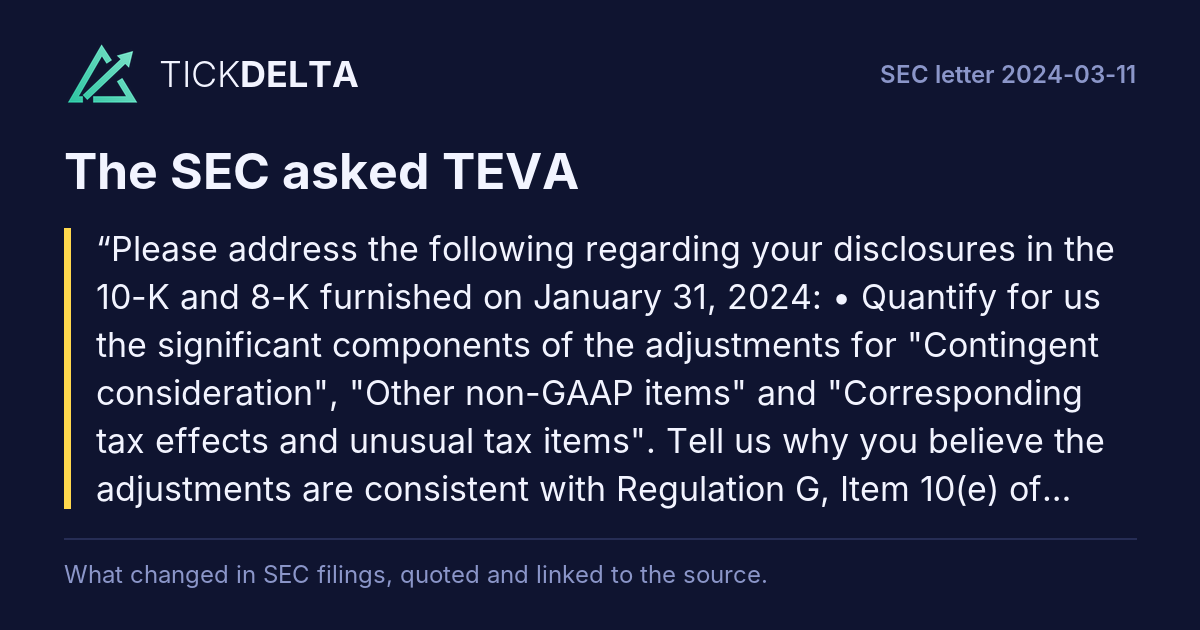
Please address the following regarding your disclosures in the 10-K and 8-K furnished on January 31, 2024: • Quantify for us the significant components of the adjustments for "Contingent consideration", "Other non-GAAP items" and "Corresponding tax effects and unusual tax items". Tell us why you believe the adjustments are consistent with Regulation G, Item 10(e) of Regulation S-K, and C&DI 100.01.
Rest of the question

• For the Corresponding tax effects and unusual tax items you state the amount includes a portion of the realization of a loss related to an investment in one of your subsidiaries. Please tell us the amount of the loss, whether that is the only adjustment not related to corresponding tax effects, and if the related loss is included as an adjustment as well. • Tell us why presenting Adjusted EBITDA in the narrative discussion of your earnings release prior to the presentation of net income is consistent with Item 10(e)(1)(i) of Regulation S-K and C&DI 102.10.

TEVA answered
The Company acknowledges the

Staff’s comment and set forth below is a discussion of the significant components of each of “Contingent Consideration,” “Other non-GAAP items” and “Corresponding tax effects and unusual tax items,” as well as the Company’s rationale for including such adjustments in the Company’s calculation of its Non-GAAP Net Income.
Rest of the answer

On a prospective basis, the Company will quantify the significant components of significant adjustments that have multiple components that are included in the calculation of its non-GAAP measures.

Contingent Consideration

Teva’s contingent consideration expenses relate to past business combination agreements that provide for additional payments contingent upon specific future events that the Company would not have otherwise incurred as part of its continuing operations. These expenses represent adjustments to the fair value of the estimated contingent payments. For the years ended December 31, 2023 and 2022, Teva adjusted for contingent consideration expenses of $548 million and $261 million, respectively. In 2023, contingent consideration expenses primarily consisted of (i) $422 million in changes in the estimated future royalty payments to be paid by the Company to Allergan PLC (“Allergan”) in connection with lenalidomide (generic equivalent of Revlimid®) as part of the Company’s arrangement with Allergan in connection with the acquisition of Allergan’s worldwide generic pharmaceuticals business in August 2016 (the “Allergan Royalty Arrangement”); and (ii) $132 million in changes in the estimated future royalty payments to be paid by the Company to Eagle Pharmaceuticals, Inc. (“Eagle”) in connection with expected future bendamustine sales as part of the exclusive license agreement the Company entered into with Eagle in February 2015 (the “Eagle Licensing Arrangement”), which was accounted as a business combination. In 2022, contingent consideration expenses primarily consisted of (i) $240 million in changes in the estimated future royalty payments to be paid by the Company to Allergan in connection with the Allergan Royalty Arrangement; and (ii) $21 million in changes in the estimated future royalty payments to be paid by the Company to Eagle in connection with the Eagle Licensing Arrangement. Teva’s contingent consideration expenses are quantified and disclosed in Note 20 (Fair value measurement) to the Company’s consolidated financial statements included in Teva’s Annual Report on Form 10-K for the year ended December 31, 2023.

The Company respectfully advises the Staff that it has reviewed the requirements set forth in Regulation G and Item 10(e) of Regulation S-K of the Securities Act of 1933, as amended (the “Securities Act”), and the Staff’s guidance as set forth in C&DI 100.01 (collectively, the “Non-GAAP

Requirements”) and believes that adjusting for contingent consideration expenses in the Company’s calculation of its Non-GAAP Net Income is consistent with the

Non-GAAP Requirements and does not cause its Non-GAAP Net Income to be misleading. Contingent consideration expenses relate to contingent consideration arrangements that are unique and do not follow a repetitive pattern characteristic of recurring expenses. Instead, such contingent expenses vary and are dependent on the circumstances of the particular acquisition from which they arise. The specific amount of contingent consideration expenses recorded by the Company in each reporting period is highly variable and unpredictable, can range in value from several million to several hundreds of millions of dollars and can either be an income or an expense from period to period. Additionally, given that the Company’s contingent consideration expenses represent specific acquisition-related obligations arising from past business combinations, they are not indicative of the Company’s day-to-day operational performance. The Company believes that removing the impact of contingent consideration expenses from its calculation of

Non-GAAP Net Income is consistent with the presentation of non-GAAP measures by other companies within the Company’s industry, as such expenses can vary substantially from company to company depending upon the nature of the business combination arrangements they arise from but are not indicative of the Company’s continuing core business activities. The Company believes that excluding contingent consideration expenses provides investors a clearer view of the Company’s ongoing operational performance and therefore facilitates more meaningful comparisons of the Company’s operational performance across financial periods and enhances investors’ insight into trends in the Company’s core business operations.

Other non-GAAP items

Other non-GAAP items consist of other exceptional items that the Company believes are sufficiently large that their exclusion is important to facilitate investors’ understanding of trends in the Company’s financial results. Other non-GAAP items excluded from the Company’s calculation of its non-GAAP Net Income typically consist of items such as significant costs for the rationalization of the Company’s plants that are not in the ordinary course of business, certain inventory write-offs that are not in the ordinary course of business, certain expenses related to legal proceedings or litigation that are not in the ordinary course of business or other unusual events. For the years ended December 31, 2023 and 2022, Teva adjusted for other non-GAAP items of $330 million and $465 million, respectively. In 2023, other non-GAAP items primarily consisted of (i) $107 million of litigation fees mainly attributed to: (a) the settlement of the Company’s opioids litigation (the “Opioids Litigation”), for which the Company entered into a settlement with all 50 U.S. states and the Native American tribes party thereto in

2023, and (b) the settlement of the U.S. Department of

Justice’s (the “DOJ”) antitrust charges against the Company on the marketing and pricing of certain Teva USA generic products (the “Antitrust Proceeding”); and (ii) $154 million of costs relating to the Company’s plant rationalization efforts, a portion of which consisted of costs related to plants used in the

Company’s API business that the Company intends to divest, as previously announced by the Company concurrently with its earnings release for the year ended December 31, 2023, with the remaining other non-GAAP items in 2023 comprised across several discrete items, none of which are individually material. In 2022, other non-GAAP items primarily consisted of (i)

$114 million of litigation fees related to the Opioids Litigation and the Antitrust Proceeding; (ii) $179 million of costs relating to the Company’s plant rationalization efforts; and (iii) $122 million of expenses related to a specific product that Teva decided to divest, consisting primarily of a write-off of raw materials purchased to produce the product and penalties related to the Company’s exit from a contract related to the product, with the remaining other non-GAAP items in 2022 comprised across several discrete items, none of which are individually material.

The Company has reviewed the other non-GAAP items discussed above against the

Non-GAAP Requirements and believes that adjusting for such other non-GAAP items in the Company’s calculation of its Non-GAAP

Net Income is consistent with the Non-GAAP Requirements and does not cause its Non-GAAP Net Income to be misleading. Each of the other non-GAAP items relates to matters that are distinctive and substantial and are not indicative of the ordinary course of the Company’s operations. The litigation fees included in other non-GAAP items represent fees relating to significant legal settlements for distinctive legal proceedings, primarily brought by governmental agencies, that are predicated on discrete and unique factual circumstances. Litigation fees are only included in other non-GAAP items to the extent they involve significant amounts and relate to litigation for which the Company has recorded a significant legal provision. The Company does not expect such distinctive legal proceedings to reoccur on a regular basis in the ordinary course of its business. The plant rationalization costs included in other non-GAAP items relate to the Company’s efforts to reduce its manufacturing network. Beginning in 2017, following the Company’s acquisition of Allergan’s worldwide generic pharmaceuticals business in August 2016 for which it paid approximately

$40 billion, the Company initiated a robust restructuring program, through which it has divested approximately 50% of its manufacturing network. Given the scale of these rationalization efforts, the costs related thereto would have had an outsized impact on the Company’s financial statements if not otherwise excluded as a non-GAAP item in the Company’s calculation of Non-GAAP Net Income.

Although the rationalization efforts have been ongoing for several years, they were the result of an extraordinarily large acquisition for which integration related to the rationalization of manufacturing plants takes years to implement and continues to be implemented as Teva effects the previously announced divestiture of its API business. Additionally, this plant rationalization process is not indefinite and is expected to be completed in the near future. The Company has already significantly reduced its manufacturing network, which is nearing the scale the Company expects to maintain to support its current business plans for the foreseeable future.

Teva believes that failing to exclude such costs would potentially cause investors to extrapolate its future financial performance from financial results that are not reflective of the Company’s underlying business performance. Adjusting for the Company’s plant rationalization costs helps investors ascertain differences between the Company’s spending on its core business activities and the

Company’s spending on strategic efforts to reduce its manufacturing network. Lastly, other non-GAAP items in 2022 included one-time inventory write-off and related penalties related to a specific product that Teva decided to divest in 2022 as part of its portfolio optimization efforts. The inventory write-off was excluded due to its significant, but non-recurring, impact on the Company’s financial performance, and is further described in Note 6 (Identifiable Intangible Assets) to the Company’s consolidated financial statements included in Teva’s Annual Report on Form 10-K for the year ended December 31, 2023.

These expenses were excluded from the Company’s Non-GAAP Net

Income to eliminate the impact these expenses may have of obscuring trends in the Company’s underlying business performance and to enhance the comparability of the Company’s financial results across periods.

Corresponding tax effects and unusual tax items

Corresponding tax effects and unusual tax items consist of the tax implications of adjustments made in our calculation of

Non-GAAP Net Income and other tax items that the Company views as non-recurring, infrequent or unusual. Generally, most of the expenses excluded from the Company’s Non-GAAP Net Income have a corresponding tax effect. In the years ended December 31, 2023 and 2022, the Company adjusted for corresponding tax effects and unusual tax items of $446 million and

$1,021 million, respectively. In 2023, corresponding tax effects and unusual tax items primarily consisted of corresponding tax effects on expenses and income which are recognized for tax purposes, inclusive of amortization and impairment charges, legal settlements and contingent consideration expenses. In 2022, corresponding tax effects and unusual tax items primarily consisted of $436 million of worthless stock deductions permitted under U.S. tax regulations and related items and $585 million of corresponding tax effects on expenses and income which are recognized for tax purposes, inclusive of amortization and impairment charges, legal settlements and contingent consideration expenses.

The Company has reviewed its adjustments for corresponding tax effects and unusual tax items against the Non-GAAP

Requirements and believes that making such adjustments in the calculation of its Non-GAAP Net Income is consistent with the Non-GAAP Requirements and does not cause its Non-GAAP Net Income to be misleading. The vast majority of corresponding tax effects and unusual tax items excluded from Non-GAAP Net Income are directly attributable to specific pre-tax transactions that are excluded from Non-GAAP Net Income. In 2022, corresponding tax effects and unusual tax items also included worthless stock deductions. Such worthless stock deductions related to Cephalon, Inc. (“Cephalon”), a U.S. subsidiary of Teva USA acquired in 2011, and had no impact on the Company’s valuation of Cephalon or its intangible assets for GAAP reporting purposes. The tax loss recognized in 2022 was a discrete event and no tax deduction was taken on any tax returns prior to 2022 in connection with the values assigned to Cephalon’s intangibles in the Company’s purchase accounting or its outside basis in Cephalon. The Company excludes these discrete tax effects and tax items because they are not reflective of income tax expenses or benefits incurred as a result of the Company’s ordinary course cash-generating operations.

For the Corresponding tax effects and unusual tax items you state the amount includes a portion of the realization of a loss related to an investment in one of your subsidiaries. Please tell us the amount of the loss, whether that is the only adjustment not related to corresponding tax effects, and if the related loss is included as an adjustment as well.

Response: The Company acknowledges the Staff’s comment and respectfully advises the Staff that its adjustment for corresponding tax effects and unusual tax items in 2022 for a portion of the realization of a loss related to an investment in one of its subsidiaries was attributable to the Company’s investment in Cephalon. The total taxable loss recognized in connection with the Company’s investment in Cephalon was approximately $4.2 billion, with a corresponding tax benefit of $909 million. $1.96 billion of the taxable loss, with a corresponding tax effect of $436 million, was included in the Company’s adjustment for corresponding tax effects and unusual tax items in 2022. The remainder of the total taxable loss recognized in connection with the Company’s investment in Cephalon was included under the GAAP line item “Income taxes (benefit)”, and the total GAAP benefit is disclosed in Note 13 (Income Taxes) to the Company’s consolidated financial statements included in Teva’s Annual Report on Form

10-K for the year ended December 31, 2023.

Tell us why presenting Adjusted EBITDA in the narrative discussion of your earnings release prior to the presentation of net income is consistent with Item 10(e)(1)(i) of Regulation S-K and C&DI 102.10.

Response: The Company acknowledges the Staff’s comment and respectfully advises the Staff that, in prior periods it presented Adjusted EBITDA following the presentation of operating income since the Company had, at one time, reconciled Adjusted EBITDA to operating income, and in future periods, the Company will revise its presentation of

Adjusted EBITDA in the narrative discussion of its earnings release to appear after its presentation of net income.

* * * * * *

Should any member of the Staff have any questions or comments concerning this letter, please do not hesitate to call me.
Read in the reply
In its next report

First report after the company's reply of Apr 8, 2024: 10-Q filed May 8, 2024 ↗, against the 10-Q filed Nov 9, 2023 ↗.

Tickdelta does not hold the text of both reports, so they are not compared here.

Also in this review: closing letter, 2024-04-17

Form 10-K for the Fiscal Year Ended December 31, 2021

2022-09-13 to 2022-12-21 · 2 questions · 2 letters from the SEC, 2 from the company
Review closed 2022-12-21
Non-GAAP measuresResults discussion (MD&A)
Management's Discussion and Analysis of Financial Condition and Results of Operations · Supplemental Non-GAAP Income Data, page 73
SEC asked
We note that you modified your non-GAAP reconciliation in your 2021 Annual and Quarterly Reports to essentially present a full non-GAAP Statement of Income, which is specifically prohibited by Question 102.10 of the Compliance and Disclosure Interpretations on Non-GAAP Financial Measures.
Rest of the question

Please confirm that you will revise your future filings to eliminate the full non-GAAP Statement of Income and provide us with a draft of your proposed changes.

TEVA answered
The Company acknowledges the Staff’s comment and confirms that the Company will not present a full non-GAAP Statement of Income in its filings for future financial periods. To address the concerns raised by the Staff, the Company will revise its presentation of its non-GAAP financial measures in future filings to substantially reflect the proposed changes to the presentation of the Company’s reconciliation of its non-GAAP financial measures for the years ended

December 31, 2021 and 2020 set forth in Exhibit A hereto in connection with future Form 10-K and Form 10-Q filings and as set forth
Rest of the answer

in Exhibit B hereto in connection with future earnings press releases.

* * * * * *

Should any member of the Staff have any questions or comments concerning this letter, please do not hesitate to call me.
Read in the reply
In its next report

First report after the company's reply of Oct 26, 2022: 10-Q filed Nov 3, 2022 ↗, against the 10-Q filed Jul 27, 2022 ↗.

Tickdelta does not hold the text of both reports, so they are not compared here.

Exhibit 99.1 Teva Reports 2022 Third Quarter Financial Results · Non-GAAP Financial Measures, page 19
SEC asked
We note your response to our prior comment and your proposed revisions to future earnings releases as presented in Exhibit B. As indicated in the non-GAAP headnote and reconciliation tables for the three and nine months ended September 30, 2022 and 2021, your revised non-GAAP presentation appears to include most of the major captions of the consolidated statements of income (loss), which continues to give undue
Rest of the question

prominence to your non-GAAP financial measures. Please further revise your presentation to comply with Question 102.10 of the Compliance and Disclosure Interpretations on Non-GAAP Financial Measures.

TEVA answered
The

Company acknowledges the Staff’s comment and confirms that the Company will revise the presentation of its non-GAAP financial measures in its earnings releases for future financial periods to comply with

Question 102.10 of the Compliance and Disclosure Interpretations on Non-GAAP Financial Measures.
Rest of the answer

To address the concerns raised by the Staff, the Company will revise its earnings releases for future financial periods to substantially reflect the proposed changes to the Company’s disclosure under the caption “Non-GAAP Financial Measures” set forth in Exhibit A hereto and the proposed changes to the

Company’s reconciliation of its non-GAAP financial measures for the three months ended September 30, 2022 and 2021 set forth in Exhibit B hereto.

* * * * * *

Should any member of the Staff have any questions or comments concerning this letter, please do not hesitate to call me.
Read in the reply
In its next report

First report after the company's reply of Dec 20, 2022: 10-K filed Feb 10, 2023 ↗, against the 10-K filed Feb 9, 2022 ↗.

Tickdelta does not hold the text of both reports, so they are not compared here.

Also in this review: closing letter, 2022-12-21

Form 10-K for the Fiscal Year Ended December 31, 2020

2021-03-22 to 2021-04-21 · 3 questions · 1 letter from the SEC, 1 from the company
Review closed 2021-04-21
Results discussion (MD&A)Liquidity and cashLegal and contingenciesRevenueSegmentsNon-GAAP measures
b. Contingencies · Intellectual Property Litigation, page 133
SEC asked (1)
You state that you may elect to market a generic version even though litigation is still pending and you could face substantial liability for patent infringement which could be material to your results of operations and cash flows in a given period. You also state that the general rule is that the patentee may be compensated by no less than a reasonable royalty which is calculated based on the sales of your product.
Rest of the question

Please tell us your consideration of disclosing the amount of sales of products for each period marketed prior to settlement of patent infringement litigation.

TEVA answered
With respect to the Staff’s comments regarding disclosure of patent litigation contingencies

(“Contingencies note”), there are significant complexities within the law related to compensation for damages if a Company is found to infringe a patent. Potential outcomes of a contingency related to a patent infringement brought to final judgment by a court would generally be that the Company is found: (1) non-infringing with an outcome of zero exposure; (2) infringing an invalid patent with an outcome of zero exposure;

(3) infringing a valid patent with damages of a reasonable royalty based on
Rest of the answer

the Company’s level of sales and/or profit; or (4) infringing a valid patent with damages at a maximum exposure of “lost profits” of the infringed company or even a multiple of “lost profits” (as disclosed in our Note 12b, page 1331 of the 10-K). Because of all the legal variables in any given patent case, the Company has historically considered the indicator of maximum exposure to be the most relevant for disclosure related to its patent cases. However, since the Company does not have transparency to the alleged infringed company’s financial data to calculate an estimate of lost profits as a maximum indicator, the Company has generally included in the past a reference to “IMS/IQVIA sales value” of the patentee’s sales at the time of launch in order to provide a frame of reference to maximum exposure. We examine the information we provide in our disclosure on a quarterly basis as the facts of a particular legal proceeding develop and the judicial process progresses.

In Teva’s December 31, 2020 Contingencies note, it included specific disclosure regarding only two potentially material patent infringement cases which were considered reasonably possible and potentially material for risk of infringement damage claims and therefore disclosed such litigation regarding:

• carvedilol tablets (the generic version of GlaxoSmithKline’s Coreg®) and bortezomib (the generic equivalent of Janssen/Millenimum’s Velcade®).

With respect to carvedilol, there was a previous verdict against Teva for patent infringement of which the outcome was $235.5 million. The outcome was based on a combination of lost profits and reasonable royalty damages. This verdict was overturned and is currently on appeal. Given that there was already a determined amount of potential damages from the jury trial that is disclosed in our Contingencies note, the Company determined that its sales of its respective product is not relevant to disclose with regards to the carvedilol tablets patent infringement case and we believe the previous verdict is the best indicator of potential exposure for disclosure purposes.

With respect to the bortezomib patent infringement case, as noted in our disclosure in the Contingencies note, the case outcome was resolved in favor of the Company as of May 8, 2020 and the case is closed. We will remove this case in our next periodic report filing.

The Company will continue to consider all the relevant factors in its estimate of potential exposure for any accrual or disclosure purposes in future patent infringement cases, including IMS/IQVIA data as an indicator of patentee sales/profit level as well as the Company’s own sales as potential outcomes of cases and will include those it considers most pertinent to each case.

The general rule for damages in patent infringement cases in the United States is that the patentee should be compensated by no less than a reasonable royalty and it may also be able, in certain circumstances, to be compensated for its lost profits. The amount of a reasonable royalty award would generally be calculated based on the sales of Teva’s product. The amount of lost profits would generally be based on the lost sales of the patentee’s product. In addition, the patentee may seek consequential damages as well as enhanced damages of up to three times the profits lost by the patent holder for willful infringement, although courts have typically awarded much lower multiples.

Read in the reply
In its next report

First report after the company's reply of Apr 15, 2021: 10-Q filed Apr 28, 2021 ↗, against the 10-Q filed Nov 5, 2020 ↗.

Tickdelta does not hold the text of both reports, so they are not compared here.

Note 19-Segments, page 158
SEC asked (2)
Your segment presentation is based on geographic regions which include multiple countries. Please confirm that you will separately disclose in future filings revenue from external customers attributed to your country of domicile and revenues attributed to an individual foreign country that are material. Include the basis for attributing revenues to the individual countries. Refer to ASC 280-10-50-41.
Rest of the question

In addition, your disclosure of segment revenues by major products and activities on pages 160 and 161 includes a separate line item for Generic products, which is significant to the total revenues. Please confirm that there are no individual generic products that are significant to total revenues that may require separate disclosure pursuant to ASC 280-10-50-40. Form 8-K filed February 10, 2021

TEVA answered
With respect to the Staff’s comment regarding disclosure of revenue from external customers attributed to the Company’s country of domicile

(Israel), the Company agrees with the Staff’s comment and will include in future filings the revenues from external customers attributed to Israel, its country of domicile.

With respect to the Staff’s comment regarding disclosure of revenue from external customers attributed to an individual country that are significant as required by ASC 280-10-50-41, the largest individual country that the Company operates in is the United States, representing 48% of
Rest of the answer

the Company’s total revenues as disclosed in note 1j of our annual consolidated financial statements (page 101 of the 10-K). No other country’s revenues to external customers represent greater than 10% of total revenues and none are considered to be significantly different on a qualitative basis for disclosure. The basis for attributing revenues to individual countries is measured by sales to external customers in such countries and we will include this disclosure in future filings.

With respect to the Staff’s comment regarding generic revenue on page 160 and 161 of the 10-K, the Company confirms that in 2020 there were no generic products that were individually significant for disclosure in consideration of both quantitative and qualitative factors. We confirm there are no generic products that we consider significant in relation to total revenues or total revenues of any segment.

Read in the reply
In its next report

First report after the company's reply of Apr 15, 2021: 10-Q filed Apr 28, 2021 ↗, against the 10-Q filed Nov 5, 2020 ↗.

Tickdelta does not hold the text of both reports, so they are not compared here.

Exhibit 99.1 · 2020 Annual Consolidated Results, page 3
SEC asked (3)
You disclose in your earnings release EBITDA, Adjusted EBITDA, Non-GAAP operating income, Non-GAAP gross profit, Non-GAAP gross profit margin, and basic and diluted Non-GAAP EPS. Please confirm that for each Non-GAAP measure that is presented in future filings, including your earnings release and periodic reports, you will include a reconciliation from the most directly comparable GAAP number to the non-GAAP measure
Rest of the question

pursuant to Item 10(e)(1)(i) of Regulation S-K.

TEVA answered
We acknowledge the Staff’s comment and in accordance with Item 10(e)(1)(i) of Regulation S-K, Teva will include a reconciliation from the most directly comparable GAAP number to the non-GAAP measure regarding the aforementioned non-GAAP financial measures.

Should any member of the Staff have any questions or comments concerning this letter, please do not hesitate to call me.
Read in the reply
In its next report

First report after the company's reply of Apr 15, 2021: 10-Q filed Apr 28, 2021 ↗, against the 10-Q filed Nov 5, 2020 ↗.

Tickdelta does not hold the text of both reports, so they are not compared here.

Also in this review: closing letter, 2021-04-21

Form 10-K for the Fiscal Year Ended December 31, 2019

2020-03-31 to 2020-07-15 · 1 question · 1 letter from the SEC, 2 from the company
Review closed 2020-07-15
Results discussion (MD&A)Legal and contingencies
Consolidated Financial Statements · Note 11 - Legal settlements and loss contingencies, page 145
SEC asked
During 2019, you recorded an expense of $1,178 million in legal settlement and loss contingencies “mainly related to an estimated settlement provision recorded in connection with the remaining opioid cases,” of which $646 million was recorded in the second quarter and $468 million was recorded in the third quarter.
Rest of the question

Please describefor us the methods and key assumptions used to calculate these loss provisions, particularly the factors that you considered in distinguishing between opioid cases deemed to be probable or not probable. In addition, provide us the following information in your response. • For the $646 million loss provision, quantify the specific amounts associated with the Oklahoma litigation, as well as the general loss provision for “a portion of opioidrelated cases as probable” based on this settlement. • For the $468 million loss provision, quantify the specific amounts associated with the settlement with “two plaintiffs in the MDL Opioid Proceeding” and the agreement in principle with North Carolina, Pennsylvania, Tennessee and Texas, as well as the general loss provision for "more likely" opioid-related cases based on these settlements. • Explain the factors considered in determining the timing for recognition of these two opioid loss provisions. • Quantify for us your range reasonably possible losses related to your opioid exposure, and explain why you did not disclose such range pursuant to ASC 450-20-50-4. • Explain the terms, obligations and rights associated with the nationwide settlement framework and how you expect this arrangement to operate in future periods, particularly the expected timing for recognition of costs associated with your provision of up to $23 billion of sublingual tablets and up to $250 million of cash payments over a ten-year period. • Describe your expected accounting treatment for each element of this nationwide settlement framework. Refer us to the applicable authoritative accounting guidance.

TEVA answered
The Company has faced significant litigation relating to the Company’s historic opioid marketing, distribution and monitoring. Since May

2014, more than 2,000 complaints have been filed with respect to opioid sales and distribution against various Teva affiliates, along with a number of other pharmaceutical companies, distributors and chain pharmacies by a number of cities, counties, states, other political subdivisions, tribes and private plaintiffs (including various putative class actions of individuals) in both state and federal courts.
Rest of the answer

As of December 31, 2019, most of the federal cases have been consolidated into a multidistrict litigation in the Northern District of Ohio (“MDL Opioid Proceeding”) and the majority of the cases filed in state court have been removed and consolidated into the MDL Opioid Proceeding. A number of state Attorneys

General (“AG”), and in some cases political subdivisions within states, have sued the Company in state courts. Many of those state cases are proceeding, with trials for some matters expected in 2020 and 2021.

The opioid complaints contend that the defendants allegedly engaged in improper marketing and distribution of opioids, including ACTIQ® and FENTORA®. The complaints also assert claims related to Teva’s generic opioid products. Plaintiffs seek a variety of civil and equitable remedies, including restitution, civil penalties, disgorgement of profits, treble damages, attorneys’ fees and injunctive relief. Certain plaintiffs assert that the measure of damages is the entirety of the costs associated with addressing the abuse of opioids and opioid addiction and certain plaintiffs have specified multiple billions of dollars in the aggregate as alleged damages. In many of these cases, plaintiffs are seeking joint and several liability among all defendants.

Prior to the second quarter of 2019, in accordance with Accounting Standards Codification (“ASC”) 450-20-25-2 “Contingencies”, management evaluated the claims for whether a loss was considered probable and reasonably estimable. Management concluded, in consultation with internal and external legal counsel, that there were significant potential legal defenses in response to the untested assertions of public nuisance claims related to the legal sale and distribution of FDA-approved medications. However, at that time, given that the complex and overlapping litigation in multiple jurisdictions had not been tested at trial, management concluded that the potential exposure was considered reasonably possible and Teva disclosed the exposure could be material in accordance with ASC

450-20-50-3&4. No range of reasonable exposure was considered estimable. See Note 16 to Teva’s Consolidated Financial

Statements in its Form 10-Q for the first quarter of 2019 (page 33):

“[A]n adverse resolution of any of these lawsuits or investigations may involve large monetary penalties and could have a material and adverse effect on Teva’s reputation, business, results of operations and cash flows.”

Second Quarter of 2019

In the second quarter of 2019, Teva recorded a legal settlement provision of $646 million, of which $585 million was related to the opioid litigation (comprised of an $85 million settlement in the Oklahoma litigation and an estimated provision of $500 million for certain other opioid cases).

In May 2019, Teva settled the Oklahoma litigation brought by the Oklahoma Attorney General (State of Oklahoma, ex. rel. Mike Hunter, Attorney

General of Oklahoma vs. Purdue Pharma L.P., et. al.) for $85 million. In doing so, Teva was one of the first public companies to settle an opioid-related public nuisance claim.

The Company subsequently determined that it was also likely to settle other similar cases, as settlement of certain cases was viewed to be an effective long-term strategy for the Company if such settlements resulted in a reasonable economic outcome. As of the end of the second quarter of 2019, there were 24 states that had either brought, or threatened to bring, litigation against the

Company (state AG cases).

In order to estimate a potential settlement value for the 24 state AG cases, the Company adjusted certain aspects of the Oklahoma settlement in order to extrapolate to determine a reasonable estimate of potential settlement outcomes related to the state AG cases. In consultation with internal and external legal counsel, the Company identified unique considerations of the Oklahoma settlement. Those considerations included, but were not limited to: (1) the risk of Teva being held jointly and severally liable for billions of dollars in potential damages claims by plaintiffs with only one other remaining defendant (a large pharmaceutical, medical device and consumer packaged goods company); (2) the unfavorable political environment of factfinders for a bench trial and on appeal; (3) as the first of many duplicative cases that could go to trial, the first settlement would come at a significant premium; and (4) the Company’s belief that the Oklahoma AG statewide case had distinct characteristics that would not be applicable to the states’ political subdivisions.

The Company considered the factors noted above to calculate a more “normalized” view of the Oklahoma settlement for extrapolation to the other state AG cases. Accordingly, the Company first adjusted for an estimated premium for the first resolution.1 The Company also

As several authors have noted, there is often a premium for resolving the first of many duplicative cases to go to trial. See Howard M. Erichson, Interjurisdictional Preclusion, 96 Mich. L. Rev. 945, 956–57 (1998) (“[A] litigant facing potential related litigation with others attributes extra value to avoiding a judgment. This settlement incentive may affect the parties unequally, changing the settlement dynamic and creating a more favorable settlement for one of the parties, ordinarily the plaintiff. . . . [A] manufacturer facing product liability claims by a number of plaintiffs may prefer to pay additional money to avoid the risk of an issue-preclusive determination of a product defect. If the first case to reach trial is weak for the defendant–for example, if the plaintiff is especially sympathetic or plaintiff’s counsel especially well prepared–the defendant will be even more inclined to settle, so that a stronger defense case will be the first to reach judgment.”); L. Elizabeth Chamblee, Unsettling Efficiency: When Non-Class Aggregation of Mass Torts Creates Second-Class Settlements, 65 La. L. Rev. 157, 175–76 (2004) (“Since federal courts permit nonmutual issue preclusion, a mass torts defendant who faces a growing number of cases arising out of similar facts sees the first trial as a must win situation. . . Due to the high stakes of the first trial for the defendant, the initial plaintiffs can exert more pressure on the defendant to settle.”). Indeed, this premium has been seen in similar pharmaceutical litigation like in In re Vioxx Products Liability Litigation. Merck reached a settlement in principle in November 2007 to settle product liability claims for $4.85 billion. At the time of settlement, there were approximately 27,000 filed cases. See Bruce Patsner, The Vioxx Settlement: Salvation or Sell-Out?, Health Law Perspectives (Feb. 2008), available at http://www.law.uh.edu/Healthlaw/perspectives/2008/(BP)%20vioxx.pdf. This equates to average nationwide settlement of approximately $180,000 per claim. However, the first jury verdict was for $234 million, which was reduced to $26.1 million and then immediately appealed. See Pastner, at n.21. This demonstrates the significant premium for the first successful jury trial compared to the nationwide settlement ($26.1 million versus an average claim of $180,000).

considered the degree to which a payment to the plaintiffs to settle litigation would be more cost-effective than paying legal fees to try cases to verdict. The result of this estimation was a minimum amount of approximately $500 million to settle the 24 state AG cases. Although management considered other scenarios for the state AG cases, these were only “settlement scenarios”, which were not indicative of a high end of the range for ultimate outcome which could include numerous lengthy trials to inestimable verdicts. Given the relatively early stage of the cases and the above-referenced variables, management could not determine a reasonable upper end of the range that would be meaningful to users of the financial statements, as the various scenarios were complex and difficult to estimate. The Company also could not determine any amount within the estimate range to be better than any other. Accordingly, in accordance with ASC 450-20-30-1, the Company recorded a liability of $500 million at that time for the estimated settlement value of the state AG cases at the low end of the range of potential settlement outcomes.

In addition, as noted in Teva’s Form 10-Q for the second quarter of 2019, the Company accounted for only a portion of the opioid cases at that time (the state AG cases, as noted above). As of June 30, 2019, the cases that were included in the MDL

Opioid Proceeding were not factored into the settlement provision estimate. The outcome in the MDL Opioid Proceeding (federal proceeding) was viewed as having an overall higher probability of success for Teva than the state AG cases. The majority of the cases in the MDL Opioid Proceeding relate to state political subdivisions. Given the significant overlap (same population included between state, county and subdivisions) between the potential damages claims in the MDL Opioid Proceeding and the state AG cases, it had not yet been determined if any damages would be awarded or, if damages were awarded, the extent to which damages awarded to states would be allocable to the subdivisions. Therefore, at the time, any damages in the MDL Opioid

Proceeding were not considered probable or estimable in accordance with ASC 450-25-20-2.

Third Quarter of 2019

In the third quarter of 2019, Teva recorded a legal settlement provision of $468 million, of which $440 million was related to an increase in the provision for opioid litigation. During the third quarter of 2019, two events occurred related to the opioid litigation that led the Company to reconsider the estimated low end of the range of potential settlements:

In October 2019, the Company settled with two Ohio county political subdivisions in the MDL Opioid Proceeding

Track 1 litigation (“Ohio Track 1 settlement”). The terms of the settlement were $20 million cash payment of four equal installments over three years and a three year product supply of buprenorphine/naloxone2 valued at $25 million at Wholesaler Acquisition Cost (“WAC”).3

Concurrently with such settlement, the Company entered into an agreement in principle for a nationwide framework for resolving outstanding opioid-related claims with the Attorneys General of four states. Teva’s agreement is in part with the big three distributors (McKesson, Cardinal Health and AmerisourceBergen) as well as Johnson & Johnson, which other defendants have agreed to provide aggregate cash consideration of over $22 billion.4 The framework is designed to provide a vehicle to resolve the majority of the remaining state and political subdivision opioid-related litigation. Teva agreed in principle to a payment of $250 million over 10 years (less a credit of $10 million related to the Track 1 settlement discussed above) plus a ten-year product supply of buprenorphine/naloxone tablets valued at $23 billion at WAC.

Generic suboxone (buprenorphine/naloxone) is recognized as the leading pharmaceutical treatment for opioid abuse disorder.

The framework is based on WAC value, over the ten year period of the product agreement term, to capture a market comparable value. Wholesale Acquisition Cost is defined in 42 CFR Part 403 (HHS/CMS Rule Re: Regulation to Require Drug Pricing Transparency) as follows: “Wholesale acquisition cost means, with respect to a prescription drug or biological product, the manufacturer’s list price for the prescription drug or biological product to wholesalers or direct purchasers in the United States, not including prompt pay or other discounts, rebates or reductions in price, for the most recent month for which the information is available, as reported in wholesale price guides or other publications of drug or biological product pricing data.” See § 403.1201(d).

WAC is commonly understood to be closer to gross revenue and not a true indicator of the net revenue in the generic pharmaceutical industry.

See Medicine Use and Spending in the U.S.: A Review of 2017 and Outlook to 2022, IQVIA Institute, at Chart 36 (2018), available at https://www.iqvia.com/-/media/iqvia/pdfs/institute-reports/medicine-use-and-spending-in-theus-a-review-of-2017-and-outlook-to-2022.pdf (finding that in 2017 only 36% of the WAC price was actually realized by manufacturers for generic medicines);

Steven M. Lieberman, et al., A billion here, a billion there: Selectively disclosing actual generic drug prices would save real money, USC-Brookings Schaffer on Health Policy (Sept. 12, 2017) available at https://www.brookings.edu/blog/usc-brookings-schaeffer-on-health-policy/2017/09/12/a-billion-here-a-billion-there-selectively-disclosing-actual-generic-drug-prices-would-save-real-money (“The ingredient costs actually paid by pharmacies for generic drugs reflect steep discounts from published prices. Unlike brand drugs, where ingredient costs paid by pharmacies track closely to published prices (wholesale acquisition cost or WAC), actual generic ingredient costs average 30 percent of

WAC. However, the overall discount of WAC minus 70 percent varies significantly by product and pharmacy.”)

For more information on the agreement in principle, see the website and details from the Attorney

General of North Carolina available at https://ncdoj.gov/attorney-general-josh-stein-announces-48-billion-settlement-framework-with-five-companies-over-opioid-epidemic/.

As a result of the Ohio Track 1 settlement and the nationwide agreement in principle, which contemplated participation of all U.S. state and subdivision cases, management concluded that this “framework” was a more meaningful basis to estimate a “settlement reserve” that would include all states in the litigation. Thus, the methodology in the third quarter of 2019 based on the nationwide settlement in principle effectively updated and replaced the methodology in the second quarter of 2019 that was limited to only certain state AG cases. Accordingly, management increased the low end of the range of potential settlement outcomes as of the end of the third quarter of 2019 to $940 million (i.e., an increase of $440 million compared to the second quarter of 2019), which reflects an estimate of the low end of the range of the potential cost of the framework agreement with all states.

Although there were various contingencies, the framework agreement was evaluated to assess the estimated range of outcomes. Management considered various scenarios, each of which included various estimates of the volume of product supply, manufacturing costs to produce the product, the price to acquire or internally produce the API (raw material), alternative packaging, the Company’s supply chain need for safety stock and back up supply and possible cost variances due to reduction in labor and overhead allocations resulted from increasing volumes as well as warehousing and distribution costs. The cash component had a specific payout timeline and did not vary between the different scenarios.5

As noted in the Company’s public filings, the negotiations over the framework agreement continue. The Company cannot predict when or if the final settlement will be consummated or if a settlement will be consummated in its current form. The settlement was agreed “in principle” with current terms if all “states and subdivisions” opt in. The initial terms were only agreed to with four states (North Carolina, Pennsylvania, Tennessee and Texas, covering approximately ~18% of the U.S. population by census). If the framework agreement is not consummated as currently contemplated, the terms of any settlement or further litigation would be uncertain and the Company would not be able to determine a reasonable upper end of a range for disclosure that would be meaningful to users of the financial statements.

Prospective Treatment

The Company has accrued for its estimated actual costs of providing product at the low end of a range and has also accrued for the cash. The

Company will continue to monitor whether the settlement framework is finalized in accordance with the terms set forth in the framework. If modifications to the terms are offered or agreed to, the reserve will continue to be monitored for required changes in accordance with ASC 450-20-25-2b. If the settlement framework were ultimately to be agreed to by the majority of parties based on the terms agreed to in principle currently and entered into on such terms, the Company anticipates that the liability established would be reduced each period, as product is supplied and/or cash is paid. In addition, the Company would continue to monitor the estimates established for items that are of a variable nature (i.e., product costs and volumes) and make adjustments to such reserve when circumstances dictate in accordance with ASC 450-20-25-2b.

Since the cash component had a specific payout timeline it was discounted to net present value; the product cost however was not discounted to net present value given the significant variables around costs and volumes.

Disclosure

The Company believes it has appropriately disclosed the potential settlements and related provisions in the quarterly reports on Form 10-Q for the second and third quarters of 2019 (see pages 30 and 36-37 of each such quarterly report). There are thousands of claims, each of which has unique facts and circumstances. If the framework agreement is not executed substantially in its current form, the assumptions the Company would have to make to develop an estimate of loss include, but are not limited to, the following:

the damages sought may not be alleged in the complaints and, when alleged, may bear little or no relationship to the amounts of a potential adverse judgement;

the various procedural and jurisdictional issues and defenses;

the number of claims and overlap of claimants (e.g., states versus subdivisions) are uncertain and unpredictable;

there has been little discovery on most claims; and adverse verdicts may be reversed or reduced upon appeal.

Given the subjectivity and wide-ranging assumptions that would have to be made, if the framework is not successful, the Company would not be able to determine a reasonable upper end of a range for disclosure that would be meaningful to users of the financial statements. However, the Company did disclose (and continues to disclose) that the outcome of the litigation could have a material effect on the Company’s overall financial position as noted below. The Company believes this satisfies the requirement in ASC

450-20-50-3 to disclose the potential impact of such claims. See Note 12 to Teva’s Consolidated Financial Statements in its

Form 10-K for 2019 (page 156):

“An adverse resolution of any of these lawsuits or investigations may involve large monetary penalties, damages, and/or other forms of monetary and non-monetary relief and could have a material and adverse effect on Teva’s reputation, business, results of operations and cash flows.”

* * * * * *

Should any member of the Staff have any questions or comments concerning this letter, please do not hesitate to call me.
Read in the reply
In its next report

First report after the company's reply of Apr 17, 2020: 10-Q filed May 7, 2020 ↗, against the 10-Q filed Nov 7, 2019 ↗.

Tickdelta does not hold the text of both reports, so they are not compared here.

Also in this review: company letter, Jun 19, 2020, closing letter, 2020-07-15

Form S-3

2018-02-09 to 2018-04-16 · 4 questions · 1 letter from the SEC, 2 from the company
No closing letter
Description of Purchase Contracts, page 19
SEC asked (1)
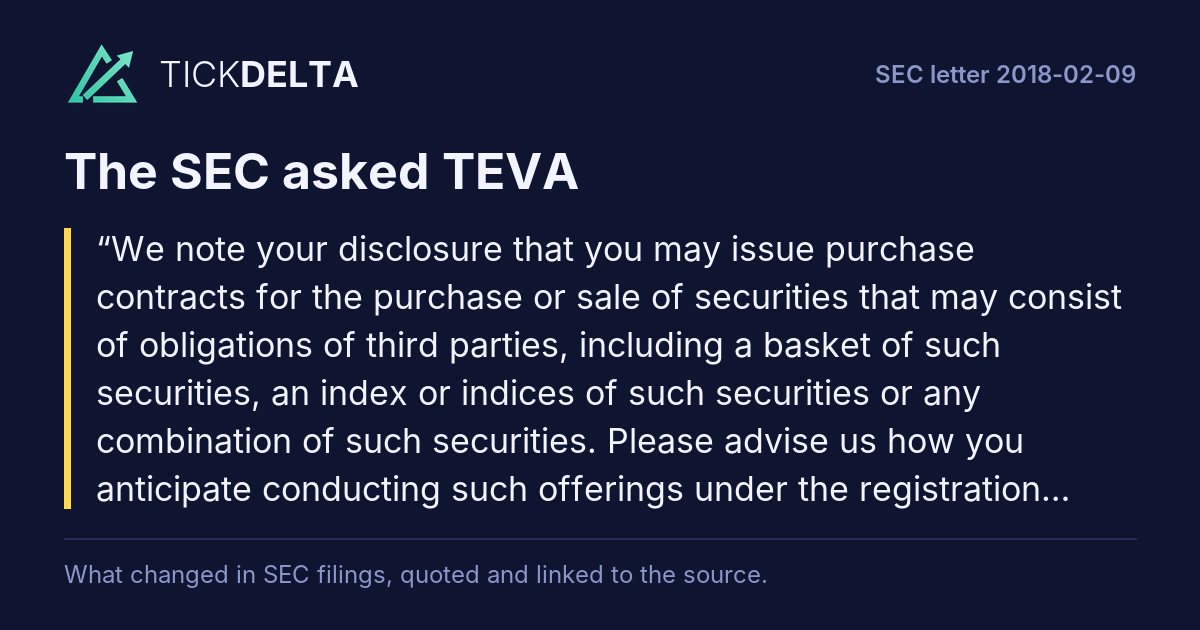
We note your disclosure that you may issue purchase contracts for the purchase or sale of securities that may consist of obligations of third parties, including a basket of such securities, an index or indices of such securities or any combination of such securities. Please advise us how you anticipate conducting such offerings under the registration and disclosure requirements of the Securities Act.
Rest of the question

For example, please advise us of the disclosure you will provide in the applicable prospectus supplement or other offering materials, including, as necessary, any required financial statement and non-financial statement disclosure about the issuer of such securities. For guidance, please refer to the Morgan Stanley & Co., Inc. no action letter (June 24, 1996) and Securities Act Sections Compliance and Disclosure Interpretation 203.03.

TEVA answered
The Company acknowledges the Staff’s comment and the Company does not wish to offer any third party securities underlying purchase contracts. The Company has revised the Registration Statement to remove reference to such third party securities on page 19 of the Registration Statement.
Read in the reply
Description of Purchase Contracts, page 19
SEC asked (2)
It is not clear how the purchase contracts you propose to issue should be characterized for purposes of the federal securities laws. For example, the disclosure in the filing indicates that these contracts may be cash settled.
Rest of the question

The disclosure in the filing also indicates that these contracts may require you to make periodic payments to the holders of the contracts or for holders of these contracts to make periodic payments to you. Finally, the disclosure in the filing indicates that these contracts may require the holders of the contracts to secure their obligations in a specified manner. Based on this disclosure it appears that these contracts may have characteristics associated with forwards, options and securitybased swaps. Please provide us with your legal analysis as to how these contracts should be appropriately characterized under the federal securities laws.

TEVA answered
The Company respectfully notes that because the Registration Statement seeks to register purchase contracts with respect to the future delivery of “debt or equity securities issued by Teva, a basket of such securities, an index or indices of such securities or any combination of the above as specified in the applicable prospectus supplement.” under the

Registration Statement, the Company respectfully submits that the purchase contracts are properly characterized as either “investment contracts” as that term is used in Section 2(a)(1) of the Securities Act or “security forwards” as defined in
Rest of the answer

the Commission’s Release No. 33-9338; 34-67453, and further submits that such purchase contracts should be properly excluded from the definition of “swap” under Section 1a(47)(B) of the Commodity Exchange Act and from the definition of “security-based swap” under Section 2(a)(17) of the Securities Act, Section 1a(42) of the Commodity Exchange

Act and Section 3(a)(68) of the Securities Exchange Act of 1934, as amended (the “Exchange Act”). The Company has also revised its disclosure on page 19 of the Registration Statement in response to the Staff’s comment.

Read in the reply
Description of Purchase Contracts, page 19
SEC asked (3)
We note that the purchase contracts also may involve currencies and commodities. It appears that such purchase contracts may be characterized as swaps or another financial instrument subject to regulation under the Commodity Exchange Act. Please provide us with your legal analysis as to the appropriate characterization of such purchase contracts under the Commodity Exchange Act.
TEVA answered
The Company acknowledges the Staff’s comment and confirms that it does not wish to issue purchase contracts for the purchase or sale of currencies or commodities. Accordingly, the Company has revised its disclosure on page 19 of the Registration Statement in response to the Staff’s comment to remove references to contracts for the purchase or sale of currencies or commodities.
Read in the reply
Description of Units, page 19
SEC asked (4)
We note your disclosure that you may issue units consisting, in part, of equity securities. Please revise your fee table to cover the registration of these equity securities, list them on the prospectus cover page, provide a description of these securities in the prospectus (unless capital stock is to be registered and securities of the same class are registered pursuant to Section 12 of the Exchange Act) and revise
Rest of the question

the legal opinion accordingly. We remind you that the company and its management are responsible for the accuracy and adequacy of their disclosures, notwithstanding any review, comments, action or absence of action by the staff. Refer to Rules 460 and 461 regarding requests for acceleration. Please allow adequate time for us to review any amendment prior to the requested effective date of the registration statement.

TEVA answered
In response to the Staff’s comment, the Company respectfully submits that any equity securities to be issued as part of a unit will be separately registered or issued pursuant to an exemption in compliance with the registration requirements of the Securities Act. Further, the equity securities, if any, comprising in part the units that may be issued consists of ordinary shares of the Company, which are registered pursuant to Section 12 of the Exchange Act. Footnote (6) to the fee table has been revised accordingly.
Read in the reply

Also in this review: company letter, Apr 16, 2018

SEC enforcement releases naming TEVA

Litigation releases and accounting and auditing enforcement releases (AAER) · sec.gov

1

A release is listed only when SEC's list names TEVA PHARMACEUTICAL INDUSTRIES LTD (or a name it had before) among those the action is against. The page does not say what the release found: open it on sec.gov. A release against a person at the company, or one that names the company under another spelling, is not matched, so this list can be shorter than SEC's.

Letters without questions

Other letters

UPLOAD and CORRESP
6 other letters: notices that a filing will not be reviewed, requests to declare a registration effective, and the like

From the SEC's correspondence on EDGAR: staff letters (form UPLOAD) and company letters (form CORRESP), 27 letters filed since 2018-02-09. Questions and answers are matched by their numbers; topics come from words in each question. The reports are compared word for word (same form, before the first SEC letter against the first report after the company's reply). No AI.

Sources

The SEC's correspondence on EDGAR: staff letters (form UPLOAD) and company letters (form CORRESP), matched question by question. No AI.

Also

Filings: the letters in the filing list.

Work with it

Excel workbook · CSV. Google Sheet that stays up to date: paste =IMPORTDATA("https://tickdelta.com/company/TEVA/export.csv") into a cell.

Next in Owners and insiders:Insider trades
Esc

Type a ticker such as AAPL, a name, an investor such as Buffett, or a topic such as tariffs. ↑ ↓ to move, Enter to open.