Paragraph 36 · 46% changed
Every version of it
Screener
/
SEC EDGAR
/CIK 0000070318
/10-K filed Feb 17, 2026, compared with Feb 18, 2025
/Numbers from the XBRL of the 10-Ks
NYSE
Health care · Hospitals
Tenet Healthcare Corp THC
The 10-K against last year's
242 changes: 27 added, 40 removed, 175 reworded
10-K Feb 17, 2026 vs Feb 18, 2025
Risk Factors
15.5%
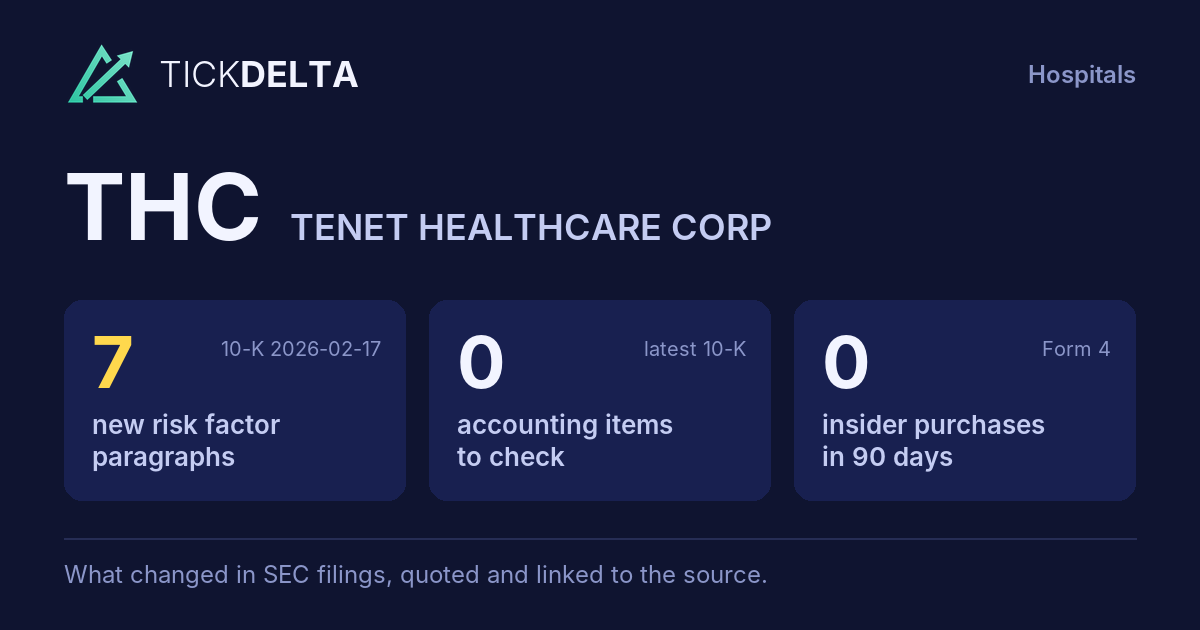
of the text changed · 10,241 words now · 7 new paragraphs, 8 gone
MD&A
24.3%
of the text changed · 21,566 words now · 20 new paragraphs, 32 gone
Legal Proceedings
8.4%
of the text changed · 607 words now
Accounting Policies
14.9%
of the text changed · 5,275 words now
10-K 0000070318-26-000012 (Feb 17, 2026) vs 10-K 0000070318-25-000009 (Feb 18, 2025)
Every paragraph, and how much of it changed
One bar per paragraph, in the order of the 10-K. Height and colour show the share of its words not in the closest paragraph a year earlier; the tallest bars are new paragraphs.
Risk Factors
113 paragraphs · 7 new · 49 reworded · 8 gone · 10-K Feb 17, 2026 against Feb 18, 2025
New paragraph
Reworded (5% of its words or more)
Same or nearly
Paragraph 51 · 45% changed
Every version of it
Paragraph 9 · 41% changed
Every version of it
Over the past several years, various laws and regulations lengthened the enrollment period, expanded income eligibility, and reduced premium caps for subsidies for provided EPTCs to eligible individuals purchasing Affordable Care Act coverage through state and federal health insurance marketplaces. Certain of these provisions are set to expire expired at the end of 2025; if they are not extended, it could result 2025, resulting in significant increases in premiums, potentially leading health insurance premiums. Such increases have led to decreased decreases in enrollment and insurance coverage, and are expected to cause a corresponding rise in the uninsured or a shift of individuals from commercial coverage to government program coverage or other more limited coverage alternatives beginning in 2026. In such a case, As such, we could may experience decreased patient volumes, reduced revenues and an increase in uncompensated care, which would adversely affect our results of operations and cash flows. We cannot predict whether or how the new Congress may extend or modify provisions of or relating to the Affordable Care Act or other laws affecting the healthcare industry generally, nor can we predict how the new administration will influence, promulgate or implement rules, regulations or executive orders that affect the healthcare industry directly or indirectly. We may also experience potential impacts on our business, in ways we cannot anticipate, from healthcare-related policy changes at the state level. Some federal and state changes, initiatives and requirements could, among other things, negatively impact our patient volumes, case mix and revenue mix, increase our operating costs, adversely affect the reimbursement we receive for our services, impact our competitive position or require us to expend resources to modify
Paragraph 33 · 38% changed
Every version of it
Paragraph 43 · 33% changed
Every version of it
Third parties to whom we outsource certain of our functions, with whom we share data for interoperability purposes or from whom we obtain or to whom we provide products and related services, including those that are part of our revenue cycle processes or supply chain, or other third parties with whom our systems interface (such as clients and their vendors, among others), in some instances, store our sensitive and confidential data; these third parties are also subject to the risks outlined above and may not have or use controls effective to protect such information. An attack, breach or other system disruption affecting any of these third parties could similarly harm our business, impact payment of claims, and potentially harm our patients and clients. Further, successful cyber-attacks at other healthcare services companies, whether or not we are impacted, could lead to a general loss of consumer confidence in our industry that could negatively affect us, including harming the market perception of the effectiveness of our security measures or of the healthcare industry in general, which could result in reduced use of our services.
Paragraph 17 · 33% changed
Every version of it
Several states in which we operate continue to face budgetary challenges that have resulted in reduced Medicaid funding levels to hospitals and other providers. Because most states must operate with balanced budgets, and the Medicaid program is generally a significant portion of a state’s budget, states can be expected to adopt or consider adopting future legislation designed to reduce or not increase reevaluate their Medicaid expenditures. In addition, some states delay issuing Medicaid payments to providers to manage state expenditures. As an alternative means of funding provider payments, many of the states where we operate have adopted supplemental payment programs authorized under the Social Security Act. Continuing pressure on state budgets financial plans for 2026 and other factors, including beyond. The OBBBA’s legislative and forthcoming regulatory changes, could changes may result in future material reductions to Medicaid payments, payment delays or changes and reductions to Medicaid supplemental payment programs that could negatively impact our financial condition, results of operations or cash flows. programs, and payment delays. Federal government denials or delayed approvals of state waiver applications or extension requests by the states where we operate could also materially impact our Medicaid funding levels. levels, most significantly in those states that have expanded Medicaid.
Paragraph 13 · 25% changed
Every version of it
We are unable to predict the effect of future government healthcare funding policy changes on our business. If the rates paid by governmental payers are materially reduced, if the scope of services covered by governmental payers is significantly limited, if eligibility or enrollment is further restricted, if there are changes to align payment rates for certain procedures across various care settings, settings in a site neutral manner, or if we or one or more of our hospitals are excluded from participation in the Medicare or Medicaid program or any other government healthcare program, there could may be a material adverse effect on our business, financial condition, results of operations or cash flows. Future federal and state healthcare funding policy changes, along with other initiatives and requirements, may, among other things, adversely affect our patient volumes, case mix and revenue mix, increase our operating costs, materially reduce the reimbursement we receive for our services, diminish our competitive position or require us to expend resources to modify certain aspects of our operations.
Paragraph 44 · 24% changed
Every version of it
Paragraph 36 · 46% changed
Every version of it
10-K Feb 18, 2025New variants or future surges of COVID-19 or the emergence or outbreak of another infectious disease could adversely impact our patient volumes, service mix, revenue mix, operating expenses and net operating revenues in some markets or broadly across our enterprise, depending on how widespread the illness becomes. As with the COVID-19 pandemic, we could experience spikes in admissions at our hospitals, which may put a strain on our resources and personnel, and increased case cancellations in our Ambulatory Care segment. We have been required, and we may in the future be required, to temporarily reduce overall operating capacity or suspend certain services at individual facilities due to staffing constraints and other infectious disease-related factors.
10-K Feb 17, 2026
have been required, and we may in the future be required, to temporarily reduce overall operating capacity or suspend certain services at individual facilities due to staffing constraints and other infectious disease-related factors.
Paragraph 51 · 45% changed
Every version of it
10-K Feb 18, 2025We are unable at this time to predict how future alternative payment models and value-based purchasing initiatives will affect our results of operations, but they could negatively impact our revenues, particularly if we are unable to meet the quality and cost standards established by both governmental and private payers.
10-K Feb 17, 2026
Alternative payment models and value‑based purchasing initiatives of both governmental and private payers tying financial incentives to quality and efficiency of care can affect the results of operations of our hospitals and other healthcare facilities, and may negatively impact our revenues if we are unable to meet expected quality standards. Medicare requires
Paragraph 9 · 41% changed
Every version of it
10-K Feb 18, 2025
Over the past several years, various laws and regulations lengthened the enrollment period, expanded income eligibility, and reduced premium caps for subsidies for individuals purchasing Affordable Care Act coverage through state and federal marketplaces. Certain of these provisions are set to expire at the end of 2025; if they are not extended, it could result in significant increases in premiums, potentially leading to decreased enrollment and a corresponding rise in the uninsured or a shift of individuals from commercial coverage to government program coverage beginning in 2026. In such a case, we could experience decreased patient volumes, reduced revenues and an increase in uncompensated care, which would adversely affect our results of operations and cash flows. We cannot predict whether or how the new Congress may extend or modify provisions of or relating to the Affordable Care Act or other laws affecting the healthcare industry generally, nor can we predict how the new administration will influence, promulgate or implement rules, regulations or executive orders that affect the healthcare industry directly or indirectly. We may also experience potential impacts on our business, in ways we cannot anticipate, from healthcare-related policy changes at the state level. Some federal and state changes, initiatives and requirements could, among other things, negatively impact our patient volumes, case mix and revenue mix, increase our operating costs, adversely affect the reimbursement we receive for our services, impact our competitive position or require us to expend resources to modify
10-K Feb 17, 2026
Over the past several years, various laws and regulations lengthened the enrollment period, expanded income eligibility, and provided EPTCs to eligible individuals purchasing Affordable Care Act coverage through state and federal health insurance marketplaces. Certain of these provisions expired at the end of 2025, resulting in significant increases in health insurance premiums. Such increases have led to decreases in enrollment and insurance coverage, and are expected to cause a corresponding rise in the uninsured or a shift of individuals from commercial coverage to government program coverage or other more limited coverage alternatives beginning in 2026. As such, we may experience decreased patient volumes, reduced revenues and an increase in uncompensated care, which would adversely affect our results of operations and cash flows.
Paragraph 33 · 38% changed
Every version of it
10-K Feb 18, 2025The market for our revenue cycle management services is also competitive. To be successful, we must respond more quickly and effectively than our competitors to new or changing opportunities, technologies, standards, regulations and client requirements. There can be no assurance that we will be successful in generating new client relationships or maintaining existing relationships on favorable terms.
10-K Feb 17, 2026
In addition, we face competition from existing participants and new entrants to the revenue cycle management market, as well as from the internal revenue cycle management staff of hospitals and other healthcare providers. To be successful, we must respond more quickly and effectively than our competitors to new or changing opportunities, technologies, standards, regulations and client requirements. There can be no assurance that we will be successful in generating new client relationships, maintaining current relationships on favorable terms, growing service revenues from existing clients, or replacing contracts when they expire or are terminated, which could have a material adverse impact on our results of operations and financial condition.
Paragraph 43 · 33% changed
Every version of it
10-K Feb 18, 2025
Third parties to whom we outsource certain of our functions, with whom we share data for interoperability purposes or from whom we obtain or to whom we provide products and related services, including those that are part of our revenue cycle processes or supply chain, or other third parties with whom our systems interface (such as clients and their vendors, among others), in some instances, store our sensitive and confidential data; these third parties are also subject to the risks outlined above and may not have or use controls effective to protect such information. An attack, breach or other system disruption affecting any of these third parties could similarly harm our business, impact payment of claims, and potentially harm our patients and clients. Further, successful cyber-attacks at other healthcare services companies, whether or not we are impacted, could lead to a general loss of consumer confidence in our industry that could negatively affect us, including harming the market perception of the effectiveness of our security measures or of the healthcare industry in general, which could result in reduced use of our services.
10-K Feb 17, 2026
Third parties to whom we outsource certain of our functions, with whom we share data for interoperability purposes or from whom we obtain or to whom we provide products and related services, including those that are part of our revenue cycle processes or supply chain, or other third parties with whom our systems interface (such as clients and their vendors, among others), in some instances, store our sensitive and confidential data; these third parties are also subject to the risks outlined
Paragraph 17 · 33% changed
Every version of it
10-K Feb 18, 2025
Several states in which we operate continue to face budgetary challenges that have resulted in reduced Medicaid funding levels to hospitals and other providers. Because most states must operate with balanced budgets, and the Medicaid program is generally a significant portion of a state’s budget, states can be expected to adopt or consider adopting future legislation designed to reduce or not increase their Medicaid expenditures. In addition, some states delay issuing Medicaid payments to providers to manage state expenditures. As an alternative means of funding provider payments, many of the states where we operate have adopted supplemental payment programs authorized under the Social Security Act. Continuing pressure on state budgets and other factors, including legislative and regulatory changes, could result in future reductions to Medicaid payments, payment delays or changes to Medicaid supplemental payment programs that could negatively impact our financial condition, results of operations or cash flows. Federal government denials or delayed approvals of waiver applications or extension requests by the states where we operate could also materially impact our Medicaid funding levels.
10-K Feb 17, 2026
Several states in which we operate continue to face budgetary challenges that have resulted in reduced Medicaid funding levels to hospitals and other providers. Because most states must operate with balanced budgets, and the Medicaid program is generally a significant portion of a state’s budget, states can be expected to reevaluate their financial plans for 2026 and beyond. The OBBBA’s legislative and forthcoming regulatory changes may result in material reductions to Medicaid payments, changes and reductions to Medicaid supplemental payment programs, and payment delays. Federal government denials or delayed approvals of state waiver applications or extension requests could also materially impact Medicaid funding levels, most significantly in those states that have expanded Medicaid.
Paragraph 13 · 25% changed
Every version of it
10-K Feb 18, 2025
We are unable to predict the effect of future government healthcare funding policy changes on our business. If the rates paid by governmental payers are reduced, if the scope of services covered by governmental payers is limited, if eligibility or enrollment is further restricted, if there are changes to align payment rates for certain procedures across various care settings, or if we or one or more of our hospitals are excluded from participation in the Medicare or Medicaid program or any other government healthcare program, there could be a material adverse effect on our business, financial condition, results of operations or cash flows.
10-K Feb 17, 2026
We are unable to predict the effect of future government healthcare funding policy changes on our business. If the rates paid by governmental payers are materially reduced, if the scope of services covered by governmental payers is significantly limited, if eligibility or enrollment is further restricted, if there are changes to align payment rates for certain procedures across various care settings in a site neutral manner, or if we or one or more of our hospitals are excluded from participation in the Medicare or Medicaid program or any other government healthcare program, there may be a material adverse effect on our business, financial condition, results of operations or cash flows. Future federal and state healthcare funding policy changes, along with other initiatives and requirements, may, among other things, adversely affect our patient volumes, case mix and revenue mix, increase our operating costs, materially reduce the reimbursement we receive for our services, diminish our competitive position or require us to expend resources to modify certain aspects of our operations.
Paragraph 44 · 24% changed
Every version of it
10-K Feb 18, 2025Third parties to whom we outsource certain of our functions, with whom we share data for interoperability purposes or from whom we obtain or to whom we provide products and related services, including those that are part of our revenue cycle processes or supply chain, or other third parties with whom our systems interface (such as clients and their vendors, among others), in some instances, store our sensitive and confidential data; these third parties are also subject to the risks outlined above and may not have or use controls effective to protect such information. An attack, breach or other system disruption affecting any of these third parties could similarly harm our business, impact payment of claims, and potentially harm our patients and clients. Further, successful cyber-attacks at other healthcare services companies, whether or not we are impacted, could lead to a general loss of consumer confidence in our industry that could negatively affect us, including harming the market perception of the effectiveness of our security measures or of the healthcare industry in general, which could result in reduced use of our services.
10-K Feb 17, 2026
above and may not have or use controls effective to protect such information. An attack, breach or other system disruption affecting any of these third parties could similarly harm our business or reputation, impact payment of claims, and potentially harm our patients and clients. Further, successful cyber-attacks at other healthcare services companies, whether or not we are impacted, could lead to a general loss of consumer confidence in our industry that could negatively affect us, including harming the market perception of the effectiveness of our security measures or of the healthcare industry in general, which could result in reduced use of our services.
MD&A
272 paragraphs · 20 new · 122 reworded · 32 gone · 10-K Feb 17, 2026 against Feb 18, 2025
New paragraph
Reworded (5% of its words or more)
Same or nearly
Paragraph 220 · 50% changed
Paragraph 110 · 48% changed
CMS projects that the combined impact of the payment and policy changes in the Final OPPS/ASC Rule will yield an average 3.2% 3.3% increase in Medicare FFS OPPS payments for hospitals in urban areas and an average 4.9% increase in Medicare FFS OPPS payments for proprietary propriety hospitals. The projected CY 2025 impact of the payment and policy changes in the Final OPPS/ASC Rule is an increase to Medicare FFS hospital outpatient revenues of approximately $21 million, or 4.32%, for the facilities in our Hospital Operations segment and $20 million, or 2.87%, for USPI’s ASCs and surgical hospitals. Because of the uncertainty associated with various factors that may influence our future OPPS payments, including legislative or legal actions, volumes and case mix, we cannot provide any assurances regarding our estimates of the impact of the final payment and policy changes.
Paragraph 187 · 48% changed
Paragraph 26 · 45% changed
Paragraph 112 · 45% changed
Payment and Policy Changes to the MPFS—In November 2024, October 2025, CMS released the CY 2025 2026 Medicare Physician Fee Schedule Final Rule (“MPFS Final Rule”). The MPFS Final Rule includes updates to payment policies, payment rates and other provisions for services reimbursed under the MPFS from January 1 through December 31, 2025. 2026. The MPFS Final Rule also includes a one-time temporary 2.5% MPFS conversion factor increase from the OBBBA. Under the MPFS Final Rule, the CY 2025 2026 conversion factor, which is the base rate that is used factors will increase from $32.35 to convert relative units into payment rates, was reduced from $33.29 $33.57 for qualifying APM QPs and to $32.35, a decrease of 2.82%. We estimate the impact of the MPFS Final Rule will result in a reduction of approximately $5 million to our 2025 FFS MPFS revenues. Because of the uncertainty associated with various factors that may influence our future MPFS payments, including legislative, regulatory or legal actions, volumes and case mix, we cannot provide any assurances regarding our estimate of the impact of the final payment and policy changes. $33.40 for non-QP clinicians.
Paragraph 42 · 45% changed
Supplies expense for our Hospital Operations segment decreased increased by $48 $22 million, or 7.4%, 3.7%, during the three months ended December 31, 2024 2025 compared to the same period in 2024. This change was driven by an increase in same‑hospital admissions, as well as higher acuity, during the 2025 period. These increases were partially offset by our continued focus on cost‑efficiency measures, which include product standardization, contract management, improved utilization, bulk purchases, focused spending and operational improvements, among others. On a per adjusted admission basis, supplies expense increased by 2.7% in the three months ended December 31, 2025 compared to the three months ended December 31, 2023, primarily due to the sales of the Divested Hospitals. Excluding the impact of these sales, supplies expense increased by $64 million, or 11.9%, during the three months ended December 31, 2024 as compared to the same period in 2023. This increase was primarily due to higher patient 2024.
Paragraph 163 · 42% changed
During the year ended December 31, 2024, 2025, we acquired commenced operations at six de novo ASCs. In the same period, we paid an aggregate of $301 million to acquire controlling ownership interests in 52 ASCs, as well as noncontrolling ownership interests in two 27 ASCs and one surgical hospital. Prior to these transactions, hospital in which we did not have previously held no investment, as well as nine facilities that were previously unconsolidated. We also acquired a prior investment non‑controlling ownership interest in these facilities. In addition, we acquired controlling ownership interests in seven previously unconsolidated ASCs. We paid an aggregate ASC and ceased operations or disposed of $554 million to acquire all of the aforementioned ownership interests 19 ASCs during the year ended December 31, 2024. 2025.
Paragraph 66 · 41% changed
Paragraph 220 · 50% changed
10-K Feb 18, 2025Letter of Credit Facility—Our LC Facility provides for the issuance, from time to time, of standby and documentary letters of credit in an aggregate principal amount of up to $200 million. At December 31, 2024, we were in compliance with all covenants and conditions in the LC Facility, and we had $106 million of standby letters of credit outstanding thereunder.
10-K Feb 17, 2026
$1.900 billion was available for borrowing under the 2025 Credit Agreement at December 31, 2025. We were in compliance with all covenants and conditions in our 2025 Credit Agreement at December 31, 2025.
Paragraph 110 · 48% changed
10-K Feb 18, 2025
CMS projects that the combined impact of the payment and policy changes in the Final OPPS/ASC Rule will yield an average 3.2% increase in Medicare FFS OPPS payments for hospitals in urban areas and an average 4.9% increase in Medicare FFS OPPS payments for proprietary hospitals. The projected CY 2025 impact of the payment and policy changes in the Final OPPS/ASC Rule is an increase to Medicare FFS hospital outpatient revenues of approximately $21 million, or 4.32%, for the facilities in our Hospital Operations segment and $20 million, or 2.87%, for USPI’s ASCs and surgical hospitals. Because of the uncertainty associated with various factors that may influence our future OPPS payments, including legislative or legal actions, volumes and case mix, we cannot provide any assurances regarding our estimates of the impact of the final payment and policy changes.
10-K Feb 17, 2026
CMS projects that the combined impact of the payment and policy changes in the Final OPPS/ASC Rule will yield an average 3.3% increase in Medicare FFS OPPS payments for propriety hospitals.
Paragraph 187 · 48% changed
10-K Feb 18, 2025At December 31, 2024, we had outstanding senior unsecured notes and senior secured notes with an aggregate principal balance of $12.662 billion, the maturity dates of which are staggered from 2027 through 2031. In March 2024, we redeemed all $2.100 billion aggregate principal amount outstanding of our 2026 Senior Secured First Lien Notes in advance of their maturity date. We paid $2.100 billion using cash on hand to redeem the notes. In connection with the redemption, we recorded a loss from early extinguishment of debt of $8 million in the three months ended March 31, 2024, primarily related to the write-off of associated unamortized issuance costs.
10-K Feb 17, 2026
•We used the net proceeds from the issuance of the 2032 Senior Secured First Lien Notes and 2033 Senior Unsecured Notes, together with cash on hand, to finance the redemption of all $1.500 billion aggregate principal amount outstanding of our February 2027 Senior Secured Second Lien Notes and the redemption of $750 million aggregate principal amount of the then $2.500 billion aggregate principal amount outstanding of our October 2028 Senior Unsecured Notes, in each case in advance of their maturity dates.
Paragraph 26 · 45% changed
10-K Feb 18, 2025At December 31, 2024, we had outstanding senior unsecured notes and senior secured notes with an aggregate principal balance of $12.662 billion, the maturity dates of which are staggered from 2027 through 2031. In March 2024, we redeemed all $2.100 billion aggregate principal amount outstanding of our 2026 Senior Secured First Lien Notes in advance of their maturity date. We paid $2.100 billion using cash on hand to redeem the notes. In connection with the redemption, we recorded a loss from early extinguishment of debt of $8 million in the three months ended March 31, 2024, primarily related to the write-off of associated unamortized issuance costs.
10-K Feb 17, 2026
During the three months ended December 31, 2025, we issued $1.500 billion aggregate principal amount of our 5.500% senior secured notes due on November 15, 2032 (the “2032 Senior Secured First Lien Notes”) and $750 million aggregate principal amount of our 6.000% senior notes due on November 15, 2033 (the “2033 Senior Unsecured Notes”). We used the net proceeds from these issuances, together with cash on hand, to redeem all $1.500 billion aggregate principal amount outstanding of our 6.250% senior secured second lien notes due February 2027 (the “February 2027 Senior Secured Second Lien Notes”) and redeem $750 million of the then $2.500 billion aggregate principal amount outstanding of our 6.125% senior notes due October 2028 (the “October 2028 Senior Unsecured Notes”) in advance of their respective maturity dates.
Paragraph 112 · 45% changed
10-K Feb 18, 2025
Payment and Policy Changes to the MPFS—In November 2024, CMS released the CY 2025 Medicare Physician Fee Schedule Final Rule (“MPFS Final Rule”). The MPFS Final Rule includes updates to payment policies, payment rates and other provisions for services reimbursed under the MPFS from January 1 through December 31, 2025. Under the MPFS Final Rule, the CY 2025 conversion factor, which is the base rate that is used to convert relative units into payment rates, was reduced from $33.29 to $32.35, a decrease of 2.82%. We estimate the impact of the MPFS Final Rule will result in a reduction of approximately $5 million to our 2025 FFS MPFS revenues. Because of the uncertainty associated with various factors that may influence our future MPFS payments, including legislative, regulatory or legal actions, volumes and case mix, we cannot provide any assurances regarding our estimate of the impact of the final payment and policy changes.
10-K Feb 17, 2026
Payment and Policy Changes to the MPFS—In October 2025, CMS released the CY 2026 Medicare Physician Fee Schedule Final Rule (“MPFS Final Rule”). The MPFS Final Rule includes updates to payment policies, payment rates and other provisions for services reimbursed under the MPFS from January 1 through December 31, 2026. The MPFS Final Rule also includes a one-time temporary 2.5% MPFS conversion factor increase from the OBBBA. Under the MPFS Final Rule, the CY 2026 conversion factors will increase from $32.35 to $33.57 for qualifying APM QPs and to $33.40 for non-QP clinicians.
Paragraph 42 · 45% changed
10-K Feb 18, 2025
Supplies expense for our Hospital Operations segment decreased by $48 million, or 7.4%, during the three months ended December 31, 2024 compared to the three months ended December 31, 2023, primarily due to the sales of the Divested Hospitals. Excluding the impact of these sales, supplies expense increased by $64 million, or 11.9%, during the three months ended December 31, 2024 as compared to the same period in 2023. This increase was primarily due to higher patient
10-K Feb 17, 2026
Supplies expense for our Hospital Operations segment increased by $22 million, or 3.7%, during the three months ended December 31, 2025 compared to the same period in 2024. This change was driven by an increase in same‑hospital admissions, as well as higher acuity, during the 2025 period. These increases were partially offset by our continued focus on cost‑efficiency measures, which include product standardization, contract management, improved utilization, bulk purchases, focused spending and operational improvements, among others. On a per adjusted admission basis, supplies expense increased by 2.7% in the three months ended December 31, 2025 compared to the three months ended December 31, 2024.
Paragraph 163 · 42% changed
10-K Feb 18, 2025
During the year ended December 31, 2024, we acquired controlling ownership interests in 52 ASCs, as well as noncontrolling ownership interests in two ASCs and one surgical hospital. Prior to these transactions, we did not have a prior investment in these facilities. In addition, we acquired controlling ownership interests in seven previously unconsolidated ASCs. We paid an aggregate of $554 million to acquire all of the aforementioned ownership interests during the year ended December 31, 2024.
10-K Feb 17, 2026
During the year ended December 31, 2025, we commenced operations at six de novo ASCs. In the same period, we paid an aggregate of $301 million to acquire controlling ownership interests in 27 ASCs and one surgical hospital in which we previously held no investment, as well as nine facilities that were previously unconsolidated. We also acquired a non‑controlling ownership interest in an ASC and ceased operations or disposed of 19 ASCs during the year ended December 31, 2025.
Paragraph 66 · 41% changed
10-K Feb 18, 2025Several states in which we operate continue to face budgetary challenges that have resulted in reduced Medicaid funding levels to hospitals and other providers. Because most states must operate with balanced budgets, and the Medicaid program is generally a significant portion of a state’s budget, states can be expected to adopt or consider adopting future legislation designed to reduce or not increase their Medicaid expenditures. In addition, some states delay issuing Medicaid payments to providers to manage state expenditures. As an alternative means of funding provider payments, many of the states where we operate have adopted supplemental payment programs authorized under the Social Security Act. Continuing pressure on state budgets and other factors, including legislative and regulatory changes, could result in future reductions to Medicaid payments, payment delays or changes to Medicaid supplemental payment programs. Federal government denials or delayed approvals of waiver applications or extension requests by the states where we operate could also materially impact our Medicaid funding levels.
10-K Feb 17, 2026
Because most states must operate with balanced budgets, and the Medicaid program is generally a significant portion of a state’s budget, states can be expected to reevaluate their financial plans for 2026 and beyond. The OBBBA’s legislative and forthcoming regulatory changes may result in material reductions to Medicaid payments, changes and reductions to Medicaid supplemental payment programs, and payment delays. Federal government denials or delayed approvals of state waiver applications or extension requests could also materially impact Medicaid funding levels, most significantly in those states that have expanded Medicaid.
A paragraph is matched with the one last year that shares the most of its words; under half in common makes it new. The paragraphs shown are the 8 reworded the most in each section.
The paragraph that changed most in each section
The redline
Marked against last year's 10-K: cut words struck through, new words highlighted.
MD&A247 words changed in this paragraph; it is 57% similar to last year's version.
Revenues under managed care plans are based primarily on payment terms involving predetermined rates per diagnosis, per‑diem rates, discounted FFS rates and/or other similar contractual arrangements. These revenues are also subject to review and possible audit by the payers, which can take several years before they are completely resolved. The payers are billed for patient services on an individual patient basis. An individual patient’s bill is subject to adjustment on a patient‑by‑patient basis in the ordinary course of business by the payers following their review and adjudication of each particular bill. We estimate the discounts for contractual allowances at the individual hospital level utilizing billing data on an individual patient basis. At the end of each month, on an individual hospital basis, we estimate our expected reimbursement for patients of managed care plans based on the applicable contract terms. We believe it is reasonably likely for there to be an approximately 3% increase or decrease in the estimated contractual allowances related to managed care plans. Based on reserves at December 31, 2024, a 3% increase or decrease in the estimated contractual allowance would impact the estimated reserves by approximately $29 million. Some of the factors that can contribute to changes in the contractual allowance estimates include: (1) changes in reimbursement levels for procedures, supplies and drugs when threshold levels are triggered; (2) changes in reimbursement levels when stop‑loss or outlier limits are reached; (3) changes in the admission status of a patient due to physician orders subsequent to initial diagnosis or testing; (4) final coding of in‑house and discharged‑not‑final‑billed patients that change reimbursement levels; (5) secondary benefits determined after primary insurance payments; and (6) reclassification of patients among insurance plans with different coverage and payment levels. Contractual allowance estimates are periodically reviewed for accuracy by taking into consideration known contract terms, as well as payment history. We believe our estimation and review process enables us to identify instances on a timely basis where such estimates need to be revised. We do not believe there were any adjustments to estimates of patient bills that were material to our revenues during the year ended December 31, 2024. In addition, on a corporate‑wide basis, we do not record any general provision for adjustments to estimated contractual allowances for managed care plans. Managed care accounts, net of contractual allowances recorded, are further reduced to their net realizable value through implicit price concessions based on historical collection trends for these payers and other factors that affect the estimation process.
Source: Item 7, 10-K 0000070318-26-000012 vs Item 7, 10-K 0000070318-25-000009
Accounting Policies214 words changed in this paragraph; it is 30% similar to last year's version.
Source: Item 8, Note 1 – SIGNIFICANT ACCOUNTING POLICIES, 10-K 0000070318-26-000012 vs Item 8, Note 1 – SIGNIFICANT ACCOUNTING POLICIES, 10-K 0000070318-25-000009
Risk Factors187 words changed in this paragraph; it is 48% similar to last year's version.
Over the past several years, various laws and regulations lengthened the enrollment period, expanded income eligibility, and reduced premium caps for subsidies for provided EPTCs to eligible individuals purchasing Affordable Care Act coverage through state and federal health insurance marketplaces. Certain of these provisions are set to expire expired at the end of 2025; if they are not extended, it could result 2025, resulting in significant increases in premiums, potentially leading health insurance premiums. Such increases have led to decreased decreases in enrollment and insurance coverage, and are expected to cause a corresponding rise in the uninsured or a shift of individuals from commercial coverage to government program coverage or other more limited coverage alternatives beginning in 2026. In such a case, As such, we could may experience decreased patient volumes, reduced revenues and an increase in uncompensated care, which would adversely affect our results of operations and cash flows. We cannot predict whether or how the new Congress may extend or modify provisions of or relating to the Affordable Care Act or other laws affecting the healthcare industry generally, nor can we predict how the new administration will influence, promulgate or implement rules, regulations or executive orders that affect the healthcare industry directly or indirectly. We may also experience potential impacts on our business, in ways we cannot anticipate, from healthcare-related policy changes at the state level. Some federal and state changes, initiatives and requirements could, among other things, negatively impact our patient volumes, case mix and revenue mix, increase our operating costs, adversely affect the reimbursement we receive for our services, impact our competitive position or require us to expend resources to modify
Source: Item 1A, 10-K 0000070318-26-000012 vs Item 1A, 10-K 0000070318-25-000009
Legal Proceedings51 words changed in this paragraph; it is 88% similar to last year's version.
We record accruals for estimated losses relating to claims and lawsuits when available information indicates that a loss is probable and we can reasonably estimate the amount of the loss or a range of loss. Significant judgment is required in both the determination of the probability of a loss and the determination as to whether a loss is reasonably estimable. These determinations are updated at least quarterly and are adjusted to reflect the effects of negotiations, settlements, rulings, advice of legal counsel and technical experts, and other information and events pertaining to a particular matter, but are subject to significant uncertainty regarding numerous factors that could affect the ultimate loss levels. If a loss on a material matter is reasonably possible and estimable, we disclose an estimate of the loss or a range of loss. We do not disclose an estimate when we have concluded that a loss is either not reasonably possible or a loss, or a range of loss, is not reasonably estimable, based on available information. Given the inherent uncertainties associated with material legal matters, especially those involving governmental agencies, and the indeterminate damages sought in some cases, we are unable to predict the ultimate liability we may incur from such matters, and an adverse outcome in one or more of these matters could be material to our results of operations or cash flows for any particular reporting period.
Source: Item 3, via Note 17 – CLAIMS AND LAWSUITS, 10-K 0000070318-26-000012 vs Item 3, via Note 17 – CLAIMS AND LAWSUITS, 10-K 0000070318-25-000009
Sentences and paragraphs added, removed or reworded
Every change, by type
Sentences and paragraphs of THC's Risk Factors and MD&A, 10-K Feb 17, 2026 against 10-K Feb 18, 2025. Each links to the text at sec.gov.
Quiet changes are sentences kept from last year with one to four words changed, at least one of them a hedge, a modal or a qualifier (may, could, will, not, significant, material…). A year or date rolling forward is not counted.
The full word list
adverse, adversely, all, although, anticipate, anticipates, any, approximately, believe, believes, can, cannot, certain, could, expect, expects, generally, however, if, intend, intends, largely, likely, many, material, materially, may, might, most, must, never, no, not, possible, primarily, probable, should, significant, significantly, some, substantial, substantially, unlikely, will, would
AddedRisk Factors
Moreover, once the OBBBA is implemented, the Congressional Budget Office anticipates that millions of individuals could lose health insurance between now and 2034. At this time, we cannot estimate the OBBBA’s impact, nor can we predict the timing of that impact, on our future business, financial condition or results of operations, however, we may experience decreased payments (including supplemental payments) from Medicare, Medicaid and other government programs, as well as delays in the timing of payments to our facilities.
Read it in 10-K Feb 17, 2026 at sec.gov
AddedRisk Factors
We also cannot predict whether or how Congress may further extend or modify provisions of or relating to the Affordable Care Act, the OBBBA or other laws affecting the healthcare industry generally, nor can we predict how government agencies or the current administration might further influence, promulgate or implement rules, regulations or executive orders that affect the healthcare industry directly or indirectly. Furthermore, we cannot predict the impact healthcare policy risks and uncertainties may have on the trading price of our common stock.
Read it in 10-K Feb 17, 2026 at sec.gov
AddedRisk Factors
Conifer is subject to numerous federal, state and local consumer protection and other laws governing such topics as privacy, financial services, and billing and collections activities. Regulations related to such laws are subject to changing interpretations that may be inconsistent among different jurisdictions. In addition, a regulatory determination made by, or a
Read it in 10-K Feb 17, 2026 at sec.gov
AddedRisk Factors
Risks we face during periods of economic weakness and high unemployment in the areas where we operate include potential declines in the population covered under managed care contracts, increased patient decisions to postpone or cancel elective and non-emergency healthcare procedures (including delaying surgical procedures), which may lead to poorer health and higher‑acuity interventions, potential increases in the uninsured and underinsured populations, increased adoption of health plan structures that shift financial responsibility to patients, and further difficulties in collecting patient co-pays and deductibles. Any significant deterioration in the collectability of patient accounts receivable could adversely affect our cash flows, results of operations and liquidity.
Read it in 10-K Feb 17, 2026 at sec.gov
AddedRisk Factors
Inflationary pressures may increase operating expenses to a greater degree and faster than reflected in updates to the reimbursement systems of governmental and private payers. In recent years, our business has been impacted by inflation and its effects on salaries, wages and benefits, as well as other costs. Medical supply prices remain high due to current economic conditions and other factors. Moreover, national supply shortages have impacted and could in the future impact our ability to see and treat patients. In addition, the potential for new or increased tariffs on various goods, including, but not limited to, medical supplies, pharmaceuticals and capital equipment, have created further uncertainty within the healthcare sector.
Read it in 10-K Feb 17, 2026 at sec.gov
AddedRisk Factors
We are unable to predict whether or to what extent current or future macroeconomic conditions, tariff actions, geopolitical dynamics, trade tensions, export control rules, weather events or other issues yet to emerge could materially impact our supply chain, capital expenditures or operating costs.
Read it in 10-K Feb 17, 2026 at sec.gov
AddedRisk Factors
Our future financial performance and level of profitability may depend, in part, on various cost‑reduction initiatives, including the outsourcing of certain functions unrelated to direct patient care. We may encounter challenges in executing
Read it in 10-K Feb 17, 2026 at sec.gov
RemovedRisk Factors
Show the other 55
RemovedRisk Factors
RemovedRisk Factors
RemovedRisk Factors
RemovedRisk Factors
RemovedRisk Factors
RemovedRisk Factors
RemovedRisk Factors
RewordedRisk Factors
RewordedRisk Factors
There can be no assurance that we will be successful in generating new client relationships or relationships, maintaining existing current relationships on favorable terms. terms, growing service revenues from existing clients, or replacing contracts when they expire or are terminated, which could have a material adverse impact on our results of operations and financial condition.
Read it in 10-K Feb 17, 2026 at sec.gov
RewordedRisk Factors
RewordedRisk Factors
Because most states must operate with balanced budgets, and the Medicaid program is generally a significant portion of a state’s budget, states can be expected to adopt or consider adopting future legislation designed to reduce or not increase reevaluate their Medicaid expenditures. financial plans for 2026 and beyond.
Read it in 10-K Feb 17, 2026 at sec.gov
RewordedRisk Factors
Conversely, if we are unable to successfully maintain, enhance or operate our information systems, including through the implementation of AI AI‑enabled technologies or applications in our operations, we may be, among other things, unable to efficiently adapt to evolving laws and requirements, unable to requirements or remain competitive with others who successfully implement and advance this technology, current and our patients’ safety may be adversely impacted, any of emerging technologies, which could have a material adverse impact on our overall business, financial condition, results of operations or cash flows.
Read it in 10-K Feb 17, 2026 at sec.gov
RewordedRisk Factors
Even in cases where such approvals are obtained, the process of obtaining them could delay the anticipated closing timeline timeline, cause us to incur higher than expected out-of-pocket expenses, and potentially result in significant out‑of‑pocket expenses. conditions or restrictions imposed by applicable authorities.
Read it in 10-K Feb 17, 2026 at sec.gov
RewordedRisk Factors
There can be no assurance that we will be able to maintain a level of cash flows from operating activities sufficient to permit us to pay the principal, premium, if any, and interest on our indebtedness.
Read it in 10-K Feb 17, 2026 at sec.gov
RewordedRisk Factors
As cybersecurity threats continue to evolve, we may not be able to anticipate certain attack methods methods, including those involving the integration of new or emerging technologies, such as artificial intelligence (“AI”) and Generative AI, in order to implement effective protective measures.
Read it in 10-K Feb 17, 2026 at sec.gov
RewordedRisk Factors
Recent advancements in technology and applications in healthcare, including Generative AI, are enabling our operations healthcare have allowed us to accelerate the adoption of artificial intelligence (“AI”) enabled AI and Generative AI-enabled tools in areas such as clinical care coordination, medical documentation, revenue cycle management and administrative services.
Read it in 10-K Feb 17, 2026 at sec.gov
RewordedRisk Factors
RewordedRisk Factors
Federal government denials or delayed approvals of state waiver applications or extension requests by the states where we operate could also materially impact our Medicaid funding levels. levels, most significantly in those states that have expanded Medicaid.
Read it in 10-K Feb 17, 2026 at sec.gov
RewordedRisk Factors
Moreover, Generative AI systems, which systems that require the collection and processing of sensitive patient data, data could present potential security and privacy risks. risks, as well as risks related to output quality.
Read it in 10-K Feb 17, 2026 at sec.gov
AddedMD&A
On January 27, 2026, we entered into an agreement with CommonSpirit Health (a successor to Catholic Health Initiatives) (“CHI”) relating to Conifer Health Solutions, LLC (“Conifer”). Subject to the terms of that agreement and other related contracts, the parties have agreed to, among other things: (1) terminate the amended and restated master services agreement pursuant to which Conifer provides end-to-end revenue cycle management services to certain CHI facilities effective as of December 31, 2026; (2) CHI’s payment to us of an aggregate amount equal to $1.900 billion in annual installments over the next three years; provided that, of such amount, $540 million was satisfied on January 27, 2026 by offsetting the $540 million due to CHI from Conifer as described in the next clause; (3) the reduction of our redeemable noncontrolling interest balance, and an increase in our additional paid-in capital balance associated with the redemption by Conifer of CHI’s minority equity interest in Conifer, in exchange for a payment by Conifer of $540 million, which redemption is effective as of January 1, 2026; and (4) the grant of mutual releases to each other in respect of potential disputes related to Conifer.
Read it in 10-K Feb 17, 2026 at sec.gov
AddedMD&A
The healthcare industry remains subject to significant legislative and regulatory uncertainty. Changes in federal and state healthcare laws, regulations, funding policies or reimbursement practices – especially those involving reductions to government payment rates or access to insurance coverage – could have a material impact on our future revenues and expenses. As discussed in greater detail in the Government Programs section below, the One Big Beautiful Bill Act (“OBBBA”) enacted significant changes to, among other things, the federal tax code and U.S. healthcare policy, coverage and reimbursement systems. While the most consequential healthcare provisions are not scheduled to take effect until 2027 and thereafter, the OBBBA introduces new limitations and eligibility requirements that are expected to materially impact Medicaid funding (including supplemental payments) and enrollment, as well as the health insurance marketplace. The implementation of these requirements is subject to individual state interpretation, and we are unable to predict at this time how states will implement the various requirements of the law. In addition, the OBBBA contained significant changes to the U.S. federal tax code related to the deductibility of depreciation and business interest expense. However, these changes did not have a material impact on our tax expense for the year ended December 31, 2025.
Read it in 10-K Feb 17, 2026 at sec.gov
AddedMD&A
Macroeconomic and Industry Context—The healthcare environment remains influenced by broader macroeconomic and operational factors. Our business has been impacted by inflation and its effects on salaries, wages and benefits, as well as other costs. While general inflation moderated somewhat during 2025, inflation specific to medical supply prices remained high due to current economic conditions and other factors. Furthermore, geopolitical dynamics, trade tensions, tariffs and export control rules may continue to influence pricing and availability within global supply chains. These challenges underscore the importance of operational discipline and adaptive cost management as we navigate the evolving healthcare landscape.
Read it in 10-K Feb 17, 2026 at sec.gov
AddedMD&A
In September 2025, we opened the newly constructed Florida Coast Medical Center in Port St. Lucie, Florida. This 54‑bed acute care hospital offers specialized services, including advanced cardiac care, diagnostic services, an emergency care department, general surgery, neurosciences, orthopedics, robotics and urology.
Read it in 10-K Feb 17, 2026 at sec.gov
AddedMD&A
Managing Our Capital Structure—In November 2025, we executed a new senior secured revolving credit facility (the “2025 Credit Agreement”) and concurrently terminated our then-existing senior secured revolving credit facility prior to its scheduled maturity date. Also in November, we finalized an amendment of our letter of credit facility. Through these transactions, we increased the borrowing capacity available to us and secured more favorable terms, pricing and reporting requirements.
Read it in 10-K Feb 17, 2026 at sec.gov
AddedMD&A
•Proceeds from the issuance of $2.250 billion aggregate principal amount of our 2032 Senior Secured First Lien Notes and 2033 Senior Unsecured Notes;
Read it in 10-K Feb 17, 2026 at sec.gov
AddedMD&A
•Debt payments of $2.282 billion, including $2.250 billion to fully redeem our February 2027 Senior Secured Second Lien Notes and partially redeem our October 2028 Senior Unsecured Notes;
Read it in 10-K Feb 17, 2026 at sec.gov
AddedMD&A
•$198 million of payments to purchase approximately 943 thousand shares of our common stock; and
Read it in 10-K Feb 17, 2026 at sec.gov
AddedMD&A
Of the eight states in which we operate acute care and specialty hospitals, four have taken action in accordance with the Affordable Care Act to expand their Medicaid programs; however, over half of our licensed beds at December 31, 2025 were located in four states, namely Florida, South Carolina, Tennessee and Texas, that have not expanded Medicaid under the law.
Read it in 10-K Feb 17, 2026 at sec.gov
AddedMD&A
The impact of the OBBBA is expected to be far‑reaching, with significant implications for states, their healthcare programs and consumers. Key provisions, the most consequential of which are set to take effect beginning in 2027, include new Medicaid work requirements, caps on state-directed payments, limits on provider taxes, stricter eligibility checks, financial incentives for accurate state administration and reforms to federal subsidies.
Read it in 10-K Feb 17, 2026 at sec.gov
AddedMD&A
Once the OBBBA is implemented, the Congressional Budget Office anticipates that millions of individuals could lose health insurance between now and 2034. With respect to Medicaid, these coverage losses may primarily be attributable to policy changes, including the aforementioned work requirements, more frequent eligibility reviews and limits on eligibility. With respect to individuals who purchase Affordable Care Act coverage through state and federal marketplaces, these losses may primarily be attributable to changes in pre-verification requirements and limits to tax credit eligibility. States are awaiting additional guidance from federal agencies on several provisions and are likely to have variation in the details of how they will implement the provisions of the law.
Read it in 10-K Feb 17, 2026 at sec.gov
AddedMD&A
At this time, we cannot estimate the OBBBA’s impact, nor can we predict the timing of that impact, on our future business, financial condition or results of operations, however, we may experience decreased payments (including supplemental payments) from Medicare, Medicaid and other government programs, as well as delays in the timing of payments to our facilities.
Read it in 10-K Feb 17, 2026 at sec.gov
RemovedMD&A
RemovedMD&A
RemovedMD&A
RemovedMD&A
RemovedMD&A
RemovedMD&A
RemovedMD&A
RemovedMD&A
RemovedMD&A
RemovedMD&A
RemovedMD&A
RemovedMD&A
RewordedMD&A
At December 31, 2025, our carryforwards available to offset future taxable income consisted of (1) federal net operating loss (“NOL”) carryforwards of approximately $260 $291 million pre‑tax, $139 $140 million of which expires in 2026 to 2037 and $121 $151 million of which has no expiration date, for which the associated deferred tax benefit net of valuation allowance is $2 million; million, (2) capital loss carryforwards of $100 million, for which the deferred tax benefit net of valuation allowance is $23 million, and (3) state NOL carryforwards of approximately $2.937 billion expiring in 2026 through 2045 for which the associated deferred tax benefit, net of valuation allowance and federal tax impact, is approximately $23 million.
Read it in 10-K Feb 17, 2026 at sec.gov
RewordedMD&A
Same-Hospital Increase Years Ended December 31, (Decrease) Admissions, Patient Days and Surgeries 2025 2024 2023 Number of hospitals 47 47 — (1) Total admissions 468,250 460,541 439,776 4.7% 1.7% Adjusted admissions 842,992 833,221 813,060 2.5% 1.2% Paying admissions (excludes charity and uninsured) 447,549 439,671 419,929 4.7% 1.8% Charity and uninsured admissions 20,701 20,870 19,847 5.2% (0.8)% Admissions through emergency department 352,964 344,300 330,489 4.2% 2.5% Paying admissions as a percentage of total admissions 95.5 95.6 % 95.5 % —% 0.1% (1) Charity and uninsured admissions as a percentage of total admissions 4.5 4.4 % 4.5 % —% (0.1)% (1) Emergency department admissions as a percentage of total admissions 75.4 % 74.8 % 75.1 % (0.3)% 0.6% (1) Surgeries — inpatient 118,600 118,174 114,346 3.3% 0.4% Surgeries — outpatient 152,375 154,431 156,747 (1.5)% (1.3)% Total surgeries 270,975 272,605 271,093 0.6% (0.6)% Patient days — total 2,283,359 2,297,285 2,236,682 2.7% (0.6)% Adjusted patient days 3,968,902 4,000,871 3,967,259 0.8% (0.8)% Average length of stay (days) 4.88 4.99 5.09 (2.0)% (2.2)% Licensed beds (at end of period) 12,312 12,307 12,324 (0.1)% —% Average licensed beds 12,308 12,326 12,313 0.1% (0.1)% Utilization of licensed beds 50.8 % 50.9 % 49.8 % 1.1% (0.1)% (1)
Read it in 10-K Feb 17, 2026 at sec.gov
RewordedMD&A
Salaries, wages and benefits 46.1 % 24.5 % 47.5 % 25.1 % 49.0 Supplies 14.9 % 25.0 26.6 % Supplies 15.3 15.2 % 26.2 % 15.3 % 27.0 % Other operating expenses, net 23.9 23.3 % 14.8 % 23.8 % 14.3 % 23.9 % 13.7 % Depreciation and amortization 4.2 4.4 % 2.8 % 4.3 % 3.0 % 4.5 % 3.1 % Impairment and restructuring charges, and acquisition-related costs 0.3 % 1.6 % 0.3 % 1.1 % 0.5 % 1.5 % Litigation and investigation costs 0.4 % — % 0.2 % 0.1 % 0.2 % 0.3 % Net gains losses (gains) on sales, consolidation and deconsolidation of facilities (0.1) % 0.3 % (17.4) % (2.5) % — % (0.6) % Operating income 10.7 % 34.4 % 26.2 % 38.2 % 6.8 % 35.6 %
Read it in 10-K Feb 17, 2026 at sec.gov
RewordedMD&A
Number of hospitals (at end of period) 50 49 61 (12) 1 (1) Total admissions 118,472 117,984 136,856 (13.8)% 0.4% Adjusted admissions 214,754 212,777 250,344 (15.0)% 0.9% Paying admissions (excludes charity and uninsured) 112,878 112,466 130,573 (13.9)% 0.4% Charity and uninsured admissions 5,594 5,518 6,283 (12.2)% 1.4% Admissions through emergency department 89,295 87,994 102,041 (13.8)% 1.5% Emergency department visits, outpatient 461,227 460,542 562,929 (18.2)% 0.1% Total emergency department visits 550,522 548,536 664,970 (17.5)% 0.4% Total surgeries 69,503 68,893 86,908 (20.7)% 0.9% Patient days — total 572,884 577,904 692,961 (16.6)% (0.9)% Adjusted patient days 1,000,497 1,006,377 1,217,073 (17.3)% (0.6)% Average length of stay (days) 4.84 4.90 5.06 (3.2)% (1.2)% Average licensed beds 12,492 12,435 15,476 (19.6)% 0.5% Utilization of licensed beds 49.8 % 50.5 % 48.7 % 1.8% (0.7)% (1) Total visits 1,364,976 1,366,394 1,384,105 (1.3)% (0.1)% Paying visits (excludes charity and uninsured) 1,264,324 1,267,881 1,297,846 (2.3)% (0.3)% Charity and uninsured visits 100,652 98,513 86,259 14.2% 2.2% Ambulatory Care:
Read it in 10-K Feb 17, 2026 at sec.gov
RewordedMD&A
Salaries, wages and benefits 7,440 1,265 7,664 1,137 8,182 964 Supplies 2,405 1,375 2,460 1,187 2,545 1,045 Other operating expenses, net 3,759 764 3,842 650 3,984 531 Depreciation and amortization 711 152 684 134 750 120 Impairment and restructuring charges, and acquisition-related costs 48 82 51 51 78 59 Litigation and investigation costs 63 1 30 5 34 13 Net gains losses (gains) on sales, consolidation and deconsolidation of facilities (12) 13 (2,803) (113) — (23) Operating income $ 1,730 $ 1,778 $ 4,223 $ 1,733 $ 1,135 $ 1,375 Net operating revenues 100.0 % 100.0 % 100.0 % 100.0 % Grant income 0.1 % — % 0.1 % — % Equity in earnings of unconsolidated affiliates — % 5.0 % 0.1 % 5.5 % 0.1 % 5.6 % Operating expenses:
Read it in 10-K Feb 17, 2026 at sec.gov
RewordedMD&A
Salaries, wages and benefits 8,705 8,801 9,146 (345) (96) Supplies 3,780 3,647 3,590 57 133 Other operating expenses, net 4,523 4,492 4,515 (23) 31 Depreciation and amortization 863 818 870 (52) 45 Impairment and restructuring charges, and acquisition-related costs 130 102 137 (35) 28 Litigation and investigation costs 64 35 47 (12) 29 Net gains losses (gains) on sales, consolidation and deconsolidation of facilities 1 (2,916) (23) (2,893) 2,917 Operating income $ 3,508 $ 5,956 $ 2,510 $ 3,446 (2,448) Net operating revenues 100.0 % 100.0 % — % Grant income — % 0.1 % (0.1) % Equity in earnings of unconsolidated affiliates 1.2 % 1.3 % 1.1 % 0.2 (0.1) % Operating expenses:
Read it in 10-K Feb 17, 2026 at sec.gov
RewordedMD&A
During the year ended December 31, 2024, 2025, we acquired controlling ownership interests in 54 27 ASCs and one surgical hospital hospital, and a noncontrolling ownership interest in which one additional ASC; prior to these acquisitions, we did not have a previous investment, increased our ownership interest hold an investment in seven ASCs sufficient to consolidate them and opened 14 de novo ASCs. any of these facilities.
Read it in 10-K Feb 17, 2026 at sec.gov
RewordedMD&A
Salaries, wages and benefits 40.8 % 42.6 % 44.5 % (1.9) (1.8) % Supplies 17.7 % 17.6 % 17.5 % 0.1 % Other operating expenses, net 21.2 % 21.7 % 22.0 % (0.3) (0.5) % Depreciation and amortization 4.1 % 4.0 % 4.2 % (0.2) 0.1 % Impairment and restructuring charges, and acquisition-related costs 0.6 % 0.5 % 0.7 % (0.2) 0.1 % Litigation and investigation costs 0.2 0.3 % 0.2 % — 0.1 % Net gains losses (gains) on sales, consolidation and deconsolidation of facilities — % (14.1) % (0.1) % (14.0) 14.1 % Operating income 16.5 % 28.8 % 12.2 (12.3) % 16.6 %
Read it in 10-K Feb 17, 2026 at sec.gov
RewordedMD&A
RewordedMD&A
RewordedMD&A
The decrease increase of $489 $280 million, or 11.4%, 7.3%, in our Hospital Operations segment’s net operating revenues for the three‑month period in 2024 2025 compared to the same period in 2023 2024 was primarily due to the sales positive impact of a more favorable payer mix, increases in our same-hospital admissions, higher patient acuity, growth in Medicaid supplemental revenue and negotiated commercial rate increases in the Divested Hospitals. 2025 period.
Read it in 10-K Feb 17, 2026 at sec.gov
RewordedMD&A
Sources
The two latest 10-Ks on EDGAR, section by section. Each change links to the text at sec.gov.
Also
New risk factors: paragraphs with nothing like them last year, quoted in full.
Work with it
Excel workbook · CSV. Google Sheet that stays up to date: paste =IMPORTDATA("https://tickdelta.com/company/THC/export.csv") into a cell.