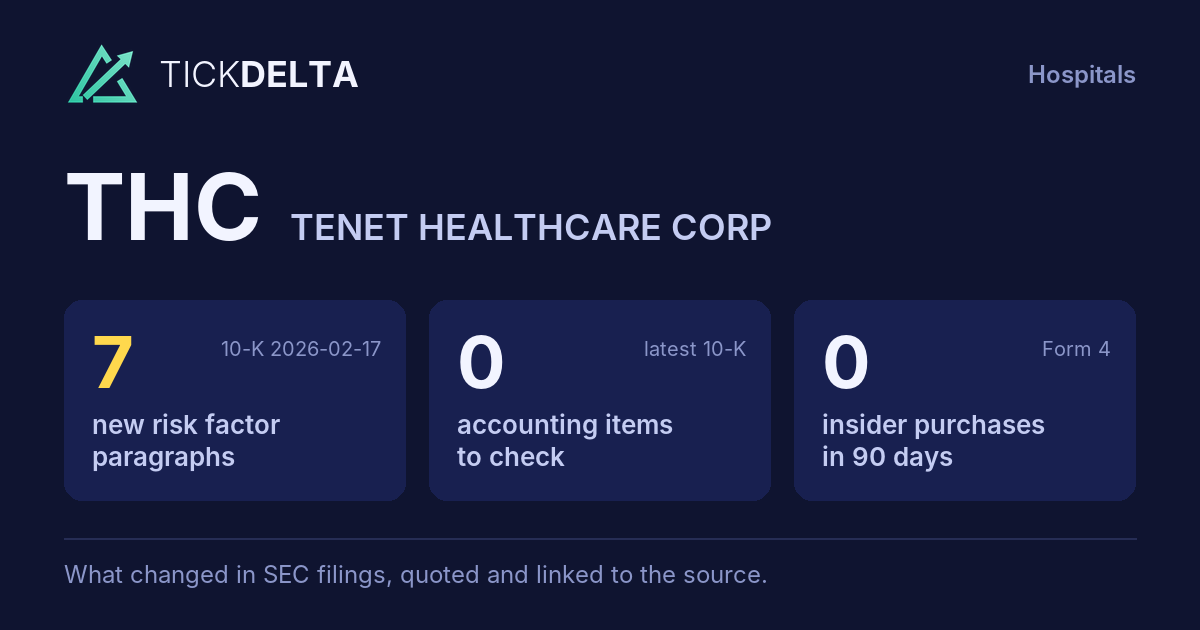
Screener / SEC EDGAR /CIK 0000070318 /10-K filed Feb 17, 2026, compared with Feb 18, 2025 /Numbers from the XBRL of the 10-Ks
NYSE Health care · Hospitals

Tenet Healthcare Corp THC

Compare with peers Embed
SEC comment letters, last 20 years

2 reviews of THC's filings by SEC staff

UPLOAD and CORRESP
Reviews 2 latest letter Jun 3, 2019
Questions asked 3 each answered in the company's own letter
No closing letter 0 reviews without a letter saying the staff completed it

When the SEC's staff reviews a filing, it writes to the company with numbered questions, and the company answers each one in a letter. SEC publishes the exchange once the review is over, at least 20 business days later. A question is not an accusation; most reviews end with the company adding detail to its next filing.

How the reviews went

Every review on EDGAR, from the first staff letter to the letter that closes it

  1. 1. Staff letters 2 UPLOAD
  2. 2. Questions in them 3 numbered comments
  3. 3. Company replies 2 CORRESP
  4. 4. Reviews closed 2 of 2 closing letter

Half the closed reviews took 26 days or less from the first letter to the closing letter.

TENET HEALTHCARE CORP · 10-K filed February 25, 2019 · File No. 001-07293

2019-06-03 to 2019-06-12 · 1 question · 1 letter from the SEC, 1 from the company
Review closed 2019-06-12
Liquidity and cashGoodwill and impairmentAcquisitions
Notes to the consolidated financial statements · Impairment and restructuring charges, and acquisition-related costs Year ended December 31, 2018, page 112
SEC asked
We note that you recorded impairment charges of $77 million, $402 million, and $54 million during 2018, 2017, and 2016 respectively. For 2018, the material adverse trends you describe include "reductions in volumes of insured patients, shifts in payer mix from commercial to governmental payers combined with reductions in reimbursement rates from governmental payers, and high levels of uninsured patients." It appears
Rest of the question

that these factors may apply more broadly as disclosed in your Selected Operating statistics on page 42 and also described in your Trends and Strategies section on page 40. To help us better understand your disclosure, tell us whether you expect these trends to have similar impacts on your other hospitals. For any long-lived asset groups (hospitals) for which you have determined that undiscounted cash flows are not substantially in excess of their carrying value and if, in the aggregate or individually, they could materially impact your operating results in the near term, please disclose the following in future filings: • the carrying values of the asset groups • the percentage by which undiscounted cash flows exceed the carrying values • their fair values.

THC answered
To provide context before responding to the Staff’s comment, the Company notes that our Selected Operating statistics disclosed on page 42 included the impact of recent divestitures, and the Company kindly directs the Staff to the operating statistics on pages 59 to 60, which reflect the same-hospital trends that applied to our remaining hospitals.

In response to the part of the Staff’s comment that questions whether the material adverse trends in insured volumes, payer mix changes and reimbursement rates from government payers that impacted hospitals impaired in 2018 more broadly impacted
Rest of the answer

other hospitals, the specific trends varied by long-lived asset group, but these were not materially adverse trends for other long-lived asset groups. In general, the trends for other long-lived asset groups were mostly positive or only slightly negative. The current trends, whether positive or negative, for each long-lived asset group were utilized in developing the undiscounted future cash flow estimates used in our 2018 impairment analysis and will continue to be updated in the future to disclose the information below.

In future filings, to the extent applicable to one or more long-lived asset groups whereby we have determined that estimates of undiscounted future cash flows are not substantially in excess of their carrying values and they could materially impact our operating results in the near term, we will disclose the carrying values of the long-lived asset groups and the percentage by which the estimated undiscounted future cash flows exceed the carrying values or in instances where the estimated undiscounted cash flows did not exceed the carrying values, the estimated fair values. We will incorporate this information within our critical accounting estimate disclosure on impairment of long-lived assets using language similar to the following:

In our most recent impairment analysis as of December 31, 20XX, we had X hospitals with an aggregate carrying value of long-lived assets of $XX million whose estimated undiscounted future cash flows exceeded the carrying value of long-lived assets by only X%. The estimated undiscounted future cash flows of these long-lived asset groups are not considered to be substantially in excess of cash flows necessary to recover the carrying values of their long-lived assets. Future adverse trends that necessitate changes in the estimates of undiscounted future cash flows could result in the estimated undiscounted future cash flows being less than the carrying values of the long-lived assets, which would require a fair value assessment, and if the fair value amount is less than the carrying value of the long-lived assets, material impairment charges could result. We also had X hospitals with an aggregate carrying value of long-lived assets of $XX million whose estimated undiscounted future cash flows did not exceed the carrying value of long-lived assets. However, the fair value of those long-lived assets of $XX million exceeded the carrying value, so no impairment was recorded. Future adverse trends that reduce the estimated fair value of the long-lived assets could result in future impairment charges that could be material.

To the extent that we recognize impairment charges in our consolidated financial statements, we will continue to disclose the fair value of the impaired assets in our Fair Value Measurements footnote.
Read in the reply

Also in this review: closing letter, 2019-06-12
Form 10-K

2016-11-17 to 2016-12-13 · 2 questions · 1 letter from the SEC, 1 from the company
Review closed 2016-12-13
Results discussion (MD&A)Liquidity and cash
Liquidity and Capital Resources · Sources and Uses of Cash, page 95
SEC asked (1)
Please expand your disclosure to include a discussion of each significant investing activity. Additionally, explain how you plan to finance the potential exercise of the put and call arrangements with your joint ventures partners. Refer to MD&A Release No 33-8350.
THC answered
to the Staff’s comment to include a discussion of each significant investing activity, we intend to update our Sources and Uses of Cash disclosures, commencing with the Company’s Form 10-K for the year ending December 31, 2016, with language that is substantially consistent

Tenet Healthcare

1445 Ross Avenue, Suite 1400, Dallas, Texas 75202-2703 T 469-893-2000 W tenethealth.com with the following (language proposed to be added to the disclosures from the Company’s Form 10-Q for the quarter ended September 30, 2016 on page 54 is in italics below):

Net cash used in investing activities was
Rest of the answer

$150 million in the nine months ended September 30, 2016 compared to $1.272 billion in the nine months ended September 30, 2015. The primary reason for the decrease was due to acquisitions of businesses and joint venture interests of only $96 million in the 2016 period primarily related to freestanding outpatient facilities compared to $720 million in the 2015 period when we purchased Aspen and formed our USPI and Carondelet Health Network joint ventures. In addition, we generated $573 million of proceeds from the sale of our Georgia facilities in the 2016 period compared to $28 million in the 2015 period from the sale of St. Louis University Hospital. Capital expenditures were $614 million and $566 million in the nine months ended September 30, 2016 and 2015, respectively.

We intend to fund future put and call arrangements with our joint venture partners from cash and cash equivalents on hand, cash provided by operating activities, borrowings under our revolving credit facility or, if necessary, other borrowings. In response to the Staff’s comment to explain how we plan to finance the exercise of these put and call arrangements, commencing with the Company’s Form 10-K for the year ending December 31, 2016, we intend to update the disclosure starting at the bottom of page 97 of the 2015 Form 10-K as follows (language proposed to be added to the disclosure is in italics below):

Our cash on hand fluctuates day-to-day throughout the year based on the timing and levels of routine cash receipts and disbursements, including our book overdrafts, and required cash disbursements, such as interest and income tax payments. These fluctuations result in material intra-quarter net operating and investing uses of cash that has caused, and in the future could cause, us to use our Credit Agreement as a source of liquidity. We believe that existing cash and cash equivalents on hand, availability under our Credit Agreement, anticipated future cash provided by operating activities, and our investments in marketable securities of our captive insurance companies classified as noncurrent investments on our balance sheet should be adequate to meet our current cash needs. These sources of liquidity, in combination with any potential future debt incurrence, should also be adequate to finance planned capital expenditures, payments on the current portion of our long-term debt, payments to joint venture partners including those related to put and call arrangements and other presently known operating needs.

We will continue to evaluate our liquidity both on a short-term and long-term basis and adjust our disclosures as necessary.

Consolidated Balance Sheets, 110:

Read in the reply
In its next report

First report after the company's reply of Dec 1, 2016: 10-K filed Feb 27, 2017 ↗, against the 10-K filed Feb 22, 2016 ↗.

Tickdelta does not hold the text of both reports, so they are not compared here.

Consolidated Balance Sheets, 110
SEC asked (2)
Please tell us the main components included in “Current Assets” and “Current Liabilities” and how you considered the presentation requirements of Rules 5-02(8) and (20) of Regulation S-X, respectively.
THC answered
Other current assets are comprised primarily of amounts accrued related to the California provider fee program, prepaid expenses, non-patient receivables and amounts accrued related to various other supplemental payment and government programs. The only item in other current assets that exceeded five percent of total current assets as of December 31, 2015 and 2014 were the amounts accrued related to the California provider fee program, which we disclosed on page 124 in the last paragraph of Footnote 3, in accordance with Rule 5-02 (8) of Regulation S-X.

Other current liabilities are
Rest of the answer

comprised primarily of amounts accrued for assessments related to the California provider fee program, deferred revenue, reserves for workers’ compensation obligations, guarantees, liabilities for healthcare services under risk sharing arrangements, property tax accruals and amounts due to investees under cash management agreements. The only item in other current liabilities that exceeded five percent of total current liabilities (as of December 31, 2014 only) were the amounts accrued for assessments related to the California provider fee program, which we disclosed on page 124 as indicated above, in accordance with Rule 5-02 (20) of Regulation S-X.

We will continue to evaluate the presentation requirements of Rules 5-02(8) and (20) of Regulation S-X in future filings.

Read in the reply
In its next report

First report after the company's reply of Dec 1, 2016: 10-K filed Feb 27, 2017 ↗, against the 10-K filed Feb 22, 2016 ↗.

Tickdelta does not hold the text of both reports, so they are not compared here.

Also in this review: request for more time, Nov 18, 2016, closing letter, 2016-12-13

From the SEC's correspondence on EDGAR: staff letters (form UPLOAD) and company letters (form CORRESP), 7 letters filed since 2016-11-17. Questions and answers are matched by their numbers; topics come from words in each question. The reports are compared word for word (same form, before the first SEC letter against the first report after the company's reply). No AI.

Sources

The SEC's correspondence on EDGAR: staff letters (form UPLOAD) and company letters (form CORRESP), matched question by question. No AI.

Also

Filings: the letters in the filing list.

Work with it

Excel workbook · CSV. Google Sheet that stays up to date: paste =IMPORTDATA("https://tickdelta.com/company/THC/export.csv") into a cell.

Next in Owners and insiders:Insider trades
Esc

Type a ticker such as AAPL, a name, an investor such as Buffett, or a topic such as tariffs. ↑ ↓ to move, Enter to open.