Screener / SEC EDGAR /CIK 0001116942 /10-K filed Feb 17, 2026, compared with Feb 21, 2025 /Numbers from the XBRL of the 10-Ks
Nasdaq Technology · Electronic Components

TTM Technologies Inc TTMI

Compare with peers Embed
SEC comment letters, last 20 years

3 reviews of TTMI's filings by SEC staff

UPLOAD and CORRESP
Reviews 3 latest letter Mar 19, 2025
Questions asked 7 each answered in the company's own letter
No closing letter 0 reviews without a letter saying the staff completed it

When the SEC's staff reviews a filing, it writes to the company with numbered questions, and the company answers each one in a letter. SEC publishes the exchange once the review is over, at least 20 business days later. A question is not an accusation; most reviews end with the company adding detail to its next filing.

How the reviews went

Every review on EDGAR, from the first staff letter to the letter that closes it

  1. 1. Staff letters 3 UPLOAD
  2. 2. Questions in them 7 numbered comments
  3. 3. Company replies 3 CORRESP
  4. 4. Reviews closed 3 of 3 closing letter

Half the closed reviews took 28 days or less from the first letter to the closing letter.

Form 10-K for the year ended December 30, 2024

2025-03-19 to 2025-04-03 · 1 question · 1 letter from the SEC, 1 from the company
Review closed 2025-04-03
SegmentsResults discussion (MD&A)Goodwill and impairmentAcquisitionsInventoryDerivatives and hedging
Management's Discussion and Analysis of Financial Condition and Results of Operations · Results of Operations, page 45
SEC asked
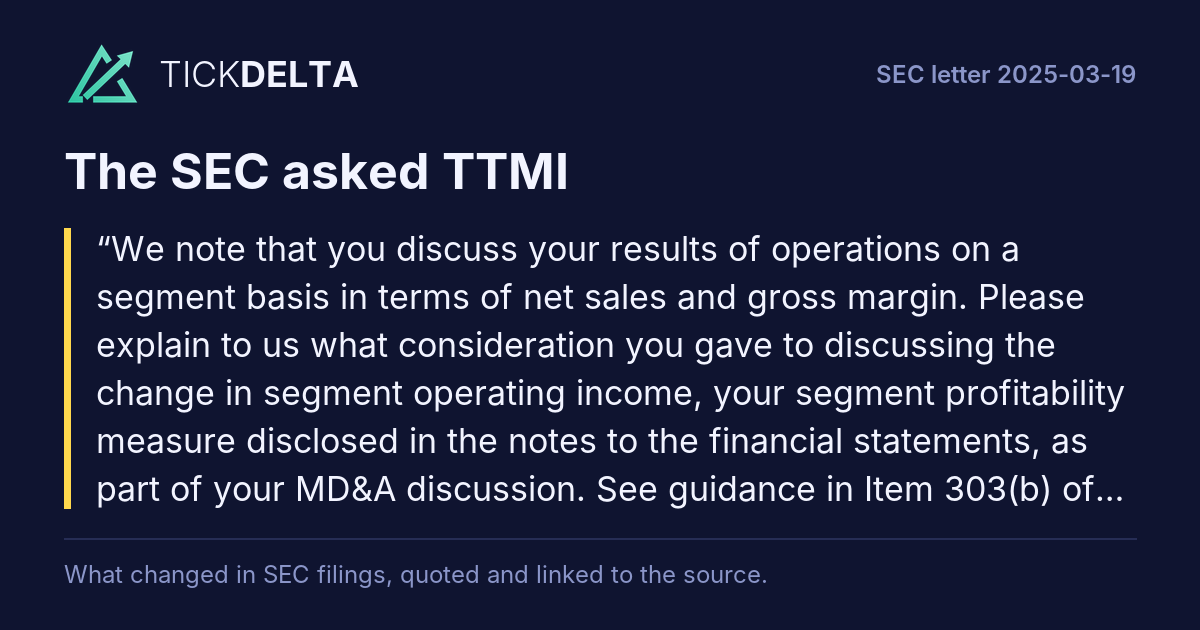
We note that you discuss your results of operations on a segment basis in terms of net sales and gross margin. Please explain to us what consideration you gave to discussing the change in segment operating income, your segment profitability measure disclosed in the notes to the financial statements, as part of your MD&A discussion. See guidance in Item 303(b) of Regulation S-K.
Rest of the question

Notes to the Consolidated Financial Statements Segment Information, page 85 Please refer to the reconciliation of net sales to segment operating income. Please tell us whether operating expenses represents a significant segment expense determined in accordance with ASC 280-10-50-26A or if it represents "other segment items" in accordance with ASC 280-10-50-26B. If the amount represents other segment items, 2. please tell us how you complied with the guidance in ASC 280-10-50-26B, including disclosure of a qualitative description of the composition of other segment items. Please advise. 3. We note your disclosure of "other profit or (loss)" in your reconciliation of total segment operating income to consolidated income before taxes. We also note from footnote (1) that this amount represents elimination of inter-segment sales, accelerated depreciation associated with plant closures, gain on sale of assets, unrealized gain/loss on commodity hedge, acquisition costs, non-cash goodwill impairment charge, restructuring, and purchase accounting related inventory markup. In light of the significance of this amount in each year presented, we believe that you should separately disclose all significant amounts in accordance with ASC 280-10-50-31. Please revise future filings accordingly.

TTMI answered
The Company acknowledges the Staff’s comment. We respectfully advise the Staff that, in preparing the MD&A, we considered the usefulness of the information to investors and other users of our financial statements. As a significant portion of our operating expenses are fixed in nature, the operational drivers of segment results are consistent at the gross profit/margin and operating income/margin level.
Rest of the answer

Additionally, both of these measures of operational performance are reviewed by the chief operating decision maker

(“CODM”).

However, to promote further consistency between the MD&A and the segment disclosure in the notes to the financial statements in accordance with the guidance in Item 303(b) of Regulation S-K, we respectfully propose to the Staff that our future filings will incorporate in the MD&A results of operations a discussion and analysis of the changes in segment operating income/margin, beginning with our next Form 10-Q filing for the first quarter of 2025.

Read in the reply
In its next report

First report after the company's reply of Mar 28, 2025: 10-Q filed May 6, 2025 ↗, against the 10-Q filed Nov 5, 2024 ↗.

Tickdelta does not hold the text of both reports, so they are not compared here.

Also in this review: closing letter, 2025-04-03
Form 10-K

2019-09-06 to 2019-10-04 · 2 questions · 1 letter from the SEC, 1 from the company
Review closed 2019-10-04
Results discussion (MD&A)Revenue
Results of Operations · Gross Margin, page 42
SEC asked (1)
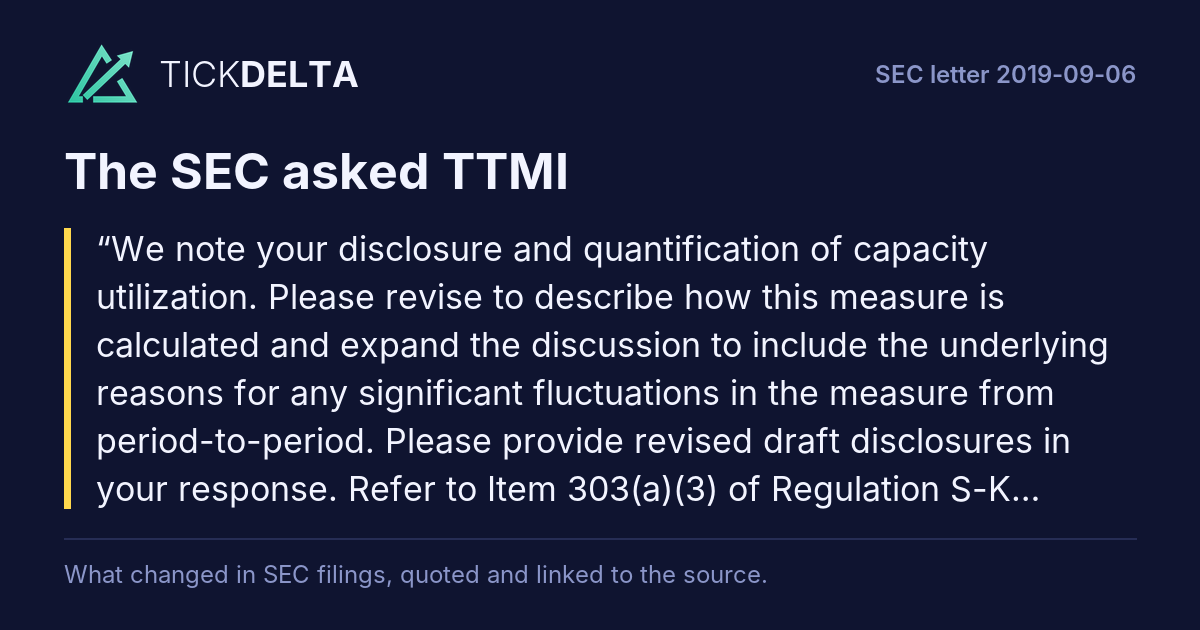
We note your disclosure and quantification of capacity utilization. Please revise to describe how this measure is calculated and expand the discussion to include the underlying reasons for any significant fluctuations in the measure from period-to-period. Please provide revised draft disclosures in your response. Refer to Item 303(a)(3) of Regulation S-K.
Rest of the question

Notes to Consolidated Financial Statements (1) Nature of Operations and Summary of Significant Accounting Policies

TTMI answered
The Company acknowledges the Staff’s comment requesting a description of how capacity utilization is calculated. The Company advises the Staff that we calculate the capacity utilization percentage rate by calculating the actual production in a given period and dividing it by the maximum potential output if capacity was fully used. The Company will include this calculation in future filings with the Commission.
Rest of the answer

Please see the example of our proposed disclosure at the end of this response.

As to the Staff’s request to expand our disclosure to include the underlying reasons for any significant fluctuations in the measure from period-to-period, the Company advises the Staff that, with respect to the current discussion of capacity utilization in the Form 10-K, capacity utilization in our Asia PCB facilities was 75% and 86% for each of the respective years ended December 31, 2018 and January 1, 2018. The decline in capacity utilization in our Asia PCB facilities was due to a decrease in sales in the Cellular Phone and Automotive end markets. Capacity utilization in our North America

PCB facilities was 60% and 54% for the respective years ended December 31, 2018 and January 1, 2018. The increase in capacity utilization in our North America PCB facilities was due to an increase in sales in the Aerospace & Defense end market. The Company notes for the Staff that the Company began including a discussion of the reasons as to significant fluctuations in capacity utilization in the Company’s Form 10-Q for the quarterly period ended April 1, 2019. The Company will continue such disclosure for significant fluctuations in future filings.

As an example of our proposed disclosure to be included in future filings, below is the capacity utilization discussion in the “Results of Operation — Gross Margin” section of Management’s Discussion and Analysis of Financial Condition and Results of

Operations in the Form 10-K, which we have revised to incorporate the above discussion (additions in bold and underlined):

“Capacity utilization is a key driver for us, which is measured by the actual production as a percentage of maximum capacity. This measure is particularly important in our high volume Asia facilities, as a significant portion of our operating costs are fixed in nature. Capacity utilization for the year ended January 1, 2018 in our Asia and North America PCB facilities was 86% and 54%, respectively, compared to 75% and 60%, respectively, for the year ended December 31, 2018. The decline in capacity utilization in our PCB facilities in Asia was due to a decrease in sales in the Cellular Phone and Automotive end markets. The increase in capacity utilization in our North America PCB facilities was due to an increase in sales in the Aerospace & Defense end market.”

Notes to Consolidated Financial Statements

(1) Nature of Operations and Summary of Significant Accounting Policies Revenue Recognition, page 66

Read in the reply
In its next report

First report after the company's reply of Sep 24, 2019: 10-Q filed Nov 7, 2019 ↗, against the 10-Q filed Aug 7, 2019 ↗.

Tickdelta does not hold the text of both reports, so they are not compared here.

Revenue Recognition, page 66
SEC asked (2)
You disclose you have long term contracts which service the aerospace and defense electronic market that you account for using the percentage of completion method. Please revise to include terms and methodologies used in this policy that comply with ASC 606, and tell us whether this policy is consistent with your policy in accounting for your PCB arrangements.
Rest of the question

Also, further clarify in your disclosures any significant differences between these long term contracts and the PCB arrangements. Please include revised draft disclosure in your response.

TTMI answered
The Company acknowledges the

Staff’s comment regarding the Company’s disclosure of long term contracts which service the aerospace and defense electronic market that are accounted for using the percentage of completion method. The Company advises the Staff that its current disclosure addresses long term contracts separate from PCB arrangements in order to distinguish between short-term and long-term circumstances.
Rest of the answer

In light of the Staff’s comment, however, the Company believes combining the disclosure will more clearly describe the terms and methodologies applicable to our long term contracts and their compliance with ASC 606, Revenue from Contracts with Customers (“ASC 606”). To that point, the Company further advises the Staff that revenue, whether pursuant to our long term contracts or our PCB arrangements, is recognized on a “cost-to-cost” percentage of completion basis as the services are performed. The Company evaluated its long term contracts and determined over time revenue recognition is appropriate in accordance with ASC 606, as the Company’s performance does not create an asset with an alternative use to the Company and has an enforceable right to payment for performance completed to date. This policy is consistent with the Company’s accounting policy for PCB arrangements. As a result, there are no significant differences between our long term contracts and our PCB arrangements.

The Company will modify its disclosure in future filings as follows (additions in bold and underlined and deletions in strikethrough):

“Revenue Streams

For the PCBs and custom electronic assemblies, including pursuant to our long-term contracts related to the manufacture of components, assemblies and subsystems, orders for products generally correspond to the production schedules of the Company’s customers and are supported with firm purchase orders. The Company’s customers have continuous control of the work in progress and finished goods throughout the PCB and custom electronic assemblies manufacturing process, as PCBs these are built to customer specifications with no alternative use, and there is an enforceable right to payment for work performed to date. As a result, beginning in the first quarter of 2018, the Company now recognizes began recognizing revenue over time based on the extent of progress towards completion of the performance obligation. Revenue recognized under these contracts is based on the cost-to-cost method as it best depicts the transfer of control to the customer which takes place as we incur costs. Under the cost-to-cost measure of progress, the extent of progress toward completion is measured based on the ratio of costs incurred to date to the total estimated costs at completion of the performance obligation. Revenues are recorded proportionally as costs are incurred.

Additionally, the Company has certain long-term contracts related to its manufacture of components, assemblies, and subsystems which service the aerospace and defense electronics market. These long-term contracts, many of which provide for periodic payments, are recognized over time under the percentage-of completion method. Estimated manufacturing cost-at-completion for these contracts are reviewed on a periodic basis, and adjustments are made as needed to the estimated cost-at-completion, based on actual costs incurred, progress made, and estimates of costs required to complete the contractual requirements. When the estimated manufacturing cost-at-completion exceeds the contract value, the contract is written down to its net realizable value and the loss resulting from the cost overruns are immediately recognized.

FinallyIn addition, the Company manufactures components, assemblies, and subsystems which service its wireless communications customers. The Company recognizes revenue at a point in time upon transfer of control of the products to the customer. Point in time recognition was determined as the customer does not simultaneously receive or consume the benefits provided by the Company’s performance and the asset being manufactured has alternative uses to the Company.”

Read in the reply
In its next report

First report after the company's reply of Sep 24, 2019: 10-Q filed Nov 7, 2019 ↗, against the 10-Q filed Aug 7, 2019 ↗.

Tickdelta does not hold the text of both reports, so they are not compared here.

Also in this review: closing letter, 2019-10-04

Form 10-K for the fiscal year ended January 2, 2017

2017-08-10 to 2017-09-20 · 4 questions · 1 letter from the SEC, 1 from the company
Review closed 2017-09-20
Results discussion (MD&A)Risk factorsKey metricsLiquidity and cashDerivatives and hedgingSegmentsNon-GAAP measures
Management’s Discussion and Analysis of Financial Condition and Results of Operations, page 42
SEC asked (1)
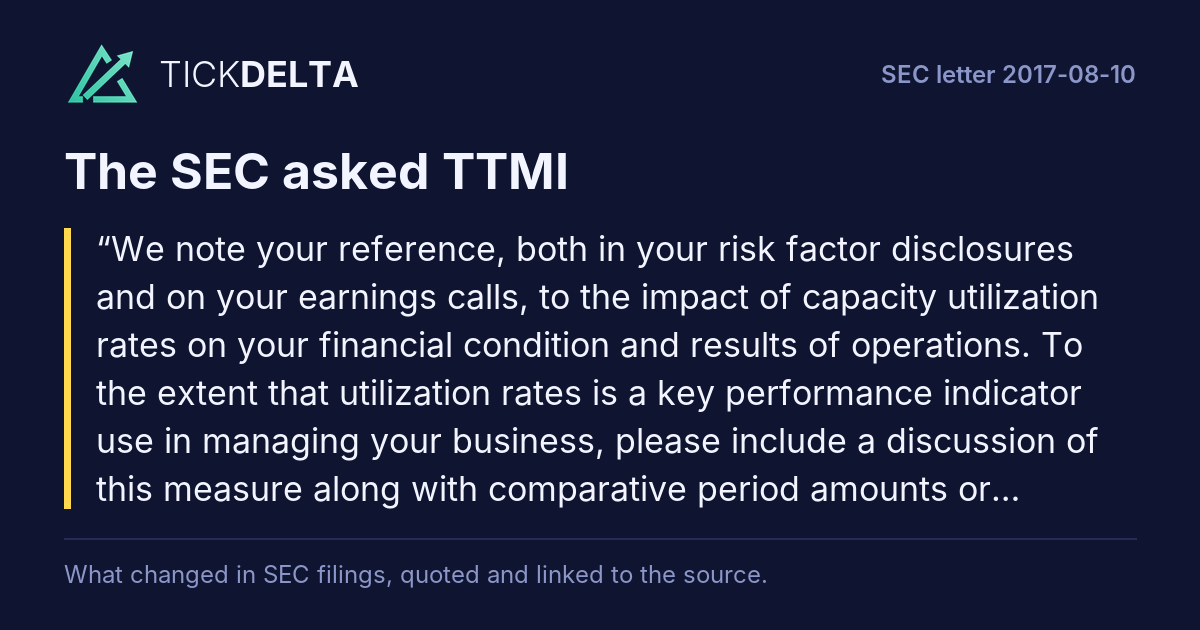
We note your reference, both in your risk factor disclosures and on your earnings calls, to the impact of capacity utilization rates on your financial condition and results of operations. To the extent that utilization rates is a key performance indicator use in managing your business, please include a discussion of this measure along with comparative period amounts or explain why you do not believe this disclosure
Rest of the question

is necessary. Refer to Section III.B.1 of SEC Release No. 33-8350.

TTMI answered
The Company acknowledges the Staff’s comment regarding the Company’s disclosure of capacity utilization rates in our risk factors and earnings calls, and whether a discussion of capacity utilization rates along with comparative period amounts should be included in Management’s Discussion and Analysis of Financial Condition and Results of Operations of our Form

10-K (“MD&A”). The Company respectfully submits that a discussion of capacity utilization rates as a driver of our business is already included in our MD&A.
Rest of the answer

The Company directs the

Staff’s attention to the “Financial Overview” section of our MD&A on page 43 of our Form 10-K in which we explained that the increased demand we experienced during fiscal year 2016

“…resulted in higher capacity utilization at our Automotive focused facilities resulting in higher gross margins.” The Company further directs the Staff’s attention to the “Results of Operations – Gross Margins” section on page 48 and 49 of our Form 10-K in which we noted that the increase in gross margin we experienced in our PCB operating segment from fiscal year 2015 to fiscal year 2016 was due, among other drivers, to “…higher utilization and full year contribution from the Automotive focused facilities….” Similarly, we explained that the increase in our gross margin from fiscal 2014 to fiscal 2015 was primarily due to

“…higher utilization at our advanced technology plants….”

TTM-002

In light of the Staff’s comment, however, the Company will include capacity utilization rates for each applicable comparative period in future filings in which capacity utilization rate is discussed.

Read in the reply
In its next report

First report after the company's reply of Sep 7, 2017: 10-Q filed Nov 8, 2017 ↗, against the 10-Q filed Aug 8, 2017 ↗.

Tickdelta does not hold the text of both reports, so they are not compared here.

Notes to the Consolidated Financial Statements · Note 12. Fair Value Measures, page 98
SEC asked (2)
We note your reference to $13.5 million of derivative transaction gains included in fiscal 2016 earnings as well as amounts related to cash flow hedges reflected in other comprehensive income. Please tell us the extent to which you continue to use derivative financial instruments for risk management purposes and if material, revise to include the disclosures required by ASC 815-10-50.
TTMI answered
The Company acknowledges the Staff’s comment regarding the Company’s disclosure of $13.5 million of derivative transaction gains. The Company respectfully submits that, as disclosed in the “Other Income (Expense)” subsection of the MD&A on page 50 of our Form 10-K, such amount relates to both foreign currency gains, as well as derivative transaction gains. Further, the Company advises the Staff that the derivative impact was approximately $30,000 of the total referenced amount.
Rest of the answer

Accordingly, the Company determined its use of derivatives to be immaterial for purposes of ASC

815-10-50 and therefore did not merit further disclosure in the Form 10-K.

The Company further advises the Staff that from time to time, it enters into foreign currency forward contracts to mitigate the impact of changes in foreign currency exchange rates. Specifically, the Company’s foreign subsidiaries at times purchase forward exchange contracts to manage their foreign currency risks in relation to certain purchases of machinery denominated in foreign currencies other than our foreign functional currency.

The Company designates certain of these foreign exchange contracts as cash flow hedges. To ensure the adequacy and effectiveness of our foreign exchange hedge positions, the Company continually monitors its foreign exchange forward positions, both on a stand-alone basis and in conjunction with their underlying foreign currency exposures, from an accounting and economic perspective.

As of July 3, 2017, our most recent quarter, the fair value of all open derivative assets and liabilities was approximately

$109,000 and $101,000, respectively. Additionally, for the quarter and two quarters ended July 3, 2017, the Company recognized net losses related to derivative transactions of approximately $176,000 and $30,000, respectively. The Company does not believe the fair value of open derivatives nor the derivative transaction losses is material to its consolidated financial statements as of and for the quarter and two quarters ended July 3, 2017. The Company will continue to evaluate its use of derivatives, and if such use becomes material, the Company will include appropriate disclosure in future filings as required by ASC 815-10-50.

TTM-003

*** -

Information omitted and provided under separate cover to the Staff pursuant to Rule 83.

Read in the reply
In its next report

First report after the company's reply of Sep 7, 2017: 10-Q filed Nov 8, 2017 ↗, against the 10-Q filed Aug 8, 2017 ↗.

Tickdelta does not hold the text of both reports, so they are not compared here.

Note 18. Segment Information, page 106
SEC asked (3)
We note that your PCB reportable segment is comprised of multiple, aggregated operating segments. Please tell us the operating segments that are aggregated into the PCB reportable segment and explain how you applied the guidance in ASC 280-10-50-11(a) to (e) when determining that these various operating segments qualified for aggregation into one reportable segment.
Rest of the question

If there are any differences in your operating segments, tell us why you determined that disaggregation was not warranted.

TTMI answered
The Company additionally advises the

Staff that our operating segments that are aggregated into the Printed Circuit Board (“PCB”) reportable segment are:

•

Aerospace & Defense/Specialty (“A&D”)

Automotive & Medical Industrial & Instrumentation (“AMI&I”)

Communications & Computing (“C&C”)

The Company manufactures multi-layer PCBs on a low-volume, quick-turn basis, as well as on a high-volume production basis. We are primarily a contract manufacturer that produces customer-specific PCBs.
Rest of the answer

To that end, we believe the use of separate PCB operating segments allows us to better align with our end customers and markets. However, the Company ultimately decides where the customer-ordered products will be produced based on available capacity, facility capabilities, and facility qualification requirements. As a result, customer orders can be produced at different facilities or PCB operating segments if all factory qualification requirements are met.

We applied the guidance in ASC

280-10-50-11(a) to (e) as outlined below:

PCB Reportable Segment – Aggregation Analysis

Economic Criteria

Management determined that long-term average gross margins were the key economic factor in the consideration of similar economic characteristics. Gross margins for each operating segment have historically had variability due to fixed operating costs and business cycles, with variation also driven by volume, plant performance, and product mix. The A&D, C&C, and AMI&I operating segments have similar long-term average gross margins. The Company is a contract manufacturer and product pricing follows the same process irrespective of the operating segment. The Company’s historical average gross margins and expected future gross margins for the PCB operating segments would be within a range of [***] to [***].

Based on the analysis above management concluded the PCB operating segments have similar economic characteristics.

TTM-004

Similar in Following Areas a.

Nature of the products and services

The A&D, C&C, and AMI&I operating segments provide the same products and services. The value chain of manufacturing electrical equipment is outlined below:

The A&D, C&C, and AMI&I operating segments are in the initial or intermediate manufacturing step (the first two boxes above) of the manufacturing equipment value chain where raw materials are transformed into printed circuit boards. The PCB end product is not usable unless it undergoes further component loading and system integration. The size of the products range from small to mid-size and have low weight per unit. All the operating segments produce only one type of product (PCBs) which can be manufactured at any of the operating segments.

b.

Nature of Production Processes – the A&D, C&C, and AMI&I operating segments operate the same processes and functions.

All PCBs are processed using similar equipment and processes. PCB manufacturing uses a wet process with chemicals to produce PCBs. Manufacturing is process-driven, and the primary drivers include labor efficiency, yield performance, and scrap reduction. Although the A&D, C&C, and AMI&I operating segments can have production differences due to customer preferences, specific requests, and historical relationships, and some specialization in the plants, customer orders for most products can be processed from any of our operating segments because each operating segment has the same core processes. Moreover, the A&D, C&C, and AMI&I operating segments supply PCBs to customers who have similar PCB needs in the electronic equipment industry.

c.

Type or Class of Customer – The A&D, C&C, and AMI&I operating segments’ customers are OEMs who utilize the product as a component in the final manufacturing of their end-products. We sell directly to the OEMs or to their EMS providers who purchase on their behalf from our operating segments.

d.

Nature of distribution – The A&D, C&C, and AMI&I operating segments ship to our OEM customers or their EMS providers utilizing air freight, ground or ocean transport.

e.

Regulatory requirements – The A&D, C&C, and AMI&I operating segments adhere to similar local environmental regulations, including air quality and discharge regulations.

TTM-005

Based on the analysis above, management concluded that the A&D, C&C, and AMI&I operating segments are similar. As such, the A&D, C&C, and AMI&I segments were aggregated into a single reportable operating segment, the PCB reportable operating segment, in accordance with the guidance in ASC 280-10-50-11(a) to (e).

Read in the reply
In its next report

First report after the company's reply of Sep 7, 2017: 10-Q filed Nov 8, 2017 ↗, against the 10-Q filed Aug 8, 2017 ↗.

Tickdelta does not hold the text of both reports, so they are not compared here.

Business Outlook
SEC asked (4)
Please revise to include a quantitative reconciliation of your non-GAAP guidance measures to the most directly comparable GAAP measure, or include a statement that such reconciliation is not practicable without unreasonable effort. Refer to guidance in Item 10(e)(1)(i)(B) of Regulation S-K and Question 102.10 of the Non-GAAP Compliance Disclosure and Interpretations issued May 17, 2016.
TTMI answered
The Company acknowledges the Staff’s comment regarding its use of non-GAAP forward looking information in our earnings guidance, namely the Company’s forecasted non-GAAP net income attributable to stockholders per diluted share (the “Non-GAAP Measure”) for the third quarter of 2017. The Company additionally advises the Staff that the financial measure calculated and presented in accordance with U.S. GAAP most directly comparable to the Non-GAAP Measure is net income attributable to stockholders per diluted share.
Rest of the answer

The Company further notes that the timing and amount of certain items the Company excludes from its Non-GAAP Measure, such as restructuring actions, impairment charges, unusual gains and losses, and tax adjustments, are highly variable and difficult to predict due to various factors outside of management’s control and could have a material impact on the GAAP reported results for the applicable guidance period. Accordingly, the Company was unable to provide a reconciliation of its Non-GAAP Measure to net income attributable to stockholders per diluted share, on a forward-looking basis, without unreasonable efforts. In an effort to provide investors with transparency on the operations of the business and a method for investors to measure the Company’s performance period-over-period and to anticipate financial performance in future periods, and further given the inherent uncertainties in forecasting GAAP net income attributable to stockholders per diluted share, the Company determined to provide the Non-GAAP Measure it had available in lieu of providing no future guidance.

In future filings with the Commission in which the Company provides the

Non-GAAP Measure, the Company will modify its disclosure to explain that a quantitative reconciliation cannot be provided without unreasonable effort, and will identify the information that is unavailable and the probable significance of such unavailable information, all in a manner substantially similar to our discussion in the paragraph above and in a location of equal or greater prominence as the Non-GAAP

Measure.

TTM-006

* * * * * * * * *

The Company hereby acknowledges the following:

The Company is responsible for the adequacy and accuracy of the disclosure in the Company’s filings;

Staff comments or changes to disclosure in response to Staff comments do not foreclose the Commission from taking any action with respect to the Company’s filings; and

The Company may not assert Staff comments as a defense in any proceeding initiated by the Commission or any person under the federal securities laws of the United States.

Best regards,

Read in the reply
In its next report

First report after the company's reply of Sep 7, 2017: 10-Q filed Nov 8, 2017 ↗, against the 10-Q filed Aug 8, 2017 ↗.

Tickdelta does not hold the text of both reports, so they are not compared here.

Also in this review: request for more time, Aug 15, 2017, closing letter, 2017-09-20

From the SEC's correspondence on EDGAR: staff letters (form UPLOAD) and company letters (form CORRESP), 10 letters filed since 2017-08-10. Questions and answers are matched by their numbers; topics come from words in each question. The reports are compared word for word (same form, before the first SEC letter against the first report after the company's reply). No AI.

Sources

The SEC's correspondence on EDGAR: staff letters (form UPLOAD) and company letters (form CORRESP), matched question by question. No AI.

Also

Filings: the letters in the filing list.

Work with it

Excel workbook · CSV. Google Sheet that stays up to date: paste =IMPORTDATA("https://tickdelta.com/company/TTMI/export.csv") into a cell.

Next in Owners and insiders:Insider trades
Esc

Type a ticker such as AAPL, a name, an investor such as Buffett, or a topic such as tariffs. ↑ ↓ to move, Enter to open.