Added10-Q 2026-05-12 vs 10-K 2025-09-24
As a “smaller reporting company”, the Company is not required to provide the information required by this item.
Tickdelta is free for now. Sign up and get Pro free
We are in the cryptocurrency industry and the management of cash assets through a cryptocurrency portfolio, primarily focused in Solana tokens and generating a yield from the treasury, primarily through staking of those tokens. 10-K, Item 1
23 paragraphs in Risk Factors of the 10-K filed Sep 17, 2026 with nothing like them in the 10-K filed Sep 24, 2025. Quoted exactly. Paragraphs that were only edited are under 10-K change.
Compared with the Risk Factors in the latest 10-K of the other 31 Crypto companies: a paragraph with at least half its words the same at another company is called similar, and the companies are listed under it. A paragraph most of them have is marked boilerplate. No line means no other company has one like it. This counts text; it does not say how serious a risk is.
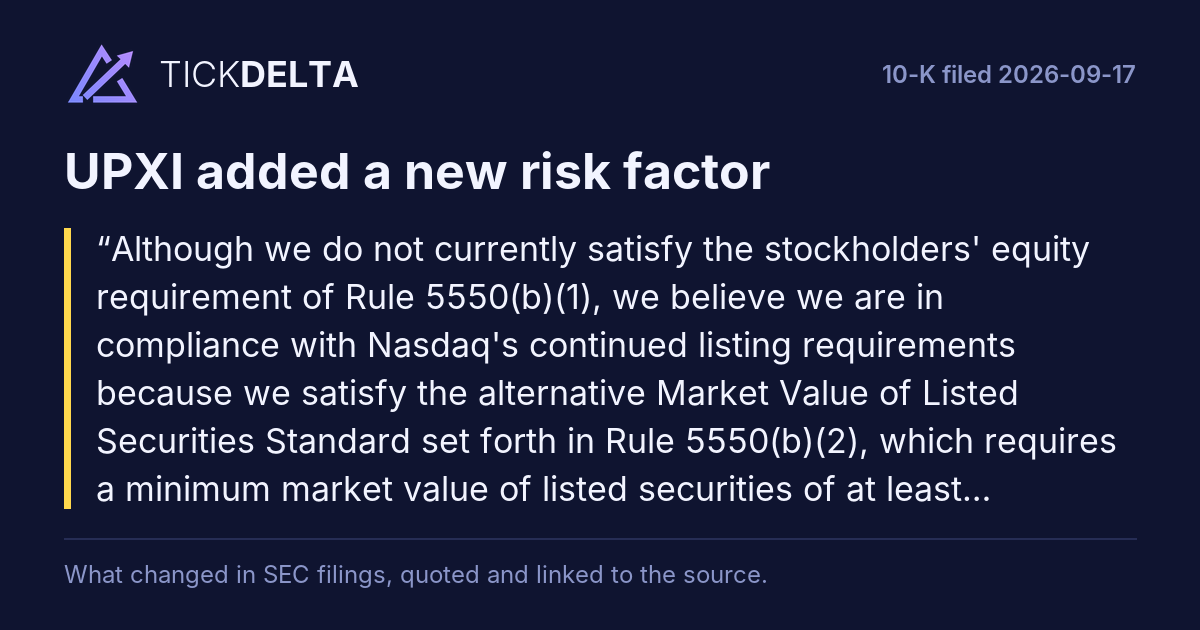
Although we do not currently satisfy the stockholders' equity requirement of Rule 5550(b)(1), we believe we are in compliance with Nasdaq's continued listing requirements because we satisfy the alternative Market Value of Listed Securities Standard set forth in Rule 5550(b)(2), which requires a minimum market value of listed securities of at least $35,000,000. As of September 8, 2026, the market value of our listed securities was approximately $85.0 million. A company listed on The Nasdaq Capital Market must meet at least one of the three standards set forth in Rule 5550(b) - the Equity Standard, the Market Value of Listed Securities Standard, or the Net Income Standard - in addition to the other continued listing requirements under Rule 5550(a).
Read in the 10-K ↗
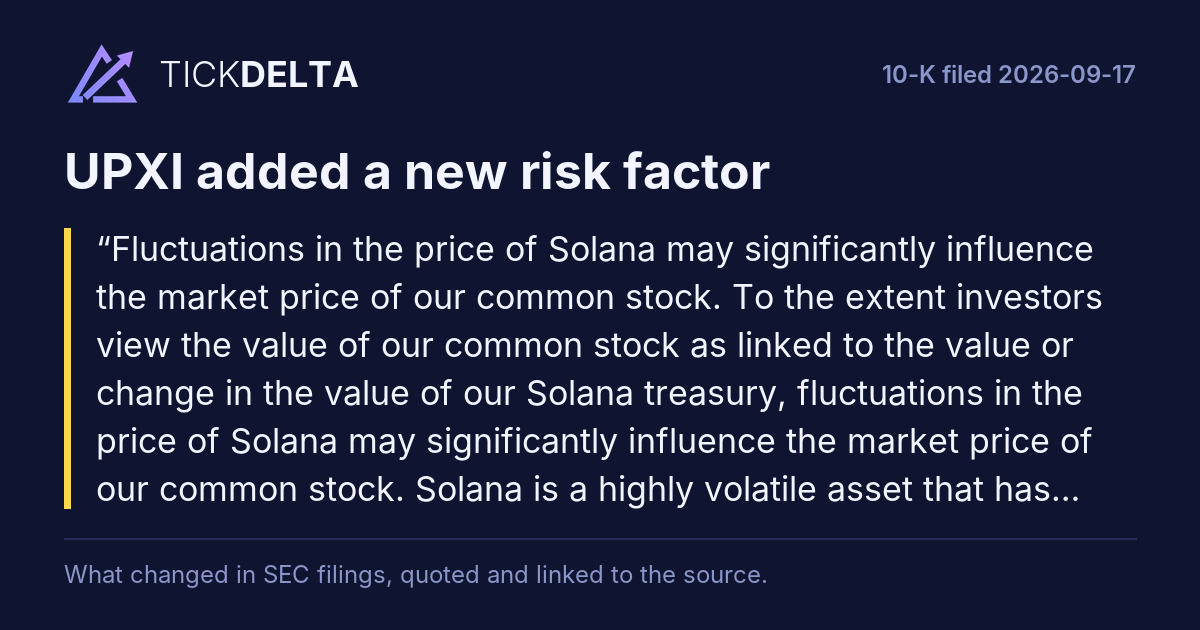
Fluctuations in the price of Solana may significantly influence the market price of our common stock.
Similar paragraph at 12 of 31 other Crypto companies: CIFR, CLSK, DFDV, DJT, EXOD, GME, HSDT, HUT and 4 moreTo the extent investors view the value of our common stock as linked to the value or change in the value of our Solana treasury, fluctuations in the price of Solana may significantly influence the market price of our common stock. Solana is a highly volatile asset that has traded as low as $60 and as high as $253 in the 12 months preceding the date of this Annual Report. The impact of our Solana treasury on our financial results and the market price of our common stock is likely to increase as we increase our overall holdings of our Solana treasury in the future.
A significant decrease in the market value of our Solana could adversely affect our ability to satisfy our financial obligations.
As part of our Solana treasury strategy, we expect to incur or continue to incur additional indebtedness and fixed charges. We do not expect our consumer products business to generate sufficient cash flow from operations to satisfy our financial obligations over the next twelve months. In such a case, we intend to fund our obligations using cash proceeds from equity or debt financings. Our ability to obtain equity or debt financing may in turn depend on, among other factors, the value of our Solana treasury holdings, investor sentiment and the general public perception of Solana, our strategy and our value proposition. Accordingly, a significant decline in the market value of our Solana treasury holdings or a negative shift in these other factors may create liquidity and credit risks, as such a decline or such shifts may adversely impact our ability to secure sufficient equity or debt financing to satisfy our financial obligations, including our debt and cash dividend obligations. These risks could materialize at times when Solana is trading below its value on our most recent balance sheet or our cost basis.
As Solana constitutes the vast bulk of assets on our balance sheet, if we are unable to secure equity or debt financing in a timely manner, on favorable terms, or at all, we may be required to sell Solana to satisfy our financial obligations, and we may be required to make such sales at prices below our cost basis or that are otherwise generally unfavorable. Any such sale of Solana may have a material adverse effect on our operating results and financial condition, and could impair our ability to secure additional equity or debt financing in the future. Our inability to secure additional equity or debt financing in a timely manner, on favorable terms or at all, or to sell our Solana holdings in amounts and at prices sufficient to satisfy our financial obligations, including our debt service, could cause us to default under such obligations. Any default on our current or future indebtedness could have a material adverse effect on our financial condition.
Read in the 10-K ↗
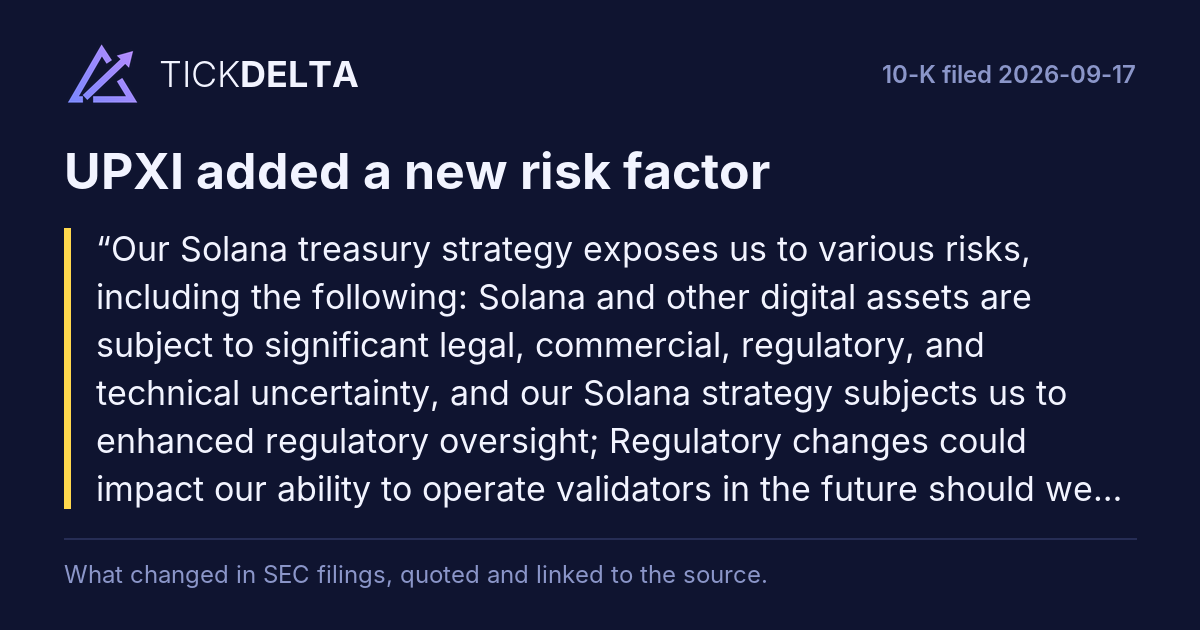
Our Solana treasury strategy exposes us to various risks, including the following:
Similar paragraph at 9 of 31 other Crypto companies: DFDV, DJT, HSDT, HYPD, MSTR, NAKA, SBET, SUIG and 1 moreSolana and other digital assets are subject to significant legal, commercial, regulatory, and technical uncertainty, and our Solana strategy subjects us to enhanced regulatory oversight;
Similar paragraph at 9 of 31 other Crypto companies: DFDV, DJT, FWDI, HSDT, HYPD, MSTR, NAKA, SUIG and 1 moreRegulatory changes could impact our ability to operate validators in the future should we decide to do so or receive rewards;
Regulatory scrutiny of the Company’s activities may increase, potentially limiting our operations;
Potential litigation risks exist related to smart contract vulnerabilities, validator operations, or our business activities;
Uncertainty around Solana’s regulatory status may impact our ability to list on certain exchanges;
Changes in political administration may not guarantee a favorable regulatory environment for Solana; and
Increased regulatory focus on Layer-1 blockchains beyond Bitcoin and Ethereum could result in new compliance requirements.
The foregoing factors could lead to disruption in the market for Solana, which could adversely affect the value of the Company’s stock price.
SOL faces unique technical, governance and concentration risks that could materially affect its long-term viability.
The Solana Network is a high-throughput Layer-1 blockchain with architectural features that differ significantly from other blockchains, such as Ethereum. While these features allow for rapid processing of transactions, they introduce risks that could adversely impact the value of SOL and the stability of the Solana Network. Historically, the Solana Network has suffered network outages, slow operations and validator coordination failures. If such challenges were to persist, the confidence of the Solana development community and its users will be adversely affected, which could cause a rapid decline in the value of SOL. In addition, Solana’s consensus mechanism (PoH combined with PoS) is novel and relatively untested at a large scale over time. Structural flaws could emerge that require a fork, which may have an adverse impact on the Solana Network and our holdings.
Solana validators are relatively small in number, which may lead to coordinated censorship.
SOL requires high-performing computing hardware and internet connectivity to operate a validator node. These substantial infrastructure demands create a barrier of entry for validators, leading to a high concentration of validators that must be well capitalized. A significant portion of staked SOL tokens may be delegated to a few validators, resulting in a centralized block production environment. This concentration and centralization could lead to the risk of coordinated censorship, which validators or node operators could delay or exclude transactions or blocks from being confirmed and recorded on the blockchain, severely undermining neutrality and causing an erosion of the integrity of the Solana Network.
Our Solana validator reward yield is expected to decline over time and could have a material adverse effect on our financial results.
Solana’s current protocol distributes rewards to validators based on a declining inflation model. This model reduces the total amount of Solana rewards available to distribute to validators by 15% each year until it reaches a long-term rate of 1.5%. A significant reduction in validator reward yield could negatively impact our business and results of operations.
Our SOL treasury strategy is dependent on the Solana Foundation and core development team.
Similar paragraph at 1 of 31 other Crypto companies: DFDVThe Solana Network is more centralized than other blockchain protocols such as Bitcoin and Ethereum. The Solana Foundation and a relatively small group of core developers play a significant role in the governance, maintenance, and technical direction of the Solana protocol. If one or more key individuals that is responsible for the core development or leadership were to depart, become incapacitated or otherwise decide not to participate, the health of the Solana network will be significantly affected and would result in a material adverse impact on the value of SOL. Further, if the Solana Foundation were to become subject to a reputational event, it could lead to reduced developer engagement and adversely affect the functionality and value of the Solana Network.
Similar paragraph at 1 of 31 other Crypto companies: DFDVRead in the 10-K ↗
13 paragraphs in the 10-Q filed May 12, 2026 with nothing like them in the 10-Q filed Feb 10, 2026 (at least half the words must differ; new numbers alone do not count). Quoted exactly, grouped by the item heading above them. This is text that changed, not a judgement of how serious it is.
During the three months ended March 31, 2026, the Company disposed of fully amortized intangible assets with an original cost of approximately $9.6 million. As the intangible assets had no remaining net book value, the disposals did not result in a gain or loss.
Read in the 10-Q ↗
The agreement provides for two additional potential investments of $250,000 each: (i) upon completion of the platform and achievement of 10,000 active users, which would increase the Company’s royalty interest to 19.90% of gross revenue, and (ii) upon the achievement of 25,000 active users. Upon achievement of the second milestone, the Company may elect to either maintain its 19.90% royalty interest in perpetuity or convert a portion of its royalty interest into a 9.99% equity ownership in Alpha City Exchange on a fully diluted basis.
Read in the 10-Q ↗
As the royalty interest has no contractual termination and extends in perpetuity, the Company accounts for the initial $750,000 investment as an indefinite-lived intangible asset. The royalty interest is not amortized and is evaluated for impairment at least annually or more frequently if indicators of impairment arise.
Read in the 10-Q ↗
As of March 31, 2026, the agreement remains in effect and the platform has not generated gross revenue from which the Company would be entitled to amounts under the royalty interest.
Read in the 10-Q ↗
During March 2026, an arbitration ruling resulted in the extinguishment of certain debt obligations and recognition of a receivable for approximately $0.4 million from the counterparty. In connection with the ruling, the Company extinguished (i) an inventory consignment note with an outstanding principal balance of approximately $1.0 million, (ii) a GF Note with an outstanding principal balance of approximately $0.7 million, and (iii) the elimination of approximately $0.2 million of accrued interest associated with these obligations. As of March 31, 2026, the Company has reserved the $0.4 million receivable in full and accrued approximately $0.5 million for future expenses and liabilities in connection with the ruling. As a result, the Company recognized a gain on extinguishment of debt of approximately $1.3 million during the three and nine months ended March 31, 2026.
Read in the 10-Q ↗
During the three months ended March 31, 2026, the Company repurchased 2,478,061 shares of common stock at a weighted-average price, including fees, of $0.80 per share, for total consideration of approximately $2.0 million.
Read in the 10-Q ↗
During the nine months ended March 31, 2026, the Company repurchased 2,894,287 shares of common stock at a weighted-average price, including fees, of $0.96 per share, for total consideration of approximately $2.8 million.
Read in the 10-Q ↗
The PSU awards vest on June 30 following the grant date, provided the participant remains employed by the Company on such date. The value of each PSU equals the excess of (a) the 30-day average closing price of Upexi, Inc. common stock for the period June 1 to June 30 immediately preceding the payment date, over (b) the grant date value. The PSU award value is settled in cash to the participant subsequent to June 30. As the PSU awards are settled in cash, they are classified as liability awards under ASC 718.
Read in the 10-Q ↗
The Company recognizes the estimated compensation cost related to the PSU awards in its condensed consolidated financial statements in accordance with ASC 718. Compensation cost is recognized over the requisite service period, with the liability remeasured at fair value at each reporting date. Changes in the estimated fair value are recognized in General and administrative expense in the Condensed Consolidated Statement of Operations and the related liability is presented within Accrued compensation in the Condensed Consolidated Balance Sheets.
Read in the 10-Q ↗
As of April 1, 2026, the Company had 10 full-time employees. As of June 1, 2026, the Company will no longer lease warehouse space, with all brand distributions activities to be handled by third-party providers.
Read in the 10-Q ↗
We are a digital asset treasury company focused on acquiring, holding, and deploying Solana (“SOL”) as a core treasury asset in a disciplined and capital efficient manner. Our treasury strategy allocates capital to SOL and related activities with the objective of enhancing long-term shareholder value while maintaining appropriate liquidity and managing risk.
Read in the 10-Q ↗
In addition to potential price appreciation of SOL, we seek to generate incremental returns through capital allocation strategies that include staking SOL, delegating SOL to validators, and selectively acquiring discounted locked token positions. We may also utilize equity or convertible debt issuances to support treasury growth when management determines such issuances are in the best interests of its shareholders. As of March 31, 2026, we held liquid and locked SOL tokens of approximately 1,383,079 and 978,852, respectively.
Read in the 10-Q ↗
During the period covered by this Quarterly Report on Form 10-Q, there were no changes to the procedures by which security holders may recommend nominees to the Company’s Board of Directors.
Read in the 10-Q ↗
Item 1A of the 10-Q filed May 12, 2026 against Item 1A of the 10-K filed Sep 24, 2025.
A 10-Q repeats only the risks that changed, so a 10-K paragraph that is missing from it is not counted as removed.
Added is a paragraph with nothing like it in the 10-K, Reworded a sentence that is in both with several words changed,
Quiet changes a sentence in both where one to four words changed and one is a hedge or a modal
(cut words struck through, new words highlighted and underlined).
Text on the page, not a score; each links to the filing at sec.gov.
Work on UPXI in a spreadsheet:
Excel workbook (a sheet per section, ten years by column, charts, links to the filings) ·
CSV.
For a Google Sheet that stays up to date, paste =IMPORTDATA("https://tickdelta.com/company/UPXI/export.csv") into a cell.