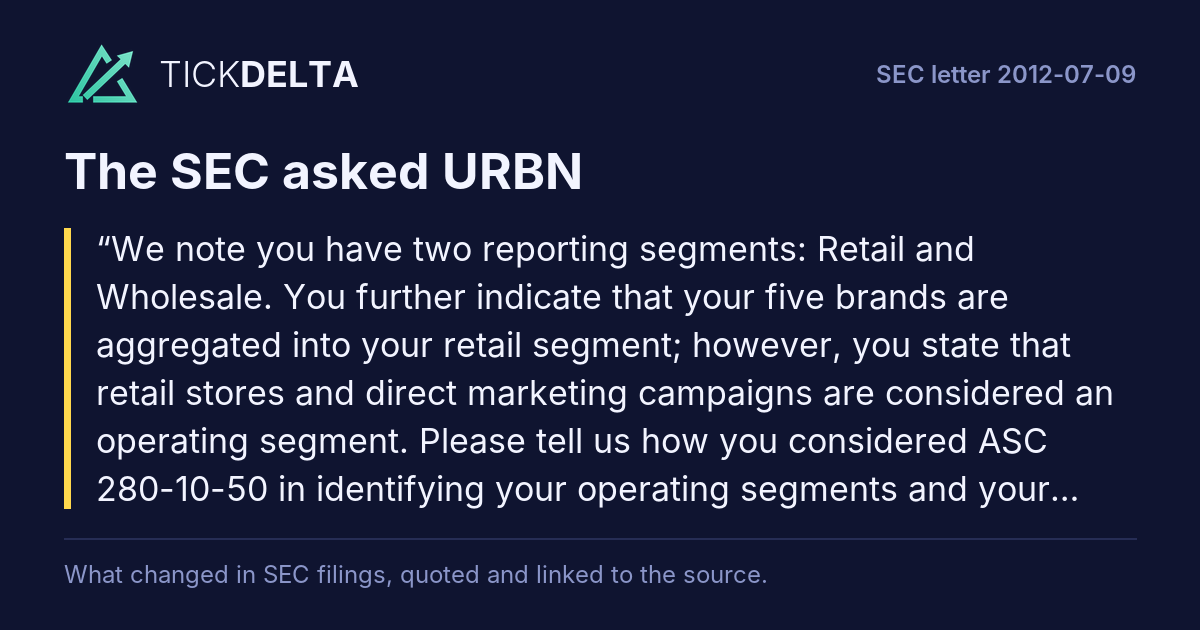
to your request, the Company has supplementally provided a copy of information regularly reviewed by the Chief Operating Decision Maker (“CODM”) as Appendix A, which is a supplemental copy of the June 30, 2012 reporting package reviewed by the Company’s CODM.
The CODM package is prepared based on our internal financial statement format, which excludes certain buying, distribution and occupancy costs from cost of goods sold. All of these costs are included in cost of goods sold in our external financial statements and serve as the basis for the brand analysis in Appendix B.
Rest of the answer
If these costs were included in the CODM package, the gross profit percentages in the CODM package would be consistent with the gross profit percentages included in Appendix B.
The CODM package includes discrete financial information for the following: consolidated;
each of our two reportable segments (retail and wholesale); our five brand operating segments; home office and other corporate activities. In accordance with ASC 280-10-50-4, we do not consider the home office and other corporate activities to be operating segments.
Operating Segments:
Based on the consideration of ASC 280-10-50-1, we have identified six operating segments as noted above. We have concluded these are each separate operating segments as each 1) engages in business activities from which we earn revenue and incur expenses, 2) has discrete financial information, and 3) has operating results that are used by our CODM to make resource decisions and assess performance.
For the purpose of this response, while very similar in all respects mentioned below, the BHLDN and Terrain operating segments each individually account for less than 1% of our revenue, gross profit, income and assets; therefore, for simplicity, each of these brands are not specifically addressed further in this response.
Each brand enables its customers to purchase through multiple sales channels including stores and direct-to-consumer channels. As you will note in Appendix A, the CODM package does not include separate discrete financial information for our individual sales channels; rather, the results are combined for each brand.
The Company’s philosophy is channel agnostic and is meant to serve our customers through any and all of their preferred sales channels. A significant portion of our customers purchase our product through multiple sales channels. Product pricing and selection is consistent across sales channels. In addition, we do not structure our product, marketing, shared service or executive teams to focus on one channel versus another and we do not compensate our employees on one channel versus another. This demonstrates that the distinctions among channels are merely marketing-based.
The Company markets its merchandise under each brand in a similar manner and through various means, which include retail store display, catalog advertising, web site advertising, social media and direct electronic communication. Marketing materials such as catalogs, e-mails or social media support the same product regardless of the sales channel. A customer that receives a catalog can purchase product on-line or go into a store to purchase that product. A customer that receives an electronic communication can go directly to our website and purchase product online, purchase product via telephone or purchase product at a store
A customer can purchase merchandise through one channel that we can fulfill from a different channel. For example, merchandise can be purchased through e-commerce that we can deliver from a store.
Customer returns of merchandise, originally purchased through e-commerce, can be returned at a store or by mail, for resale in either case at a store or through e-commerce.
The Company’s brand presidents, who report directly to the CODM, act as operating segment managers. These presidents are responsible for the entire brand, inclusive of store and direct-to-consumer sales. Further, annual goals for incentive bonuses for brand-level employees focus on performance across all sales channels for each brand and Company-wide. Primary metrics used in the majority of incentive compensation formulas are sales results, gross profit margin performance and labor cost control. These metrics are evaluated on the results of the consolidated brand or Company, without regard to the sales channel.
As the CODM package does not include separate discrete financial information for the direct-to-consumer and retail store sales channels and for the additional reasons discussed above, we have concluded that retail store and direct-to-consumer sales channels do not meet the definition of separate operating segments and thus are included within one operating segment for each brand.
Aggregation Criteria
Aggregation of the five brands’ operating segments into a single retail reporting segment is based on the fact that each of the retail operating segments have similar economic characteristics and the operating segments are similar in each of the five specific areas identified in ASC 280-10-50-11.
Furthermore, many of our retail functions are fully integrated across the brands. Functions such as training, policy and procedure, loss prevention, information technical support, legal, financial reporting and analysis, talent acquisition and development, facilities management, communications, purchasing, including all brand specific supplies, warehousing and distribution, merchandise control and other operational functions are similar in process and shared among the brands and/or their various sales channels.
We have determined that our wholesale business does not meet the aggregation criteria of ASC 280-10-50-11 because our wholesale division does not market directly to consumers. Instead, it markets to other businesses for resale of our product and has distinct economic characteristics from the retail segment; therefore, we report this segment separately. Furthermore, the Company’s wholesale segment is not discussed in the same manner as the retail segment because the segment is not as material. Our wholesale segment represents approximately 5% of the Company’s total net sales.
We have aggregated the five brand operating segments into one retail reportable segment due to the following:
Similar economic characteristics
Based on the analysis included in Appendix B, which we have provided as supplemental information, we have determined that our retail brands have similar economic characteristics. The three-year average gross profit percentages for each of the brands are within a narrow range of a high of 42.4% and a low of 38.7% and are consistent in terms of trend of gross profit percentages.
Similarities in the Five Specific Areas Identified in ASC 280-10-50-11 a)
The nature of the products and services –
Each brand primarily sells retail women’s apparel and accessories as well as housewares and gift items using a similar market approach. All brands strive to be fashion forward and are affected by similar customer preferences and trends, which our brands accommodate through continuous adjustment of their styles offered and the depth and breadth of their product assortment.
b)
The nature of the production processes –
All private label merchandise is sourced by one consolidated in-house department at our offices in Philadelphia, Pennsylvania. This department often utilizes the same agents and factories to manufacture merchandise for all brands. Each brand sources very similar levels of domestic compared to foreign produced merchandise. Each brand offers both private label merchandise (i.e. produced in-house) and branded merchandise (i.e. purchased from third parties).
c)
The type or class of customer for their products and services –
Based on our observations, our customers, throughout all brands, are very similar in that they are typically young, fashion forward and aspirational, with similar demographics. They prefer a lifestyle retail environment that is unique and eclectic. We do not believe there is a significant difference between the type and class of our customers who shop in our retail stores or through direct-to-consumer channels. Additionally, many of our customers shop multiple brands. All of our brands utilize similar marketing functions, primarily including catalog advertising, web site advertising, social media and direct electronic communication.
d)
The methods used to distribute their products or provide services –
Each brand utilizes similar methods to distribute their products. All brands operate retail stores and offer sales to customers via telephone and through websites. In addition, all of our brands use any or all of our multiple warehouse resources located in various parts of the United States and in Europe. These warehouses are managed and typically serviced by in-house staff shared across all brands.
Customers may order merchandise in person, via telephone through a common call center or through our websites, where the same or similar styles are typically available and presented in a similar manner to capture our brand lifestyle message. Our goal is to provide a seamless experience for our customers while catering to their ordering preferences. For example, a sale cycle may begin with a customer, who prefers direct shipment, placing an order on our website for merchandise that is marketed in our stores or catalog. For convenience, the customer may decide to return merchandise to a store location where it is re-stocked on store shelves for re-sale.
The Company has the systems capability to determine the availability of merchandise at any of its locations, including its stores and warehouses, to satisfy customer orders in the timeliest fashion possible. All brands seek to satisfy any customer shipping request regardless of the nature of the request.
e)
If applicable, the nature of the regulatory environment –
This criterion does not apply to the Company as it does not operate in a regulated industry.
Conclusion:
Based on the similarities in economic characteristics, the criteria above and consistent with the objectives of ASC 280, we have concluded that the five retail brand operating segments can be aggregated into one retail reportable segment.