Form 10-K for the Fiscal Year Ended December 31, 2022
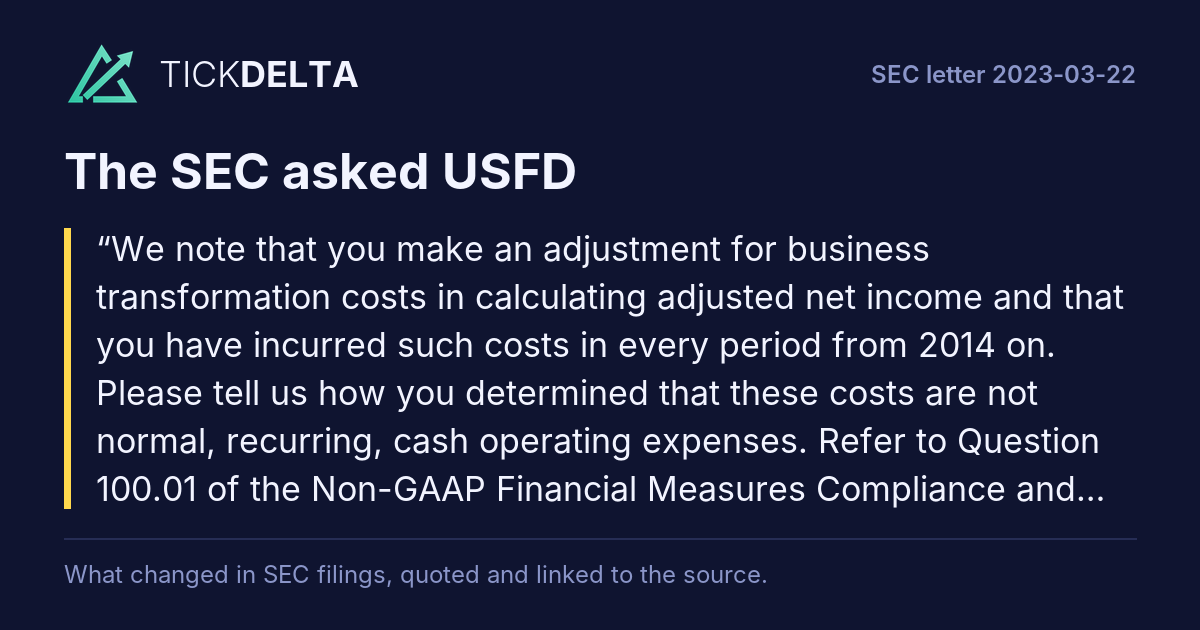
We note that you make an adjustment for business transformation costs in calculating adjusted net income and that you have incurred such costs in every period from 2014 on. Please tell us how you determined that these costs are not normal, recurring, cash operating expenses. Refer to Question 100.01 of the Non-GAAP Financial Measures Compliance and Disclosure Interpretations.
The Company acknowledges the Staff’s comment and respectfully advises that it has considered the guidance set forth in Question 100.01 of the Compliance and Disclosure Interpretations on Non-GAAP Financial Measures and believes that the costs included in its Form 10-K for the fiscal year ended December 31, 2022 (“2022 Form 10-K”) that are characterized as business transformation costs are not normal, recurring, cash operating expenses necessary to operate the Company’s business, and therefore are appropriate adjustments made as part of the Company’s presentation of Adjusted net income.Read in the replyRest of the answer
The Company further believes that adjusting these items as part of its presentation of Adjusted net income provides meaningful supplemental information about the Company’s operating performance, enhances comparability of current results to prior periods, and may be useful for investors to analyze the Company’s financial performance because it excludes amounts that the Company does not consider part of its normal, recurring cash operating expenses necessary to operate the business.
| US Foods |
9399 W. Higgins Road | ROSEMONT, IL 60018 | USFOODS.COM |
As noted in the 2022 Form 10-K, “Business transformation costs consists primarily of costs related to significant process and systems redesign across multiple functions.” Business transformation costs consist of incremental non-recurring costs incurred for various initiatives undertaken as part of the Company’s strategic plan to better align its operating model with its service delivery offerings. The non-recurring costs include, among other things, engaging external consultants to provide expertise and strategic guidance to the Company to identify and accelerate progress on various projects designed to transform the Company’s business. The magnitude of these costs can vary significantly year over year dependent upon the complexity of each initiative. The Company discloses the amount of transformation costs for transparency to the reader and in future filings will add more specificity on the initiatives included and why such costs are not considered part of its normal, recurring cash operating expenses necessary to operate the business, to the extent any such costs are incurred.
In order for a project to be considered transformational, successful completion of the project must be expected to bring long-term material benefits to the organization and involve significant changes to process and or underlying technology. Management ensures that each initiative is unique and will effect a step change in the Company’s operational efficiency and/or cost structure. The characterization of projects as transformational is reviewed by Finance leadership, including the Chief Financial Officer, prior to adjusting such costs as part of the Company’s presentation of non-GAAP adjusted net income.
The Company has provided additional detail below on the items that primarily drive “Business transformation costs” for the most recent periods presented in the 2022 Form 10-K. These items are indicative of the types of projects that were treated as transformational in prior periods as well. The Company believes this detail supports its view that these costs are non-recurring and not reflective of costs necessary for the Company to operate its business on an ongoing basis.
•CHEF’STORE New Store Opening Costs – As part of the acquisition of Smart Foodservice in April 2020, the Company significantly expanded its retail offering, targeted primarily at restaurant operators, from six locations to approximately eighty. The CHEF’STORE business had been immaterial to the Company prior to the Smart Foodservice acquisition. As the Company developed a strategic plan and tested options as to how the new store pre-opening process would be executed (given the expectation of a significant number of new store openings prospectively), such costs for new stores during the test period were determined to be transformational. Now that a process has been developed, tested and will be implemented for future store openings, beginning in 2023 the Company will not include these new store pre-opening costs as an adjustment to its non-GAAP adjusted net-income disclosure. Instead, these costs will be treated as a normal portion of the business and will be included in recurring operational costs prospectively.
•Distribution Center Pre-Opening Costs – The Company completed the build out of two new distribution centers in 2022. These costs represent non-capitalizable costs, including stocking and staffing the facility prior to opening. Once the facilities were operational, all future costs were treated as normal operations. Prior to 2022, the last distribution center opened by the Company was in 2015, demonstrating that such activity is infrequent and the related costs are not normal, recurring cash operating expenses necessary to operate the business.
•New Digital Foundation – With the hiring of a new Chief Information & Digital Officer in 2021, the Company undertook a review of its entire information technology infrastructure. As part of this multi-year initiative, consultants have been working with the Company to develop a strategy and identify various systems solutions that may be applicable for comprehensively modernizing its integrated technology platform, inclusive of the potential implementation of a core enterprise resource planning (“ERP”) system and other related/integrated best-in-class systems to complete functions not included in the core ERP system.
One of the first related best-in-class systems implemented was a new financial planning tool that was rolled out in 2022 and replaced the prior tools that were more than ten years old. This tool is used throughout Finance and at each distribution center.
The amounts that have been adjusted from Adjusted net income predominately relate to third party consulting costs. As such primarily third-party costs are non-recurring and separate from the normal recurring costs of the Company related to its infrastructure, the Company does not consider these costs to be normal, recurring, cash operating expenses necessary to operate the Company’s business.
•Supply Chain Strategy – The Company, with the assistance of third-party consultant experts, has been developing several processes and tools to reimagine and improve its supply chain strategy, systems and processes with an intent to increase automation and drive significant optimization. This includes initiatives such as:
oSupply Chain Selection Tool Deployment – In 2022, the Company completed a multi-year roll out of a new warehouse selecting tool utilizing best-in class technology at each of our 70 distribution centers. As part of this initiative, the Company implemented new technology and significantly redefined processes to create additional efficiencies for warehouse staff as well as improved accuracy with the selection process leading to better customer experiences.
oSupply Chain Network Design – The Company, with the assistance of third-party experts, completed a comprehensive review of its entire Supply Chain network and potential changes to such network, inclusive of the introduction of meaningful warehouse automation. The work to date includes development of new tools and the redesign of processes to reduce miles from delivery routes, which the Company expects will reduce costs and improve customer experiences.
Because the primarily third-party costs related to this comprehensive review and redesign of the Company’s supply chain technology, network and processes are non-recurring and separate from the normal recurring costs of the Company related to its supply chain infrastructure, the Company does not consider these costs to be normal, recurring, cash operating expenses necessary to operate the Company’s business.
We hope that the foregoing has been responsive to the Staff’s comment. If you have any questions related to this letter, please feel free to contact the undersigned at (847) 720-2459.
First report after the company's reply of Mar 30, 2023: 10-Q filed May 11, 2023 ↗, against the 10-Q filed Nov 10, 2022 ↗.
Tickdelta does not hold the text of both reports, so they are not compared here.
We note your response to comment 1. Please address the following: • Quantify the amount recorded for each of the categories provided. • It appears that costs related to distribution center pre-opening, the multi-year initiative to modernize your integrated technology platform and supply chain strategy would be critical to your operations, revenue generating activities and business strategy and thus represent normal,Rest of the question
recurring, cash operating expenses necessary to operate your business. Please further explain why you believe they are appropriate or remove them from your non-GAAP measure. Refer to the guidance in Question 100.01 of the Compliance and Disclosure Interpretations on Non-GAAP Financial Measures which notes that the staff would view an operating expense that occurs repeatedly or occasionally, including at irregular intervals, as recurring.
The amount recorded for the categories described in the Company’s letter to the Staff dated March 30, 2023, are as follows:Read in the reply
(in millions) Fiscal 2022 Fiscal 2021
CHEF’STORE New Store Opening Costs $5 $1
Distribution Center Pre-Opening Costs $6 -
New Digital Foundation $12 $2
Supply Chain Strategy $23 $9
The Company acknowledges the Staff’s comment and respectfully advises that it considered the guidance set forth in Question 100.01 of the Compliance and Disclosure Interpretations on Non-GAAP Financial Measures when preparing the disclosures in its Form 10-K for the fiscal year endedRest of the answer
December 31, 2022 (“2022 Form 10-K”) related to the costs characterized as business transformation. The Company appreciates the perspective of Staff in its letter dated April 25, 2023, and agrees that, prospectively, it will no longer include costs for CHEF’STORE or Distribution Center pre-opening costs, Supply Chain Strategy costs, or any other similar activities, as adjustments to net income in the Company’s presentation of adjusted net income.
However, the Company believes the costs associated with the New Digital Foundation (“NDF”) are not part of its normal, recurring cash operating expenses necessary to operate the business and may appropriately be classified as a non-GAAP adjustment to the Company’s presentation of adjusted net income. The NDF-related costs are discrete and specific costs which do not represent normal cash operating expenses that are necessary to run the Company's business.
It should be noted that the costs, both internal and external to the Company, incurred to run and maintain its current information technology (“IT”) infrastructure, including but not limited to operate existing systems, third party licensing costs, patches to fix bugs, and normal upgrades or enhancements to the Company’s various operating systems, are included within operating expenses in the Company’s Consolidated Statements of Comprehensive Income. These items, which represent the vast majority of the Company’s IT spend each year, are considered normal recurring operating expenses and thus, per the guidance in Question 100.01 of the Compliance and Disclosure Interpretations on Non-GAAP Financial Measures (“Question 100.01”), not included as adjustments to our net income in our non-GAAP presentation of adjusted net income.
As discussed in the Company’s letter to the Staff dated March 30, 2023, it views the NDF program as part of a multi-year initiative to develop a strategy and identify various systems solutions that are necessary for comprehensively modernizing its integrated technology platform. These activities are inclusive of the implementation of a core enterprise resource planning (“ERP”) system and other integrated best-in-class systems to complement functionality not present in the core ERP system. The Company views this as a once-in-a-generation undertaking due to the extensive scope and inherent change management involved in comprehensively elevating its IT infrastructure to the current technology available from systems that are decades old in certain cases. For example, one component of the NDF program that the Company is currently developing is a new warehouse management system (“WMS”) that will replace the current 30-year-old technology. The Company believes that completion of the new WMS will truly be transformational to the way it operates its business in the future.
Furthermore, the Company expects that costs associated with each component of the NDF program will vary materially year-by-year and the various components of the NDF program will be irregular and episodic, often with large start-up and implementation costs followed by a period of integration that may have smaller costs while testing and assimilation into processes is on-going. Upon completion of the entirety of the NDF program, these incremental costs will be eliminated and not repeated. Additionally, during the implementation of the NDF projects, the Company will be incurring costs associated with duplicative systems for the same functions since such transitions must take place over time. The Company's management believes that, consistent with Question 100.01, that it is appropriate to exclude these discrete, irregular, episodic and duplicative costs that are not part of normal operations so that investors are provided with a measure that enhances the comparability of the Company's underlying operating results period over period. As such, the Company's management believes that using non-GAAP measures that exclude these incremental costs is a useful supplement for investors to GAAP disclosures because they enhance the understanding of trends in operating the business without the impact of the NDF program.
We hope that the foregoing has been responsive to the Staff’s comment. If you have any questions related to this letter, please feel free to contact the undersigned at (847) 720-2459.
First report after the company's reply of May 4, 2023: 10-Q filed May 11, 2023 ↗, against the 10-Q filed Nov 10, 2022 ↗.
Tickdelta does not hold the text of both reports, so they are not compared here.
Also in this review: closing letter, 2023-05-08