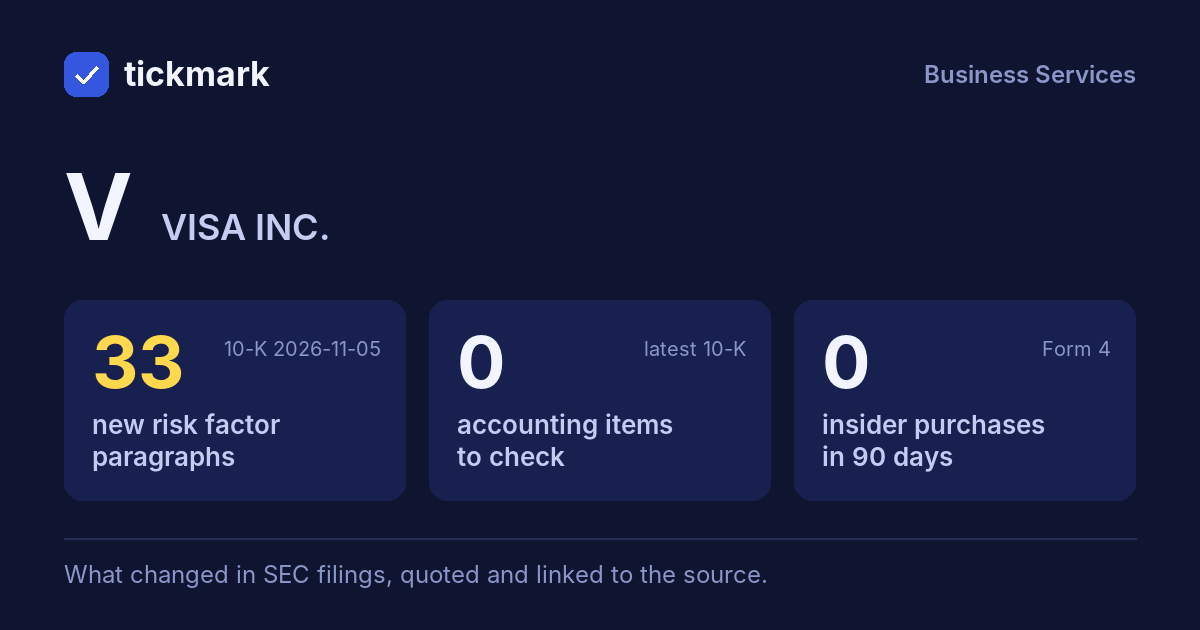
10-K 0001403161-26-000134 (2026-11-05) vs 10-K 0001403161-25-000089 (2025-11-06)
| Section | Compared text | Words now | Changed |
|---|
| Risk Factors | Item 1A | 9,721 |
56.1% |
| MD&A | Item 7 | 6,665 |
22.5% |
| Legal Proceedings | Item 3, via Note 20 – Legal Matters | 5,909 |
18.6% |
| Accounting Policies | Item 8, Note 1 – Summary of Significant Accounting Policies | 4,977 |
10.1% |
The redline: what was cut and what was added
In each section, the paragraph that changed most, marked against last year's 10-K:
cut words struck through, new words highlighted and underlined.
Risk Factors 299 words changed in this paragraph; it is 31% similar to last year's version.
In particular, the adoption The deployment and use of agentic commerce, in which autonomous AI agents initiate may also present technical, operational and execute transactions on behalf of users, presents novel and complex regulatory, privacy and cybersecurity risks. Legal frameworks governing such autonomous agents remain nascent, with limited direct guidance specific to payments. compliance challenges. The interplay between payments regulations, data privacy laws and evolving AI regulations may create uncertainty around compliance obligations and potential liability exposure as more participants (including sellers, fintechs, AI developers and enablers) enter the agentic commerce ecosystem. The market is still assessing how regulators may apply existing consumer protection and other laws in the context of AI. For example, as agentic commerce solutions scale, we may see increased instances of erroneous or disputed payments, increased chargebacks and reputational harm. Furthermore, reliance on agentic AI introduces challenges in monitoring cross-border, prohibited or high-risk transactions, where conflicting regulatory requirements may apply. The fragmented regulatory landscape for emerging technologies such as AI and inconsistent requirements across legal frameworks may amplify difficulties in identifying, preventing or mitigating risk with a single global approach, potentially increasing our compliance costs or stratifying our ability to leverage certain data or technologies for innovation. For instance, the EU has adopted a comprehensive AI Act that establishes established harmonized rules across Europe, with key provisions for most high-risk AI systems taking effect in August 2026. Meanwhile, 2027. In the U.S., several U.S. states, including California, Colorado and Utah, states have adopted AI-specific frameworks or are considering applying existing consumer and data protection laws to regulate AI. Depending on how these different regulations are interpreted and enforced, they may limit the our ability to develop and deploy AI systems or significantly increase associated compliance costs. Our development and implementation The introduction of governance frameworks aimed at complying with emerging laws and regulations applicable new or modified data use cases involving confidential or personal information, including through AI-enabled technologies, may result in sensitive data being exposed to our AI and machine learning systems may not be successful unauthorized access, exfiltration or retention by third-party providers, replicated into weakly governed derivative stores, or transferred across jurisdictions in mitigating all of these emerging risks. ways that raise data
Source: Item 1A, 10-K 0001403161-26-000134 vs Item 1A, 10-K 0001403161-25-000089
Accounting Policies 126 words changed in this paragraph; it is 48% similar to last year's version.
Income taxes. The Company accounts for income taxes using the asset and liability method. Deferred tax assets and liabilities are recognized to reflect the future tax consequences attributable to for temporary differences between the financial statement carrying amounts and the respective tax basis of existing assets and liabilities, and operating loss and credit carryforwards. Deferred tax assets and liabilities are measured carryforwards using enacted tax laws and rates expected to be applied to taxable income in apply when the periods in which those temporary differences amounts are expected to be recovered realized or settled. In assessing whether deferred Deferred tax assets are realizable, management considers whether reduced by a valuation allowance when, based on available evidence, including qualifying tax planning strategies, it is more likely than not that some portion or all of the deferred tax assets will not be realized. A valuation allowance is recorded for the portions that are not expected to be realized based on the level of historical taxable income, projections of future taxable income over the periods in which the temporary differences are deductible, and qualifying tax planning strategies.
Source: Item 8, Note 1 – Summary of Significant Accounting Policies, 10-K 0001403161-26-000134 vs Item 8, Note 1 – Summary of Significant Accounting Policies, 10-K 0001403161-25-000089
MD&A 123 words changed in this paragraph; it is 34% similar to last year's version.
Dividends. Common stock repurchases. During fiscal 2025, 2026, we declared and paid $4.6 billion in dividends to holders repurchased shares of our common and preferred stock. On October 28, 2025, our board of directors declared a quarterly cash dividend of $0.67 per share of class A common stock (determined in the case open market for $20.5 billion. As of all other outstanding common and preferred stock on an as-converted basis). We expect to continue paying quarterly dividends in cash, September 30, 2026, our share repurchase programs had remaining authorized funds of $24.4 billion. Share repurchases will be executed at prices we deem appropriate subject to approval by the board of directors. various factors, including market conditions and our financial performance, and may be effected through accelerated share repurchase programs, open market purchases or privately negotiated transactions, including through Rule 10b5-1 plans. See Note 15—Stockholders’ Equity to our consolidated financial statements included in Item 8 of this report.
Source: Item 7, 10-K 0001403161-26-000134 vs Item 7, 10-K 0001403161-25-000089
Legal Proceedings 107 words changed in this paragraph; it is 67% similar to last year's version.
On June 17, 2020, the Supreme Court of the United Kingdom UK found that Visa’s UK domestic interchange before the introduction of the Interchange Fee Regulation (IFR) restricted competition, a case which was subsequently settled. On November 26, 2021, the UK Competition Appeal Tribunal (CAT) found that the question of whether domestic interchange fees are a restriction of competition after the introduction of the IFR, along with inter-regional and commercial interchange fees across all time periods, would need to be resolved at trial. The trial, a ruling that was subsequently affirmed by the UK Court of Appeal affirmed the CAT’s ruling, and in February and March 2024, the CAT held Appeal. Following a trial to consider whether certain interchange rates are a restriction of competition. In April 2025, the CAT completed a trial regarding the extent to which interchange fees were passed 2024 trial, on by acquirers and merchants. On June 25, 27, 2025, the CAT issued a decision finding that certain interchange rates restrict competition under UK competition law, and Visa which has sought permission from been appealed. Following a 2025 trial, on February 18, 2026, the UK Court of Appeal to appeal CAT issued a decision finding that decision. merchants, except in certain categories, did not pass on interchange. The decision is being appealed.
Source: Item 3, via Note 20 – Legal Matters, 10-K 0001403161-26-000134 vs Item 3, via Note 20 – Legal Matters, 10-K 0001403161-25-000089
Every change, by type
Sentences and paragraphs of V's Risk Factors and MD&A, 10-K 2026-11-05 against 10-K 2025-11-06.
Each links to the text at sec.gov.
Quiet changes are sentences kept from last year with one to four words changed, at least one of them a hedge, a modal or a qualifier
(may, could, will, not, significant, material…). A year or date rolling forward is not counted.
The full word list
adverse, adversely, all, although, anticipate, anticipates, any, approximately, believe, believes, can, cannot, certain, could, expect, expects, generally, however, if, intend, intends, largely, likely, many, material, materially, may, might, most, must, never, no, not, possible, primarily, probable, should, significant, significantly, some, substantial, substantially, unlikely, will, would
AddedRisk Factors
In addition to the other information contained in this report, you should carefully consider the following material risk factors that could affect the Company’s business, financial condition, results of operations and/or stock price. The disclosures in this section reflect the Company’s current beliefs and opinions regarding factors that could materially and adversely affect the Company and its securities in the future. References to past events are provided by way of example only and are not intended to be a complete listing or a representation as to whether or not such factors have occurred in the past or their likelihood of occurring in the future.
Read it in 10-K 2026-11-05 at sec.gov ↗
AddedRisk Factors
The risks and uncertainties the Company faces are not limited to those described below. You should not consider any descriptions of these risk factors to be a complete set of all potential risks that could affect the Company. Additional risks and uncertainties not presently known to us or that we currently believe to be immaterial may also adversely affect the Company.
Read it in 10-K 2026-11-05 at sec.gov ↗
AddedRisk Factors
Regulators worldwide are expanding their authority over the payments industry, including IRFs, MDRs, network fees, operating rules, and related practices. See Item 1—Government Regulation of this report for more information. Although we generally do not receive IRF revenue directly, IRFs are a key competitive factor that affects our overall payments volume and net revenue.
Read it in 10-K 2026-11-05 at sec.gov ↗
AddedRisk Factors
Countries globally have adopted or are exploring interchange caps or MDR regulations. For example:
Read it in 10-K 2026-11-05 at sec.gov ↗
AddedRisk Factors
•U.S. Federal Reserve regulations cap U.S. debit IRFs for large issuers, and the Dodd-Frank Act restricts network exclusivity and preferred routing for debit and prepaid products. The Federal Reserve has recently
Read it in 10-K 2026-11-05 at sec.gov ↗
AddedRisk Factors
taken actions to revisit its regulations that implement these aspects of the Dodd-Frank Act, including requiring issuers to ensure dual-network availability for ecommerce debit transactions and proposing further rate reductions with automatic biennial adjustments. Recent conflicting federal court decisions on the validity of Regulation II's interchange fee standard have created additional uncertainty and could result in a significantly lower interchange cap for debit transactions. Separately, Congress has reintroduced the Credit Card Competition Act (CCCA), legislation requiring, among other things, large issuers to offer routing choices for credit transactions. It remains unclear if the CCCA will gain sufficient traction to advance in the current Congress. States such as Illinois have enacted or are considering laws restricting how interchange is set and assessed and how payment transaction data may be used, potentially imposing significant compliance and operational costs, requiring significant changes to our systems and processes, and even potentially limiting the products and services we are able to offer in those states.
Read it in 10-K 2026-11-05 at sec.gov ↗
AddedRisk Factors
•EU’s Interchange Fee Regulation caps consumer credit and debit IRFs for transactions within the EEA. Member states may impose further reductions, and the European Commission (EC) may periodically reassess Interchange Fee Regulations, which could further lower caps or expand regulation to additional products, services and fees.
Read it in 10-K 2026-11-05 at sec.gov ↗
AddedRisk Factors
•Regulatory interest in cross-border interchange rates continues to grow and governments are using regulation to drive down MDR, which could negatively affect transaction economics. Our EC settlement in 2019, which was extended through 2029, limits certain cross-border IRFs within the EEA. Additional jurisdictions have adopted or proposed cross-border interchange caps or cross-border MDR regulations.
Read it in 10-K 2026-11-05 at sec.gov ↗
AddedRisk Factors
Certain regulators are reviewing or have passed requirements relating to network scheme and processing fees, including with respect to governance, reporting and transparency that could impose additional compliance burdens and competitive complexities where the requirements are not imposed evenly across all payment networks. For example, in 2024, the Greek Parliament limited acquirer fees for certain small ticket transactions in some seller categories for a period of three years. Separately, industry participants in multiple jurisdictions have sought regulatory or judicial intervention regarding our network rules, including restrictions on cross-border acquiring. Certain countries have enacted regulations permitting cross-border acquiring for ecommerce. Other countries require government pre-approval of network rule changes more broadly. Government regulation may also require us to permit competing networks to support our products, share intellectual property, meet onshore capital requirements, or accommodate other networks' branding on Visa-issued products.
Read it in 10-K 2026-11-05 at sec.gov ↗
AddedRisk Factors
In addition, regulatory developments in one jurisdiction or product category may be replicated elsewhere or extended to other products. Reduced IRFs may make our network less attractive to issuers and acquirers and may make other payment systems including closed-loop payment systems that connect directly with sellers and consumers more competitive. Issuers may respond by raising fees or reducing benefits to consumers, and acquirers may charge higher MDRs regardless of our IRFs, steering sellers and consumers toward alternative payment methods, all of which could harm our business and financial results.
Read it in 10-K 2026-11-05 at sec.gov ↗
AddedRisk Factors
Governments in numerous jurisdictions seek to strengthen domestic control over payments infrastructure and reduce reliance on international payment providers like Visa, through market access barriers, preferential domestic regulations, localization requirements and support for domestic systems. These measures impair the ability of international payments networks to compete and may prevent end-to-end transaction processing in certain markets.
Read it in 10-K 2026-11-05 at sec.gov ↗
AddedRisk Factors
•In China, UnionPay remains the predominant domestic processor and acceptance network for bank cards. The People’s Bank of China (PBOC) accepted our application to operate a Bank Card Clearing Institution (BCCI) in June 2020, and approved our Application to Prepare in October 2026, which permits us to begin formal preparations to establish a domestic BCCI. We must take additional steps, including obtaining further regulatory approval, before we can begin domestic bank card clearing operations. There can be no assurance that we will receive this approval, and its timing is uncertain. Co-badging and co-residency regulations limit our competitive position, and the PBOC is considering phasing out dual-branded cards as international licenses are issued. Even if we receive approval to begin operations, competition from UnionPay and alternative payment providers such as Alipay and WeChat Pay, which have rapidly expanded across ecommerce, offline and cross-border payments, poses significant challenges.
Read it in 10-K 2026-11-05 at sec.gov ↗
RemovedRisk Factors
Regulators around the world have been establishing or increasing their authority to regulate various aspects of the payments industry. See Item 1—Government Regulation for more information. In the U.S. and many other jurisdictions, we have historically set default IRFs. Even though we generally do not receive any revenue related to IRFs in a payment transaction (in the context of credit and debit transactions, those fees are paid by the acquirers to the issuers; the reverse is true for certain transactions like ATM transactions), IRFs are a factor on which we compete with other payments providers and are therefore an important determinant of the volume of transactions we process. Consequently, changes to these fees, whether voluntarily or by mandate, can substantially affect our overall payments volume and net revenue.
Read it in 10-K 2025-11-06 at sec.gov ↗
RemovedRisk Factors
Interchange reimbursement fees, certain operating rules and related practices continue to be subject to increased government regulation globally, and regulatory authorities and central banks in a number of jurisdictions have reviewed or are reviewing these fees, rules and practices. For example:
Read it in 10-K 2025-11-06 at sec.gov ↗
RemovedRisk Factors
•Regulations adopted by the U.S. Federal Reserve cap the maximum U.S. debit interchange reimbursement rate received by large financial institutions at 21 cents plus 5 basis points per transaction, plus a possible fraud adjustment of 1 cent. Additionally, the Dodd-Frank Act limits issuers’ and payment networks’ ability to adopt network exclusivity and preferred routing in the debit and prepaid area, which also impacts our business. In response to seller requests, the Federal Reserve has recently taken actions to revisit its regulations that implement these aspects of the Dodd-Frank Act. For example, in October 2022, the Federal Reserve published a final rule effectively requiring issuers to ensure that at least two unaffiliated networks are available for routing ecommerce debit transactions by July 1, 2023. In October 2023, the Federal Reserve issued a proposal for comment that further lowers debit interchange rates, with a mechanism for automatic adjustment every two years. Finally, in August 2025, the District Court for the District of North Dakota ruled that the Federal Reserve exceeded its authority in implementing Regulation II, which sets debit card interchange fees. The court found the Federal Reserve improperly included various costs beyond what the Durbin Amendment allows, such as fraud losses, network fees and other fixed costs, when setting the debit interchange fee standard. As a result, the court vacated Regulation II’s debit interchange fee
Read it in 10-K 2025-11-06 at sec.gov ↗
RemovedRisk Factors
standard. Subsequently, however, the District Court in Kentucky ruled that the Federal Reserve acted within its discretion in setting the debit interchange cap. If the District Court of North Dakota’s decision is affirmed on appeal and ultimately prevails, it could potentially result in the Federal Reserve setting a significantly lower interchange cap for relevant debit transactions in the U.S. Separately, there continues to be interest in regulation of credit interchange fees and routing practices by members of Congress and state legislators. It is possible that the Credit Card Competition Act may be reintroduced in Congress or attempted to be offered as an amendment to unrelated legislation. Previous versions of the legislation were introduced in 2022 and 2023, and required among other things, that large issuing banks offer a choice of at least two unaffiliated networks over which electronic credit transactions may be processed. Finally, some states have passed or are considering passing laws that regulate how interchange can be set and assessed. For example, in May 2024, Illinois passed a law that restricts the assessment of interchange on the state tax and gratuity portions of a transaction, and restricts financial institutions and payment networks, among others, from using payment transaction data for any purpose other than facilitating or processing a transaction. While the Illinois law remains subject to legal challenge, if such laws are allowed to go into effect, they may also impose significant technical and compliance burdens on our business.
Read it in 10-K 2025-11-06 at sec.gov ↗
RemovedRisk Factors
•In Europe, the EU’s IFR places an effective cap on consumer credit and consumer debit interchange fees for both domestic and cross-border transactions within the European Economic Area of 30 basis points and 20 basis points, respectively. EU member states have the ability to further reduce these interchange levels within their territories. The European Commission has announced its intention to conduct another impact assessment of the IFR, which could result in even lower caps on interchange rates and the expansion of regulation to other types of products, services and fees.
Read it in 10-K 2025-11-06 at sec.gov ↗
RemovedRisk Factors
•Several countries in Latin America continue to explore regulatory measures against payments networks and have either adopted or are exploring interchange caps, including Argentina, Brazil, Chile and Costa Rica. In Asia Pacific, the Reserve Bank of Australia (RBA) which already regulates interchange, recently proposed reducing existing interchange caps on domestic credit and debit transactions and not allowing differential interchange treatment for consumer and commercial transactions. Similarly, in New Zealand, the Commerce Commission recently lowered existing caps on domestic credit transactions. Interchange is also regulated in certain countries in the Central and Eastern Europe, Middle East and Africa region, including the United Arab Emirates. Finally, many governments, including but not limited to governments in India, Costa Rica, and Turkey, are using regulation to further drive down MDR, which could negatively affect the economics of our transactions.
Read it in 10-K 2025-11-06 at sec.gov ↗
RemovedRisk Factors
•While the focus of interchange and MDR regulation has primarily been on domestic rates, interest on cross-border rates has been growing. For example, we agreed to limit certain cross-border interchange rates in a settlement with the European Commission in 2019, which was extended through 2029. In 2020, Costa Rica became the first country to formally regulate cross-border interchange rates by regulation. In June 2022, the UK’s PSR initiated a market review focusing on post-Brexit increases in interchange rates for e-commerce transactions between the UK and Europe and is proposing to cap cross-border interchange on certain transactions in that geographic corridor. Most recently, in July 2025, New Zealand adopted interchange caps on cross-border transactions including commercial credit transactions. Australia has also proposed adopting caps for cross-border transactions. Cross-border MDR is also regulated in Costa Rica and Turkey.
Read it in 10-K 2025-11-06 at sec.gov ↗
RemovedRisk Factors
•With increased lobbying by sellers and other industry participants, we are also beginning to see regulatory interest in network fees. For example, the UK’s PSR is conducting a market review into scheme and processing fees. In its interim report, the PSR indicated that it is reviewing possible remedies in the areas of governance, reporting and transparency, any of which, if adopted, could impose additional complexity and burdens on our business in the UK. Other regulators, for example, those in Australia, the EU, Chile and New Zealand have expressed an interest in network fees, including issues related to transparency. Finally, in 2024, the Greek Parliament limited acquirer fees for certain small ticket transactions in some seller categories for a period of three years.
Read it in 10-K 2025-11-06 at sec.gov ↗
RemovedRisk Factors
•In addition, industry participants in some countries, including Argentina, Chile, Colombia, the Dominican Republic, Paraguay, Peru, South Africa and Turkey have sought intervention from competition regulators or filed claims relating to certain network rules, including Visa’s restrictions on cross-border acquiring. The Central Banks of Chile and the Dominican Republic recently enacted regulation that will permit cross-border acquiring for ecommerce transactions under certain conditions. Other countries, like Brazil, have adopted regulations that require us to seek government pre-approval for certain of our network rules, which could also impact the way we operate in those markets.
Read it in 10-K 2025-11-06 at sec.gov ↗
RemovedRisk Factors
•Government regulations or pressure may also impact our rules and practices and require us to allow other payments networks to support Visa products or services, to have the other networks’ functionality or brand marks on our products, or to share our intellectual property with other networks. In addition, the EU’s requirement to separate scheme and processing adds costs and impacts the execution of our commercial, innovation and product strategies.
Read it in 10-K 2025-11-06 at sec.gov ↗
RemovedRisk Factors
•We are also subject to central bank oversight in a growing number of countries, including Brazil, India, the UK and within the EU. In several jurisdictions, we have been designated as a “systemically important payment system.” Some countries with existing oversight frameworks are looking to further enhance their regulatory powers, while regulators in other jurisdictions are considering or adopting approaches based on these regulatory principles. For example, in October 2023, VisaNet was designated as a prominent payment system in Canada. These types of designations generally result in oversight of authorization, clearing and settlement activities, including policies, procedures and requirements related to governance, client and seller access to our payment systems, reporting, cybersecurity, processing infrastructure, capital and/or credit risk management. We could also be required to adopt policies and practices designed to mitigate settlement and liquidity risks, including increased requirements to maintain sufficient levels of capital and financial resources locally, as well as localized risk management or governance.
Read it in 10-K 2025-11-06 at sec.gov ↗
RemovedRisk Factors
•As innovations in payment technology have enabled us to expand into new products and services, they have also expanded the potential scope of regulatory influence. For instance, new products and capabilities, including tokenization, push payments and cross-border money movement solutions could bring increased licensing or authorization requirements in the countries where the product or capability is offered. Furthermore, certain portions of our business are regulated as payment institutions or as money transmitters, subjecting us to various licensing, supervisory and other requirements. As we continue to expand our capabilities and offerings in furtherance of our multi-year growth strategy, we will need to obtain new types of licenses. These licenses could result in increased supervisory and compliance obligations that are distinct from the obligations we are subject to in our capacity as a payment card network.
Read it in 10-K 2025-11-06 at sec.gov ↗
RewordedRisk Factors
Because our stakeholders often hold differing views on our CRS-related goals and initiatives and we face conflicting directives from U.S. and international regulatory authorities, any Any failure, or perceived failure, to meet these evolving and legal requirements or varied stakeholder expectations and standards may could result in negative attention in the media, media attention, reputational impacts, including an inaccurate perception perceptions or misrepresentation misrepresentations of our actual CRS practices, diversion of management’s attention and resources, and proxy fights, among contests, litigation, investigations or other material adverse impacts on our business.
Read it in 10-K 2026-11-05 at sec.gov ↗
RewordedRisk Factors
The These regulations, and their impact of these regulations on us, our clients, and other third parties could limit our ability to enforce our payments system rules; require us to adopt new rules or change existing modified rules; affect our existing contractual arrangements; require us to maintain additional capital or financial resources; increase the complexity and increase cost of our compliance costs. operations or compliance; and adversely affect our financial condition.
Read it in 10-K 2026-11-05 at sec.gov ↗
RewordedRisk Factors
Any of these events, individually or in the aggregate, could significantly disrupt our operations; impact the availability and integrity of our systems, applications, applications or the systems of our third-party service providers; result in the unauthorized disclosure, release, gathering, monitoring, misuse, loss or destruction of confidential, proprietary, sensitive and personal information (including account data information) or data security compromises; result in unauthorized access to, retention of, replication of or cross-border transfer of sensitive data through AI-enabled tools, third-party models, infrastructure, or derivative data stores; impact our clients and consumers; impact the magnitude of our settlement exposure; increase the risk of fraudulent transactions; damage our reputation and brand; result in litigation or claims, violations of applicable privacy and other laws, and increased regulatory review or scrutiny, investigations, actions, fines or penalties; result in damages or changes to our business practices; decrease the overall use and acceptance of our products; decrease our volume, net revenue revenue, and future growth prospects; cause financial losses to Visa’s financial institution clients, sellers sellers, or third-party service providers, and be costly, time consuming and difficult to remedy.
Read it in 10-K 2026-11-05 at sec.gov ↗
RewordedRisk Factors
We are subject to dynamic, dynamic and sometimes at times, conflicting laws, regulations and other directives that govern a wide array broad range of issues, including some that extend issues extending beyond our core products and services. services, including sustainability, climate change, people and talent management, equal opportunity and inclusion, supply chain management and human rights.
Read it in 10-K 2026-11-05 at sec.gov ↗
RewordedRisk Factors
From time to time, we may restate previously reported data to reflect updated methodologies for reporting our CRS data, an improvement methodologies, improvements in the data availability and quality of data, quality, changing assumptions, changes in the nature and scope of our operations, or other changes in circumstances. circumstances, which may limit the consistency or comparability of our data across periods or relative to industry peers.
Read it in 10-K 2026-11-05 at sec.gov ↗
RewordedRisk Factors
The global payments industry is undergoing significant and rapid technological change, including increased proliferation of developments in mobile and other proximity and in-app payment technologies, ecommerce, AI and agentic commerce, machine payments, tokenization, cryptocurrencies, stablecoins, tokenized deposits, distributed ledger and blockchain technologies, cloud-based encryption and authorization, and new digital identity and authentication technologies such as biometrics, FIDO 2.0, 3D Secure 2.0 and dynamic cardholder verification values or dCVV2. technologies.
Read it in 10-K 2026-11-05 at sec.gov ↗
RewordedRisk Factors
Certain In certain jurisdictions, including the U.S., Australia, Canada and Europe, sellers and seller-affiliated groups have been exerting their exerted significant influence in the global payments system in certain jurisdictions, such as the U.S., Australia, Canada and Europe, to attempt to lower acceptance costs paid by sellers to acquirers or their agents to accept payment products or services, services by lobbying for new legislation, seeking regulatory intervention, filing lawsuits and in some cases, surcharging or refusing to accept Visa products.
Read it in 10-K 2026-11-05 at sec.gov ↗
RewordedRisk Factors
Internal Revenue Service as well as tax authorities and governments in various other jurisdictions, and we may be subject to additional examinations examinations, disputes or disputes assessments in the future. future, including those involving the availability of deductions or credits, transfer pricing, permanent establishment assertions, or indirect and other non-income taxes.
Read it in 10-K 2026-11-05 at sec.gov ↗
RewordedRisk Factors
Furthermore, in efforts In addition, governments responding to deal with adverse macroeconomic conditions, governments conditions may introduce new or additional initiatives or requests requirements to reduce or eliminate payment fees or other costs. costs, which could create additional financial pressures on our business.
Read it in 10-K 2026-11-05 at sec.gov ↗
RewordedRisk Factors
If widely varying regulations come into existence emerge worldwide, we may have difficulty rapidly adjusting our products, services, fees and other important aspects of our business to comply with the regulations. regulatory requirements, including those related to anti-money laundering, anti-corruption, competition, money transfer services, privacy, cybersecurity, and trade and economic sanctions.
Read it in 10-K 2026-11-05 at sec.gov ↗
RewordedRisk Factors
Increased scrutiny and regulation of fees, operating rules and related practices of the global payments industry, including with respect to interchange reimbursement fees, merchant discount rates, operating rules, risk management protocols and other related practices, could harm our business.
Read it in 10-K 2026-11-05 at sec.gov ↗
RewordedRisk Factors
Moreover, many sellers have advocated for lower acceptance costs in the form of reduced interchange rates, which could result in lead some issuers eliminating to eliminate or reducing reduce their promotion or use of Visa’s products and services, eliminating eliminate or reducing reduce cardholder benefits such as rewards programs, or charging account holders impose increased or new fees for using Visa-branded products, on account holders, all of which could negatively impact Visa’s our payments volume and related revenue.
Read it in 10-K 2026-11-05 at sec.gov ↗
Quiet changesRisk Factors
However, we We cannot guarantee that our practices will be deemed compliant by all applicable regulatory authorities.
Read it in 10-K 2026-11-05 at sec.gov ↗
AddedMD&A
Acquisitions. In August 2026, we entered into a definitive agreement to acquire BioCatch, a leading provider of behavioral-first, multi-signal fraud intelligence, for $2.4 billion in cash. This acquisition is subject to customary closing conditions, including applicable regulatory approvals.
Read it in 10-K 2026-11-05 at sec.gov ↗
AddedMD&A
Net revenue increased in fiscal 2026 over the prior year primarily due to the growth in nominal cross-border volume, processed transactions and nominal payments volume, partially offset by higher client incentives. Volume growth was driven primarily by continued resilience in consumer spending and ongoing expansion in digital commerce. Cross-border volume growth was supported by cross-border ecommerce and travel-related activity. Nominal payments volume growth of 10% was supported by broad-based growth across both credit and debit spending, with ecommerce continuing to grow faster than face-to-face spend. We expect that the ongoing shift toward digital commerce and electronic payments will continue; however, the extent to which these trends support volume increases will depend on a number of factors, including consumer spending levels and broader macroeconomic conditions.
Read it in 10-K 2026-11-05 at sec.gov ↗
AddedMD&A
Growth across the value-added services portfolios in fiscal 2026 over the prior year was primarily driven by increases in underlying business drivers, including client consulting and marketing engagements, processed transactions and number and mix of payment credentials; and pricing. Client consulting engagements increased approximately 30% over the prior year. Demand for marketing services increased over the prior year primarily due to sponsorship events, including the FIFA World Cup 2026TM and the Olympic and Paralympic Winter Games Milano Cortina 2026. Processed transactions increased 9% and payment credentials increased 6% over the prior year.(2)
Read it in 10-K 2026-11-05 at sec.gov ↗
AddedMD&A
(2) Growth is calculated based on payment credentials as of June 30, 2026 and 2025 as reported by our financial institution clients.
Read it in 10-K 2026-11-05 at sec.gov ↗
AddedMD&A
In fiscal 2026, the OECD introduced a side-by-side safe harbor that, if elected and implemented in applicable local jurisdictions, provides qualifying U.S. parented groups relief from certain provisions of the global minimum tax rules. The safe harbor does not eliminate local minimum taxes applicable to foreign subsidiaries. We continue to monitor legislative and administrative developments and assess the potential tax impact on future years.
Read it in 10-K 2026-11-05 at sec.gov ↗
AddedMD&A
We exclude the following from our GAAP financial results to arrive at our non-GAAP financial results:
Read it in 10-K 2026-11-05 at sec.gov ↗
AddedMD&A
Cash, cash equivalents and investments. As of September 30, 2026, our cash and cash equivalents balance was $12.9 billion and primarily consisted of cash and money market funds. As of September 30, 2026, our available-for-sale debt securities balance was $850 million and consisted of debt securities issued by the U.S.
Read it in 10-K 2026-11-05 at sec.gov ↗
AddedMD&A
Acquisitions. In August 2026, we entered into a definitive agreement to acquire BioCatch, a leading provider of behavioral-first, multi-signal fraud intelligence, for $2.4 billion in cash. This acquisition is subject to customary closing conditions, including applicable regulatory approvals.
Read it in 10-K 2026-11-05 at sec.gov ↗
AddedMD&A
The Central Bank of Brazil has adopted regulations applicable to payment networks like Visa that impose enhanced prudential requirements, including requirements that would obligate Visa to absorb certain settlement related losses for certain transactions involving sellers in Brazil when settlement failures occur and our risk mitigation measures do not fully protect against the resulting exposure. The evolving regulatory landscape and the new regulatory framework create additional risk, uncertainty and operational challenges for Visa. In response to these regulations, we have submitted to the Central Bank of Brazil enhanced operating rule provisions, which, when approved, are expected to increase our settlement exposure and related collateral requirements. We are updating our processes and risk management protocols to comply with these requirements and mitigate our exposure.
Read it in 10-K 2026-11-05 at sec.gov ↗
RemovedMD&A
In July 2025, U.S. tax legislation was enacted that includes, among other provisions, the allowance of accelerated tax deductions for qualified property and research expenditures, as well as changes in various international provisions. The changes are applicable to Visa with effective dates ranging from January 2025 through fiscal 2027. The legislation did not have a material tax impact in fiscal 2025, and we do not expect a material tax impact in future years, though we will continue to evaluate the provisions as additional guidance becomes available.
Read it in 10-K 2025-11-06 at sec.gov ↗
RemovedMD&A
Cash, cash equivalents and investments. As of September 30, 2025, our cash and cash equivalents balance was $17.2 billion and our available-for-sale debt securities was $2.4 billion. Our investment portfolio is designed to invest cash in securities which enables us to meet our working capital and liquidity needs. Our investment portfolio consists of debt securities issued by the U.S. Treasury and U.S. government-sponsored agencies. $1.6 billion of the investments are classified as current and are available to meet short-term liquidity needs. The remaining non-current investments have stated maturities of more than one year from the balance sheet date; however, they are also generally available to meet short-term liquidity needs.
Read it in 10-K 2025-11-06 at sec.gov ↗
RemovedMD&A
transactional information accumulated from our systems, historical information, market and economic conditions and discussions with our clients, sellers and business partners.
Read it in 10-K 2025-11-06 at sec.gov ↗
RewordedMD&A
For the Year Ended September 30, 2023 2026 Operating Expenses Non-operating Income (Expense) Income Tax Provision(1) Effective Income Tax Rate(2) Net Income Diluted Earnings Per Share(2) (in millions, except percentages and per share data) GAAP $ 11,653 17,793 $ 37 (17) $ 3,764 17.9% 4,589 16.3% $ 17,273 23,504 $ 8.28 12.32 (Gains) losses on equity investments, net — 104 23 81 0.04 (124) (27) (97) (0.05) Amortization of acquired intangible assets (176) (229) — 38 138 0.07 66 163 0.09 Acquisition-related costs (90) (76) — 7 83 9 67 0.04 Litigation provision (906) (1,724) — 201 705 0.34 386 1,338 0.70 Deferred tax benefit (expense) — — 314 (314) (0.16) Severance costs (563) — 125 438 0.23 Charitable contributions (282) — 67 215 0.11 Non-GAAP $ 10,481 14,919 $ 141 (141) $ 4,033 18.1% 5,529 17.9% $ 18,280 25,314 $ 8.77 13.27
Read it in 10-K 2026-11-05 at sec.gov ↗
RewordedMD&A
Visa may, but is under no obligation to, conduct a successive exchange offer for class B common stock if (i) one year has passed since the initial exchange offer for the next preceding class of class B common stock; completed in May 2026; and (ii) if the estimated interchange reimbursement fees at issue in unresolved claims for damages in the U.S. covered litigation have been reduced by 50% or more since the consummation of the prior exchange offer (or in the case of the first successive exchange offer, since October 1, 2023), May 2026, as determined by Visa.
Read it in 10-K 2026-11-05 at sec.gov ↗
RewordedMD&A
These estimates do not include interchange reimbursement fees attributable to claims asserted in certain purported indirect purchaser class actions or recently filed merchant class actions, or brought by any claims of merchants serviced by opt-outs that are payment processors and facilitators. have not asserted a claim for damages.
Read it in 10-K 2026-11-05 at sec.gov ↗
RewordedMD&A
Cash used in financing activities decreased increased in fiscal 2025 2026 over the prior year primarily due to the principal debt repayments upon maturity of senior notes, higher share repurchases and lower proceeds received from the issuance of senior notes, partially offset by higher share repurchases and higher dividends paid. notes.
Read it in 10-K 2026-11-05 at sec.gov ↗
RewordedMD&A
Value-added services revenue in fiscal 2025 2026 increased 24% 31% over the prior year primarily due to year, reflecting growth in across all portfolios, with the largest contributions from Issuing Solutions, Solutions and Advisory and Other Services and Acceptance Solutions. Services.
Read it in 10-K 2026-11-05 at sec.gov ↗
RewordedMD&A
The determination of our provision for income taxes and income tax assets and liabilities requires significant judgment, estimates with respect to the use timing and amount of estimates income, deductions and the interpretation and application of accounting principles and tax laws. credits.
Read it in 10-K 2026-11-05 at sec.gov ↗
RewordedMD&A
The Organization for Economic Cooperation and Development (OECD) published issued administrative guidance around regarding the implementation of a 15% global minimum tax (Pillar Two). tax, which various jurisdictions have enacted or are in the process of enacting.
Read it in 10-K 2026-11-05 at sec.gov ↗
RewordedMD&A
Principal payments on our senior notes of $4.0 totaling $2.75 billion and €1.4 billion ($1.6 billion) are due in December 2025 between April 2027 and June 2026, respectively, September 2027 for which we have sufficient liquidity.
Read it in 10-K 2026-11-05 at sec.gov ↗
RewordedMD&A
These costs also include retention equity and deferred compensation when they are agreed upon as part of the purchase price of the transaction but are required to be recognized as expense
Read it in 10-K 2026-11-05 at sec.gov ↗
RewordedMD&A
Cash provided by operating activities increased in fiscal 2025 2026 over the prior year primarily due to growth in our underlying business business, partially offset by higher litigation payments and the timing of payments related to income taxes, partially offset by higher incentive payments. taxes.
Read it in 10-K 2026-11-05 at sec.gov ↗
RewordedMD&A
In fiscal 2025, 2026, exchange rate movements did not have a material impact on increased our net revenue growth. growth by approximately one percentage point.
Read it in 10-K 2026-11-05 at sec.gov ↗
RewordedMD&A
Although we believe that our estimates and judgments are reasonable, if actual results may differ from these estimates. our estimates, we may recognize additional income tax expense or benefits.
Read it in 10-K 2026-11-05 at sec.gov ↗