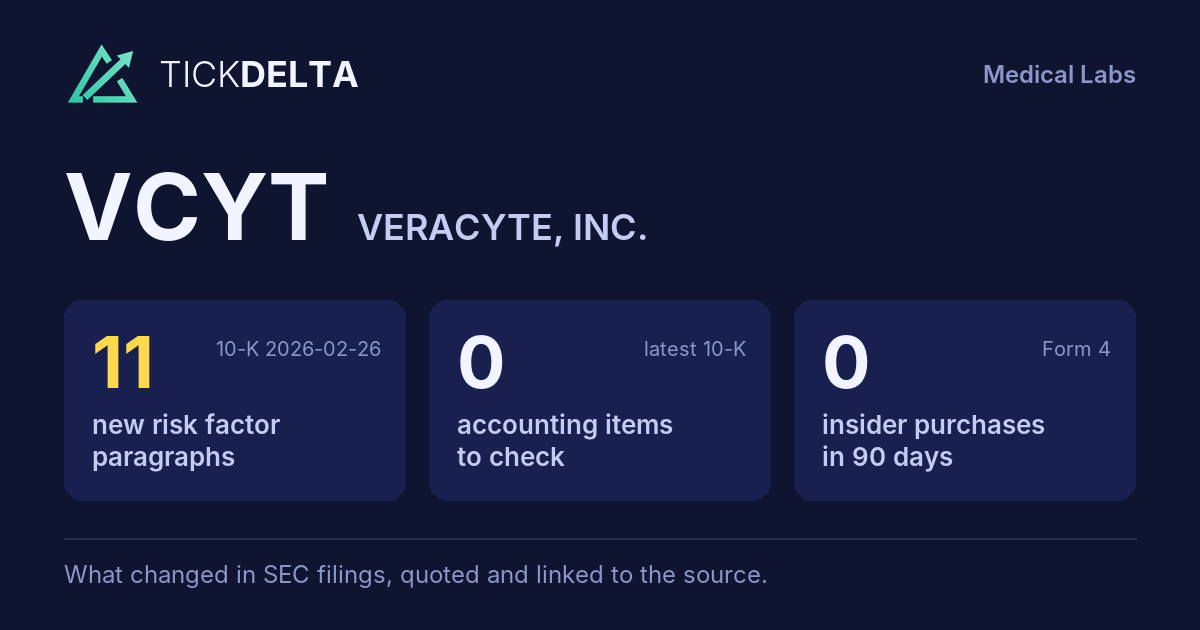
Screener / SEC EDGAR /CIK 0001384101 /10-K filed Feb 26, 2026, compared with Feb 28, 2025 /Numbers from the XBRL of the 10-Ks
Nasdaq Health care · Medical Labs

Veracyte, Inc. VCYT

Compare with peers Embed
SEC comment letters, last 20 years

3 reviews of VCYT's filings by SEC staff

UPLOAD and CORRESP
Reviews 3 latest letter May 28, 2024
Questions asked 14 each answered in the company's own letter
No closing letter 0 reviews without a letter saying the staff completed it

When the SEC's staff reviews a filing, it writes to the company with numbered questions, and the company answers each one in a letter. SEC publishes the exchange once the review is over, at least 20 business days later. A question is not an accusation; most reviews end with the company adding detail to its next filing.

How the reviews went

Every review on EDGAR, from the first staff letter to the letter that closes it

  1. 1. Staff letters 4 UPLOAD
  2. 2. Questions in them 14 numbered comments
  3. 3. Company replies 4 CORRESP
  4. 4. Reviews closed 3 of 3 closing letter

Half the closed reviews took 24 days or less from the first letter to the closing letter.

Form 10-K

2024-05-28 to 2024-06-13 · 4 questions · 1 letter from the SEC, 1 from the company
Review closed 2024-06-13
Non-GAAP measuresGoodwill and impairmentRevenue
Consolidated Financial Statements · Note 5. Balance Sheet Components, Intangible Assets, Net, page 100
SEC asked (1)
We reference the disclosure here and throughout the filing that you recognized impairment for certain long-lived assets related to the HalioDx biopharmaceutical services developed technology, customer relationships and customer backlog finite-lived intangible assets due to "a significant change in the business environment." In future filings, please provide more context regarding the nature and impact of any
Rest of the question

triggering events that require assessment for impairment of your intangible assets.

VCYT answered
The Company acknowledges the Staff’s comment and advises the Staff that it will provide further disclosure in future filings, where applicable, providing additional context regarding the nature and impact of any triggering events that require the Company to assess its intangible assets for impairment.
Rest of the answer

To that end, in response to the Staff’s comment, the Company shall update future disclosures describing the 2023 impairment of certain long-lived assets related to the HalioDx biopharmaceutical services developed technology, customer relationships and customer backlog finite-lived intangible assets to include additional context, as illustrated below:

U.S. Securities and Exchange Commission

“During 2023, the Company concluded that it had a triggering event requiring assessment of impairment for certain of its long-lived assets related to HalioDx biopharmaceutical services. This determination was due to spending constraints across the industry and loss of customers, which resulted in a significant decline in management’s current and future revenue and cashflow expectations for this product offering. As a result, the Company recorded a $32.0 million impairment charge associated with its HalioDx developed technology, customer relationships and customer backlog finite-lived intangible assets. The impairment is recorded within impairment of long-lived assets on the consolidated statement of operations.”

Read in the reply
In its next report

First report after the company's reply of Jun 7, 2024: 10-Q filed Aug 7, 2024 ↗, against the 10-Q filed May 8, 2024 ↗.

Tickdelta does not hold the text of both reports, so they are not compared here.
Exhibit 99.1 · Reconciliation of U.S.GAAP to Non-GAAP Financial Measures
SEC asked (2)
Your presentation of the reconciliation of U.S. GAAP to non-GAAP financial measures gives the appearance of a full non GAAP income statement. Please note that the presentation of a full non- GAAP income statement, or a presentation that gives the appearance of one, may place undue prominence on the non-GAAP information.
Rest of the question

Under Question 102.10(c) of the C&DI's on Non-GAAP Financial Measures, a non-GAAP income statement is considered to be one that is comprised of non-GAAP measures and includes all or most of the line items and subtotals found in a GAAP income statement. Confirm to us that you will not present full non-GAAP consolidated income statements or their equivalents in future filings.

VCYT answered
The Company acknowledges the Staff’s comment and advises the Staff that it will not present full non-GAAP consolidated income statements or their equivalents in its future filings.
Read in the reply
In its next report

First report after the company's reply of Jun 7, 2024: 10-Q filed Aug 7, 2024 ↗, against the 10-Q filed May 8, 2024 ↗.

Tickdelta does not hold the text of both reports, so they are not compared here.

Exhibit 99.1 · Reconciliation of U.S.GAAP to Non-GAAP Financial Measures
SEC asked (3)
As a related matter, if you continue to present non-GAAP total operating costs excluding costs of revenue in future filings, please revise to reconcile to the most comparable GAAP measure, as required by Item 10(e)(1)(i) of Regulation S-K.
VCYT answered
The Company acknowledges the Staff’s comment and, to the extent that it continues to present non-GAAP total operating costs excluding costs of revenue in future filings, it will reconcile such measure to the most comparable GAAP measure, as required by Item 10(e)(1)(i) of Regulation S-K.
Read in the reply
In its next report

First report after the company's reply of Jun 7, 2024: 10-Q filed Aug 7, 2024 ↗, against the 10-Q filed May 8, 2024 ↗.

Tickdelta does not hold the text of both reports, so they are not compared here.

Exhibit 99.1 · Reconciliation of U.S.GAAP to Non-GAAP Financial Measures
SEC asked (4)
With reference to Note 1. to the Reconciliation of U.S. GAAP to Non-GAAP Financial Measures, please tell us the nature and composition of the non-GAAP adjustments for post-combination compensation expenses. Tell us how you determined it is appropriate to adjust for such payments in the determination of your non-GAAP measures and clarify how such compensation differs from other compensation paid to employees and
Rest of the question

management. Refer to Question 100.01 of the Commission's Compliance and Disclosure Interpretation for Non-GAAP measures.

VCYT answered
The Company acknowledges the Staff’s comment and advises the Staff that all of the Company’s non-GAAP adjustments follow the Company’s non-GAAP policy. The nature of the non-GAAP adjustments for post-combination expenses referenced in Note 1. to the Reconciliation of U.S. GAAP to Non-GAAP Financial Measures is stock-based compensation expense related to certain restricted stock unit awards that were granted to the founders of HalioDx (the “Founder RSU Awards”) following the closing of the Company’s acquisition of HalioDx.
Rest of the answer

As a result, such compensation expense does not constitute a cash operating expense as contemplated in Question 100.01 of the Commission’s Compliance and Disclosure Interpretation for Non-GAAP measures. Moreover, consistent with the Company’s current policy, which provides for the adjustment of non-routine stock-based compensation, the Founder RSU Awards were comprised of non-routine, outsized retention awards outside of the Company’s standard equity award practices and bands, and were negotiated in connection with the transaction. Accordingly, the Company believes that its adjustment of such stock-based compensation relating to the Founder RSU Awards from its non-GAAP financial measures is appropriate. The Company further notes that the Founder RSU Awards have been expensed using the straight-line method over the duration of the vesting period. One founder left employment with the Company prior to the full vesting of the applicable Founder RSU Award, and so in the first quarter of 2024, the Company reversed the expense that had been recorded in prior periods for the unvested Founder RSU Awards that were forfeited, representing a $1.2 million adjustment.

*******

Should the Staff have additional questions or comments regarding the foregoing, please do not hesitate to contact the undersigned at (650) 335-7613, or, in his absence, Chelsea Anderson at (206) 389-4516.

Read in the reply
In its next report

First report after the company's reply of Jun 7, 2024: 10-Q filed Aug 7, 2024 ↗, against the 10-Q filed May 8, 2024 ↗.

Tickdelta does not hold the text of both reports, so they are not compared here.

Also in this review: closing letter, 2024-06-13
Form 10-K for the Fiscal Year Ended December 31, 2020

2021-08-27 to 2021-09-20 · 1 question · 1 letter from the SEC, 1 from the company
Review closed 2021-09-20
Acquisitions
Item 2.01. Completion of Acquisition or Disposition of Assets, page 1
SEC asked
We note that you consummated the Decipher Bioscience acquisition on March 12, 2021 but have not filed audited financial statements of the acquired business or pro forma information relating to the acquisition. Please provide us with your calculations of the significance tests outlined in Rule 1-02(w) of Regulation S-X that you used in applying the requirements of Rule 3-05 and Article 11 of Regulation S-X.
VCYT answered
The Company acknowledges the Staff’s comment and advises the Staff that it analyzed the significance of its acquisition of Decipher Biosciences, Inc. (“Decipher”) as follows, pursuant to Rule 3-05 of Regulation S-X:

With respect to the investment test under Rule 1-02(w)(1)(i), the Company analyzed its investment in the acquired business as a percentage of the aggregate worldwide market value of its common stock.
Rest of the answer

The Company advises the Staff that its investment in Decipher was approximately $595 million which, as a percentage, represented 18.6% of the average of the Company’s aggregate worldwide market value calculated daily for the last five trading days of January 2021, the Company’s most recently completed month ending prior to the announcement of the acquisition of Decipher, of approximately $3.19 billion.

With respect to the asset test under Rule 1-02(w)(1)(ii), the Company compared its total assets of approximately $457 million as of December 31, 2020, the end of its most recent fiscal year, to those of Decipher’s of approximately $32 million as of December 31, 2020, and concluded that the Decipher assets represented 7.0% of the Company’s total assets.

With respect to the income test under Rule 1-02(w)(1)(iii), the Company first analyzed the income prong of the test. Under the income component of Rule 1-02(w)(1)(iii)(A)(1), as both Decipher and the Company recorded a net loss for the most recent fiscal year, the Company compared its pre-tax income (loss) from continuing operations of approximately $(35) million for 2020 to that of Decipher of approximately $(2.5) million for 2020, and concluded that Decipher’s pre-tax income (loss) represented 7.2%. Because the income prong of the test fell below 20%, the Company did not analyze the revenue prong of the test.

Based on the above, the Company concluded that, as neither the investment test, nor the asset test, nor the income test exceeded 20%, no historical or pro forma financial statements were required for Decipher under Rule 3-05 or Article 11 of Regulation S-X.

Should the Staff have additional questions or comments regarding the foregoing, please do not hesitate to contact me at (650) 335-7613.

Read in the reply
In its next report

First report after the company's reply of Sep 9, 2021: 10-Q filed Nov 9, 2021 ↗, against the 10-Q filed Jul 29, 2021 ↗.

Tickdelta does not hold the text of both reports, so they are not compared here.

Also in this review: closing letter, 2021-09-20

Form 10-K for the Year Ended December 31, 2014

2015-08-14 to 2015-09-29 · 9 questions · 2 letters from the SEC, 2 from the company
Review closed 2015-09-29
RevenueResults discussion (MD&A)Controls
General
SEC asked (1)
We note from the cover page that the aggregate market value of your voting and nonvoting common stock held by non-affiliates was approximately $122.4 million as of June 30, 2014. We also note you indicated that the Company was a non-accelerated filer on the December 31, 2014 Form 10-K and the March 31, 2015 Form 10-Q.
Rest of the question

Please clarify how you determined your non-accelerated filer status as of December 31, 2014, pursuant to Rule 12b-2 of Exchange Act. To the extent you now determine that you were an accelerated filer, also tell us how you considered the impact of this change on your evaluation of the effectiveness of your disclosure controls and procedures as of December 31, 2014.

VCYT answered
The Company advises the Staff that, based on its public float held by non-affiliates at June 30, 2014, the Company has now concluded it was an accelerated filer as defined in Rule 12b-2 of the Securities Exchange Act of 1934. In light of the Company’s inadvertent failure to recognize that it had achieved accelerated filer status, the Company has implemented improvements to its existing procedures to regularly assess its accelerated filer status and reporting deadlines as part of its disclosure controls and procedures in order to ensure that in the future, information that is required to be
Rest of the answer

disclosed by the Company is reported on a timely basis. The Company believes that its 2014 10-K and its Forms 10-Q for the quarters ended

Ms. Tia L. Jenkins

March 31, 2015 and June 30, 2015 complied with the disclosure requirements applicable to accelerated filers that are also emerging growth companies and thus were appropriately responsive in all material respects to the requirements of Forms 10-K and 10-Q. The Company believes that it has effective disclosure controls, and now realizes, as the Staff has indicated, that it failed to recognize its accelerated filer status as of December 31, 2014. As discussed above, it has enhanced its procedures to ensure its compliance with the accelerated filer filing dates.

Read in the reply
Factors Affecting Our Performance · How We Recognize Revenue, page 66
SEC asked (2)
We note your disclosure of the amounts billed in the last 12 months at list price, for tests processed for which were not recognized as revenue upon delivery of a patient report because your accrual revenue recognition criteria were not met.
Rest of the question

Please expand your disclosure in future filings to also quantify the cumulative amounts billed for processed tests as of the most recent balance sheet date for which you have billed at list price, but not yet recognized revenue or written off as uncollectible.

VCYT answered
In response to the Staff’s comment, the Company will quantify as part of its disclosures in future filings the cumulative amounts billed for processed tests that are not yet recognized as revenue or written off as uncollectible as of the most recent balance sheet date.
Read in the reply
In its next report

First report after the company's reply of Sep 4, 2015: 10-Q filed Nov 5, 2015 ↗, against the 10-Q filed Aug 13, 2015 ↗.

Tickdelta does not hold the text of both reports, so they are not compared here.

Factors Affecting Our Performance · How We Recognize Revenue, page 66
SEC asked (3)
We note your disclosure of the amounts billed in the last 12 months at list price, for tests because your accrual revenue recognition criteria were not met. Given the significant difference between the list prices for the GEC and routine cytopathology tests (page 65), please expand your discussion in future filings to clearly describe the composition of the total amounts billed that have not yet been recognized as
Rest of the question

revenue as of each balance sheet date.

VCYT answered
The Company predominately markets and sells Afirma as a complete solution and provides various offerings that are part of its product suite. The Company does not provide cytopathology as a stand-alone service; it is solely provided as a component of the Afirma solution. Moreover, the Company currently provides additional tests, launched in May 2014, called the Afirma Malignancy Classifiers, and in the future may offer additional add-on tests and features as part of its Afirma solution.

The Company advises the Staff that management: (1) does not internally generate and review billed but not
Rest of the answer

recorded receivables by product component or type in the course of managing its business; (2) does not separately disclose revenue from cytopathology and the GEC in its financial statements; and (3) cannot break out all payments for cytopathology versus GECs cumulatively.

Given these factors, the Company does not believe it can provide the requested information on the basis of product type and does not believe the information would be meaningful to investors.

Read in the reply
In its next report

First report after the company's reply of Sep 4, 2015: 10-Q filed Nov 5, 2015 ↗, against the 10-Q filed Aug 13, 2015 ↗.

Tickdelta does not hold the text of both reports, so they are not compared here.

Factors Affecting Our Performance · How We Recognize Revenue, page 66
SEC asked (4)
We note your disclosure indicating that the actual amount of revenue recorded from these test, if any, may not be equal to the billed amount due to a number of factors. Please expand your disclosure in future filings to discuss your actual collection history for your cash basis customers to provide investors with an understanding of your ability to collect the total list price amounts disclosed in your filing.
Rest of the question

To the extent that you reasonably expect the actual amount of revenue recorded from these tests will be significantly less than the total list price amounts disclosed, please expand your disclosure accordingly in future filings.

VCYT answered
The Company advises the Staff that payments received for testing in general are well below list prices, regardless of whether the payment is from contracted payers, non-contracted payers or individuals, and whether the payer is on an accrual or cash basis. It often takes several appeals and significant time to get paid by payers. The factors disclosed in prior filings are the same factors that affect payment timing and relate to both accrualand cash-basis payers. The Company will expand its disclosure in future filings to elaborate factors as they affect cash-based payers.
Rest of the answer

Additionally, the Company believes that the net amount we collect, or the average GEC reimbursement, is the key to understanding the payments we expect to receive, and the Company will also expand its disclosure in subsequent periodic reports as requested by the Staff in response to Question #5 to provide average GEC reimbursement.

Read in the reply
In its next report

First report after the company's reply of Sep 4, 2015: 10-Q filed Nov 5, 2015 ↗, against the 10-Q filed Aug 13, 2015 ↗.

Tickdelta does not hold the text of both reports, so they are not compared here.

Results of Operations · Revenue, page 74
SEC asked (5)
We note that you quantify the year-over-year changes in revenue recognized when cash is received and revenue recognized on an accrual basis, and that you also quantify the total amount of accrual and cash basis revenue recorded for each period.
Rest of the question

We further note in your Q1 2015 earnings conference call transcript that you indicate the average reimbursement rate for the GEC in the quarter was over $2,200; and you believe this rate will remain fairly static until you secure increased payments from major Blues plans that do currently cover the test. Please expand your revenue disclosure in future filings to include the following information for each period presented and provide draft disclosure in your response letter:  Disclose the average revenue per test for both your GEC and routine cytopathology tests that met your revenue recognition criteria, and clearly discuss how you arrive at the average revenue per test.  Discuss any significant effects on the average revenue per test resulting from reimbursement differences between your accrual and cash basis customers, to the extent applicable.  Discuss the reason(s) for any significant changes in average revenue per test between the comparable periods presented or any known trends or uncertainties that you reasonably expect to have a material favorable or unfavorable impact on this measure, as applicable.

VCYT answered
The Company advises the Staff that it has tracked and disclosed during conference calls in the past its average reimbursement per GEC test, since average revenue per GEC test is quite challenging to calculate in any given quarter, primarily due to the process and time it takes payers and patients to pay the Company. For example, for each GEC test performed, the Company may receive a number of payments from both the payer and the patient over the following 12 months or longer: Invoices for payment go through a payer’s initial adjudication process and, in many instances, subsequent appeals.
Rest of the answer

Since payments for the GEC test can be unpredictable and vary significantly each quarter, we believe the total we expect to receive per test is best estimated by providing average reimbursement per GEC test. Average reimbursement per GEC test represents the aggregate of payments from all sources against tests that are on average a year old, which allows for receipt of payments from multiple sources, eliminates quarterly volatility of payments, and is unaffected by movement of payers from cash to accrual.

· The Company advises the Staff that it does not use cytopathology average reimbursement to manage its business or to develop its future operating plans. The Company does not believe that cytopathology average reimbursement per test is meaningful to investors or reasonably calculable. The number is difficult to calculate since cytopathology samples may be received for only the technical component (i.e., the preparation of slides), the professional component (i.e., the reading of the slides by a physician), or the global (combined) analysis, each with different pricing and CPT (payment) codes. Additionally, the cytopathology market is highly competitive, and even if the Company were able to accurately calculate the cytopathology average reimbursement per test, it would be disadvantaged in the market by disclosing this average price both in terms of competitors and in contracting negotiations with payers.

· The Company does not use cash versus accrual reimbursement averages to manage its business, nor does it calculate said amounts.

· The Company uses the average GEC reimbursement for all payers, calculated as described above, and feels it is the most appropriate and meaningful metric.

In future filings, the Company will provide the average reimbursement per GEC test in Management’s Discussion and Analysis of Financial Condition and Results of Operations (“MD&A”) and discuss the reasons for any significant change in GEC average reimbursement between the comparative periods presented or any known trends or uncertainties that the

Company reasonably expects to have a material favorable or unfavorable impact on this measure.

In response to the Staff’s comments, the Company will provide disclosure similar to the following in future filings:

· Our average reimbursement per GEC test was over $2,200 in the quarter ended June 30, 2015. We calculate the average GEC reimbursement from all payers, whether they are on a cash or an accrual basis, for tests that are on average a year old, since it can take a significant period of time to collect from some payers. We use an average of reimbursement for tests provided over two quarters as it reduces the effects of temporary volatility and seasonal effects. Thus, the average reimbursement per GEC represents the total cash collected to date against GEC tests performed during the relevant period divided by the number of GEC tests performed during that same period.

· The average reimbursement rate for the GEC, as calculated above, was approximately $2,200 in 2014 compared with approximately $1,500 in 2013. The difference in the average reimbursement rate is primarily due to positive coverage decisions provided by three significant payers at various times during 2014, which led to an increase in reimbursed amounts beginning in 2014. The average GEC reimbursement rates will change over time due to a number of factors, including medical coverage decisions by payers, the effects of contracts signed with payers, changes in allowed amounts by payers, and our ability to collect cash payments from third-party payers and individuals.

Read in the reply
Cost of revenue, page 75
SEC asked (6)
We note you attributed the increase in cost of revenue to an increase in variable costs, offset in part by continuing refinements in your testing process and economics of scale related to the increase in FNAs processed.
Rest of the question

Please provide us with draft disclosure to be included in future filings to expand your discussion of cost of revenue by quantifying the individual factors driving the period-to-period changes and also clarifying the nature of the significant variable costs that increased or decreased. Refer to Item 303(a)(3)(i) of Regulation S-K.

VCYT answered
The Company notes that the components of cost of revenue are generally described in MD&A — Cost of revenue (see, for example, page 69 of the 2014 10-K). In future filings, the Company will include in its MD&A discussion of cost of revenue disclosure similar to the following:

Comparison of the [periods ended , 2015 and 2014] (in thousands) is as follows:

[Period Ended]

Dollar

%

201[5]

201[4]

Change

Reagents, Chips, Consumables and Related

Cytopathology Fees

Sample Collection

Direct Labor

Other

Total

Cost of revenue [increased/decreased] $XX.X million, or X%, for the [period ended
Rest of the answer

, 2015] compared to the same period in 2014. GEC tests [increased/decreased] by X% and cytopathology tests by X%. The [increase/decrease] in reagents, chips, consumables and related costs is associated with [increased/decreased] test volume as well as [describe significant factors contributing to change], offset in part by [describe]. The [increase/decrease] in cytopathology fees is related to the volume of FNA samples processed, offset by [describe as applicable]. The [increase/decrease] in sample collection costs is related to the [increased/decreased] volume of samples, offset by [describe as applicable]. The [increase/decrease] in direct labor is associated with the [increase/decrease] in sample volume, offset in part by [describe as applicable]. Other costs are primarily indirect costs, such as facilities allocation, depreciation, and equipment maintenance, which [increased/decreased] as a result of [describe factors contributing to change].

Read in the reply
In its next report

First report after the company's reply of Sep 4, 2015: 10-Q filed Nov 5, 2015 ↗, against the 10-Q filed Aug 13, 2015 ↗.

Tickdelta does not hold the text of both reports, so they are not compared here.

Cost of revenue, page 75
SEC asked (7)
We note that the relationship between your cost of revenue and revenue has changed over the periods presented. In addition, we note the statement in your Q1 2015 earnings conference call transcript that your gross margin for the first quarter of 2014 was aided by the additional accrual of one payer as well as some catch-up cash payments in the quarter; and that this percentage can change due to the lumpiness of
Rest of the question

payments. Please confirm that you will discuss the factors that cause significant changes in the relationship between your revenue and cost of revenue in future filings and provide draft disclosure in your response letter. Refer to Item 303(a)(3)(ii) of Regulation S-K. Notes to Consolidated Financial Statements 2. Summary of Significant Accounting Policies

VCYT answered
The Company confirms to the Staff that it will discuss the factors that cause significant changes in the relationship between revenue and cost of revenue in future filings, as in the case of the first quarter of 2015, when applicable. However, the Company notes that these type of events are unusual. The types of events that would likely result in this type of disclosure being provided include: catch-up payments due to settlement of litigation or negotiation with specific payers, catch-up payments associated with contracted amounts not being adjudicated correctly or other similar events.
Rest of the answer

The Company also experiences a benefit in the relationship of its cost of revenue in relation to revenue beginning with the first quarter that it begins to recognize revenue from a payer on an accrual basis. Please note that beginning in the quarter ended December 31, 2014, the Company began to disclose the incremental revenue, if significant, in the first quarter that it began to accrue a payer(s).

The sample disclosure is provided below (assuming the Company receives a catch-up payment related to a payer entering into a contract and one from payers moving from cash to accrual for revenue recognition purposes):

During the [period ended , 2015], a payer made a catch-up payment of approximately $XX relating to tests performed in prior periods. The catch-up payment was the result of a contract being put in place in [period]. The payment was recorded as cash revenue. Because payments from this payer were previously recorded on a cash basis, the relationship of cost of revenue to revenue for the [period ended , 2015] was favorably impacted as the costs associated with processing the tests associated with the catch-up payment had been expensed in the period in which the patient reports were delivered.

Additionally, [one/several] payers met the Company’s revenue recognition criteria for accrual beginning with the [period ended , 2015]. As a result, approximately $XXX of incremental revenue was accrued for [this/these] payer[s] and therefore the revenues were recognized in the same period as the related expenses for these tests, which represents as change for [this/these] payer[s] from prior periods.

Notes to Consolidated Financial Statements

2. Summary of Significant Accounting Policies

Read in the reply
In its next report

First report after the company's reply of Sep 4, 2015: 10-Q filed Nov 5, 2015 ↗, against the 10-Q filed Aug 13, 2015 ↗.

Tickdelta does not hold the text of both reports, so they are not compared here.

Revenue Recognition, page 97
SEC asked (8)
We note your disclosure that states you consider whether the following revenue recognition criteria are met for all services performed: (1) persuasive evidence of an arrangement exists, (2) delivery has occurred or services have been rendered and (3) a reasonable estimate of reimbursement can be made.
Rest of the question

Please clarify for us your statement that a reasonable estimate of reimbursement can be made and tell us which of the required criteria in ASC 605-10-S99-1 that this satisfies. Also tell us how you considered each of the required criteria prior to the recognition of revenue given that your current disclosure does not appear to include all four of the required criteria. Finally, confirm that you will clearly disclose your revenue recognition policy in future filings and provide draft disclosure in your response letter.

VCYT answered
Since launching its first product in 2011, the Company has recognized revenue on a consistent basis in accordance with the provisions of ASC 954-605, Health Care Entities — Revenue Recognition. Accordingly, revenue is recognized at the Company’s established rates (i.e., list price) in the period test results are delivered to prescribing physicians, net of contractual and other adjustments. Contractual and other adjustments are recognized in the period test results are delivered and reflect management’s estimates of amounts that will ultimately be realized.
Rest of the answer

When estimating contractual and other adjustments, management considers such things as whether a coverage decision has been obtained or a contractual agreement has been entered into with a payer, and, in all cases, whether a payer has demonstrated a predictable level of payment amounts. When a payer has not exhibited a predictable level of payment amounts, contractual and other adjustments can be equal to the Company’s established rates with revenue, if any, being recognized upon the earlier of payment notification or cash receipt. Bad debt expense has not been material to date.

The Company will revise its revenue recognition policy disclosure in future filings as follows:

2. Summary of Significant Accounting Policies

Revenue Recognition

The Company recognizes revenue in accordance with the provisions of ASC 954-605, Health Care Entities — Revenue Recognition. The Company’s revenue is generated from the provision of diagnostic services using the Afirma solution, and the service is completed upon the delivery of test results to the prescribing physician, at which time the Company bills for the service. The Company recognizes revenue related to billings for Medicare and commercial payers on an accrual basis, net of contractual and other adjustments, when amounts that will ultimately be realized can be estimated. Contractual and other adjustments represent the difference between the list price (the billing rate) and the estimated reimbursement rate for each payer. Upon ultimate collection, the amount received from Medicare and commercial payers where reimbursement was estimated is compared to previous estimates and, if necessary, the contractual allowance is adjusted accordingly. Until a contract has been negotiated with a commercial payer or governmental program, the Afirma solution may or may not be covered by these entities’ existing reimbursement policies. In addition, patients do not enter into direct agreements with the Company that commit them to pay any portion of the cost of the tests in the event that their insurance declines to reimburse the Company. In the absence of an agreement with the patient or other clearly enforceable legal right to demand payment from the patient, the related revenue is only recognized upon the earlier of payment notification, if applicable, or cash receipt.

The estimates of amounts that will ultimately be realized requires significant judgment by management. Some patients have out-of-pocket costs for amounts not covered by their insurance carrier, and the Company may bill the patient directly for these amounts in the form of co-payments and co-insurance in accordance with their insurance carrier and health plans. Some payers may not cover the Company’s GEC as ordered by the prescribing physician under their reimbursement policies. The Company pursues reimbursement from such patients on a case-by-case basis. In the absence of contracted reimbursement coverage or the ability to estimate the amount that will ultimately be realized for the Company’s services, revenue is recognized upon the earlier of receipt of third-party payer notification of payment or when cash is received.

* * *

The Company hereby acknowledges that:

· The Company is responsible for the adequacy and accuracy of the disclosure in the filing;

· Staff comments or changes to disclosure in response to staff comments do not foreclose the Commission from taking any action with respect to the filing; and

· The Company may not assert staff comments as a defense in any proceeding initiated by the Commission or any person under the federal securities laws of the United States.

We believe the foregoing to be responsive to the Staff’s comments and thank you for your consideration of our responses in this letter. Should you have any questions or comments regarding this letter, please call me at (650) 243-6341.

Read in the reply
In its next report

First report after the company's reply of Sep 4, 2015: 10-Q filed Nov 5, 2015 ↗, against the 10-Q filed Aug 13, 2015 ↗.

Tickdelta does not hold the text of both reports, so they are not compared here.

Item 9A. Controls and Procedures · Evaluation of Disclosure Controls and Procedures, page 119
SEC asked
We note your response to comment 1. Please further explain to us the basis for your conclusion that your disclosure controls and procedures (“DC&P”) were effective as of December 31, 2014, March 31, 2015 and June 30, 2015 given the Company’s failure to recognize its accelerated filer status, which resulted in untimely filings on Forms 10-K and 10-Q for these periods.
Rest of the question

In this regard, DC&P is designed to ensure that information required to be disclosed in reports that are filed or submitted under the Exchange Act is recorded, processed, summarized and reported within the time periods specified in Securities and Exchange Commission rules and forms (see Rule 13a-15(e) under the Securities Exchange Act of 1934). Alternatively, please amend your filings to disclose that your DC&P were not effective as of each date.

VCYT answered
In response to the Staff’s comment, the Company will amend its Annual Report on Form 10-K for the year ended December 31, 2014 and its Quarterly Reports on Form 10-Q for the quarters ended March 31, 2015 and June 30, 2015 to indicate that its disclosure controls and procedures were not effective as of such dates.

Ms. Tia L. Jenkins

We believe the foregoing to be responsive to the Staff’s comment. Should you have any questions or comments regarding this letter, please call me at (650) 243-6300.
Read in the reply
In its next report

First report after the company's reply of Sep 25, 2015: 10-Q filed Nov 5, 2015 ↗, against the 10-Q filed Aug 13, 2015 ↗.

Tickdelta does not hold the text of both reports, so they are not compared here.

Also in this review: request for more time, Aug 25, 2015, closing letter, 2015-09-29

Letters without questions

Other letters

UPLOAD and CORRESP
2 other letters: notices that a filing will not be reviewed, requests to declare a registration effective, and the like
  • May 9, 2018 · VCYT: letter to the SEC · Veracyte, Inc. Registration Statement on Form S-3 (File No. 333-224576) filed May 1, 2018.
  • May 7, 2018 · SEC: will not review the filing · Veracyte, Inc. · Registration Statement on Form S-3 · Filed May 1, 2018 · File No. 333-224576

From the SEC's correspondence on EDGAR: staff letters (form UPLOAD) and company letters (form CORRESP), 14 letters filed since 2015-08-14. Questions and answers are matched by their numbers; topics come from words in each question. The reports are compared word for word (same form, before the first SEC letter against the first report after the company's reply). No AI.

Sources

The SEC's correspondence on EDGAR: staff letters (form UPLOAD) and company letters (form CORRESP), matched question by question. No AI.

Also

Filings: the letters in the filing list.

Work with it

Excel workbook · CSV. Google Sheet that stays up to date: paste =IMPORTDATA("https://tickdelta.com/company/VCYT/export.csv") into a cell.

Next in Owners and insiders:Insider trades
Esc

Type a ticker such as AAPL, a name, an investor such as Buffett, or a topic such as tariffs. ↑ ↓ to move, Enter to open.