Screener / SEC EDGAR /CIK 0000103379 /10-K filed May 20, 2026, compared with May 22, 2025 /Numbers from the XBRL of the 10-Ks
NYSE Consumer discretionary · Apparel

V F Corp VFC

Compare with peers Embed
SEC comment letters, last 20 years

2 reviews of VFC's filings by SEC staff

UPLOAD and CORRESP
Reviews 2 latest letter Jan 5, 2024
Questions asked 5 each answered in the company's own letter
No closing letter 0 reviews without a letter saying the staff completed it

When the SEC's staff reviews a filing, it writes to the company with numbered questions, and the company answers each one in a letter. SEC publishes the exchange once the review is over, at least 20 business days later. A question is not an accusation; most reviews end with the company adding detail to its next filing.

How the reviews went

Every review on EDGAR, from the first staff letter to the letter that closes it

  1. 1. Staff letters 2 UPLOAD
  2. 2. Questions in them 5 numbered comments
  3. 3. Company replies 2 CORRESP
  4. 4. Reviews closed 2 of 2 closing letter

Half the closed reviews took 24 days or less from the first letter to the closing letter.

Form 8-K

2024-01-05 to 2024-01-29 · 1 question · 1 letter from the SEC, 1 from the company
Review closed 2024-01-29
Results discussion (MD&A)Cybersecurity
Item 1.05 Material Cybersecurity Incidents
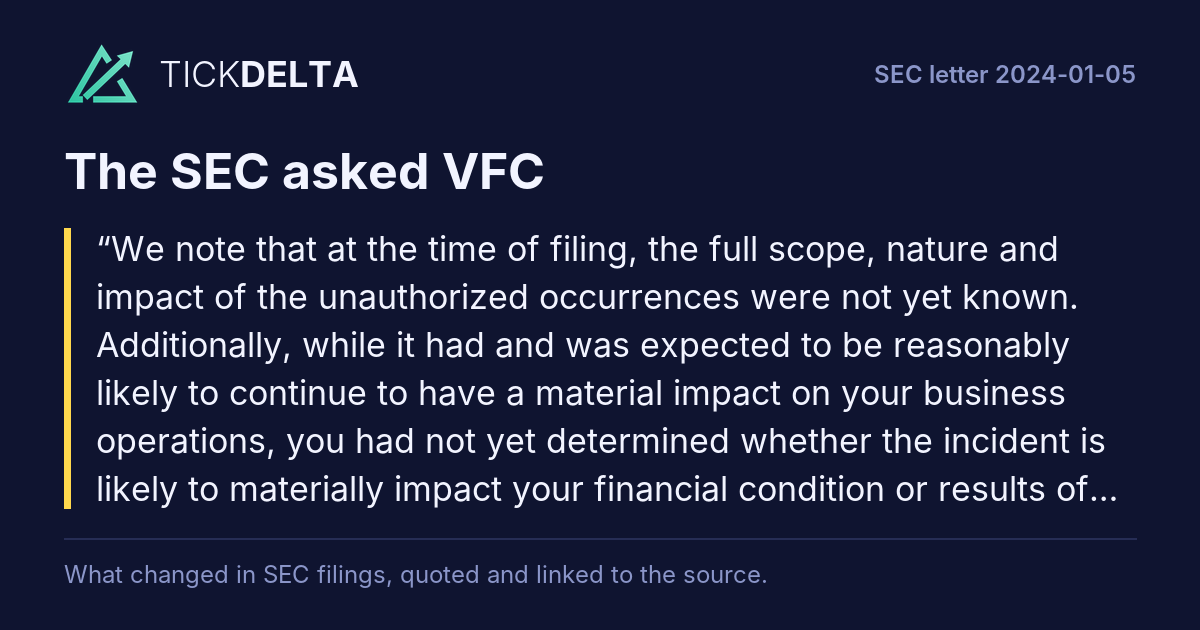
SEC asked
We note that at the time of filing, the full scope, nature and impact of the unauthorized occurrences were not yet known. Additionally, while it had and was expected to be reasonably likely to continue to have a material impact on your business operations, you had not yet determined whether the incident is likely to materially impact your financial condition or results of operations.
Rest of the question

When you file your amended Form 8-K pursuant to Instruction 2 to Item 1.05 of Form 8-K, please also expand your disclosure to address the following items: • expand your discussion to describe the scope of your business operations impacted; and • describe the known material impact(s) the incident has had and the material impact(s) that are likely to continue. In considering material impacts, please describe all material impacts. For example, consider vendor relationships and potential reputational harm related to stolen data and unfulfilled orders, as well as any impact to your financial condition or results of operations.

VFC answered
The Company respectfully acknowledges the Staff’s comment and advises the Staff that when the Company files its amended Form 8-K, it will (i) expand the disclosure to describe the scope of impacted business operations and (ii) describe all known material impacts the incident has had and all known material impacts that are likely to continue.
Read in the reply

Also in this review: closing letter, 2024-01-29

Form 10-K for the Fiscal Year Ended March 28, 2020

2021-02-22 to 2021-03-12 · 4 questions · 1 letter from the SEC, 1 from the company
Review closed 2021-03-12
Goodwill and impairmentNon-GAAP measuresSegmentsRevenueResults discussion (MD&A)
Long-Lived Assets, Including Intangible Assets and Goodwill · Testing of Indefinite-Lived Assets and Goodwill, page 42
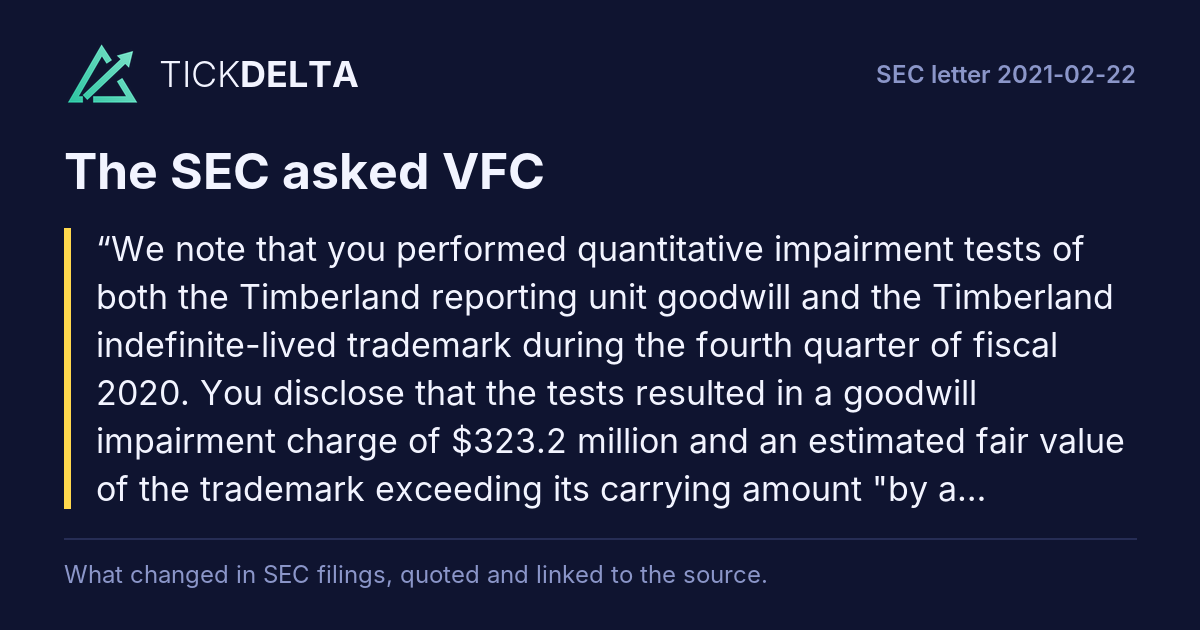
SEC asked (1)
We note that you performed quantitative impairment tests of both the Timberland reporting unit goodwill and the Timberland indefinite-lived trademark during the fourth quarter of fiscal 2020. You disclose that the tests resulted in a goodwill impairment charge of $323.2 million and an estimated fair value of the trademark exceeding its carrying amount "by a significant amount." Given the different outcomes of these
Rest of the question

impairment tests, please clarify why the trademark had a fair value significantly exceeding its carrying value. Consider disclosing the specific factors or assumptions used in the estimated fair value of your trademark.

VFC answered
The quantitative impairment analysis of the Timberland indefinite-lived trademark intangible asset as of March 28, 2020 resulted in an estimated fair value that exceeded its carrying amount by approximately 35%. For reference, the revenue projections used in the different valuation methods were substantially the same.
Rest of the answer

The key differences between the quantitative analysis of the Timberland indefinite-lived trademark intangible asset as compared to the quantitative impairment analysis of the Timberland reporting unit that drove the different outcomes included:

•

The carrying value of the Timberland indefinite-lived trademark intangible asset as of March 28, 2020 of

$1.0 billion was significantly lower than the carrying value of the Timberland reporting unit, including goodwill prior to impairment, of $2.0 billion and thus a significantly lower estimated fair value was required to recover the carrying value of the trademark;

Financial projections used in the quantitative impairment analysis of the Timberland indefinite-lived trademark intangible asset are limited to revenues given the nature of the relief-from-royalty method, and thus are not burdened by operating expenses included in the discounted cash flows for the quantitative impairment analysis of the Timberland reporting unit. As such, there was no impact to the estimated fair value of the Timberland indefinite-lived trademark intangible asset from the near-term decrease in profitability, primarily resulting from COVID-19, when compared to the income approach used for the quantitative impairment analysis of the Timberland reporting unit;

Tax rates used in the quantitative impairment analysis of the Timberland indefinite-lived trademark intangible asset over the period covered by the financial projections range from 11.3% to 14.9% based on the statutory rate for the country where the intellectual property is domiciled. This compares to a tax rate of 22.5% used in the income approach for the quantitative impairment analysis of the Timberland reporting unit, which is based on statutory rates for the countries in which the brand operates. The difference in tax rates resulted in a higher value of after-tax royalty income under the relief-from-royalty method of approximately $125 million; and

The estimated fair value of the Timberland indefinite-lived trademark intangible asset reflects the tax amortization benefit related to amortizing the intangible asset for tax purposes, which provides incremental value (approximately $116 million) not considered in the income approach used for the quantitative impairment analysis of the Timberland reporting unit.

In response to the Staff’s comment, we respectfully submit that we believe our disclosures included in the

“Timberland Reporting Unit and Indefinite-Lived Intangible Asset Impairment Analysis” section on page 43 of our Form 10-K for the fiscal year ended March 28, 2020 appropriately provide key factors and assumptions used in the quantitative impairment analysis of the Timberland indefinite-lived trademark intangible asset similar to that provided for the Timberland reporting unit. As noted in the considerations above, the primary assumption difference between the Timberland quantitative impairment analyses relates to the different tax rates used, which we note in the key assumptions disclosed in our Form 10-K. The other differences relate to the nature of the valuation methods and the carrying values of the balances being reviewed.

Read in the reply
In its next report

First report after the company's reply of Mar 5, 2021: 10-K filed May 27, 2021 ↗, against the 10-K filed May 27, 2020 ↗.

Tickdelta does not hold the text of both reports, so they are not compared here.

Notes to the Consolidated Financial Statements · Note 1 - Basis of Presentation, page 11
SEC asked (2)
We note that on January 21, 2020, you announced your decision to explore the divestiture of your Occupational Workwear business and that it met the held-for-sale and discontinued operations criteria. You disclosed in your fiscal year 2020 Form 10-K that you expected to divest the business in the next twelve months.
Rest of the question

Please tell us what consideration you gave to ASC 205-20-45-1 when determining that these assets should still be classified as held-for-sale, given the extended length of time that they have been classified as such. In your response, include an assessment of the probability that a sale will be consummated and the anticipated timing.

VFC answered
As of March 28, 2020, the Occupational Workwear business met the held-for-sale and discontinued operations accounting criteria, which was after the public announcement on January 21, 2020 regarding our plans to explore the divestiture. We concluded that it was probable that a sale of the Occupational Workwear business would be completed within one year based on initial market interest in the business, the fact that our estimated market price was reasonable in relation to the estimated fair value of the business, and our recent history of successfully completing the divestitures of other
Rest of the answer

businesses within one year, including the Reef® brand business sold in October 2018, the Nautica® brand business sold in April 2018 and the Licensing business sold in April 2017.

Subsequent to the initial classification of the Occupational Workwear business as held-for-sale and discontinued operations, we maintained an active program to complete a sale of the business, identified multiple interested parties and engaged in discussions with potential buyers, including certain advanced negotiations; however, a signed agreement to complete a sale has not been consummated. [***]

We assessed the classification of the Occupational Workwear business as held-for-sale and discontinued operations as of December 26, 2020 in connection with our quarterly report on Form 10-Q based on the latest information regarding our ability to complete a sale, including the criteria set forth in ASC 205-20-45-1E, and we concluded that the classification remained appropriate while also noting the one-year period from initial classification as held-for-sale and discontinued operations had not lapsed. While we considered all of the classification criteria, we placed particular emphasis on the probability of sale and the reasonableness of the price range being actively marketed compared to prevailing market conditions.

We also considered the criteria set forth in ASC 205-20-45-1G which states “events or circumstances beyond an entity’s control may extend the period required to complete the sale of an entity to be sold beyond one year” and provides exceptions to the one-year requirement in ASC 205-20-45-1E(d), specifically ASC 205-20-45-1G(c) that acknowledges “if during the initial one-year period, circumstances arise that previously were considered unlikely and, as a result, an entity to be sold previously classified as held for sale is not sold by the end of that period.” [***]

Based on our assessment, we believed a sale continued to be probable at December 26, 2020 and that we would be able to complete the divestiture within one year.

Read in the reply
In its next report

First report after the company's reply of Mar 5, 2021: 10-K filed May 27, 2021 ↗, against the 10-K filed May 27, 2020 ↗.

Tickdelta does not hold the text of both reports, so they are not compared here.

Exhibit 99 · Reconciliation of Select GAAP Measures to Non-GAAP Measures
SEC asked (3)
We note your non-GAAP measures exclude costs related to "specified strategic business decisions," comprised of "cost optimization" activities indirectly related to the "strategic review" of your Occupational Workwear business, costs related to strategic business decisions and "planned business model changes" in South America, and the operating results of jeanswear wind down activities following the spin-off of
Rest of the question

Kontoor Brands. We further note your disclosure on page F-23 of your fiscal year 2020 Form 10-K that certain overhead and segment costs previously allocated to the Jeans business for segment reporting did not qualify for discontinued operations and have been reallocated to continuing operations. Please tell us your basis for excluding these specified strategic business decisions costs in your non-GAAP measures and your consideration of Questions 100.01 and 100.04 of the Non-GAAP Financial Measures Compliance and Disclosure Interpretations. In particular, tell us how the excluded items do not represent standard cash expenses necessary to operate your business.

VFC answered
The disclosure included on page F-23 of our fiscal year 2020 Form 10-K referenced in the Staff’s comment relates to items that are not clearly identifiable as costs of the Company’s discontinued operations and will continue to be recognized on an ongoing basis, thus considered to be retained costs of the

Company. These amounts primarily relate to allocations of shared-service costs of functions including information technology, finance, human resources, and other corporate activities.
Rest of the answer

These activities are considered normal operating expenses and thus have been reported within the Company’s continuing operations in the current and all historical reporting periods as presented in our filed Form 10-K’s, Form

10-Q’s and furnished Form 8-K’s. Furthermore, to clarify, these retained costs are not excluded as part our non-GAAP financial measures and thus are not reflected in the activity referenced in the Staff’s comment related to the “Reconciliation of Select GAAP Measures to Non-GAAP Measures” provided in our earnings release furnished on Form 8-K. The Company recognizes these retained costs do represent standard cash expenses as necessary to operate our business.

The activities referenced in the Staff’s comment related to “specified strategic business decisions” costs that have been excluded as part of our non-GAAP financial measures in fiscal 2021 primarily represent costs of projects and actions indirectly related to the strategic review of the

Occupational Workwear business, which represent approximately $52 million on a pre-tax basis. These strategic decisions primarily relate to exiting our existing global manufacturing footprint and resulted in both cash and non-cash charges including severance and employee-related benefits, asset write downs and other costs. The other significant costs referenced in the Staff’s comment associated with our strategic actions in fiscal 2021 included the shutdown of our operational footprint in South America in connection with the jeanswear wind down. The largest component of the costs was a non-cash charge of approximately $42 million related to the release of currency translation amounts associated with the substantial liquidation of foreign entities in certain countries in South America. The remaining costs and related impact in fiscal 2021 were insignificant. Substantially all of the net impact of the adjustments associated with this exit strategy in fiscal 2020 related to various restructuring activities and other expenses associated with the shutdown of our operational footprint.

We have considered Questions 100.01 and 100.04 of the Non-GAAP Financial Measures Compliance and Disclosure

Interpretations and note these charges clearly do not represent normal, recurring operating expenses necessary to operate the Company’s business. By excluding these items as part of our non-GAAP financial measures, we provide investors with useful supplemental information regarding our underlying business trends and the performance of our ongoing operations that is consistent with key financial information reviewed by the Company’s executives for assessing performance and decision-making.

Read in the reply
In its next report

First report after the company's reply of Mar 5, 2021: 10-K filed May 27, 2021 ↗, against the 10-K filed May 27, 2020 ↗.

Tickdelta does not hold the text of both reports, so they are not compared here.

Top 4 Brand Revenue Information
SEC asked (4)
We note the supplemental financial information disclosed herein and within your investor presentations that shows, on a percentage change and percentage change constant currency basis, "Top 4 Brand" revenue growth in total and by geographic region. We also note that you discuss the global changes in your periodic filings.
Rest of the question

Please tell us your consideration of disclosing in your periodic filings the dollar amounts of revenue for these top four brands and the geographic information provided in the supplemental table. It appears such information would be meaningful to investors. Refer to Item 303 of Regulation S-K and SEC Release No. 33-8350.

VFC answered
In response to the Staff’s comment, we will enhance our disclosures in future periodic filings to include the dollar amounts of revenue for the

Company’s most significant brands in total and by geographic region. The following illustrates the tabular form disclosure we plan to incorporate within Management’s Discussion and Analysis in future periodic filings based on our current brand portfolio, with the initial disclosure provided in our annual report on Form 10-K for the period ending April 3, 2021.

The following tables present revenues by geography for VF’s top four brands:

Year Ended
Rest of the answer

March 2021

(in millions)

Read in the reply
In its next report

First report after the company's reply of Mar 5, 2021: 10-K filed May 27, 2021 ↗, against the 10-K filed May 27, 2020 ↗.

Tickdelta does not hold the text of both reports, so they are not compared here.

Also in this review: closing letter, 2021-03-12

From the SEC's correspondence on EDGAR: staff letters (form UPLOAD) and company letters (form CORRESP), 6 letters filed since 2021-02-22. Questions and answers are matched by their numbers; topics come from words in each question. The reports are compared word for word (same form, before the first SEC letter against the first report after the company's reply). No AI.

Sources

The SEC's correspondence on EDGAR: staff letters (form UPLOAD) and company letters (form CORRESP), matched question by question. No AI.

Also

Filings: the letters in the filing list.

Work with it

Excel workbook · CSV. Google Sheet that stays up to date: paste =IMPORTDATA("https://tickdelta.com/company/VFC/export.csv") into a cell.

Next in Owners and insiders:Insider trades
Esc

Type a ticker such as AAPL, a name, an investor such as Buffett, or a topic such as tariffs. ↑ ↓ to move, Enter to open.