Form 10-K for the Fiscal Year Ended December 31, 2012
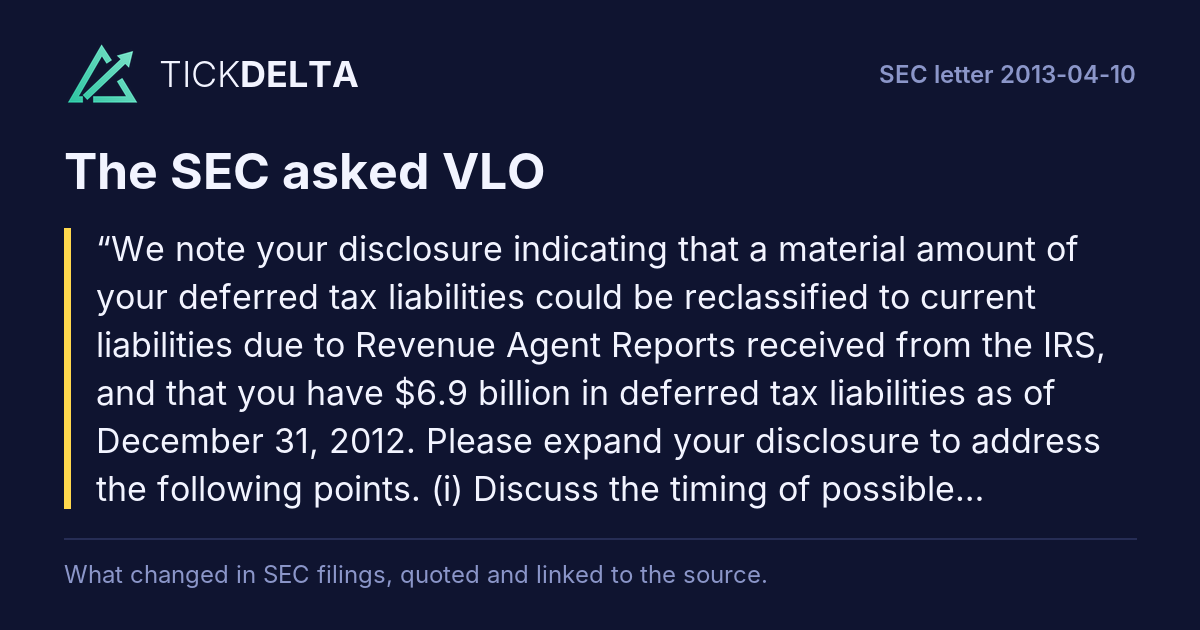
We note your disclosure indicating that a material amount of your deferred tax liabilities could be reclassified to current liabilities due to Revenue Agent Reports received from the IRS, and that you have $6.9 billion in deferred tax liabilities as of December 31, 2012. Please expand your disclosure to address the following points.Rest of the question
(i) Discuss the timing of possible significant reclassifications and payments and the course of action that you might take to make these payments. (ii) Quantify possible reclassifications and interest and penalties (iii) Provide a brief overview of the upcoming and remaining steps you envision as part of contesting the tax positions and assertions taken in the Revenue Agent Reports, and the anticipated duration of these remaining steps. Please include any additional information necessary to comply with the guidance in Item 303(a)(1) of Regulation S-K, Instruction 5 to Item 303(a) of Regulation S-K, and Section IV of SEC Release No. 34-48960 (FR-72).
We received your letter dated April 10, 2013 and advise you that we will provide our response to the comment raised in that letter on or about May 9, 2013, concurrent with filing the Company’s Form 10-Q for the quarter ended March 31, 2013 (the “Form 10-Q”). We are currently preparing the Company’s earnings release and Form 10-Q, and we are also preparing for the spin-off of the Company’s retail business under a new company named CST Brands, Inc., which is expected to occur on May 1, 2013. Because of these matters, we are unable to respond within ten business days from the date of your letter. Read in the reply ↗
First report after the company's reply of 2013-04-23: 10-Q filed 2013-05-08 ↗.
No earlier 10-Q before the SEC's letter is in Tickdelta, so there is nothing to compare with.
We note your obligation to blend biofuels was categorized in Level 1 of the fair value hierarchy as of December 31, 2012, and Level 2 as of March 31, 2013. Tell us your reason for transferring this financial instrument between these two categories and explain why this reason has not been disclosed to comply with FASB ASC 820-10-50-2.
The Company’s obligation to blend biofuels and the liability that may be recognized and disclosed in the recurring fair value measurements table related to that obligation are described in the third bulleted paragraph on page 21 and under “Obligation to Blend Biofuels” on page 28 of the Form 10-Q. The basis for recognizing a liability and the measurement of that liability are also described in the disclosure referred to above on page 21 of the Form 10-Q.Read in the reply ↗Rest of the answer
In addition, we have provided further details regarding the recognition and measurement of the liability in our response to the Staff’s request for clarification of how the Company accounts for RINs and RFTCs in comment #2.
Supplementally, we inform the Staff that the $10 million liability as of December 31, 2012, related to the Company’s obligation to blend biofuels was improperly categorized in the Form 10-K as being measured in accordance with a Level 1 valuation technique. In connection with the preparation of the Form 10-Q and a review of the inputs utilized to measure the fair value of the liability, the Company determined that the fair value measurement technique utilized was more appropriately categorized in Level 2 of the fair value hierarchy because the measurement is based on prices for RINs and RFTCs posted by independent pricing services.
The reclassification of the liability from Level 1 to Level 2 was not due to a change in valuation technique, which would result in the disclosures described in FASB ASC 820-10-50-2bb; rather, the reclassification reflects the proper classification of the liability as being measured using a Level 2 valuation technique. Due to the immaterial nature of the liability and the fact that there was no change in the measurement technique, we believe that the disclosures described in FASB ASC 820-10-50-2bb do not apply and that no disclosure is warranted in the Form 10-Q.
We note in the Staff’s comment that the Staff referred to the liability as being associated with a financial instrument. Supplementally, we inform the Staff that the liability is not associated with a financial instrument, primarily because there is no underlying contract associated with that liability. Rather, the liability is a nonfinancial liability that is measured at fair value. We believe that the disclosure on page 21 of the Form 10-Q describes the basis for recognizing the liability and does not indicate that it is associated with a financial instrument. However, we acknowledge that the disclosure provided on page 18 under “General” and on page 19 under “Recurring Fair Value Measurements” of the Form 10-Q could be read to imply that all amounts provided in the tables on pages 19 and 20 of the Form 10-Q are associated with financial instruments. This was not the Company’s intent; therefore, the disclosure under these headings will be revised in the Company’s future filings with the Commission.
First report after the company's reply of 2013-06-06: 10-Q filed 2013-08-07 ↗.
No earlier 10-Q before the SEC's letter is in Tickdelta, so there is nothing to compare with.
We note your disclosure regarding your market risk exposure to changes in prices in Renewable Identification Numbers (RINs) and Renewable Transport Fuel Certificates (RTFCs). Please disclose your accounting policy for recognizing an obligation to blend biofuels and attributing the accompanying cost to operations.Rest of the question
Please clarify how you are accounting for RINs and RTFCs acquired in order to fulfill these obligations, including any purchases that occur in advance of recognizing an obligation.
As noted in our response to the Staff’s comment #1, the Company disclosed the basis for recognizing a liability related to its obligation to blend biofuels and the manner in which that liability is measured in the third bulleted paragraph on page 21 of the Form 10-Q. That disclosure refers to the disclosure under “Obligation to Blend Biofuels” on page 28 of the Form 10-Q, which provides further information regarding the Company’s obligation to blend biofuels, as well as the cost recognized by the Company to meet its obligation and the classification of those costs in cost of sales.Read in the reply ↗Rest of the answer
The Company believes that these disclosures describe adequately its accounting policy for recognizing a liability related to its obligation to blend biofuels and the basis for recognizing costs incurred to meet that obligation. As such, the Company believes that it has disclosed its accounting policy. In addition, the Company disclosed the classification of such costs in its income statement. The Company does not believe, however, that U.S. generally accepted accounting principles or the Commission’s rules and regulations require it to disclose the reason for attributing costs to certain income statement line items.
With respect to the Company’s disclosure of its accounting policy for recognizing a liability related to its obligation to blend biofuels and the reason for attributing the cost of meeting that obligation to cost of sales, we supplementally provide the Staff with the following information:
•
The Company provided the disclosures on pages 21 and 28 of the Form 10-Q to help the reader of its financial statements better understand its obligation to blend biofuels and the costs of meeting that obligation. The Company will continue to evaluate the materiality of such costs and any related liability to its results of operations or financial position, respectively. Should such costs or related liability become material, the Company will consider including its accounting policy with respect to this matter within the note to its financial statements that describes its significant accounting policies.
As further discussed below in response to the Staff’s request for clarification of how the Company accounts for its obligation to blend biofuels, it should be noted that the Company purchases biofuels from third parties to blend into its products, and each gallon of biofuel purchased includes a RIN. Upon the sale of the blended product, the Company charges cost of sales for the cost of the blended product, which includes the cost of the biofuel and, inherently, the cost of the RIN. Therefore, even if the Company purchased and blended a sufficient quantity of biofuels such that it was not obligated to purchase RINs in the open market, cost of sales would inherently include the cost of the RIN purchased along with the biofuels. As such, the Company believes that it is appropriate to charge cost of sales for the purchase of RINs needed to meet its obligation to blend biofuels.
In response to the Staff’s request to clarify how the Company accounts for RINs and RTFCs acquired to fulfill its obligation to blend biofuels, we supplementally provide the Staff with the following overview of the Company’s accounting, beginning with the initial recognition of a liability related to the Company’s obligation to blend biofuels. We refer only to RINs in this overview; however, the Company’s accounting for RFTCs is applied in a consistent manner.
The Company is obligated by government regulations to blend a certain percentage of biofuels into the products it produces that are consumed in the U.S. The Company purchases biofuels from third parties and blends those biofuels into its products, and each gallon of biofuel purchased includes a RIN. To the degree the Company is unable to blend biofuels at the required percentage, a RIN deficit is generated and the Company must acquire that number of RINs by the annual reporting deadline in order to remain in compliance with applicable regulations. At the end of each month, the Company determines whether or not it has a RIN deficit related to the annual reporting period to date. If a RIN deficit exists, the Company records a liability equal to the product of the RIN deficit and the market price of a RIN as of the balance sheet date, and it charges cost of sales for an equal amount. This process occurs each month and the liability is trued-up, along with a related charge to or reduction in cost of sales based on the RIN deficit and the market value of a RIN at that time. It should be noted that this liability is the nonfinancial liability measured at fair value, which is discussed in our response to the Staff’s comment #1 and disclosed in the fair value measurements table.
From time to time, the Company purchases RINs from third parties and charges cost of sales for an amount equal to the purchase price. In connection with the month-end process discussed above, RINs purchased reduces the RIN deficit used to true-up the liability. Again, the amount by which the liability is trued-up results in a charge to or reduction in costs of sales. Therefore, if a sufficient number of RINs were purchased resulting in there being no RIN deficit at the end of the month, the liability recorded at the previous month-end would be adjusted to zero and cost of sales would be reduced by an equal amount. This properly results in the net charge to cost of sales being equal to the actual purchase price of the RINs. If the number of RINs acquired to date exceeds the RIN deficit at that time, the Company records a prepaid asset equal to the product of the RIN excess and the purchase price of those RINs. The prepaid asset is amortized to cost of sales as the Company generates an additional need for RINs as a result of not meeting the required blending percentage.
Also from time to time, the Company may enter into contracts with third parties to purchase RINs for delivery in the future at a fixed price. These forward purchase contracts are derivative instruments; however, the Company elects the normal purchase and sale exception with respect to these derivative instruments because it expects to use the RINs acquired under these contracts in the normal course of its business in order to satisfy its RIN deficit. As a result, there is no accounting by the Company for these contracts at the time they are entered into with the third parties. However, because the biofuels blending obligation is ultimately determined on an annual basis and the RINs to be acquired under these contracts will be delivered during that period, the Company includes these RINs in its month-end determination of whether it has a RIN deficit or excess. Should there be a RIN deficit at month-end before considering RINs associated with these contracts, cost of sales is charged for an amount equal to the product of the number of contracted RINs (not to exceed the RIN deficit) and the contracted price of those RINs, and an accrued liability is recorded for an equal amount. If there is no longer a RIN deficit after considering contracted RINs, the liability related to the Company’s obligation to blend biofuels recorded at the previous month-end is adjusted to zero and cost of sales would be reduced by an equal amount, consistent with the situation described in the previous bulleted paragraph. However, should there continue to be a RIN deficit after considering the contracted RINs, the liability related to the Company’s obligation to blend biofuels is trued-up, along with a related charge to or reduction in cost of sales, in a manner consistent with the process described above. Finally, in the situation where there is a RIN excess after considering contracted RINs, the Company does not record a prepaid asset for those excess RINs because the Company has not yet taken delivery of those RINs or paid for them.
The Company acknowledges that:
the Company is responsible for the adequacy and accuracy of the disclosure in the filing;
Staff comments or changes to disclosure in response to Staff comments do not foreclose the Commission from taking any action with respect to the filing; and the Company may not assert Staff comments as a defense in any proceeding initiated by the Commission or any person under the federal securities laws of the U.S.
First report after the company's reply of 2013-06-06: 10-Q filed 2013-08-07 ↗.
No earlier 10-Q before the SEC's letter is in Tickdelta, so there is nothing to compare with.
Also in this review: company letter, 2013-05-08, closing letter, 2013-06-21