Valmont Industries Inc VMI
New risk paragraphs, branching off last year
Each branch is a paragraph in Risk Factors with nothing like it in the 10-K filed Feb 25, 2025. A box jumps to the paragraph as filed, below.
Paragraphs with nothing like them in last year's 10-K
35 paragraphs in Risk Factors of the 10-K filed Feb 24, 2026 with nothing like them in the 10-K filed Feb 25, 2025. Quoted exactly. Paragraphs that were only edited are under 10-K change.
Our ability to effectively manage the procurement and inventory of key components and raw materials may be adversely affected by supply disruptions and demand volatility, which could reduce our profitability.
Our Agriculture and Infrastructure businesses are subject to pronounced business cycles and, at times, sudden changes in customer demand. Our operating results depend in part on our ability to accurately forecast demand and procure inventories that align with production schedules and customer delivery requirements. In recent years, global supply chain disruptions and availability constraints for certain components and raw materials have adversely affected our ability to manage inventory efficiently.
To mitigate the risk of supply disruptions, we may increase inventory levels for certain components or materials. While this strategy may support continuity of operations, it also increases the risk that inventories may become excess or obsolete if customer demand weakens, forecasts fail to materialize, or customers delay or cancel orders due to adverse conditions in their end markets.
If we determine that inventory is excess or obsolete, we would be required to record inventory reserve charges or write-offs, which could adversely affect our gross margins, operating results, and financial condition. These risks may be exacerbated during periods of economic uncertainty or rapid changes in market conditions.
decline due to factors beyond our control, including budget constraints, reduced tax revenues, and legislative delays affecting appropriations.
Adverse economic conditions, particularly in certain international markets, could impair the collectability of our accounts receivable and adversely affect our operating results.
Adverse economic conditions in certain international regions, most notably Brazil, may increase our exposure to credit losses resulting from financial distress, insolvency, or potential bankruptcy of our Agriculture or Infrastructure customers. Under these conditions, customers may delay payments or be unable to meet their obligations to us.
Our accounts receivable are stated at net estimated realizable value, and our allowance for credit losses is based on management’s judgment and estimates, including receivable aging, the creditworthiness of significant individual customers, historical loss experience, and current and forecasted economic conditions. These estimates may not accurately predict actual future credit losses, particularly during periods of heightened economic uncertainty or rapid deterioration in customer financial conditions.
If our assumptions regarding customer credit risk or economic conditions prove inaccurate, or if adverse conditions persist or worsen, we may be required to record additional provisions for credit losses, which could adversely affect our operating results, financial condition, and cash flows.
Recent and ongoing tariff actions affecting steel, aluminum, and goods imported from Canada, China, and Mexico, have increased uncertainty regarding the cost and availability of raw materials and components critical to our manufacturing operations. These actions, as well as any future changes in tariffs, trade agreements, or the imposition of new protectionist or retaliatory measures, could increase our cost of goods sold, reduce margins, disrupt supply chains, or adversely affect our financial results.
In addition, retaliatory trade actions by China, such as tariffs on imported U.S. soybeans, may continue to pressure U.S. farm income. Because reduced farm income can directly affect growers’ purchasing decisions, including for mechanized irrigation equipment, these trade dynamics may negatively impact demand for our products in the U.S. agricultural market.
Several of our international operations are located in regions experiencing political or economic instability. In particular, certain countries within our Caribbean and Latin America (“CALA”) region, such as Brazil and Argentina, continue to face economic volatility, inflationary pressures, and uncertain regulatory environments, all of which can affect demand, foreign currency cash flows, and financial results. We also operate in areas with heightened geopolitical risk, such as the Middle East.
economic recessions or volatility in key markets, including within our CALA region, that may reduce sales;
Show the other 8
Changes in the application and enforcement of U.S. trade and tariff laws, including Section 232 tariffs on steel and aluminum content, could increase our costs and adversely affect our results of operations.
We manufacture Utility structures in Mexico and ship them to customers in the U.S. While most of the structures we sell to U.S. customers are manufactured domestically, we imported approximately $220.0 million of fabricated steel structures from Mexico into the U.S. during fiscal 2025.
We are subject to U.S. and foreign trade laws and tariffs, including Section 232 tariffs applicable to certain steel and aluminum products and derivative articles. As of June 4, 2025, a 50% tariff is assessed on the steel and aluminum content of certain steel and aluminum imports into the U.S. Although an exemption exists for fabricated structures produced using steel that was melted and poured in the U.S., and the structures produced at our Mexico facility are U.S.-Mexico-Canada Agreement-compliant, changes in the interpretation, application, or availability of these tariffs or exemptions could increase our costs or adversely affect the competitiveness of products manufactured outside the U.S.
In February 2026, the U.S. Supreme Court ruled that certain tariffs imposed under the International Emergency Economic Powers Act were invalid, but the decision did not affect existing Section 232 tariffs on steel and aluminum. As a result, there may be increased reliance on, expansion of, or changes to Section 232 tariffs or other trade measures, which could increase our tariff exposure and adversely affect our costs, results of operations, or cash flows. We are continuing to monitor legal developments, potential replacement measures, and related regulatory actions, including newly announced global tariffs on certain foreign goods, and we may be required to adjust our sourcing, pricing, or compliance practices in response to such changes.
U.S. Customs and Border Protection (“CBP”) has increased scrutiny of how Section 232 duties apply to imported products, including the valuation methodologies used to calculate such duties. In February 2026, we received CBP inquiries relating to the valuation methodology applied to historical import entries. These inquiries are ongoing, and no final
determinations have been made. While we believe our valuation methodologies have complied with CBP guidance, CBP may ultimately disagree with our position.
Adverse determinations could result in additional duties, interest, or penalties related to the entries under review and could require changes to our valuation methodology for future imports, which may increase our ongoing tariff costs. Although CBP has not indicated an intent to do so, it has the authority to review other import entries or initiate broader enforcement actions. Any such actions, or further changes in trade laws, tariff rates, exemptions, or enforcement practices, could adversely affect our results of operations, financial condition, or cash flows.
Although we have recorded all known environmental obligations in our Consolidated Financial Statements, the discovery of previously unidentified contamination or the need for additional remediation could result in liabilities exceeding our existing provisions. These risks may be heightened at certain galvanizing facilities in the Asia-Pacific region due to the nature of galvanizing processes and the complexity and evolving requirements of local environmental regulations.
As required by accounting principles generally accepted in the U.S., we establish reserves when legal matters become probable and reasonably estimable. As of December 27, 2025, we have reserved, in aggregate, approximately $24.2 million related to these matters. Subsequent developments may impact our assessment of probability or change our previous estimate of certain loss contingencies and require us to make payments in excess of our reserves, which could have an adverse effect on our financial condition or results of operations.
To remain competitive, we must invest in our manufacturing capabilities, product development, customer service, and our information technology systems and networks, including artificial intelligence. Ineffective implementation, integration, or adoption of these technologies within our business operations and decision-making processes could reduce productivity, widen talent gaps, and diminish our competitive position.
The use of artificial intelligence presents risks and challenges that may adversely impact our business and operating results.
We may adopt and integrate generative artificial intelligence and machine learning (collectively, “AI”) tools into our operations to enhance efficiencies and streamline existing systems. However, the development, implementation, and
maintenance of AI tools may entail substantial risks. While these tools hold promise in optimizing processes and improving productivity, they may also produce inaccurate or biased outputs, infringe upon or misappropriate intellectual property, or expose us to data privacy, cybersecurity, and regulatory compliance risks. In addition, evolving legal, regulatory, and ethical standards governing the use of AI may increase compliance costs or limit our ability to deploy these technologies effectively. If we are unable to manage these risks, our business, financial condition, or results of operations could be adversely affected.
and operational disruptions. All of these could harm our reputation and competitiveness, and materially affect our business strategy, results of operations, or financial condition.
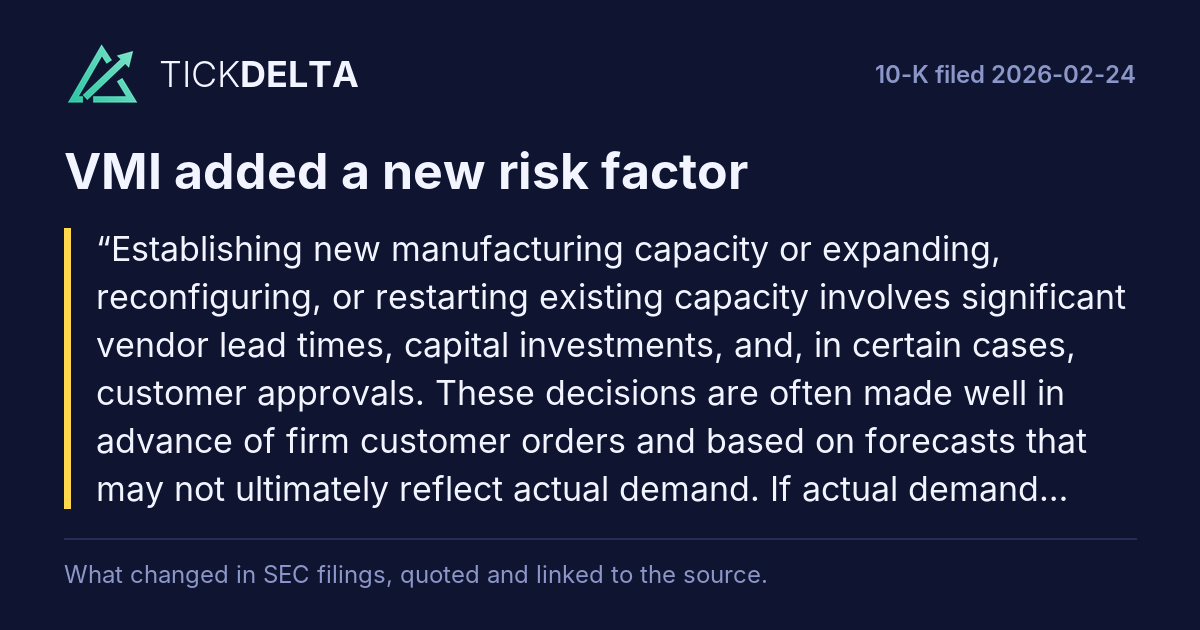
Challenges in managing manufacturing capacity and responding to demand volatility could adversely affect our business.
Establishing new manufacturing capacity or expanding, reconfiguring, or restarting existing capacity involves significant vendor lead times, capital investments, and, in certain cases, customer approvals. These decisions are often made well in advance of firm customer orders and based on forecasts that may not ultimately reflect actual demand. If actual demand does not develop as anticipated, or declines after we have expanded capacity or increased our fixed cost structure, our manufacturing facilities may operate below optimal utilization, which could result in higher per-unit manufacturing costs, elevated inventory levels, reduced margins, asset impairments, restructuring charges, or lower profitability. Conversely, if actual demand exceeds our forecasts, we may be required to extend customer lead times or may be unable to satisfy customer demand, which could lead to customer dissatisfaction, the loss of market share to competitors, increased overtime and expediting costs, and reputational harm.
In addition, efforts to expand, modify, or rapidly ramp manufacturing capacity can increase operational complexity and elevate safety risks for our employees and contractors. Such activities may involve the installation of new equipment, changes to manufacturing processes, compressed production timelines, or the use of temporary or less-experienced labor. Workplace accidents, safety incidents, or regulatory actions arising from these conditions could disrupt operations, delay production, result in litigation or regulatory scrutiny, increase insurance or self-insurance costs, and adversely affect our reputation and financial performance. Although we maintain insurance coverage and safety programs designed to mitigate these risks, such measures may not be sufficient to prevent or fully offset the impact of all incidents or liabilities.
If we are unable to effectively manage manufacturing capacity, respond to changes in demand, or safely execute capacity expansions and production ramp-ups, our business, financial condition, operating results, and reputation could be adversely affected.
If our internal control over financial reporting is found to be ineffective, our operating results could be adversely affected.
Our internal control over financial reporting is subject to inherent limitations, including human error, the circumvention or override of controls, and fraud. Even effective internal controls can provide only reasonable assurance
regarding the reliability of financial reporting and the preparation of financial statements in accordance with generally accepted accounting principles.
The complexity of our business, including diversified product lines across multiple jurisdictions, the use of multiple enterprise resource planning systems, and complex revenue recognition requirements, further increases the challenge of maintaining effective internal controls. If we fail to maintain our internal control over financial reporting, or if we experience deficiencies or delays in implementing necessary improvements, it could have a negative impact on our operating results and damage our reputation.
Paragraphs in the 10-Q filed Oct 27, 2026 that were not in the one before
New in the latest 10-Q
12 paragraphs in the 10-Q filed Oct 27, 2026 with nothing like them in the 10-Q filed Jul 28, 2026 (at least half the words must differ; new numbers alone do not count). Quoted exactly, grouped by the item heading above them. This is text that changed, not a judgement of how serious it is.
Financial statements and notes
The Company maintains an uncommitted trade receivables sale program with a third-party financial institution, which was renewed in March 2026. Under the program, the Company may sell certain eligible trade accounts receivable on a non-recourse basis.
Read in the 10-Q
The Company did not utilize the program during the first half of fiscal 2026. During the thirteen weeks ended September 26, 2026, the Company resumed use of the program and sold $40,000 of trade accounts receivable. Transfers of accounts receivable are accounted for as sales, and the sold receivables are removed from “Receivables, less allowance” in the Condensed Consolidated Balance Sheets. Cash proceeds from the sale of receivables are reflected within “Cash flows from operating activities” in the Condensed Consolidated Statements of Cash Flows. Discounts and other fees associated with the program are recorded within “Selling, general, and administrative expenses” in the Condensed Consolidated Statements of Earnings.
Read in the 10-Q
In the fourth quarter of fiscal 2025, the Company completed negotiations with the noncontrolling interest holders of ConcealFab, Inc. to acquire the remaining 40% ownership interest outside of the existing redemption rights period. The Company entered into revised shareholder purchase agreements with each minority shareholder for an aggregate purchase price of approximately $81,822. Approximately $72,900 of this amount was paid during the fourth quarter of fiscal 2025 and approximately $8,922 was paid during the first quarter of fiscal 2026.
Read in the 10-Q
In the third quarter of fiscal 2025, following the exercise of put options by the minority shareholders, the Company acquired an additional approximately 30% ownership interest of Valmont Irrigation Argentina B.V. for $14,624.
Read in the 10-Q
These transactions involved acquiring additional shares of consolidated subsidiaries without resulting in changes in control.
Read in the 10-Q
Show the other 7
In the fourth quarter of fiscal 2025, the Company completed a legal entity reorganization that resulted in a deemed liquidation of the former Prospera business. In connection with this restructuring, the Prospera shares were determined to be worthless under Internal Revenue Code Section 165(g)(1), resulting in the recognition of a federal income tax benefit of approximately $66,094.
Read in the 10-Q
During the third quarter of fiscal 2026, the Company received $ 7,343 of refunds related to previously paid tariffs imposed under the International Emergency Economic Powers Act (“IEEPA”). The refunds were recorded primarily within cost of sales, consistent with the classification of the underlying tariffs and related costs.
Read in the 10-Q
We evaluate goodwill for impairment annually during the third fiscal quarter, aligning this assessment with our strategic planning process. For the fiscal 2026 annual goodwill impairment test, we estimated the fair value of the eleven reporting units with recorded goodwill using a discounted cash flow model. This model factors in projected after-tax cash flows from operations, net of capital expenditures, discounted to their present value. Additionally, we perform sensitivity analyses to assess the impact of changes in key assumptions, such as discount rates and cash flow forecasts, on the valuation of the reporting units. For the fiscal 2026 annual impairment testing, the estimated fair value of each reporting unit with recorded goodwill exceeded its carrying value.
Read in the 10-Q
The operating results of our reporting units may be affected by cyclical economic conditions and may fluctuate from period to period. For our APAC Highway Safety and EMEA Structures reporting units, which had a combined goodwill of approximately $42.3 million as of September 26, 2026, the estimated fair value of each reporting unit exceeded its carrying value by less than 15% as of the most recent impairment test. We believe these reporting units will generate positive cash flows that meet or exceed their current carrying values, and we will continue to monitor their growth prospects and opportunities for continuous improvement.
Read in the 10-Q
The discount rate is a key assumption in our goodwill impairment analyses, as it reflects management’s assessment of the time value of money and the risks inherent in each reporting unit’s projected cash flows. The U.S. market participant weighted average cost of capital used as the baseline for developing the discount rates was 10.90%. The discount rates applied to individual reporting units were then adjusted, as applicable, for a country-specific risk premium based on each reporting unit’s geographic revenue mix in addition to a company-specific risk premium to account for uncertainty associated with projected future cash flows. Management believes that a hypothetical increase of 50 basis points in the discount rate, considered in isolation, would not have resulted in an impairment for any reporting unit as of the testing date. However, changes in multiple assumptions simultaneously, or adverse changes in future operating performance or market conditions, could significantly impact the estimated fair values of our reporting units.
Read in the 10-Q
We actively monitor the global economy for potential factors that could impact the operating results of our reporting units. Should adverse conditions arise, we will conduct an impairment test for any affected reporting units prior to our annual testing. When evaluating reporting units, we focus on their long-term prospects, recognizing that current performance may not always be indicative of future value, which requires management judgment, particularly regarding cash flow projections.
Read in the 10-Q
Our indefinite-lived intangible assets primarily consist of trade names, which are tested separately from goodwill. We use the relief-from-royalty method to value these assets, calculating the potential royalty a third party might pay to use the trade name, which is then discounted to present value and tax-effected. For the fiscal 2026 annual impairment testing, the estimated fair values of our trade names exceeded their respective carrying values.
Read in the 10-Q
The 10-Q's risk factors against the 10-K
Item 1A of the 10-Q filed Oct 27, 2026 against Item 1A of the 10-K filed Feb 24, 2026.
A 10-Q repeats only the risks that changed, so a 10-K paragraph that is missing from it is not counted as removed.
Added is a paragraph with nothing like it in the 10-K, Reworded a sentence that is in both with several words changed,
Quiet changes a sentence in both where one to four words changed and one is a hedge or a modal
(cut words struck through, new words highlighted).
Text on the page, not a score; each links to the filing at sec.gov.
What the 10-Q itself says about its risk factors:There were no material changes in the Company’s risk factors during the thirty-nine weeks ended September 26, 2026. For additional information on the Company’s risk factors, refer to Part I, Item 1A of the Company’s Annual Report on Form 10‑K for the fiscal year ended December 27, 2025.
Read in the 10-Q
1 paragraph in the 10-Q's Item 1A, and none of them adds, rewords or quietly edits a paragraph of the 10-K's.
Phrases used for the first time
Two-word phrases in Risk Factors of the 10-K filed Feb 24, 2026 that are in none of the 1 earlier 10-Ks stored, back to Feb 25, 2025
Where each one is used
- credit losses: Adverse economic conditions in certain international regions, most notably Brazil, may increase our exposure to credit losses resulting from financial distress, insolvency, or potential bankruptcy of our Agriculture or Infrastructure customers. Under these conditions, customers may delay payments or be unable to...
- section tariffs: Changes in the application and enforcement of U.S. trade and tariff laws, including Section 232 tariffs on steel and aluminum content, could increase our costs and adversely affect our results of operations.
- customer demand: Our Agriculture and Infrastructure businesses are subject to pronounced business cycles and, at times, sudden changes in customer demand. Our operating results depend in part on our ability to accurately forecast demand and procure inventories that align with production schedules and customer delivery requirements....
- actual demand: Establishing new manufacturing capacity or expanding, reconfiguring, or restarting existing capacity involves significant vendor lead times, capital investments, and, in certain cases, customer approvals. These decisions are often made well in advance of firm customer orders and based on forecasts that may not...
- internal control: If our internal control over financial reporting is found to be ineffective, our operating results could be adversely affected.
- effectively manage: Our ability to effectively manage the procurement and inventory of key components and raw materials may be adversely affected by supply disruptions and demand volatility, which could reduce our profitability.
- supply disruptions: Our ability to effectively manage the procurement and inventory of key components and raw materials may be adversely affected by supply disruptions and demand volatility, which could reduce our profitability.
- demand volatility: Our ability to effectively manage the procurement and inventory of key components and raw materials may be adversely affected by supply disruptions and demand volatility, which could reduce our profitability.
Used at least twice, small words left out. Counted, not picked: a phrase can be new because the company renamed something.
What was taken out
4 paragraphs of last year's Risk Factors with nothing like them now. The longest are quoted.
Sources
Item 1A of each 10-K and 10-Q on EDGAR, quoted exactly. Each paragraph links to the filing at sec.gov.
Also
10-K change: what was reworded or cut, section by section.
Work with it
Excel workbook · CSV. Google Sheet that stays up to date: paste =IMPORTDATA("https://tickdelta.com/company/VMI/export.csv") into a cell.