Screener / SEC EDGAR /CIK 0000936528 /10-K filed Nov 18, 2025, compared with Nov 20, 2024 /Numbers from the XBRL of the 10-Ks
Nasdaq Financials · Banks

Wafd Inc WAFD

Compare with peers Embed
SEC comment letters, last 20 years

4 reviews of WAFD's filings by SEC staff

UPLOAD and CORRESP
Reviews 4 latest letter Sep 23, 2024
Questions asked 12 each answered in the company's own letter
No closing letter 0 reviews without a letter saying the staff completed it

When the SEC's staff reviews a filing, it writes to the company with numbered questions, and the company answers each one in a letter. SEC publishes the exchange once the review is over, at least 20 business days later. A question is not an accusation; most reviews end with the company adding detail to its next filing.

How the reviews went

Every review on EDGAR, from the first staff letter to the letter that closes it

  1. 1. Staff letters 5 UPLOAD
  2. 2. Questions in them 12 numbered comments
  3. 3. Company replies 5 CORRESP
  4. 4. Reviews closed 4 of 4 closing letter

Half the closed reviews took 33 days or less from the first letter to the closing letter.

Form 10-K

2024-09-23 to 2024-10-18 · 1 question · 1 letter from the SEC, 1 from the company
Review closed 2024-10-18
Non-GAAP measuresLiquidity and cash
After reviewing your response to this letter, we may have additional comments. Form 8-K, filed July 17, 2024 · Exhibit 99.1, page 12
SEC asked
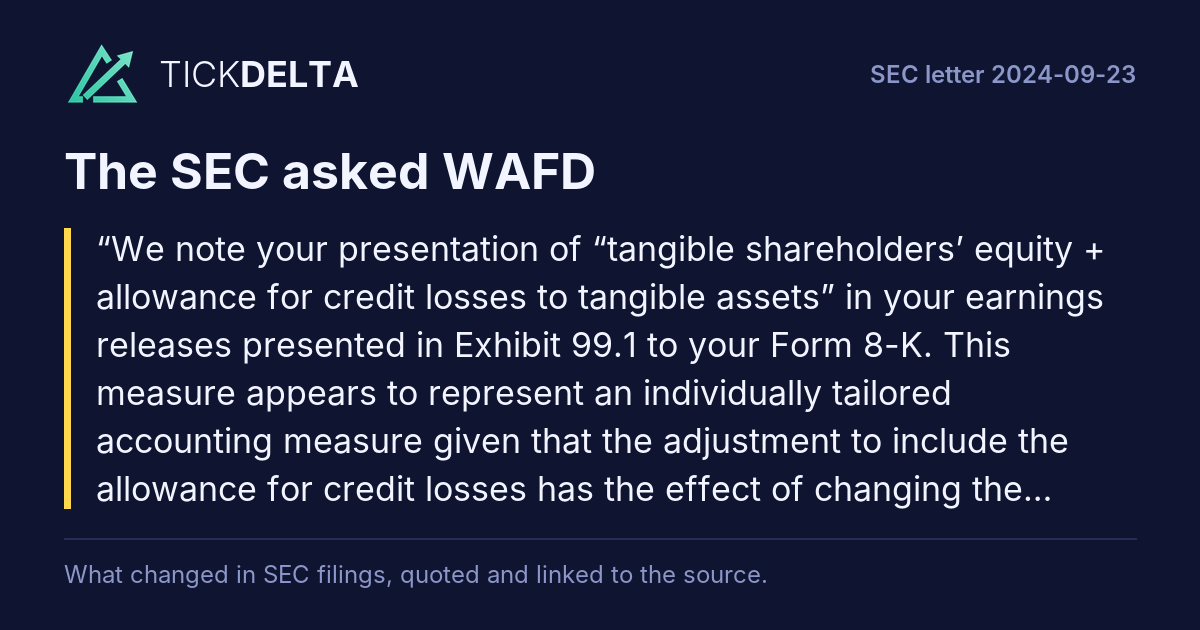
We note your presentation of “tangible shareholders’ equity + allowance for credit losses to tangible assets” in your earnings releases presented in Exhibit 99.1 to your Form 8-K. This measure appears to represent an individually tailored accounting measure given that the adjustment to include the allowance for credit losses has the effect of changing the recognition and measurement principles required to be applied
Rest of the question

in accordance with GAAP. Therefore, please remove the presentation of this non-GAAP measure from your future filings. Refer to Question 100.04 of the Division of Corporation Finance’s Compliance & Disclosure Interpretations on Non-GAAP Financial Measures and Rule 100(b) of Regulation G. Lending Activities, page 7 We note the tabular presentation of gross loans by category. Given the significance of the commercial real estate ("CRE") loan portfolio, please revise your disclosures in future 2. filings to further disaggregate the composition of your CRE loan portfolio by separately presenting the components of the portfolio by borrower type (e.g., by office, hotel, etc.). Revise your disclosure in future filings to clarify the extent that your CRE are owneroccupied and non-owner occupied. We also note that you separately present your loans receivable by geography in your annual report, but you do not present similar disclosure in your quarterly reports for the periods ended December 31, 2023, March 31, 2024, and June 30, 2024. In future filings, please revise your disclosure to presents your loans receivable by geography. Quantitative and Qualitative Disclosures About Market Risk Interest Rate Risk, page 56 3. We note your disclosure that the company manages interest rate risk within guidelines established by the Board. We also note your disclosure at page 27 that your risk management framework is comprised of various processes, systems and strategies, and is designed to manage the types of risk to which you are subject to, including credit, market, liquidity, interest rate and compliance. To provide additional context for these statements, in future filings, please describe your risk management policies and how the Board of Directors and / or the risk management committee oversee existing and emerging risks, such as interest rate risk, liquidity and compliance. Please also revise future filings to provide a materially complete description of how your corporate governance policies and procedures seek to manage risks due to changes in, for example, the economy or regulatory framework, as well as your operational facts and circumstances. We remind you that the company and its management are responsible for the accuracy and adequacy of their disclosures, notwithstanding any review, comments, action or absence of action by the staff.

WAFD answered
to the Staff’s comments, the Company will add further description of its risk management practices and the Board’s risk management oversight function to its future filings. The Company will also include additional explanation on how its corporate governance policies and procedures are designed to manage shifting risks. If you have any questions or comments regarding these responses or require any additional information, please do not hesitate to contact me at 360-756-6304. Very truly yours, /s/ Kelli J. Holz Kelli J. Holz cc: Brent Beardall Justin Monroe Blayne Sanden
Read in the reply
In its next report

First report after the company's reply of Oct 3, 2024: 10-K filed Nov 20, 2024 ↗, against the 10-K filed Nov 17, 2023 ↗.

Tickdelta does not hold the text of both reports, so they are not compared here.

Also in this review: closing letter, 2024-10-18
Form 10-K for the Fiscal Year Ended September 30, 2014

2015-05-05 to 2015-06-09 · 1 question · 1 letter from the SEC, 1 from the company
Review closed 2015-06-09
Executive pay
Annual Incentive Compensation, page 20 · Long-Term Incentives, page 20
SEC asked
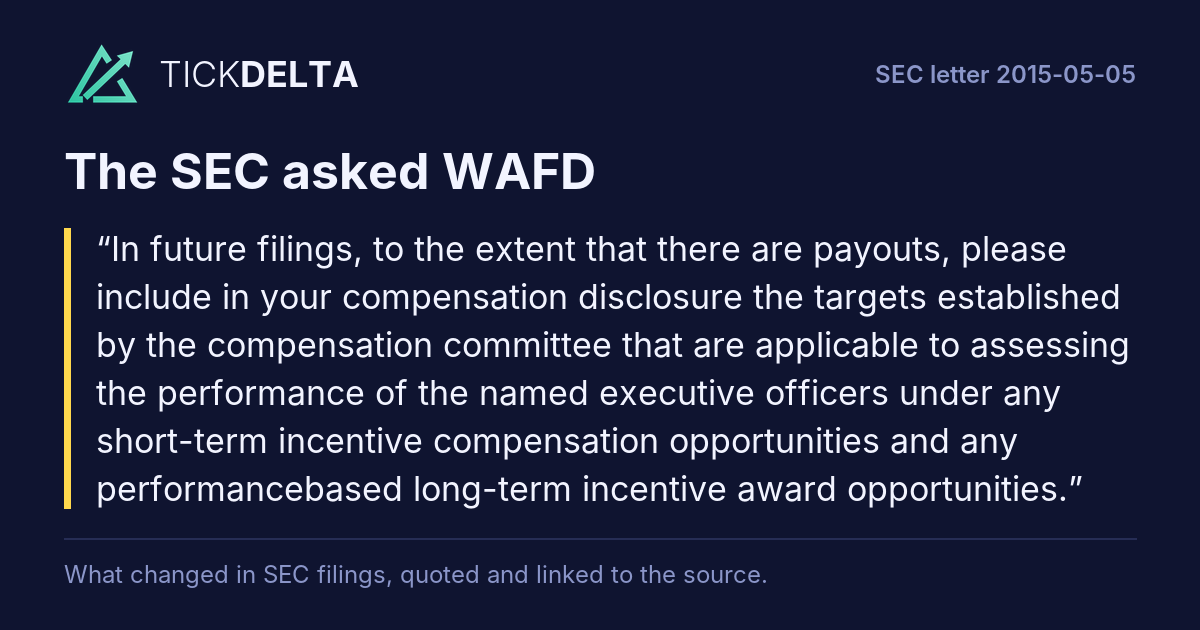
In future filings, to the extent that there are payouts, please include in your compensation disclosure the targets established by the compensation committee that are applicable to assessing the performance of the named executive officers under any short-term incentive compensation opportunities and any performancebased long-term incentive award opportunities.
WAFD answered
Washington Federal, Inc. (the “Company”) appreciates the opportunity to respond to your comment letter dated May 5, 2015, concerning the disclosure of incentive-based compensation targets for named executive officers in the Company’s Proxy Statement on Schedule 14A filed December 9, 2014.

In our future filings, to the extent there are payouts on short-term and long-term incentive compensation, the Company’s proxy will include the targets established by the Compensation Committee that were applicable to assessing the performance of its named executive officers.

Consistent with Commission
Rest of the answer

guidance, the Company reserves the right to assess each year if (i) the performance targets involve confidential trade secrets or confidential commercial or financial information and (ii) whether their disclosure would result in competitive harm to the Company.

The Company acknowledges its responsibility for the adequacy and accuracy of the disclosure in our filings, understands that staff comments or changes to disclosure in response to staff comments do not foreclose the Commission from taking any action with respect to a filing and may not assert staff comments as a defense in any proceeding initiated by the Commission or any person under federal securities laws of the United States.

Read in the reply
In its next report

First report after the company's reply of May 26, 2015: 10-Q filed Aug 7, 2015 ↗, against the 10-Q filed Feb 10, 2015 ↗.

Tickdelta does not hold the text of both reports, so they are not compared here.

Also in this review: closing letter, 2015-06-09

Form 10-K for the Fiscal Year Ended September 30, 2012

2013-03-26 to 2013-04-17 · 6 questions · 1 letter from the SEC, 1 from the company
Review closed 2013-04-17
Results discussion (MD&A)Reserves and insuranceDebtSegmentsGoodwill and impairment
Management’s Discussion and Analysis of Financial Condition and Results of Operations · Asset Quality and Allowance for Loan Losses, page 11
SEC asked (1)
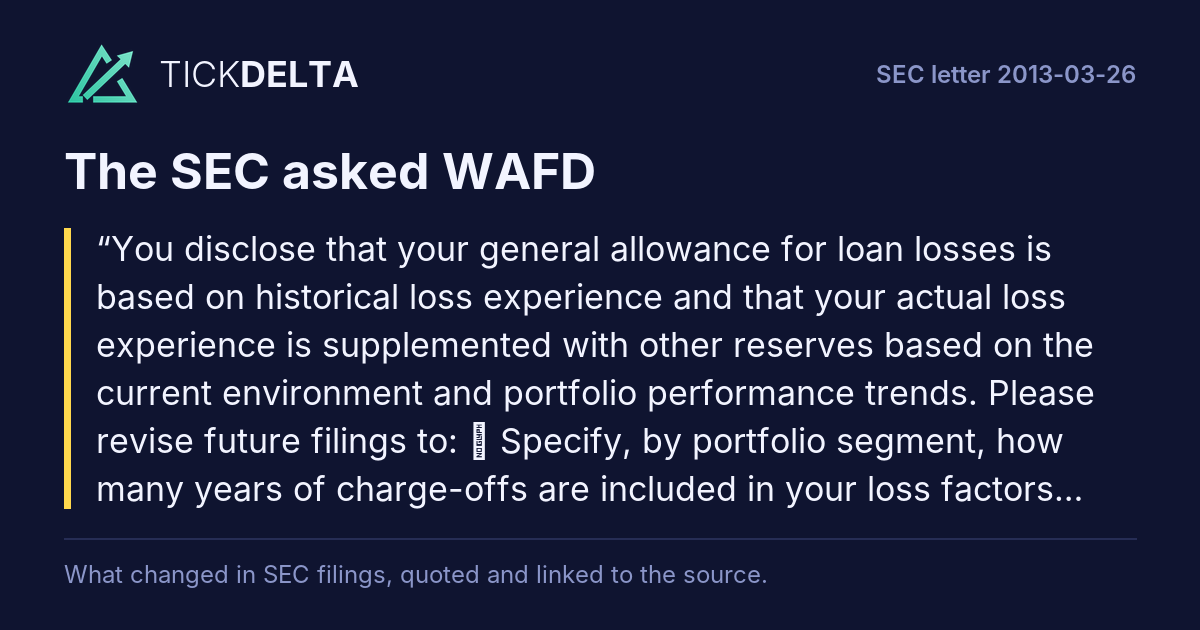
You disclose that your general allowance for loan losses is based on historical loss experience and that your actual loss experience is supplemented with other reserves based on the current environment and portfolio performance trends. Please revise future filings to:  Specify, by portfolio segment, how many years of charge-offs are included in your loss factors.
Rest of the question

Identify and discuss any changes made during the periods presented;  Present additional granularity regarding any adjustments made to historical losses including how each of the pertinent factors underlying the quality of the loan portfolio as listed in your disclosure are considered;  Discuss and quantify the adjustments made by class or portfolio segment for each period presented and discuss the specific facts and circumstances addressing why the adjustments were needed; and  Discuss the amount of the allowance for loan losses that is attributable to these pertinent factors as of each period end presented and provide a discussion of the facts and circumstances related to any trends in this amount.

WAFD answered
We will revise future filings to provide the additional information requested regarding the allowance for loan losses.
Read in the reply
In its next report

First report after the company's reply of Apr 8, 2013: 10-Q filed May 8, 2013 ↗, against the 10-Q filed Feb 5, 2013 ↗.

Tickdelta does not hold the text of both reports, so they are not compared here.

Management’s Discussion and Analysis of Financial Condition and Results of Operations · Asset Quality and Allowance for Loan Losses, page 11
SEC asked (2)
Please tell us why restructured single-family residential loans are reserved for under the Company’s general reserve methodology. We believe the guidance in ASC 310 indicates that a troubled debt restructuring (TDR) is always considered impaired and therefore impairment should be measured individually using the guidance in ASC 310-10-35 for all TDRs.
Rest of the question

Please tell us the amount of TDR’s not evaluated for impairment under ASC 31010-35 at September 30, 2012 and the impact on your financial statements if you measured impairment on these loans using the guidance in ASC 310-10-35.

WAFD answered
We agree that all TDR’s should be accounted for under ASC 310 as impaired loans and we follow this guidance. We evaluate the homogeneous mortgage loan TDR’s collectively for impairment as permitted in ASC 310-10-35-13(a), based on expected future cash flows using a formulaic methodology. This methodology incorporates, time from restructuring, delinquency, geography and loss given default. The non-homogeneous commercial loan TDR’s are evaluated individually.
Rest of the answer

We group the allowance for these homogeneous impaired loans as a separate sub category of the general allowance because they are evaluated collectively, similar to the other categories in the general allowance. All TDR’s are included in our impaired loan tables on page 48 of the Annual Report. Footnote (1) on this page goes on to describe that $25 million of the reserves on these impaired loans are included in the general reserve. Because we are measuring these loans in accordance with ASC 310-10-35 we do not believe that there is an impact to the financial statements.

Read in the reply
In its next report

First report after the company's reply of Apr 8, 2013: 10-Q filed May 8, 2013 ↗, against the 10-Q filed Feb 5, 2013 ↗.

Tickdelta does not hold the text of both reports, so they are not compared here.

Management’s Discussion and Analysis of Financial Condition and Results of Operations · Asset Quality and Allowance for Loan Losses, page 11
SEC asked (3)
We note your disclosure that homogeneous loans are restructured only if the borrower can demonstrate the ability to meet the restructured payment terms; therefore all are placed on accrual status upon the restructuring of the loan, even if they were on nonaccrual status prior to the restructuring.
Rest of the question

Please tell us and revise your future filings to disclose how these borrowers demonstrate to you their ability to meet the restructured payment terms.

WAFD answered
The disclosure we made that said “all” loans are placed on accrual status was outdated and will be updated in future filings. Prior to 2012 we had a system limitation causing this restriction. Starting in fiscal 2012, we have used the following methodology for determination of accrual status. Before granting approval to modify a loan as a TDR, we consider a borrower’s ability to repay by evaluating:

1)

Current income levels and debt to income ratio

2)

Borrower’s credit score

3)

Payment history of the loan at Washington Federal

4)

Updated valuation of the secondary repayment source

If
Rest of the answer

a loan is on non-accrual status before becoming a TDR it will stay on non-accrual status following restructuring until it has been performing for at least six months, at which point it may be moved to accrual status. If a loan is on accrual status before it becomes a TDR, and we conclude full repayment is highly probable based on our internal evaluation, it will remain on accrual status following restructuring. We will update our disclosure to state current practice and detail these criteria in future filings.

Nonperforming Assets, page 12.

Read in the reply
In its next report

First report after the company's reply of Apr 8, 2013: 10-Q filed May 8, 2013 ↗, against the 10-Q filed Feb 5, 2013 ↗.

Tickdelta does not hold the text of both reports, so they are not compared here.

Nonperforming Assets, page 12
SEC asked (4)
Please revise, in future filings, to provide the following credit quality coverage ratios and additional information:  Ratio of the allowance for loan losses to total loans;  Ratio of the allowance for loan losses to nonperforming loans addressing how nonperforming restructured loans were considered;  Clarify how restructured loans have been considered in the determination of the ratio of nonperforming assets to
Rest of the question

total assets; and  A rollforward of restructured loans activity in light of the continued increases. These disclosures should be supplemented with sufficient narrative discussion addressing the changes therein between periods presented.

WAFD answered
We will revise future filings to provide the credit quality coverage ratios and additional information requested, including narrative discussion addressing the changes between the periods presented.
Read in the reply
In its next report

First report after the company's reply of Apr 8, 2013: 10-Q filed May 8, 2013 ↗, against the 10-Q filed Feb 5, 2013 ↗.

Tickdelta does not hold the text of both reports, so they are not compared here.

Comparison of 2012 Results with 2011, page 16
SEC asked (5)
Regarding the discussion of the ratio of nonaccrual loans to total loans, please address, and clarify in future filings, as to whether these ratios include restructured loans.
WAFD answered
Restructured loans are included in the nonaccrual calculation if any of the following three criteria are met:

They were on nonaccrual before restructuring and have been performing for less than 6 months.

They are greater than 90 days past due on the restructured terms

Management has judgmentally placed the loan on nonaccrual

As of September 30, 2012, we had $433 million of restructured loans and 93% of those loans are performing as required by the modified terms or in some cases back to the original terms of the loans.
Rest of the answer

The 7% or $30 million that are not performing are included in the nonaccrual calculation cited on page 16 of the Annual Report.

We will revise future filings to clarify what loans are included as nonaccrual.

Read in the reply
In its next report

First report after the company's reply of Apr 8, 2013: 10-Q filed May 8, 2013 ↗, against the 10-Q filed Feb 5, 2013 ↗.

Tickdelta does not hold the text of both reports, so they are not compared here.

Notes to Consolidated Financial Statements · Note A- Summary of Significant Accounting Policies
SEC asked (6)
We note your disclosure on page 30 that the Company will consider modifying the interest rates and terms of a loan if it determines the modification is a better alternative to foreclosure. Please tell us and revise your future filings to provide your specific accounting policies for these modifications. Discuss, by modification type, how you determine whether such modifications are troubled debt restructurings.
Rest of the question

If you have modified any loans that you do not consider troubled debt restructurings, explain why. In addition, explain how you determine the allowance for loan losses for such modifications.

WAFD answered
The presumption on these loans is that the borrower is troubled since foreclosure is an option; therefore, the modification would be a TDR as defined in ASC 310-40-15. The loans we have modified and not classified as TDR’s are generally due to the exception noted in ASC310-40-15-12-C, a restructuring where the “creditor reduces the effective interest rates on the debt primarily to reflect a decrease in market interest rates”.
Rest of the answer

Loans that have been modified, but not classified as a TDR, are included in the general reserve allowance calculation similarly to other non-modified loans.

We will revise future filings to clarify what modifications are classified as restructurings.

We are pleased to provide any further detail you may request. I can be contacted by phone at 206-777-8331 or email at [email protected].

Read in the reply
In its next report

First report after the company's reply of Apr 8, 2013: 10-Q filed May 8, 2013 ↗, against the 10-Q filed Feb 5, 2013 ↗.

Tickdelta does not hold the text of both reports, so they are not compared here.

Also in this review: closing letter, 2013-04-17

Form 10-K for the Fiscal Year Ended September 30, 2011

2012-02-22 to 2012-03-26 · 4 questions · 2 letters from the SEC, 2 from the company
Review closed 2012-03-26
Executive payControls
Corporate Governance, page 13 · General
SEC asked (1)
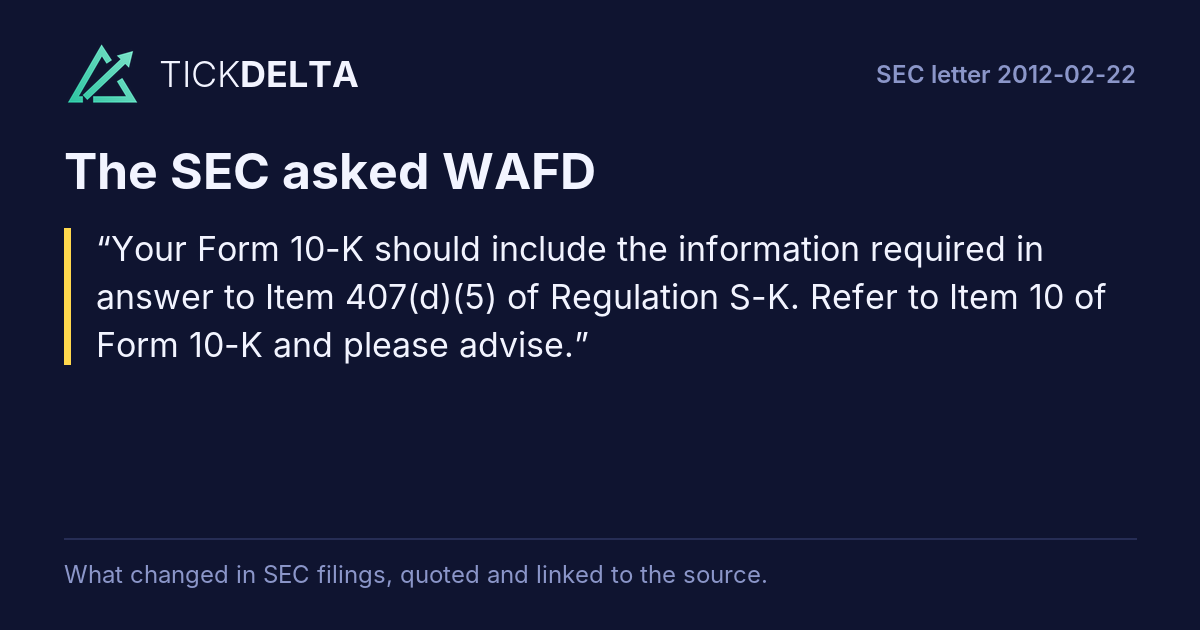
Your Form 10-K should include the information required in answer to Item 407(d)(5) of Regulation S-K. Refer to Item 10 of Form 10-K and please advise.
WAFD answered
The following sentence was unintentionally omitted from page 13 of the proxy:

The Board has determined that Chairman Clearman and Mr Kelley are “audit committee financial experts”, as defined by SEC regulation.

Washington Federal will ensure that this disclosure is included in all future proxy statements.

Executive Compensation, Compensation Discussion and Analysis,
Read in the reply
In its next report

First report after the company's reply of Feb 27, 2012: 10-Q filed May 8, 2012 ↗, against the 10-Q filed Feb 7, 2012 ↗.

Tickdelta does not hold the text of both reports, so they are not compared here.

Compensation Discussion and Analysis · Elements of Compensation, page 19
SEC asked (2)
Please expand your discussion to provide additional analysis of the effect of individual performance on compensation. We note that your disclosure suggests that it is considered by the Committee in determining base salary and annual incentive compensation. You should provide additional detail and an analysis of how individual performance contributed to actual compensation for the named executive officers.
Rest of the question

For example, disclose the elements of individual performance, both quantitative and qualitative, and specific contributions the Committee considered in its evaluation. See Item 402(b)(2)(vii) of Regulation S-K.

WAFD answered
Washington Federal will expand future Compensation Discussion and Analysis to include the following discussion (this will of course be updated based on actual performance determinations made by the Compensation Committee):

The Compensation Committee of the Board evaluates the individual performance of the named executives officers based primarily on the specific contributions of each NEO to the accomplishment of the following qualitative and quantitative objectives:

The Compensation Committee chose these objectives to ensure integration and alignment of individual performance with the
Rest of the answer

Company's performance. The Chief Executive Officer’s objectives are most closely linked to the Company’s objectives since the Chief Executive Officer bears overall responsibility for the Company’s success. Objectives for the other NEO’s differ based on each officer’s ability to contribute to the Company’s performance. For the NEO’s other than the Chief Executive Officer, the Compensation Committee relied upon the recommendations of the Chief Executive Officer based on his interactions with and assessment of performance of each of the other executives.

We are pleased to provide any further detail you may request. I can be contacted by phone at 206-777-8331 or email at [email protected].

Read in the reply
In its next report

First report after the company's reply of Feb 27, 2012: 10-Q filed May 8, 2012 ↗, against the 10-Q filed Feb 7, 2012 ↗.

Tickdelta does not hold the text of both reports, so they are not compared here.

Elements of Compensation, page 19 · General
SEC asked (1)
We understand from your response letter dated February 27, 2012 that decisions regarding compensation are derived from specific contributions of each NEO to certain objectives. Yet your response letter merely provides objectives (e.g., financial performance, client service and external relations) that serve as the basis for the implementation of your compensation program, without providing corresponding discussion
Rest of the question

of how the level of performance in each of these areas impacted actual compensation awarded in 2011. Please understand that discussion of the various items of individual performance that were considered by the Compensation Committee must be accompanied by a complete qualitative and quantitative discussion of how the Compensation Committee determined to award each specific form and level of compensation in 2011. For each named executive officer, state the factors that were considered in deriving the payouts awarded for each component of compensation and provide an analytical evaluation of why the Committee determined that the specific payout was appropriate in light of the factors considered.

WAFD answered
As disclosed in our 2011 Compensation Discussion and Analysis (“CD&A”), the Compensation Committee determined, with the assistance of its outside compensation consultant, that total compensation of Washington Federal’s NEOs generally was below competitive market levels. This is reflected in the table under the caption “Total Compensation” that shows the total compensation of the NEOs as a percentage of the median total compensation of the peer group.
Rest of the answer

It should be noted that these levels take into account the increases in

2011 total compensation and planned increases for 2012 total compensation. As a result of this data and based on the analysis described in the CD&A, the Compensation Committee approved changes to 2011 base salaries to more closely align executive compensation practices with competitive practice and to be consistent with attracting and retaining top performing executive officers. In addition, the Compensation Committee approved changes to annual incentive compensation and long-term incentives that went into effect for fiscal year 2012, as disclosed in the CD&A.

The objectives described in our prior letter are most relevant to base salary determinations. However, the Compensation Committee did not specifically discuss or weigh particular objectives or individual contributions to those objectives as a part of its base salary deliberations. The objectives referred to in our CD&A and highlighted in our prior letter reflect those aspects of Washington Federal’s business over which the particular NEO may have the most direct influence and thus they are representative of the types of objectives that the Compensation Committee could take into account. We did not intend to suggest that Washington Federal’s compensation policies employ a formulaic approach or define specific metrics for evaluating or adjusting individual NEO compensation. In 2011, the Compensation Committee did not undertake an analytical evaluation of why it determined that a specific base salary adjustment was appropriate in light of particular factors considered. Instead, job performance was subjectively assessed, as part of the available mix of information, by the Compensation Committee, in the case of the CEO, and by the CEO, for the other NEOs, taking into account the broad objectives set forth in our prior response letter.

We acknowledge the Staff’s comment. If and to the extent the Compensation Committee determines that specific items of individual performance contribute to the level of that NEO’s compensation, positively or negatively, Washington Federal will describe those items in the CD&A. In addition, if performed by the Compensation Committee, Washington Federal will provide an analytical evaluation of why the Committee determined that the specific payout was appropriate in light of the factors involved.

Read in the reply
Item 4. Controls and Procedures, page 37
SEC asked (2)
You state that there have been no significant changes in the company’s internal controls or in other factors that have materially affected, or are reasonably likely to materially affect, the company’s internal control over financial reporting.
Rest of the question

Please be advised that Item 308(c) of Regulation S-K requires that you disclose any change in your internal control over financial reporting that occurred during the relevant quarter that has materially affected, or is reasonably likely to materially affect, your internal control over financial reporting. Please confirm that there were no such changes in your internal control over financial reporting during the quarter ended December 31, 2011. In addition, please provide us with a representation that you will conform your disclosures in future filings to comply with Item 308(c) of Regulation S-K. Please address all questions to Michael F. Johnson, Staff Attorney, at (202) 551-3477 or, if you thereafter need further assistance, to me at (202) 551-3434.

WAFD answered
We confirm that there were no changes to controls over financial reporting that occurred during the relevant quarter that has materially affected, or is reasonably likely to materially affect, internal control over financial reporting. Additionally, we will make this change going forward on item 4.

We are pleased to provide any further detail you may request. I can be contacted by phone at 206-777-8331 or email at [email protected].
Read in the reply
In its next report

First report after the company's reply of Mar 16, 2012: 10-Q filed May 8, 2012 ↗, against the 10-Q filed Feb 7, 2012 ↗.

Tickdelta does not hold the text of both reports, so they are not compared here.

Also in this review: closing letter, 2012-03-26

Letters without questions

Other letters

UPLOAD and CORRESP
2 other letters: notices that a filing will not be reviewed, requests to declare a registration effective, and the like
  • Mar 27, 2023 · WAFD: letter to the SEC · Washington Federal, Inc. · Acceleration Request · Registration Statement on Form S-4 ·...
  • Mar 13, 2023 · SEC: will not review the filing · Washington Federal, Inc. · Registration Statement on Form S-4 · Filed March 1, 2023 ·...

From the SEC's correspondence on EDGAR: staff letters (form UPLOAD) and company letters (form CORRESP), 16 letters filed since 2012-02-22. Questions and answers are matched by their numbers; topics come from words in each question. The reports are compared word for word (same form, before the first SEC letter against the first report after the company's reply). No AI.

Sources

The SEC's correspondence on EDGAR: staff letters (form UPLOAD) and company letters (form CORRESP), matched question by question. No AI.

Also

Filings: the letters in the filing list.

Work with it

Excel workbook · CSV. Google Sheet that stays up to date: paste =IMPORTDATA("https://tickdelta.com/company/WAFD/export.csv") into a cell.

Next in Owners and insiders:Insider trades
Esc

Type a ticker such as AAPL, a name, an investor such as Buffett, or a topic such as tariffs. ↑ ↓ to move, Enter to open.