19 paragraphs in Risk Factors of the 10-K filed Aug 14, 2026
with nothing like them in the 10-K filed Aug 14, 2025. Quoted exactly.
Paragraphs that were only edited are under 10-K change.
Compared with the Risk Factors in the latest 10-K of the other 74 Technology companies:
a paragraph with at least half its words the same at another company is called similar, and the companies are listed under it.
A paragraph most of them have is marked boilerplate. No line means no other company has one like it.
This counts text; it does not say how serious a risk is.
Additionally, new technologies could impact demand for our products in unforeseen or unexpected ways. For example, if a shift away from Cloud and toward on-premises hardware diminishes the need for large-scale data center infrastructure, demand
Read in the 10-K ↗
Long-term agreements expose us to certain execution, financial, and market risks, which could be significant.
Similar paragraph at 1 of 74 other Technology companies:
SNDKWe have entered into long-term agreements with certain customers that commit us to deliver and our customers to purchase substantial volumes of products over multi-quarter or multi-year periods. These agreements also generally commit us to sell agreed volumes to these customers at predetermined or formula-based prices for the duration of the contract terms. As a result, we may be obligated to continue selling products to these customers even when demand from other customers, prevailing market prices, or other sales opportunities would be more favorable to us, and we may be unable to take full advantage of periods of rising prices, increased demand, or supply shortages. If market prices for our products increase above the prices set under these agreements, or if higher-margin or otherwise more attractive alternatives become available, our commitments under these agreements could prevent us from realizing the benefit of those conditions, which could result in significant opportunity costs and could have a material adverse effect on our results of operations and financial condition.
Our ability to fulfill our obligations under these agreements depends on a number of factors, including our manufacturing capacity, production yields, supply chain performance, and the availability of raw materials and other critical inputs. There can be no assurance that we will be able to perform these contractual obligations throughout the contract terms without disruption or shortfall. If we are unable to deliver products in the quantities, at the times, or meeting the specifications required under these agreements, we may be subject to pricing or volume reductions, contractual damages, other financial losses, or early termination. Any failure to perform could harm our customer relationships, damage our reputation, and have a material adverse effect on our results of operations and financial condition.
Similar paragraph at 1 of 74 other Technology companies:
SNDKIf a customer were to breach its purchase obligations, including by failing to meet its purchase commitments, or if a customer were to terminate the agreement due to our material breach of supply commitments, we may need to find alternative customers for any affected product volumes. Depending on market conditions at the time, we may be unable to resell those products at comparable prices, or at all, which could result in reduced revenue, lower margins, excess inventory, or manufacturing underutilization or asset impairment charges, and could have a material adverse effect on our business, results of operations, and financial condition.
Similar paragraph at 2 of 74 other Technology companies:
MU,
SNDKEach agreement provides for certain remedies designed to protect us if the customer fails to perform its purchase obligations. In such event, these contractual remedies are expected to offset at least some portion of revenue that may be lost due to the customer’s failure to perform, but they may not fully offset such lost revenue depending on the reason for such nonperformance, our ability to recover in any action and other factors. Any enforcement of these contractual remedies by us could be costly and time-consuming and could adversely affect our customer relationships. If we are unable or unsuccessful in enforcing or if we choose not to enforce any contractual remedy in the event of a customer’s failure to perform its purchase obligations, we may experience consequences that could have a material adverse effect on our business and results of operations.
Similar paragraph at 1 of 74 other Technology companies:
SNDK
In addition, armed conflicts and heightened geopolitical tensions can result in sanctions, export controls, tariffs and other trade restrictions, limit or restrict our ability to access certain markets and disrupt critical logistics networks, including air and ocean freight routes. For example, the escalation of the conflict involving Iran and heightened tensions in the Middle East could cause disruption to critical logistics and supply routes, which could affect the availability and cost of materials used in our business. Additionally, China has imposed export restrictions on rare earth minerals and related materials critical to semiconductor and hard drive manufacturing. These developments have increased, and could further increase, costs for, or limit the availability of, energy, rare earth minerals, materials, components and transportation, constrain manufacturing capacity and may require us to redesign products or reconfigure aspects of our global supply chain. Geopolitical instability may also elevate cybersecurity risks, including state-sponsored attacks, which could disrupt our operations or those of our suppliers, customers or partners, and further adversely affect demand for our products.
Similar paragraph at 1 of 74 other Technology companies:
STX
requirements (including encryption and other technology), trade wars, tariffs and complex customs regulations; difficulties in managing international operations, including appropriate internal controls; and fluctuations in financial markets and interruptions to supply chains from public health crises.
Read in the 10-K ↗
We may be adversely affected by the risks, challenges, and evolving regulatory landscape associated with the use of AI in our operations, product development, and business practices.
Similar paragraph at 4 of 74 other Technology companies:
CIEN,
COHR,
MU,
SNDKWe are increasingly leveraging AI technologies, including generative AI applications and tools, to support and enhance our various operational processes. While AI may promote efficiency and offer analytical advantages, it is complex and rapidly-changing, and its implementation carries inherent risks. Implementation of AI technologies can be costly and time-consuming, and the effectiveness or potential benefits of such technologies may vary depending on use case, integration, and oversight. The incorporation of AI algorithms or training methodologies into our operations or decision-making processes may result in flawed, irrelevant, insufficient, inaccurate, biased or non-compliant outputs, potentially impacting our strategic choices, operational effectiveness, and regulatory compliance. These inaccuracies can arise from limitations in training data, algorithmic design, or unintended consequences of machine learning models. Actual or perceived deficiencies, failures or misuse in our implementation or use of AI could result in competitive disadvantages, operational inefficiencies, regulatory action, legal liability, brand or reputational harm, and negative financial results.
Similar paragraph at 1 of 74 other Technology companies:
SNDKIn addition, the use of AI in the development of our products could potentially lead to ambiguities in intellectual property ownership, infringement or misappropriation risks, which could impact our competitive position and expose us to litigation, monetary penalties, or operational disruptions. The unauthorized or unapproved use of generative AI tools by our employees, contractors, or other third parties, as well as overreliance on AI automation or agentic AI without appropriate human oversight, may lead to the inadvertent disclosure of confidential, proprietary, or personal information, flawed or unauthorized actions, or other adverse consequences, including disruptions to business operations, exposing us to data security, privacy, legal, regulatory, and reputational risks.
Similar paragraph at 1 of 74 other Technology companies:
SNDKMisuse of such tools can also result in violations of applicable laws and regulations, including data protection and intellectual property laws. Governments worldwide are adopting or proposing AI-specific regulations, including the European Union’s Artificial Intelligence Act, as well as various proposed frameworks in the U.S., China, and other jurisdictions. These regulations may impose requirements on the development, deployment, and use of AI systems in our products or operations, require jurisdiction-specific product configurations, increase compliance costs, or limit our ability to leverage AI technologies. The evolving and potentially divergent nature of these regulations creates uncertainty and could adversely affect our business. Public and governmental perceptions regarding the use and impact of AI may evolve over time and could give rise to new regulatory requirements, legal liability, or reputational harm. If we enable or offer products that support AI solutions that draw
controversy due to their perceived or actual impact on society, including concerns relating to human rights, privacy, employment, or other social, economic, or political issues, we may experience reputational harm, competitive harm, or legal liability, even if we do not directly control the end-use applications.
Further, the rapid growth of AI infrastructure, including data centers that use our products, requires substantial energy consumption. Environmental concerns about the energy demands of AI workloads, including actual or perceived environmental issues associated with data center power consumption, could lead to regulatory constraints on data center development, increased sustainability reporting obligations, or shifts in customer or public sentiment regarding AI infrastructure expansion. Any of these developments could adversely affect demand for our products or increase our customers’ costs of deploying storage solutions in AI environments, which could have a material adverse effect on our business.
Read in the 10-K ↗
technologies. These may include highly convincing phishing or social engineering attacks that use AI-generated deepfakes, the exploitation of vulnerabilities in electronic identity validation security programs via AI-replicated images or voices, or the inadvertent incorporation of malicious or hallucinated content generated by AI tools into our systems or those of our customers or partners. Separately, the AI technologies that we employ for business purposes may be vulnerable to prompt-injection or other adversarial attacks, which could result in unauthorized access to or leakage of sensitive information. Geopolitical tensions or conflicts may also create heightened risk of cybersecurity incidents.
Read in the 10-K ↗
We also utilize convertible debt in our capital structure. Our 3.00% convertible senior notes due 2028 (the “2028 Convertible Notes”) are currently convertible as a result of the sale price conditional feature being triggered, and as a result, the holders of the 2028 Convertible Notes have the right to convert the notes during the next succeeding calendar quarter. As such, these convertible notes were classified as current debt as of July 3, 2026. When holders of our convertible debt exercise conversion rights, we are required to settle the principal amount of the converted notes in cash and may pay or deliver, as the case may be, cash, shares of our common stock or a combination thereof, at our election, in respect of the remainder, if any, of our conversion obligation in excess of the principal amount. The satisfaction of our conversion obligations, therefore, could reduce available cash, result in the incurrence of additional borrowings, and/or result in the issuance of a significant number of shares of our common stock, which issuance could dilute our existing stockholders, reduce the value of our common stock, or both.
Read in the 10-K ↗
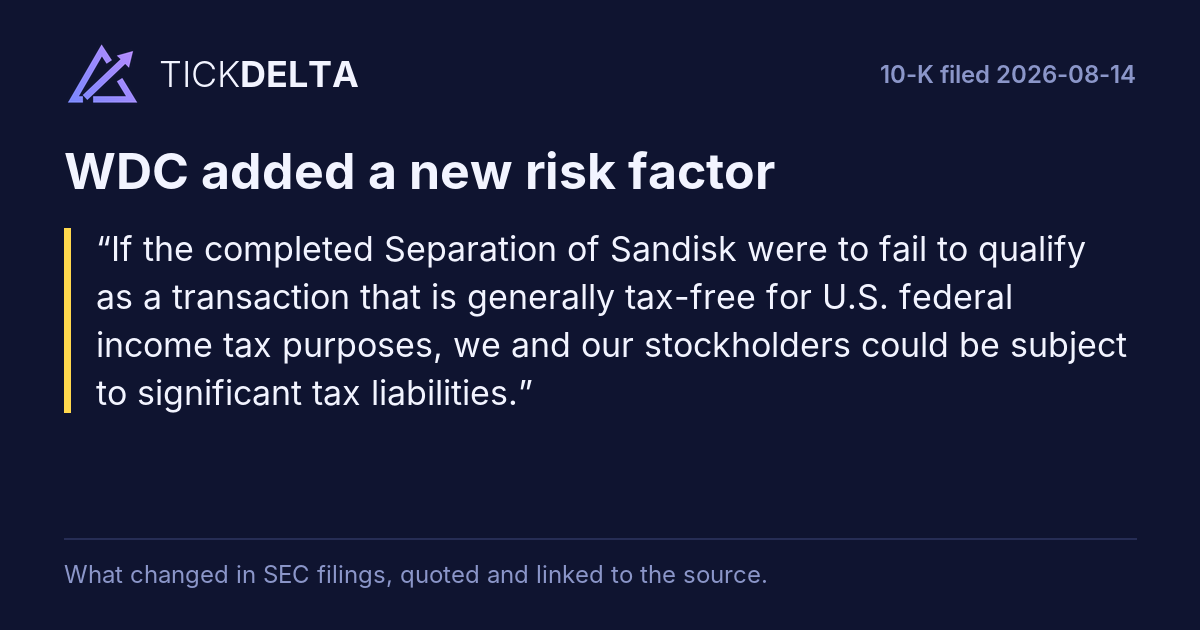
If the completed Separation of Sandisk were to fail to qualify as a transaction that is generally tax-free for U.S. federal income tax purposes, we and our stockholders could be subject to significant tax liabilities.
Similar paragraph at 2 of 74 other Technology companies:
Q,
SNDK
2 more
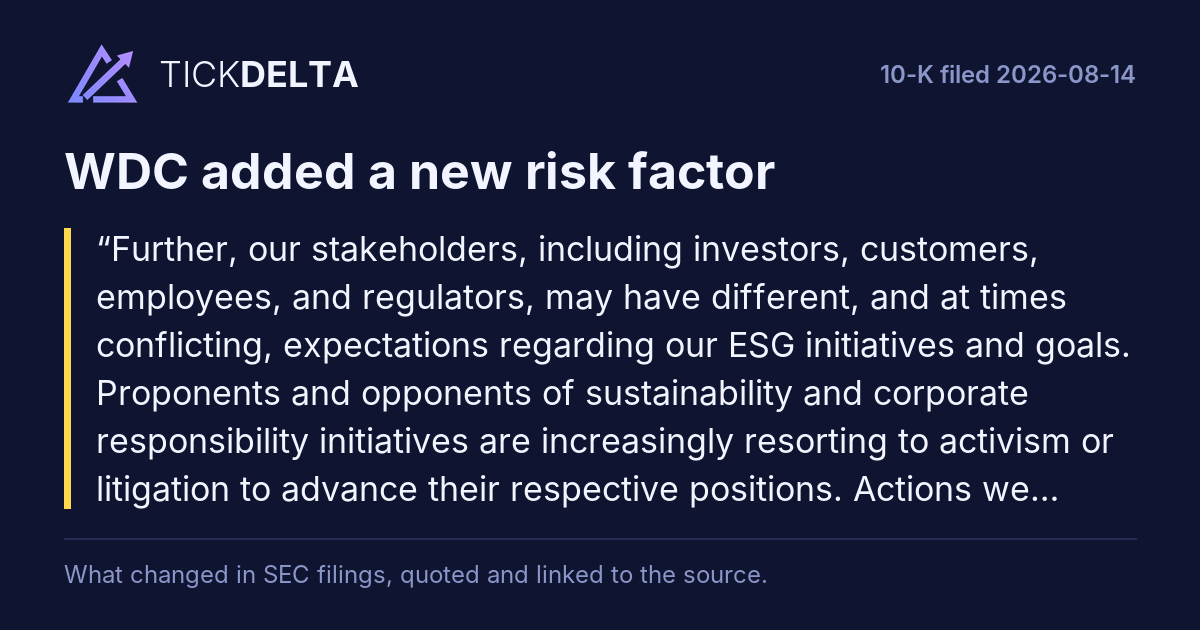
Further, our stakeholders, including investors, customers, employees, and regulators, may have different, and at times conflicting, expectations regarding our ESG initiatives and goals. Proponents and opponents of sustainability and corporate responsibility initiatives are increasingly resorting to activism or litigation to advance their respective positions. Actions we take in response to one set of stakeholder expectations may be viewed unfavorably by others, which could expose us to reputational harm, loss of business or litigation regardless of the approach we adopt.
Read in the 10-K ↗
U.S. will, to the fullest extent permitted by law, be the exclusive forum for resolving any complaint asserting a cause of action under the Securities Act of 1933, as amended (the “Federal Forum Provision”).
Read in the 10-K ↗
New in the latest 10-Q
29 paragraphs in the 10-Q filed Oct 23, 2026 with nothing like
them in the 10-Q filed May 1, 2026 (at least half the words must differ; new numbers alone do not count).
Quoted exactly, grouped by the item heading above them. This is text that changed, not a judgement of how serious it is.
10-Q
• adverse global or regional conditions, including new or additional tariffs or trade restrictions, inflation, increases in interest rates and an economic recession;
Read in the 10-Q ↗
• any decisions to reduce or discontinue paying cash dividends or repurchasing shares of our common stock;
Read in the 10-Q ↗
Financial statements and notes
2026 2025 Net income $ 1,779 $ 1,182 Other comprehensive income (loss), before tax: Actuarial pension loss (1) — Net unrealized gain (loss) on derivative contracts 3 (7) Total other comprehensive income (loss), before tax 2 (7) Income tax benefit (expense) related to items of other comprehensive income (loss), before tax (1) 1 Other comprehensive income (loss), net of tax 1 (6) Total comprehensive income $ 1,780 $ 1,176
Read in the 10-Q ↗
Beginning in the three months ended October 2, 2026, the Company updated its methodology for identifying customers for purposes of revenue concentration disclosure. Under the updated methodology, concentrations are attributed to the ultimate end customer when products are purchased on its behalf by distributors, contract manufacturers, or other resellers (collectively referred to as “intermediary purchasers”), rather than being attributed to such intermediary purchasers. The Company believes this presentation provides investors with a more meaningful reflection of the Company’s economic relationship with its customers. Prior year concentrations have been revised to conform to the current year presentation.
Read in the 10-Q ↗
2026 2025 Warranty accrual, beginning of period $ 207 $ 152 Charges to operations 37 27 Utilization (26) (24) Changes in estimate related to pre-existing warranties 23 5 Warranty accrual, end of period $ 241 $ 160
Read in the 10-Q ↗
2026 2026 Revolving Credit Facility maturing January 2027 $ 650 $ 350 3.00% convertible notes 141 710 Total principal 791 1,060 Issuance costs (2) (8) Debt, current $ 789 $ 1,052
Read in the 10-Q ↗
During the three months ended October 3, 2025, the Company made scheduled principal repayments of $ 31 million under its then outstanding term loan A-3, which was later settled in full in February 2026.
Read in the 10-Q ↗
During the three months ended October 2, 2026, the Company entered into privately negotiated exchange agreements with certain holders of the Convertible Notes, in an aggregate principal amount of $ 191 million, pursuant to which the Company fully settled the obligation for an aggregate $ 193 million in cash (which reflected the principal amount and a small inducement cost) and 4.7 million shares of the Company’s common stock for the conversion premium of $ 2.16 billion. In connection with these exchange transactions, $ 2 million of remaining unamortized issuance costs associated with these notes was charged to Additional paid-in capital. The Company accounted for these exchange transactions as induced conversion transactions and recognized an immaterial induced conversion expense in Other expense, net in the Condensed Consolidated Statements of Income. There were no settlements or modifications made to the related capped call transactions in connection with the exchange agreements (see “Capped Calls” below).
Read in the 10-Q ↗
During the three months ended October 2, 2026, the Company also settled the conversion obligation on $ 378 million in aggregate principal amount of Convertible Notes that had been tendered by holders pursuant to the Indenture. The aggregate principal amount of these notes was settled in cash with substantially all of the conversion premium of $ 5.09 billion settled for 9.3 million shares of the Company’s common stock. In connection with these conversions, $ 4 million of remaining unamortized issuance costs associated with these notes was charged to Additional paid-in capital.
Read in the 10-Q ↗
On September 14, 2026, the Company issued a notice of redemption to redeem at par plus unpaid and accrued interest, on November 16, 2026 (the “Redemption Date”), all then-outstanding Convertible Notes that have not been converted prior to the Redemption Date. The Company currently expects that holders of substantially all Convertible Notes will convert such Convertible Notes before the Redemption Date.
Read in the 10-Q ↗
2026 2025 Cost of operating leases $ 10 $ 9 Cash paid for operating leases 12 10 Operating lease assets obtained in exchange for operating lease liabilities 2 —
Read in the 10-Q ↗
2026 2025 ($ in millions) Income before taxes $ 2,038 $ 1,337 Income tax expense 259 155 Effective tax rate 13% 12%
Read in the 10-Q ↗
In January 2026, the Organisation for Economic Co-operation and Development (“OECD”) released a side-by-side package that modifies key elements of the Pillar Two GMT by introducing new safe harbors and providing an exemption for U.S. based multinational companies from parts of the GMT. While these safe harbors and exemptions are generally favorable to the Company, they require local legislative action by each country before they can be considered enacted for financial accounting purposes. The Company evaluated the potential effects of these rules based on current local legislative developments in jurisdictions where the Company operates and expects the financial statement impact associated with their enactment to be immaterial. For 2027, the Company’s effective tax rate considers GMT in Malaysia and Thailand.
Read in the 10-Q ↗
In connection with Internal Revenue Service (“IRS”) settlements for the years 2008 through 2015, the Company expects to realize reductions to its mandatory deemed repatriation tax obligations aggregating to approximately $ 101 million. These tax receivables are classified in Other current assets on the Condensed Consolidated Balance Sheets as of October 2, 2026.
Read in the 10-Q ↗
2026 2025 Cash-based employee termination benefits $ 27 $3 Stock-based employee termination benefits 16 — Total business realignment charges $ 43 $3
Read in the 10-Q ↗
During the three months ended October 2, 2026, the Company issued shares of common stock in connection with settlements of Convertible Notes and vestings under employee stock plans, utilizing all of its then available treasury stock balance. These transactions resulted in charges to Additional paid-in capital. To the extent such charges exceeded the available Additional paid-in capital balance, the excess of $ 2.45 billion was reflected as a reduction of Retained earnings. Subsequent to Additional paid-in capital being initially exhausted, activity related to stock-based compensation expense recognized and capped call settlements resulted in an Additional paid-in capital balance of $ 66 million as of October 2, 2026.
Read in the 10-Q ↗
Beginning in the three months ended October 2, 2026, we updated our methodology for identifying customers for purposes of revenue concentration disclosure. Under the updated methodology, concentrations are attributed to the ultimate end customer when products are purchased on its behalf by distributors, contract manufacturers, or other resellers (collectively referred to as “intermediary purchasers”), rather than being attributed to such intermediary purchasers. We believe this presentation provides investors with a more meaningful reflection of the economic relationship with our customers. Prior year concentrations have been revised to conform to the current year presentation.
Read in the 10-Q ↗
2026 2025 ($ in millions) Income before taxes $ 2,038 $ 1,337 Income tax expense 259 155 Effective tax rate 13% 12%
Read in the 10-Q ↗
Beginning in 2027, we became subject to CAMT of 15% on corporations as our average annual AFSI exceeded $1.0 billion for the preceding three-year period. We anticipate that our CAMT liability will exceed our regular tax liability due to tax deductions in excess tax of book deductions attributable to stock-based compensation during the year. We anticipate that any CAMT paid in 2027 will generate credit carryforwards that can be carried forward indefinitely to offset future regular tax liabilities in cases where they exceed CAMT liabilities. Because we expect regular tax liabilities to exceed CAMT liabilities in future periods, no valuation allowance is required against these credit carryforwards. As a result, the CAMT liability did not impact the effective tax rate for the three months ended October 2, 2026.
Read in the 10-Q ↗
In January 2026, the OECD released a side-by-side package that modifies key elements of the Pillar Two GMT by introducing new safe harbors and providing an exemption for U.S. based multinational companies from parts of the GMT. While these safe harbors and exemptions are generally favorable to us, they require local legislative action by each country before they can be considered enacted for financial accounting purposes. We evaluated the potential effects of these rules based on current local legislative developments in jurisdictions where we operate and expect the financial statement impact associated with their enactment to be immaterial. For 2027, our effective tax rate considers GMT in Malaysia and Thailand.
Read in the 10-Q ↗
We expect capital expenditures to average 4% to 6% of revenue over the next five years; however, we anticipate capital expenditures as a percentage of revenue will be modestly above that range over the next two years as we invest in heads and media technology and factory automation.
Read in the 10-Q ↗
On September 14, 2026, we issued a notice of redemption to redeem at par plus unpaid and accrued interest, on November 16, 2026 (the “Redemption Date”), all then-outstanding Convertible Notes that have not been converted prior to the Redemption Date. We currently expect that holders of substantially all Convertible Notes will convert such Convertible Notes before the Redemption Date.
Read in the 10-Q ↗
In addition, as of October 2, 2026, we had $650 million outstanding on our Revolving Credit Facility maturing in January 2027 and had $600 million remaining available borrowing capacity under this facility, subject to customary conditions under the loan agreement. We believe our existing cash and cash expected to be generated from our business will be adequate to meet our debt repayment requirements.
Read in the 10-Q ↗
In connection with IRS settlements for the years 2008 through 2015, we expect to realize reductions to our mandatory deemed repatriation tax obligations aggregating to approximately $101 million. These tax receivables are classified in Other current assets on the Condensed Consolidated Balance Sheets as of October 2, 2026.
Read in the 10-Q ↗
In May 2026, the Financial Accounting Standards Board (“FASB”) issued accounting standards update (“ASU”) No. 2026-02, “Environmental Credits and Environmental Credit Obligations (Topic 818),” which introduces specific accounting models for entities that generate, purchase, or hold environmental credits, or have an enforceable regulatory compliance obligation that may be settled with such credits. Under the new guidance, environmental credits intended for compliance are recorded at cost, while certain non-compliance credits are tested for impairment or can be subject to a fair value accounting policy election. Additionally, the standard requires gross financial statement presentation, prohibiting the netting of environmental credit assets against related compliance obligations. This standard is effective for the year beginning July 1, 2028, and interim periods within that year, with early adoption permitted. Adoption will be applied on a retrospective basis through a cumulative-effect adjustment to the opening balance of retained earnings. We are currently assessing the impact of this standard on our consolidated financial statements and related disclosures.
Read in the 10-Q ↗
Market risk
We have historically held a balance of fixed and variable rate debt. As of October 2, 2026, our variable rate debt outstanding consisted of borrowings under our Revolving Credit Facility, which are based on index rates as discussed further in Note 5, Debt, of the Notes to Condensed Consolidated Financial Statements included in this Quarterly Report on Form 10-Q. As of October 2, 2026, the outstanding balance on our Revolving Credit Facility was $650 million, and a 1% increase in the variable rate of interest would increase annual interest expense by $7 million.
Read in the 10-Q ↗
Share sales and buybacks
(3) Amount includes an aggregate of 176,008 shares of our common stock that we received during the month ended October 2, 2026 upon the settlement of $378 million notional amount of Capped Calls in connection with the settlement of the same principal amount of Convertible Notes that had been tendered by the holders. This transaction is not part of our publicly announced Share Repurchase Program and the shares received from the settlement of these Capped Calls are not reflected in the column captioned “Average Price Paid per Share.”
Read in the 10-Q ↗
Other information
• On August 7, 2026, Brian Scott Davis, Executive Vice President and Chief Sales and Marketing Officer of the Company, terminated his previously reported Rule 10b5-1 Plans adopted on November 3, 2025 and June 5, 2026. The November 3, 2025 plan was scheduled to expire on August 14, 2026, and the June 5, 2026 plan was scheduled to commence on November 9, 2026.
Read in the 10-Q ↗
Item 6
** Management contract or compensatory plan or arrangement required to be filed as an exhibit pursuant to applicable rules of the Securities and Exchange Commission.
Read in the 10-Q ↗
The 10-Q's risk factors against the 10-K
Item 1A of the 10-Q filed Oct 23, 2026 against Item 1A of the 10-K filed Aug 14, 2026.
A 10-Q repeats only the risks that changed, so a 10-K paragraph that is missing from it is not counted as removed.
Added is a paragraph with nothing like it in the 10-K, Reworded a sentence that is in both with several words changed,
Quiet changes a sentence in both where one to four words changed and one is a hedge or a modal
(cut words struck through, new words highlighted and underlined).
Text on the page, not a score; each links to the filing at sec.gov.
Reworded10-Q 2026-10-23 vs 10-K 2026-08-14
Additional risks and uncertainties not presently known to us or that we currently deem immaterial may also negatively adversely affect our business. business, financial condition, results of operations or the market price of our common stock.
Read it in the 10-Q at sec.gov ↗ · The 10-K sentence ↗