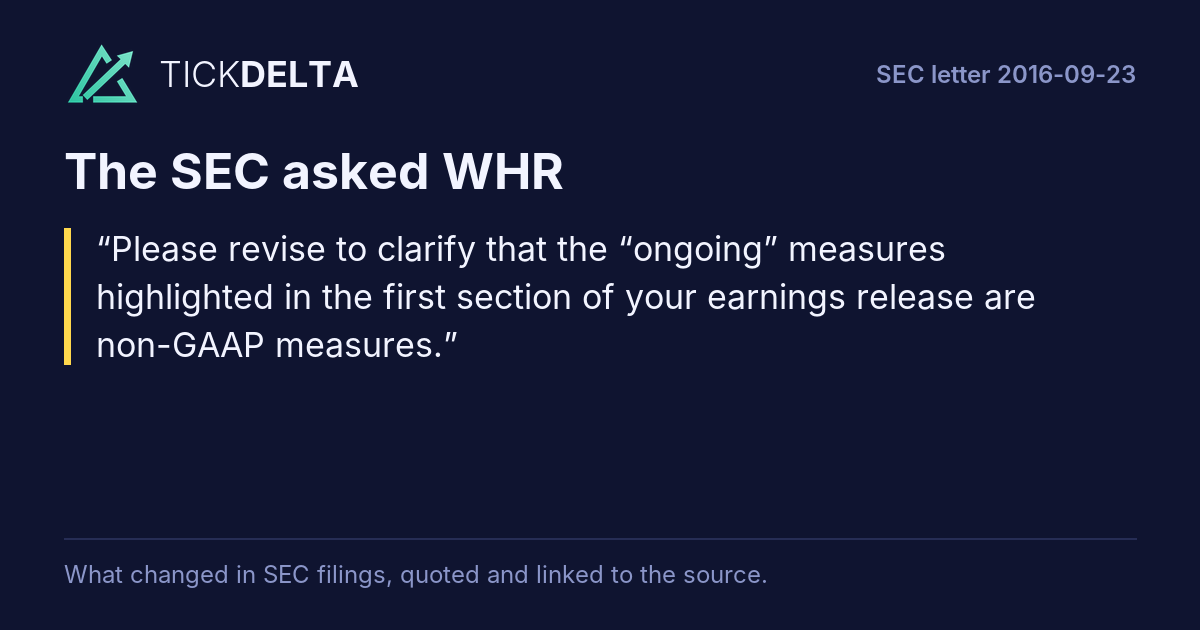
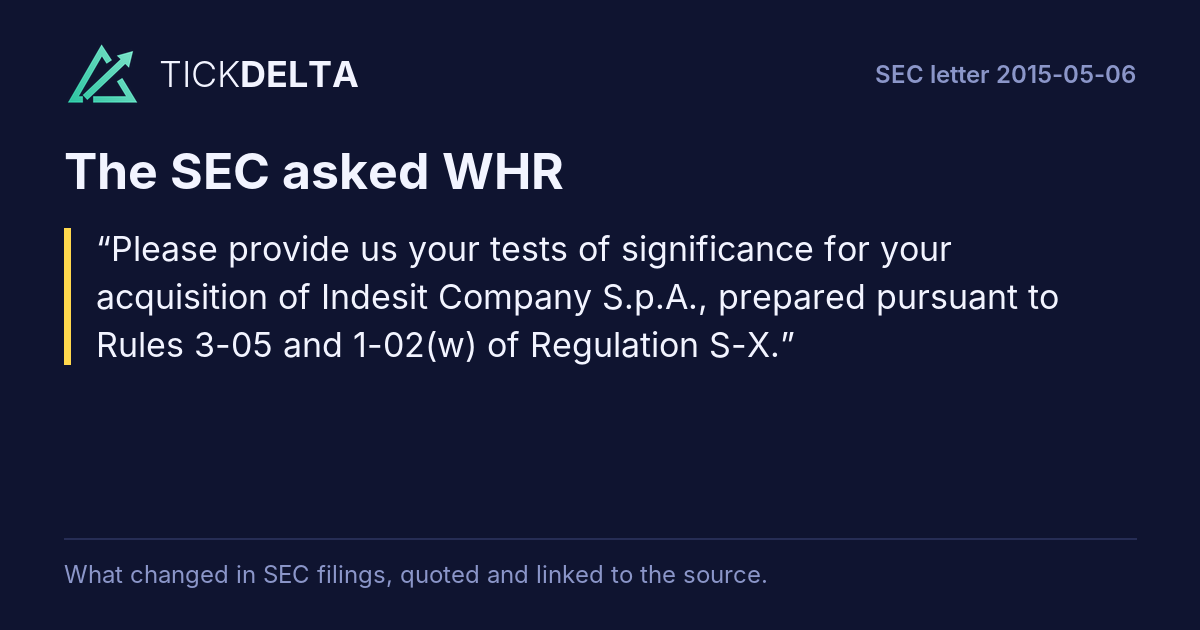
In response to the Staff’s comment, we respectfully provide the following supplemental information.
With respect to each of the line items excluded from Ongoing EBIT, Whirlpool Corporation (“Whirlpool” or
“the Company”) has historically provided incremental footnote disclosure within our
reconciliations for press releases and other investor communication material, which provides additional narrative on each line item.
Rest of the answer
We intend to further supplement our non-GAAP reconciliations in subsequent Form 10-Q and Form 10-K filings with similar footnote disclosure, which we believe will provide additional clarity to investors on the line items cited in the Staff’s comment, among others. Below is our response to each of the line items cited in the Staff’s comment.
Product warranty costs
Our product warranty cost line item excluded from Ongoing EBIT represents two large, distinct product recall campaigns for which costs were incurred and subsequently adjusted as a result of claim experience. These campaigns were related to legacy acquisition product designs for which we incurred significant overall expenses. Specifically, we incurred expenses on a dryer recall campaign in our EMEA region in 2019 totaling $26 million, in addition to previously recognized amounts over $300 million for this dryer recall. All amounts related to the dryer campaign were excluded from Ongoing EBIT over multiple years. Separately, we commenced a washer recall campaign in our EMEA region in 2019, and incurred a $105 million charge in connection with our cash expenditure expectations for the recall, which was excluded from Ongoing EBIT during the year. In 2020, we excluded from Ongoing EBIT the benefit of a reserve release related to the washer recall campaign, as a result of claim experience.
Furthermore, both of these actions were executed based upon product designs from a legacy acquisition that are no longer in use. We view these items as distinct from normal, ongoing service repair costs that would be reflected under ongoing warranty expenses within the operation of our businesses. We believe that excluding the expenses, as well as favorable adjustments such as adjustments based on claims experience and supplier recoveries, from these unique, discrete recall events provides investors with a clearer view of the operating performance of our business, and we do not believe that the expenses represent, in the words of Question
100.01, “normal, recurring, cash operating expenses necessary to operate the business.”
Trade customer insolvency claim settlement
In 2017, Alno AG and certain affiliated companies filed for insolvency protection in Germany. Bauknecht Hausgeräte GmbH, a subsidiary of the
Company, was a long-standing supplier to Alno and certain of its affiliated companies. The Company was also a former indirect minority shareholder of Alno. In August 2018, the insolvency trustee asserted €174.5 million in clawback and related claims against Bauknecht. In January 2020, we entered into an agreement to settle all potential claims that the insolvency trustee may have related to this matter, resulting in a one-time charge of €52.75 million (approximately $59 million as of December 31, 2019), which was recorded in interest and sundry (income) expense in the Consolidated Statements of Income (Loss) for the year ended December 31, 2019.
Our trade customer insolvency claim settlement line item excluded from Ongoing EBIT represents expenses related to this unique, non-recurring legal settlement. The settlement was both large ($59M) and unique in nature, in that it was unrelated to the current operations of our EMEA business. The settlement resolved any potential legal claims arising out of the insolvency proceeding. Given the unique and non-recurring nature of this legal settlement, we do not believe the settlement expenses represent normal, recurring, cash operating expenses necessary to operate the business.
Trade customer insolvency
Our trade customer insolvency line item excluded from Ongoing EBIT represents expenses related to two unique trade customer insolvencies. In late 2018 we experienced receivable losses associated with the insolvencies of two of our larger customers within our North America and Latin America regions, and we excluded an associated combined net expense of $30 million for the year. Trade customer insolvencies, particularly involving some of our most significant trade customers, occur infrequently. These insolvencies were the first of this or similar magnitude to occur over the past ten years. Given the unusual nature of these significant insolvency events, we do not believe that they reflect normal, recurring, cash operating expenses necessary to operate the business.
Adjustment for restructuring charges
Our restructuring line item excluded from Ongoing EBIT represents expenses related to certain discrete, unique restructuring actions that largely flow from acquisition or divestiture activities undertaken in recent years. We recognize that Question 102.03 of the updated Non-GAAP Compliance and Disclosure Interpretations cautions registrants against describing a charge or gain as non-recurring, infrequent or unusual unless it meets the specified criteria. At the same time, Question 102.03 provides that even if a company cannot describe a charge or gain as non-recurring, infrequent or unusual, that does not mean that a company cannot adjust for that charge or gain. Although we acknowledge that our restructuring charges have not been non-recurring or infrequent during the prior three years, we believe that adjustment is appropriate for the reasons that follow.
Restructuring expenses over this period largely consisted of (i) acquisition or divestiture-related actions, and (ii) COVID-related cost actions. In recent years, we have completed major acquisitions and divestitures for which we initiate restructuring actions to eliminate redundancies, some of which can span multiple years.
The nature of the expenses comprised in restructuring are broken out as follows:
Restructuring Summary
2020
2019
2018
Acquistion / Divestiture Related
125
184
220
Covid Related
163
Other
Total Restructuring
288
188
247
For example, in 2018 we undertook a number of restructuring actions consistent with the significant manufacturing footprint realignment in our EMEA region following our acquisition of Indesit Company S.p.A. We also initiated the closure of a plant in Italy used by our Embraco compressor subsidiary, which we then sold in 2019.
In 2019, consistent with our post integration EMEA footprint realignment, we initiated a plant closure in Naples, Italy. Due to customary timing of notice periods and discussions with unions and the Italian government, which resulted in plant operations continuing into 2020, these costs continued to be incurred in 2020.
Additionally, in 2020 Whirlpool experienced an abnormally high level of restructuring costs related to fixed cost reduction actions in response to the global
COVID environment. Those actions were necessary given the level of uncertainty within our business, and were comparatively large in scope and breadth.
We believe that the Ongoing EBIT measure that adjusts for these restructuring expenses provides investors with a clearer view of the operating performance of our business absent these discrete, unique items. In addition, consistent with Item 10(e) and
Question 102.03, Whirlpool has not historically described the restructuring charges specifically as non-recurring or in other terms that mischaracterize the frequency of these charges and instead has described the restructuring actions specifically as discrete, unique restructuring events.
Given the distinct nature of these large actions, we believe they do not reflect normal ongoing operating performance and that adjustment is important for increased clarity to investors as well as for quarterly performance comparison purposes.
Sale-leaseback, real estate and receivable adjustments
Our sale-leaseback, real estate and receivable adjustments line item excluded from Ongoing EBIT represents three real estate-related adjustments:
Sale-Leaseback
As part of a review of our global real estate footprint, Whirlpool entered into simultaneous sale-leaseback transactions consisting of non-core properties to our operations.
The Company recorded the entire gain from the transactions, in accordance with ASC 842 in the Consolidated Statements of Comprehensive Income at the time the transaction was completed and ownership and control changed. The Company does not consider real estate transactions part of our core operating business of appliance sales and service and therefore excluded these gains from ongoing results.
Receivable
Whirlpool held a real estate-related loan receivable from an independent not-for-profit entity in connection with a community and economic development project. The underlying project for the loan receivable was not related to Whirlpool operations. The entity did not repay the loan, resulting in an $18 million charge from the loan write off. The loan receivable transaction was assessed under ASC 326 for credit impairment with both historical experience and reasonable future forecasts considered.
Real estate
Whirlpool wrote-down the book value of certain Whirlpool-owned, held for sale real estate properties that became impaired during the reporting period, recognizing a loss of approximately $7 million related to the impairments. The Whirlpool owned properties were assessed for impairment under the long lived asset guidance in ASC 360.
We do not believe that these non-operating receivable and real estate expenses reflect normal, recurring, cash operating expenses necessary to operate the business. In addition, due to the unique and, in some cases, non-core nature of these transactions, the material net gain on the “sale-leaseback, real estate and receivable adjustments” line item as a whole did not represent our ongoing operational activity. Accordingly, we excluded the net gain from these transactions, consistent with our practice of excluding significant benefits, as well as expenses, that are not representative of our ongoing results.
Conclusion
As a result of the factors summarized above, we believe these expenses and benefits are not representative of Whirlpool’s underlying operating performance and thus are appropriately excluded from our Ongoing EBIT measure so that investors can better understand our operating results. Whirlpool uses non-GAAP measures as a supplement to financial information presented in accordance with GAAP in order to facilitate operating performance comparisons from period to period by eliminating differences caused by the existence and timing of these charges and benefits that would not otherwise be apparent on a
GAAP basis.