tickdelta
Sign in

Tickdelta is free for now. Sign up and get Pro free

← Screener

WMWaste Management

Industrials · Waste Management · NYSE

Waste Management, Inc. is a holding company and all operations are conducted by its subsidiaries. 10-K, Item 1

Employees
60,500
Headquarters
Houston, TX
Next results
around Jan 27, 2027
Compare with peers → Embed

When the SEC's staff reviews a filing, it writes to the company with numbered questions, and the company answers each one in a letter. SEC publishes the exchange once the review is over, at least 20 business days later. Below: what the staff asked WM, and the company's answer to each question, quoted from the letters. A question is not an accusation; most reviews end with the company adding detail to its next filing.

Form 10-K for the Fiscal Year Ended December 31, 2021

2022-03-22 to 2022-03-30 · 1 question · 1 letter from the SEC, 1 from the company
Review closed 2022-03-30
Controls
Item 9A. Controls and Procedures · Management's Report on Internal Control Over financial Reporting, page 127
SEC asked
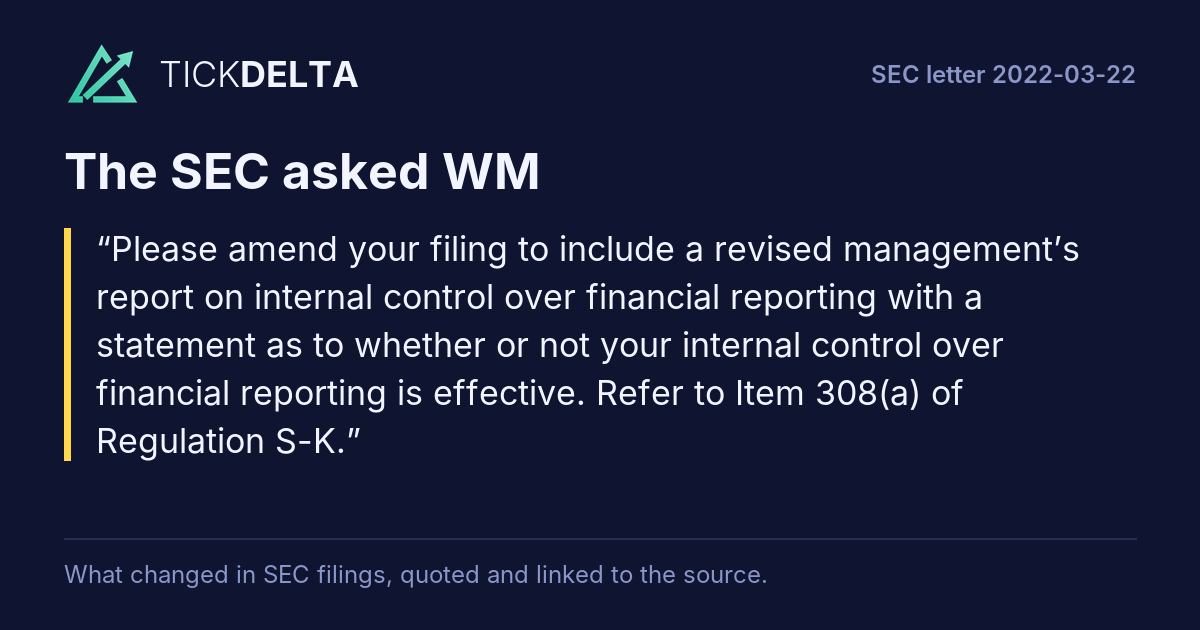
Please amend your filing to include a revised management’s report on internal control over financial reporting with a statement as to whether or not your internal control over financial reporting is effective. Refer to Item 308(a) of Regulation S-K.
WM answered
Amended Item 9A Controls and Procedures. Management’s Report on Internal Control Over Financial Reporting, page 127

The Company will include the following statement in Management’s Report on Internal Control Over Financial Reporting within a Form 10-K/A for the year ended December 31, 2021:

“Management of the Company assessed the effectiveness of our internal control over financial reporting as of December 31, 2021 based on the 2013 framework in Internal Control—Integrated Framework issued by the Committee of Sponsoring Organizations of the Treadway Commission (the COSO criteria).
Rest of the answer

Based on this assessment, management has concluded that our internal control over financial reporting was effective as of December 31, 2021.”

The Company intends to file the amendment to the Form 10-K on March 29, 2022.

* * * *

The Company acknowledges that:

● the Company is responsible for the adequacy and accuracy of the disclosure in the filing;

● Staff comments or changes to disclosure in response to Staff comments do not foreclose the Commission from taking any action with respect to the filing; and

● the Company may not assert Staff comments as a defense in any proceeding initiated by the Commission or any person under the federal securities laws of the United States.

Read in the reply ↗
In its next report

First report after the company's reply of 2022-03-29: 10-Q filed 2022-04-26 ↗, against the 10-Q filed 2021-10-26 ↗.

Tickdelta does not hold the text of both reports, so they are not compared here.
Also in this review: closing letter, 2022-03-30
Form 10-K for the Fiscal Year Ended December 31, 2018

2018-07-06 to 2018-07-30 · 2 questions · 1 letter from the SEC, 1 from the company
Review closed 2018-07-30
Liquidity and cashDebt
Form 10-Q for the Period Ended March 31, 2018 · Note 3. Debt, page 9
SEC asked (1)
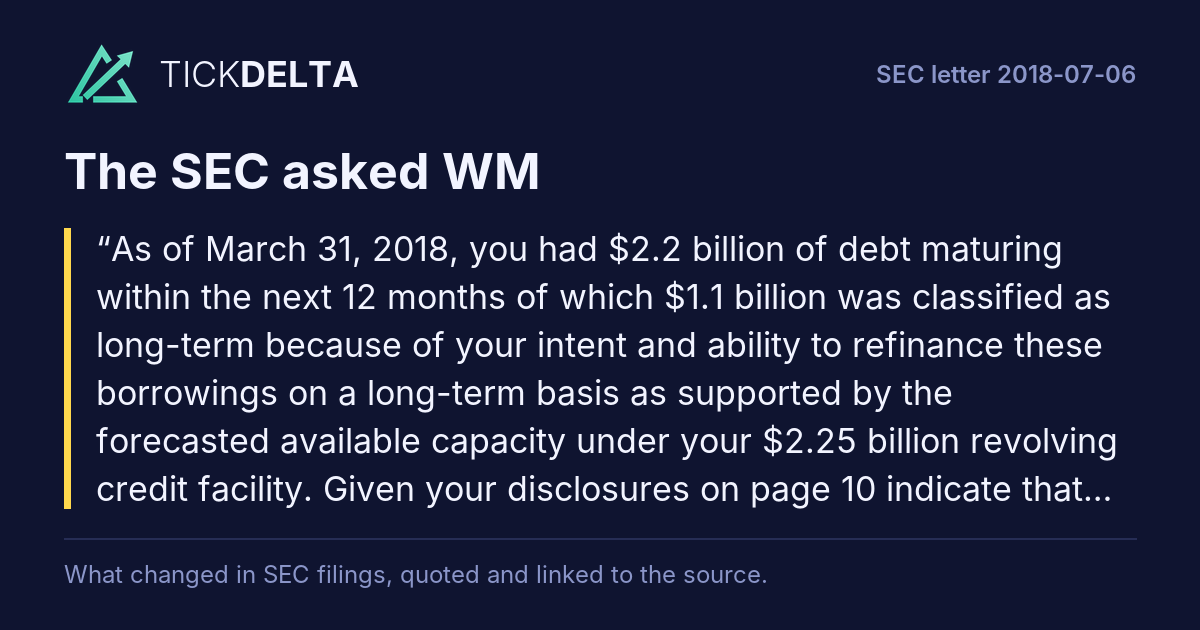
As of March 31, 2018, you had $2.2 billion of debt maturing within the next 12 months of which $1.1 billion was classified as long-term because of your intent and ability to refinance these borrowings on a long-term basis as supported by the forecasted available capacity under your $2.25 billion revolving credit facility.
Rest of the question

Given your disclosures on page 10 indicate that there was unused and available credit capacity of only $629 million as of March 31, 2018, please help us further understand how you determined that it was appropriate to classify $1.1 billion as long-term debt. Please provide us with your analysis pursuant to ASC 470-10-45-12A through 45-20 as of March 31, 2018.

WM answered
On a quarterly basis, we assess our debt classification for reporting purposes in accordance with ASC 470-10-45-14, Intent and Ability to Refinance on a Long-Term Basis, which provides that short-term obligations shall be excluded from current liabilities only if (1) the Company intends to refinance the obligation on a long-term basis and (2) the Company’s intent to refinance the short-term obligation on a long-term basis is supported by an ability to consummate the refinancing with either a post-balance-sheet-date issuance of a long-term obligation or a financing agreement that clearly
Rest of the answer

permits the Company to refinance the short-term obligation on a long-term basis on terms that are readily determinable.

The $1.1 billion of debt maturing in the next 12 months that was classified as long-term as of March 31, 2018 was comprised of: 1) $495 million of outstanding commercial paper borrowings, which are directly supported by the Company’s $2.25 billion revolving credit facility (the “Facility”) and were, therefore, subtracted from the measurement of available credit capacity of the Facility and 2) $629 million of other current obligations. The Company’s classification of these borrowings as long-term is based on management’s assessment of the Company’s intent and ability to refinance these borrowings on a long-term basis. The specific application of ASC 470-10-45 to these assessments is outlined below.

Intent:

Our quarterly analysis of the $2.2 billion of short-term obligations outstanding as of March 31, 2018 reflected that the Company had the intent to refinance or maintain $1.326 billion of such obligations on a long-term basis, as set forth below:

1) Borrowings Outstanding under the Commercial Paper Program — Total borrowings outstanding under the commercial paper program were $989 million as of March 31, 2018. We intend to repay approximately $494 million of this outstanding balance within the next 12 months with projected excess cash flow from operations of the business. Management intends to maintain the remaining $495 million of outstanding borrowings on a long-term basis under the Facility.

Read in the reply ↗
In its next report

First report after the company's reply of 2018-07-13: 10-Q filed 2018-07-25 ↗, against the 10-Q filed 2018-04-23 ↗.

Tickdelta does not hold the text of both reports, so they are not compared here.

Liquidity and Capital Resources, page 40
SEC asked (2)
We note that you reported a working capital deficit as of December 31, 2016, December 31, 2017, and March 31, 2018. We also note that you are relying on the remaining availability under your primary revolving credit facility to support your intent and ability to refinance your short-term debt on a long-term basis as of March 31, 2018.
Rest of the question

In this regard, please expand your disclosures to address your consideration of both the working capital deficit as well as the availability under your credit agreements in determining that your sources of cash will be sufficient to meet your cash and liquidity requirements over the next twelve months.

WM answered
While a working capital deficit can, in some instances, be an indicator of liquidity concerns, the Company generally elects to maintain a working capital deficit in its normal course of business due to the strong and consistent cash from operations of the business. Cash from operations meaningfully exceeds the near-term working capital needs of the business as well as other recurring investing and financing activities. In order to better clarify management’s outlook for liquidity, including its ability to meet working capital needs, we intend to complement existing disclosures as proposed.
Rest of the answer

By way of example, and subject to further revision and refinement, we propose to provide the disclosure set forth below in future filings.

Prospective Expanded Disclosure:

Liquidity and Capital Resources

The Company consistently generates cash flow from operations that meets and exceeds its working capital needs, the payments of its dividend and investment in the business through capital expenditures and acquisitions. We continually monitor our actual and forecasted cash flows, our liquidity and our capital resources, enabling us to plan for our present needs and fund unbudgeted business activities that may arise during the year as a result of changing business conditions or new opportunities. The Company believes that its investment grade credit ratings, large value of unencumbered assets and modest leverage enable it to obtain adequate financing to meet its ongoing capital, operating and other liquidity requirements.

Read in the reply ↗
In its next report

First report after the company's reply of 2018-07-13: 10-Q filed 2018-07-25 ↗, against the 10-Q filed 2018-04-23 ↗.

Tickdelta does not hold the text of both reports, so they are not compared here.

Also in this review: closing letter, 2018-07-30

3 other letters: notices that a filing will not be reviewed, requests to declare a registration effective, and the like
  • 2025-05-20 · WM: letter to the SEC · Waste Management, Inc. · Registration Statement on Form S-4 · Filed May 8, 2025 · File...
  • 2025-05-20 · WM: letter to the SEC · Request for Acceleration of Effectiveness of Waste Management, Inc.’s and Waste...
  • 2025-05-16 · SEC: will not review the filing · WASTE MANAGEMENT, INC. · Registration Statement on Form S-4 · Filed May 8, 2025 · File...

From the SEC's correspondence on EDGAR: staff letters (form UPLOAD) and company letters (form CORRESP), 9 letters filed since 2018-07-09. Questions and answers are matched by their numbers; topics come from words in each question. The reports are compared word for word (same form, before the first SEC letter against the first report after the company's reply). No AI.

Work on WM in a spreadsheet: Excel workbook (a sheet per section, ten years by column, charts, links to the filings) · CSV. For a Google Sheet that stays up to date, paste =IMPORTDATA("https://tickdelta.com/company/WM/export.csv") into a cell.