Form 10-K
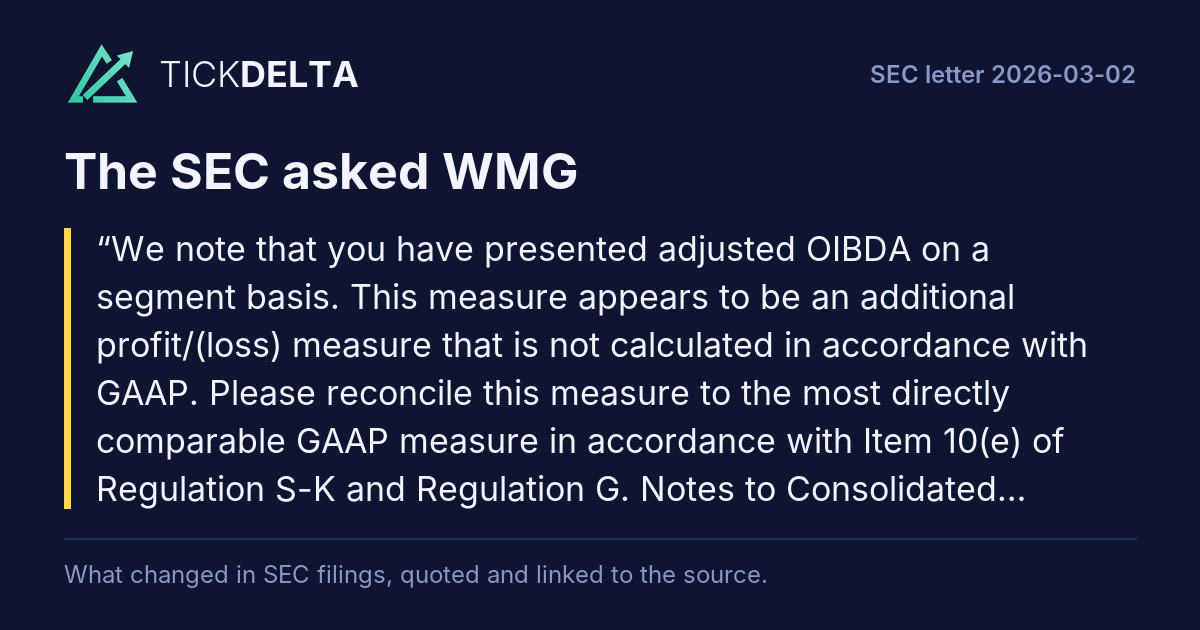
We note that you have presented adjusted OIBDA on a segment basis. This measure appears to be an additional profit/(loss) measure that is not calculated in accordance with GAAP. Please reconcile this measure to the most directly comparable GAAP measure in accordance with Item 10(e) of Regulation S-K and Regulation G. Notes to Consolidated Financial Statements 17. Segment Information, page 115
The Company will provide the requested reconciliations for adjusted OIBDA on a segment basis in its periodic reports on Form 10-K and Form 10-Q in future filings. The reconciliations for each of the Recorded Music and Music Publishing segments and Corporate for the fiscal years endedRead in the reply
September 30, 2025, 2024 and 2023 and for the three months ended December 31, 2025 and 2024 are presented in the table below.
Three Months Ended
December 31,
Fiscal Year Ended
September 30,
2025
2024
2023
Recorded Music
Recorded Music operating income
329
238
850
916
875
Depreciation andRest of the answer
amortization expense
189
179
205
Restructuring and impairments
198
166
Executive transition costs
—
Net gain on divestitures
(17
)
(41
Non-cash stock-based compensation and other related costs
Recorded Music Adjusted OIBDA
403
323
1,269
1,282
1,094
Music Publishing
Music Publishing operating income
224
200
Depreciation and amortization
127
102
(14
Music Publishing Adjusted OIBDA
361
330
296
Corporate
Corporate operating loss
(106
(79
(380
(331
(285
(1
Transformation initiatives and other related costs
Corporate Adjusted OIBDA
(42
(43
(187
(180
(155
Notes to Consolidated Financial Statements
17. Segment Information, page 115
First report after the company's reply of Mar 11, 2026: 10-Q filed May 7, 2026 ↗, against the 10-Q filed Feb 9, 2026 ↗.
Business Segment Results: 86 paragraphs changed; the 3 closest in words to the question are below.
Adjusted EBITDA as presented below should not be used by investors as an indicator of performance for any future period. Further, our debt instruments require that it be calculated for the most recent four fiscal quarters. As a result, the measure can be disproportionately affected by a particularly strong or weak quarter. Further, it may not be comparable to the measure for any subsequent four-quarter period or any complete fiscal year. In addition, our debt instruments require that the leverage ratio be calculated on a pro forma basis for certain transactions including acquisitions as if such transactions had occurred on the first date of the measurement period and may include expected cost savings and synergies resulting from or related to any such transaction. There can be no assurances that any such cost savings or synergies will be achieved in full.
In addition, Adjusted EBITDA is a key measure used by our management to understand and evaluate our operating performance, generate future operating plans and make strategic decisions regarding the allocation of capital. Adjusted EBITDA has limitations as an analytical tool, and you should not consider it in isolation or as a substitute for analysis of our results as reported under U.S. GAAP. Some of those limitations include: (1) it does not reflect the periodic costs of certain capitalized tangible and intangible assets used in generating revenue for our business; (2) it does not reflect the significant interest expense or cash requirements necessary to service interest or principal payments on our indebtedness; and (3) it does not reflect every cash expenditure, future requirements for capital expenditures or contractual commitments. In particular, this measure adds back certain non-cash, extraordinary, unusual or non-recurring charges that are deducted in calculating net income; however, these are expenses that may recur, vary greatly and are difficult to predict. In addition, Adjusted EBITDA is not the same as net income or cash flow provided by operating activities as those terms are defined by U.S. GAAP and does not necessarily indicate whether cash flows will be sufficient to fund cash needs. Accordingly, Adjusted EBITDA should be considered in addition to, not as a substitute for, net income (loss) and other measures of financial performance reported in accordance with U.S. GAAP.
The Revolving Credit Facility contains a springing leverage ratio that is tied to a ratio based on EBITDA, which is defined under the Revolving Credit Agreement. Our ability to borrow funds under the Revolving Credit Facility may depend upon our ability to meet the leverage ratio test at the end of a fiscal quarter to the extent we have drawn a certain amount of revolving loans. On May 4, 2021, certain covenants set forth in our Revolving Credit Facility were suspended, including the restriction on incurring certain additional indebtedness, based on the determination that the total indebtedness to EBITDA ratio is below the required threshold specified therein. EBITDA as defined in the Revolving Credit Facility is based on Consolidated Net Income (as defined in the Revolving Credit Facility), both of which terms differ from the terms “EBITDA” and “net income” as they are commonly used. For example, the calculation of EBITDA under the Revolving Credit Facility, in addition to adjusting net income to exclude interest expense, income taxes and depreciation and amortization, also adjusts net income by excluding items or expenses such as, among other items, (1) the amount of any restructuring charges or reserves; (2) any non-cash charges (including any impairment charges); (3) any net loss resulting from hedging currency exchange risks; (4) the amount of management, monitoring, consulting and advisory fees paid to Access; (5) business optimization expenses (including consolidation initiatives, severance costs and other costs relating to initiatives aimed at profitability improvement); (6) transaction expenses; (7) equity-based compensation expense; and (8) certain extraordinary, unusual or non-recurring items. The definition of EBITDA under the Revolving Credit Facility also includes adjustments for the pro forma impact of certain projected cost savings, operating expense reductions and synergies and any quality of earnings analysis prepared by independent certified public accountants in connection with an acquisition, merger, consolidation or other investment. The Senior Term Loan Facility and the Secured Notes Indenture use financial measures called “Consolidated EBITDA” or “EBITDA” and “Consolidated Net Income” that have substantially the same definitions to EBITDA and Consolidated Net Income, each as defined under the Revolving Credit Agreement.
Paragraphs where only numbers, dates or period words changed are not shown. Cut words struck through, new words highlighted.
Please revise your disclosure to provide a reconciliation of your total segment profit/(loss) measure to your consolidated income before taxes for each reporting period presented as required by ASC 280-10-50-30.
The Company will revise its segment footnote disclosure in future periodic reports on Form 10-K andRead in the reply
Form 10-Q as set forth below.
Recorded
Music expenses and
Publishing eliminations
Total
(in millions)
Revenues
5,408
1,306
(7
6,707
Cost of revenue
2,818
821
3,632
Selling and marketing expense
615
642
Distribution expense
112
General and administrative expense
679
131
325
1,135
Restructuring & Impairment
234
Amortization expense
136
122
258
Operating income (loss)
694
Interest expense, net
162
Other expense, net
Income before income taxes
490
TotalRest of the answer
assets
5,328
3,463
1,038
9,829
Capital expenditures
114
139
Depreciation expense
118
September 30, 2024
5,223
1,210
6,426
2,599
763
3,355
663
685
105
664
123
302
1,089
177
(32
823
161
601
4,945
3,017
1,193
9,155
116
103
September 30, 2023
4,955
1,088
(6
First report after the company's reply of Mar 11, 2026: 10-Q filed May 7, 2026 ↗, against the 10-Q filed Feb 9, 2026 ↗.
Business Segment Results: 86 paragraphs changed; the 3 closest in words to the question are below.
The Revolving Credit Facility contains a springing leverage ratio that is tied to a ratio based on EBITDA, which is defined under the Revolving Credit Agreement. Our ability to borrow funds under the Revolving Credit Facility may depend upon our ability to meet the leverage ratio test at the end of a fiscal quarter to the extent we have drawn a certain amount of revolving loans. On May 4, 2021, certain covenants set forth in our Revolving Credit Facility were suspended, including the restriction on incurring certain additional indebtedness, based on the determination that the total indebtedness to EBITDA ratio is below the required threshold specified therein. EBITDA as defined in the Revolving Credit Facility is based on Consolidated Net Income (as defined in the Revolving Credit Facility), both of which terms differ from the terms “EBITDA” and “net income” as they are commonly used. For example, the calculation of EBITDA under the Revolving Credit Facility, in addition to adjusting net income to exclude interest expense, income taxes and depreciation and amortization, also adjusts net income by excluding items or expenses such as, among other items, (1) the amount of any restructuring charges or reserves; (2) any non-cash charges (including any impairment charges); (3) any net loss resulting from hedging currency exchange risks; (4) the amount of management, monitoring, consulting and advisory fees paid to Access; (5) business optimization expenses (including consolidation initiatives, severance costs and other costs relating to initiatives aimed at profitability improvement); (6) transaction expenses; (7) equity-based compensation expense; and (8) certain extraordinary, unusual or non-recurring items. The definition of EBITDA under the Revolving Credit Facility also includes adjustments for the pro forma impact of certain projected cost savings, operating expense reductions and synergies and any quality of earnings analysis prepared by independent certified public accountants in connection with an acquisition, merger, consolidation or other investment. The Senior Term Loan Facility and the Secured Notes Indenture use financial measures called “Consolidated EBITDA” or “EBITDA” and “Consolidated Net Income” that have substantially the same definitions to EBITDA and Consolidated Net Income, each as defined under the Revolving Credit Agreement.
The following is a reconciliation of net income (loss), which is a U.S. GAAP measure of our operating results, to Adjusted EBITDA as defined, for the most recently ended four fiscal quarters, or the twelve months ended December 31, 2025, for the twelve months ended December 31, 2024 and for the three months ended December 31, 2025 and December 31, 2024. In addition, the reconciliation includes the calculation of the Senior Secured Indebtedness to Adjusted EBITDA ratio, which we refer to as the Leverage Ratio, under the Revolving Credit Agreement for the most recently ended four fiscal quarters, or the twelve months ended December 31, 2025. The terms and related calculations are defined in the Revolving Credit Agreement. All amounts in the reconciliation below reflect Acquisition Corp. (in millions, except ratios):
Reconciliation of Net Income Attributable to Warner Music Group Corp. and Operating Income to Consolidated Adjusted OIBDA
Paragraphs where only numbers, dates or period words changed are not shown. Cut words struck through, new words highlighted.
Also in this review: closing letter, 2026-03-12