Form 10-K
On page 35 you disclose decreased revenue in fiscal 2024 for Pottery Barn was due in part to your strategy to reduce promotional activity, whereas on page 40 you disclose increased SG&A in fiscal 2024 was in part due to an increase in advertising expenses. Please reconcile these disclosures for us and revise your disclosures as appropriate.
The Company acknowledges the Staff’s comment and would like to provide additional context regarding the use of the term “promotional activity.” In the retail industry, this phrase typically refers to selling products at a discounted price rather than to advertising expenses.
Therefore, it is possible that during a fiscal year, like fiscal 2024, one of the Company’s brands can both reduce promotional activity (meaning fewer sales made at a discounted price) and increase advertising expenses (spending more on marketing). The Company believes its disclosures are appropriate. Read in the reply ↗
It appears the increase of $82.8 million in cash paid for income taxes, net of refunds, in fiscal 2024 compared to fiscal 2023 is a material item that is not disclosed as a factor in your analysis of changes in operating cash flows. Please discuss all material usages of cash as appropriate. Refer to Item 303(a) and (b) of Regulation S-K.Rest of the question
Additionally, quantify each variance factor cited in annual and interim period reports. Exhibit 99.1
The Company acknowledges the Staff’s comment and, in future filings, to the extent cash paid for income taxes, net of refunds, is determined to be a material factor in the changes in operating cash flows, the Company will disclose such factor in its analysis of changes in operating cash flows. Additionally, in future filings, the Company will quantify the variance for any material factor cited. Read in the reply ↗
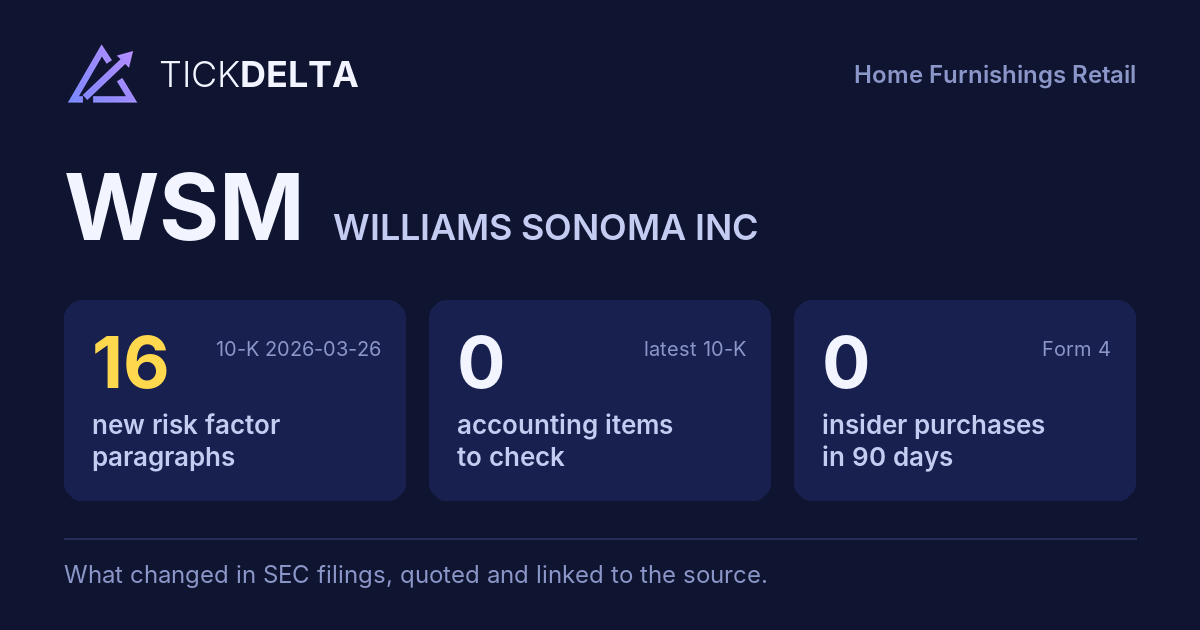
First report after the company's reply of 2026-01-15: 10-K filed 2026-03-26 ↗, against the 10-K filed 2025-03-27 ↗.
Cash Flows from Operating Activities: 39 paragraphs changed; the 3 closest in words to the question are below.
We review the carrying value of all long-lived assets for impairment, primarily at an individual store level, whenever events or changes in circumstances indicate that the carrying value of an asset or asset group may not be recoverable. Our impairment analyses determine whether projected cash flows from operations are sufficient to recover the carrying value of these assets. The asset group is comprised of both property and equipment and operating lease right-of-use assets. Impairment may result when the carrying value of the asset or asset group exceeds the estimated undiscounted future cash flows over its remaining useful life. For asset impairment, our estimate of undiscounted future cash flows over the lease term is based upon our experience, the historical operations and estimates of future profitability and economic conditions. The estimates of future profitability and economic conditions require estimating such factors as sales growth, gross margin, employment costs, lease escalations, inflation and the overall economics of the retail industry, and are therefore subject to variability and difficult to predict. For operating lease right-of-use assets, we determine the fair value of the assets by using estimated market rental rates. These estimates can be affected by factors such as future results, real estate supply and demand, closure plans and economic conditions that can be difficult to predict. Actual future results may differ from those estimates. If a long-lived asset is found to be impaired, the amount recognized for impairment is equal to the excess of the asset or asset group’s net carrying value over its estimated fair value. We measure property and equipment at fair value on a nonrecurring basis using Level 3 inputs as defined in the fair value hierarchy (see Note L). We measure operating lease right-of-use assets at fair value on a nonrecurring basis using Level 2 inputs, primarily market rental rates, that are corroborated by market data. Where Level 2 inputs are not readily available, we use Level 3 inputs. Fair value of these long-lived assets is based on the present value of estimated future cash flows using a discount rate commensurate with the risk. During fiscal 2024, 2025, fiscal 2023 2024 and fiscal 2022, 2023, we recognized impairment charges, as a component of SG&A, selling, general and administrative expenses (“SG&A”), of $ 3.9 1.6 million, $ 14.5 3.9 million and $ 15.6 14.5 million, respectively.
As of February 1, 2026 and February 2, 2025 and January 28, 2024, 2025, we had goodwill of $ 77.3 $77.4 million and $77.3 million, respectively, primarily related to our fiscal 2017 acquisition of Outward and our fiscal 2011 acquisition of Rejuvenation. In fiscal 2025, fiscal 2024 and fiscal 2023, we performed our qualitative annual assessment of goodwill impairment and concluded that the fair value of each of our reporting units exceeded its carrying value. Accordingly, no further impairment testing of goodwill was performed and we did not recognize any goodwill impairment in fiscal 2025, fiscal 2024 and or fiscal 2023. In fiscal 2022, we performed our annual quantitative assessment of goodwill impairment for the Aperture reporting unit, a division of our Outward subsidiary, using the income approach. We fully impaired the goodwill related to the Aperture reporting unit due to these assets not being recoverable in light of projected future cash flows, resulting in goodwill impairment charges of $ 8.0 million. For all other reporting units, we concluded that the fair value exceeded their carrying values and no further impairment testing of goodwill was performed.
Goodwill is initially recorded as of the acquisition date and is measured as any excess of the purchase price over the estimated fair value of the identifiable net assets acquired. Goodwill is not amortized, but rather is subject to impairment testing annually (on the first day of the fourth quarter), or between annual tests whenever events or changes in circumstances indicate that the fair value of a reporting unit may be below its carrying amount. We first perform a qualitative assessment to evaluate goodwill for potential impairment. If based on that assessment it is more likely than not that the fair value of the reporting unit is below its carrying value, a quantitative impairment test is necessary. The quantitative impairment test requires determining the fair value of the reporting unit. We use the income approach, whereby we calculate the fair value based on the present value of estimated future cash flows, using a discount rate that approximates the reporting unit's unit’s weighted-average cost of capital. The process of evaluating the potential impairment of goodwill is subjective and requires significant estimates and assumptions about the future such as sales growth, gross margins, employment costs, capital expenditures, inflation and future economic and market conditions. We measure the fair value using Level 3 inputs as defined in the fair value hierarchy (see Note L). Actual future results may differ from those estimates. If the carrying value of the reporting unit’s assets and liabilities, including goodwill, exceeds its fair value, impairment is recorded for the excess, not to exceed the total amount of goodwill allocated to the reporting unit.
Paragraphs where only numbers, dates or period words changed are not shown. Cut words struck through, new words highlighted and underlined.
You make adjustments to both the numerator and denominator in your calculation of Return on Invested Capital. As it appears your calculation is not that as typically calculated, it appears you should qualify the label of the measure as "adjusted" or some other appropriate description.Rest of the question
Also, please explain the purpose and basis for all adjustments made and disclose what the measure is intended to represent and why your measure provides useful information to investors. Lastly, present this measure calculated using the most directly comparable GAAP measures. Refer to Item 10(e)(1)(i) of Regulation S-K and the third bullet under Question 102.10(a) and by analogy to Questions 102.02 and 103.01 of the Staff's Compliance and Disclosure Interpretations on Non-GAAP Financial Measures.
The Company acknowledges the Staff's comment and confirms that, in future filings, it will refer to this ratio as “Adjusted Return on Invested Capital” (Adjusted ROIC), and disclose what the measure is intended to represent and why the Company believes the measure provides useful information to investors. Additionally, we will explain the purpose and basis for all adjustments made in the calculation of Adjusted ROIC with footnote disclosure.Read in the reply ↗Rest of the answer
We will also present the ratio using the most directly comparable GAAP measures and refer to it as “Return on Invested Capital” (ROIC).
An example of the intended future disclosure of ROIC and Adjusted ROIC based on an illustrative revision of the actual disclosure in Exhibit 99.1 to the Company’s Form 8-K furnished on March 19, 2025 is presented below.
Adjusted Return on Invested Capital (“Adjusted ROIC”)
We believe that Adjusted ROIC is a useful financial ratio for investors in evaluating the efficiency and effectiveness of the capital we have invested in our business to generate returns over time. Our Adjusted ROIC calculation excludes certain items that we do not consider representative of our operating performance.
Adjusted ROIC is not a measure of financial performance under GAAP and should be considered in addition to, and not as a substitute for net earnings, total assets or other GAAP financial measures. Our method of calculating a non-GAAP financial ratio may differ from other companies’ methods and therefore may not be comparable to those used by other companies. We also present the financial ratio calculated using the most directly comparable GAAP measures and refer to this as Return on Invested Capital (“ROIC”). The following tables reconcile ROIC to Adjusted ROIC:
Numerator (using the most directly comparable GAAP measures):
For the Fiscal Year Ended
(In thousands) February 2, 2025 January 28, 2024
Operating income
$ 1,430,184 $ 1,244,193
Income tax 1
(347,535) (316,025)
Operating income after tax $ 1,082,649 $ 928,168
1Reflects a hypothetical provision for income taxes on operating income, using the Company's effective tax rates of 24.3% for fiscal 2024 and 25.4% for fiscal 2023.
Numerator (adjusted):
Out-of-period Freight Adjustment 1
(48,972) —
Exit Costs 2
— 17,931
Reduction-in-force Initiatives 3
— 8,316
Operating lease costs 4
299,105 296,779
Income tax adjustment 5
(408,317) (398,074)
Adjusted operating income after tax $ 1,272,000 $ 1,169,145
1During Q1 2024, we determined that we over-recognized freight expense in fiscal 2021, 2022 and 2023. Therefore, we recorded an out-of-period adjustment to reduce cost of goods sold. We believe this is not related to the operations of fiscal 2024.
2During Q1 2023, we incurred exit costs of $17.9 million, including $9.3 million associated with the closure of our West Coast manufacturing facility and $8.6 million associated with the exiting of Aperture, a division of our Outward, Inc. subsidiary.
3During Q1 2023, we incurred costs related to reduction-in-force initiatives of $8.3 million primarily in our corporate functions.
4We adjust for operating lease costs to align with the metrics we use to determine certain components of management compensation.
5Adjustment reflects a hypothetical provision for income taxes using the Company's effective tax rates of 24.3% for fiscal 2024 and 25.4% for fiscal 2023.
Denominator:
As of
(In thousands)
February 2, 2025 January 28, 2024 January 29, 2023
Total assets
$ 5,301,607 $ 5,273,548 $ 4,663,016
Total current liabilities
(1,911,974) (1,880,315) (1,636,451)
Cash in excess of $200 million
(1,012,977) (1,062,007) (167,344)
First report after the company's reply of 2026-01-15: 10-K filed 2026-03-26 ↗, against the 10-K filed 2025-03-27 ↗.
Item 10: no words changed. Only numbers, dates or period words differ, if anything.
Also in this review: closing letter, 2026-01-26