Screener / SEC EDGAR /CIK 0001140536 /10-K filed Feb 25, 2026, compared with Feb 25, 2025 /Numbers from the XBRL of the 10-Ks
Nasdaq Financials · Insurance Brokers

Willis Towers Watson WTW

Compare with peers Embed
New in the 10-K 11 paragraphs with nothing like them in the 10-K filed Feb 25, 2025 New in the 10-Q 15 paragraphs not in the 10-Q filed Jul 30, 2026 10-Q against the 10-K 3 risk factor paragraphs and sentences added or reworded

New risk paragraphs, branching off last year

Each branch is a paragraph in Risk Factors with nothing like it in the 10-K filed Feb 25, 2025. A box jumps to the paragraph as filed, below.

11 new

Paragraphs with nothing like them in last year's 10-K

Quoted exactly

11 paragraphs in Risk Factors of the 10-K filed Feb 25, 2026 with nothing like them in the 10-K filed Feb 25, 2025. Quoted exactly. Paragraphs that were only edited are under 10-K change.

Compared with the Risk Factors in the latest 10-K of the other 75 Financials companies: a paragraph with at least half its words the same at another company is called similar, and the companies are listed under it. A paragraph most of them have is marked boilerplate. No line means no other company has one like it. This counts text; it does not say how serious a risk is.

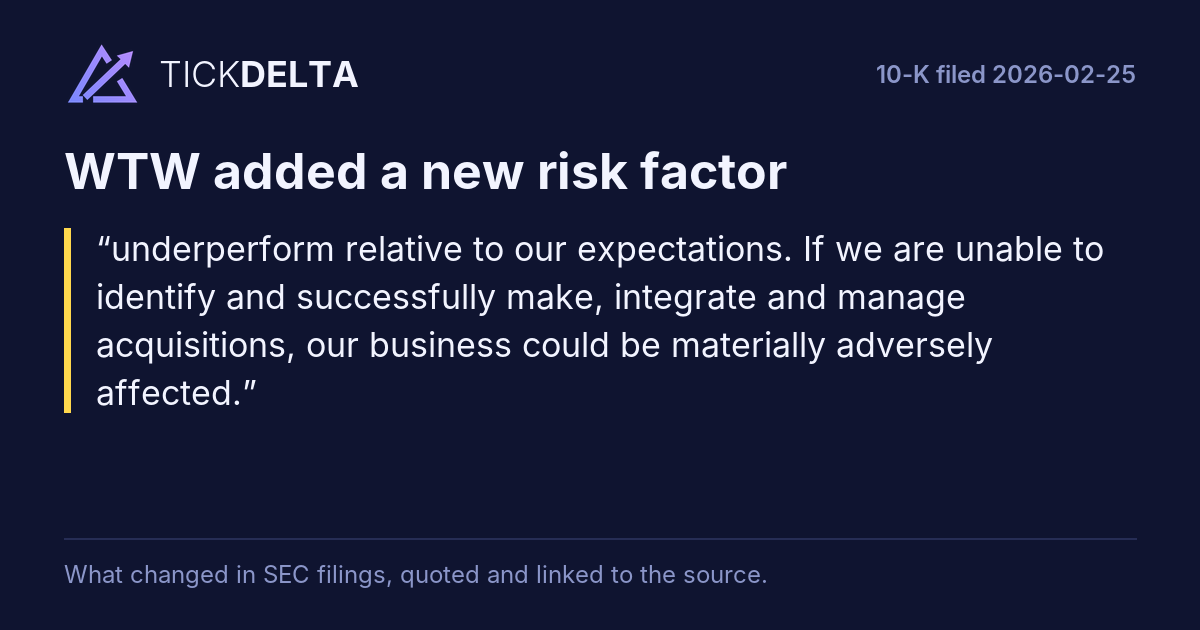
underperform relative to our expectations. If we are unable to identify and successfully make, integrate and manage acquisitions, our business could be materially adversely affected.

Similar paragraph at 9 of 75 other Financials companies: AXP, FISV, GPN, MRSH, NTRS, PGR, SYF, WRB and 1 more
Read in the 10-K

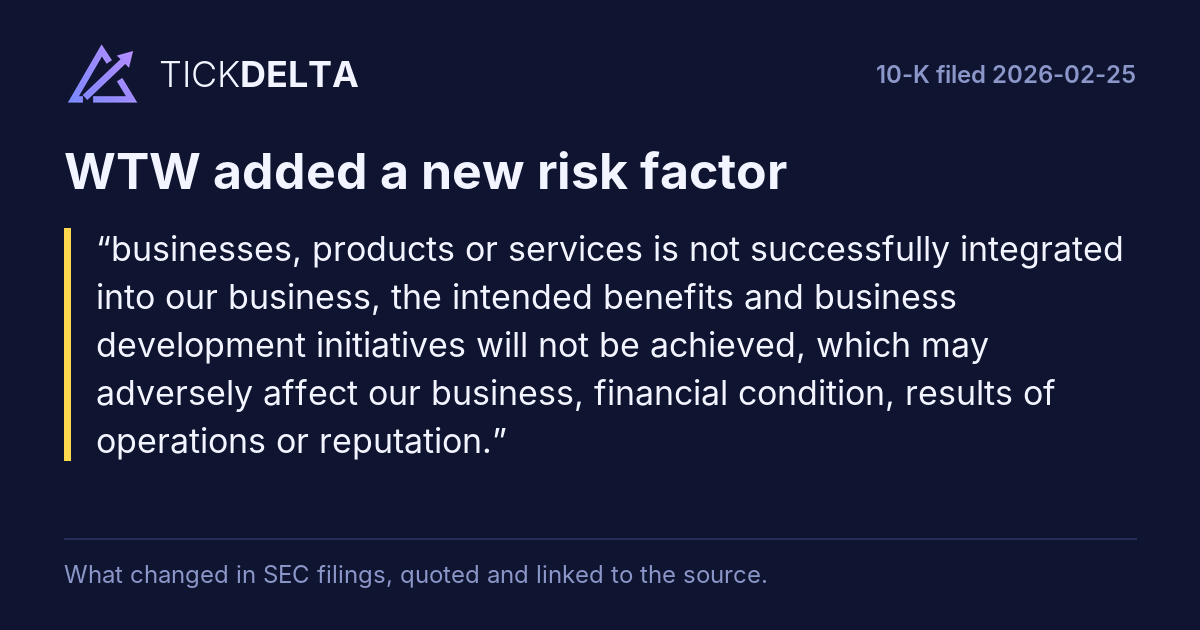
businesses, products or services is not successfully integrated into our business, the intended benefits and business development initiatives will not be achieved, which may adversely affect our business, financial condition, results of operations or reputation.

Similar paragraph at 3 of 75 other Financials companies: EG, GPN, HIG
Read in the 10-K

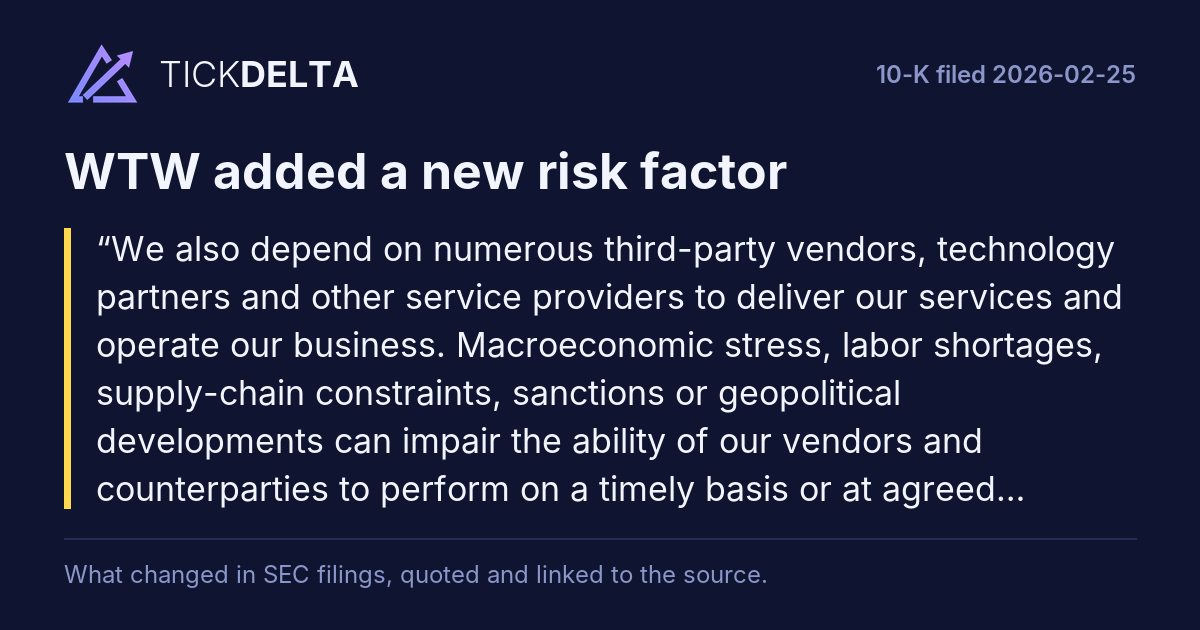
We also depend on numerous third-party vendors, technology partners and other service providers to deliver our services and operate our business. Macroeconomic stress, labor shortages, supply-chain constraints, sanctions or geopolitical developments can impair the ability of our vendors and counterparties to perform on a timely basis or at agreed service levels, which could result in service

Read in the 10-K

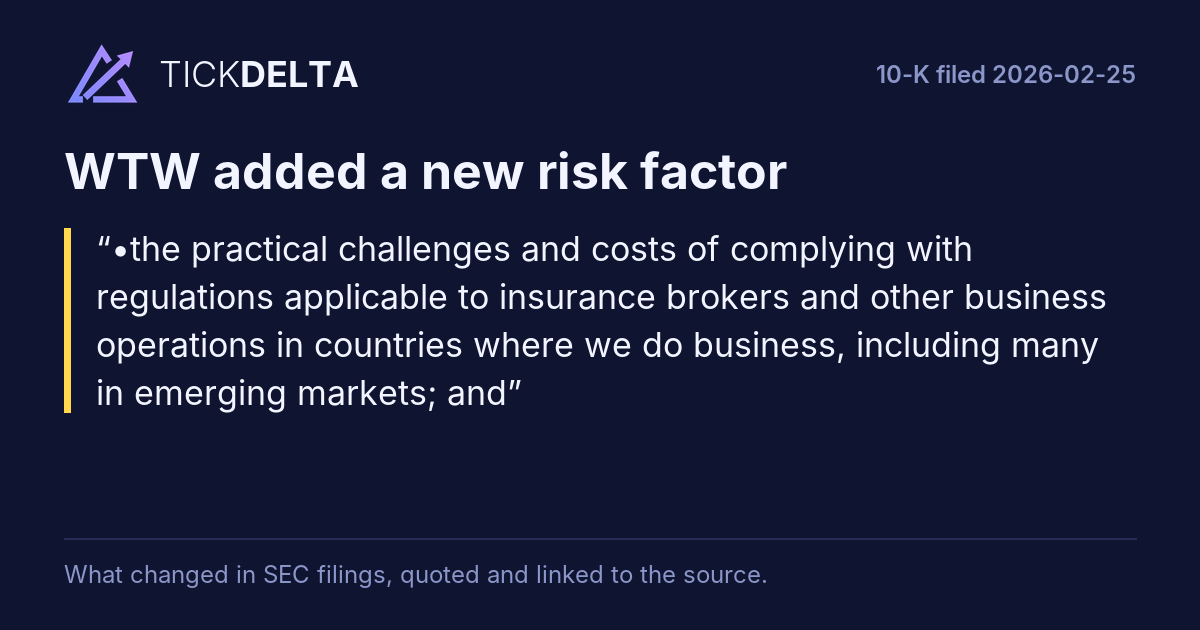
•the practical challenges and costs of complying with regulations applicable to insurance brokers and other business operations in countries where we do business, including many in emerging markets; and

Read in the 10-K

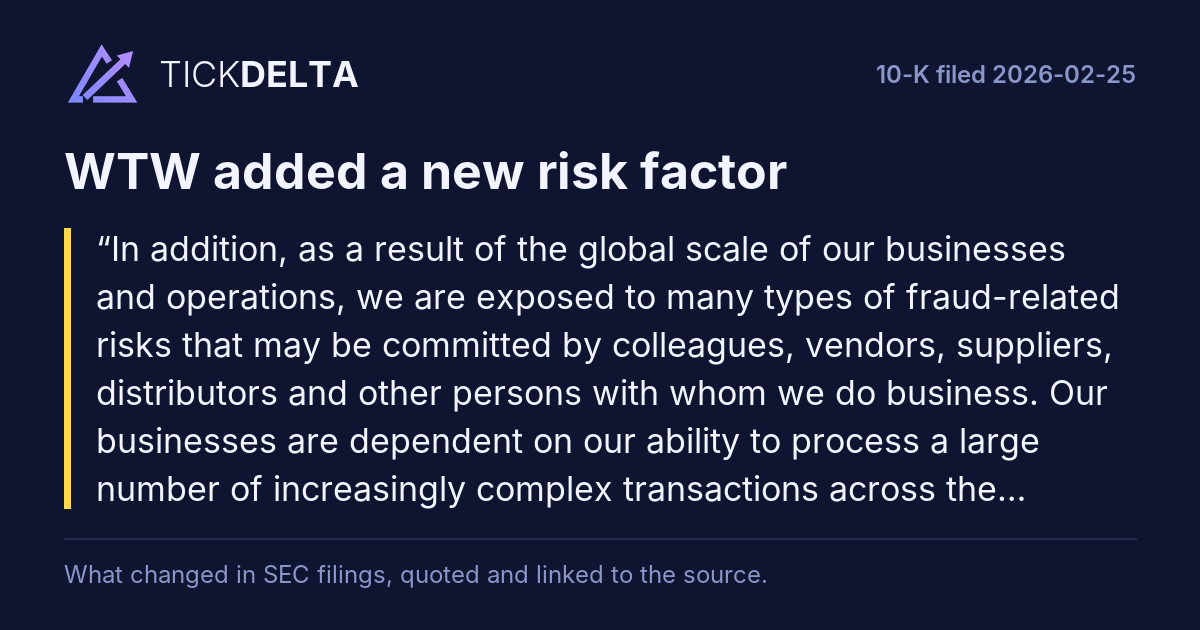
In addition, as a result of the global scale of our businesses and operations, we are exposed to many types of fraud-related risks that may be committed by colleagues, vendors, suppliers, distributors and other persons with whom we do business. Our businesses are

dependent on our ability to process a large number of increasingly complex transactions across the globe, which, when coupled with geographic and industry vulnerabilities in the different jurisdictions in which we operate, can subject us to potentially fraudulent activity. If, for example, any of our financial, accounting, or other data processing systems are subjected to fraudulent manipulation or purposeful sabotage by our colleagues or one or more outsiders, these systems could fail or have other significant shortcomings, which could materially adversely affect our ongoing business and operations both in the U.S. and abroad. We are similarly dependent on our colleagues. We could be materially adversely affected if one or more of our colleagues causes a significant operational break-down or failure, either as a result of human error or where an individual purposefully sabotages or fraudulently manipulates our operations or systems. Third parties with whom we do business could also be sources of operational risk to us, including by conducting fraudulent activities within such parties’ own systems or carried out by its employees. Any of these occurrences could adversely affect our ability to operate one or more of our businesses, while simultaneously exposing us to potential liability to clients and customers, reputational damage, as well as legal, judicial and regulatory intervention or fines.

Read in the 10-K
Show the other 5

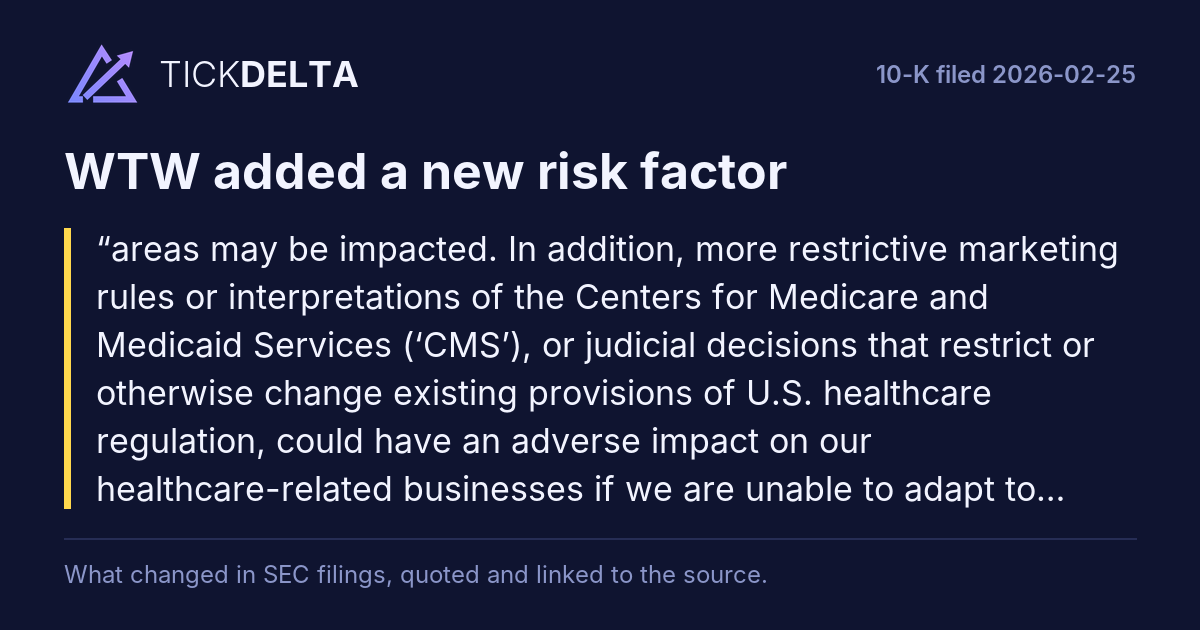
areas may be impacted. In addition, more restrictive marketing rules or interpretations of the Centers for Medicare and Medicaid Services (‘CMS’), or judicial decisions that restrict or otherwise change existing provisions of U.S. healthcare regulation, could have an adverse impact on our healthcare-related businesses if we are unable to adapt to such changes. CMS has recently proposed and finalized additional marketing-related requirements for Medicare Advantage and Part D plans, including Contract Year 2026 proposed rules released in November 2024 that expand the definition of ‘marketing’, increase compliance obligations, introduce new beneficiary-protection provisions, and heighten enforcement risk. CMS also issued earlier rules in April 2024 aimed at curbing marketing misconduct and agent/broker incentive structures, and certain elements of those April 2024 rules are currently on hold due to ongoing litigation. These developments contribute to increased regulatory uncertainty. Additionally, CMS finalized further program changes in April 2025, some of which apply beginning in 2025-2027 and include updated marketing and communication standards. We could also be adversely affected if changes in regulations or government policies impact us directly or indirectly, for example, by adversely impacting markets in which we participate, and we are not able to adapt to such changes.

Read in the 10-K

forms, including volume- or profit-based contingent commissions, facilities administration charges, business development agreements, and fees for providing certain data to carriers.

Read in the 10-K

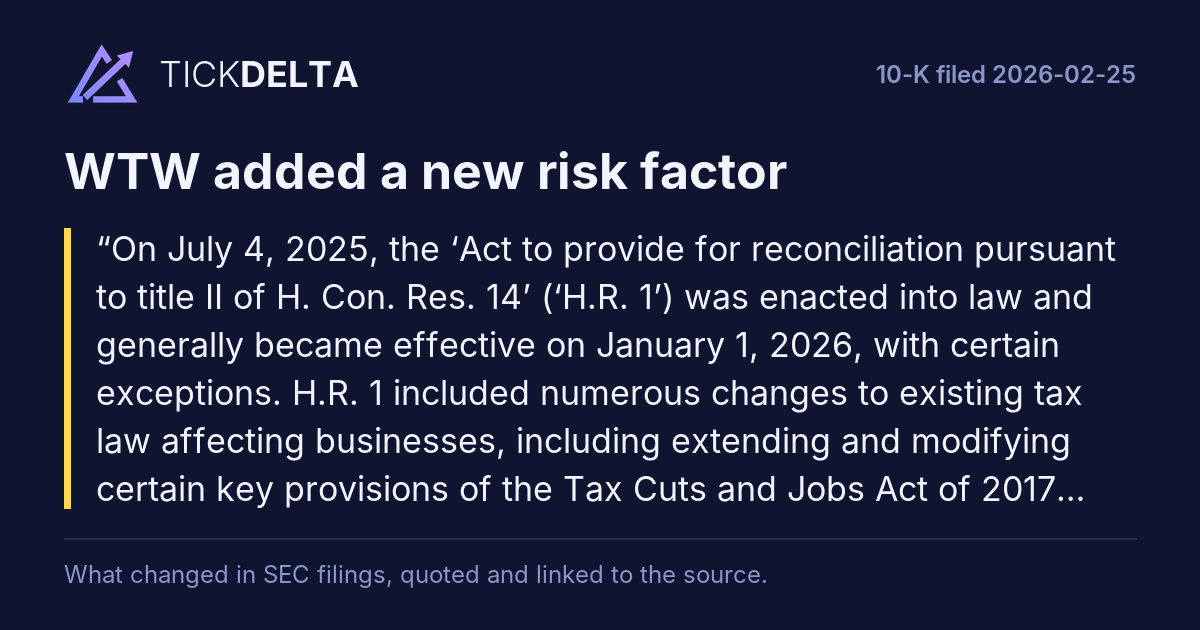
On July 4, 2025, the ‘Act to provide for reconciliation pursuant to title II of H. Con. Res. 14’ (‘H.R. 1’) was enacted into law and generally became effective on January 1, 2026, with certain exceptions. H.R. 1 included numerous changes to existing tax law affecting businesses, including extending and modifying certain key provisions of the Tax Cuts and Jobs Act of 2017, both domestic and international, expanding certain Investment Retirement Account incentives while accelerating the phase-out of others.

Read in the 10-K

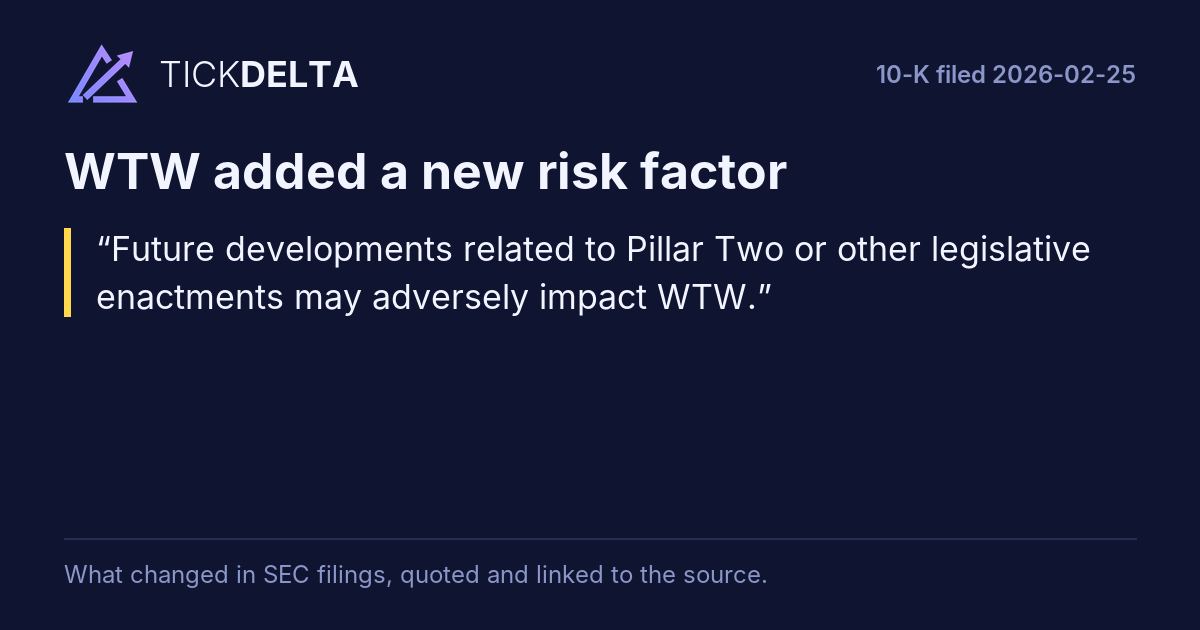
Future developments related to Pillar Two or other legislative enactments may adversely impact WTW.

Read in the 10-K

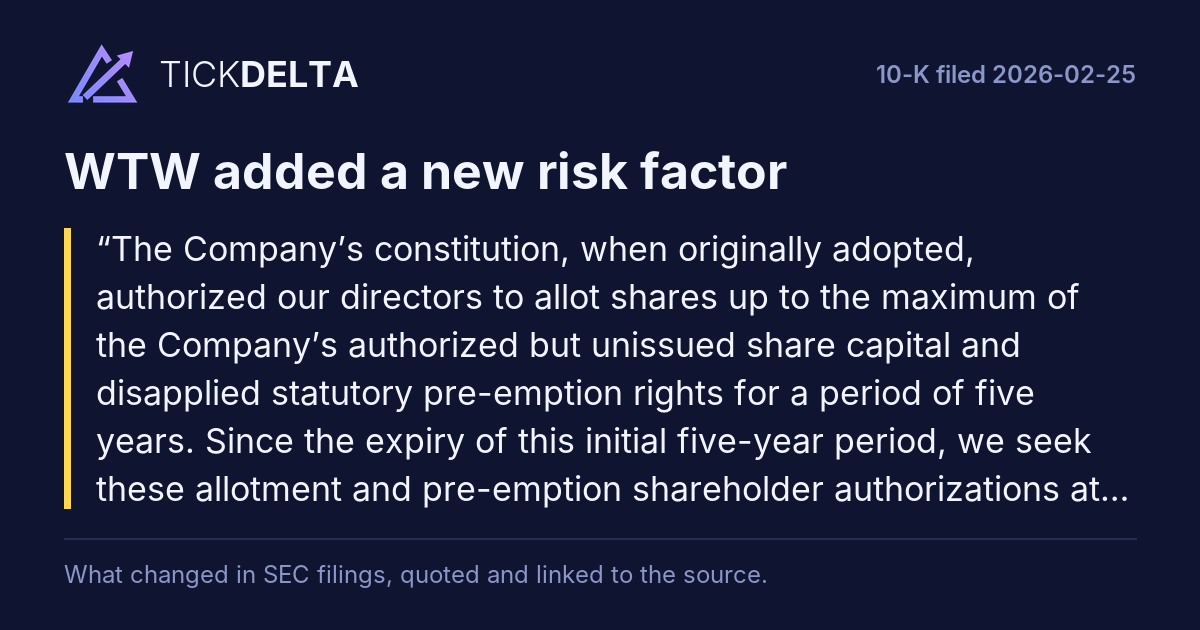
The Company’s constitution, when originally adopted, authorized our directors to allot shares up to the maximum of the Company’s authorized but unissued share capital and disapplied statutory pre-emption rights for a period of five years. Since the expiry of this initial five-year period, we seek these allotment and pre-emption shareholder authorizations at appropriate levels and intervals. However, if we are unable to obtain these authorizations from our shareholders or are otherwise limited by the terms of our authorizations, then our ability to issue shares under our equity compensation plans and, if applicable, facilitate funding acquisitions or otherwise raise capital could be adversely affected.

Read in the 10-K

Paragraphs in the 10-Q filed Oct 29, 2026 that were not in the one before

New in the latest 10-Q

15 paragraphs in the 10-Q filed Oct 29, 2026 with nothing like them in the 10-Q filed Jul 30, 2026 (at least half the words must differ; new numbers alone do not count). Quoted exactly, grouped by the item heading above them. This is text that changed, not a judgement of how serious it is.

Financial statements and notes

compensation plans Share-based compensation and net settlements — 58 — — 58 — 58 Acquisition of Newfront (ii) — 7 — — 7 — 7 Reduction of non-controlling interests (iii) — 2 — — 2 (2) — Foreign currency translation — 1 — — 1 — 1 Balance as of September 30, 2026 92,337 $11,304 $(707) $(2,833) $7,764 $76 $7,840

Read in the 10-Q

Attributable to the divestiture of businesses that are less than wholly-owned or the acquisition of shares previously owned by minority interest holders.

Read in the 10-Q

compensation plans Share-based compensation and net settlements — 26 — — 26 — 26 Reduction of non-controlling interests (ii) — — — — — (3) (3) Foreign currency translation — (1) — — (1) — (1) Balance as of September 30, 2025 96,047 $11,037 $(593) $(2,709) $7,735 $75 $7,810

Read in the 10-Q

Attributable to the divestiture of businesses that are less than wholly-owned or the acquisition of shares previously owned by minority interest holders. In an acquisition, additional paid-in capital is adjusted as well to the extent that the consideration transferred differs from the carrying value of non-controlling interests prior to the acquisition.

Read in the 10-Q

Certain costs under the Plan are accounted for under ASC 420, Exit or Disposal Cost Obligation, and are included as restructuring costs in the condensed consolidated statements of comprehensive income. Other costs incurred under the Plan are included in transaction and program expenses and were $7 million for the three months ended September 30, 2026. Restructuring costs incurred under the Plan from commencement to September 30, 2026 consist of $14 million of asset impairment expense attributable to our R&B segment.

Read in the 10-Q
Show the other 10

Other Intangible Assets The following table reflects changes in the net carrying amounts of the components of finite-lived intangible assets for the nine months ended September 30, 2026: Client relationships Software Trademark and trade name Other Total Balance at December 31, 2025: ───────────────────────────────────────────────────────────────────────────────────────────────────────────────────────────────────────────────────────────────────────────────────────────────────── Intangible assets, gross $ 3,239 $ 750 $ 1,041 $ 29 $ 5,059 Accumulated amortization (2,710) (749) (430) (29) (3,918) Intangible assets, net - December 31, 2025 529 1 611 - 1,141 Intangible assets acquired 318 104 4 30 456 Amortization (120) (10) (32) - (162) Foreign exchange (3) (1) - - (4) Balance at September 30, 2026: Intangible assets, gross 3,528 849 1,044 59 5,480 Accumulated amortization (2,804) (755) (461) (29) (4,049) Intangible assets, net - September 30, 2026 $ 724 $ 94 $ 583 $ 30 $ 1,431 The weighted-average remaining life of amortizable intangible assets at September 30, 2026 was 10.1 years. The table below reflects the future estimated amortization expense for amortizable intangible assets for the remainder of 2026 and for subsequent years: Amortization Remainder of 2026 $ 57 2027 212 2028 197 2029 175 2030 157 Thereafter 633 Total $ 1,431

Read in the 10-Q

Note 13 - Leases and Related Transactions The following tables present lease costs recorded on our condensed consolidated statements of comprehensive income for the three and nine months ended September 30, 2026 and 2025: Three Months Ended September 30, Nine Months Ended September 30, 2026 2025 2026 2025 ───────────────────────────────────────────────────────────────────────────────────────────────────────────────────────────────────────────────────────────────────────────── Finance lease cost: Amortization of right-of-use assets $ - $ - $ - $ 1 Interest on lease liabilities - 1 - 1 Operating lease cost 32 29 94 88 Short-term cost - - 1 - Variable lease cost 9 10 26 25 Sublease income (7) (11) (26) (24) Total lease cost, net $ 34 $ 29 $ 95 $ 91 The total lease costs are included in other operating expenses in our condensed consolidated statements of comprehensive income. During the three and nine months ended September 30, 2026, the Company disposed of buildings and related improvements for cash proceeds of $29 million and recognized a gain of $13 million included in other operating expenses in the condensed consolidated statements of operations. The Company entered into new operating leases for portions of the buildings for a term of 10 years.

Read in the 10-Q

On August 18, 2026, Willis Re entered into a definitive purchase agreement through a newly created subsidiary (‘Seahawk Purchaser’) to acquire the U.S. reinsurance business of independent broker BMS Group (the ‘Seahawk Acquisition’). In support of Seahawk Purchaser’s obligations in the purchase agreement, the Company and Bain Capital (the ‘Equity Investors’), as shareholders of Willis Re, entered into an equity commitment letter with BMS Group pursuant to which they are required to subscribe for equity or debt securities in, and/or make loans to, Seahawk Purchaser so that it can satisfy the Seahawk Acquisition purchase price and, as applicable, cover any damages in the event Seahawk Purchaser breaches obligations under the purchase agreement leading to a failure to complete the Seahawk Acquisition. To satisfy these obligations and to support general corporate purposes at Willis Re, the Equity Investors entered into a side letter agreement pursuant to which the Company is obligated to fund a maximum amount of approximately $102 million to Willis Re. Once all of the Company’s obligations under that agreement are fully funded, any remaining currently-committed funding obligations that the Company has to Willis Re are extinguished. The Company may in the future commit to additional capital contributions or other obligations to provide funding to Willis Re.

Read in the 10-Q

All of the Company’s purchase price obligations are required to be funded upfront at the closing of the Seahawk Acquisition. All commitments made by the Company under the purchase agreement, the equity commitment letter, and the side letter investor agreement are subject to completion of the Seahawk Acquisition, and will fall away if such acquisition does not occur. The Seahawk Acquisition is expected to close during the fourth quarter of 2026, subject to receipt of the remaining regulatory approvals and satisfaction or waiver of all other closing conditions applicable to the transaction.

Read in the 10-Q

Net periodic pension and postretirement benefit credits/(costs) (ii) 19 12 33 (50)

Read in the 10-Q

For the three and nine months ended September 30, 2026, includes a preliminary $ 37 million non-cash revaluation gain related to an acquisition completed in stages. See Note 3 - Acquisitions and Divestitures.

Read in the 10-Q

Net current-period other comprehensive (loss)/income (14) (20) - (3) 31 20 (1) 16 (3)

Read in the 10-Q

Certain costs under the Plan are accounted for under ASC 420, Exit or Disposal Cost Obligation, and are included as restructuring costs in the condensed consolidated statements of comprehensive income. From commencement of the Plan to September 30, 2026, restructuring charges under the Plan totaled $14 million. Other costs incurred under the Plan are included in transaction and program expenses in the condensed consolidated statements of comprehensive income and were $7 million for the three months ended September 30, 2026.

Read in the 10-Q

Restructuring costs for the three months ended September 30, 2026 were $14 million and consisted of costs associated with the Company’s recently-commenced Propel AI Acceleration Plan (see Note 6 - AI Acceleration Plan for more information).

Read in the 10-Q

• Acquisition-related adjustments - Adjustment to remove the gains or losses associated with earnout adjustments, including both fair value adjustments and interest accretion, and gains or losses associated with amounts that were estimated at the time of acquisition but for which the measurement period has ended.

Read in the 10-Q

The 10-Q's risk factors against the 10-K

Item 1A of the 10-Q filed Oct 29, 2026 against Item 1A of the 10-K filed Feb 25, 2026. A 10-Q repeats only the risks that changed, so a 10-K paragraph that is missing from it is not counted as removed. Added is a paragraph with nothing like it in the 10-K, Reworded a sentence that is in both with several words changed, Quiet changes a sentence in both where one to four words changed and one is a hedge or a modal (cut words struck through, new words highlighted). Text on the page, not a score; each links to the filing at sec.gov.

What the 10-Q itself says about its risk factors:Except for the risk factor discussed below, there are no material changes from risk factors as previously disclosed in our Annual Report on Form 10-K, filed with the SEC on February 25, 2026. We urge you to read the risk factors contained therein.

Read in the 10-Q
Added10-Q Oct 29, 2026 vs 10-K Feb 25, 2026
Our artificial intelligence (‘AI’) acceleration plan (the ‘Plan’), or other activities we may from time to time undertake that impact our workforce, technology or processes could have adverse effects on the Company and may not achieve the intended benefits.

Read it in the 10-Q at sec.gov

Added10-Q Oct 29, 2026 vs 10-K Feb 25, 2026
The Plan, described in more detail in this Quarterly Report on Form 10-Q under Note 6 - AI Acceleration Plan within Part I, Item 1 ‘Financial Statements,’ and under ‘AI Acceleration Plan’ within Part I, Item 2 ‘Management’s Discussion and Analysis of Financial Condition and Results of Operations,’ may not be successful. Programs such as the Plan, or similar transformation activities we may undertake in the future impacting our workforce, technology or processes, create significant risks, including exacerbating risks to the Company as we discussed in our Risk Factors within Part I, Item 1A of our Annual Report on Form 10-K for the fiscal year ended December 31, 2025.

Read it in the 10-Q at sec.gov

Added10-Q Oct 29, 2026 vs 10-K Feb 25, 2026
Among other things, the implementation of the Plan, as well as our regular ongoing transformation or cost reduction activities (including in connection with the integration of acquired businesses), may reduce or restructure some roles, adversely impact other resources, significantly change processes and/or distract our available human capital assets, which could slow the anticipated platform enhancements, technology optimization and improvements in our products and services, adversely affect our ability to effectively respond to clients, harm our ability to generate revenue growth and/or limit our ability to address client demands effectively, efficiently and on the desired timelines. Implementation of AI initiatives may not achieve planned benefits, further our strategic goals or strengthen our competitive position, and they can create significant operational risks, such as potential correlated errors and omission liability from AI not operating as intended, regulatory, privacy or other compliance exposures, intellectual property challenges, cyber-security exposures, operational resilience challenges from reliance on AI tools or vendors, and potential reputational damage. There can be no assurance that our intended governance processes will sufficiently mitigate risks, especially given the complexity and scale of the Plan and the limited time to implement. We also may not successfully manage human capital challenges and implement cultural changes needed to achieve the Plan goals, and retention or engagement of key employees could suffer as the Plan is implemented. In addition, delays in implementing planned actions or other productivity improvements, unexpected costs or other problems with planned initiatives, or failure to meet targeted improvements may diminish the operational or financial benefits we realize from such actions. Moreover, we can provide no assurance that we will realize the expected savings in the amounts or on the timeline currently anticipated. Any of the circumstances described above could adversely impact our business and results.

Read it in the 10-Q at sec.gov

Phrases used for the first time

Two-word phrases in Risk Factors of the 10-K filed Feb 25, 2026 that are in none of the 1 earlier 10-Ks stored, back to Feb 25, 2025

political geopolitical ×3geopolitical economic ×3growth cost ×2savings efficiencies ×2require enhanced ×2vendor outages ×2outages flawed ×2geopolitical developments ×2individual clients ×2business-to-business-to-consumer arrangements ×2required minimum ×2two global ×2global minimum ×2tax rules ×2statutory pre-emption ×2pre-emption rights ×2
Where each one is used
  • political geopolitical: •We are subject to political, geopolitical, economic, legal, regulatory, compliance, cultural, market, operational and other risks that are inherent in operating our global businesses.
  • geopolitical economic: •We are subject to political, geopolitical, economic, legal, regulatory, compliance, cultural, market, operational and other risks that are inherent in operating our global businesses.
  • growth cost: •Our success largely depends on our ability to achieve our global business strategy as it evolves, and our results of operations and financial condition could suffer if the Company were unable to successfully establish and execute on its strategy and generate anticipated revenue growth, cost savings, efficiencies...
  • savings efficiencies: •Our success largely depends on our ability to achieve our global business strategy as it evolves, and our results of operations and financial condition could suffer if the Company were unable to successfully establish and execute on its strategy and generate anticipated revenue growth, cost savings, efficiencies...
  • require enhanced: Our success depends, in part, on our ability to develop and implement innovative technology, data and analytic solutions that anticipate, lead, keep pace with or respond to rapid and continuing changes in technology both for internal operations, for maintaining industry standards, meeting client preferences and...
  • vendor outages: investment may not be profitable or may be less profitable than what we have experienced historically. In addition, investments in technology systems may not deliver the benefits or perform as expected or may be replaced or become obsolete more quickly than expected, which could result in operational difficulties...
  • outages flawed: investment may not be profitable or may be less profitable than what we have experienced historically. In addition, investments in technology systems may not deliver the benefits or perform as expected or may be replaced or become obsolete more quickly than expected, which could result in operational difficulties...
  • geopolitical developments: We also depend on numerous third-party vendors, technology partners and other service providers to deliver our services and operate our business. Macroeconomic stress, labor shortages, supply-chain constraints, sanctions or geopolitical developments can impair the ability of our vendors and counterparties to...

The 10-K at sec.gov

Used at least twice, small words left out. Counted, not picked: a phrase can be new because the company renamed something.

What was taken out

14 paragraphs of last year's Risk Factors with nothing like them now. The longest are quoted.

Across all companies
Finally, on October 8, 2021, the OECD announced an international agreement with more than 140 countries to implement a two-pillar solution to address tax challenges arising from digitalization of the economy. The agreement introduced rules that would result in the reallocation of certain taxing rights over multinational companies from their home countries to the markets where they have business activities and earn profits, regardless of physical presence (‘Pillar One’) and introduced a global corporate minimum tax of 15% for certain large multinational companies starting in 2024 (‘Pillar...
In the 10-K filed Feb 25, 2025
and gaining efficiencies. These initiatives may have adverse impacts on the business or different results than intended. In connection with these future changes, we will manage a number of large-scale and complex projects in furtherance of our strategic objectives, which may include multiple and connected phases dependent on factors that are outside of our control. As a result, we cannot guarantee the success of these projects or initiatives, individually or collectively. Effectively managing these organizational changes (including ensuring that they are implemented on schedule, within...
In the 10-K filed Feb 25, 2025
For example, in August 2022, the U.S. enacted the Inflation Reduction Act of 2022 (‘IRA’), which, among other effects, creates a new corporate alternative minimum tax of at least 15% on adjusted financial statement income for certain corporations with average book income of more than $1 billion. The book minimum tax applied to us beginning in 2023 and did not have a material impact on our effective tax rate.
In the 10-K filed Feb 25, 2025
We have in the past few years undergone several significant business and organizational changes, including the conclusion of our multi-year operational Transformation program at the end of fiscal year 2024 and the implementation of a new management and organizational structure, and have other planned or future initiatives aimed at transforming and updating our systems and processes
In the 10-K filed Feb 25, 2025

Sources

Item 1A of each 10-K and 10-Q on EDGAR, quoted exactly. Each paragraph links to the filing at sec.gov.

Also

10-K change: what was reworded or cut, section by section.

Work with it

Excel workbook · CSV. Google Sheet that stays up to date: paste =IMPORTDATA("https://tickdelta.com/company/WTW/export.csv") into a cell.

Next:10-K change
Esc

Type a ticker such as AAPL, a name, an investor such as Buffett, or a topic such as tariffs. ↑ ↓ to move, Enter to open.