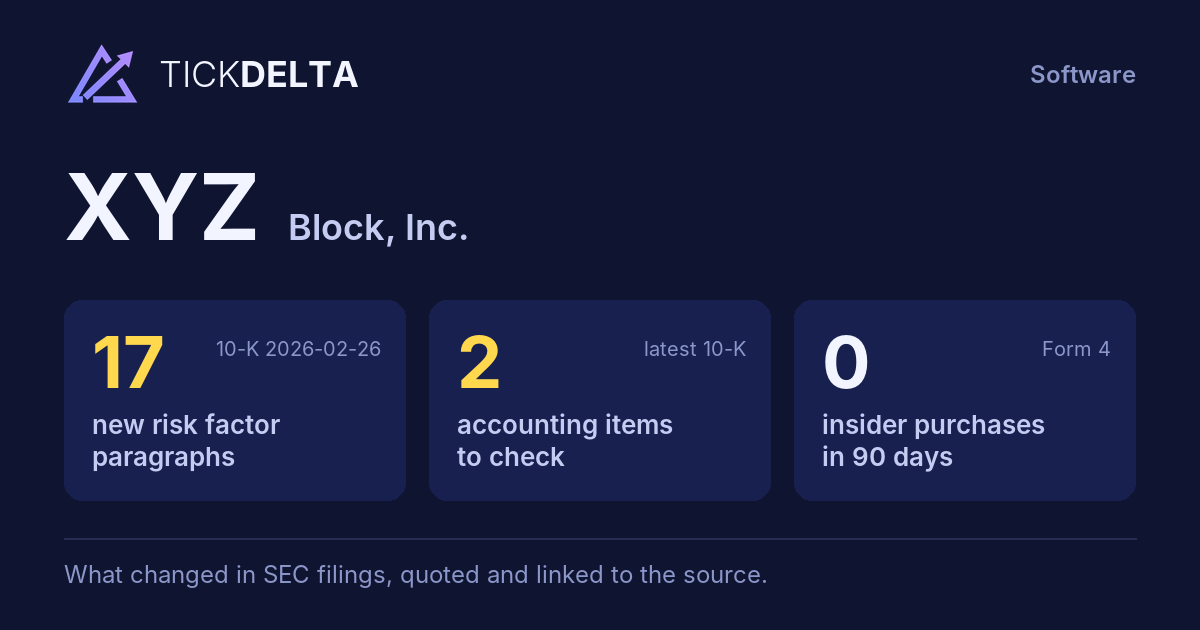
10-K 0001628280-26-012254 (2026-02-26) vs 10-K 0001628280-25-007376 (2025-02-24)
| Section | Compared text | Words now | Changed |
|---|
| Risk Factors | Item 1A | 27,235 |
11.5% |
| MD&A | Item 7 | 10,007 |
22.8% |
| Legal Proceedings | Item 3, via Note 19 – COMMITMENTS AND CONTINGENCIES | 1,345 |
35.4% |
| Accounting Policies | Item 8, Note 1 – DESCRIPTION OF BUSINESS AND SUMMARY OF SIGNIFICANT ACCOUNTING POLICIES | 10,185 |
11.0% |
The redline: what was cut and what was added
In each section, the paragraph that changed most, marked against last year's 10-K:
cut words struck through, new words highlighted and underlined.
Risk Factors 328 words changed in this paragraph; it is 32% similar to last year's version.
Revenue generated by our loan products such as Square Loans, as well as Cash App Borrow, and our BNPL products depends on our ability to recoup the loan amount. Loan amount and to effectively manage risk. Square Loans is our commercial lending program. Cash App Borrow is a consumer credit product, allowing our Cash App customers access to short-term loans for a fee. Our BNPL products facilitate commerce between retail merchants and consumers by allowing retail merchant clients to offer their customers the ability to buy goods and services on a BNPL basis. Our loan products are generally unsecured obligations of our borrowers, borrowers. To the extent a seller breaches a contractual obligation, such as the requirement to make minimum payments or other breach, the seller would be liable for an accelerated business loan repayment, and they are our recourse is generally to the business and not guaranteed to any individual or insured in any way. other asset. Although we rely on technology to assess repayment capability for these our loan products, there can be no guarantee that such assessment processes will always accurately predict repayments. Miscalculation If our underwriting processes fail to adequately capture risks or otherwise miscalculate repayment ability, we may experience higher levels of delinquencies, default and credit losses. As we expand into new products, customer segments, and geographies, including offering existing products to borrowers on different repayment ability terms or a material increase in expanding product eligibility, or as inflation, economic downturns, or market volatility increases repayment failures, whether due our ability to inflation, macroeconomic uncertainty appropriately evaluate and downturn, market volatility, manage credit risk may be further challenged, and we may experience higher levels of delinquencies or otherwise, may adversely affect defaults than we have historically experienced, which could negatively impact our business, results of operations, and financial condition. If consumers who have purchased products or services using our BNPL platform do not receive the products or services, they may also cease payment on their outstanding balances or request a refund on previous payments, and our business may be negatively impacted. If a merchant ceases its operations, closes some or all of its locations, or fails to deliver goods or services to our BNPL customers, the merchant may not be able to reimburse us for chargebacks or refunds or may not be able to repay the funds we have advanced to them, all of which could result in higher charge-off rates than anticipated.
Source: Item 1A, 10-K 0001628280-26-012254 vs Item 1A, 10-K 0001628280-25-007376
Legal Proceedings 259 words changed in this paragraph; it is 45% similar to last year's version.
In June 2024, the Office of the Treasurer and Tax Collector of the City and County of San Francisco (the "Tax Collector") finalized its audit and issued an assessment of San Francisco’s Francisco gross receipts tax, including interest and penalties, following its gross receipt tax audit for fiscal years 2020, 2021 and 2022. The Tax Collector has asserted that 2020 through 2022, asserting the Company owes incremental taxes are owed on a portion of the receipts generated by the Company related to sales of Bitcoin. bitcoin. The Company paid the assessed amount of $71.4 million in January 2025. In September 2025, the Tax Collector issued an assessment of gross receipt tax, including tax, interest, and penalties, of $42.7 million for fiscal years 2023 and 2024, which the Company paid in October 2025. In both cases, the Company paid the assessment in order to preserve its rights to dispute the assessments and initiate the dispute process. The Company strongly disagrees with the Tax Collector’s assessment assessments and plans to vigorously pursue all available remedies. In January 2025, the Tax Collector rejected the Company’s request for redetermination, and the Company paid Given the assessed amount of $71.4 million and plans to file a claim for a refund. Given the amount amounts must be paid to initiate the dispute process and will be returned in full or used to settle any final amount due to the Tax Collector, the Company views the amount amounts as a deposit asset in the period the payment is made. Should the Company not reach a settlement or prevail in its legal challenge, the Tax Collector may challenge the Company’s gross receipts tax position going forward, including for 2023 and 2024. The Company estimates that it could incur losses associated with taxes, interest, and penalties that range from approximately $0 to $97 million in the aggregate for the fiscal years 2020, 2021, 2022, 2023 and 2024. Additional taxes, interest, and penalties for future periods could be material as well. Given the Company has concluded that a loss for this matter is not probable, the Company has not recorded a liability for the exposure related to the dispute with the Tax Collector on San Francisco’s gross receipts tax. assets.
Source: Item 3, via Note 19 – COMMITMENTS AND CONTINGENCIES, 10-K 0001628280-26-012254 vs Item 3, via Note 19 – COMMITMENTS AND CONTINGENCIES, 10-K 0001628280-25-007376
MD&A 224 words changed in this paragraph; it is 44% similar to last year's version.
Starting in 2023, we sharpened our focus on our organizational structure and expenditures with a view to identifying areas where we can be more cost efficient as we focus on disciplined growth and pursuing cost efficiencies. In 2023, we also announced we would implement an absolute cap of 12,000 on the number of employees we have at our company, which we have achieved in 2024, and we plan to continue to operate below this cap through a combination of performance management, centralization of teams and functions to reduce duplication, and prioritization of our scope. In 2024, we continued to make growth. We made progress on our cost efficiency goals in 2025, and we expect to continue these efforts. For the year ended December 31, 2025 and 2024, we recorded $78.6 million and $26.8 million of severance and other expenses related to these efforts, including implementing greater expense discipline respectively. In February 2026, we announced a workforce reduction restructuring plan (the “Workforce Plan”) designed to better align our organizational structure with our operating model and reassessing certain contractual vendor arrangements. strategic priorities. As part of the Workforce Plan, we expect to reduce our current workforce by more than 40%. We may expect that the execution of the Workforce Plan will be substantially complete by the end of the second quarter of fiscal 2026. We will continue to incur expenses, including additional restructuring costs, in the short term to implement these initiatives. We continue expect to realize benefits related to our focus on disciplined growth and cost efficiencies efficiencies, and we expect to continue to benefit from these actions in future periods. We plan to continue to operate at this smaller size and are continuing to look at ways to improve our efficiency through a combination of AI automation, prioritization of our scope, performance management, and centralization of teams and functions to reduce duplication.
Source: Item 7, 10-K 0001628280-26-012254 vs Item 7, 10-K 0001628280-25-007376
Accounting Policies 164 words changed in this paragraph; it is 31% similar to last year's version.
In November 2023, September 2025, the FASB issued ASU No. 2023-07, 2025-06, Targeted Improvements to Reportable Segment Disclosures (“ASU 2023-07”). the Accounting for Internal-Use Software ("ASU 2025-06"). The amendments expand segment disclosures by requiring disclosure of significant segment expenses that are regularly provided intended to clarify and modernize the CODM, accounting for costs related to internal-use software. The guidance removes all references to project stages and clarifies the amount and description of other segment items, permits companies threshold entities apply to disclose more than one measure of segment profit or loss, and requires all annual segment disclosures to be included in the interim periods. begin capitalizing costs. The amendments do not change how an entity identifies its operating segments, aggregates are effective for fiscal years beginning after December 15, 2027, and interim periods within those operating segments, or applies quantitative thresholds to determine its reportable segments. fiscal years, with early adoption permitted. The Company adopted this guidance effective for does not expect the annual reporting period beginning January 1, 2024, and has applied the guidance retrospectively. The adoption of this guidance did not to have a material impact on the Company's financial statements and related disclosures. Refer to Note 20, Segment and Geographical Information for further details. statements.
Source: Item 8, Note 1 – DESCRIPTION OF BUSINESS AND SUMMARY OF SIGNIFICANT ACCOUNTING POLICIES, 10-K 0001628280-26-012254 vs Item 8, Note 1 – DESCRIPTION OF BUSINESS AND SUMMARY OF SIGNIFICANT ACCOUNTING POLICIES, 10-K 0001628280-25-007376
Every change, by type
Sentences and paragraphs of XYZ's Risk Factors and MD&A, 10-K 2026-02-26 against 10-K 2025-02-24.
Each links to the text at sec.gov.
Quiet changes are sentences kept from last year with one to four words changed, at least one of them a hedge, a modal or a qualifier
(may, could, will, not, significant, material…). A year or date rolling forward is not counted.
The full word list
adverse, adversely, all, although, anticipate, anticipates, any, approximately, believe, believes, can, cannot, certain, could, expect, expects, generally, however, if, intend, intends, largely, likely, many, material, materially, may, might, most, must, never, no, not, possible, primarily, probable, should, significant, significantly, some, substantial, substantially, unlikely, will, would
AddedRisk Factors
•our recently announced workforce reduction and related reorganization, including the potential for increased reliance on proactive intelligence and artificial intelligence tools;
Read it in 10-K 2026-02-26 at sec.gov ↗
AddedRisk Factors
•obligations and restrictions as a licensed money transmitter and virtual currency business;
Read it in 10-K 2026-02-26 at sec.gov ↗
AddedRisk Factors
Our recently announced workforce reduction and related reorganization, including the potential for increased reliance on proactive intelligence and artificial intelligence tools, may not achieve their intended benefits and could adversely affect our business, financial condition and results of operations.
Read it in 10-K 2026-02-26 at sec.gov ↗
AddedRisk Factors
In February 2026 we announced a workforce reduction restructuring plan designed to better align our organizational structure with our operating model and strategic priorities. As part of this plan, we expect an increased reliance on automation, proactive intelligence capabilities and AI tools that we believe will enhance productivity and maintain operational efficiency. In addition, these actions will result in severance and other restructuring charges, and may require additional investments in technology and systems. We may not realize the expected cost savings, operating efficiencies or other anticipated benefits of these initiatives within the anticipated timeframe, or at all.
Read it in 10-K 2026-02-26 at sec.gov ↗
AddedRisk Factors
The workforce reduction and reorganization may disrupt our operations and adversely affect employee morale and productivity. The departure of employees, including experienced personnel, may result in the loss of institutional knowledge and expertise, and remaining employees may experience increased workloads, which could lead to increased error rates, reduced innovation and attrition of key talent. Our ability to successfully operate with a reduced workforce is expected to depend in part on the effectiveness, reliability and adoption of our proactive intelligence and AI tools. These technologies may not perform as expected, may require more time or expense to implement effectively, may introduce operational or cybersecurity risks, or may fail to enhance productivity and maintain operational efficiency as expected. These actions could increase the risk of operational disruptions, service interruptions, control failures or other significant events, particularly during transition periods, as responsibilities are reassigned and processes are adjusted. We expect to continue to invest in employees we wish to retain and attract, including through increased compensation. In addition, evolving regulatory requirements and public scrutiny relating to AI technologies could increase compliance costs or limit our ability to deploy such tools as intended.
Read it in 10-K 2026-02-26 at sec.gov ↗
AddedRisk Factors
We may also incur additional costs not currently contemplated, including costs related to technology implementation, operational disruptions, employee claims, regulatory compliance, or other matters arising from the workforce reduction and reorganization. We may also suffer indirect harm to our business as a result of reputational harm or concerns our customers have regarding the use of AI. Any failure to successfully implement these actions, or any unintended consequences resulting from them, could result in delays in product development or strategic initiatives and could materially and adversely affect our business, financial condition and results of operations.
Read it in 10-K 2026-02-26 at sec.gov ↗
AddedRisk Factors
In addition, any reassignment of responsibilities, together with potential increased reliance on automation and AI tools to support certain legal, regulatory compliance and risk management functions, may limit our capacity and introduce additional oversight risks. If such tools do not perform as anticipated or are not effectively implemented and monitored, our ability to maintain effective governance, compliance, and risk processes during and after the transition could be impaired, which could increase the risk of regulatory inquiries, investigations, litigation, enforcement actions, control deficiencies and penalties.
Read it in 10-K 2026-02-26 at sec.gov ↗
AddedRisk Factors
The development and use of AI in our products may result in reputational and competitive harm and could adversely impact our business.
Read it in 10-K 2026-02-26 at sec.gov ↗
AddedRisk Factors
We have incorporated and expect to continue to incorporate AI technologies, including generative AI and AI agents, into our products and technologies. Our use of AI depends on third-party large language models that we do not control, and these models may generate inaccurate, biased, or unexpected outputs that conflict with our business objectives or brand standards.
Read it in 10-K 2026-02-26 at sec.gov ↗
AddedRisk Factors
Consumer and societal attitudes toward AI are evolving and there is a risk that customers, regulators or the public may perceive AI technologies negatively. Concerns about automation, privacy, security, bias, transparency, flawed datasets, or other ethical considerations could reduce trust in our products and services or deter customer adoption of AI-enabled features in our products or services. Our customers and sellers may become increasingly reliant on AI outputs in our products and services when making financial or operational decisions. AI-enabled features in our products may generate outputs that could be interpreted as regulated advice, even if unintended or automated. If such AI outputs are, or are perceived to be, inaccurate, biased, flawed, or otherwise determined as providing regulated advice without appropriate authorization, we could face reputational harm, regulatory scrutiny, enforcement actions or liability claims, any of which could materially and adversely affect our business, financial condition, and results of operations.
Read it in 10-K 2026-02-26 at sec.gov ↗
AddedRisk Factors
Our ability to develop and deploy AI features depends on the availability and pricing of third-party AI models, tools, and technical infrastructure, and increases in such costs or constraints on availability could adversely affect our ability to scale and our business. Further, evolving and inconsistent legal frameworks governing AI across different jurisdictions, such as the EU AI Act, other international regimes, and emerging U.S. state regulations may create conflicting compliance obligations, all of which may impose additional costs on us, increase our risk of liability and fines, and may require us to modify, limit, or withdraw certain AI-enabled products or services in particular markets, and adversely affect our ability to scale globally.
Read it in 10-K 2026-02-26 at sec.gov ↗
AddedRisk Factors
Our AI initiatives may not improve efficiency, performance, or profitability as expected, and may underperform or fail entirely due to technological limitations, regulatory requirements, or other factors. If our investments in AI do not produce expected benefits, our operating results and long-term growth could be materially and adversely affected.
Read it in 10-K 2026-02-26 at sec.gov ↗
RemovedRisk Factors
Square Loans is our commercial lending program. Adverse changes in macroeconomic conditions or the credit quality of our sellers could cause some sellers who utilize Square Loans to cease operating or to experience a decline in their payment processing volume, thereby rendering them unable to make payment on the business loan and/or extend the repayment period beyond the contractual repayment terms on the business loan. To the extent a seller breaches a contractual obligation, such as the requirement to make minimum payments or other breach, the seller would be liable for an accelerated business loan repayment, where our recourse is to the business and not to any individual or other asset. In addition, because the servicing fees we receive from third-party investors depend on the repayment of the business loans, if there is an increase in sellers who utilize Square Loans who are unable to repay their business loans, we will be unable to collect our entire servicing fee for such loans. While our exposure to loans that we sell to third parties is more limited, if the sellers who utilize Square Loans are unable to repay their loans, the risk of loss in our owned loan portfolio will increase and our business may be adversely affected. Square Financial Services, as the originator of the loans provided by Square Loans in the U.S., is subject to additional risks described elsewhere in this Annual Report on Form 10-K.
Read it in 10-K 2025-02-24 at sec.gov ↗
RemovedRisk Factors
If we fail to successfully operate and grow our TIDAL business, we will not realize the benefits anticipated when we acquired a majority interest in the business, and any such failure could result in adverse effects on our business and financial results.
Read it in 10-K 2025-02-24 at sec.gov ↗
RemovedRisk Factors
We may have exposure to greater-than-anticipated tax liabilities, which may materially and adversely affect our business.
Read it in 10-K 2025-02-24 at sec.gov ↗
RemovedRisk Factors
We are subject to income taxes and non-income taxes in the United States and other countries in which we transact or conduct business, and such laws and rates vary by jurisdiction. We are subject to review and audit by U.S. federal, state, local, and foreign tax authorities. Such tax authorities have in the past disagreed, and may in the future disagree, with tax positions we take, and if any such tax authority were to successfully challenge any such position, our financial results and operations could be materially and adversely affected. For example, in June 2024, the Office of the Treasurer and Tax Collector of the City and County of San Francisco (the "Tax Collector") finalized its audit and issued an assessment of San Francisco’s gross receipts tax, including interest and penalties, following its gross receipt tax audit for fiscal years 2020, 2021 and 2022. The Tax Collector has asserted that incremental taxes are owed on a portion of the receipts generated by the Company related to sales of Bitcoin. The Company strongly disagrees with the Tax Collector’s assessment and plans to vigorously pursue all available remedies. In January 2025, the Tax Collector rejected the Company’s request for redetermination, and in January 2025 the Company paid the assessed amount of $71.4 million and plans to file a claim for a refund. Should the Company not reach a settlement or prevail in its legal challenge, the Tax Collector may challenge the Company’s gross receipts tax position going forward, including for 2023 and 2024. In addition, we currently are, and expect to continue to be, subject to numerous federal, state, local and foreign tax audits relating to transfer pricing, income, sales and use, gross receipts, franchise, value-added (“VAT”), and other tax liabilities. While we have established reserves based on assumptions and estimates that we believe are reasonably sufficient to cover such eventualities, any adverse outcome of such a review or audit could have an adverse impact on our financial position and results of operations if the reserves prove to be insufficient.
Read it in 10-K 2025-02-24 at sec.gov ↗
RemovedRisk Factors
Our tax liability could be adversely affected by changes in tax laws, rates, regulations, and administrative practices. For example, various levels of government and international organizations, such as in the United States, the Organisation for Economic Co-operation and Development (“OECD”), and the European Union (“EU”), have increasingly focused on tax reform and any result from this development may create changes to long-standing tax principles, which could adversely affect our effective tax rate. On October 8, 2021, the OECD announced an international agreement with more than 130 countries to implement a new global minimum effective corporate tax rate of 15% (known as "Pillar Two") for large multinational companies with certain aspects of Pillar Two effective January 1, 2024 and other aspects effective January 1, 2025. Countries we operate in have adopted or intend to adopt laws to implement this initiative. Such countries and organizations are also actively considering changes to existing tax laws or have proposed or enacted new laws that could increase our tax obligations in countries where we do business or cause us to change the way we operate our business.
Read it in 10-K 2025-02-24 at sec.gov ↗
RemovedRisk Factors
On August 16, 2022, the Inflation Reduction Act was enacted in the United States, which introduced, among provisions, a new minimum corporate income tax on certain large corporations, an excise tax of 1% on certain share repurchases by corporations, and increased funding for the Internal Revenue Service. Although we do not anticipate the new corporate minimum income tax will currently apply to us, we may be subject to the corporate minimum income tax in the future due to changes in our financial results, business and any future regulations or other guidance on the interpretation and application of the new corporate minimum tax. We currently have a share repurchase program and we may enter into share repurchase programs in the future. The new minimum corporate income tax and 1% excise tax on share repurchases may result in additional taxes payable by us, which could materially and adversely affect our financial results and operations.
Read it in 10-K 2025-02-24 at sec.gov ↗
RemovedRisk Factors
Our income tax obligations are based on our corporate operating structure, including the manner in which we develop, value, and use our intellectual property and the scope of our international operations. The tax authorities of the jurisdictions in which we operate may challenge our methodologies for valuing developed technology or intercompany arrangements. Additionally, tax authorities at the international, federal, state, and local levels are currently reviewing the appropriate tax treatment of companies engaged in internet commerce and financial technology and attempting to broaden the classification and definitions of activities subject to taxation. For example, various states may attempt to broaden the definition of internet hosting, data processing, telecommunications, and other services to capture additional types of activities. These developing changes could affect our financial position and results of operations. In particular, it is possible that tax authorities at the international, federal, state, and local levels may attempt to regulate our transactions or levy new or revised sales and use taxes, gross receipts, franchise, VAT, digital services taxes, digital advertising taxes, income taxes, loan taxes, streaming taxes, or other taxes relating to our activities, which would likely increase the cost of doing business. New taxes could also create significant increases in internal costs necessary to capture data and collect and remit taxes. Proposed or enacted laws regarding tax compliance obligations could require us to make changes to our infrastructure or increase our compliance obligation. Any of these events could have an adverse effect on our business and results of operations. Moreover, an increasing number of states, the U.S. federal government, and certain foreign jurisdictions have considered or adopted laws or administrative practices that impose obligations for on-demand and streaming services, online marketplaces, payment service providers and other intermediaries. These obligations may deem parties, such as us, to be the legal agent of merchants and therefore may require us to collect and remit taxes on the merchants' behalf and take on additional reporting and record-keeping obligations. For example, the American Rescue Plan Act of 2021 requires businesses that process payments to report payments for goods and services on Form 1099-K when those transactions total more than $600 in a year for a given seller, which reporting requirement applies to Square and Cash App for Business accounts. However, the IRS has delayed the $600 threshold for 2023 and prior tax years and affected businesses are only required to send out Forms 1099-K to taxpayers who receive over $20,000 and have over 200 transactions in those years. According to IRS guidance released in 2024, the threshold for reporting is $5,000 for 2024, $2,500 for 2025, and $600 for 2026. Any failure by us to prepare for and to comply with these and similar reporting and record-keeping obligations could result in substantial monetary penalties and other sanctions, adversely impact our ability to do business in certain jurisdictions, and harm our business.
Read it in 10-K 2025-02-24 at sec.gov ↗
RewordedRisk Factors
If such third parties fail to continue to purchase such business loans Square Loans, or reduce the amount of future loans Square Loans they purchase, purchase or reduce the price they are willing to pay for the Square Loans, then we may need to reduce originations, or we would need to fund the origination or purchase of additional business loans from Square Loans using other sources of financing, all of which could adversely impact our own resources. business.
Read it in 10-K 2026-02-26 at sec.gov ↗
RewordedRisk Factors
As of December 31, 2024, 2025, we had $1.0 billion in aggregate principal amount of 2025 Convertible Notes, $575.0 million in outstanding aggregate principal amount of 2026 Convertible Notes, $575.0 million outstanding aggregate principal amount of 2027 Convertible Notes, $1.0 billion in outstanding aggregate principal amount of 2026 Senior Notes, $1.2 billion outstanding aggregate principal amount of 2030 Senior Notes, $1.0 billion in outstanding aggregate principal amount of 2031 Senior Notes, and $2.0 billion in outstanding aggregate principal amount of 2032 Senior Notes, and $1.0 billion outstanding aggregate principal amount of 2033 Senior Notes.
Read it in 10-K 2026-02-26 at sec.gov ↗
RewordedRisk Factors
Further, our plan to continue to cap our employee base at approximately 12,000, recent changes in our organizational structure, and any other future plans to restructure restructurings of our employee base to improve operational efficiencies we have undertaken and operating costs, may undertake in the future may adversely impact employee morale, and adversely affect our ability to retain or attract highly skilled employees.
Read it in 10-K 2026-02-26 at sec.gov ↗
RewordedRisk Factors
We may not be able to secure financing on favorable terms, or at all, to meet our future capital needs, and our existing credit agreement and our Senior Notes contain, and any future debt financing may contain, covenants that impact the operation of our business and pursuit of business opportunities. needs.
Read it in 10-K 2026-02-26 at sec.gov ↗
RewordedRisk Factors
In addition, any perceived or actual failure by us to comply with applicable laws, rules, regulations, standards or consent orders orders, including any perception that the risk of such a failure by us has increased, could have a significant impact on our reputation as a trusted brand and could cause increased regulatory scrutiny, including the imposition or extension of regulatory obligations, could cause us to lose existing customers, prevent us from obtaining new customers, require us to expend significant funds to remedy issues identified by regulators, and expose us to legal risk and potential criminal and civil liability.
Read it in 10-K 2026-02-26 at sec.gov ↗
RewordedRisk Factors
While In addition, we maintain a program of self-insure (including through captive insurance coverage for various types of liabilities, we may self-insure against certain business risks and expenses arrangements) where we believe we can adequately self-insure against the anticipated exposure and risk or where insurance is either not deemed cost-effective or is unavailable.
Read it in 10-K 2026-02-26 at sec.gov ↗
RewordedRisk Factors
Prior to our adoption of ASU Accounting Standards Update 2023-08, Accounting "Accounting for and Disclosure of Crypto Assets Assets", which added Subtopic Accounting Standards Codification 350-60, “Intangibles - Goodwill and Other - Crypto Asset”, to the accounting standards codification (“ASU 2023-08”), our bitcoin was accounted for as an indefinite-lived intangible asset and for each reporting period, we were required to evaluate our bitcoin for impairment and record impairment losses if the fair value decreased below the carrying value during the assessed period.
Read it in 10-K 2026-02-26 at sec.gov ↗
RewordedRisk Factors
In the U.K., personal data generally may be transferred from the EU to the U.K. without restriction pursuant to an adequacy decision issued by the European Commission under the GDPR and the Law Enforcement Directive, subject which was renewed in 2025 to a four-year “sunset” period that expires in 2025, after which the European Commission’s adequacy decision may be renewed. extend through December 2031.
Read it in 10-K 2026-02-26 at sec.gov ↗
RewordedRisk Factors
For example, we have implemented, and may in the future implement, expense cuts and reduced reductions in the size of our workforce to, among other things, align our cost structure with our business and longer term strategies, which may increase expenses in the short term and impact our ability to grow or quickly develop and introduce products. strategies.
Read it in 10-K 2026-02-26 at sec.gov ↗
RewordedRisk Factors
These laws, rules, regulations, and standards are enforced by multiple authorities and governing bodies in the United States, including federal agencies, such as the FDIC, the SEC, FinCEN, the Consumer Financial Protection Bureau ("CFPB"), the Department of Justice ("DOJ") ("DOJ"), the Federal Trade Commission, the IRS and Office of Foreign Assets Control, self-regulatory organizations, and numerous state and local agencies, such as the Utah Department of Financial Institutions. state money transmission license regulators and virtual currency regulators.
Read it in 10-K 2026-02-26 at sec.gov ↗
RewordedRisk Factors
Any negative publicity about the industries we operate in or our company, the quality and reliability of quality, reliability, or the way in which we market, disclose, or represent our products and services, our risk management processes, changes to our products and services, our ability to effectively manage and resolve customer complaints, our privacy, data protection, and information security practices, litigation, regulatory activity, policy positions, and the experience of our sellers sellers, customers, employees and customers former employees with us, our products or services could adversely affect our reputation and the confidence in and use of our products and services.
Read it in 10-K 2026-02-26 at sec.gov ↗
RewordedRisk Factors
If we are not successful in developing and implementing the right processes and tools to manage our enterprise, our ability to compete successfully and achieve our business objectives could be impaired. impaired, we could face regulatory or other enforcement actions, and our business, results of operations, and financial condition may be adversely impacted.
Read it in 10-K 2026-02-26 at sec.gov ↗
Quiet changesRisk Factors
If the costs associated with acquiring and supporting new or larger sellers, attracting and supporting new Cash App customers, or with developing and supporting products, services and technologies materially increase in the future, including the fees we pay to third parties to advertise our products and services and compliance costs, our total expenses may rise significantly.
Read it in 10-K 2026-02-26 at sec.gov ↗
Quiet changesRisk Factors
Deterioration Any deterioration in the cryptocurrency markets may also have an adverse effect on our reputation, and any negative perception by our customers of one or more cryptocurrencies, or our bitcoin operations, may lead to a loss of customer demand for our products and services, any of which could have an adverse impact on our business and financial condition.
Read it in 10-K 2026-02-26 at sec.gov ↗
Quiet changesRisk Factors
We serve sellers across a variety of industry verticals and in an economic downturn, certain verticals, particularly those that may be are viewed as discretionary by consumers, may be impacted to a greater degree than others, which may harm our business and financial results.
Read it in 10-K 2026-02-26 at sec.gov ↗
Quiet changesRisk Factors
Further, we might may need to make other changes to our business operations, our products or our services as a result of changes in laws, regulations, standards, or decisions made by governing or regulatory authorities, all of which could cause the price of our Class A common stock to decrease.
Read it in 10-K 2026-02-26 at sec.gov ↗
AddedMD&A
In 2025, we generated gross profit of $10.4 billion, up 17% year over year. Cash App generated gross profit of $6.3 billion in 2025, up 21% year over year, primarily driven by growth in Cash App Borrow. Square generated gross profit of $3.9 billion in 2025, up 9% year over year, driven by financial solutions, most notably Square Loans.
Read it in 10-K 2026-02-26 at sec.gov ↗
AddedMD&A
Financial solutions revenue is primarily comprised of revenue the Company generates from Cash App Borrow, Cash App Instant Deposit, ATM withdrawal fees, interest earned on customer funds, and Square Loans.
Read it in 10-K 2026-02-26 at sec.gov ↗
AddedMD&A
•a decrease in expenses related to litigation and regulatory matters for the year ended December 31, 2025. These expenses during the year ended December 31, 2024 were primarily driven by estimated and settled amounts in connection with certain litigation and regulatory matters that did not recur during the year ended December 31, 2025;
Read it in 10-K 2026-02-26 at sec.gov ↗
AddedMD&A
•impairment charges recognized during the year ended December 31, 2024 related to our TIDAL reporting unit that did not recur during the year ended December 31, 2025; partially offset by
Read it in 10-K 2026-02-26 at sec.gov ↗
AddedMD&A
•an increase in personnel costs of $71.4 million, primarily driven by increased employee travel as well as restructuring costs, including severance and other related expenses, recognized during the year ended December 31, 2025.
Read it in 10-K 2026-02-26 at sec.gov ↗
AddedMD&A
(i) Amounts do not include reserves for certain receivables, such as late fees. Consumer receivables losses also includes provision for charge-back losses that are realized and written-off within the same period, rather than through the allowance for consumer receivable losses.
Read it in 10-K 2026-02-26 at sec.gov ↗
AddedMD&A
•Loan losses increased by $497.8 million, or 154%, compared to the year ended December 31, 2024. The increase in loan losses was driven by significant growth in loan volumes, particularly from Cash App Borrow, which increased 143% compared to the year ended December 31, 2024, as well as Square Loans, while loan loss rates remained stable. Additionally, beginning in the second quarter of 2025, Cash App Borrow, along with certain other loan products, were retained on our balance sheet and classified as held for investment, resulting in upfront recognition of expected credit losses upon origination.
Read it in 10-K 2026-02-26 at sec.gov ↗
AddedMD&A
Year Ended December 31, 2025 2024 $ Change % Change Remeasurement loss (gain) on bitcoin investment $ 55,900 $ (420,918) $476,818 (113)%
Read it in 10-K 2026-02-26 at sec.gov ↗
AddedMD&A
Beginning in fiscal 2025, we revised our definition of Adjusted Net Income Per Share ("Adjusted EPS") to include share-based compensation. We believe this change provides a more comprehensive view of our operating performance and also aligns with our non-GAAP measure of Adjusted Operating Income. Prior period amounts have been recast to reflect the updated presentation.
Read it in 10-K 2026-02-26 at sec.gov ↗
AddedMD&A
In February 2026 we announced the Workforce Plan designed to better align our organizational structure with our operating model and strategic priorities. We currently expect to incur charges of $450 million to $500 million in connection with the Workforce Plan, consisting primarily of cash expenditures for notice period and severance payments, employee benefits, and related costs as well as non-cash expenses related to vesting of share-based awards. We expect that the majority of the restructuring charges will be incurred in the first quarter of fiscal 2026, and that the execution of the Workforce Plan will be substantially complete by the end of the second quarter of fiscal 2026. The Company’s estimates are subject to a number of assumptions, and the actual costs incurred may differ materially from those initial estimates.
Read it in 10-K 2026-02-26 at sec.gov ↗
AddedMD&A
Beginning in the second quarter of 2025, we began originating Cash App Borrow loans through Square Financial Services, which are classified as loans held for investment. Additionally, beginning July 1, 2025, Cash App Borrow loans and certain other customer loan products purchased from our bank partner, along with customer loan products originated through Square Financial Services, are retained on the Company's balance sheet and classified as held for investment. Cash flows associated with these loans, including originations and principal repayments, are included within cash flows from investing activities.
Read it in 10-K 2026-02-26 at sec.gov ↗
RemovedMD&A
We delivered strong growth across our primary ecosystems in 2024, with gross profit of $8.9 billion, up 18% year over year. Cash App generated gross profit of $5.2 billion in 2024, up 21% year over year. Performance was driven by growth in inflows per active as we execute on our Bank Our Base strategy, which prioritizes engaging customers with more products across our ecosystem and increasing paycheck deposit actives. Square generated gross profit of $3.6 billion in 2024, up 15% year over year, as we continued to increase product velocity and optimize our go-to-market strategies.
Read it in 10-K 2025-02-24 at sec.gov ↗
RemovedMD&A
Refer to the Key Operating Metrics and Non-GAAP Financial Measures section below for reconciliations of non-GAAP financial measures to their nearest generally accepted accounting principles ("GAAP") equivalents.
Read it in 10-K 2025-02-24 at sec.gov ↗
RemovedMD&A
Hardware costs consist primarily of product costs associated with magstripe readers, contactless and chip readers, Square Stand, Square Register, Square Terminal, and third-party peripherals. Product costs include manufacturing-related overhead and personnel-related costs, certain royalties, packaging, and fulfillment costs. Hardware is sold primarily as a means to grow our transaction-based revenue and, as a result, generating positive gross margins from hardware sales is not the primary goal of the hardware business.
Read it in 10-K 2025-02-24 at sec.gov ↗
RemovedMD&A
•a decrease in personnel costs of $169.4 million due to a decrease in headcount as well as a reduction of facilities and other expenses of $59.5 million for the year ended December 31, 2024;
Read it in 10-K 2025-02-24 at sec.gov ↗
RemovedMD&A
•an increase in accrued expenses for estimated and settled amounts in connection with certain litigation and regulatory matters of $231.9 million. Refer to Note 19, Commitments and Contingencies within Notes to the Consolidated Financial Statements for more details; and
Read it in 10-K 2025-02-24 at sec.gov ↗
RemovedMD&A
•a charge of $32.2 million related to adjustments of certain TIDAL acquisition deferred purchase consideration during the first quarter of 2024, as well as a derecognition of $15.1 million during the second quarter of 2024 of certain indemnification assets related to the TIDAL acquisition which were deemed no longer recoverable.
Read it in 10-K 2025-02-24 at sec.gov ↗
RemovedMD&A
•a decrease in transaction losses of $87.7 million for the year ended December 31, 2024. The decrease in transaction losses is attributable to both an operational outage in the third quarter of 2023, which resulted in higher transaction losses incurred, as well as a release of previously established risk loss provisions in the second quarter of 2024 related to prior periods.
Read it in 10-K 2025-02-24 at sec.gov ↗
RemovedMD&A
Adjusted EBITDA, Adjusted Net Income Per Share ("Adjusted EPS") and Adjusted Operating Income
Read it in 10-K 2025-02-24 at sec.gov ↗
RemovedMD&A
In the fourth quarter of 2024, based on the relative weight of positive and negative evidence, including the amount of our taxable income in 2024, and consideration of our expected future taxable earnings, we concluded that it is more likely than not that a material portion of our U.S. federal and certain state deferred tax assets are realizable. Therefore, we released the valuation allowance associated with a material portion of our U.S. federal and certain states' deferred tax assets, resulting in a $1.3 billion non-cash benefit to the provision for income taxes.
Read it in 10-K 2025-02-24 at sec.gov ↗
RemovedMD&A
We have retained a full valuation allowance against California deferred tax assets which primarily consists of tax loss carryovers and tax credit carryovers. We do not have sufficient evidence of future income to realize the California deferred tax assets on a more likely than not basis.
Read it in 10-K 2025-02-24 at sec.gov ↗
RewordedMD&A
Year Ended December 31, 2024 2023 2022 Net income (loss) attributable to common stockholders $ 2,897,047 $ 9,772 $ (540,747) Net loss attributable to noncontrolling interests (1,426) (30,550) (30,896) (12,258) Net income (loss) 1,304,210 2,866,497 (21,124) (553,005) Share-based compensation expense 1,264,486 1,276,097 1,069,289 Restructuring share-based compensation expense 8,071 — — Acquisition-related and integration costs 2,059 49,019 11,422 105,518 Contingencies, restructuring and other charges 168,509 302,446 239,582 51,746 Restructuring share-based compensation expense 12,260 8,071 — Goodwill and intangible asset impairment — 133,854 132,313 — Amortization of intangible assets 192,579 223,072 246,873 208,952 Amortization of debt discount and issuance costs 13,499 14,413 11,904 15,162 Loss (gain) on revaluation of equity investments (172,256) (32,245) 16,523 (73,457) Remeasurement gain loss (gain) on bitcoin investment 55,900 (420,918) (207,084) — Bitcoin impairment losses — — 46,571 Loss on disposal of property and equipment 2,546 2,634 3,186 1,619 Acquired deferred revenue and cost adjustment 39 67 99 230 Tax effect of one-time income Income tax benefits from deferred tax assets (58,196) (1,909,848) — — Tax effect of non-GAAP net income adjustments (360,782) (582,703) (264,523) (43,761) 2,854 (173,748) Adjusted Net Income - basic $ 2,140,766 1,477,388 $ 1,127,088 1,239,916 $ 608,102 259,946 Cash interest expense on convertible notes 1,244 2,711 3,554 5,014 Adjusted Net Income - diluted $ 2,143,477 1,478,632 $ 1,130,642 1,242,627 $ 613,116 263,500 Weighted-average shares used to compute Adjusted Net Income Per Share:
Read it in 10-K 2026-02-26 at sec.gov ↗
RewordedMD&A
As of December 31, 2024, 2025, we held $6.2 $7.4 billion in aggregate principal amount of debt, comprised of, $1.0 billion in aggregate amount of convertible senior notes that mature on March 1, 2025 ("2025 Convertible Notes"), $575.0 million in aggregate amount of convertible senior notes that mature on May 1, 2026 ("2026 Convertible Notes"), and $575.0 million in aggregate amount of convertible senior notes that mature on November 1, 2027 ("2027 Convertible Notes," collectively referred to as the “Convertible Notes”), as well as an outstanding $1.0 billion in aggregate principal amount of senior unsecured notes that mature on June 1, 2026 ("2026 Senior Notes"), $1.2 billion in aggregate principal amount of senior unsecured notes that mature on August 15, 2030 ("2030 Senior Notes"), $1.0 billion in aggregate principal amount of senior unsecured notes that mature on June 1, 2031 ("2031 Senior Notes"), and $2.0 billion in aggregate principal amount of senior unsecured notes that mature on May 15, 2032 ("2032 Senior Notes), and $1.0 billion in aggregate principal amount of senior unsecured notes that mature on August 15, 2033 ("2033 Senior Notes" and, together with the 2026 Senior Notes Notes, 2030 Senior Notes, 2031 Senior Notes, and 2031 2032 Senior Notes, the “Senior Notes” and, together with the Convertible Notes, the “Notes”).
Read it in 10-K 2026-02-26 at sec.gov ↗
RewordedMD&A
Year Ended December 31, 2024 2023 2022 Net income (loss) attributable to common stockholders $ 2,897,047 $ 9,772 $ (540,747) Net loss attributable to noncontrolling interests (1,426) (30,550) (30,896) (12,258) Net income (loss) 1,304,210 2,866,497 (21,124) (553,005) Share-based compensation expense 1,203,220 1,264,486 1,276,097 1,069,289 Restructuring share-based compensation expense 12,260 8,071 — — Depreciation and amortization 369,529 376,127 408,560 340,523 Acquisition-related and integration costs 2,059 49,019 11,422 105,518 Contingencies, restructuring and other charges 168,509 302,446 239,582 51,746 Goodwill and intangible asset impairment — 133,854 132,313 — Interest expense (income), net 129,363 9,302 (47,221) 36,228 Remeasurement gain loss (gain) on bitcoin investment 55,900 (420,918) (207,084) — Other expense (income), net (166,768) (53,211) 4,609 (95,443) Bitcoin impairment losses — — 46,571 Benefit from Provision for (benefit from) income taxes 385,701 (1,509,343) (8,019) (12,312) Loss on disposal of property and equipment 2,546 2,634 3,186 1,619 Acquired deferred revenue and cost adjustment 39 67 99 230 Adjusted EBITDA $ 3,466,568 $ 3,029,031 $ 1,792,420 $ 990,964
Read it in 10-K 2026-02-26 at sec.gov ↗
RewordedMD&A
These were partially offset by a change in deferred income taxes of $1.7 billion; amortization of discounts and premiums and other non-cash adjustments on consumer receivables of $1.1 billion; net outflows from loan products of $797.5 million; bitcoin remeasurement of $420.9 million; and gains on the revaluation of certain equity investments of $32.2 million. $172.3 million; and net outflows related to changes in other assets and liabilities, including settlements receivable, customers payable, and prepaid expenses, of $841.5 million due to timing of period end.
Read it in 10-K 2026-02-26 at sec.gov ↗
RewordedMD&A
For the year ended December 31, 2024, cash provided These were partially offset by financing activities was $2.0 billion, primarily due to approximately $2.0 $2.2 billion of net proceeds related to the issuance of the 2032 2030 and 2033 Senior Notes in the second third quarter of 2024, a change 2025; an increase in customer funds of $1.0 billion, and $589.0 million; proceeds from issuances of common stock from the exercise of options and purchases under our employee share purchase plan of $154.8 $88.9 million; and an increase in interest-bearing deposits of $55.5 million.
Read it in 10-K 2026-02-26 at sec.gov ↗
RewordedMD&A
The increase decrease in product development expenses was partially offset driven by impairment charges of certain assets related to our TIDAL reporting unit of $60.3 million recognized in the fourth quarter of 2024 that did not recur during the year ended December 31, 2025, as well as a decrease of $87.9 $21.7 million in personnel costs primarily expenses due to a decrease in headcount, which is a result of executing on our cost efficiency goals and employee headcount cap.
Read it in 10-K 2026-02-26 at sec.gov ↗
RewordedMD&A
As of December 31, 2024, 2025, we had approximately $10.7 $9.2 billion in available liquidity, with $9.9 $8.4 billion in cash, cash equivalents, restricted cash, and investments in marketable debt securities, which includes net proceeds of approximately $2.0 billion from the issuance of our 2032 Senior Notes in the second quarter of 2024, as well as an undrawn amount of $775.0 million available under our revolving credit facility subject to compliance with the terms of the credit facility, including our covenants. facility.
Read it in 10-K 2026-02-26 at sec.gov ↗
RewordedMD&A
This increase for For the year ended December 31, 2024 2025, the decrease in the total sale amount of bitcoin sold to customers was driven by a decrease in trading volume, partially offset by an increase in the average market price of bitcoin, partially offset by a decrease in the quantity of bitcoin sold to customers, compared to the year ended December 31, 2023. 2024.
Read it in 10-K 2026-02-26 at sec.gov ↗
RewordedMD&A
Benefit Provision for income taxes of $385.7 million for the year ended December 31, 2025, compared to a benefit from income taxes of $1.5 billion for the year ended December 31, 2024, compared to a benefit from income taxes of $8.0 million for the year ended December 31, 2023, was primarily due to one-time benefits a benefit of $1.9 billion related to both the release of the valuation allowance associated with certain federal and state deferred tax assets as well as the recognition of deferred tax assets as part of internal legal entity restructuring efforts in the fourth quarter of 2024.
Read it in 10-K 2026-02-26 at sec.gov ↗
RewordedMD&A
Product development expenses currently represent the largest component of our operating expenses and consist primarily of expenses related to our engineering, data science, and design personnel; fees and supply costs related to maintenance at third-party data center facilities; Square hardware related development and tooling costs; software and cloud computing infrastructure fees; and fees for software licenses, consulting, legal, and other services that are directly related to growing and maintaining our portfolio of products and services.
Read it in 10-K 2026-02-26 at sec.gov ↗
RewordedMD&A
Year Ended December 31, 2025 2024 2023 2022 Benefit from Provision for (benefit from) income taxes, as reported $ 385,701 $ (1,509,343) $ (8,019) $ (12,312) Tax effect of one-time income Income tax benefits from deferred tax assets 58,196 1,909,848 — — Tax effect of other non-GAAP net income adjustments 360,782 582,703 264,523 43,761 (2,854) 173,748 Adjusted provision for income taxes, non-GAAP $ 761,287 487,658 $ 574,684 397,651 $ 252,211 165,729 Non-GAAP effective tax rate 26 25 % 34 24 % 29 39 %
Read it in 10-K 2026-02-26 at sec.gov ↗
RewordedMD&A
Year Ended December 31, 2025 2024 2023 2022 Operating income (loss) $ 1,708,406 $ 892,327 $ (278,839) $ (624,532) Amortization of acquired technology assets 56,850 68,364 72,829 70,194 Acquisition-related and integration costs 2,059 49,019 11,422 105,518 Contingencies, restructuring and other charges 168,509 302,446 239,582 51,746 Restructuring share-based compensation expense 12,260 8,071 — — Goodwill and intangible asset impairment — 133,854 132,313 — Bitcoin impairment losses — — 46,571 Amortization of customer and other acquired intangible assets 135,729 154,709 174,044 138,758 Acquisition-related share based acceleration costs — — 66,337 Adjusted Operating Income (Loss) $ 2,083,813 $ 1,608,790 $ 351,351 $ (145,408)
Read it in 10-K 2026-02-26 at sec.gov ↗
Quiet changesMD&A
We may will continue to incur expenses, including additional restructuring costs, in the short term to implement these initiatives.
Read it in 10-K 2026-02-26 at sec.gov ↗
Quiet changesMD&A
We continue expect to realize benefits related to our focus on disciplined growth and cost efficiencies efficiencies, and we expect to continue to benefit from these actions in future periods.
Read it in 10-K 2026-02-26 at sec.gov ↗
Quiet changesMD&A
As bitcoin ecosystem revenue is primarily the total sale amount of bitcoin sold to customers, the amount of bitcoin ecosystem revenue recognized will fluctuate depending on customer demand as well as changes in the market price of bitcoin.
Read it in 10-K 2026-02-26 at sec.gov ↗