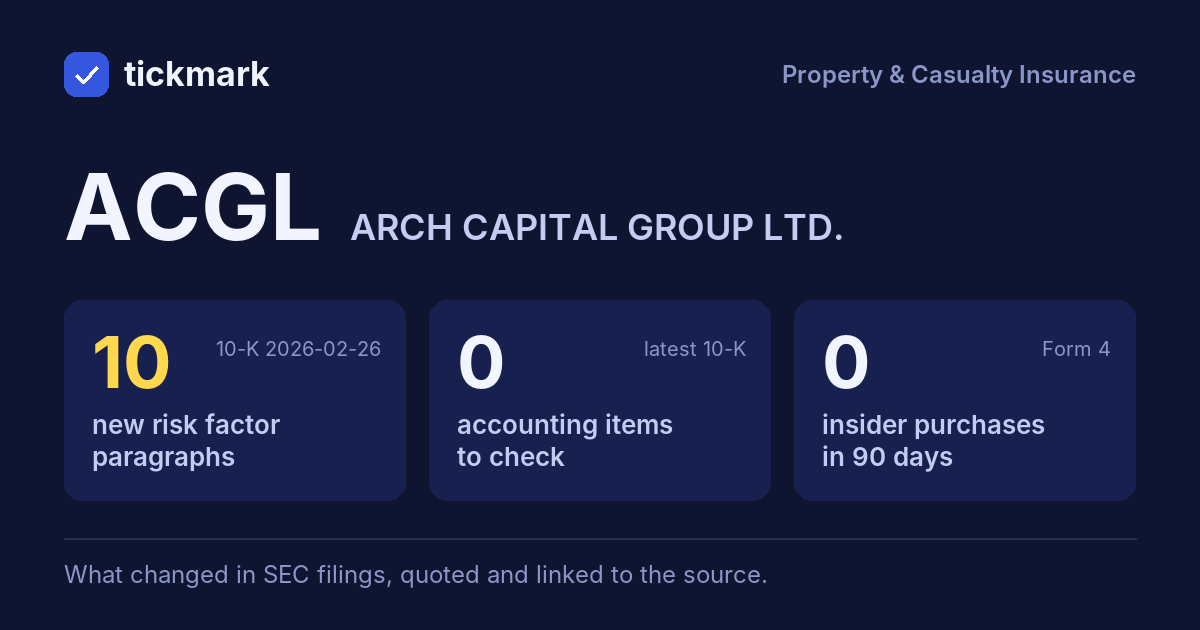
10-K 0000947484-26-000017 (2026-02-26) vs 10-K 0000947484-25-000017 (2025-02-27)
| Section | Compared text | Words now | Changed |
|---|
| Risk Factors | Item 1A | 15,460 |
15.5% |
| MD&A | Item 7 | 19,118 |
14.7% |
| Legal Proceedings | Item 3, via Note 18 – Commitments and Contingencies | 626 |
0.8% |
| Accounting Policies | Item 8, Note 3 – Significant Accounting Policies | 6,877 |
21.4% |
The redline: what was cut and what was added
In each section, the paragraph that changed most, marked against last year's 10-K:
cut words struck through, new words highlighted and underlined.
Risk Factors 200 words changed in this paragraph; it is 49% similar to last year's version.
On July 27, In 2023, the Federal banking agencies released a proposed rule to implement the Basel III Endgame in the United States. States, which would apply to banks with assets greater than $100 billion. The proposal would increase the capital charges for mortgages held in portfolio and eliminate the capital relief currently afforded mortgage loans protected by private mortgage insurance. Instead, the capital treatment would be based on the mortgage’s loan to value ratio without consideration of mortgage insurance. The comment period for this proposal closed on January 16, 2024. If the U.S. regulators decide to adopt the proposed Basel III Endgame approach to mortgage assets, the capital treatment of mortgages held in portfolio will increase and the capital relief benefits of mortgage insurance would be eliminated, insurance, which could adversely affect the volume of mortgages originated by banks subject to the rule and the demand for mortgage insurance. With the change in the Presidential administration, administration in 2025, and based on feedback received in response to the proposed rule, the Federal Banking banking agencies have indicated an intent to repropose the Basel III Rules, Rules. In September 2025, Federal Reserve Vice Chair for Supervision, Michelle Bowman, stated that the U.S. bank regulators are working toward unveiling a revised Basel III Endgame by early 2026. She indicated that the revised proposal would be more “industry friendly” than prior versions, though the timing, requirements, and implementation of the reproposed rule remain uncertain. In January 2025, the European Commission stated that it is considering what steps to take in light of possible delay or changes to the Basel III implementation in the United States, and the Bank of England announced a one-year delay in implementation in order to get clarity on what the United States plans to do.
Source: Item 1A, 10-K 0000947484-26-000017 vs Item 1A, 10-K 0000947484-25-000017
Accounting Policies 149 words changed in this paragraph; it is 67% similar to last year's version.
The Company applies a fair value based measurement method in accounting for its share-based payment arrangements with eligible employees and directors. Compensation expense is estimated based on the fair value of the award at the grant date and is recognized in net income over the requisite service period with a corresponding increase in shareholders’ equity. No value is attributed to awards that employees forfeit because they fail to satisfy vesting conditions. The Company’s (i) time-based awards generally vest over a three year period with one-third vesting on the first, second and third anniversaries of the grant date and (ii) performance-based awards cliff vest after each three year performance period based on achievement of the specified performance criteria. The share-based compensation expense associated with awards that have graded vesting features and vest based on service conditions only is calculated on a straight-line basis over the requisite service period for the entire award. Compensation expense recognized in connection with performance awards is based on the achievement of the specified performance and service conditions. The final measure of compensation expense recognized over the requisite service period reflects the final performance outcome. During the recognition period compensation expense is accrued based on the performance condition that is probable of achievement. For awards granted to retirement-eligible employees where no service is required for the employee to retain the award, the grant date fair value is immediately recognized as compensation expense at the grant date because the employee is able to retain the award without continuing to provide service. For employees near retirement eligibility, attribution of compensation cost is over the period from the grant date to the retirement eligibility date. These charges had no impact on the Company’s cash flows or total shareholders’ equity. See note 22, for information relating to the Company’s share-based payment awards.
Source: Item 8, Note 3 – Significant Accounting Policies, 10-K 0000947484-26-000017 vs Item 8, Note 3 – Significant Accounting Policies, 10-K 0000947484-25-000017
MD&A 146 words changed in this paragraph; it is 37% similar to last year's version.
If we are not able to obtain adequate capital, our business, results of operations and financial condition could be adversely affected, which could include, among other things, the following possible outcomes: (1) potential downgrades in the financial strength ratings assigned by ratings agencies to our operating subsidiaries, which could place those operating subsidiaries at a competitive disadvantage compared to higher-rated competitors; (2) reductions in the amount of business that our operating subsidiaries are able to write in order to meet capital adequacy-based tests enforced by statutory agencies; and (3) any resultant ratings downgrades could, among other things, affect our ability to write business and increase the cost of bank credit and letters of credit. In addition, under certain of the reinsurance agreements assumed by our reinsurance operations, upon the occurrence of a ratings downgrade or other specified triggering event with respect to our reinsurance operations, such as a reduction in surplus by specified amounts during specified periods, our ceding company clients may be provided with certain rights, including, among other things, the right to terminate the subject reinsurance agreement and/or to require that our reinsurance operations post additional collateral.
Source: Item 7, 10-K 0000947484-26-000017 vs Item 7, 10-K 0000947484-25-000017
Legal Proceedings 5 words changed in this paragraph; it is 99% similar to last year's version.
The areas where significant concentrations of credit risk may exist include unpaid losses and loss adjustment expenses recoverable, contractholder receivables, ceded unearned premiums, paid losses and loss adjustment expenses recoverable net of reinsurance balances payable, investments and cash and cash equivalent balances. A credit exposure exists with respect to reinsurance recoverables as they may become uncollectible. The Company manages its credit risk in its reinsurance relationships by transacting with reinsurers that it considers financially sound and, if necessary, the Company may hold collateral in the form of funds, trust accounts and/or irrevocable letters of credit. This collateral can be drawn on for amounts that remain unpaid beyond specified time periods on an individual reinsurer basis. In addition, certain insurance policies written by the Company’s insurance operations feature large deductibles, primarily in its construction and national accounts lines of business. Under such contracts, the Company is obligated to pay the claimant for the full amount of the claim. The Company is subsequently reimbursed by the policyholder for the deductible amount. These amounts are included on a gross basis in the consolidated balance sheet in contractholder payables and contractholder receivables, respectively. In the event that the Company is unable to collect from the policyholder, the Company would be liable for such defaulted amounts. Collateral, primarily in
Source: Item 3, via Note 18 – Commitments and Contingencies, 10-K 0000947484-26-000017 vs Item 3, via Note 18 – Commitments and Contingencies, 10-K 0000947484-25-000017
Every change, by type
Sentences and paragraphs of ACGL's Risk Factors and MD&A, 10-K 2026-02-26 against 10-K 2025-02-27.
Each links to the text at sec.gov.
AddedRisk Factors
•Certain U.S. policies and actions have created geopolitical risks which are not possible to manage or predict, some of which may result in uncertainty in the global markets.
Read it in 10-K 2026-02-26 at sec.gov ↗
AddedRisk Factors
Certain U.S. policies and actions have created geopolitical risks which are not possible to manage or predict, some of which may result in uncertainty in the global markets.
Read it in 10-K 2026-02-26 at sec.gov ↗
AddedRisk Factors
Recent U.S. policies and actions, such as actions relating to Venezuela and Greenland, may jeopardize certain global alliances and create geopolitical uncertainty. While the long-term impact of these policies is currently unknown, these policies and other geopolitical tensions have resulted in, or could result in, volatile global capital markets, sanctions, trade restrictions and harm countries’ relationships.
Read it in 10-K 2026-02-26 at sec.gov ↗
AddedRisk Factors
With new technologies and AI tools emerging at a rapid pace, there is no assurance that we will be able to evaluate and integrate new technologies or update our existing systems to keep pace with our competitors and customer needs. While we believe AI presents significant opportunities to support our strategic goals, we may not be successful in implementing AI technologies. It is possible that any AI we use does not perform as anticipated, suffers from “hallucinations” or that its outputs may not be as expected or may result in unlawful discrimination, which may put us at a competitive disadvantage, result in reputational damage and regulatory fines and actions.
Read it in 10-K 2026-02-26 at sec.gov ↗
AddedRisk Factors
Additionally, the regulatory landscape surrounding traditional AI and generative AI is evolving, and the expanded use of these technologies may become subject to regulatory scrutiny under new or existing laws. Moreover, the intellectual property and ownership rights associated with both forms of artificial intelligence have not been fully addressed by courts in the U.S. or in other jurisdictions that we operate in. We established the Artificial Intelligence Governance and Oversight Committee (“AIGOC”) to evaluate and approve new AI use cases and issue and oversee our Company’s Artificial Intelligence Policy. While we believe the AIGOC and our larger AI governance framework is responsive to new risks and regulations, failure to comply with the applicable AI-related regulations could result in fines, penalties, litigation, or restrictions on our business operations. These outcomes may have a materially adverse effect on our business or financial condition.
Read it in 10-K 2026-02-26 at sec.gov ↗
AddedRisk Factors
remediation costs, increased insurance premiums, employee dissatisfaction and/or monetary fines, penalties or litigation, any of which could adversely affect our business.
Read it in 10-K 2026-02-26 at sec.gov ↗
AddedRisk Factors
“terminated” or 100% collateral upon the entry of an order of rehabilitation, liquidation or conservation against a ceding insurer.
Read it in 10-K 2026-02-26 at sec.gov ↗
AddedRisk Factors
which would limit their ability to sell the property without incurring a loss and could increase the frequency and severity of claims. Changes to credit scoring models, data inputs or evaluation frameworks could result in borrowers being assessed as lower risk than their actual performance ultimately reflect, increasing uncertainty in default and claim performance due to model changes.
Read it in 10-K 2026-02-26 at sec.gov ↗
AddedRisk Factors
While some countries outside of the EU have begun implementing the Basel III Endgame, both the U.K. and the EU have announced that the start of implementation will be delayed until January 1, 2027. In addition, the U.K. is considering applying different rules for smaller banks, and the EU is consulting on proposals to amend the EU Securitization Regulation (“SECR”) and Capital Requirements Regulation (“CRR”), which implement the Basel III Endgame. The proposed SECR and CRR amendments improve the capital relief EU banks receive from insurance-based SRT transactions in which the Company participates. The timing, requirements, and implementation of the final rules remain uncertain and subject to continued debate, which could negatively impact the capital relief afforded by the protection we provide and the volume of insurance-based SRT transactions in the EU.
Read it in 10-K 2026-02-26 at sec.gov ↗
AddedRisk Factors
In 2019, the OECD published a “Programme of Work,” divided into two pillars, which is designed to address the tax challenges created by an increasing digitalized economy. Pillar I addresses the broader challenge of a digitalized
Read it in 10-K 2026-02-26 at sec.gov ↗
AddedMD&A
We reported very good results for 2025, with an annualized net income return on average common equity and operating return on average common equity of 20.1% and 17.1%, respectively. See “Comment on Non-GAAP Financial Measures.” Meaningful contributions from all three segments along with solid investment returns resulted in book value growth for 2025 of 22.6%. Our strong balance sheet and capital-generating capabilities permit us to both invest in our business and return capital to investors. During 2025, we repurchased $1.9 billion of Arch common shares.
Read it in 10-K 2026-02-26 at sec.gov ↗
AddedMD&A
As we head into 2026 with measured optimism and increased competition across our property and casualty businesses, our commitment to deliver long-term value for our shareholders remains unchanged. Critical to our cycle management is emphasizing risk selection, as we continue to leverage our diversified specialty platform and the expertise of our underwriting teams. We invest and use data and analytics to sharpen insights, enhance risk selection and deliver a differentiated customer experience while fostering a culture that attracts the best-in-class talent. We closed 2025 with a balance sheet in excellent health, giving us optionality as we remain prudent stewards of the capital entrusted to us by our shareholders.
Read it in 10-K 2026-02-26 at sec.gov ↗
AddedMD&A
Our insurance segment reported $375 million of underwriting income in 2025, with net premium written nearly $7.8 billion, an increase of 13.4% from 2024. Growth in net premiums written primarily resulted from the U.S MidCorp and Entertainment insurance businesses acquired from Allianz on August 1, 2024 (“MCE Acquisition”). The acquired business further expands our insurance platform, providing more opportunities to capitalize on attractive margins. Across the insurance platform, our underwriters continue to pursue growth in areas where risk-adjusted returns exceed or meet our long-term objectives. In North America, the casualty rate environment is largely keeping pace with loss cost trends, while pricing in our international business units is tracking slightly below loss trends. In North America, we continue to grow in specialty casualty lines, including alternative markets, construction and E&S casualty. Within each geography, consistent with our cycle management approach, we adjust our business mix in response to changing market conditions and pricing dynamics.
Read it in 10-K 2026-02-26 at sec.gov ↗
AddedMD&A
Our reinsurance segment contributed $1.6 billion of underwriting income in 2025. At the January 1, 2026 renewals, property catastrophe and more generally short-tail excess of loss renewals were highly competitive with rates down 10% to 20%. Despite these headwinds, our underwriting teams leveraged the strength of our platform and trading relationships to source new opportunities that mitigate the impact of the rate pressure in the market. We are growing selectively and focusing on areas where margins are attractive. We continue to like our prospects in most lines of business and, with improving conditions in casualty lines, our agility and ability to create opportunities is an advantage for us in this market. Our diversified reinsurance platform, supported by strong partnerships with brokers and cedants across multiple lines and geographies, further enhance our ability to navigate a competitive environment.
Read it in 10-K 2026-02-26 at sec.gov ↗
AddedMD&A
(1) ‘Other underwriting income’ includes revenue earned from underwriting related activities covered under existing service contracts.
Read it in 10-K 2026-02-26 at sec.gov ↗
AddedMD&A
(2) The ‘Other operating expense ratio’ for the 2025 period includes ‘Other underwriting income.’ See ‘Comments on Non-GAAP Financial Measures’ for further details.
Read it in 10-K 2026-02-26 at sec.gov ↗
AddedMD&A
(1) ‘Other underwriting income’ includes revenue earned from underwriting related activities covered under existing service contracts.
Read it in 10-K 2026-02-26 at sec.gov ↗
AddedMD&A
(2) The ‘Other operating expense ratio’ for the 2025 period includes ‘Other underwriting income.’ See ‘Comments on Non-GAAP Financial Measures’ for further details.
Read it in 10-K 2026-02-26 at sec.gov ↗
AddedMD&A
(1) ‘Other underwriting income’ includes revenue earned from underwriting related activities covered under existing service contracts.
Read it in 10-K 2026-02-26 at sec.gov ↗
AddedMD&A
(2) The ‘Other operating expense ratio’ for the 2025 period includes ‘Other underwriting income.’ See ‘Comments on Non-GAAP Financial Measures’ for further details.
Read it in 10-K 2026-02-26 at sec.gov ↗
AddedMD&A
(1) Amounts include dividends and other distributions on investment funds, term loan investments, funds held balances, cash balances and other items.
Read it in 10-K 2026-02-26 at sec.gov ↗
AddedMD&A
(1) Represents delinquent loans related to the acquisition of RMIC Companies, Inc.
Read it in 10-K 2026-02-26 at sec.gov ↗