Screener / SEC EDGAR /CIK 0001820953 /10-K filed Aug 27, 2026, compared with Aug 28, 2025 /Numbers from the XBRL of the 10-Ks
Nasdaq Financials · Personal Credit Institutions

Affirm Holdings, Inc. AFRM

Compare with peers Embed
SEC comment letters, last 20 years

2 reviews of AFRM's filings by SEC staff

UPLOAD and CORRESP
Reviews 2 latest letter Mar 6, 2026
Questions asked 24 each answered in the company's own letter
No closing letter 1 reviews without a letter saying the staff completed it

When the SEC's staff reviews a filing, it writes to the company with numbered questions, and the company answers each one in a letter. SEC publishes the exchange once the review is over, at least 20 business days later. A question is not an accusation; most reviews end with the company adding detail to its next filing.

How the reviews went

Every review on EDGAR, from the first staff letter to the letter that closes it

  1. 1. Staff letters 3 UPLOAD
  2. 2. Questions in them 24 numbered comments
  3. 3. Company replies 3 CORRESP
  4. 4. Reviews closed 1 of 2 closing letter

Half the closed reviews took 19 days or less from the first letter to the closing letter.

Form 10-K for the Fiscal Year Ended June 30, 2025

2026-03-06 to 2026-03-25 · 1 question · 1 letter from the SEC, 1 from the company
Review closed 2026-03-25
RevenueResults discussion (MD&A)
Item 7. Management's Discussion and Analysis of Financial Condition and Results of Operations · Overview, page 61
SEC asked
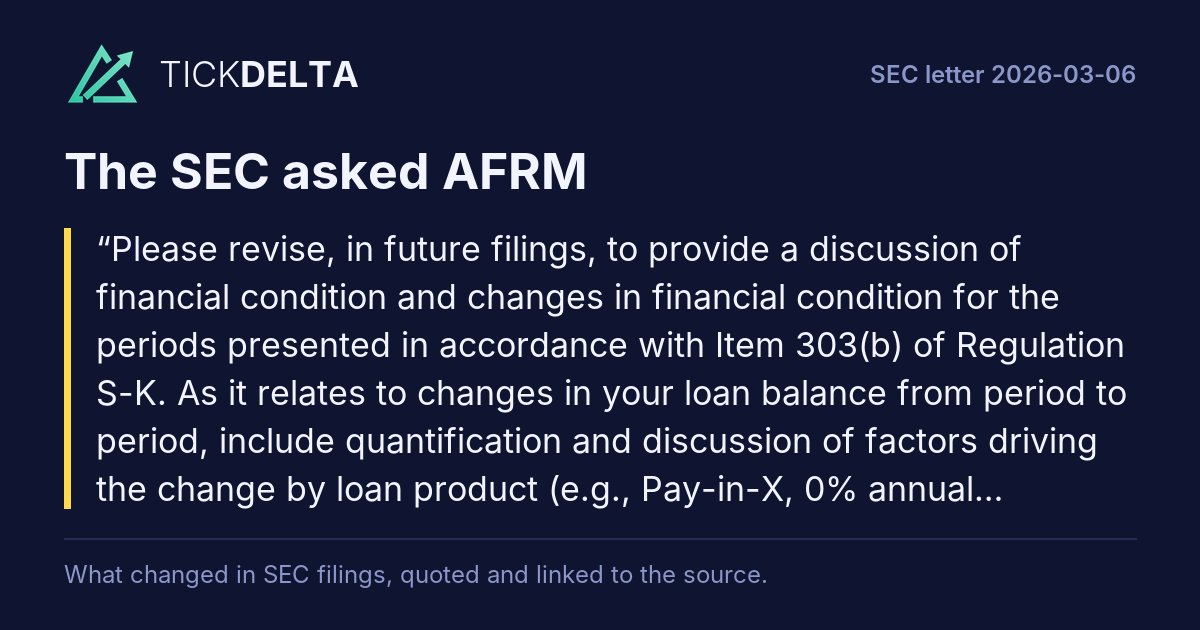
Please revise, in future filings, to provide a discussion of financial condition and changes in financial condition for the periods presented in accordance with Item 303(b) of Regulation S-K. As it relates to changes in your loan balance from period to period, include quantification and discussion of factors driving the change by loan product (e.g., Pay-in-X, 0% annual percentage rate (“APR”) monthly installment
Rest of the question

loans and interest-bearing monthly installment loans.). In this regard, we note that you quantify the percentage of GMV by loan product for each period on page 62. Results of Operations Comparison of the Years Ended June 30, 2025 and 2024, page 68 In future filings, please expand your discussion of period-over-period changes by revenue line item to also disclose changes in the weighted average fee rates, interest rates and expected weighted average loan duration, to the extent applicable or appropriate, for the differing loan portfolio products for each of the periods presented. In this regard, we 2. note that your current discussion indicates a 31% increase in your merchant network revenue from June 30, 2024 to June 30, 2025, while GMV grew by 38% over the same periods. Similarly, we note that card network revenue grew by 53% while GMV grew by 45% over the same periods. Refer to Item 303(b)(2) of Regulation S-K. In closing, we remind you that the company and its management are responsible for the accuracy and adequacy of their disclosures, notwithstanding any review, comments, action or absence of action by the staff.

AFRM answered
The Company respectfully acknowledges the Staff's comment. In future filings, beginning with the Quarterly Report on Form 10-Q for the fiscal quarter ending March 31, 2026, we will revise the discussion of financial condition under Item 303(b) of Regulation S-K to provide disclosure of material period-over-period changes in our loan balances by product type, including quantification and discussion of the factors driving material changes.
Read in the reply
In its next report

First report after the company's reply of Mar 19, 2026: 10-Q filed May 7, 2026 ↗, against the 10-Q filed Feb 5, 2026 ↗.

Item 2, MD&A: 50 paragraphs changed; the 3 closest in words to the question are below.

Reworded

We regularly monitor the direct and indirect impacts of the current macroeconomic conditions on our business, financial condition, and results of operations. Following the Federal Reserve’s decision to begin reducing the federal funds interest rate in September 2024, interest rates have declined; however, uncertainty remains as to whether and to what extent the federal funds interest rate will remain at current levels, increase or decrease in future periods. Simultaneously, economic uncertainty and unpredictability, including the prospect of economic recession recession, persistent inflation, and the magnitude, duration and impact of tariffs on global trade, has impacted and may continue to impact both consumer spending and loan repayments. These challenges have affected, and may continue to affect, our business and results of operations in the following ways:

1 word cut, 3 added sec.gov
Reworded

Product and economic terms of commercial agreements vary among our merchants, which may impact our results. For example, our low average order value (“AOV”) products generally benefit from shorter duration, but also have lower revenue as a percentage of GMV when compared to high AOV products. Merchant mix shifts are driven in part by the products offered by the merchant, the economic terms negotiated with the merchant, merchant-side activity relating to the marketing of their products, whether or not the merchant is fully integrated within our network, and general economic conditions affecting consumer demand. Our revenue as a percentage of GMV in any given period varies across products. As such, as we continue to expand our network to include more merchants and product offerings, revenue as a percentage of GMV may vary.

67 words cut, 0 added sec.gov
Reworded

These loan modification programs also impact our delinquency rates, and such impact can vary over time. The volume of loan modifications during the fiscal quarter ended December March 31, 2025 2026 increased to 0.18% 0.16% up from 0.15% 0.09% in the same period in 2024. 2025. As of December March 31, 2025, 2026, loans modified within the last twelve months represent 0.25%, respectively, 0.28% of the outstanding principal balance of loans held on our balance sheet, compared to 0.29%, 0.21% for the same periods period in 2024. 2025. Our reported delinquency and charge off rates include loans which have become past due or have charged off subsequent to modification. An unknown percentage of loans which have been modified and are current as of December March 31, 2025 2026 may become delinquent or charge off in the future. We continue to evaluate the effectiveness of these programs and may modify, expand, or contract their usage, which may affect the timing of reported delinquencies and charge offs in future periods.

14 words cut, 13 added sec.gov

Paragraphs where only numbers, dates or period words changed are not shown. Cut words struck through, new words highlighted.

Also in this review: closing letter, 2026-03-25

Form S-1

2020-11-04 to 2020-12-14 · 23 questions · 2 letters from the SEC, 2 from the company
No closing letter
Results discussion (MD&A)RevenueRisk factorsNon-GAAP measuresKey metricsControlsLiquidity and cash
Draft Registration Statement on Form S-1 filed October 8, 2020 · Prospectus Summary, page 1
SEC asked (1)
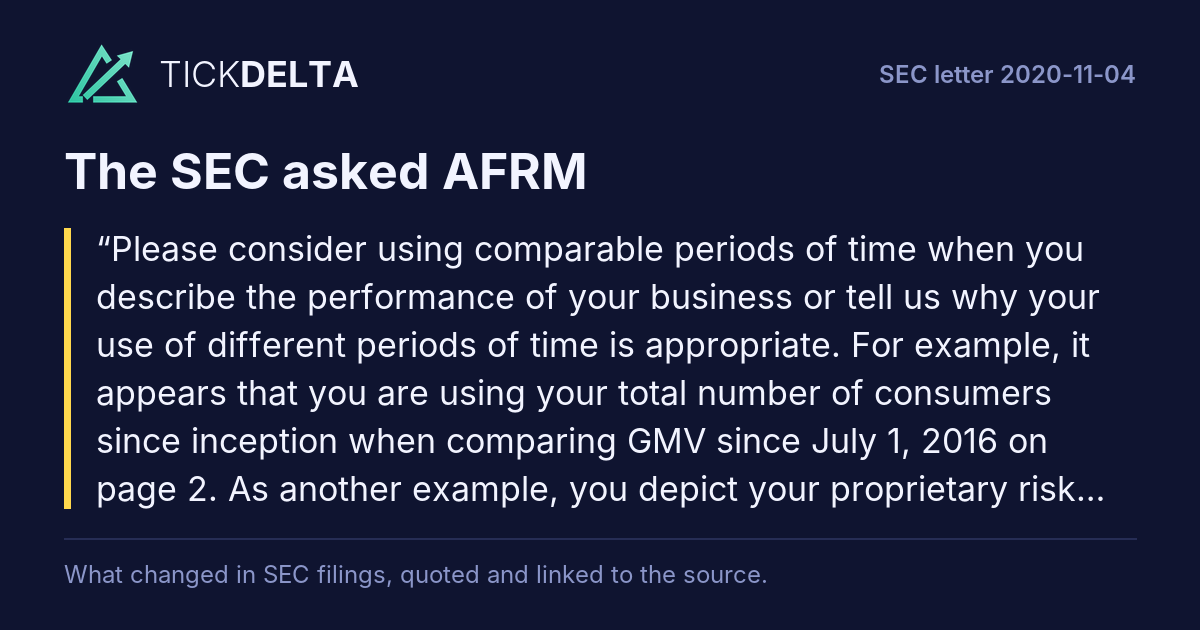
Please consider using comparable periods of time when you describe the performance of your business or tell us why your use of different periods of time is appropriate. For example, it appears that you are using your total number of consumers since inception when comparing GMV since July 1, 2016 on page 2.
Rest of the question

As another example, you depict your proprietary risk model for February 2020, however, it is not clear why you have selected this period. Also, on page 75, you discuss monthly cohort information since February 2016, however, it is not clear why you have selected this period.

AFRM answered
The Company respectfully acknowledges the Staff’s comment and has revised the disclosure on page 83 of the Revised Registration

Statement to discuss monthly cohort information beginning on July 1, 2016, so that the time period presented aligns with the disclosure of the Company’s GMV net of refunds since July 1, 2016 and the disclosure of the Company’s dollar-based merchant retention rate across each cohort that joined its platform since July 1, 2016 on page 129 of the Revised Registration Statement.
Rest of the answer

With respect to the selection of February 2020 as the month used in the depiction of the Company’s proprietary risk model on page 139 of the Revised Registration Statement, the Company advises the Staff that the month of February 2020 was chosen as it was the last full month prior to the onset of the COVID-19 pandemic in the United States so as to eliminate any potential uncertainty as to whether the data presented was impacted by the existence of the pandemic.

Further in response to the Staff’s comment, the Company has reviewed the periods of time used to describe the performance of its business elsewhere in the Revised

Registration Statement. The Company advises the Staff that, except as noted above, the time periods used represent the most recent periods for which the data being presented is available. For example, the repeat consumer data and the net promoter score data on pages 2 and 124 of the Revised Registration Statement is the most recent data available because the Company measures that data based on half fiscal year periods, and the second half of fiscal year 2020 was the Company’s most recent half fiscal year completed. In addition, the January 2019 cohort was selected to illustrate the percentage of consumer repeat purchases at the same merchant on page 129 of the Revised Registration Statement, and the 2019 calendar year was used to show the higher reported AOVs compared to other payment methods on page 129 of the Revised Registration Statement, because those analyses are only run annually at the end of each calendar year.

Read in the reply
Draft Registration Statement on Form S-1 filed October 8, 2020 · Prospectus Summary, page 1
SEC asked (2)
On page 9, please provide an explanation that accompanies your Portfolio Net Charge-off chart to explain how to interpret the data depicted. Similarly, on page 82 please quantify the GMV for each merchant cohort. And on page 84, please provide additional narrative disclosure to explain the "Portfolio DQ" depicted.
AFRM answered
The Company respectfully acknowledges the Staff’s comment and has revised the disclosure on pages 90, 93 and 139 of the

Revised Registration Statement to explain the Portfolio Net Charge-off chart, quantify GMV for each merchant cohort and explain the Portfolio DQ chart.
Read in the reply
Summary Consolidated Financial and Other Data · Key Operating Metrics and Non-GAAP Financial Measures, page 20
SEC asked (3)
You define your non-GAAP measure "contribution profit" as total revenue less the direct costs of achieving that revenue. You disclose that since there is a timing difference in the income statement recognition of the amortization or release of discount on loans held for investment versus loans sold, adjusting out these items is a useful measure of your performance during the current period.
Rest of the question

It is not clear why you believe this measure is informative of the economic return generated from the payments volume facilitated through your platform. Please help us better understand how this measure is useful to investors. In your response, please also address: • The timing difference cited above; • Why technology and data analytics are excluded from the measure considering these costs appear to be directly related to revenue generation; • The basis for the following adjustments made in the reconciliation to operating loss to arrive at contribution profit: (i) loss on loan purchase commitments; (ii) amortization of discount, which is included in GAAP interest income, and (iii) unamortized discount released on loans sold to third-party loan buyers; and • Why only certain components of interest income are excluded from contribution profit, and a description of the remaining components included as part of contribution profit and why.

AFRM answered
The Company respectfully acknowledges the Staff’s comment and has provided additional details below. The Company has revised the disclosure on pages 22, 23, 79 and 80 of the Revised Registration Statement to provide additional clarity on the measure, why the Company believes this measure is informative, the timing differences mentioned, and the reason for excluding technology and data analytics from the measure.

Overview of Contribution Profit

The Company views contribution profit as a non-GAAP measure of the revenues generated by the Company’s platform less those operating costs closely
Rest of the answer

correlated to, and variable with, those revenue generating activities to measure the unit economics of the transactions facilitated by the

Company’s platform in the period. The operating costs that are directly attributable to revenue-generating activities consist of the Company’s provision for credit losses, funding costs, and processing and servicing expenses as they vary with the volume of transactions processed by the Company’s platform and changes in the balance of loans held for investment on the

Company’s consolidated balance sheet. The Company’s remaining operating expenses represent the costs of the design, development, improvement, maintenance, and administration of the Company’s platform as a whole. Such costs are generally fixed or are not closely correlated with revenues. In addition, there are certain timing differences in the recognition of certain revenues and expenses associated with the Company’s relationship with their originating bank partners that do not reflect the unit economics of transactions processed by the Company’s platform in the period presented. The Company believes that adjusting for these timing differences provides investors with useful information about the Company’s unit economics in the period and facilitates comparability of the Company’s financial performance between periods and against other operating metrics such as GMV.

Why technology and data analytics are excluded from the measure considering these costs appear to be directly related to revenue generation?

The Company’s technology and data analytics expenses are largely made up of the personnel costs of the Company’s engineering, product, and risk organizations that are attributable to the delivery of the Company’s platform as a whole. These teams are focused on the design, development, improvement, maintenance, and administration of the Company’s technology platform and proprietary risk scoring model. The related personnel costs, including salaries and stock-based compensation, represented approximately 62% of the Company’s overall technology and data analytics expenses for the fiscal year ended June 30, 2020. The remaining portion of these expenses consists of costs incurred to support the Company’s infrastructure, cloud hosting, and operational data inputs to refine the Company’s risk scoring model. Because most of these expenses are fixed or do not represent an incremental unit of cost on a transaction processed on the Company’s platform, the Company has excluded them from the calculation of contribution profit.

Discussion of timing differences cited above

The Company purchases loans from their originating bank partner that are processed through the Company’s platform and that their bank partner puts back

(i.e., sells) to the Company. Under the terms of the agreement with the Company’s originating bank partner, the Company is generally required to pay the principal amount plus accrued interest for such loans. In certain instances, the Company’s originating bank partner may originate loans with zero or below market interest rates. In these instances, the Company may be required to purchase the loan for a price in excess of the fair market value of such loans, which results in a loss and a discount included in the amortized cost basis of the loan.

When a merchant captures a transaction, the Company recognizes merchant fees as revenue. Simultaneously, because the Company is obligated to purchase the loans that the

Company’s originating bank partner originates and puts to the Company, the Company recognizes a liability in an amount equal to the difference between the purchase price and the loan’s fair value. The corresponding debit is recognized as a loss on loan purchase commitment in the Company’s operating expenses. When the Company purchases the loan from the Company’s originating bank partner, the Company presents the liability that the Company initially recorded as a reduction of the carrying amount of the loan (i.e., discount). The accounting for the discount is dependent on whether the Company retains or sells the loan and is described below.

For loans the Company purchases from the Company’s originating bank partner and then retains on the Company’s balance sheet, the Company recognizes an expense associated with this loss on loan purchase commitment upfront. The Company then amortizes the loan discount into interest income over the loan’s life. Since the recognition of interest income is associated with unwinding the discount created by the initial loss on loan purchase commitment, the cumulative value of the interest income recognized and loss on loan purchase commitment expense incurred equal one another and thus net to zero over the life of the loan. However, the recognition of the amortization into interest income creates a timing difference relative to when the expense associated with the loss on loan purchase is incurred.

The Company believes that this timing difference obscures the unit economics of the transactions facilitated by the Company’s platform and that adjusting for this timing difference provides investors useful information about the unit economics of the transactions facilitated by the Company’s platform in the period.

from the Company’s originating bank partner and then sells to third-party loan buyers, the Company similarly recognizes an expense associated with the loss on loan purchase commitment upfront as well as an amortization of loan discount recognized into interest income for the period of a loan’s life in which it is held on the Company’s consolidated balance sheet, but the Company releases the remaining unamortized discount in full when the loan is sold. The unamortized discount released at the time of sale is recognized as part of the gain or loss on sales of loans. The aggregate value of all three of these mechanisms

(the initial loss, recognized interest income, and the discount released at the time of sale) net to zero over the life of the loan. However, the timing of when the loan is sold and how long the loan is held on the balance sheet prior to being sold creates a timing difference amongst the income statement impacts of loss on loan purchase commitment, interest income, and gain or loss on sales of loans. As with loans the Company retains on the Company’s balance sheet, the Company believes that this timing difference obscures the unit economics of the transactions facilitated by the Company’s platform and that adjusting for this timing difference provides investors with useful information about the unit economics of the transactions facilitated by the Company’s platform in the period.

The basis for the following adjustments made in the reconciliation to operating loss to arrive at contribution profit:

(i) loss on loan purchase commitment: As mentioned above, since the loss on loan purchase commitment that is recognized upfront (at the time the merchant captures a transaction) and the associated amortization of the discount that is recognized over the life of the loan are equal, there exists a timing difference that results in a net expense in the period in which the transaction occurs versus the income that is amortized over the life of the loan. The Company believes that adjusting this net expense out of the calculation of contribution profit provides investors with useful information about the unit economics of the transactions facilitated on the

Company’s platform during the period.

(ii) amortization of discount:

As mentioned above, since the amortization of the discount created by the purchase of a loan at a price above the fair market value of the loan is recognized into interest income over the life of the loan, but the corresponding loss on loan purchase commitment is incurred upfront when the merchant captures the transaction, there exists a timing difference. This difference results in income being recognized in the periods after the transaction is facilitated, while the loan is held for investment, compared with the expense being recognized during the period in which the transaction is facilitated. The Company believes that adjusting this component of interest income out of the calculation of contribution profit provides investors with useful information about the unit economics of the transactions facilitated on the Company’s platform during the period.

(ii) unamortized discount released on loans sold: When a loan is sold to a third-party loan buyer, the unamortized discount is released in full at the time of sale, against the gain or loss recognized on the sale of the loan. Similar to those mentioned above, the timing of this release into income differs from the time in which the loss on loan purchase commitment is incurred and any previous amortization of discount is recognized, though the aggregate amounts net to zero over the life of the loan. The Company believes that adjusting this component of revenues out of the calculation of contribution profit provides investors with useful information about the unit economics of the transactions facilitated on the Company’s platform during the period.

Why only certain components of interest income are excluded from contribution profit, and a description of the remaining components included as part of contribution profit and why.

Interest income consists of interest earned on unpaid principal balances, amortization of discount on loans held for investment, amortization of premiums on loans, and interest receivable charged-off, net of recoveries. Of these components, only the amortization of discount results in a timing difference, as mentioned above. The other components not excluded from the calculation of contribution profit are as follows:

(i) interest income on unpaid principal balance: This reflects the interest that is earned based on the finance charge disclosed to the consumer (consumer’s APR) and recognized under the effective interest method over the life of the loan.

This is the largest component of the Company’s GAAP interest income and does not have an offsetting operating expense that would yield a timing difference.

(ii) amortization of premiums on loans: The Company records certain premiums upon the purchase of a loan from the Company’s originating bank partner related to certain fees charged by the Company’s originating bank partner. These premiums are amortized over the life of the loan as a reduction of interest income and, unlike the discounts, do not have an offsetting operating expense that would yield a timing difference in recognition.

(iii) interest receivable charged-off, net of recoveries: The Company charges-off the accrued interest on a loan directly to interest income when a loan becomes 120 days past due or becomes otherwise uncollectible. This contra-revenue item is unrelated to the mechanics of the loss on loan purchase commitment and does not have an offsetting effect that would yield a timing difference in recognition.

Fiscal Year Ended June 30,

2019

2020

($ in millions)

Interest income on unpaid principal balance (i)

$ 103.7

$ 163.4

Amortization of discount on loans held for investment

21.8

35.3

Amortization of premiums on loans (ii)

(2.5 )

(6.2 )

Interest receivable charged-off, net of recoveries (iii)

(3.7 )

(5.7 )
Read in the reply
Risk Factors · "We identified a material weakness in our internal control over financial reporting...", page 44
SEC asked (4)
Please identify the COSO framework used in your evaluation of internal control over financial reporting.
AFRM answered
The Company respectfully acknowledges the Staff’s comment and has revised the disclosure on page 48 of the Revised

Registration Statement to state that its evaluation was based on the Committee of Sponsoring Organizations of the Treadway Commission

Internal Control - Integrated Framework (2013).
Read in the reply
Management's Discussion and Analysis of Financial Condition and Results of Operation · Key Operating Metrics and Non-GAAP Financial Measures, page 78
SEC asked (5)
Tell us whether you track new consumers and, if so, please quantify this amount for recent periods here. In this regard, we note your risk factor on page 22 indicating your need to attract new consumers.
AFRM answered
The Company respectfully acknowledges the Staff’s comment and advises that it does track new consumers primarily as part of its risk model and assessment of credit risk. However, the Company does not track the number of new consumers as an operating metric; rather, the Company tracks the number of active consumers (which are new consumers and repeat consumers) as a key operating metric, which is consistent with the Company’s risk factor on pages 25 and 26 of the Revised Registration Statement which refers to both the need to generate repeat use and increased transaction volume from existing
Rest of the answer

consumers and the need to attract new consumers on the Company’s platform. The number of active consumers across the Company’s platform is a key operating metric that management uses to evaluate the business because it is the primary measure of the size of the Company’s network and is a key driver of GMV and revenue. The number of new consumers on a standalone basis is not as useful.

Read in the reply
Factors Affecting Our Performance, page 80
SEC asked (6)
We note that your disclosure indicates that you have recently partnered with Shopify and Adyen. Please elaborate upon why these partnerships are considered key ones and, if material to an understanding of these partnerships, revise your disclosure to discuss the material terms of any agreements with these entities.
Rest of the question

In this regard, we also note that you highlight your top merchant partner, Peloton, in your risk factor disclosure. Please revise to explain how you would characterize your relationship with Peloton, as compared to the ones disclosed in this section, and disclose the material terms of any agreements you have with Peloton. If your business is substantially dependent upon any of these arrangements, please file any agreements as exhibits pursuant to Item 601(b)(10) of Regulation S-K. Results of Operations, page 88

AFRM answered
The Company respectfully acknowledges the Staff’s comment and has revised the disclosure on pages 89 and 91 of the Revised

Registration Statement to clarify that its partnerships with Shopify and Adyen are simply examples of how it plans to increase merchant adoption and to explain how the factors related to its relationship with Peloton affect its performance.
Rest of the answer

In addition, the Company has revised the disclosure on pages 121 to 122 of the Revised Registration Statement to disclose the material terms of its agreement with Peloton and its agreement with Shopify, which it expects to become material. The agreement with Peloton is filed as exhibit 10.6 to the Revised Registration Statement and will file the Company’s agreement with Shopify as exhibit

10.7 to the Revised Registration Statement in accordance with Item 601(b)(10)(iv) of Regulation S-K.

Read in the reply
Factors Affecting Our Performance, page 80
SEC asked (7)
Please expand your discussion of your results of operations for the periods presented to provide greater analysis to the reasons why increases in total revenue, merchant network revenue, virtual card network revenue, and interest income occurred.
Rest of the question

Also, please revise to specifically discuss the change in total revenue, merchant network revenue, virtual card network revenue, and interest income attributable to new and existing customers. In this regard, we note your disclosure that "[a]pproximately 70% of the loans in the second half of fiscal year 2020 were taken out by repeat users."

AFRM answered
The Company respectfully acknowledges the Staff’s comment and has revised the disclosure on page 103 of the Revised Registration

Statement to expand the discussion of the Company’s results of operations. Additionally, with regard to the discussion of revenues attributable to new and existing customers, the Company respectfully acknowledges the Staff’s comment and advises that while the Company does track consumer retention by analyzing the number of loans taken out by repeat consumers, the Company does not measure changes in revenue attributable to new and existing consumers, as management
Rest of the answer

believes such measures are not useful for analyzing the Company's financial results.

Read in the reply
Cash Flows · Operating Activities, page 95
SEC asked (8)
Your analysis appears to emphasize how cash used in operating activities was derived for each period presented and the noncash items therein. Please note your analysis should discuss the material factors causing a material change in operating cash between comparable periods pursuant to Instruction 4 to Item 303(a) of Regulation S-K.
Rest of the question

In this regard, cash used in operating activities decreased in fiscal 2020 compared to fiscal 2019, yet the only factor cited is an increase in net cash outflows from sales and purchases of loans held for sale in 2020 versus 2019. In performing your analysis, refer to section IV.B.1 of Release No. 33-8350 for guidance, and quantify all variance factors cited pursuant to section 501.04 of the staff’s Codification of Financial Reporting Releases.

AFRM answered
The Company respectfully acknowledges the Staff’s comment and has revised the disclosure on pages 113 - 115 to discuss the sources and uses of cash flows as well as the factors giving rise to material changes in particular line items underlying the major captions in the cash flows from operating activities, both by introducing new analysis and by drawing on existing analysis from other parts of the Management’s Discussion and Analysis section.
Read in the reply
Contractual Obligations, page 97
SEC asked (9)
In note 3 to your contractual obligations table you disclose that "[i]n May 2020, [you] entered into a three year agreement with a third-party services provider for cloud computing and hosting services which included annual spending commitments." Based on this table, it appears that you have an annual spending commitment with your web services provider in the amount of $31,667.
Rest of the question

As a related matter, in your risk factor disclosure on page 32, you disclose that you are "solely reliant on [y]our agreement with [y]our cloud computing web services provider for the provision of cloud infrastructure services to support [y]our platform." Please revise your disclosure to discuss the material terms of your agreement with your web services provider and, as applicable, file your agreement as an exhibit.

AFRM answered
The Company respectfully acknowledges the Staff’s comment and advises the Staff that it has reviewed its arrangements and relationship with its cloud computing web services provider, and, based on that review, believes that it is not required to file the agreement with such cloud computing web services provider as a material contract. The agreement with the Company’s cloud computing web services provider is the type of arrangement that typically accompanies the kind of business conducted by the Company in the ordinary course.
Rest of the answer

While the Company’s cloud computing web services provider is a leading provider of cloud infrastructure, other companies do provide comparable offerings, including companies with resources that are comparable to those of the Company’s cloud computing web services provider, and the Company believes that these providers could provide it with services to host the Company’s platform that are substantially similar to those that it receives from its cloud computing web services provider. In addition, even though the Company’s platform is entirely in the cloud, the Company believes that it could transition to one or more alternative cloud infrastructure providers on commercially reasonable terms. While transitioning the cloud infrastructure currently hosted by the Company’s cloud computing web services provider to alternative providers could potentially be disruptive and the Company may incur significant costs for a short period, it would not cause substantial harm to the Company’s business or results of operations over the longer term. For the foregoing reasons, the Company does not believe that its business is substantially dependent on its arrangements with its cloud computing web services provider, and therefore does not believe it is required to file the agreement as an exhibit under Item 601(b)(10)(ii)(B) of Regulation S-K. Nevertheless, the Company has revised the disclosures on page 116 of the Revised

Registration Statement to disclose the material terms of the Company’s agreement with its cloud computing web services provider.

Read in the reply
Choice of Forum, page 149
SEC asked (10)
Clarify whether your exclusive forum provision appears in your amended and restated certificate of incorporation or bylaws or both. Please ensure that the exclusive forum provision clearly states that your provision does not apply to Securities Act claims and does not apply to Exchange Act claims, or tell us how you will inform future investors of the provision's limited applicability.
AFRM answered
The Company respectfully acknowledges the Staff’s comment and has revised the disclosures on pages 64, 65 and 185 of the Revised Registration Statement to clarify that the Company expects the exclusive forum provision will be included in its amended and restated bylaws. In addition, the Company advises the Staff that its form of amended and restated bylaws filed as exhibit 3.4 to the Revised Registration Statement clearly states that the exclusive forum provision does not apply to suits brought to enforce any liability or duty created by the Exchange Act or the rules and regulations under the
Rest of the answer

Exchange Act, or any other claim for which the U.S. federal courts have exclusive jurisdiction, and further provides that the federal district courts of the United

States of America shall, to the fullest extent permitted by law, be the sole and exclusive forum for the resolution of any complaint asserting a cause of action arising under the Securities Act.

Read in the reply
Consolidated Financial Statements · Consolidated Statements of Operations and Comprehensive Loss, page F-5
SEC asked (11)
Please tell us your basis for including the "gain (loss) on sales of loans" as total revenue.
AFRM answered
The Company respectfully acknowledges the Staff’s comment and notes that selling a significant portion of the loans purchased from the Company’s originating bank partner to third party loan buyers is a part of the Company’s business model. During the fiscal year ended June 30, 2020, 56% of loans purchased from the Company’s originating bank partner were sold to third party loan buyers. The Company considers the “gain (loss) on sales of loans” as revenue because the sale of loans constitutes part of the Company’s ongoing or central operations.
Rest of the answer

The Company sells loans to third party loan buyers several times per week on a regularly scheduled cadence.

Both FASB Concept Statement No.

6, Elements of Financial Statements, and ASC 606, Revenues From Contracts With Customers, defines revenues as follows:

Inflows or other enhancements of assets of an entity or settlements of its liabilities (or a combination of both) from delivering or producing goods, rendering services, or other activities that constitute the entity’s ongoing major or central operations.

The Company believes that gains realized on sales of loans represent inflows from delivering such loans and it constitutes part of the Company’s major or central operations. As a result, the Company believes such gains meets the definition of revenues.

Read in the reply
Note 2. Summary of Significant Accounting Policies · Unaudited Pro Forma Presentation, page F-10
SEC asked (12)
You disclose here the unaudited pro forma basic and diluted net loss per share attributable to common stockholders in the consolidated statements of operation for the year ended June 30, 2020 have been prepared as if the proposed IPO and noted effects had occurred on June 30, 2020. Please explain to us why reflecting these as if they occurred at the end of the fiscal year rather than at the beginning is appropriate.
Rest of the question

In connection with this, please provide us with how the pro forma weighted average number of shares shown in note 19 for each of the items in the denominator was computed.

AFRM answered
The Company respectfully acknowledges the Staff’s comment and has revised the disclosure of unaudited pro forma basic and diluted net loss per share attributable to common stockholders in the consolidated financial statements of operation on pages

F-10, F-50 and F-51 of the Revised Registration Statement as if the proposed IPO and noted effects occurred on July 1, 2019.

1.
Rest of the answer

The pro forma weighted average number of common shares used in the calculation of the unaudited pro forma basic and diluted net loss per share attributable to common stockholders is determined on the following basis:

Pro forma adjustment for the automatic conversion of all outstanding shares of redeemable convertible preferred stock into shares of common stock, as follows:

The pro forma adjustment is determined assuming conversion of the redeemable convertible preferred shares on July 1, 2019, or the date of issuance of the redeemable convertible preferred shares if later than July 1, 2019. In accordance with ASC 260-10-55-2, the redeemable convertible preferred shares are weighted based on the number of days during the financial year for which they were outstanding, divided by the total number of days in the financial year. Each issuance of redeemable convertible preferred stock during the financial year is weighted from the date of the issuance and each repurchase of redeemable convertible preferred stock during the financial year is weighted until the date of the repurchase.

The conversion ratio applied to each series of redeemable convertible preferred stock is 1:1 and is determined by dividing the original issue price for the specific series of redeemable convertible preferred shares by the conversion price for that series of redeemable convertible preferred shares.

2. Pro forma adjustment for the conversion of convertible debt into shares of common stock, as follows:

As described more fully in note

12 of the Company’s annual financial statements, the Company entered into a note purchase agreement in April 2020 pursuant to which the Company issued convertible notes in an aggregate amount of $75 million. The principal and any unpaid and accrued interest of each convertible note convert into shares of redeemable convertible preferred stock either automatically (in the case of the closing of a financing in which the Company receives no less than $50 million in gross proceeds from the issuance of redeemable convertible preferred stock) or at the election of the holders of a majority of the interest in the aggregate principal amount of the convertible notes (in the case of the closing of a financing in which the Company receives less than $50 million in gross proceeds, in the event of a liquidation transaction or qualified IPO, or upon the maturity of the convertible notes in April 2021).

The conversion price varies depending on the different scenarios. As described more fully in note 15 of the Company’s annual financial statements, the shares of redeemable convertible preferred stock issued upon the conversion of the convertible notes are automatically converted into shares of common stock upon the earlier of a qualifying IPO or the written consent of a percentage of the holders of the redeemable convertible preferred shares.

Subsequent to the year ended June

30, 2020, in September 2020, the Company issued shares of Series G redeemable convertible preferred stock for aggregate gross proceeds of $435 million. As part of this equity financing round, the convertible notes converted into 4,444,321 shares of Series G-1 redeemable convertible preferred stock.

The pro forma adjustment is calculated based on the number of shares of Series G-1 redeemable convertible preferred shares issued upon the conversion of the Company’s convertible notes in September 2020, which amounts to 4,444,321 shares. The Company believes this approach is the most meaningful to potential investors as it reflects the facts relating to the conversion of the convertible notes to the redeemable convertible preferred stock. The conversion ratio for the conversion of the Series G-1 redeemable convertible preferred stock into shares of common stock is 1:1 and is determined by dividing the original issue price for Series G-1 redeemable convertible preferred shares by the conversion price for the Series G-1 redeemable convertible preferred shares.

assuming the IPO occurred on July 1, 2019, or the date of issuance of the convertible notes if later than July 1, 2019. As the convertible notes were issued in April 2020, the number of common shares issuable upon the conversion to redeemable convertible preferred stock and the subsequent automatic conversion to shares of common stock is weighted from the issuance date, assuming that the IPO occurred on the issuance date.

3. Pro forma adjustment for the vesting of RSUs with vesting conditions contingent upon an IPO, as follows:

The Company’s RSUs are subject to two vesting conditions: a service-based vesting condition (i.e., employment over a period of time) and a performance-based vesting condition (i.e., a liquidity event in the form of either a change of control or an IPO, each as defined in the Company’s

2012 Equity Incentive Plan).

assuming that the IPO occurred on July 1, 2019 or the vesting date of the RSUs, if the vesting date is later than July 1, 2019.

As all the Company’s RSUs vested during the financial year ended June 30, 2020, each RSU is weighted from the date of its vesting, assuming that the IPO occurred on the vesting date.

4. Pro forma adjustment for the exercise of common stock warrants contingent upon an IPO, as follows:

Certain of the Company’s common stock warrants are automatically net exercised upon an IPO. The pro forma adjustment is determined assuming that the IPO occurred on July 1, 2019, or the vesting date of the warrants if such date is later than July 1, 2019. As these common stock warrants vested during the financial year ended June 30, 2020, the common shares issuable upon the net exercise of the warrants are weighted from the vesting date, assuming that the IPO occurred on the vesting date. The number of common shares issuable upon the net exercise of the warrants is determined using the exercise price of the warrants and the fair market value of the Company’s common shares on the vesting date.

Read in the reply
General
SEC asked (13)
Please supplementally provide us with copies of all written communications, as defined in Rule 405 under the Securities Act, that you, or anyone authorized to do so on your behalf, present to potential investors in reliance on Section 5(d) of the Securities Act, whether or not they retain copies of the communications.
Rest of the question

Please contact the staff member associated with the review of this filing to discuss how to submit the materials, if any, to us for our review.

AFRM answered
The Company respectfully acknowledges the Staff’s comment and has provided to the Staff on a supplemental basis copies of all written communications, as defined in Rule 405 under the Securities Act, that the Company, or anyone authorized to do so on behalf of the Company, presented to potential investors in reliance on Section 5(d) of the Securities Act, whether or not such investors retained copies of the communications.
Read in the reply
General
SEC asked (14)
Please disclose the basis for all your assertions about your competitive position within your industry. If you do not have appropriate independent support for a statement, please revise the language to make clear that this is your belief based upon your experience in the industry, if true.
Rest of the question

For example, please disclose the basis for your assertion that "[y]our ability to effectively price credit risk is one of [y]our core competitive advantages."

AFRM answered
The Company respectfully acknowledges the Staff’s comment and has revised the disclosures on pages 2, 6, 8, 30, 82, 91,

124, 136, 138, 145 of the Revised Registration Statement in response to the Staff’s comment.
Read in the reply
General
SEC asked (15)
Please disclose the source of the following assertions in your prospectus or revise to describe them as your belief, if true: • "The spending power of this new generation of consumers continues to expand significantly, reaching over $2.5 trillion in 2020.
Rest of the question

Most importantly, these consumers are also increasingly looking to solutions like 'buy now pay later' as superior, more transparent payment options that match their demand for technology and mobile firstsolutions. This trend has been accelerated by an erosion of trust in legacy financial institutions as consumers look to mission-driven technology companies for new financial products" (see pages 2 and 103); • "A lack of transparency by traditional financial and payments institutions, ranging from hidden penalties, hard to understand 'fine print,' and unwanted bundling of products, has led to an erosion of trust and a poor consumer experience. These views are particularly acute for the over 160 million Gen Z and Millennials in the U.S., who prefer to build trusted relationships with the brands with whom they engage and from whom they buy products and services" (see pages 3 and 104); • "[A]pproximately 25% of Millennials do not carry credit cards" (see pages 3 and 105); • "Debit cards also do not meet the buying needs of many consumers" (see pages 3 and 105); and • "U.S. e-commerce sales were approximately $600 billion in 2019, growing at 15% compared to the previous year" (see pages 12 and 115).

AFRM answered
The Company respectfully acknowledges the Staff’s comment and has revised the disclosures on pages 2, 3, 12, 68, 69,

123, 125 and 142 of the Revised Registration Statement in response to the Staff’s comment.
Read in the reply
General
SEC asked (16)
Your disclosures indicate that you have entered into agreements with Cross River Bank and that you originate a substantial majority of the loans through your platform with Cross River Bank. Please revise your disclosures to provide the material terms of this arrangement. Please also file any such agreements as exhibits. See Item 601(b)(10) of Regulation S-K.
AFRM answered
The Company respectfully acknowledges the Staff’s comment and has revised the disclosures on page 121 of the Revised

Registration Statement to disclose the material terms of the Company’s agreement with Cross River Bank. In addition, the

Company will file its loan program agreement and loan sale agreement with Cross River Bank as exhibits 10.4 and 10.5, respectively to the Revised Registration Statement in accordance with Item 601(b)(10)(iv) of Regulation S-K.
Read in the reply
Key Operating Metrics and Non-GAAP Financial Measures · Contribution Profit, page 22
SEC asked (1)
We note you have reconciled the non-GAAP measure "Contribution Profit" to net loss. Please reconcile this measure to the most directly comparable GAAP measure, gross margin, as calculated on a GAAP basis. Further, as you have presented Contribution Profit as a Percent of GMV, please also present GAAP-based Gross Margin as a Percent of GMV. Please refer to Item 10(e)(1)(i)(A) of Regulation S-K.
AFRM answered

No numbered answer found in the reply. Read the reply ↗

Key Operating Metrics and Non-GAAP Financial Measures · Contribution Profit, page 22
SEC asked (2)
We note from your response and revised disclosure that you have excluded amounts related to the purchase, investment, and sale of loans. While it may be important to discuss the impact timing differences related to the recognition and amortization of the discount on purchased loans has on Contribution Profit, it is unclear that your current presentation is compliant with Item 10(e) of Regulation S-K in that it
Rest of the question

appears that the exclusion of this activity creates an individually tailored pattern of recognition and measurement. Refer to Question 100.04 of the Compliance and Disclosure Interpretation on Non-GAAP Measures.

AFRM answered
The Company respectfully acknowledges the Staff’s comments 1 and 2 and as a result has revised the disclosure on pages 23-25,

82-83 and 90 of the Revised Registration Statement to reflect a change in the definition of contribution profit and made corresponding changes to the reconciliation from operating loss to contribution profit.
Rest of the answer

The Revised Registration Statement defines contribution profit as operating loss plus the following operating expenses that are not closely correlated to, or variable with, the generation of revenue in the period: (i) Technology and data analytics; (ii) Sales and marketing; (iii) General and administrative expenses. The Company does not believe that the revised definition of contribution profit is a substitute for any GAAP measure but helps readers understand the way the Company manages its business. Although the revised definition of contribution profit no longer adds back Loss on loan purchase commitment, adjusts for the amortization of discount, nor adjusts for the unamortized discount released on loans sold, the Company believes that the value of those adjustments is outweighed by the simplicity and usability of the revised definition of contribution profit. The Company believes contribution profit would likely vary from a GAAP gross profit measure, which the Company does not have and does not intend to adopt in the future. The Company uses contribution profit to measure the marginal profitability of its business and therefore to assess performance, make strategic decisions and otherwise manage its operations.

The reconciliation of operating loss to contribution profit set forth in the Revised Registration Statement is below:

Fiscal Year Ended

June 30,

Three Months Ended

September 30,

2019

2020

(in thousands, except percent data)

Operating loss

$ (127,441 )

$ (107,790 )

$ (32,972 )

$ (44,623 )

Add back: Technology and data analytics

76,071

122,378

25,368

33,768

Add back: Sales and marketing

16,863

25,044

5,219

22,582

Add back: General and administrative

88,902

121,230

27,704

32,266

Contribution profit(1)

$ 54,395

$ 160,862

$ 25,319

$ 43,993

GMV

$ 2,620,059

$ 4,637,220

$ 861,306

$ 1,475,929

Contribution profit as a percentage of GMV

2.1 %

3.5 %

2.9 %

3.0 %

(1) Contribution profit does not include adjustments related to: (i) the amortization of discount, which is recorded within

Interest income in the Consolidated Statements of Operations and Comprehensive Loss; or (ii) the unamortized discount released on loans sold to third party loan buyers, which is released in full at the time of sale and recorded within Gain (loss) on sales of loans in the Consolidated Statements of Operations and Comprehensive Loss. The following table details activity for the discount included in loans held for investment for the periods indicated:

Balance at beginning of period

$ 5,201

$ 13,068

$ 28,659

Additions from loans purchased, net of refunds

70,700

157,426

20,207

58,143

Amortization of discount

(21,833 )

(35,251 )

(7,406 )

(14,770 )

Unamortized discount released on loans sold

(41,000 )

(106,584 )

(12,682 )

(15,997 )

Balance at the end of the period

$ 13,187

$ 56,035

Risk Factors

Risks Related to Our Business and Industry

A large percentage of our revenue is concentrated…,

Read in the reply
Risks Related to Our Business and Industry · A large percentage of our revenue is concentrated . . ., page 26
SEC asked (3)
We note your disclosure on page 26 that "an anticipated material modification in the merchant agreement with a significant merchant partner could affect the results of our operations, financial condition, and future prospects." Please elaborate on what is meant by the term "anticipated" and clarify whether you expect any material modifications to your significant merchant agreements to occur.
AFRM answered
The Company respectfully acknowledges the Staff’s comment and has revised the disclosure on pages 27-28 of the Revised

Registration Statement to provide additional clarity recent material modifications in the financial operations of a significant merchant partner and how such modifications will affect the results of our operations.
Read in the reply
Management's Discussion and Analysis of Financial Condition and Results of Operations · Results of Operation, page 97
SEC asked (4)
We note your revised disclosures in response to our prior comment 7 and re-issue our comment in part. Please expand your discussion of your results of operations for the periods presented to provide greater analysis to the reasons why increases in merchant network revenue occurred.
AFRM answered
The Company respectfully acknowledges the Staff’s comment and has revised the disclosure on pages 101 and 105 of the Revised Registration Statement to provide greater analysis to the reasons why increases in merchant network revenue occurred.
Read in the reply
Material Agreements · Shopify, page 121
SEC asked (5)
You disclose that you pay Shopify a fee for each sale processed through your platform. Please explain to us how you account for these fees and your consideration of ASC 60610-32-25 in your treatment.
AFRM answered
The Company respectfully acknowledges the Staff’s comment and advises that in practice, the Company enters into and executes all contracts with eligible merchants and considers Shopify’s role as acting as a customer referral partner providing lead generation services.

To determine how to account for the fees paid to

Shopify for each transaction processed through the Company’s technology platform, the Company first evaluated whether Shopify is a customer or a vendor.
Rest of the answer

The Company would consider Shopify as a customer if it determined that Shopify is the principal to eligible merchants in providing the facilitation of credit service. The Company would consider Shopify as a vendor if it determined that the Company is the principal to eligible merchants in providing the facilitation of credit service. The Company evaluated the customer installment program agreement with Shopify pursuant to ASC 606 10-55-36, given the multitude of parties involved. The Company considers its facilitation of credit service to be a single specified service provided to its customers, the eligible merchant.

Pursuant to ASC 606-10-55-36, the Company assessed whether it controls the facilitation of credit service prior to them being transferred to the merchants. The Company considered both the commercial intent and the contractual relationships of the Company and Shopify when making this assessment. The Company determined that Shopify’s role under the agreement is to generate sales leads in exchange for payments in the form of fees from the Company. Shopify’s intent is not to resell the Company’s facilitation of credit service to eligible merchants.

Shopify provides eligible merchants with access to its e-commerce platform and does not play a role in the loan transactions facilitated by the Company. The Company enters into facilitation of credit service agreements directly with eligible merchants, which govern their use of the services. As Shopify does not enter into agreements with eligible merchants in connection with the facilitation of credit service, Shopify does not have the ability to grant the eligible merchants any rights to use this service. Further, eligible merchants can benefit from Shopify’s e-commerce platform services independently from the Company’s facilitation of credit service.

The Company further considered the indicators of control pursuant to ASC 606 10-55-39 and determined that it is primarily responsible for fulfilling the promise to facilitation of credit service to eligible merchants. The Company also has the discretion in establishing pricing with eligible merchants under the facilitation of credit service contracts it enters into with these merchants. While Shopify does have the ability to review all contracts entered into between the Company and eligible merchants, it is not expected that Shopify will have unilateral rights to determine pricing and will not reasonably prevent these contracts from being executed.

Based on its evaluation of ASC 606 10-55-36, the

Company has determined that it is the principal in providing facilitation of credit service to eligible merchants. Accordingly, the Company does not consider Shopify as a customer pursuant to ASC 606 10-32-25 and instead has determined that Shopify is a vendor.

As such, the Company has accounted for fees paid to Shopify on a gross basis within Operating Expenses in its Consolidated Statements of Operations and Comprehensive Loss, similar to payments made to other vendors for distinct services.

Read in the reply
Certificate of Incorporation and Bylaws · Choice of Forum, page 185
SEC asked (6)
We note your amended disclosures in response to comment 10, and that you have filed your Form of Amended and Restated Bylaws as Exhibit 3.4. In this regard, we note that your risk factor disclosure on page 64 and the exclusive forum provision contained in Article IX of your Form of Amended and Restated Bylaws state that the federal district courts of the United States of America will be the exclusive forum for
Rest of the question

resolving any complaint asserting a cause of action arising under the Securities Act of 1933. However, your exclusive forum disclosure in your Description of Capital Stock section does not include language to that effect. Please revise your disclosure to reconcile this inconsistency.

AFRM answered
The Company respectfully acknowledges the Staff’s comment and has revised the disclosure on page 189 of the Revised

Registration Statement to include the exclusive forum disclosure in its Description of Capital Stock section.
Read in the reply
General
SEC asked (7)
We note your revised disclosures in response to our prior comment 15, and re-issue our comment in part. Please disclose the source of your assertion that "[a] lack of transparency by traditional financial and payments institutions, ranging from hidden penalties, hard to understand 'fine print,' and unwanted bundling of products, has led to an erosion of trust and a poor consumer experience.
Rest of the question

These views are particularly acute for the over 160 million Gen Z and Millennials in the U.S., who prefer to build trusted relationships with the brands with whom they engage and from whom they buy products and services." Alternatively, please revise to describe this assertion as your belief, if true.

AFRM answered
The Company respectfully acknowledges the Staff’s comment and has revised the disclosure on pages 3 and 127 of the

Revised Registration Statement in response to the Staff’s comment.
Read in the reply

Letters without questions

Other letters

UPLOAD and CORRESP
2 other letters: notices that a filing will not be reviewed, requests to declare a registration effective, and the like

From the SEC's correspondence on EDGAR: staff letters (form UPLOAD) and company letters (form CORRESP), 9 letters filed since 2020-11-05. Questions and answers are matched by their numbers; topics come from words in each question. The reports are compared word for word (same form, before the first SEC letter against the first report after the company's reply). No AI.

Sources

The SEC's correspondence on EDGAR: staff letters (form UPLOAD) and company letters (form CORRESP), matched question by question. No AI.

Also

Filings: the letters in the filing list.

Work with it

Excel workbook · CSV. Google Sheet that stays up to date: paste =IMPORTDATA("https://tickdelta.com/company/AFRM/export.csv") into a cell.

Next in Owners and insiders:Insider trades
Esc

Type a ticker such as AAPL, a name, an investor such as Buffett, or a topic such as tariffs. ↑ ↓ to move, Enter to open.