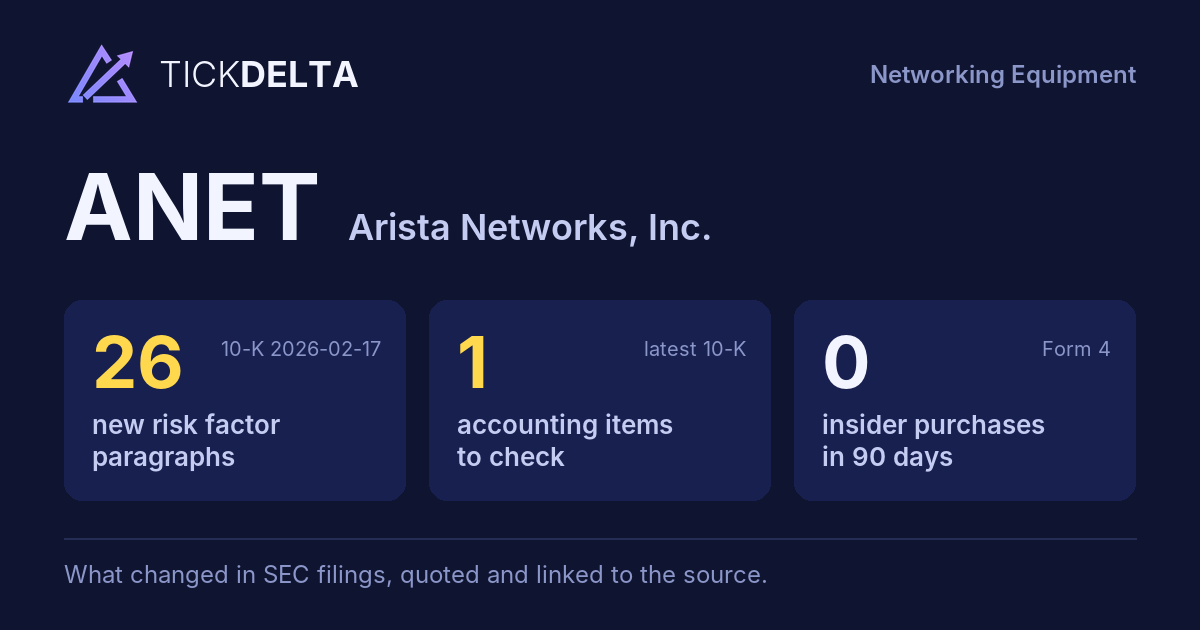
10-K 0001596532-26-000013 (2026-02-17) vs 10-K 0001596532-25-000028 (2025-02-19)
| Section | Compared text | Words now | Changed |
|---|
| Risk Factors | Item 1A | 28,057 |
25.0% |
| MD&A | Item 7 | 5,720 |
32.9% |
| Legal Proceedings | Item 3, via Note 5 – Commitments and Contingencies | 626 |
35.2% |
| Accounting Policies | Item 8, Note 1 – Organization and Summary of Significant Accounting Policies | 5,236 |
13.6% |
The redline: what was cut and what was added
In each section, the paragraph that changed most, marked against last year's 10-K:
cut words struck through, new words highlighted and underlined.
Risk Factors 441 words changed in this paragraph; it is 46% similar to last year's version.
Our revenue growth rates in previous periods may not be indicative of our future performance. We have experienced annual revenue growth rates of 28.6%, 19.5%, 33.8%, 48.6%, and 27.2% 48.6% in 2025, 2024, 2023, 2022 2023 and 2021, 2022, respectively. In the future, our revenue growth rates will continue to be volatile due to cyclical trends in our business, and as we become more penetrated in embedded with our existing customer base and product markets and look to enter and expand into new markets. Our growth strategy relies on maintaining our agility and increasing our investment in research and development to deliver market-leading features to enhance the functionality of existing cloud networking platform, expand our product offerings and build upon our technology leadership. We must continue to expand our product offerings and build upon our technology leadership. In addition, addition we must continue to expand our global sales force and deepen our channel partnerships to reach new customers more effectively and increase sales to existing customers. An increase in customer trials and contracts with acceptance provisions, and an increase in the volatility and magnitude of our product deferred revenue balances, have created variability in our revenue. Any delays in acceptance, or rejection, or any return, of those products could further negatively impact our revenue. We have also previously experienced supply constraints that have resulted in manufacturing and shipment delays, which have negatively affected the timing of revenue recognition. If these manufacturing and supply chain disruptions recur and/or if we are unable to reduce our lead times it could also result in the cancellation of orders by customers, reduce demand from existing customers in future periods, and increase difficulty in adding new customers. Other factors may also contribute to declines in our revenue growth rates, including changes in demand for our products and services, particularly from our large customers, the deterioration of the financial performance, condition or prospects of our large customers, changes in capital spending by our large customers, increased competition, price sensitivities from our customers to increases in our pricing, our ability to successfully manage our expansion or continue to capitalize on growth opportunities, the maturation of our business, geopolitical pressures, recession risks and monetary policy shifts, and our ability to be successful in the AI market and adjacent markets, such as campus switching, Wi-Fi networking markets and network security markets. Recent technologies, such as generative AI models, have emerged, and while they have driven increased demand for networking, the long-term trajectory is unknown and it is difficult for us to predict the demand for such new technologies. Customers may overestimate demand for their AI build outs and cancel, delay, reduce or otherwise modify their purchase commitments with little or no notice to us. In addition, customer may implement changes to their network architecture to improve efficiencies and reduce demand for our products. As such, demand estimates for our new products are difficult to forecast and create volatility in our revenue. In addition, given the timing and prioritization of customer orders and shipment patterns, near term revenue trends may not be reflective of current demand levels. Furthermore, any prolonged economic disruptions or deterioration in the global economy could have a negative impact on demand from our customers in future periods, particularly in the enterprise market where we are continuing to expand our penetration. which may result in reductions in overall demand from these customers in future periods and negatively impact our revenue, financial condition, business or prospects. You should not rely on our revenue for any prior quarterly or annual period as an indication of our future revenue or revenue growth. If we are unable to maintain consistent revenue or revenue growth, our business, financial condition, results of operations and prospects could be materially adversely affected, and our stock price could be volatile.
Source: Item 1A, 10-K 0001596532-26-000013 vs Item 1A, 10-K 0001596532-25-000028
MD&A 272 words changed in this paragraph; it is 38% similar to last year's version.
During the year ended December 31, 2023, 2024, cash provided by operating activities was $2.0 $3.7 billion, primarily from net income of $2.1 billion, $2.9 billion along with a net decrease in working capital requirements of $985.2 million, offset by net non-cash adjustments to net income of $37.4 million, $129.0 million. Cash inflows consisted of an increase in deferred revenue of $1.3 billion resulting from increased customer PCS contracts and an increase in product deferred revenue related to customer contracts with acceptance terms, and a net change $110.6 million decrease in inventory resulting from strong product shipments. These cash inflows were partially offset by a $234.2 million increase in other assets driven by increased deferred cost of $15.9 goods sold associated with higher product revenue deferrals, an increase in accounts receivable of $106.1 million due to increased product and service billings and a $66.5 million increase in working capital requirements. income tax payments due to timing. Net non-cash adjustments primarily consisted of an increase in deferred income taxes of $370.8 $492.9 million primarily resulting from increased deferred tax assets associated with the increase in deferred revenue and capitalization of research and development costs under IRC Section 174, which were largely offset by $296.8 $355.4 million of stock-based compensation expenses and $70.6 million of depreciation, amortization and other expenses. The change in working capital requirements primarily consisted of a $655.5 million increase in inventory in response to a significant increase in business volume, a $101.5 million increase in accounts receivable due to the larger business volume and timing of shipments in the fourth quarter of 2023, as well as a $66.4 million increase in other assets primarily driven by increased deferred cost of sales associated with higher product revenue deferrals. These cash outflows were largely offset by a $465.0 million increase in deferred revenue driven by a growth in PCS contracts and increased product deferred revenue related to customer contracts with acceptance terms, a $322.3 million increase in accounts payable and other liabilities related to significant business volume, timing of payments, and increased supplier and contract manufacturer liability reserves and a $20.2 million increase in income taxes, net, due to timing of payments.
Source: Item 7, 10-K 0001596532-26-000013 vs Item 7, 10-K 0001596532-25-000028
Accounting Policies 137 words changed in this paragraph; it is 69% similar to last year's version.
We use significant judgment in establishing our forecasts of future demand and obsolete material exposures. These estimates depend on our assessment of current and expected orders from our customers, product development plans and current sales levels. In addition, when industry-wide Despite general improvements in the supply chain shortages resulted environment, fluctuations in extended supplier lead times for components, and the persistence of some long-lead components require us to maintain elevated inventory levels and purchase commitments. To manage this continued volatility, we were required maintain extended demand-planning horizons and strategic inventory buffers to extend the time horizon ensure continuity of our demand forecasts supply and increase our purchase commitments for long lead time components. As customer lead times reduce more broadly, we have seen and expect to continue to see a commensurate reduction in visibility to customer demand and a gradual return to shorter demand-planning horizons. Although the global supply chain has shown improvement, we have had to invest in inventory to address forecast uncertainty and we uncertainty. We expect that our inventory and purchase commitments will to remain volatile as we ramp due to new product introductions. introductions, fluctuating customer demand, and varying supplier lead times. There is, however, no guarantee that all suppliers will meet their commitments in the time frame committed or that actual customer demand will directly match our demand forecasts. If actual market conditions are less favorable than those projected by management, which may be caused by factors within and/or outside of our control, we may be required to increase our inventory write-downs and liabilities to our contract manufacturers and suppliers, which could have an adverse impact on our gross margins and profitability. We regularly evaluate our exposure for inventory write-downs and adequacy of our contract manufacturer and supplier liabilities.
Source: Item 8, Note 1 – Organization and Summary of Significant Accounting Policies, 10-K 0001596532-26-000013 vs Item 8, Note 1 – Organization and Summary of Significant Accounting Policies, 10-K 0001596532-25-000028
Legal Proceedings 59 words changed in this paragraph; it is 81% similar to last year's version.
We outsource most of our manufacturing and supply chain management operations to third-party contract manufacturers, who procure components and assemble products on our behalf. A significant portion of our purchase orders to our contract manufacturers for finished products goods and strategic components, including integrated circuits consigned to contract manufacturers, consists of non-cancellable commitments. Our purchase commitments. In addition, we purchase strategic component inventory from certain suppliers under non-cancellable purchase commitments, including integrated circuits, which are consigned to our contract manufacturers. obligations also encompass software and technology licenses, property and equipment, and other corporate goods and services. As of December 31, 2024, 2025, we had non-cancellable purchase commitments not recorded on our balance sheet of $3.1 $6.8 billion, of which $2.8 $6.3 billion have confirmed receipt dates within 12 months, and $0.3 $0.5 billion have confirmed receipt dates greater than 12 months. These open purchase orders are considered enforceable and legally binding, and while we may have some limited ability to reschedule, and adjust our requirements based on our business needs prior to the delivery of goods or performance of services, this can only occur with the agreement of the related supplier.
Source: Item 3, via Note 5 – Commitments and Contingencies, 10-K 0001596532-26-000013 vs Item 3, via Note 5 – Commitments and Contingencies, 10-K 0001596532-25-000028
Every change, by type
Sentences and paragraphs of ANET's Risk Factors and MD&A, 10-K 2026-02-17 against 10-K 2025-02-19.
Each links to the text at sec.gov.
Quiet changes are sentences kept from last year with one to four words changed, at least one of them a hedge, a modal or a qualifier
(may, could, will, not, significant, material…). A year or date rolling forward is not counted.
The full word list
adverse, adversely, all, although, anticipate, anticipates, any, approximately, believe, believes, can, cannot, certain, could, expect, expects, generally, however, if, intend, intends, largely, likely, many, material, materially, may, might, most, must, never, no, not, possible, primarily, probable, should, significant, significantly, some, substantial, substantially, unlikely, will, would
AddedRisk Factors
•sales of our switching and routing platforms generate most of our product revenue;
Read it in 10-K 2026-02-17 at sec.gov ↗
AddedRisk Factors
•we, or third parties on which we rely, could experience cybersecurity incidents, which could disrupt our operations, cause vulnerabilities in our products or services, compromise intellectual property or other sensitive data, or otherwise negatively impact our business.
Read it in 10-K 2026-02-17 at sec.gov ↗
AddedRisk Factors
•enhanced import/export restrictions, such as enhanced export controls the U.S. has adopted targeting trade with China, as well as countermeasures taken by affected countries may negatively affect our business;
Read it in 10-K 2026-02-17 at sec.gov ↗
AddedRisk Factors
Our products are primarily manufactured in Malaysia, Vietnam, and Mexico, and we also procure a limited number of products originating from China, Taiwan, Thailand and the Philippines. In addition, our contract manufacturing partners procure some components from China for use in the manufacturing of our products. Because our products are primarily manufactured internationally, the import of our products into the U.S. may be affected by applicable tariff policies.
Read it in 10-K 2026-02-17 at sec.gov ↗
AddedRisk Factors
Over the last decade, and especially under the current administration, the U.S. government has enacted various new and increased tariffs affecting the import of various items from various countries. For example, since 2018, the U.S. government has enacted various tariffs on products from China under Section 301 trade authorities, including on communications equipment products and components manufactured and imported from China. Since February 2025, the U.S. has also imposed additional country-specific tariffs on most trading partners, including China, as well as additional commodity-specific tariffs on certain imported items, in both instances pursuant to executive orders issued under various trade authorities, including the International Emergency Economic Powers Act and Section 232 of the Trade Expansion Act of 1962.
Read it in 10-K 2026-02-17 at sec.gov ↗
AddedRisk Factors
In response to these and other U.S. measures, China, Mexico and other countries have taken or threatened to take a range of retaliatory measures. These include the imposition of retaliatory tariffs on certain U.S.-origin goods; the implementation of new export controls by China on various critical minerals, including rare earths metals; the scheduling of further retaliatory tariff measures; and other actions that may affect us directly or indirectly.
Read it in 10-K 2026-02-17 at sec.gov ↗
AddedRisk Factors
The situation regarding these tariffs and trade policies has been and continues to be fluid, leading to significant uncertainty about the future relationship between the U.S., and other countries, with respect to tariffs and trade policies.
Read it in 10-K 2026-02-17 at sec.gov ↗
AddedRisk Factors
The U.S., China, Malaysia, Vietnam, Mexico, Taiwan, Thailand, the Philippines and other governments may place additional tariffs and trade barriers on communication equipment products, our products and services, our inputs, or other items, which could result in higher costs to us and negatively affect our gross margins.
Read it in 10-K 2026-02-17 at sec.gov ↗
AddedRisk Factors
An increase in trade-related costs associated with these tariff actions may affect our cost of production, impair the profitability of our international production, affect our ability to procure certain items, strain our suppliers’ ability to provide
Read it in 10-K 2026-02-17 at sec.gov ↗
AddedRisk Factors
•the budgeting, sales, implementation and refresh cycles, purchasing practices, technology roadmaps and priorities and buying patterns of customers;
Read it in 10-K 2026-02-17 at sec.gov ↗
AddedRisk Factors
New and changing laws, regulations, executive orders, directives, and enforcement priorities can adversely affect the Company’s business by increasing the Company’s costs, limiting the Company’s ability to continuously navigate global supply chain options in lieu of optimizing tariff outcomes, offer a product or service to customers in a timely manner, impacting customer demand for the Company’s products and services, and requiring changes to the Company’s business or supply chain. New and changing laws, regulations, executive orders, directives, and enforcement priorities can also create uncertainty about how such laws and regulations will be interpreted and applied.
Read it in 10-K 2026-02-17 at sec.gov ↗
AddedRisk Factors
acquisitions could result in dilution to our stockholders. The incurrence of indebtedness would result in increased fixed obligations and could also include covenants or other restrictions that would impede our ability to manage our operations. Moreover, if the investment or acquisition becomes impaired, we may be required to take an impairment charge, which could adversely affect our financial condition or the market price of our common stock.
Read it in 10-K 2026-02-17 at sec.gov ↗
RemovedRisk Factors
•failure to raise additional capital on favorable terms could harm our business.
Read it in 10-K 2025-02-19 at sec.gov ↗
RemovedRisk Factors
•breaches of our cybersecurity systems or other security breaches could degrade our ability to conduct our business operations and deliver products and services to our customers, cause vulnerabilities in our products and services or subject us to regulatory enforcement actions and or fines or liabilities for damages incurred by our customers or partners.
Read it in 10-K 2025-02-19 at sec.gov ↗
RemovedRisk Factors
•enhanced U.S. tax, tariff, import/export restrictions, Chinese regulations or other trade barriers may negatively affect our business;
Read it in 10-K 2025-02-19 at sec.gov ↗
RemovedRisk Factors
•we are subject to governmental export and import controls that could impair our ability to compete in international markets or subject us to liability for violations.
Read it in 10-K 2025-02-19 at sec.gov ↗
RemovedRisk Factors
•failure to comply with anti-bribery and anti-corruption laws and anti-money laundering laws, and similar laws, could subject us to penalties and other adverse consequences.
Read it in 10-K 2025-02-19 at sec.gov ↗
RemovedRisk Factors
•the budgeting, sales, implementation and refresh cycles, purchasing practices, technology roadmaps and priorities and buying patterns of customers, including large customers who generally receive lower pricing terms due to volume discounts and who may or may not make large bulk purchases in certain quarters or who may elect to re-assign allocations to multiple vendors based upon specific network roles or projects or who may be placing orders based on longer planning horizons to ensure supply;
Read it in 10-K 2025-02-19 at sec.gov ↗
RemovedRisk Factors
•disruptions caused by pandemics, such as the COVID-19 pandemic, and the government restrictions in response to pandemics;
Read it in 10-K 2025-02-19 at sec.gov ↗
RemovedRisk Factors
•our overall effective tax rate, including impacts caused by any reorganization in our corporate structure, any changes in our valuation allowance for domestic deferred tax assets and any new legislation or regulatory developments;
Read it in 10-K 2025-02-19 at sec.gov ↗
RemovedRisk Factors
•increases or decreases in our expenses caused by fluctuations in foreign currency exchange rates, as an increasing portion of our expenses are incurred and paid in currencies other than the U.S. dollar;
Read it in 10-K 2025-02-19 at sec.gov ↗
RemovedRisk Factors
•increases in cybersecurity threats, including security threats from state sponsors; and
Read it in 10-K 2025-02-19 at sec.gov ↗
RemovedRisk Factors
stress or recession, many of the risk factors identified in this risk factors section could be heightened. We determine our operating expenses largely on the basis of anticipated revenue and a high percentage of our expenses are fixed in the short and medium term. As a result, a failure or delay in generating or recognizing revenue could cause significant variations in our operating results and operating margin from quarter to quarter. Failure to sustain or improve our gross margins reduces our profitability and may have a material adverse effect on our business and stock price.
Read it in 10-K 2025-02-19 at sec.gov ↗
RemovedRisk Factors
•deterioration of political relations between the U.S. and China, Canada, Mexico, Russia and EU including international trade wars and increased tariffs between the U.S. and such countries or regions, which could have a material adverse effect on our sales as well as our manufacturing operations and supply chain in these countries;
Read it in 10-K 2025-02-19 at sec.gov ↗
RewordedRisk Factors
Our income taxes are subject to volatility and could be adversely affected by several factors, some of which are outside of our control, including earnings that are lower than anticipated the manner in countries that have lower tax rates which we structure our international operations, and higher than anticipated in countries that have higher tax rates; our ability to generate and use tax attributes; changes in the valuation of our deferred tax assets and liabilities; any transfer pricing adjustments from tax authorities challenging our methods for valuing developed technology or intercompany arrangements; as a result thereof tax effects of nondeductible compensation, including certain stock-based compensation; tax costs related to inter-company restructuring; changes in accounting principles; changes in tax law and regulations, treaties, or interpretation thereof; imposition of withholding or other taxes on payments by subsidiaries or customers; or a change in our decision to indefinitely reinvest certain foreign earnings.
Read it in 10-K 2026-02-17 at sec.gov ↗
RewordedRisk Factors
Other factors may also contribute to declines in our revenue growth rates, including changes in demand for our products and services, particularly from our large customers, the deterioration of the financial performance, condition or prospects of our large customers, changes in capital spending by our large customers, increased competition, price sensitivities from our customers to increases in our pricing, our ability to successfully manage our expansion or continue to capitalize on growth opportunities, the maturation of our business, geopolitical pressures, recession risks and monetary policy shifts, and our ability to be successful in the AI market and adjacent markets, such as campus switching, Wi-Fi networking markets and network security markets.
Read it in 10-K 2026-02-17 at sec.gov ↗
RewordedRisk Factors
In addition, the global macroeconomic environment has been negatively affected by, among other things, the uncertainty in the global banking and financial services markets, epidemics, instability in global economic markets, the new U.S. presidential administration, changes in government administration and policy positions, increased uncertainty associated with recent and scheduled scheduled, threatened and/or anticipated increases in U.S. trade tariffs in the context of escalated and unresolved trade disputes and tensions between the U.S., China, Mexico, Canada and other countries, trade barriers, inflationary pressures, higher interest rates, instability in the global credit markets, the impact and uncertainty regarding global central bank monetary policy, instability instability, tension and conflict in the geopolitical environment, the Russia-Ukraine and Israel-Hamas conflicts, political tensions between Taiwan and China, political demonstrations, and foreign governmental debt concerns which have caused, and are likely to continue to cause, uncertainty and instability in local economies and in global financial markets.
Read it in 10-K 2026-02-17 at sec.gov ↗
RewordedRisk Factors
We believe we can adjust are adjusting our supply chain and manufacturing practices to minimize the impact of the tariffs and any impact on the supply chain of components sourced in China, from affected countries, but our efforts may not be successful, there can be no assurance that we will not experience a disruption in our business related to these or other changes in trade practices and the process of changing suppliers in order to mitigate any such tariff costs could be complicated, time-consuming, and costly. successful.
Read it in 10-K 2026-02-17 at sec.gov ↗
RewordedRisk Factors
Our corporate headquarters and the operations of our key manufacturing vendors, logistics providers and partners, as well as many of our customers, are located in areas exposed to risks of natural disasters areas, such as earthquakes and tsunamis, including the San Francisco Bay Area, Japan and Taiwan. Taiwan, that are exposed to risks of natural disasters and threats, such as fires, earthquakes, tsunamis, extreme precipitation or winds, high heat or outbreaks of disease, and systemic failures, or other catastrophic events, such as widespread power outages or transportation network malfunctions.
Read it in 10-K 2026-02-17 at sec.gov ↗
RewordedRisk Factors
Additionally, these These controls or any additional restrictions may impact our ability to export certain products to China and/or or other countries, prohibit us from selling our products to certain of our customers. customers, restrict our ability to use certain ICs in our products, impact our suppliers who may utilize facilities or equipment described in these controls, or impact the cost of components or inputs used to produce our products.
Read it in 10-K 2026-02-17 at sec.gov ↗
RewordedRisk Factors
We believe we can adjust our supply chain and manufacturing practices to minimize the impact of the tariffs and any impact on the supply chain of components sourced in China, but our efforts may not be successful, In addition, there can be no assurance that we will not experience a disruption in our business related to these or other changes in trade practices practices, and the process of changing suppliers in order to mitigate any such tariff costs could be complicated, time-consuming, and costly.
Read it in 10-K 2026-02-17 at sec.gov ↗
RewordedRisk Factors
Our ability to manage our supply chain has also and could continue to be adversely affected by other factors including geopolitical conditions such as international trade tensions between the U.S. and China, Canada, Mexico and other countries where we manufacture our products including Malaysia and Vietnam, the Russia-Ukraine conflict and related economic sanctions against Russia, the Israel-Hamas conflict, the Houthi attacks on marine vessels in the Red Sea, changing international trade policies and political tensions between China and Taiwan.
Read it in 10-K 2026-02-17 at sec.gov ↗
RewordedRisk Factors
If we are held to have breached the terms of an open source software license, we could be required to seek licenses from third parties to continue offering our products on terms that are not economically feasible, to re-engineer our products, to discontinue the sale of our products if re-engineering could not be accomplished on a timely basis or to make generally available, in source code form, our proprietary code, any of which could adversely affect our business, financial condition, results of operations and prospects.
Read it in 10-K 2026-02-17 at sec.gov ↗
RewordedRisk Factors
Proposed Although new regulations would introduced in January 2025 further expand expanding the controls to impose a worldwide licensing requirement on certain integrated circuits ICs and computing resources that are used for training of AI models. models were rescinded prior to the scheduled compliance date, we expect the U.S. government may issue new controls on similar technologies in the future.
Read it in 10-K 2026-02-17 at sec.gov ↗
RewordedRisk Factors
Also, the The regulatory and contractual actions, proceedings, litigation, investigations, fines, penalties and liabilities relating to any actual or perceived data breaches or security incidents that result in losses of, damage or destruction of, or unauthorized access to or acquisition of, credit card information or other personal or sensitive data of users of our services can be significant in terms of fines and reputational impact and necessitate changes to our business operations that may be disruptive to us.
Read it in 10-K 2026-02-17 at sec.gov ↗
RewordedRisk Factors
Proposed Although new regulations would introduced in January 2025 which further expand expanded the controls to impose a worldwide licensing requirement on certain integrated circuits and computing resources that are used for training of AI models. models were rescinded prior to the scheduled compliance date, we expect the U.S. government may issue new controls on similar technologies in the future.
Read it in 10-K 2026-02-17 at sec.gov ↗
Quiet changesRisk Factors
Such delays or expeditions may create forecasting difficulties for us and increase the risk that orders might be canceled or might never be placed.
Read it in 10-K 2026-02-17 at sec.gov ↗
Quiet changesRisk Factors
For example, if If we are unsuccessful at integrating any acquisitions or retaining key talent from those acquisitions, or the technologies associated with such acquisitions, into our company, the business, financial condition, results of operations and prospects of the combined company could be adversely affected.
Read it in 10-K 2026-02-17 at sec.gov ↗
Quiet changesRisk Factors
Generally, our products comprise only a part of the network infrastructure and must interoperate with our customers’ existing infrastructure, specifically their networks, servers, software and operating systems, any of which may be manufactured by a wide variety of vendors and OEMs.
Read it in 10-K 2026-02-17 at sec.gov ↗
Quiet changesRisk Factors
There is no guarantee that any contract manufacturing location may will not be targeted by tariffs or other trade measures imposed by the United States or another country.
Read it in 10-K 2026-02-17 at sec.gov ↗
Quiet changesRisk Factors
Importers are may be required to present clear and convincing evidence that such goods are not made with forced labor.
Read it in 10-K 2026-02-17 at sec.gov ↗
Quiet changesRisk Factors
Significant judgment Judgment is required to evaluate our tax positions and determine our income tax liability.
Read it in 10-K 2026-02-17 at sec.gov ↗
Quiet changesRisk Factors
Several Many jurisdictions have passed new laws and regulations relating to privacy, data protection, and other matters, and other jurisdictions are considering imposing additional restrictions.
Read it in 10-K 2026-02-17 at sec.gov ↗
Quiet changesRisk Factors
They may also have interests that differ from yours and may vote in a way with which you disagree and which may be adverse averse to your interests.
Read it in 10-K 2026-02-17 at sec.gov ↗
AddedMD&A
In a world where data is increasingly a precious commodity and competitive differentiator, Arista was founded to enable our customers to access all their centers of data in the quickest, most reliable, and secure manner. Over the last two decades, we have emerged as an industry leader, delivering data-driven, client-to-cloud networking-as-a-service. Our “Centers of Data” strategy is a fundamental pivot from legacy networking approaches that create incongruent silos to a unified, data-driven approach in which the network is a service that interconnects four primary domains: AI Centers, Data Centers, Campus Centers, and WAN Centers. Anchored by Arista’s state-oriented Extensible Operating System (EOS) and Network Data Lake (NetDL), our network-as-a-service platform delivers a seamless, consolidated networking experience regardless of data location
Read it in 10-K 2026-02-17 at sec.gov ↗
AddedMD&A
•offer uncompromising reliability derived from the foundation of robust quality assurance capabilities, and a suite of automated diagnostics;
Read it in 10-K 2026-02-17 at sec.gov ↗
AddedMD&A
•are based on advanced open and standards-based technology that avoids what is often expensive vendor lock-in, and
Read it in 10-K 2026-02-17 at sec.gov ↗
AddedMD&A
•provide consistent real-time telemetry and intelligent automation to decrease the manual workload on the operator.
Read it in 10-K 2026-02-17 at sec.gov ↗
AddedMD&A
This strategy and differentiation have also allowed us to deliver our comprehensive suite of products, services, and technologies to a global customer base segmented into three primary categories: Cloud and AI Titans, AI and Specialty Providers, and Enterprise. Market research confirms that we continue to be a leader in high-speed Ethernet switching. The percentage of revenue derived from these customers during the current fiscal year was approximately 48% from Cloud and AI Titans, 32% from Enterprise and 20% from AI and Specialty Providers.
Read it in 10-K 2026-02-17 at sec.gov ↗
AddedMD&A
Additionally, the pricing discounts typically required for these large-scale orders often reduce gross margins in the periods when the sales occur.
Read it in 10-K 2026-02-17 at sec.gov ↗
AddedMD&A
Management is actively working with contract manufacturers and suppliers to optimize our supply chain in response to evolving international trade policies and tariff uncertainties. While we have not yet experienced significant disruptions, the potential for future trade measures remains a risk to our supply chain continuity and product costs. We are maintaining a disciplined fulfillment cadence to ensure reliable inventory deployment. As we build capacity to meet escalating demand, we are shipping products against previously committed demand/deployment plans and accelerating some deployments as needed. Simultaneously, we are balancing customers’ requirements and lead times against the availability and lead times of key components and products from our suppliers and contract manufacturers. Given the timing and prioritization of customer orders and shipment patterns, as well as the timing and outcome of customer trials and contracts with acceptance periods, near term revenue trends may not be reflective of current demand levels and may benefit from demand/deployment plans that have been previously committed.
Read it in 10-K 2026-02-17 at sec.gov ↗
AddedMD&A
In addition, we anticipate continued volatility in our inventory and purchase commitments as a result of new product introductions, shifts in customer demand, and fluctuations in supplier lead times. This volatility creates a heightened risk of excess or obsolete inventory and supplier liability charges. Simultaneously, supply chain inflation and material scarcity, such as the recent tightening of supply conditions in the memory market, have continued to put pressure on our gross margin. If tariff or non-tariff measures escalate, and/or if supply conditions worsen and we are unable to pass on these costs to customers, our gross margins could be further impacted. Additionally, broader macroeconomic instability could negatively affect demand, particularly within the enterprise market. Given these unpredictable factors, current financial conditions discussed herein may not be indicative of future operating results and trends.
Read it in 10-K 2026-02-17 at sec.gov ↗
AddedMD&A
and excess/obsolete inventory and supplier liability charges. We expect our gross margin to fluctuate over time, depending on the factors described above.
Read it in 10-K 2026-02-17 at sec.gov ↗
AddedMD&A
Gross margin remained constant at 64.1% for the years ended December 31, 2025 and 2024.
Read it in 10-K 2026-02-17 at sec.gov ↗
AddedMD&A
On July 4, 2025, the OBBB Act was signed into law in the U.S. This legislation contains a broad range of tax reform provisions affecting businesses, which are reflected in our twelve months ended December 31, 2025 period results.
Read it in 10-K 2026-02-17 at sec.gov ↗
RemovedMD&A
Arista Networks is an industry leader in data-driven, client to cloud networking for large AI, data center, campus and routing environments. Arista's platforms deliver availability, agility, automation, analytics and security through an advanced network operating stack. Since Arista’s inception, our founders have reimagined cloud networks for performance, scale and programmability with a focus on differentiating in three ways: uncompromising reliability built on the foundation of robust quality assurance capabilities with a suite of automated diagnostics, advanced open and standards-based technology and intelligent automation to decrease the manual workload on the operator. At the core of Arista’s platform is Arista EOS, a modernized publish-subscribe state-sharing networking operating system. Arista EOS, combined with a set of network applications and our Ethernet switching and routing platforms using best of breed merchant silicon, provides customers with a highly competitive and diversified portfolio of products with improved price/performance and time to market.
Read it in 10-K 2025-02-19 at sec.gov ↗
RemovedMD&A
We believe that cloud computing represents a fundamental shift from traditional legacy network architectures. As organizations of all sizes have moved workloads to the cloud, spending on cloud and next-generation data centers has increased rapidly, while traditional legacy IT spending has grown at a slower rate. Our cloud networking platforms are well positioned to address the growing cloud networking market, and to address increasing performance requirements driven by the growing number of connected devices, as well as the need for constant connectivity and access to data and applications.
Read it in 10-K 2025-02-19 at sec.gov ↗
RemovedMD&A
Our business is emerging from a period of unprecedented global supply chain disruptions. Throughout this period, we made significant supply chain investments, including funding additional working capital and incremental purchase commitments in response to extended visibility to deployment plans from our customers. We have worked closely with our contract manufacturers and supply chain partners to ramp production following a period of delayed component sourcing and workforce disruptions. Increased capacity has allowed us to ship products against previously committed demand/deployment plans and accelerate some deployments where needed, while trying to balance our customers' requirements and lead times with the availability of key components and products and lead times of our key suppliers and contract manufacturers. As a result, some shipments against these previously committed demand/deployment plans have extended into 2025.
Read it in 10-K 2025-02-19 at sec.gov ↗
RemovedMD&A
As the global supply chain has experienced some improvements and as customer lead times have been reduced from their peak, we have seen and expect to continue to see a commensurate reduction in visibility to customer demand and a gradual return to shorter demand-planning horizons. Given the timing and prioritization of customer orders and shipment patterns, as well as the timing and outcome of customer trials and contracts with acceptance periods, near term revenue trends may not be reflective of current demand levels, and as discussed above will also benefit from demand/deployment plans that have been previously committed. We expect that our inventory and purchase commitments will remain volatile as we ramp new product introductions. The magnitude of these balances, combined with a reduction in customer demand-planning horizons and shifting customer product priorities, has resulted in increased risk that we may not be able to sell all of this inventory, which in turn has resulted in additional excess and obsolete inventory and supplier liability charges. In addition, inflation pressure in our supply chain and scarcity of some materials needed to build our products have increased our cost of revenue and have impacted, and may continue to negatively impact our gross margin. These cost pressures may be increased if escalating tariff and non-tariff international trade measures continue to proliferate in or affect our supply chain. We also may not be able to pass on the full burden of the increase in trade-related costs to our customers, which could further negatively impact our gross margin. While we have seen improvements in our supply chain and manufacturing operations, any remaining or new supply chain and manufacturing related constraints could negatively impact our business in future periods.
Read it in 10-K 2025-02-19 at sec.gov ↗
RemovedMD&A
Management continues to actively monitor the impact of macroeconomic factors on the Company's financial condition, liquidity, operations, suppliers, industry, and workforce. The extent of the impact of these factors on our operational and financial performance, including our ability to execute our business strategies and initiatives in the expected time frame, will depend on future developments, the impact on our customers, partners, employees, contract manufacturers and supply chain, all of which continue to evolve and are unpredictable. In addition, any continued or renewed disruption in manufacturing and supply and new or enhanced tariffs imposed by the U.S. and other countries resulting from these factors could negatively
Read it in 10-K 2025-02-19 at sec.gov ↗
RemovedMD&A
impact our business. Furthermore, any prolonged economic disruptions or further deterioration in the global economy could have a negative impact on demand from our customers in future periods, particularly in the enterprise market where we are continuing to expand our penetration. Accordingly, current results and financial conditions discussed herein may not be indicative of future operating results and trends.
Read it in 10-K 2025-02-19 at sec.gov ↗
RemovedMD&A
personnel and other costs associated with our global customer support and services organizations.
Read it in 10-K 2025-02-19 at sec.gov ↗
RemovedMD&A
As of December 31, 2024, we have recorded long-term tax liabilities of $110.0 million related to uncertain tax positions; however, we are unable to make a reasonably reliable estimate of the timing of settlement, if any, of these future payments.
Read it in 10-K 2025-02-19 at sec.gov ↗
RemovedMD&A
In connection with the TCJA, effective from January 1st, 2022, the TCJA eliminates the option to deduct research and development expenditures currently and requires taxpayers to capitalize and amortize them over five or fifteen years pursuant to Internal Revenue Code (“IRC”) Section 174. As of December 31, 2024, the incremental cash tax impact resulting from the regulation was approximately $210.2 million for the year, of which substantially all the liability has been paid. It is anticipated that IRC Section 174 will result in cash tax outlays exceeding our income tax expense over the next three years unless the current legislation is changed. There is no material change to our effective tax rate as a result of this regulation.
Read it in 10-K 2025-02-19 at sec.gov ↗
RemovedMD&A
We limit the amount of revenue recognition for contracts containing forms of variable consideration, such as future performance obligations, customer-specific returns, and acceptance or refund obligations. We defer revenue recognition on customer contracts for new products or use cases, which contain customer-specified requirements that must be met prior to acceptance. We include some or all of an estimate of the related at-risk consideration in the transaction price only to the extent that it is probable that a significant reversal in the amount of cumulative revenue recorded under each contract will not occur when the uncertainties surrounding the variable consideration are resolved.
Read it in 10-K 2025-02-19 at sec.gov ↗
RemovedMD&A
We have elected a practical expedient to apply the guidance to a portfolio of contracts or performance obligations with similar characteristics so long as such application would not differ materially from applying the guidance to the individual contracts (or performance obligations) within that portfolio. Consequently, we have chosen to apply the portfolio approach when possible, which we do not believe will happen frequently. Additionally, we will evaluate a portfolio of data, when possible, in various situations, including accounting for commissions, rights of return and transactions with variable consideration.
Read it in 10-K 2025-02-19 at sec.gov ↗
RewordedMD&A
Cash Operating cash inflows consisted of an increase in deferred revenue of $1.3 $2.5 billion resulting from increased customer PCS contracts and an increase in product deferred revenue related to customer contracts with acceptance terms, terms and increased customer PCS contracts, and a $110.6 $379.9 million decrease increase in inventory resulting from strong product shipments. accounts payable and other liabilities related to growing business volume and timing of payments to our large vendors.
Read it in 10-K 2026-02-17 at sec.gov ↗
RewordedMD&A
During the year ended December 31, 2024, 2025, cash used in financing activities was $421.8 million, $1.6 billion, consisting of payments for repurchases of our common stock from the open market of $423.6 million and employee taxes withheld and paid of $58.4 million upon vesting of restricted stock units, partially offset by proceeds from the issuance of common stock under employee equity incentive plans of $60.2 million. $1.6 billion.
Read it in 10-K 2026-02-17 at sec.gov ↗
RewordedMD&A
We intend In addition, we must continue to continue expanding expand our global sales force and marketing activities in key geographies, as well as deepen our relationships with channel, technology and system-level partners in order channel partnerships to reach new customers more effectively, effectively and increase sales to existing customers, and provide services and support. customers.
Read it in 10-K 2026-02-17 at sec.gov ↗
RewordedMD&A
Net non-cash adjustments primarily consisted of $439.2 million of stock-based compensation expenses, which was largely offset by an increase in deferred income taxes of $492.9 $312.0 million primarily resulting from increased deferred tax assets associated with the increase in deferred revenue and capitalization of research and development costs under IRC Section 174, which were largely offset by $355.4 million of stock-based compensation expenses. revenue.
Read it in 10-K 2026-02-17 at sec.gov ↗
RewordedMD&A
Year Ended December 31, 2025 2024 2023 2022 (in thousands) millions) Cash provided by operating activities $ 3,708,235 4,371.9 $ 2,034,014 3,708.2 $ 492,813 2,034.0 Cash provided by (used in) investing activities (2,457,354) (687,454) 216,327 (3,576.2) (2,457.3) (687.5) Cash (used in) financing activities (421,810) (83,749) (654,601) (1,595.9) (421.8) (83.8) Effect of exchange rate changes (4,767) 675 (3,611) 1.7 (4.8) 0.8 Net increase in cash, cash equivalents and restricted cash $ 824,304 (798.5) $ 1,263,486 824.3 $ 50,928 1,263.5
Read it in 10-K 2026-02-17 at sec.gov ↗
RewordedMD&A
These cash inflows were partially offset by a $234.2 $412.5 million increase in inventory in response to an increase in business volume, a $937.4 million increase in other assets driven by increased deferred cost of sales goods sold associated with higher product revenue deferrals, and an increase in accounts receivable of $106.1 $746.4 million due to increased product and service billings and a $66.5 million increase in income tax payments due to timing. billings.
Read it in 10-K 2026-02-17 at sec.gov ↗
RewordedMD&A
In addition, we intend to continue to invest Our growth strategy relies on maintaining our agility and increasing our investment in our research and development organization to deliver market-leading features to enhance the functionality of our existing cloud networking platform, introduce new products and features, expand our product offerings and build upon our technology leadership.
Read it in 10-K 2026-02-17 at sec.gov ↗
RewordedMD&A
During the year ended December 31, 2023, 2025, cash used in investing activities was $687.5 million, $3.6 billion, consisting of purchases of available-for-sale securities of $2.6 $6.7 billion, $300.0 million for the business acquisition of VeloCloud. and purchases of property, equipment and intangible assets of $34.4 $119.5 million, partially offset by proceeds of $1.9 $3.6 billion from maturities and sales of marketable securities, and proceeds from the sale of marketable securities of $67.3 million, securities.
Read it in 10-K 2026-02-17 at sec.gov ↗
RewordedMD&A
For example, Sales to one end customer represented 16%, 15%, and 21% of our total revenue, and sales to our the other end customer Microsoft represented 26%, 20%, and 18% and 16% of our total revenue for the years ended December 31, 2025, 2024, 2023 and 2022 2023, respectively.
Read it in 10-K 2026-02-17 at sec.gov ↗
RewordedMD&A
The increase in our income taxes was largely due to an increase in pre-tax income, partly offset by primarily associated with a decrease in our effective tax rate due to favorable changes in state taxes and tax benefits attributable to stock-based equity-based compensation.
Read it in 10-K 2026-02-17 at sec.gov ↗
RewordedMD&A
During the year ended December 31, 2024, 2025, we repurchased a total of $279.0 $921.0 million of our common stock under our Prior Repurchase Program and $682.1 million of our common stock under our New Repurchase Program and $144.6 million of our common stock under our Prior Repurchase Program.
Read it in 10-K 2026-02-17 at sec.gov ↗
RewordedMD&A
These increases were driven by a corresponding increase in product and service revenues, partially offset by reductions of $180.4 million in net excess/obsolete inventory and supplier liability charges for the year ended December 31, 2024 compared to 2023. revenues.
Read it in 10-K 2026-02-17 at sec.gov ↗