Form 10-K for the Fiscal Year Ended December 31, 2023
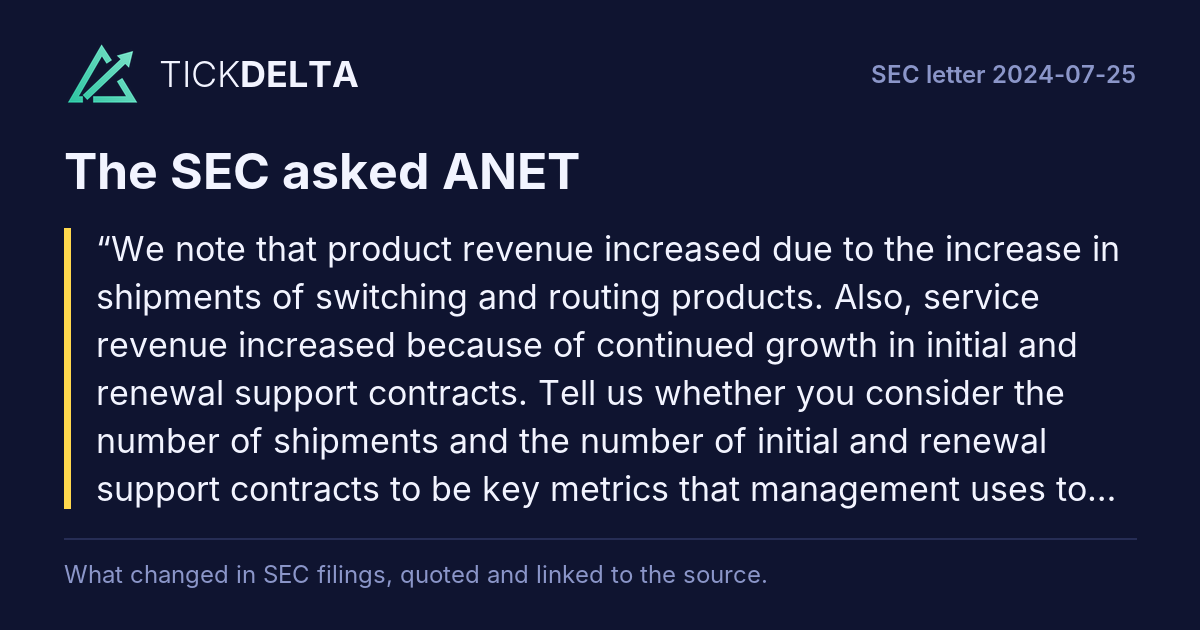
We note that product revenue increased due to the increase in shipments of switching and routing products. Also, service revenue increased because of continued growth in initial and renewal support contracts. Tell us whether you consider the number of shipments and the number of initial and renewal support contracts to be key metrics that management uses to manage the business and, if so, revise to include keyRest of the question
business metric disclosures for these measures in your MD&A. Refer to SEC Release No. 33-10751. Provide us with your proposed future disclosure, as applicable.
The Company acknowledges the Staff’s comment and respectfully advises the Staff that the Company does not consider the number of product shipments to be a key business metric it uses to manage its business because of the variability in the value of each shipment. The Company has a broad product base with a wide range of prices for those products.Read in the reply ↗Rest of the answer
Each shipment will contain a different set of products with a different aggregate purchase price.
Division of Corporation Finance
Page
The Company also does not consider the number of initial and renewal support contracts to be a key business metric that the Company’s management uses to manage its business because of the variability in the value of each support contract, which is based on the type and number of products at the customer site that require support. In addition, customers also have the option to purchase different levels of support, with higher-level contracts generally providing faster technical support response times and faster parts replacement than more basic support contracts.
Consequently, while the number of shipments and number of initial and renewal support contracts may be factors that contribute to a change in revenue, management does not use the number of shipments and number of initial and renewal support contracts to drive the Company’s business decisions and such metrics are not material to the understanding of the Company’s overall financial condition, changes in financial condition and results of operations.
The Company believes that revenue and, to a more limited extent, non-GAAP gross margin, non-GAAP operating income and non-GAAP net income, each on a consolidated basis, are the most important metrics in evaluating the Company’s financial condition and performance because these are metrics the Company is focused on and drive the Company’s business decisions, are relevant to the understanding of the business of the
Company and to its industry.
If additional or different metrics become material, the Company will reassess whether any such metrics should be discussed in future filings or given increased prominence as a key metric.
You indicate that gross margin increase between periods due to an improvement in product margins driven by a lower mix of revenue from your larger customers, partly offset by an increase in excess/obsolete inventory-related charges. In addition, your gross margin benefited in 2023 from the leverage of relatively fixed overhead costs on a higher revenue base.Rest of the question
Where you describe two or more factors that contributed to a material change, including any offsetting factors, please revise to quantify each material factor that contributed to the overall change. Refer to Item 303(b) of Regulation S-K. Revise for all line items as applicable. Provide us with your proposed future disclosure. Notes to Consolidated Financial Statements 1. Organization and Summary of Significant Accounting Policies
The Company acknowledges the Staff’s comment and respectfully confirms that in future filings, where the Company describes two or more factors that contributed to a material change to a financial statement line item, including any offsetting factors, where possible, the Company will quantify each material factor that contributed to the overall change in that line item.
The Company respectfully advises the Staff that with regard to its ability to quantify gross margin fluctuations, while it estimates price and volume changes and standard margins at a high level for internal managementRead in the reply ↗Rest of the answer
purposes, it would be prohibitively burdensome to calculate such changes with sufficient detail to accurately include this data in its public disclosures. This is because the Company offers many products that are sold at varying prices to different customers in different regions. Ongoing new product launches, product discontinuances and unpredictability in the timing, size and nature of customer orders contribute to customer and product mix changes that impact specific price and volume calculations. In some cases, changes in volume may have a pricing component as a result of promotions or from groups of products sold at a combined price or discount from prices of the products sold separately.
Below is proposed future disclosure using the Company’s 2023 Annual Report, with proposed revisions marked in bold and underlined text:
Gross margin increased from 61.1% for the year ended
December 31, 2022 to 61.9% for the year ended December 31, 2023. These changes reflect an improvement in product margins of 59.0% in 2023 compared to 57.7% in 2022 driven by a lower mix of revenue from our larger customers, partly offset by an increase of $273.1 million in excess/obsolete inventory-related charges in 2023 compared to 2022. In addition, our gross margin benefited in 2023 from the leverage of relatively fixed overhead costs on a higher revenue base of $5.9 billion in 2023 compared to $4.4 billion in 2022.
First report after the company's reply of 2024-08-08: 10-Q filed 2024-11-08 ↗, against the 10-Q filed 2024-05-08 ↗.
Tickdelta does not hold the text of both reports, so they are not compared here.
We note that on page 79 you disclose, "Accounts receivable are recorded at the invoiced amount, net of allowances for doubtful accounts, sales rebates and returns reserves." Also, on page 89 you label the contra accounts receivable account as "Product sales rebate, returns reserve and others." Please tell us why you believe sales rebates and return reserves should be netted against accounts receivables.Rest of the question
Refer us to your basis in the accounting literature. If you choose to revise disclosure, provide us with your proposed future disclosure.
The Company acknowledges the Staff’s comment and respectfully advises the Staff that the amount of sales rebates and return reserves that were netted against accounts receivable in the 2023 Annual Report was immaterial both individually and in the aggregate. The amount of sales rebates and return reserves recorded as a reduction to accounts receivable were $9.8 million and
$5.4 million, or approximately 1.0% and 0.6% of gross accounts receivable as of December 31, 2023 and 2022, and less than 0.2% of current assets and 0.6% of current liabilities as of December 31, 2023 and 2022,Read in the reply ↗Rest of the answer
respectively. In future filings, the Company will reflect sales rebates and return reserves as a liability on the Company’s balance sheet and not as a reduction of accounts receivable. In addition, the Company will revise its Accounts Receivable accounting policy in the Notes to its Consolidated Financial Statements beginning with its Annual Report on Form 10-K for the year ended December 31, 2024 as follows (with proposed revisions marked in bold and underlined text):
Accounts receivable are recorded at the invoiced amount, net of allowances for doubtful accounts, sales rebates and return reserves. We estimate our allowance for doubtful accounts based upon the collectability of the receivables in light of historical trends, reasonable and supportable information of our customers’ economic conditions that may affect our customers’ ability to pay, and prevailing economic conditions. Specific customer allowances are considered when determining our estimates. This evaluation is done in order to identify issues that may impact the collectability of receivables and related estimated required allowance. Revisions to the allowance are recorded as an adjustment to bad debt expense. After appropriate collection efforts are exhausted, specific accounts receivable deemed to be uncollectible are charged against the allowance in the period they are deemed uncollectible. Recoveries of accounts receivable previously written-off are recorded as credits to bad debt expense. We primarily estimate our sales rebates and returns reserves based on historical rates applied against current period billings. Specific customer returns, rebates and allowances are considered when determining our estimates.
Revisions to sales rebate and return reserves are recorded as adjustments to revenue.
Furthermore, the Company will revise its Revenue Recognition accounting policy in the Notes to its Consolidated Financial Statements beginning with its Annual Report on Form 10-K for the year ended December 31, 2024 to include the following language:
We account for customer sales rebates as a reduction to revenue and accrue for such rebates based on the amount that is earned and expected to be claimed by customers.
Lastly, the Company will eliminate the Accounts Receivable, net disclosure in the Financial Statements
Details in the Notes to its Consolidated Financial Statements beginning with its Quarterly Report on Form 10-Q for the quarter ended September 30, 2024.
First report after the company's reply of 2024-08-08: 10-Q filed 2024-11-08 ↗, against the 10-Q filed 2024-05-08 ↗.
Tickdelta does not hold the text of both reports, so they are not compared here.
We note from your disclosure on page 84 that you operate as one reportable segment. Based upon your May 7, 2024 earnings call, it appears that you have three sectors; Cloud and AI Titans, Enterprise and Providers. Please tell us specifically what information is provided to your chief operating decision maker and the Board of Directors.Rest of the question
Tell us how you considered ASC 280-10-50 in determining your operating and reportable segments. To the extent that you have aggregated multiple operating segments into a single reportable segment, please also tell us your basis for doing so. In addition, tell us your consideration for providing entity-wide disclosures discussed in ASC 280-10-50-40. We remind you that the company and its management are responsible for the accuracy and adequacy of their disclosures, notwithstanding any review, comments, action or absence of action by the staff.
The Company acknowledges the Staff’s comment and respectfully advises the Staff that the Company has determined it has one operating segment and one reportable segment after careful consideration of all relevant factors discussed in ASC 280-10-50, including but not limited to the factors set out below.Read in the reply ↗Rest of the answer
The context in which the Company referred to its three sectors in its May 7, 2024 earnings call was to describe the types of customers to which the Company sells its products and not its operating segments.
a.
Identification of the Chief Operating Decision Maker (the “CODM”): The
Company has concluded that its Chief Executive Officer (“CEO”) meets the definition as the Company’s CODM. The Company’s senior leadership team is led by the Company’s CEO and includes other functional and operating leaders. These other leaders assist the CEO by providing input on resource allocation decisions and the Company’s financial performance; however, the CEO has the ultimate decision-making responsibility for resource allocation decisions and assessing the Company’s financial performance. For example, the CEO is responsible for presenting decisions to the Board of Directors for approval (as applicable), approves all M&A transactions, operating budgets and the hiring of key management or executive personnel, makes strategic decisions, conducts operations reviews and interacts with the Company’s senior leadership team.
b.
Consolidated Financial Information: The financial information reviewed by the CODM and Board of
Directors reflects quarterly and year-to-date consolidated results, with a primary focus on revenue, non-GAAP gross margin, non-GAAP operating margin and non-GAAP net income.
c.
Resource Allocation, Budgeting and Forecasts: Consolidated financial information is used by the CODM to evaluate performance and make decisions regarding resource allocation. This consolidated financial information is also what is used for the approval of budgets and forecasts.
d.
Discrete Financial Information: The Company sells to three primary types of customers: Cloud and AI
Titans, Enterprise and Providers. Supplemental quarterly revenue information for these sectors and underlying customers is included in the financial information reviewed by the CODM; however no other discrete financial information (including operating expense metrics) is provided.
e.
Organizational Structure: The other members of the Company’s senior leadership team are functional leaders over their particular areas of expertise, rather than being directly accountable for the operating activities, financial results, forecasts or plans for a type of customer, product or service.
f.
Compensation: The Company’s senior leadership compensation structure is also based on consolidated performance metrics:
i.
For the year ended December 31, 2023, the structure of the Company’s annual bonus plan was based on a bonus pool established by the Company’s Compensation Committee upon consideration of revenue and non-GAAP operating income for the year, each on a consolidated basis.
ii.
In 2023, the Company granted performance-based restricted stock units to its executive officers that are paid out based on certain financial metrics such as revenue, non-GAAP gross margin, and non-GAAP operating margin, each on a consolidated basis.
Due to the fact that the CODM and Board of Directors review consolidated operating results and other consolidated financial information in the allocation of resources and assessment of Company performance, the Company has determined it only has one operating segment and thus has only one reporting segment. In addition, because the Company only has one operating segment, the Company does not aggregate operating segments.
In addition, the Company also considered the entity-wide disclosures prescribed by ASC 280-10-50-40, which requires disclosures of revenue from external customers for each product and service or each group of similar products and services unless it is impracticable to do so. As the guidance in ASC 280 does not define “similar” products and services, the Company has relied on an analysis of the facts and circumstances of the Company to determine whether its respective products and services are similar and can be combined for purposes of the entity-wide disclosures. In connection with this analysis, the Company has concluded that the existing product and service revenue line items in the
Company’s consolidated financial statements reflect the appropriate groupings for purposes of ASC 280-10-50-40. In reaching this conclusion, the Company contemplated the criteria outlined in ASC 280-10-50-11 (Aggregation criteria for operating segments) and determined that the nature of the products and services, the nature of the production processes, and the methods used to distribute the products and provide the services were similar within the products included in the product revenue grouping and were similar within the services included in the service revenue grouping.
The Company’s product revenue consists of cloud networking product solutions, which are primarily switching and routing platforms and related networks applications. The Company’s products have similar manufacturing and research and development processes, sales efforts, and distribution methods. Predominately all of the Company’s products incorporate Arista’s Extensible Operating System (“EOS”) and we do not have separate product-line managers that are responsible for the performance of the respective products. While the Company’s product offerings are used by its customers for different architectures and use cases, the Company believes all of these applications constitute of a group of similar cloud networking product solutions.
The vast majority of the Company’s service revenue consists of revenue from post-contract support (“PCS”), which customers typically purchase in conjunction with the Company’s products, and subsequent renewals of PCS. PCS includes technical support, hardware repair and replacement parts beyond standard warranty, bug fixes, patches and unspecified upgrades on a when-and-if-available basis. The customers for service revenue are similar to its customers that purchase its products. Customers have the option to buy different levels of PCS, with higher-level contracts generally providing faster technical support response times and faster parts replacement than more basic PCS contracts. The nature of the underlying support services and the delivery of those services are the same for any level-specific PCS contract.
Based on the factors noted above, the Company believes that the single product and service revenue lines shown in its existing financial statement disclosures reflects the appropriate grouping of products and services in accordance with the guidance in ASC
280-10-50-40.
First report after the company's reply of 2024-08-08: 10-Q filed 2024-11-08 ↗, against the 10-Q filed 2024-05-08 ↗.
Tickdelta does not hold the text of both reports, so they are not compared here.
We note your response to prior comment 4. It appears that you manage your business by three primary types of customers: Cloud and AI Titans, Enterprise and Providers. This is evident since you track revenue for these sectors and discuss the sectors in your earnings calls. In future filings please disclose revenue by these categories in your MD&A. Provide us with your proposed future disclosure.Rest of the question
We refer to guidance in Item 303 of Regulation S-K which states the objective of the MD&A is to allow investors to view registrants from management's perspective. Also, tell us if revenue or statistical information is provided to the CODM by any other categories such as: Core Data Center/Cloud/AI Switching Products, Adjacent Campus and Routing Products, and Network Software and Services.
to the Staff’s comment, the Company respectfully advises the Staff that it will begin disclosing the approximate percentages of sector revenue on an annual basis in Management’s Discussion & Analysis beginning with its Form 10-K for the fiscal year ending December 31, 2024. The Company will revise its disclosure to include the following language:
Division of Corporation Finance
“The Company currently sells its products and services to three primary types of customers, Cloud and AI Titans, Enterprise and Providers.Read in the reply ↗Rest of the answer
The percentage of revenue derived from these customers during the current fiscal year was approximately [ ]% from Cloud and AI Titans, [ ]% from Enterprise and [ ]% from
Providers.”
While the Company believes that this annual disclosure provides useful directional information about the trending nature of our customer base, the Company respectfully advises the Staff that it does not believe that disclosing estimated sector revenue on a quarterly basis would be meaningful to investors. Management’s categorization of customers often involves subjective determinations depending upon the nature of the customer’s business model, the size and scope of customer deployments or whether customers deploy their products among differing categories of projects. For instance, an
Enterprise or Provider customer may have a substantial project that is for a specific AI use case for which the revenue would appropriately be allocated to the Cloud and AI Titan sector, while the Company will also generate revenue from those same customers for non-AI projects that would be appropriately included in their existing sectors. Further, management’s selection of the customer categories and the allocation of the individual customers to these categories has changed from time to time and will continue to change based on management’s discretion, the evolution of our customers’ businesses and the addition of new customers. Consequently, we believe that the subjective nature of these categories and the potential changes that can occur throughout the year do not allow for a consistent quarter to quarter quantitative allocation of the underlying customers and revenues to these categories.
As stated in the Company’s previous response letter, the Company does provide its CODM with revenue data for customer categories on a quarterly basis for her review, but no other discrete financial information (including operating expenses) is provided. While the information provides underlying historical data to illuminate potential influences on our revenue, the fluctuation and unpredictability of the percentage mix of the categories makes it less reliable as a means to manage the business. Consequently, the CODM does not use this data to manage the business. Rather, the CODM makes resource allocation and other business decisions based on its customers as a whole, with the delivery of similar products, services and a software operating system that spans our customer base. Our CODM evaluates the Company’s business using company-wide financial and other information such as quarterly and year-to-date consolidated results, with a primary focus on revenue, non-GAAP gross margin, non-GAAP operating margin and non-GAAP net income.
In addition, the Company respectfully advises the Staff that the Company does provide its CODM with revenue data for product sectors, which includes Core (Data Center and Cloud Networks), Cognitive Adjacencies (Campus and Routing), and Cognitive Network
(Software and Services). The CODM does review this information to understand the relative mix of revenue for these categories. However, the CODM does not use this data to evaluate financial performance or make resource allocation decisions.
The Company continually evaluates its quantitative and qualitative disclosures to ensure that it is providing meaningful discussion and analysis of its financial statements and other statistical data that it believes will allow investors to view the Company from management’s perspective and comply with the requirements of Item 303 of Regulation
S-K.
First report after the company's reply of 2024-11-07: 10-Q filed 2024-11-08 ↗, against the 10-Q filed 2024-05-08 ↗.
Tickdelta does not hold the text of both reports, so they are not compared here.
We note in your response to prior comment 1 you refer to the CODM using certain metrics to evaluate financial performance or make resource allocation decisions. However, please note the guidance in Item 303 of Regulation S-K states, "the objective of the MD&A is to allow investors to view registrants from management’s perspective." If management is provided underlying historical data "to illuminate potentialRest of the question
influences on our revenue," or "to understand the relative mix of revenue for these categories," then it appears investors should also have access to this revenue information. Please revise accordingly and provide us with your proposed future disclosure.
The Company respectfully advises the Staff that it will disclose the approximate percentages of revenue of our current customer categories (Cloud and AI Titans, Enterprise, and Providers) on an annual basis in Management’s Discussion & Analysis beginning with its Form 10-K for the fiscal year ending
December 31, 2024 (the “FY 2024 10-K”) as stated in the Company’s previous response letter.Read in the reply ↗Rest of the answer
In addition, the Company will also disclose the approximate percentages of revenue for its product categories, which include Core (Data Center and Cloud Networks), Cognitive Adjacencies (Campus and Routing), and Cognitive Network (Software and Services) on an annual basis in Management’s Discussion & Analysis beginning with the FY 2024 10-K. The Company will revise its disclosure to include the following language:
Division of Corporation Finance
Page
“The Company currently sells its products and services to three primary types of customers, Cloud and AI Titans, Enterprise and Providers. The percentage of revenue derived from these customers during the current fiscal year was approximately [ ]% from Cloud and AI Titans, [ ]% from Enterprise and
[ ]% from Providers.”
“The Company’s main product categories are Core (Data Center and Cloud
Networks), Cognitive Adjacencies (Campus and Routing), and Cognitive Network (Software and Services). The percentage of revenue derived from these product categories during the current fiscal year was approximately [ ]% from Core (Data Center and Cloud Networks), [ ]% from Cognitive Adjacencies (Campus and Routing), and [ ]% from Cognitive Network (Software and Services).”
However, the Company believes that disclosing this information on a quarterly basis is not material to an investor’s understanding of the Company’s business, changes in financial condition and results of operations and therefore not required under Item 303 of Regulation S-K.
The Company believes that quarter to quarter changes in the Company’s revenue mix across customer or product categories do not reflect known trends that are reasonably likely to have a material impact on the Company’s business, financial condition and results of operations. As the Company has disclosed in its Forms 10-K and 10-Q, revenue from its large customers represents a significant portion of the Company’s revenue and is highly unpredictable and variable from quarter to quarter. This volatility is primarily due to the nature and complexity of the large customers’ business models which involve the purchase and deployment of large quantities of network infrastructure solutions, including our products, to construct and expand their cloud data centers. The timing of these orders, the types of products purchased by these customers, the deployment cycles for these products, the evaluation, testing and qualification process for our products, and changes in the demand patterns specific to these customers are all highly variable from quarter to quarter. In addition, we expanded the Cloud Titan category in the third quarter of 2023 to include “AI Titans”, which has increased the quarterly volatility due to the nature, size and complexity of
AI customer projects. Furthermore, revenue from customer orders may span different categories depending on the nature of the customer’s project and use case. This, in turn, has and continues to cause volatility in the quarterly revenue results across our customer and product categories and does not reflect known trends that are reasonably likely to have a material impact on our business, financial condition or operating results.
As such, while the customer and product category information is among various types of information provided to the CODM, the
Company does not consider such quarterly information to be material to management’s understanding of the financial performance of the Company nor useful in management’s decision making about the business because it is highly variable from quarter to quarter and does not reflect the underlying trends of the business that are reasonably likely to have a material impact on the Company’s business, financial condition and results of operations. To further support that the CODM does not use quarterly customer and product category information to make resource allocation and business decisions, we note that the Company’s business is not organized by customer category. The Company’s network switching and routing products, including its single Extensible Operating System (EOS®), are developed by the same engineering team and sold across the Company’s customer base. In addition, the percentage mix of revenue across our customer and product categories does not impact the Company’s revenue and earnings trends or provide insight into the overall revenue for our products and services on a quarterly basis. Therefore, we believe such quarterly information does not materially impact our reported operating results, reflect underlying trends in our business, or would enhance a reader’s understanding of our operating results.
In contrast, we do consider this information to be meaningful on an annual basis because management and our CODM analyze and evaluate long-term business trends during its annual planning cycle to understand and operate the business. Such information presented over a full year provides a more complete and informative picture of our financial performance and any underlying business trends. In light of this, the Company decided to provide the percentages of revenue for its customer and product categories to investors on our earnings calls regarding our annual results and will now also include the same information in Management’s Discussion & Analysis in future Forms 10-K. With respect to the Company’s customer and product categories, however, the
Company believes that disclosure of the relative percentage mix of revenue for these categories on a quarterly basis is immaterial and, therefore, quarterly disclosure of these categories is not required under Item 303(a) of Regulation S-K.
First report after the company's reply of 2025-01-24: 10-K filed 2025-02-19 ↗, against the 10-K filed 2024-02-13 ↗.
Tickdelta does not hold the text of both reports, so they are not compared here.
Also in this review: company letter, 2024-10-30, closing letter, 2025-01-30