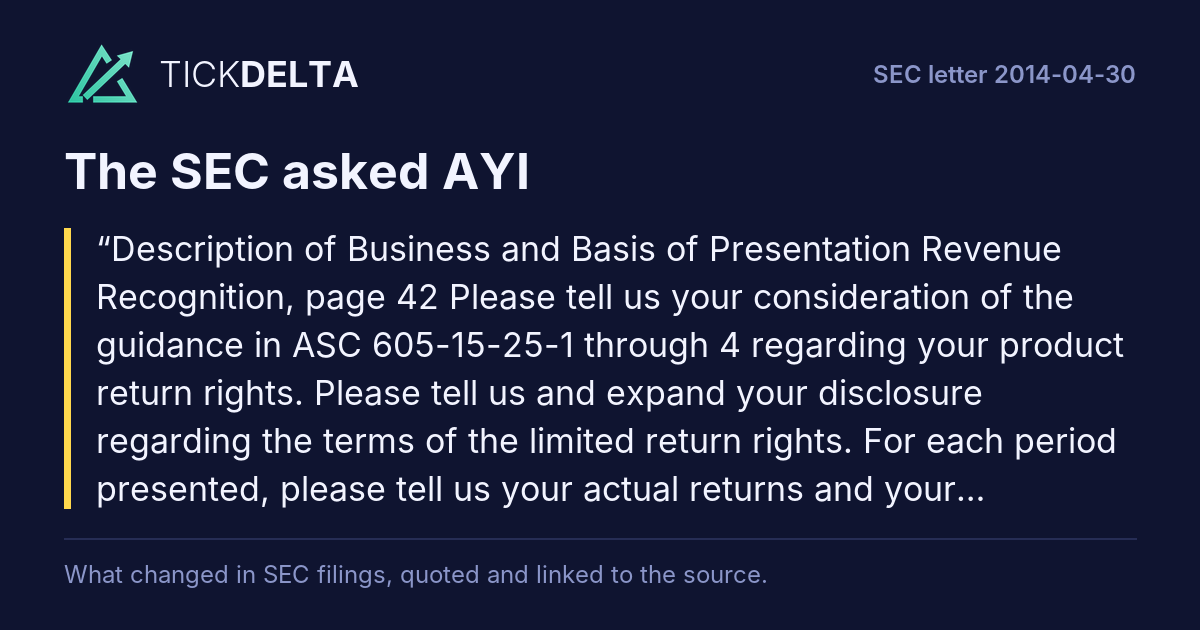
#1: Products sold by the Company under its standard terms and conditions are subject to a four month right of return. The Company's standard terms and conditions allow for returns of stock products with the following primary limitations: the product must be in salable condition, the return must be authorized by a representative of the Company, and notification of the return must occur within four months of shipment. Stock products are generally defined by the Company as non-customized products available to be shipped to customers from
.
Rest of the answer
Non-returnable merchandise under the Company's standard terms and conditions includes special, custom made or modified products, all stock products containing time-sensitive components that have reached the end of their warranty or shelf life, and outdated or phase-out stock products. The Company follows a robust process to review and approve all requests for returns to ensure they meet the standard terms and conditions or have proper authorization before accepting the return. Exceptions to the Company’s standard terms and conditions are made depending on the facts and circumstances of an individual request for return. As a result and for the reasons described in Response #2 below, the Company’s product return estimation process does not make a distinction between stock products or other products. Accordingly, the table below reflects sales revenue that was recognized for all products subject to return under the Company's various return programs less sales revenue associated with products sold for resale to the Company’s largest customer that has a contractual agreement that provides for a deduction in the invoice amount in lieu of product returns which is more fully described in Response #6 below. The table also includes total product returns and gross and net reserves for total product returns for each quarter during the three-year period ended August 31, 2013.
($ in millions)
Fiscal 2011 Quarter ended
Fiscal 2012 Quarter ended
Fiscal 2013 Quarter ended
Nov 30
Feb 28
May 31
Aug 31
Feb 29
Gross revenue on products subject to return
$
379.4
372.8
413.5
440.2
413.3
403.5
434.9
468.5
432.6
437.5
494.4
531.2
Product returns*
5.9
5.2
5.3
5.6
4.4
5.0
4.8
6.2
6.5
Reserve for total product returns at end of period, gross**
3.7
3.6
3.8
3.9
4.1
4.3
Reserve for total product returns at end of period, net***
1.3
1.4
1.5
* The provision for estimated product returns approximates product returns presented herein.
** Amounts presented herein represent the "revenue value" of total estimated product returns prior to consideration of estimated recoveries. See Response #5 below.
*** Amounts presented herein represent the "gross margin value" of total estimated product returns, which equals the revenue value of total estimated product returns minus their estimated recoveries. See Response #5 below.
Staff Comment #2: Please tell us in detail about the procedures that you employ to estimate future sales returns. We note that ASC 605-15-25-3 states that the ability to make a reasonable estimate of the amount of future returns may be impaired by many factors and circumstances, including, but not limited to: changes in demand; relatively long periods in which a particular product may be returned; absence of historical experience with similar types of sales of similar products, or inability to apply such experience because of changing circumstances, for example, changes in the selling entity's marketing policies or relationships with its customers; and, absence of a large volume of relatively homogeneous transactions. Please explain in detail why these factors did not preclude your ability to make a reasonable estimate of the amount of future returns.
Response #2: The Company estimates future product returns primarily based on the historical relationship of total product returns to gross sales adjusted for the expected time interval between the initial delivery of the product and the subsequent product return. Each year the Company computes the estimated time period differential between the delivery of the product and the subsequent product return ("product return lag") based on product return data during the respective fiscal year period. The Company then computes a product return rate by dividing total product returns by gross sales during each of the most recent eight quarters. Total product returns and, therefore, the product return rate consider all product returns, including stock products and other products. Other product returns not subject to the Company's standard terms and conditions include custom made or modified products returned to the Company for reasons such as order entry errors. On an annual basis, the average of the computed quarterly product return rates in each of the most recent eight quarters is applied to gross sales during the historical periods to estimate the amount of total gross product returns. Given the consistent relationship of product returns to gross sales over time, the Company believes that including a greater or lesser number of historical quarters in this analysis would not materially alter the Company's estimate of future product returns. When the product return rate is applied to gross sales during historical periods, the Company adjusts the estimated gross product returns in each of the historical periods by the product return lag to estimate the amount of estimated future gross product returns as of the reporting period date. The estimated future gross product returns as of the reporting date are then reduced by estimated recoveries, primarily the cost of the inventory expected to be returned, related to the future product returns. The estimated future gross product returns less estimated recoveries related to the future product returns equals the net reserve for estimated product returns. Finally, the Company performs additional analysis to evaluate the sensitivity of this model to reasonable fluctuations in the product return lag to determine the potential impact on the reserve required. For quarterly reporting periods, the Company completes analytical procedures to confirm the net reserve for estimated product returns is materially adequate.
In regards to the estimated product return lag, a majority of product returns are recorded within the first four months following delivery. For example, in fiscal 2013 the product return lag analysis indicated that approximately 40% of product returns occur within 30 days of delivery--many of which are within the same month as delivery--and approximately 80% of product returns occur within four months of delivery.
The Company does not believe its ability to reasonably estimate future returns has been precluded by the factors listed in ASC 605-15-25-3, specifically:
Changes in demand - During the years presented, the primary change in demand experienced by the Company related to a modest cyclical recovery in the Company's served market and an increase in sales of light-emitting diode ("LED") products. From the Company's perspective, LED products simply incorporate another type of light source. For many decades, the Company has integrated various light sources (such as fluorescent and high intensity discharge) with other components to produce products that achieve specific visual effects and optimize energy efficiency. LED products are used in applications identical to the Company's other products. This change in demand has not resulted in a material change in the rate of product returns. Therefore, we do not believe the change in demand represents a change in circumstances impacting our ability to estimate future product returns.
Relatively long periods in which a particular product may be returned - Consistent with the Company's standard return policy described above, the vast majority (approximately 80%) of the Company's product returns occur within the four-month return period following delivery of the product. This short product return lag enables the Company to make reasonable estimates of future product returns. Although the Company maintains a limited number of special return programs that extend beyond the standard terms and conditions, these programs incorporate limitations that minimize the impact of product returns, such as returned product generally must have been purchased within the prior twelve months, the products must be stock products in salable condition, and at times product returns require a replacement order of equal or greater value. See Response #3 below.
Absence of historical experience with similar types of sales of similar products - The Company has a long history of selling lighting and lighting related products to a consistent customer base through similar sales channels.
Inability to apply such experience because of changing circumstances, for example, changes in the selling entity's marketing policies or relationships with its customers - The Company's marketing practices and significant customer relationships have remained substantially consistent over time. As noted above, the Company has been selling to a consistent customer base through similar sales channels for many decades. Therefore, the Company believes there has not been a change in circumstances that would impact our ability to apply our historical experience.
Absence of a large volume of relatively homogeneous transactions - The Company believes our sales of lighting and lighting related products represent a large volume of relatively homogeneous transactions.
Based on the procedure described above, the Company believes that our reserve for product returns is materially adequate.