8 paragraphs in Risk Factors of the 10-K filed Feb 6, 2026
with nothing like them in the 10-K filed Feb 12, 2025. Quoted exactly.
Paragraphs that were only edited are under 10-K change.
Compared with the Risk Factors in the latest 10-K of the other 59 Health care companies:
a paragraph with at least half its words the same at another company is called similar, and the companies are listed under it.
A paragraph most of them have is marked boilerplate. No line means no other company has one like it.
This counts text; it does not say how serious a risk is.
•the approval and/or greater acceptance of other new products for the same or similar indications;
Read in the 10-K ↗
•disruptions, turnover or changes in strategy, priorities or capabilities at our collaborators resulting from, for example, a change in control, may impact the commercialization or manufacturing of our shared products and may result in loss of revenue or higher operating expense; and
Read in the 10-K ↗
In July 2025 the U.S. signed into law the OBBBA, which enacts significant potential changes to Medicaid funding and rescinds or does not continue elements of the PPACA. The OBBBA implements additional eligibility rules on government health plans, expands administrative procedures around enrollment, modifies how states can obtain federal funding for Medicaid and no longer extends ACA premium subsidies. Additional federal and state guidance is expected to be issued in order to implement these OBBBA provisions, most of which have effective dates in 2027 and 2028. At this time, we are unable to determine the overall impact that the OBBBA will have on our business, results of operations and financial condition, or the impact the OBBBA will have on the pharmaceutical industry as a whole because any such impact will depend upon developing interpretations of the OBBBA provisions and implementing regulations, which may be material.
Read in the 10-K ↗
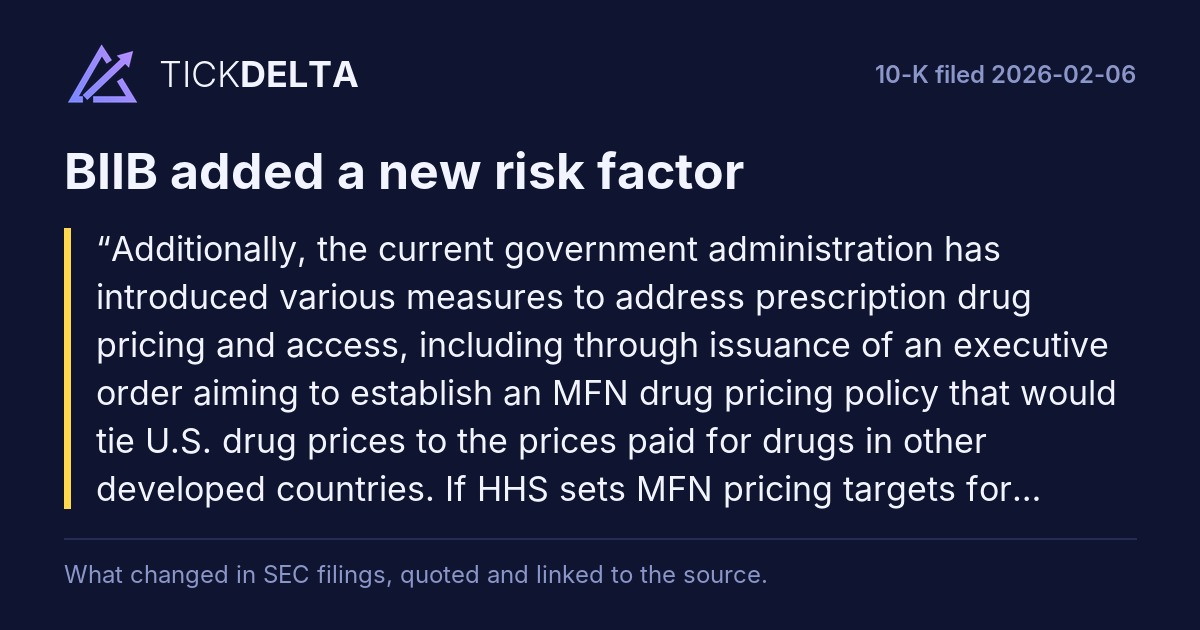
Additionally, the current government administration has introduced various measures to address prescription drug pricing and access, including through issuance of an executive order aiming to establish an MFN drug pricing policy that would tie U.S. drug prices to the prices paid for drugs in other developed countries. If HHS sets MFN pricing targets for prescription drugs, including the use of international pricing reference to set drug prices in the U.S., or if legislation is passed enabling generic drug or biosimilar entry sooner than expected, our business could be materially harmed, including with respect to our ability to set adequate pricing for new drugs to recover our research and development costs. Additional proposals, regulations or initiatives related to drug pricing, such as the CMS-proposed MFN initiatives, the Global Benchmark for Efficient Drug Pricing for certain Medicare Part B drugs and the Guarding U.S. Medicare Against Rising Drug Costs for certain Medicare Part D drugs, continue to be debated, and additional executive orders or regulatory initiatives focused on drug pricing and competition may be adopted and implemented in some form. The timing and extent of implementation of any of the measures described above is uncertain and we cannot fully predict their impact on our product candidates and our business. The adoption of these and any other government controls and measures, and tightening of restrictive policies in jurisdictions with existing controls and measures, could exclude or limit our product candidates from coverage, limit payments for
pharmaceuticals, limit our ability to launch products in certain markets and impact healthcare systems and drug markets in the U.S. and abroad, thereby negatively affecting our revenue and adversely impacting our business.
Read in the 10-K ↗
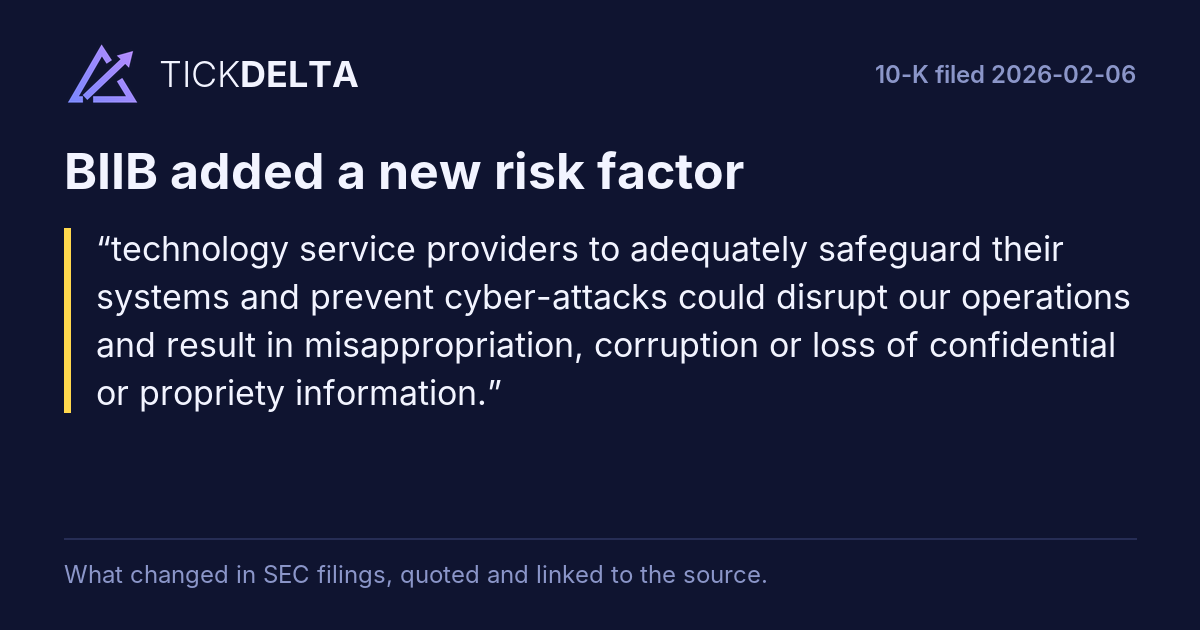
technology service providers to adequately safeguard their systems and prevent cyber-attacks could disrupt our operations and result in misappropriation, corruption or loss of confidential or propriety information.
Similar paragraph at 1 of 59 other Health care companies:
VRTX
•the imposition of tariffs or reciprocal tariffs, trade protection measures, embargoes, import or export licensing requirements and the imposition of trade sanctions and other similar restrictions.
Our international operations are also subject to regulation under U.S. law. For example, the U.S. federal government has initiated Section 232 investigations including with respect to pharmaceutical imports into the U.S. The result of these Section 232 investigations and any subsequent rulemaking could result in the government taking actions such as trade protection measures, embargoes, import or export licensing requirements, the imposition of trade sanctions or similar restrictions, which could have adverse consequences to our business and operations.
Read in the 10-K ↗
New in the latest 10-Q
27 paragraphs in the 10-Q filed Oct 28, 2026 with nothing like
them in the 10-Q filed Jul 29, 2026 (at least half the words must differ; new numbers alone do not count).
Quoted exactly, grouped by the item heading above them. This is text that changed, not a judgement of how serious it is.
10-Q
*Measurement period adjustments since the transaction close date reflect updates to our estimated valuation of inventory, intangible assets, accrued expense and other, deferred tax liability, and goodwill.
Read in the 10-Q ↗
We have undertaken a number of initiatives, including Fit for Growth and our integration of Apellis, which are designed to reduce operating costs, improve synergies, efficiency and effectiveness and integrate the operations of Apellis.
Read in the 10-Q ↗
IPR&D represents the fair value assigned to research and development assets that we acquired as part of a business combination and had not yet reached technological feasibility at the date of acquisition. Included in IPR&D balances are adjustments related to foreign currency exchange rate fluctuations.
Read in the 10-Q ↗
Foreign currency forward contracts and foreign currency options in effect as of September 30, 2026 and December 31, 2025, had durations of 1 to 15 months and 1 to 21 months, respectively. These contracts have been
Read in the 10-Q ↗
As part of our acquisition of Reata, we assumed responsibility for a single-tenant, build-to-suit building of approximately 327,400 square feet of office and laboratory space located in Plano, Texas, with an initial lease term of 16 years. We recorded a lease liability of approximately $ 151.8 million, with a corresponding right-of-use asset of approximately $ 121.2 million.
Read in the 10-Q ↗
During the fourth quarter of 2025 we performed an impairment assessment for this right-of-use asset. This assessment involved estimating undiscounted future cash flows, including potential sublease income and remaining lease obligations. As a result of this impairment assessment, we recorded an impairment charge of approximately $ 52.9 million related to this Reata lease, which is included in impairment of ROU asset within our consolidated statements of income for the year ended December 31, 2025.
Read in the 10-Q ↗
In March 2026 the District Court dismissed the action brought by Frances Clarity Stokes and Thomas Allen Gray and they appealed. In June 2026 Thomas Allen Gray requested voluntary dismissal of his appeal but the appeal by Frances Clarity Stokes continues. In August 2026 the U.S. Court of Appeals for the First Circuit affirmed dismissal of the action brought by Michigan Laborers' Pension Fund and Ray Peleckas.. In September 2026 the District Court granted final approval of a settlement of the action filed by Oklahoma Firefighters Pension and Retirement System. In October 2026 the District Court granted preliminary approval of a settlement of the action filed by Albert Aftoora, Amjad Kahn and Nadia Shash.
Read in the 10-Q ↗
In July 2026, Fresenius Kabi filed a claim for damages and injunctive relief against Biogen Inc., Biogen MA Inc., Biogen Netherlands B.V., Biogen Italia S.r.l., and Samsung Bioepis NL B.V. in the Court of Milan, Commercial Division, in Italy alleging infringement of the Italian counterpart of the EP '488 Patent by a formulation of IMRALDI no longer commercialized in Italy.
Read in the 10-Q ↗
In September 2026, CMS published a final rule establishing the Global Benchmark for Efficient Drug Pricing Model, a mandatory Medicare Part B drug payment model that implements the current administration’s MFN pricing policy for drugs reimbursed under that program. The final rule is narrower than the initial rule proposed in December 2025, with expanded exemptions. The model begins on January 1, 2027, with the collection of voluntary manufacturer-submitted international net pricing data. We do not currently believe this will have a material impact on our business in 2027.
Read in the 10-Q ↗
We continue to evaluate the potential impact of the actions discussed above on our business and operations.
Read in the 10-Q ↗
We made an upfront cash payment of $225.0 million. We may pay additional development and regulatory milestones to the former shareholders of RayThera of up to $275.0 million and $500.0 million, respectively. We accounted for this acquisition as an asset acquisition as substantially all of the value being acquired relates to the lead program.
Read in the 10-Q ↗
• In September 2026 Japan approved the NDA for LEQEMBI subcutaneous autoinjector as a new route of administration.
Read in the 10-Q ↗
• In September 2026 China approved the BLA for LEQEMBI subcutaneous autoinjector for a weekly initiation dose. We expect commercial launch to occur during the first quarter of 2027.
Read in the 10-Q ↗
• In August 2026 we and Eisai announced that Canada’s Drug Agency has issued a final recommendation supporting public reimbursement of LEQEMBI for eligible patients in Canada living with mild cognitive impairment or mild dementia due to Alzheimer’s disease.
Read in the 10-Q ↗
• In September 2026 we presented data on clinical experience with zorevunersen in patients with Dravet syndrome, including two Phase 1/2a and ongoing open-label extension studies. The data showed substantial and durable reductions in seizures and continuing improvements in cognition and behavior. A new exploratory sub-analysis also showed substantial reductions in the most severe seizure types, which are the leading risk factor for sudden unexpected death in epilepsy.
Read in the 10-Q ↗
• The global results for the third quarter of 2026 reflect rapid patient conversion to the high-dose regimen and the higher benefit of a one-time transition dose for patients converting from low-dose SPINRAZA. As the conversion cohort matures and dosing patterns normalize, we expect revenue to normalize.
Read in the 10-Q ↗
• programs acquired from Apellis, including development of pegcetacoplan for the treatment of FSGS; and
Read in the 10-Q ↗
• the conclusion of the research and development funding received from Royalty Pharma in Q2 2026;
Read in the 10-Q ↗
• programs acquired from Apellis, including development of pegcetacoplan for the treatment of FSGS; and
Read in the 10-Q ↗
We have undertaken a number of initiatives, including Fit for Growth and our integration of Apellis, which are designed to reduce operating costs, improve synergies, efficiency and effectiveness and integrate the operations of Apellis.
Read in the 10-Q ↗
payments are not considered contractual obligations as they are contingent on the successful achievement of certain development, regulatory or commercial milestones.
Read in the 10-Q ↗
Risk Factors
Cybersecurity threats and incidents also include supply chain attacks, which could cause a delay in the manufacturing of products including products produced for contract manufacturing or lead to a data privacy or security breach. Our key business partners face similar risks and any security breach of their systems could
Read in the 10-Q ↗
Use of AI technologies internally, by third parties or by threat actors, may also lead to cybersecurity risks or the release of confidential proprietary information, including personal data, which may impact our ability to realize the benefit of our intellectual property or violate our internal policies, data protection laws or contractual requirements. The use of AI technologies may also result in unauthorized access of personal data or the intellectual property of third parties, and the ownership and protectability of AI-assisted inventions and works remain uncertain.
Read in the 10-Q ↗
Since the use of AI is subject to new and evolving laws and regulations, compliance may impose operational costs and limit our ability to use AI, and failure to comply may result in potential government actions, litigation, fines, penalties or adverse publicity. In addition, if we are unable to adopt and integrate AI technologies effectively and responsibly, we may not realize their anticipated benefits, which could adversely affect our competitive position.
Read in the 10-Q ↗
cannot be certain that we could reach agreement with alternative providers or that the FDA or other regulatory authorities would approve our use of such alternatives.
Read in the 10-Q ↗
investigation or litigation related to alleged unlawful conduct could increase our expense, damage our reputation, divert management time and attention and adversely affect our business.
Read in the 10-Q ↗
Other information
In our Quarterly Report on Form 10-Q for the quarterly period ended June 30, 2026, we reported that on May 4, 2026, Lloyd Minor, a member of our Board of Directors, adopted a Rule 10b5-1 trading arrangement providing for the sale of up to 593 shares of our common stock. The correct aggregate number of shares covered by such Rule 10b5-1 trading arrangement was 1,186 shares of our common stock. All other terms of Mr. Minor's previously disclosed Rule 10b5-1 trading arrangement remain as previously described.
Read in the 10-Q ↗
The 10-Q's risk factors against the 10-K
Item 1A of the 10-Q filed Oct 28, 2026 against Item 1A of the 10-K filed Feb 6, 2026.
A 10-Q repeats only the risks that changed, so a 10-K paragraph that is missing from it is not counted as removed.
Added is a paragraph with nothing like it in the 10-K, Reworded a sentence that is in both with several words changed,
Quiet changes a sentence in both where one to four words changed and one is a hedge or a modal
(cut words struck through, new words highlighted and underlined).
Text on the page, not a score; each links to the filing at sec.gov.
Added10-Q 2026-10-28 vs 10-K 2026-02-06
experience with the development of such therapies. For example, we recently sought, and in July 2026 the FDA approved, of a subcutaneous formulation of LEQEMBI as a starting dose in the U.S. Our ability to realize the anticipated benefits from the subcutaneous formulation of LEQEMBI depends on among other things, the successful commercial launch of the subcutaneous formulation and patient and physician adoption.
Read it in the 10-Q at sec.gov ↗
Added10-Q 2026-10-28 vs 10-K 2026-02-06
Cybersecurity threats and incidents also include supply chain attacks, which could cause a delay in the manufacturing of products including products produced for contract manufacturing or lead to a data privacy or security breach. Our key business partners face similar risks and any security breach of their systems could
Read it in the 10-Q at sec.gov ↗
Added10-Q 2026-10-28 vs 10-K 2026-02-06
Use of AI technologies internally, by third parties or by threat actors, may also lead to cybersecurity risks or the release of confidential proprietary information, including personal data, which may impact our ability to realize the benefit of our intellectual property or violate our internal policies, data protection laws or contractual requirements. The use of AI technologies may also result in unauthorized access of personal data or the intellectual property of third parties, and the ownership and protectability of AI-assisted inventions and works remain uncertain.
Read it in the 10-Q at sec.gov ↗
Added10-Q 2026-10-28 vs 10-K 2026-02-06
Since the use of AI is subject to new and evolving laws and regulations, compliance may impose operational costs and limit our ability to use AI, and failure to comply may result in potential government actions, litigation, fines, penalties or adverse publicity. In addition, if we are unable to adopt and integrate AI technologies effectively and responsibly, we may not realize their anticipated benefits, which could adversely affect our competitive position.
Read it in the 10-Q at sec.gov ↗
Added10-Q 2026-10-28 vs 10-K 2026-02-06
cannot be certain that we could reach agreement with alternative providers or that the FDA or other regulatory authorities would approve our use of such alternatives.
Read it in the 10-Q at sec.gov ↗
Added10-Q 2026-10-28 vs 10-K 2026-02-06
investigation or litigation related to alleged unlawful conduct could increase our expense, damage our reputation, divert management time and attention and adversely affect our business.
Read it in the 10-Q at sec.gov ↗
Reworded10-Q 2026-10-28 vs 10-K 2026-02-06
While we continue to build and improve our systems and infrastructure, including our business continuity plans, and disaster recovery capabilities, there can be no assurance that our efforts will detect and prevent cybersecurity threats or incidents in our systems or that we will be able to restore affected systems and any such incidents could materially adversely affect our critical business and operations and/or result in the loss of critical or sensitive information, which could result in material financial, legal, operational or reputational harm to us, loss of competitive advantage or loss of consumer confidence. a timely manner.
Read it in the 10-Q at sec.gov ↗ · The 10-K sentence ↗
Reworded10-Q 2026-10-28 vs 10-K 2026-02-06
While we continue to build and improve our systems and infrastructure, including our business continuity plans, there can be no assurance that our efforts will detect and prevent cybersecurity threats or incidents in our systems and any Any such incidents could materially adversely affect our business and operations and/or result in the loss of critical or sensitive information, which could result in material financial, legal, operational or reputational harm to us, loss of competitive advantage or loss of consumer confidence.
Read it in the 10-Q at sec.gov ↗ · The 10-K sentence ↗
Reworded10-Q 2026-10-28 vs 10-K 2026-02-06
The result of these Section 232 investigations and any subsequent rulemaking could result in In addition to the Proclamation, the government taking actions such as may take additional trade protection measures, measures including embargoes, import or export licensing requirements, the imposition of trade sanctions or similar restrictions, which could have adverse consequences to our business and operations.
Read it in the 10-Q at sec.gov ↗ · The 10-K sentence ↗
Reworded10-Q 2026-10-28 vs 10-K 2026-02-06
LEQEMBI is We have many products in the early stages of ongoing commercial launch in the U.S. and certain international markets and SKYCLARYS is in the early stages of commercial launch in certain European markets.
Read it in the 10-Q at sec.gov ↗ · The 10-K sentence ↗
Reworded10-Q 2026-10-28 vs 10-K 2026-02-06
Additional proposals, regulations or initiatives related to drug pricing, such as the CMS-proposed MFN initiatives, the Global Benchmark for Efficient Drug Pricing for certain Medicare Part B drugs and initiative, the Guarding U.S.
Read it in the 10-Q at sec.gov ↗ · The 10-K sentence ↗
Reworded10-Q 2026-10-28 vs 10-K 2026-02-06
If the analyses or outputs that AI-based software AI technologies assist in producing are deficient or inaccurate, or are relied upon without appropriate human oversight, we could be subjected to competitive harm, potential legal liability and brand or reputational harm.
Read it in the 10-Q at sec.gov ↗ · The 10-K sentence ↗
Reworded10-Q 2026-10-28 vs 10-K 2026-02-06
This may result in managed care organizations influencing prescription decisions for a larger segment of the population and a corresponding limitation on prices and reimbursement for our products. products which may adversely affect our business and financial condition.
Read it in the 10-Q at sec.gov ↗ · The 10-K sentence ↗
Reworded10-Q 2026-10-28 vs 10-K 2026-02-06
We may face difficulty in attracting and retaining talent for a number of reasons, including management changes, integration related to the acquisition of HI-Bio, acquired businesses, assets or operations, the underperformance or discontinuation of one or more marketed, preclinical or clinical programs, recruitment by competitors or changes in the overall labor market.
Read it in the 10-Q at sec.gov ↗ · The 10-K sentence ↗
Reworded10-Q 2026-10-28 vs 10-K 2026-02-06
For example, algorithms may be flawed, data sets may be insufficient, of poor quality or contain biased information; outputs may be inaccurate, incomplete or not reproducible; and inappropriate or controversial data practices could impair results.
Read it in the 10-Q at sec.gov ↗ · The 10-K sentence ↗
Reworded10-Q 2026-10-28 vs 10-K 2026-02-06
The development of novel approaches for the treatment of diseases, including development efforts in new modalities such as those based on the ASO platform, presents additional challenges and risks, including obtaining approval from regulatory authorities that have limited experience with the development of such therapies.
Read it in the 10-Q at sec.gov ↗ · The 10-K sentence ↗
Reworded10-Q 2026-10-28 vs 10-K 2026-02-06
There is also significant economic pressure on state budgets, that may result in and certain states are increasingly seeking to achieve budget savings through mechanisms that limit coverage or payment for our drugs.
Read it in the 10-Q at sec.gov ↗ · The 10-K sentence ↗
Reworded10-Q 2026-10-28 vs 10-K 2026-02-06
If our employees, agents, distributors, collaborators or third-party providers are found to have engaged in such practices, we could suffer severe penalties and may be subject to other liabilities, which could negatively affect our business, operating results and financial condition. business.
Read it in the 10-Q at sec.gov ↗ · The 10-K sentence ↗
The first 18 of 26 are shown (at most 12 of each type).