VRTXVertex Pharmaceuticals
We are a global biotechnology company that invests in scientific innovation to create transformative medicines for people with serious diseases, with a focus on specialty markets. 10-K, Item 1
- Employees
- 6,400
- Headquarters
- Boston, MA
- CEO
- Reshma Kewalramani
- Next results
- around Feb 11, 2027
466 paragraphs in Risk Factors of the 10-K filed Feb 13, 2026 with nothing like them in the 10-K filed Feb 13, 2025. Quoted exactly. Paragraphs that were only edited are under 10-K change.
Compared with the Risk Factors in the latest 10-K of the other 59 Health care companies: a paragraph with at least half its words the same at another company is called similar, and the companies are listed under it. A paragraph most of them have is marked boilerplate. No line means no other company has one like it. This counts text; it does not say how serious a risk is.
Investing in our common stock involves a high degree of risk, and you should carefully consider the risks and
Similar paragraph at 1 of 59 other Health care companies: DXCMuncertainties described below in addition to the other information included or incorporated by reference in this Annual
Report on Form 10-K. If any of the following risks or uncertainties occur, our business, financial condition or results of
Similar paragraph at 1 of 59 other Health care companies: MRNARead in the 10-K ↗
Our success depends on our ability to develop and commercialize additional medicines.
Similar paragraph at 10 of 59 other Health care companies: DHR, HCA, HSIC, IQV, JNJ, MDT, MRNA, PODD and 2 moreWe invest significant resources in research and development to discover and develop transformative medicines for
people with serious diseases. Product development is highly uncertain and expensive. Product candidates may appear
promising in research and development but may fail to reach commercial success for many reasons, including:
Read in the 10-K ↗
•competition based on, among other factors, safety, efficacy, patient convenience, pricing and reimbursement.
Read in the 10-K ↗
Substantially all our net product revenues have been derived from the sale of our CF medicines. We may be unable to
sustain or increase revenues from sales of our CF medicines in the future for any number of reasons, including the potential
introduction of competitive products or the inability to successfully develop and commercialize next-generation medications
or medicines to treat people with CF who cannot benefit from our current CF medicines. Our concentrated source of revenue
increases the risks associated with potential manufacturing or supply disruptions, safety issues that may be identified with
respect to our CF medicines, and failure to gain and/or maintain market acceptance or adequate pricing or reimbursement for
Read in the 10-K ↗
A portion of the value attributed to our company by investors is based on the expected commercial success of
JOURNAVX for acute pain and on our development programs for both acute and peripheral neuropathic pain. JOURNAVX
may not gain or maintain market acceptance among physicians, patients, or payors due to various factors, including the
availability of lower-cost alternatives, and sales, marketing, pricing, and/or distribution challenges associated with
introducing a product into a highly competitive market. Furthermore, we may not succeed in developing JOURNAVX for
additional indications or in advancing other product candidates, including NaV1.8 or NaV1.7 inhibitors, for the treatment of
acute or peripheral neuropathic pain. Even if we obtain marketing approvals for these product candidates, they will face
Read in the 10-K ↗
useful, cost-effective, ethical, safe, and preferred with respect to current and potential future competitive therapies, and on
payors providing adequate reimbursement. In addition to risks generally associated with the commercialization of medicines,
the cell collection processes, manufacturing and other procedures required to manufacture and administer CASGEVY are
more complex, resource-intensive, and operationally demanding than for small molecules. For example, the cost of
manufacturing CASGEVY as a percentage of revenue is significantly higher than for our CF medicines. Moreover, market
Read in the 10-K ↗
We are subject to pricing and reimbursement pressures that could have a material adverse effect on our business,
Similar paragraph at 18 of 59 other Health care companies: ABBV, ALGN, BSX, CI, COR, DVA, DXCM, EW and 10 moreRevenues from our products depend, to a large degree, on the extent to which the products are purchased by customers,
such as wholesalers, pharmacies, and hospitals, and reimbursed by third-party payors, such as government health programs,
commercial insurers, and managed health care organizations. Increasingly, these third-party payors are becoming more
critical in evaluating and reimbursing medicines. The containment of health care costs continues to be a priority for many
governments, and drug pricing has been a focus in this effort. The U.S. federal government and state legislatures and foreign
governments have shown significant and evolving interest in implementing cost-containment programs, including price
controls, restrictions on reimbursement, value-based and reference pricing, compulsory licensing, including the pursuit of so-
called “march in” rights, and mandatory substitution with generic products, all of which could limit the prices of, or access to,
our products. Decisions by third-party payors to not cover a product or restrict access to a product may shift over time and
could reduce market acceptance of the product and limit product revenues. We must also compete to be placed on formularies
of managed care providers, as exclusion of our products from a formulary would limit usage by managed care providers and
In the U.S., pricing and access is primarily governed by practices of private managed care providers and institutional and
governmental purchasers, federal laws and regulations related to Medicare and Medicaid, including the ACA and the IRA,
and state activities, including the establishment of PDABs and price transparency rules. For example, in August 2023, the
Colorado PDAB selected five drugs for an affordability review, including TRIKAFTA. Although the Colorado PDAB later
found TRIKAFTA to be ineligible for an upper payment limit we cannot predict whether future reviews by the Colorado
PDAB, or any other PDAB, will come to the same conclusion about TRIKAFTA or any of our other therapies, or the amount
of any potential upper payment limit. Furthermore, changes to the health care system enacted as part of health care reform in
Similar paragraph at 1 of 59 other Health care companies: CVSthe U.S., as well as increased purchasing power of entities that negotiate on behalf of Medicare, Medicaid, and private
payors, could result in further pricing pressures. For example, initiatives by the U.S. government to impose most-favored-
nation pricing on U.S. prescription drug prices in government programs, including the recently proposed GUARD Model by
the CMS. While there is significant uncertainty around the related executive orders and rulemaking, mandatory initiatives
In most markets outside of the U.S., the pricing and reimbursement medicines is subject to governmental control and
governments are making greater efforts to reduce drug prices and limit drug spending. The reimbursement process in ex-U.S.
markets vary widely and can take a significant time to complete, and reimbursement decisions are made on a country-by-
country and region-by-region basis. Reimbursement for our products by governments, including the timing of any
reimbursements, may also be affected by budgetary or political constraints, particularly in challenging economic
environments. We have experienced challenges in obtaining timely reimbursement for our products in various countries
outside the U.S., and our future revenues depend on maintaining such reimbursement. There is no assurance that coverage
and reimbursement will continue for our current products or be available for our future products. Even if reimbursement is
available, there is no assurance that the timing or level of reimbursement will be sufficient. Furthermore, many ex-U.S.
governments are introducing new legislation focused on cost containment measures applicable to the pharmaceutical
industry; such legislation, if finalized, could lead to lower prices, rebates or other forms of discounts or special taxes.
Our failure to obtain or maintain adequate prices, coverage, or reimbursement for our products would have an adverse
effect on our business, revenue and results of operations, could curtail or eliminate our ability to adequately fund our research
Similar paragraph at 1 of 59 other Health care companies: BIIBand development programs and/or could cause a decline or volatility in our stock price.
Similar paragraph at 1 of 59 other Health care companies: BIIBCompeting products and technological advances from our competitors may negatively affect our business and market
Our products and product candidates face or may face competition from existing and potential competing products. See
Similar paragraph at 1 of 59 other Health care companies: AMGNalso Item 1., Business – Competition of this Annual Report on Form 10-K. Competing products may be more effective, safer,
more effectively marketed, have lower prices or better coverage or reimbursement levels, eliminate or minimize the need for
treatment with our products or product candidates, or have other differentiating factors that negatively affect the demand for
our products or product candidates. If a competitor obtains approval and reimbursement before we do, approval and/or
reimbursement of our products or product candidates could be delayed, denied, or otherwise adversely affected. We compete
with an array of companies and other organizations, including those that have substantially greater resources, more mature
development, manufacturing and commercial organizations, and/or other competitive advantages. Smaller companies with
innovative programs or technologies are frequently acquired by and enter into collaborations with larger competitors, which
may result in the acceleration or enhancement of competitive programs. We cannot predict the timing or impact of the
introduction of competitive products. If a competing product is successfully developed and commercialized for a patient
population we are currently treating or are seeking to treat, our revenues, business or market position could be materially
adversely affected. In addition, the release of new information, including clinical data and regulatory approval timelines, by
our competitors regarding competitive products or potentially competitive product candidates can affect investors’
perceptions regarding the prospects of our products and product candidates, and has caused and may in the future cause our
Read in the 10-K ↗
After regulatory approval and launch, our products are used over longer periods of time and by larger populations of
patients than during pre-approval clinical trials. Additional clinical and non-clinical studies, such as for label expansions, new
combinations or otherwise, may also be conducted after regulatory approval. For example, as part of FDA approval for
CASGEVY, we are required to conduct post-marketing safety studies to assess certain long-term risks associated with the
treatment. Additionally, when post-marketing studies involve our marketed products, or an active pharmaceutical ingredient
thereof, they can raise new safety issues for our existing products. The subsequent discovery or appearance of previously
unknown or underestimated safety or efficacy concerns with a product could negatively affect commercial sales of the
product, result in reduced coverage or reimbursement by payors, cause reputational harm, government investigations, and/or
lawsuits against us. Subsequent adverse safety events, as well as safety or efficacy issues affecting suppliers or competing
products, may also lead to recalls, denial or withdrawal of regulatory approvals, non-renewal of conditional regulatory
approvals, label changes, obligations to conduct additional or more extensive clinical trials or to implement a risk
management plan, and reductions in market acceptance. Each of our CF products shares at least one active pharmaceutical
ingredient with another of our products. If any of our CF products were to experience safety issues or labeling modifications,
our other CF products may be adversely affected. For example, in December 2024, the FDA required us to modify the
TRIKAFTA label by revising information regarding liver injury and liver failure and moving that information from the
“warnings and precautions” section to a “boxed warning” section; the FDA required similar language in the ALYFTREK
label. In addition, safety or efficacy issues affecting suppliers’ or competitors’ products also may reduce the market
The discovery of safety events involving our products or public speculation about such events could limit or reduce
product revenues and cause our stock price to decline or experience periods of volatility.
Similar paragraph at 1 of 59 other Health care companies: IDXXThe data from our product development activities may not support advancement or regulatory approval of our product
candidates, or label expansions for our marketed products, or provide sufficient data to support the successful
Extensive testing is required for our product candidates and for new indications of our marketed products. The outcomes
Similar paragraph at 1 of 59 other Health care companies: REGNof such clinical and non-clinical testing are highly uncertain, may not generate sufficient safety, efficacy, or other data, and
may not support regulatory approval of our product candidates. Clinical and non-clinical testing, and in particular our later-
stage clinical trials, are expensive and resource intensive. The data from our preclinical studies and other research activities
have in the past and may in the future fail to predict results in clinical trials. For example, despite considerable non-clinical
testing, the clinical study of VX-264 in T1D did not meet its efficacy endpoint. Similarly, results from earlier-stage clinical
Read in the 10-K ↗
38 more
candidate for commercial sale. In addition, interim or preliminary data from a clinical trial may not be predictive of final
results from the clinical trial and are subject to the risk that one or more of the clinical outcomes may materially change as
Similar paragraph at 1 of 59 other Health care companies: DXCMpatient enrollment and treatment continues, more patient data become available, or as patients continue other treatments for
The data from our clinical programs may not support approval or successful commercialization of our product
candidates, and we may be unable to recoup the significant research and development, clinical trial, acquisition-related, and
other expenses incurred, which could have an adverse effect on our business, financial condition and results of operations,
Similar paragraph at 29 of 59 other Health care companies: A, ALGN, BMY, BSX, CI, CNC, DGX, DVA and 21 moreRead in the 10-K ↗
candidate or program. For example, after VX-264 did not meet its efficacy endpoint, we announced that the program would
not advance into further clinical studies. Failure to advance product candidates through clinical development would impair
our ability to commercialize products, which could materially harm our business, financial condition and long-term prospects.
Our research and development activities are highly regulated, and it is possible that the FDA and other regulatory
•pause or halt our clinical trials based on their assessment of the potential or actual risks of continuing;
•require additional clinical trials, including confirmatory trials, or disagree with our clinical trial design or endpoint;
•fail to approve the facilities or processes used to manufacture a product candidate, or our dosing or delivery
•grant marketing approval that is more restricted than anticipated, including limiting indications to narrow patient
populations and imposing safety monitoring requirements, or risk evaluation and mitigation strategies;
•withdraw approval of a product or indication, including when the product or indication was approved under an
Furthermore, we periodically release new information, including clinical data, regarding our products and product
candidates, which may affect investors’ perceptions regarding our products and product candidates, and cause our stock price
to decline or experience periods of significant volatility. For example, our stock price decreased in August 2025 after we
released Phase 2 data for VX-993 and informed investors that the FDA did not see a path toward a broad peripheral
neuropathic pain label for suzetrigine at that time. The timing of the release of information by us regarding our product
development programs is often beyond our control and is influenced by the timing of receipt of communications from
If we fail to successfully conduct our clinical activities, our clinical trials or future regulatory approvals may be delayed or
Conducting clinical trials is a complex, lengthy and expensive process. Our ability to complete clinical trials on our
anticipated timelines depends on numerous factors, including proper and efficient protocol design, regulatory and institutional
review board approval, adequate patient enrollment and retention rates, and compliance with current good clinical practices.
Delays or complications in clinical trials may arise from difficulties in enrolling or retaining patients, competition from other
clinical trials, the occurrence of significant and/or unexpected adverse safety events, changes in regulatory requirements,
supply chain issues or disruptions at clinical trial sites. Further, we may face additional challenges identifying and enrolling
sufficient patients for clinical trials for rare diseases and cell and gene therapies due to small patient populations. With respect
to cell and genetic therapies there may be additional concerns regarding the safety of these more novel therapeutic approaches
to the treatment of these diseases. If we or our third-party clinical trial providers, including contract research organizations
(“CROs”), do not successfully conduct and manage our clinical activities or adequately comply with regulatory requirements,
our clinical trials may experience delays or increased costs, and the potential regulatory approval of a product candidate or
expansion of a label for a marketed product may be delayed or denied. Any delay in obtaining required regulatory approvals
could adversely affect our ability to successfully commercialize a product candidate.
The extensive regulatory framework governing the health care industry could adversely affect our ability to obtain
approval and market our medicines and failure to comply with these regulations could result in fines, penalties or other
The health care industry is highly regulated and subject to complex and increasing regulations. U.S. federal and state
Similar paragraph at 1 of 59 other Health care companies: MRKregulators, including the FDA and comparable ex-U.S. regulators directly regulate our most critical business activities,
including those related to research, development, manufacturing, and commercialization, as described in Item 1, “Business –
The process for obtaining regulatory approvals to market a product is costly and time consuming, and approvals may not
be granted for future products, or additional indications of existing products, on a timely basis or at all. In addition, we cannot
guarantee that we will remain compliant with applicable regulatory requirements once approval has been obtained. These
requirements govern, among other things, our manufacturing practices, communications regarding our products, and
reporting of safety events. Maintaining compliance with these extensive regulations is complex, expensive, and time
consuming, and failure to comply may result in additional regulatory actions, including recalls, withdrawal or suspension of
product approvals, civil and criminal charges, reputational harm, and fines, penalties, or other monetary or non-monetary
remedies, including exclusion from receipt of payment from U.S. federal and state healthcare programs like Medicare and
Medicaid. Compliance with the regulatory requirements for biologics and cell and gene therapies can be more burdensome,
expensive and time-consuming than for other, better known or more extensively studied types of medicines, such as small
molecules. Regulatory requirements governing cell and genetic therapy products have changed frequently and may continue
to change in the future. Furthermore, risks relating to compliance with laws and regulations may be heightened as we
continue to expand our global operations and enter new therapeutic areas with different patient populations, which may
We expect that regulation of the healthcare industry will continue to evolve through political and legal action, as future
proposals to reform healthcare systems are considered by U.S. and foreign governments and regulatory authorities. We
cannot predict when additional changes in the healthcare industry in general, or the pharmaceutical industry in particular, will
occur, or what the impact of such changes may be. For example, new proposals or requirements regarding local
manufacturing of pharmaceutical products, enhanced data security and privacy measures, sustainability, importation
restrictions, embargoes, or trade sanctions may negatively impact our business. In addition, our development and
commercialization activities could be harmed or delayed by a shutdown of the U.S. government or events that affect the
Commercialization of our products requires that we operate in compliance with applicable health care laws, including
laws regulating promotional activities, prohibiting fraud and abuse and requiring reporting of government pricing
We market our products to health care providers and provide promotional materials and informational programs
regarding the use of each product in these patient populations. In jurisdictions where permitted, we also market our products
to patients for whom the applicable product has been approved, as well as to their caregivers. If a regulatory authority
interprets any of our conduct, including our marketing practices or patient support programs, as promotion of unapproved
uses or otherwise false and misleading, it could request that we modify or withdraw our promotional materials or issue
corrective advertising. It could also take enforcement action, such as issuing warning or untitled letters, prohibiting certain of
our activities, seizing products, and imposing civil fines and criminal penalties. It is also possible that other federal, state, or
foreign enforcement authorities might take action if they believe that the alleged conduct led to the submission and payment
of claims for unapproved uses of our product, which could result in significant fines or penalties. Even if it is later determined
we were not in violation of these laws, we may be faced with negative publicity, incur significant expenses defending our
actions, and have to divert significant management resources from other matters.
Our interactions with health care providers that prescribe or purchase our products are also subject to laws and
regulations designed to prevent fraud and abuse in the sale and use of medicines and that place significant restrictions on the
marketing practices of biopharmaceutical companies. The relationships between companies and health care providers are
scrutinized and have been the target of lawsuits and investigations alleging various problematic conduct, including
submission of incorrect pricing information, improper promotion of pharmaceutical products, payments intended to influence
the referral of health care business, submission of false claims for government reimbursement, and anticompetitive behavior.
We are required to track and disclose financial interactions with health care providers and health care organizations, which
may increase government and public scrutiny of these financial interactions. Failure to comply with these reporting
requirements could result in significant civil monetary penalties. As we commercialize products for new patient populations
and in new geographies, we will have more interactions with a broader set of healthcare providers and we must continue to
expend significant efforts to establish, maintain and enhance systems and processes to comply with laws and regulations
Government price reporting and payment regulations are also complex, requiring us to continually assess the methods by
which we calculate and report pricing in accordance with these obligations. Our methodologies for calculations are inherently
subject to assumptions and may be subject to review and challenge by various government agencies, which may disagree
with our interpretation. If the government disagrees with our reported calculations, we may need to restate previously
Read in the 10-K ↗
Our success depends, in significant part, on our ability to obtain, maintain, and enforce patents and intellectual property
Similar paragraph at 1 of 59 other Health care companies: IQVrights such as trademarks and copyrights that protect our products, product candidates, and technologies. In addition, we rely
upon trade secret protection and contractual arrangements to protect certain of our proprietary information. Due to the
Read in the 10-K ↗
obtain, maintain and enforce our patents is uncertain. The initial grant of patents or regulatory exclusivity in the U.S. and ex-
U.S. markets depends upon decisions of the patent offices, courts, and governments in those countries. We may fail to obtain,
defend or otherwise preserve patent and other intellectual property rights, including certain forms of regulatory exclusivity,
and our current intellectual property rights or protections and those we obtain in the future may not be broad enough or
sufficient to protect our commercial interests in all countries where we conduct business.
In the U.S. and ex-U.S. markets, third parties have challenged and may continue to challenge, invalidate, or circumvent
our patents and patent applications relating to our products, product candidates, and technologies. We have had and may
continue to have disputes with respect to the rights to products, product candidates, and technologies developed in
collaboration with other parties. If we cannot resolve disputes and obtain adequate intellectual property right protections, we
may not be able to develop or market our products. Settlements of such proceedings could also result in reducing the period
of exclusivity and other protections, resulting in a reduction in revenue from affected products. Any litigation, including
litigation related to Abbreviated New Drug Applications (“ANDA”), litigation related to 505(b)(2) applications, interference
proceedings to determine priority of inventions, derivations proceedings, inter partes review, oppositions to patents in foreign
countries, litigation against our collaborators, or similar actions, could harm our business.
Difficulties in, or preclusion from, protecting our intellectual property rights in foreign jurisdictions could substantially
harm our business. Third-party manufacturers may be able to sell generic versions of our products in countries that do not
provide effective mechanisms for enforcement of our patents or other intellectual property rights. For example, we have
experienced a violation of our intellectual property rights in Russia, where a copy product that infringes our patents has been
made available. In addition, many foreign countries have compulsory licensing laws under which a patent owner must grant
licenses to third parties in certain circumstances. Compulsory licenses have been used in certain countries for market access
purposes and, in some cases, as a cost-containment measure. Compulsory licenses issued for our patents may diminish or
reduce revenue from those jurisdictions and negatively affect our results of operations. Third parties may also illegally
distribute and sell counterfeit versions of our products. Copy or counterfeit products may not meet our rigorous
manufacturing and testing standards and a patient who receives such product may be at risk for a number of dangerous health
consequences. Our business and reputation could suffer harm as a result of illegally produced and distributed generic versions
of our products, as well as counterfeit products sold under our brand name. The diversion of products from their authorized
market into other channels may result in reduced revenues and negatively affect our profitability.
Read in the 10-K ↗
Our competitors seek to protect their products, product candidates and proprietary information through patents,
trademarks, trade secrets, and copyrights. Third parties have claimed and may claim in the future that our products or other
activities infringe their intellectual property rights or that our employees have misappropriated their intellectual property
Similar paragraph at 1 of 59 other Health care companies: MCKrights. See also Item 1., Business – Intellectual Property of this Annual Report on Form 10-K. Resolving an intellectual
Similar paragraph at 1 of 59 other Health care companies: ELVproperty infringement or other claim can be costly and time consuming and may require us to enter into license agreements,
which may not be available on commercially reasonable terms. A successful claim of patent infringement or other violation
or misappropriation of intellectual property rights by a third party could subject us to significant damages and/or an
injunction preventing the manufacture, sale, or use of the affected product or products, and/or require us to pay royalties or
redesign our infringing products, which may be impossible or require substantial time and monetary expenditure.
Read in the 10-K ↗
The testing, manufacturing, marketing and use of our products and product candidates involve substantial risk of product
liability claims. These claims may be made directly by consumers, patients, healthcare providers, or others. Product liability
claims and lawsuits and safety alerts or product recalls, regardless of their ultimate outcome, may decrease demand for our
Read in the 10-K ↗
business, results of operations, reputation, and our ability to market our products. Our product liability and clinical trial
There continues to be a significant volume of government and regulatory investigations and litigation against companies
operating in our industry, as well as robust regulatory enforcement and whistleblower claims. Investigations into aspects of
our business include inquiries, subpoenas, and other types of information demands from government and regulatory
authorities. We are also involved in and are subject to other various legal proceedings, including litigation, and other dispute-
related proceedings. These activities require significant financial and internal resources. This includes the arbitration initiated
by the third party to whom the CFF has assigned its ALYFTREK royalty rights. Please see Item 7. Management’s Discussion
and Analysis of Financial Condition and Results of Operations of this Annual Report on Form 10-K for more information.
Similar paragraph at 1 of 59 other Health care companies: BAXThe outcome of such legal proceedings, investigations or any other dispute-related proceedings are inherently uncertain and
adverse developments or outcomes can result in significant expenses, monetary damages, penalties, injunctions, or other
relief against us, and in the ALYFTREK arbitration, could result in higher future costs of goods if royalty fees are higher than
anticipated. For a description of our litigation, investigation and other dispute-related matters, see Note P., Commitments and
Contingencies — Legal Matters and Other Contingencies, included in this Annual Report on Form 10-K.
Similar paragraph at 1 of 59 other Health care companies: GILDRead in the 10-K ↗
jurisdictions related to the collection, storage, use, sharing, and security of personal data, including health information.
Regulators globally are imposing data privacy and security requirements, such as the E.U.’s GDPR and other domestic data
privacy and security laws, such as the California Consumer Privacy Act and the California Privacy Rights Act. These and
other similar types of laws and regulations that have been or may be passed often include requirements with respect to
personal information. Compliance with privacy laws and regulations is a rigorous and time-intensive process that may
increase our cost of doing business or require us to change our business practices. Failure to comply may result in liability
through government enforcement, private actions, civil and criminal fines and penalties, litigation, and reputational harm.
Although we are not directly subject to HIPAA, we could face penalties, including criminal liability, for knowingly obtaining
or disclosing protected health information from non-compliant HIPAA-covered entities. The commercialization of cell and
genetic therapies involves processing more personal data than traditional therapies, increasing our risk exposure.
Furthermore, the number of government investigations, enforcement actions, and class action lawsuits related to data security
incidents and privacy violations, particularly focused on online data sharing, continue to increase. Government investigations
typically require significant resources and generate negative publicity, which could harm our business and reputation.
Read in the 10-K ↗
We could be subject to significant supply interruptions for our commercial products or product candidates as a result of
disruptions to our internal manufacturing capabilities or those of our suppliers or partners. Supply disruptions may result from
a variety of factors, including shortages in product raw materials or labor, technical difficulties, regulatory inspections or
restrictions, delays in construction, regulatory approval, and inspection of new facilities or the expansion of existing facilities,
shipping or customs delays, inability to maintain compliance with quality or other regulations, including cGMP requirements,
general global supply chain disruptions, and performance failures by us or any third-party manufacturer on which we rely.
Disruption in our supply chain or manufacturing capabilities can result in shipment delays, inventory shortages, lot failures,
Similar paragraph at 1 of 59 other Health care companies: BIIBproduct withdrawals, recalls and other interruptions in the commercial and clinical supply of our products and product
candidates. Any such disruption with respect to our commercial products could result in a failure to meet market demand,
could negatively affect our patients, could reduce our net product revenues and/or increase our costs. Any such disruption in
the supply of product candidates to our clinical trials could negatively affect the subjects enrolled in our clinical trials and/or
Additionally, unfavorable geopolitical events could affect our ability to interact with or conduct business with specific
vendors within our global supply network or could prevent or delay the transportation of supplies or products to their planned
destination. For example, we depend on China-based suppliers for portions of our supply chain. Finding alternative suppliers
due to geopolitical developments or otherwise may not be feasible or could take a significant amount of time and involve
significant expense due to the nature of our products and the need to obtain regulatory approvals.
Read in the 10-K ↗
We continue to invest in and expand our manufacturing capabilities and supplier relationships to ensure the stability of
our supply chains and to support the anticipated demand for our products. Establishing, managing and expanding our global
manufacturing capabilities and supply chain, particularly as we enter new therapeutic modalities, requires significant
financial commitment. This includes the creation and maintenance of numerous third-party contractual relationships upon
Read in the 10-K ↗
capacity for our product candidates and products on a timely basis, on commercially reasonable terms, or at all. The
foregoing risks may be heightened where our products and the materials that we utilize in our operations are manufactured by
only one supplier or at only one facility. In addition, in the course of providing its services, a contract manufacturer may
Read in the 10-K ↗
In addition, we and our CMOs and corporate partners are subject to cGMP, as well as comparable regulations in other
jurisdictions. Manufacturing operations are also subject to routine inspections by regulatory agencies. Even after a supplier is
qualified by the regulatory authority, the supplier must continue to expend time, money and effort in the area of production
and quality control to maintain full compliance with applicable regulatory requirements, including cGMP. If, as a result of
these inspections, a regulatory authority determines that the equipment, facilities, laboratories or processes do not comply
with applicable regulations and conditions of product approval, the regulatory authority may suspend the manufacturing
operations. There can be no assurance that we or our CMOs and corporate partners will be able to remedy any deficiencies
Furthermore, the manufacturing and logistics for drug products are highly complex and can require significant
investment, including to scale-up manufacturing processes and to secure capacity at third parties with expertise to meet our
Read in the 10-K ↗
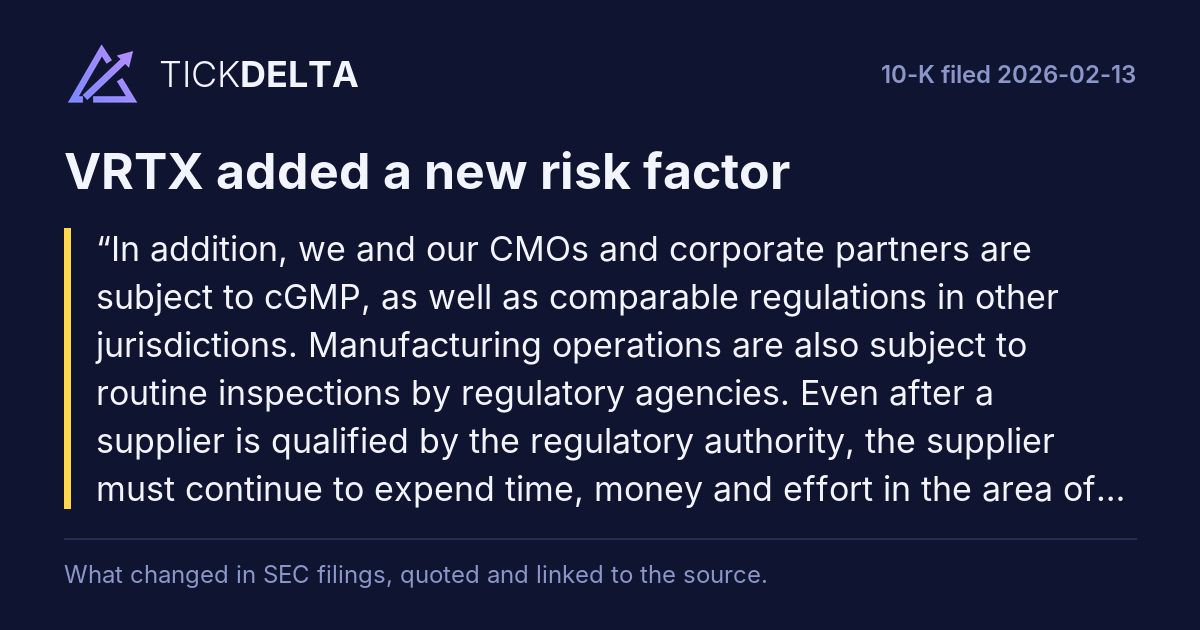
other companies seeking similar support. There are many risks that could result in delays and additional costs, including the
need to hire and train qualified employees and obtain access to necessary equipment and third-party technology. Additionally,
even with relevant experience and expertise, drug manufacturers often encounter difficulties in scale-up and production,
including difficulties with production costs and yields, quality control, and compliance with federal, state and foreign
regulations, which can prevent manufacturers from completing clinical trials or commercializing products on a timely or
Our business depends on relationships with third parties, including activities critical to research, development,
manufacturing, commercialization, and technology. For example, we rely on third parties such as CROs for the day-to-day
management and oversight of our clinical trials, on CMOs for active ingredient manufacturing and finishing operations, and
on logistics providers for the distribution of our products. We are expanding our relationships with CROs, CMOs, and other
third parties as we enter markets in which we have no or limited experience. Failure by any of our third parties to meet their
contractual, regulatory, or other obligations, any disruption in the relationship between Vertex and a third party upon whom
we rely, or the failure of a third party to conduct activities in accordance with our expectations, could adversely affect the
Similar paragraph at 1 of 59 other Health care companies: MRNArelevant research, development, manufacturing, commercial, or administrative activity and our business. The foregoing risks
may be heightened as a result of the limited number or specialized nature of certain third parties, as we may not be able to
Similar paragraph at 1 of 59 other Health care companies: LHreplace such third party in a timely manner, on commercially reasonable terms, or at all.
The third parties upon which we rely are subject to their own operational and financial risks, as well as other difficulties,
which, if realized, could negatively affect our business. If any of our third parties violate, or are alleged to have violated, any
Similar paragraph at 1 of 59 other Health care companies: ZTSlaws or regulations, including anti-corruption or anti-bribery regulations, the GDPR, or other laws and regulations, during the
performance of their obligations to us, we could suffer financial and reputational harm or other negative outcomes, including
Read in the 10-K ↗
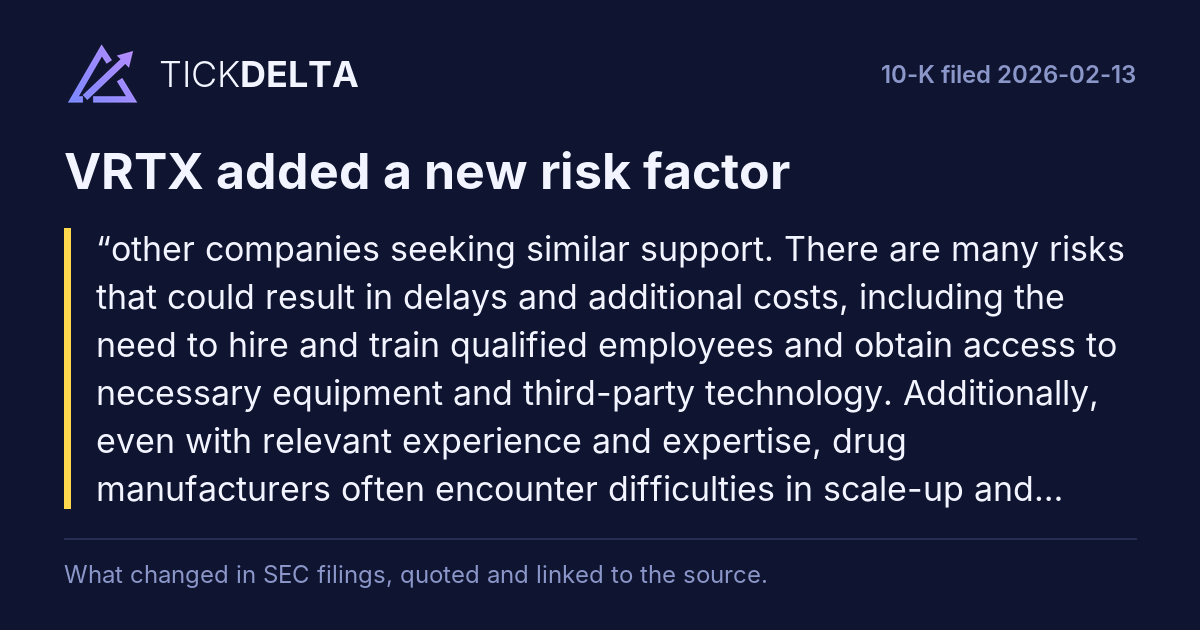
As we continue to expand our global operations and capabilities, we face increasing demands on our management and
•implement and clearly communicate corporate-wide strategies and effectively prioritize resources;
Read in the 10-K ↗
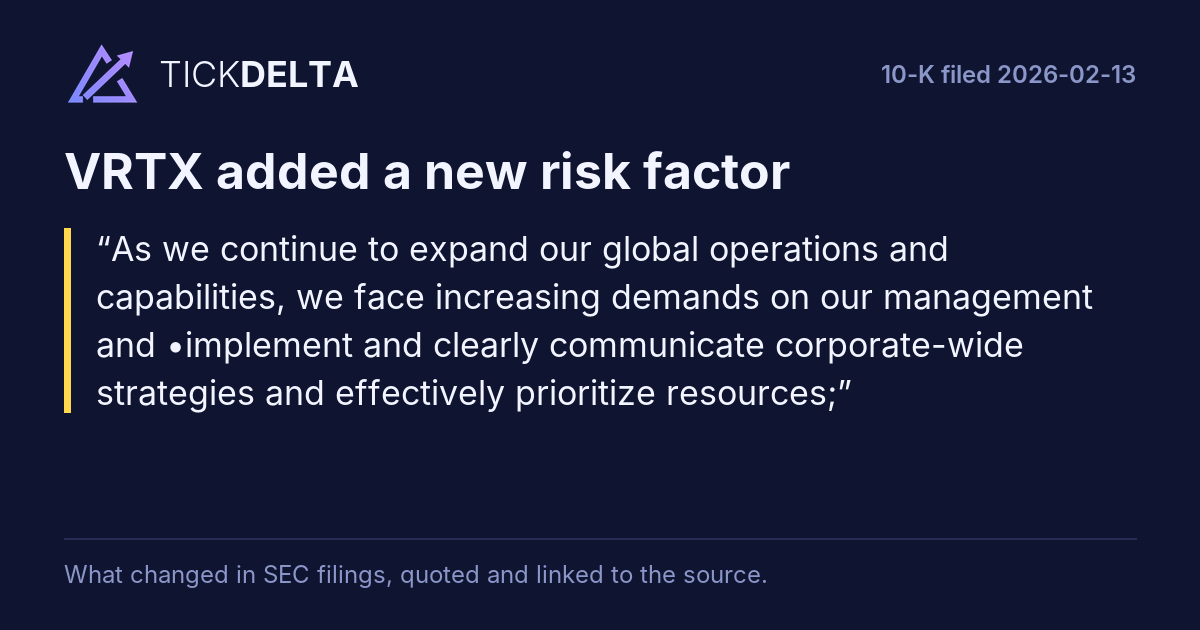
•effectively leverage technology and automation where appropriate to enable efficient growth and remain
Read in the 10-K ↗
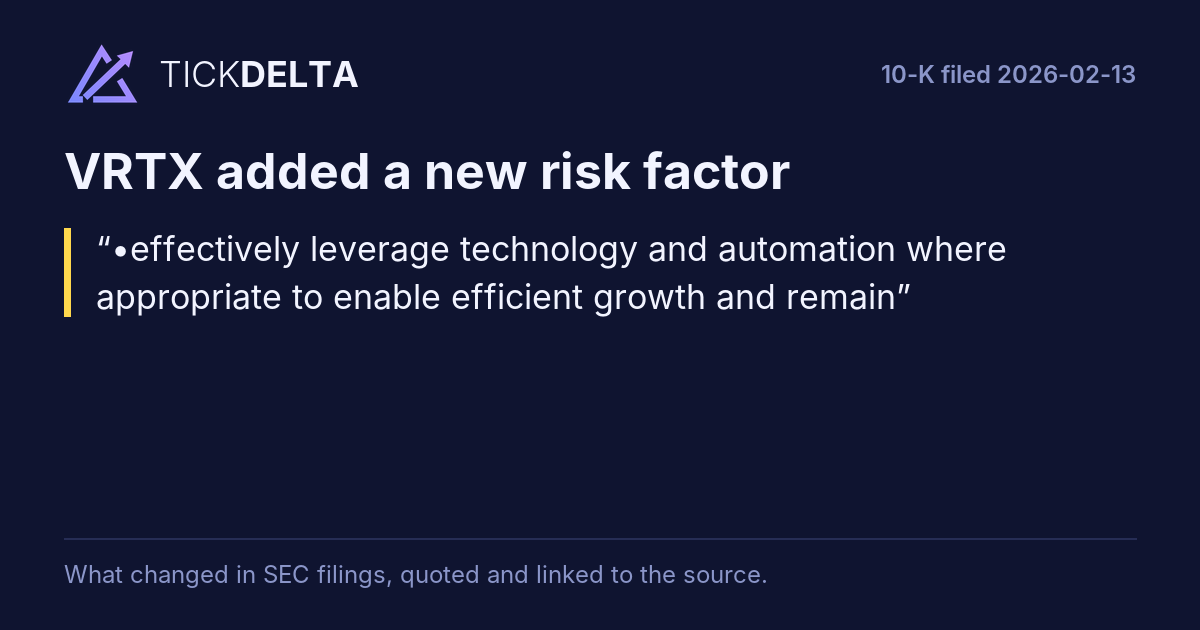
Our global operations subject us to risks that could adversely affect our business and revenue. In addition to the ex-U.S.
Similar paragraph at 12 of 59 other Health care companies: A, BIIB, CVS, DGX, DXCM, HSIC, INCY, IQV and 4 morerisks we face with respect to compliance with local laws and regulatory requirements, pricing and reimbursement, intellectual
property, manufacturing capabilities and supply chain, foreign exchange risks, and reliance on third parties, risks associated
Read in the 10-K ↗
•credit risks related to our customers, which may be higher in less developed markets; and
If any of the above risks were to occur, our revenues, results of operations, financial condition or business could be
Current or future U.S. legislation, including executive orders, or other new changes in laws, regulations or policies in the
U.S. or other countries could negatively impact our business by increasing costs, decreasing demand for our products, and
increasing government cost controls, among other risks. For example, U.S. legislation has been introduced to limit certain
U.S. biotechnology companies from using equipment or services from select Chinese biotechnology companies, and others in
Congress have advocated for limitations on those Chinese service providers’ ability to engage in business in the U.S. We
cannot predict what actions may ultimately be taken with respect to trade relations between the United States and China or
other countries, what products and services may be subject to such actions, the effective date or duration of such actions, or
Similar paragraph at 1 of 59 other Health care companies: MRNAwhat actions may be taken by the other countries in response to actions by the United States. If we are unable to obtain or use
services from existing service providers or become unable to export or sell our products to any of our customers or service
Read in the 10-K ↗
We maintain and rely extensively on information technology systems and network infrastructures, internally and with
third parties for the effective operation of our business. We collect, store, and transmit confidential information, including
personal information, financial information and intellectual property. Disruption, infiltration, or failure of our information
technology systems because of software or hardware malfunctions, computer viruses, cyber-attacks, employee theft or
misuse, power disruptions, natural disasters or accidents could cause breaches of data security and/or loss of critical data,
Cyber-attacks and incidents are increasing in their frequency, sophistication, and intensity, and are difficult to detect.
Cyber-attacks are carried out by well-resourced groups and individuals with a wide range of motives and expertise. Due to
the nature of some cyber-attacks and incidents, there is a risk that they may remain undetected for a period of time. Recent
developments in the threat landscape include the use of adversarial artificial intelligence techniques and machine learning, as
Similar paragraph at 1 of 59 other Health care companies: CNCwell as an increased number of cyber extortion attacks with higher financial ransom demand amounts and increasing
sophistication and variety of ransomware techniques. Cyber-attacks and incidents also include manufacturing, hardware or
software supply chain attacks, which could cause disruption to or a delay in the manufacturing of our products or product
candidates, or lead to data privacy or security breach. We use cloud technologies and any failure by cloud or other technology
service providers to adequately safeguard their systems and prevent cyber-attacks or data privacy incidents could disrupt our
Similar paragraph at 1 of 59 other Health care companies: BIIBoperations and result in misappropriation, corruption, or loss of confidential or proprietary information. The third parties
Similar paragraph at 1 of 59 other Health care companies: BIIBupon which we rely face similar risks and when they experience a security breach of their systems, our security can be
Like many companies, we have experienced immaterial cybersecurity incidents, including temporary service
interruptions of third-party suppliers. There can be no assurance that our efforts to protect our data and information systems
will prevent breakdowns or breaches in our systems that could adversely affect our business. While we maintain cyber
Similar paragraph at 1 of 59 other Health care companies: REGNliability insurance, this insurance may not be sufficient to cover the financial, legal, business or reputational losses that may
result from an interruption or breach of our systems and those of critical third parties. Cybersecurity incidents can cause the
loss of critical or sensitive information, including personal information, and could give rise to legal liability and regulatory
In addition, we face certain risks as we seek to leverage artificial intelligence to optimize productivity and efficiency in
various aspects of the organization. Flaws, biases, or malfunctions in these systems could lead to operational disruptions, data
loss, or erroneous decision-making, impacting our operations, financial condition, and reputation. Ethical and legal
challenges may arise, including biases or discrimination in generated outcomes, non-compliance with data protection
regulations and laws specifically governing the use of artificial intelligence systems and tools, and lack of transparency.
Furthermore, the deployment of artificial intelligence systems could expose us to increased cybersecurity threats, such as data
breaches and unauthorized access. We also face competitive risks if we do not implement artificial intelligence or other
Our operations may be disrupted by the occurrence of a natural disaster, catastrophic event, or by other serious accidents
Most of our operations, including our research and development activities, are conducted in a limited number of
facilities. If any of our major facilities were to experience a catastrophic loss due to an earthquake, flood, severe storms, fire
or similar event, our operations would be seriously harmed. For example, our corporate headquarters, as well as additional
leased space that we use for certain logistical and laboratory operations and manufacturing, are located in a flood zone along
the Massachusetts coast. If we are unable to effectively implement our business continuity plans, we may experience delays
in recovery of data and/or an inability to perform vital corporate functions, which could result in a significant disruption in
our operations, large expenses to repair or replace the facility and/or the loss of critical data. Additionally, we use hazardous
materials in some of our facilities, and any accident, injury or other loss related thereto could result in substantial liability.
Our property or other relevant insurance may not be sufficient to cover all potential losses that may result from an
Our business development strategy, including strategic transactions and collaborations, may not be successful, and there
may be delays or failures in realizing the anticipated benefits of these activities.
As part of our business strategy, we seek to enter into strategic transactions to acquire, license, or collaborate with other
entities, in each case that have potential to complement and advance our ongoing research, development, manufacturing, and
commercialization efforts. Over the last several years we have engaged in a number of strategic transactions and
Read in the 10-K ↗
collaboration arrangements. See also Item 1., Business – Strategic Transactions of this Annual Report on Form 10-K. Our
future transactions and collaborations may be similar to prior transactions, may be structured differently from prior
transactions, or may involve larger transactions or later-stage assets. We face significant competition for potential strategic
transactions and collaborations from a variety of other companies, some of which have significantly more financial resources
and experience in business development activities. We may not complete future transactions in a timely manner, or at all,
Similar paragraph at 1 of 59 other Health care companies: PODDincluding due to the possibility that a governmental entity or regulatory body may delay or refuse to grant approval for the
Read in the 10-K ↗
products contemplated by those transactions may be delayed or terminated at any point during research or clinical
development. Even if a product is approved, we may not be able to successfully commercialize it. As a result, we may fail to
generate expected revenue growth or income contribution within the anticipated timeframe or at all. We also face risks that
•may not effectively integrate acquired assets or businesses into our ongoing business;
•may incur additional expenses or fail to achieve anticipated cost savings related to the strategic transactions;
•may incur impairment charges related to assets acquired in any such transactions; or
In addition, future strategic transactions could result in potentially dilutive issuances of equity securities or the incurrence
We continue to collaborate with outside partners on research, development, manufacturing, and/or commercialization
Read in the 10-K ↗
collaborative arrangements, including with respect to the performance of the collaborator and their compliance with
Read in the 10-K ↗
Our effective tax rate is derived from a combination of applicable tax rates in the various places that we operate globally.
Similar paragraph at 1 of 59 other Health care companies: AMGNOur effective tax rate may be different than experienced in the past due to numerous factors, including:
Any of these factors could cause us to experience an effective tax rate that is significantly different from previous periods
or our current expectations. For example, actions taken with respect to tax-related matters by associations such as the
Organisation for Economic Co-operation and Development and the European Commission could influence tax laws in
jurisdictions in which we operate, such as the enactments by both E.U. and non-E.U. member countries of a global minimum
tax. We are subject to ongoing tax audits in various jurisdictions, and local tax authorities may disagree with certain positions
we have taken and assess additional taxes. We regularly assess the probable outcomes of these audits to determine the
appropriateness of our tax provision, and we have established contingency reserves for material tax exposures. However,
Read in the 10-K ↗
raised by tax authorities will be resolved at a financial cost that does not exceed our related reserves and the actual outcomes
of these disputes and other tax audits could have a material impact on our results of operations or financial condition.
Similar paragraph at 20 of 59 other Health care companies: A, BSX, CAH, COR, CRL, DGX, DVA, HSIC and 12 moreChanges in foreign currency rates, interest rate risks, the value of our investment portfolio, and inflation affect our results
Read in the 10-K ↗
have affected and will continue to affect our cash flows, results of operations, and financial condition. The exchange rates
Similar paragraph at 9 of 59 other Health care companies: AMGN, BAX, CAH, GEHC, HSIC, INCY, IQV, MRK and 1 moreRead in the 10-K ↗
mitigate against these risks may not be successful. We invest our available cash in a range of investments, including
investments in cash equivalents and debt securities, and fluctuations in interest rates, among other factors, could materially
negatively affect the value of this investment portfolio. In addition, systemic economic downturns, as well as inflationary
pressures, such as those observed in recent periods, may adversely impact our business and financial results. See also Item
7A., Quantitative and Qualitative Disclosures About Market Risk of this Annual Report on Form 10-K.
Read in the 10-K ↗
If we borrow under our current credit agreement or any future credit agreements, or otherwise issue or incur additional
debt, such indebtedness could have important consequences to our business. The credit agreement requires that we comply
Similar paragraph at 1 of 59 other Health care companies: GEHCwith certain financial covenants, including a consolidated leverage ratio covenant and negative covenants, restricting or
limiting our ability and the ability of our subsidiaries to, among other things, incur additional indebtedness, grant liens,
engage in certain investment, acquisition and disposition transactions, and enter into transactions with affiliates. As a result,
we may be restricted from engaging in business activities that may otherwise improve our business. Failure to comply with
the covenants could result in an event of default that could trigger acceleration of our indebtedness. If we incur additional
indebtedness, the risks related to our business and our ability to service or repay our indebtedness would increase.
Read in the 10-K ↗
In May 2025, our Board of Directors approved a share repurchase program pursuant to which we are authorized to
repurchase up to $4.0 billion of our common stock from time to time through open market or privately negotiated
transactions, of which $618.5 million has been repurchased as of December 31, 2025. Our stock repurchases will depend
upon, among other factors, market conditions, our cash balances and potential future capital requirements, results of
operations, financial condition, and other factors that we may deem relevant. We can provide no assurance that we will
Our stock price is subject to significant fluctuations. From January 1, 2025 to December 31, 2025, our common stock
traded between $362.50 and $519.68 per share. Our future stock price could be significantly and adversely affected by:
Read in the 10-K ↗
•our financial guidance and/or financial results, including quarterly and annual fluctuations resulting from factors
Fluctuations in our stock price can result in substantial losses for shareholders. Following periods of volatility in the
Similar paragraph at 1 of 59 other Health care companies: MRNARead in the 10-K ↗
We must attract and retain highly qualified and trained scientists, as well as employees with experience in the
development, manufacture, and commercialization of medicines, including biologic and cell and genetic therapies. We face
intense competition for such talent from our competitors, other companies, academic institutions, and other organizations
throughout our industry, especially with respect to employees with expertise in cell or genetic therapies. Our compensation
program, including equity awards, may not be sufficient to retain employees, especially if our stock price declines or other
employers offer more attractive opportunities. Our ability to commercialize our products and achieve our research and
development objectives depends on our ability to respond effectively to these demands. If we are unable to hire and retain
qualified personnel, our ability to advance our pipeline, commercialize our products, and achieve our business objectives
Social media is increasingly used by patients, advocacy groups, and other third parties to discuss our products and
product candidates. Social media posts may include statements about efficacy or adverse events that could create reporting
obligations or regulatory scrutiny. Our employees’ use of social media also presents risks, including potential noncompliance
with legal or regulatory requirements, inappropriate disclosure of confidential information or personal information, and loss
of intellectual property. In addition, misinformation, negative sentiment, or impersonation of our business on social media
could cause reputational damage or otherwise harm our business. Failure to appropriately manage these risks could result in
Read in the 10-K ↗
Our by-laws allow the Board of Directors to adjourn any meetings of shareholders prior to the time the meeting has been
convened. We may issue shares of any class or series of preferred stock in the future without shareholder approval and upon
such terms as our Board of Directors may determine. The rights of the holders of common stock will be subject to, and may
be adversely affected by, the rights of the holders of any class or series of preferred stock that may be issued in the future.
Massachusetts state law also prohibits us from engaging in specified business combinations with an interested stockholder,
subject to certain exceptions, unless the combination is approved or consummated in a prescribed manner, and places
restrictions on voting by any shareholder who acquires 20% or more of the aggregate shareholder voting power without
approval by non-interested shareholders. As a result, shareholders or other parties may find it difficult to remove or replace
our directors or to effectuate certain types of business combinations involving us.
Read in the 10-K ↗
set forth in Part I, Item 1A, and our Management’s Discussion and Analysis of Financial Condition and Results of Operations
set forth in Part II, Item 7, contains forward-looking statements. Forward-looking statements are not purely historical and
may be accompanied by words such as “anticipates,” “may,” “forecasts,” “expects,” “intends,” “plans,” “potentially,”
“believes,” “seeks,” “estimates,” and other words and terms of similar meaning. Such statements may relate to:
Read in the 10-K ↗
eligible for one of our medicines, and our beliefs that the majority of people with CF will transition to ALYFTREK
Read in the 10-K ↗
for further investigation, clinical trials or potential use as a treatment, including with respect to povetacicept as a
pipeline-in-a-product and as a potential best-in-class approach for the treatment of IgAN, pMN, and gMG;
•the data that will be generated by ongoing and planned clinical trials and the ability to use that data to advance
compounds, continue development, support regulatory filings, or accelerate regulatory approval, including our plans
to complete the full submission for potential accelerated approval of povetacicept in IgAN in the first half of 2026
and to share data from the interim analysis of the Phase 2/3 clinical trial of inaxaplin in AMKD in late 2026 or early
Read in the 10-K ↗
regarding the clinical benefits of JOURNAVX without the evidence of the several limitations of other available
Read in the 10-K ↗
•our expectations or beliefs regarding any legal proceedings in which we are involved, including any litigation,
arbitration or other similar proceedings involving our products, product candidates or activities;
Read in the 10-K ↗
•our ability to effectively implement artificial intelligence systems and tools;
Read in the 10-K ↗
Forward-looking statements are subject to certain risks, uncertainties, or other factors that are difficult to predict and
could cause actual events or results to differ materially from those indicated in any such statements. These risks,
Read in the 10-K ↗
and elsewhere in this report and those described from time to time in our future reports filed with the Securities and Exchange
Read in the 10-K ↗
New in the latest 10-Q
155 paragraphs in the 10-Q filed Nov 3, 2026 with nothing like them in the 10-Q filed Aug 4, 2026 (at least half the words must differ; new numbers alone do not count). Quoted exactly, grouped by the item heading above them. This is text that changed, not a judgement of how serious it is.
10-Q
Pharmaceuticals Incorporated, a Massachusetts corporation, and its subsidiaries.
Read in the 10-Q ↗
Financial statements and notes
Our collaboration, licensing and asset acquisition agreements that had a significant impact on our financial statements for
Read in the 10-Q ↗
months ended September 30, 2026, are described below. Additional agreements are described in Note B, “Collaboration,
Read in the 10-Q ↗
We have a joint development and commercialization agreement (the “CRISPR JDCA”) with CRISPR Therapeutics AG
Read in the 10-Q ↗
and its affiliates (“CRISPR”). Pursuant to the CRISPR JDCA, we lead global development, manufacturing and
Read in the 10-Q ↗
commercialization of CASGEVY for the treatment of hemoglobinopathies, including treatments for severe sickle cell disease
Read in the 10-Q ↗
We share with CRISPR 40 % of the net commercial profits or losses incurred with respect to CASGEVY, subject to
Read in the 10-Q ↗
certain adjustments, which is recorded to “Cost of sales.” The net commercial profits or losses equal the sum of the product
Read in the 10-Q ↗
revenues, cost of sales and selling, general and administrative expenses that we recognized during the applicable period
Read in the 10-Q ↗
related to the CRISPR JDCA. We also are reimbursed by CRISPR for its 40 % share of the research and development
Read in the 10-Q ↗
activities conducted under the CRISPR JDCA, subject to certain adjustments, and we record this reimbursement from
Read in the 10-Q ↗
consolidated statements of income for CRISPR’s share of CRISPR JDCA activities were as follows:
Read in the 10-Q ↗
Cystic Fibrosis Foundation Therapeutics, Inc., to support research and development activities. Pursuant to the agreement, as
Read in the 10-Q ↗
amended, we have agreed to pay tiered royalties ranging from single digits to sub-teens on covered compounds first
Read in the 10-Q ↗
synthesized and/or tested during a research term on or before February 28, 2014, including ivacaftor, lumacaftor and
Read in the 10-Q ↗
tezacaftor, and royalties ranging from low-single digits to mid-single digits on net sales of certain compounds first
Read in the 10-Q ↗
synthesized and/or tested between March 1, 2014 and August 31, 2016, including elexacaftor. We do not have any royalty
Read in the 10-Q ↗
obligations on compounds first synthesized and tested on or after September 1, 2016. For combination products, such as
Read in the 10-Q ↗
active pharmaceutical ingredients in the combination product, and royalties are then paid for any royalty-bearing components
Read in the 10-Q ↗
included in the combination. We record expenses related to these royalty obligations to “Cost of sales.”
Read in the 10-Q ↗
On September 1, 2026, we paid $ 85.00 per share in cash to acquire all of the issued and outstanding shares of common
Read in the 10-Q ↗
marketable securities acquired (the “Crinetics Acquisition”). The Crinetics Acquisition is expected to contribute to the
Read in the 10-Q ↗
diversity of our pipeline and support our long-term growth objectives. Crinetics’ approved medicine, PALSONIFY
Read in the 10-Q ↗
(paltusotine), received approval from the U.S. Food and Drug Administration in September 2025. It is a once-daily oral
Read in the 10-Q ↗
hyperplasia (“CAH”). Classic CAH, the most severe form of the disease, is a rare, chronic genetic condition affecting the
Read in the 10-Q ↗
adrenal glands that has significant unmet medical need. Atumelnant is also in Phase 2 development for people with ACTH-
Read in the 10-Q ↗
Dependent Cushing’s syndrome, an additional therapeutic area in which it has demonstrated potential.
Read in the 10-Q ↗
We paid total consideration of $ 10.0 billion at the acquisition date, September 1, 2026, which included $ 9.6 billion to
Read in the 10-Q ↗
acquire Crinetics and $ 409.6 million to accelerate and settle unvested Crinetics equity awards. The $ 409.6 million
Read in the 10-Q ↗
represented post-acquisition expense, which was recorded as $ 265.5 million of “Research and development expenses” and
Read in the 10-Q ↗
We accounted for the Crinetics Acquisition as a business combination, and allocated the purchase price to the following
Read in the 10-Q ↗
As of September 1, 2026 (in millions) ──────────────────────────────────────────────────────────────────────────────────────────────────── Cash consideration to acquire Crinetics’ outstanding common stock $9,055.6 Cash consideration for Crinetics’ vested and unvested equity awards 973.1 Total cash consideration paid to Crinetics 10,028.7 Less: Expense related to unvested equity awards (409.6) Total consideration allocated $9,619.1 Cash and cash equivalents $556.1 Marketable securities 293.3 Inventories 461.8 Goodwill 1,335.4 PALSONIFY finite-lived intangible asset - marketed products 3,010.0 Atumelnant in-process research and development intangible asset 5,116.0 Long-term marketable securities 158.7 Deferred tax liability, net (1,315.2) Net other assets 3.0 Total purchase price $9,619.1
Read in the 10-Q ↗
The “Inventories” acquired reflect a step-up in the fair value of acquired PALSONIFY finished goods and work-in-
Read in the 10-Q ↗
process inventory, which was determined using the comparative sales method. This method estimates the expected sales price
Read in the 10-Q ↗
of the product, reduced by all costs expected to be incurred to complete or to dispose of the inventory, as well as a profit on
Read in the 10-Q ↗
those costs and holding costs. The acquired inventory step-up adjustment is expensed to “Cost of sales” as the inventory is
Read in the 10-Q ↗
September 30, 2026. We expect to sell the inventory over a period of approximately three years from the acquisition date.
Read in the 10-Q ↗
The “Goodwill” of $ 1.3 billion, which is not deductible for tax purposes, represents the difference between the fair value
Read in the 10-Q ↗
of the consideration transferred and the fair value of the assets acquired and liabilities assumed, and primarily related to
Read in the 10-Q ↗
establishing the deferred tax liability for the acquired intangible assets, which have no tax basis.
Read in the 10-Q ↗
The $ 3.0 billion finite-lived asset related to the PALSONIFY marketed product that we acquired and a $ 5.1 billion in-
Read in the 10-Q ↗
process research and development asset related to atumelnant are recorded on our condensed consolidated balance sheet as
Read in the 10-Q ↗
“Other intangible assets, net.” The fair values of the intangible assets were determined using the multi-period excess earnings
Read in the 10-Q ↗
method to complete a discounted cash flow analysis with Level 3 fair value inputs, including significant assumptions
Read in the 10-Q ↗
regarding (i) the probability of technical and regulatory success related to atumelnant, (ii) estimated future cash flows from
Read in the 10-Q ↗
potential product sales with respect to the medicines, and (iii) earnings, which include the expected costs to continue to
Read in the 10-Q ↗
develop and commercialize the medicines. The PALSONIFY finite-lived asset is being amortized on a straight-lined basis
Read in the 10-Q ↗
through the period that we no longer have exclusive rights to market PALSONIFY, or approximately sixteen years. For the
Read in the 10-Q ↗
three and nine months ended September 30, 2026, we recorded $ 15.3 million of intangible asset amortization expense related to the PALSONIFY asset as “Cost of sales.” The “Deferred tax liability, net” of $ 1.3 billion, represents net temporary differences primarily related to intangible assets acquired and liabilities assumed, and was primarily recorded as a reduction to “Deferred tax assets” on our condensed consolidated balance sheet. As of September 30, 2026, our Crinetics purchase price allocation, including for certain intangible assets acquired and tax analyses, is preliminary and will be finalized during the measurement period of up to one year from the acquisition date. Additionally, in the three and nine months ended September 30, 2026, we incurred transaction costs of $ 58.9 million directly related to the Crinetics Acquisition, which are recorded within “Selling, general and administrative expenses.” The financial results of Crinetics did not have a material effect on our revenue or net income in the three and nine months ended September 30, 2026. Supplemental Pro Forma Financial Information The following table presents unaudited supplemental pro forma financial information for the three and nine months ended September 30, 2026 and 2025, as if the Crinetics Acquisition had occurred on January 1, 2025: Three Months Ended Nine Months Ended September 30, September 30, 2026 2025 2026 2025 (in millions) ───────────────────────────────────────────────────────────────────────────────────────────── Total Revenues $3,455.1 $3,076.5 $9,811.7 $8,812.8 Net Income 778.1 882.3 2,496.5 1,785.5 The unaudited supplemental pro forma financial information was prepared using the acquisition method of accounting and is based on the historical financial information of Vertex and Crinetics. In order to reflect the occurrence of the Crinetics Acquisition on January 1, 2025, as required, the most significant adjustments reflected in the unaudited supplemental pro forma financial information are as follows: • incremental amortization expense based on the fair value of the PALSONIFY intangible asset described above; • incremental cost of sales related to the amortization of the step-up in the fair value of finished goods and work-in- process inventory for PALSONIFY described above; • compensation expense to accelerate and settle unvested Crinetics equity awards and transaction costs directly related to the Crinetics Acquisition, reflected in the nine months ended September 30, 2025 instead of primarily in the three and nine months ended September 30, 2026; • additional interest expense associated with the issuance of the 2026 Term Loan described in Note M, “Commitments and Contingencies;” and • the income tax effects of the above adjustments plus Crinetics’ historical losses at applicable effective tax rates. The unaudited supplemental pro forma financial information is not necessarily indicative of what the condensed consolidated results of operations would have been had the Crinetics Acquisition been completed on January 1, 2025. In addition, the unaudited supplemental pro forma financial information is not a projection of future results of operations of the combined company, nor does it reflect the expected realization of any synergies or cost savings associated with the Crinetics Acquisition.
Read in the 10-Q ↗
Level 2 inputs. The fair value of the 2026 Term Loan approximates its carrying value as of September 30, 2026, because it
Read in the 10-Q ↗
bears interest at a variable rate that reflects current market rates. Please refer to Note M for further details.
Read in the 10-Q ↗
As described in Note C, “Business Combination,” we acquired a total fair value of $ 461.8 million PALSONIFY
Read in the 10-Q ↗
As described in Note C, “Business Combination,” we recorded a $ 3.0 billion finite-lived asset related to the
Read in the 10-Q ↗
PALSONIFY marketed product that we acquired and a $ 5.1 billion in-process research and development asset related to
Read in the 10-Q ↗
atumelnant as part of the purchase accounting for the Crinetics Acquisition in September 2026.
Read in the 10-Q ↗
As of September 30, 2026, the estimated future amortization of our finite-lived intangible assets through 2030 was as
Read in the 10-Q ↗
excess tax benefits related to stock-based compensation, and increased utilization of foreign tax credits, partially offset by
Read in the 10-Q ↗
loan A facility. Pursuant to the 2026 Term Loan, we borrowed the entire $ 4.5 billion on September 1, 2026, which was used
Read in the 10-Q ↗
to finance a portion of the Crinetics Acquisition. Upon entry into the 2026 Term Loan, a debt commitment letter we entered
Read in the 10-Q ↗
into concurrently with entry into the merger agreement for the Crinetics Acquisition terminated. As of September 30, 2026,
Read in the 10-Q ↗
The amounts that we borrowed under the 2026 Term Loan (the “Term Loans”) are payable in full as follows: (a) a
Read in the 10-Q ↗
$ 1.0 billion tranche due on August 31, 2027 (“Tranche 1 Loans”), (b) a $ 1.0 billion tranche due on September 1, 2028
Read in the 10-Q ↗
(“Tranche 2 Loans”), and (c) a $ 2.5 billion tranche due on August 31, 2029 (“Tranche 3 Loans”). There are no mandatory
Read in the 10-Q ↗
prepayments or amortization required in connection with the loans made under the 2026 Term Loan.
Read in the 10-Q ↗
Terms Applicable to both of the 2026 Term Loan and 2026 Revolving Credit Agreement
Read in the 10-Q ↗
In addition to the terms described above, unless specifically noted below, the 2026 Term Loan and the 2026 Revolver
Read in the 10-Q ↗
For each of the 2026 Debt Agreements, the applicable margin applied to any amounts borrowed is dependent upon,
Read in the 10-Q ↗
maximum consolidated net leverage ratio (calculated net of up to $ 1.0 billion of unrestricted cash and cash equivalents) of
Read in the 10-Q ↗
“ Product revenues, net ” are allocated based on the location of the customer. “ Other revenues ” are allocated based on the
Read in the 10-Q ↗
location of the Vertex entity associated with such revenues. Our “Total revenues” consisted of the following:
Read in the 10-Q ↗
In the nine months ended September 30, 2025, our “Other revenues” of $ 30.7 million were attributed to the U.S.
Read in the 10-Q ↗
(1)Other segment items included in “Net income” primarily include interest expense, a realized gain related to an
Read in the 10-Q ↗
investment in a privately held company in the three and nine months ended September 30, 2026, changes in the fair
Read in the 10-Q ↗
that limit the amount of annual reimbursement we can receive for our CF products. Upon exceeding the annual reimbursement amount provided by the customer’s contract with us, our CF products are provided free of charge, which is a material right. These contracts include upfront payments and fees. If we estimate that we will exceed the annual reimbursement amount under a contract, we defer a portion of the consideration received for shipments made up to the annual reimbursement limit as a portion of “Other current liabilities.” Once the reimbursement limit has been reached, we recognize the deferred amount as revenue when we ship the free products. Our CF product revenue contracts include performance obligations that are one year or less. Our contract liabilities at the end of each fiscal year relate to contracts with CF annual reimbursement limits in international markets in which the annual period associated with the contract is not the same as our fiscal year. In these markets, we recognize revenues related to performance obligations satisfied in previous years; however, these revenues do not relate to any performance obligations that were satisfied more than 12 months prior to the beginning of the current year. Operating Lease Assets and Liabilities In 2023, we entered into a strategic agreement with Lonza to support the manufacture of T1D cell therapy product candidates. As part of this agreement, we have partnered with Lonza to build a 130,000 square foot dedicated new facility in New Hampshire, which will be operated by Lonza (the “Lonza Facility”) and is an embedded lease for accounting purposes. The lease commencement for the Lonza Facility occurred during the first quarter of 2026, upon which we recorded a right-of- use asset and corresponding lease liability of $ 95.8 million within each of “Operating lease assets” and “Long-term operating lease liabilities” on our condensed consolidated balance sheet. In accordance with our policy for embedded leases with contract manufacturing organizations, we account for the lease component separately from the variable non-lease components, which we expense as incurred. Payments will continue through the tenth anniversary of the Lonza Facility’s regulatory approval for commercial production. The lease will automatically renew for additional one -year periods, unless either we or Lonza provide written notice of intent to not renew. We utilize the initial period as our lease term. We obtained $ 68.1 million and $ 310.8 million of net right-of-use operating lease assets in exchange for a similar amount of net lease obligations during the nine months ended September 30, 2026 and 2025, respectively. These represent non-cash operating activities associated with our condensed consolidated statement of cash flows. Cash, Cash Equivalents and Restricted Cash Presented in Condensed Consolidated Statements of Cash Flows T he cash, cash equivalents and restricted cash at the beginning and end of each period presented in our condensed consolidated statements of cash flows consisted of the following: Nine Months Ended September 30, 2026 2025 Beginning of End of Beginning of End of period period period period (in millions) ─────────────────────────────────────────────────────────────────────────────────────────────────────────────────────────────────────────────── Cash and cash equivalents $5,084.8 $4,979.3 $4,569.6 $4,939.6 Prepaid expenses and other current assets 3.0 9.3 2.6 8.2 Cash, cash equivalents and restricted cash per condensed $5,087.8 $4,988.6 $4,572.2 $4,947.8 consolidated statement of cash flows
Read in the 10-Q ↗
targeting CF, SCD, beta thalassemia, IgAN, neuropathic pain, APOL1-mediated kidney disease, primary membranous
Read in the 10-Q ↗
nephropathy, congenital adrenal hyperplasia, adrenocorticotropic hormone-dependent Cushing’s syndrome, autosomal
Read in the 10-Q ↗
• In the third quarter of 2026, more than 750,000 prescriptions were filled for JOURNAVX across the hospital and
Read in the 10-Q ↗
times the 170,000 JOURNAVX prescriptions that were filled in the third quarter of 2025.
Read in the 10-Q ↗
• PALSONIFY (paltusotine) is a first-in-class, small molecule, once-daily oral somatostatin receptor type 2 agonist
Read in the 10-Q ↗
approved in the U.S. for the treatment of adults with acromegaly who had an inadequate response to surgery or for
Read in the 10-Q ↗
whom surgery is not an option. Acromegaly is a rare and debilitating condition caused by a benign pituitary tumor
Read in the 10-Q ↗
that secretes excess growth hormone. There are an estimated 12,000 adults with acromegaly in the U.S. for whom
Read in the 10-Q ↗
• An estimated 3,200 endocrinologists treat the majority of people with acromegaly in the U.S. As of the end of the
Read in the 10-Q ↗
third quarter of 2026, approximately 500 of those target specialty endocrinologists are prescribing PALSONIFY.
Read in the 10-Q ↗
• Among patients starting or switching therapy, PALSONIFY has the leading brand share at more than 40%.
Read in the 10-Q ↗
• PALSONIFY was approved in the European Union in April 2026. We expect to begin launches in European markets
Read in the 10-Q ↗
in the second half of 2027. The regulatory submission for PALSONIFY in Japan was completed in April 2026, and
Read in the 10-Q ↗
the Ministry of Health, Labor and Welfare (the “MHLW”) has granted orphan drug designation in Japan.
Read in the 10-Q ↗
• We have initiated global regulatory submissions for ALYFTREK for the treatment of children with CF two to five
Read in the 10-Q ↗
neuropathy, a form of peripheral neuropathic pain, by the end of 2026 and expect to share results in mid-2027.
Read in the 10-Q ↗
will become the first commercialized therapy in our emerging nephrology franchise.
Read in the 10-Q ↗
• We are developing atumelnant, a once-daily oral adrenocorticotropic hormone (“ACTH”) receptor antagonist, for
Read in the 10-Q ↗
the treatment of classic congenital adrenal hyperplasia (“CAH”), which affects approximately 17,000 people in the
Read in the 10-Q ↗
U.S. Classic CAH is a rare, chronic, genetic condition in which the adrenal glands are unable to make enough
Read in the 10-Q ↗
cortisol. Current therapies force a choice between androgen control and steroid burden, representing a significant
Read in the 10-Q ↗
• The Phase 3 clinical trial evaluating atumelnant in adults with CAH is a global, 32-week, randomized, double blind,
Read in the 10-Q ↗
placebo-controlled trial of 150 people. Enrollment and dosing are well underway, and we expect to complete
Read in the 10-Q ↗
• Atumelnant has demonstrated therapeutic potential in people with ACTH-dependent Cushing’s syndrome, another
Read in the 10-Q ↗
serious endocrine disease, which affects more than 10,000 people in the U.S. We have initiated a Phase 2/3 clinical
Read in the 10-Q ↗
trial evaluating atumelnant in people with ACTH-dependent Cushing’s syndrome. The FDA has granted Orphan
Read in the 10-Q ↗
• Given the rapid progress of VX-017, we have decided to focus on accelerating the development of VX-017, which
Read in the 10-Q ↗
has the potential to reach more people than zimislecel, which is designed for people with blood types A or A/B only.
Read in the 10-Q ↗
We expect to advance VX-017 into pivotal development in 2027. The FDA has granted Fast Track designation to
Read in the 10-Q ↗
treatment of serious diseases outside of CF, SCD, TDT, acute pain, and acromegaly.
Read in the 10-Q ↗
JOURNAVX, PALSONIFY, and, ultimately, our pipeline therapies, in U.S. and ex-U.S. markets.
Read in the 10-Q ↗
of proceeds from the 2026 Term Loan. We have accounted for the Crinetics Acquisition as a business combination, which
Read in the 10-Q ↗
resulted in $8.1 billion of additional intangible assets, as well as other assets acquired and liabilities assumed, recorded on our
Read in the 10-Q ↗
condensed consolidated balance sheet. Please refer to Note C, “Business Combination,” for further information.
Read in the 10-Q ↗
PALSONIFY intangible asset amortization expense and $5.4 million of PALSONIFY acquired inventory step-up expense
Read in the 10-Q ↗
related to the month of September. In future quarters, the amount of intangible asset amortization expense and acquired
Read in the 10-Q ↗
of changes in product mix and the intangible asset amortization and acquired inventory step-up expense described above,
Read in the 10-Q ↗
months of 2025, primarily due to compensation expense associated with cash-settled unvested equity awards related to the
Read in the 10-Q ↗
associated with cash-settled unvested equity awards related to the Crinetics Acquisition, which we recorded in the third
Read in the 10-Q ↗
quarter of 2026, and increased outsourced services and other direct expenses. Our outsourced services and other direct
Read in the 10-Q ↗
compensation expense for cash-settled unvested equity awards and transaction costs related to the Crinetics Acquisition in the
Read in the 10-Q ↗
$369.0 million in the first nine months of 2025, primarily due to decreased market rates partially offset by increased overall
Read in the 10-Q ↗
cash, cash equivalents and marketable securities. We expect our future interest income to decrease as a result of our
Read in the 10-Q ↗
decreased cash, cash equivalents and marketable securities following the Crinetics acquisition.
Read in the 10-Q ↗
of 2025, respectively, due to $4.5 billion that we borrowed on September 1, 2026 pursuant to the 2026 Term Loan and fees
Read in the 10-Q ↗
associated with a debt commitment letter that preceded the 2026 Term Loan. Due to the amount that we borrowed in
Read in the 10-Q ↗
a realized gain associated with one of our strategic investments partially offset by realized losses on marketable securities
Read in the 10-Q ↗
benefit from a research and development tax credit study that was completed in the third quarter of 2026, and excess tax
Read in the 10-Q ↗
the U.S. statutory rate, primarily due to a benefit from a research and development tax credit study that was completed in the
Read in the 10-Q ↗
third quarter of 2025, excess tax benefits related to stock-based compensation, and increased utilization of foreign tax credits,
Read in the 10-Q ↗
compared to December 31, 2025, primarily due to $1.0 billion of short-term debt related to the 2026 Term Loan and
Read in the 10-Q ↗
decreased cash, cash equivalents and short-term marketable securities following the Crinetics Acquisition, partially offset by
Read in the 10-Q ↗
billion in the first nine months of 2025, primarily due to less cash used for income taxes and inventory purchases, partially
Read in the 10-Q ↗
acquire Crinetics, net of cash and cash equivalents acquired, partially offset by $2.8 billion net sales and maturities of
Read in the 10-Q ↗
borrowed the entire $4.5 billion in September 2026. Amounts due under the 2026 Term Loan are described below and can be
Read in the 10-Q ↗
Other than the amounts borrowed under the 2026 Term Loan, there have not been any material changes to our future
Read in the 10-Q ↗
Market risk
rate, in each case, plus an applicable margin based on our consolidated leverage ratio. We do not believe that changes in
Read in the 10-Q ↗
interest rates related to the 2026 Term Loan or 2026 Revolver would have a material effect on our consolidated financial
Read in the 10-Q ↗
statements, and we do not currently use hedge instruments to manage our exposure to these interest rate changes. As of
Read in the 10-Q ↗
September 30, 2026, we had $4.5 billion outstanding under the 2026 Term Loan that we borrowed on September 1, 2026 and
Read in the 10-Q ↗
no principal or interest outstanding under the 2026 Revolver. For amounts borrowed under the 2026 Term Loan, we estimate
Read in the 10-Q ↗
that a 1% unfavorable change in interest rates would result in a $45.0 million increase in our interest expense for the first year
Read in the 10-Q ↗
Controls and procedures
On September 1, 2026, we completed the Crinetics Acquisition, which was accounted for as a business combination. As
Read in the 10-Q ↗
While we are currently in the process of evaluating and integrating Crinetics' historical internal controls over financial
Read in the 10-Q ↗
Risk Factors
anticipated potential of atumelnant, and that Crinetics will contribute to the diversity of our pipeline and support our
Read in the 10-Q ↗
Other information
as amended. The following table describes the written plans for the sale of our securities adopted by our directors and officers
Read in the 10-Q ↗
(as defined in Rule 16a-1(f) under the Securities Exchange Act of 1934) during the third quarter of 2026, each of which is
Read in the 10-Q ↗
intended to satisfy the affirmative defense conditions of Rule 10b5-1 (each, a “Trading Plan”). Other than as described in the
Read in the 10-Q ↗
Name and Title Date of Adoption Scheduled Expiration Maximum Shares Subject of Trading Plan Date of Trading Plan (1) to Trading Plan Kristen Ambrose 8/06/2026 4/30/2027 5,422(2) SVP, Chief Accounting Officer Sangeeta Bhatia 8/13/2026 7/30/2027 1,189 Director Carmen Bozic 8/06/2026 7/30/2027 16,915(2) EVP, Global Medicines Development and Medical Affairs, and Chief Medical Officer Alan Garber 8/27/2026 7/30/2027 5,320 Director Reshma Kewalramani 8/5/2026 12/1/2027 47,800 Chief Executive Officer and President, Director Jeffrey Leiden 8/5/2026 11/4/2027 18,411 Executive Chairman Joy Liu 8/21/2026 5/3/2027 20,764(2) EVP, Chief Legal Officer Bruce Sachs 8/26/2026 7/20/2027 9,888 Director Nancy Thornberry 8/15/2026 7/30/2027 2,571 Director Charles F. Wagner, Jr. 8/10/2026 7/30/2027 15,286 EVP, Chief Operating & Financial Officer ───────────────────────────────────────────────────────────────────────────────────────────────────────────────────────────────────────────────────────────────────────────────────────────────────────────────────────── (1) A Trading Plan may expire on an earlier date if all contemplated transactions are completed before such Trading Plan’s expiration date, upon termination by broker or the holder of the Trading Plan, or as otherwise provided in the Trading Plan. (2) The maximum shares listed has not been reduced by the number of shares of common stock that will be withheld to satisfy tax withholding obligations at future vesting dates because such number of shares is not yet determinable.
Read in the 10-Q ↗
On October 30, 2026, the Company appointed Jonathan Oppenheim, our Vice President, Corporate Controller, as our
Read in the 10-Q ↗
principal accounting officer, effective on February 15, 2027 (the “Effective Date”). On the Effective Date, Kristen Ambrose
Read in the 10-Q ↗
will be appointed Senior Vice President, Global Business Operations and Transformation and will cease serving as our
Read in the 10-Q ↗
Jonathan Oppenheim, 56, has been our Vice President, Corporate Controller since August 2020. Mr. Oppenheim
Read in the 10-Q ↗
previously served as Controller, US Business Unit at Takeda Pharmaceutical Company, a global biopharmaceutical company,
Read in the 10-Q ↗
from January 2019 to August 2020. Prior to that, he served as Senior Director, Assistant Corporate Controller at Shire plc, a
Read in the 10-Q ↗
biotechnology company, from November 2015 to January 2019, and Director, Technical Accounting at Thermo Fisher
Read in the 10-Q ↗
Scientific Inc., a life sciences and clinical research company, from May 2010 to November 2015. Mr. Oppenheim received
Read in the 10-Q ↗
his B.S. in Accounting from the University of Massachusetts Dartmouth and is a Certified Public Accountant.
Read in the 10-Q ↗
There are no transactions involving the Company and Mr. Oppenheim that the Company would be required to report
Read in the 10-Q ↗
pursuant to Item 404(a) of Regulation S-K. There is no arrangement or understanding between Mr. Oppenheim and any other
Read in the 10-Q ↗
person pursuant to which Mr. Oppenheim was appointed as principal accounting officer.
Read in the 10-Q ↗
Work on VRTX in a spreadsheet:
Excel workbook (a sheet per section, ten years by column, charts, links to the filings) ·
CSV.
For a Google Sheet that stays up to date, paste =IMPORTDATA("https://tickdelta.com/company/VRTX/export.csv") into a cell.