142 paragraphs in the 10-Q filed Jul 14, 2026 with nothing like
them in the 10-Q filed Apr 14, 2026 (at least half the words must differ; new numbers alone do not count).
Quoted exactly, grouped by the item heading above them. This is text that changed, not a judgement of how serious it is.
Show the other 137
• our expectations regarding material cash requirements, including fees for digital asset management, capital expenditures, working capital requirements, public company costs, operating expenses, and dividend obligations on our Series A Preferred Stock;
Read in the 10-Q ↗
• our intentions regarding the use of proceeds from our Series A Preferred Stock offering and other equity financings to support our digital asset treasury strategy, strategic investments, working capital requirements, and general corporate purposes;
Read in the 10-Q ↗
• our expectations regarding the Pier Two acquisition, including the expected benefits of the acquisition and integration with the MAVAN platform, and the allocation of purchase consideration to acquired assets and liabilities;
Read in the 10-Q ↗
• our expectations regarding strategic “moonshot” investments and their potential to support long-term value creation and complement our ETH-focused operating model;
Read in the 10-Q ↗
• our expectations regarding the expansion of MAVAN to serve institutional investors, custodians, and ecosystem partners, and our ability to attract and retain institutional staking clients;
Read in the 10-Q ↗
• our expectations regarding the remediation of material weaknesses in our internal control over financial reporting and the timing and effectiveness of remediation efforts;
Read in the 10-Q ↗
• our expectations regarding ETH option strategies, the generation of option premium income, and the returns on our strategic investments, including moonshot investments;
Read in the 10-Q ↗
• our expectations regarding key trends and uncertainties, including Ethereum protocol upgrades, Layer 2 activity, institutional adoption trends, regulatory developments, potential classification as an investment company under the Investment Company Act of 1940, and evolving U.S. and non-U.S. regulatory frameworks applicable to digital assets, staking, and custody.
Read in the 10-Q ↗
The forward-looking statements in this Report are based on management’s current expectations and beliefs concerning future developments and their potential effects on us. There can be no assurance that future developments affecting us will be those that we have anticipated. These forward-looking statements involve a number of risks, uncertainties (some of which are beyond our control) or other assumptions that may cause actual results or performance to be materially different from those expressed or implied by these forward-looking statements. These risks and uncertainties include, but are not limited to, risks related to:
Read in the 10-Q ↗
• our digital asset holdings, including price volatility in ETH, BTC and other digital assets, liquidity constraints, and the potential for significant unrealized losses or impairments;
Read in the 10-Q ↗
• the evolving regulatory environment for digital assets, staking, custody, and blockchain infrastructure, including potential adverse legislation or enforcement actions;
Read in the 10-Q ↗
• our ability to successfully integrate the Pier Two acquisition and achieve the anticipated benefits;
Read in the 10-Q ↗
• cybersecurity, data privacy, custody arrangements, and the security of our digital asset holdings;
Read in the 10-Q ↗
• counterparty credit and operational risks, including custodians, pool operators, hosting partners, and joint venture partners;
Read in the 10-Q ↗
• our reliance on third-party infrastructure providers, including Ethereum Tower LLC and cloud computing providers, to operate validator nodes and provide staking services;
Read in the 10-Q ↗
• our ability to access capital markets on favorable terms or at all, including through our shelf registration and ATM Program;
Read in the 10-Q ↗
• Ethereum protocol developments, including protocol upgrades, changes to staking economics, and Layer 2 activity;
Read in the 10-Q ↗
• the concentration of our revenue in ETH staking and validation operations conducted through MAVAN, and our ability to diversify revenue sources;
Read in the 10-Q ↗
• the impairment of goodwill and intangible assets acquired in connection with the Pier Two acquisition, including the assumptions underlying our fair value estimates and impairment testing;
Read in the 10-Q ↗
• our ability to pay dividends on our Series A Preferred Stock, including staking yield volatility, ETH price fluctuations, and liquidity constraints affecting dividend coverage;
Read in the 10-Q ↗
• competition, technology changes, and our ability to attract and retain qualified personnel, including key technical personnel acquired in the Pier Two acquisition; and
Read in the 10-Q ↗
• other risks, including those described in Item 1A. - Risk Factors in our Annual Report on Form 10-K and those described from time to time in our other filings with the SEC.
Read in the 10-Q ↗
Should one or more of these risks or uncertainties materialize, or should any of our assumptions prove incorrect, actual results may vary in material respects from those projected in these forward-looking statements. We undertake no obligation to update or revise any forward-looking statements, whether as a result of new information, future events or otherwise, except as may be required under applicable securities laws. You should not place undue reliance on our forward-looking statements.
Read in the 10-Q ↗
Financial statements and notes
May 31, 2026 August 31, 2025 ─────────────────────────────────────────────────────────────────────────────────────────────────────────────────────────────────────────────────────────────────────────────────────────────────────────────────────────────────────────────────────────────────────────── (unaudited) ASSETS Current assets: Cash and cash equivalents $ 340,289 $ 511,999 Cash collateral related to open derivative positions 100,125 — Prepaid expenses and other current assets 4,847 1,008 Total current assets 445,261 513,007 Digital assets 10,871,934 8,281,530 Equity investments measured at cost 191,761 — Equity method investment measured at fair value 93,207 — Operating lease right-of-use asset 1,294 — Goodwill 15,006 — Intangible assets, net 11,110 — Other assets 680 516 Total assets $ 11,630,253 $ 8,795,053 LIABILITIES AND STOCKHOLDERS' EQUITY Current liabilities: Accrued liabilities $ 10,230 $ 8,894 Contract liabilities — 1,067 Other current liabilities 1,908 — Total current liabilities 12,138 9,961 Operating lease liability, net of current portion 1,216 — Deferred tax liability — 92,295 Warrant liability 2,087 — Other non-current liabilities 14,687 — Total liabilities $ 30,128 $ 102,256 Commitments and Contingencies (Note 14) Stockholders' Equity: Preferred stock, par value $0.0001 per share, 20,000,000 shares authorized; no shares issued and outstanding as of May 31, 2026 and August 31, 2025 $ — $ — Common stock, $0.0001 par value, 50,000,000,000 and 500,000,000 shares authorized; 579,652,432 and 232,412,324 shares issued and outstanding as of May 31, 2026 and August 31, 2025 respectively 58 23 Additional paid-in capital 20,371,935 8,355,382 Accumulated earnings (deficit) (8,772,950) 337,392 Accumulated other comprehensive income 534 — Total Bitmine Immersion's stockholders' equity 11,599,577 8,692,797 Non-controlling interests 548 — Total stockholders' equity $ 11,600,125 $ 8,692,797 Total liabilities and equity $ 11,630,253 $ 8,795,053
Read in the 10-Q ↗
Weighted-average number of common shares outstanding - diluted 551,788,656 2,006,202 443,947,604 2,185,206 Other comprehensive income, net of tax Foreign currency translation adjustments 545 — 545 — Other comprehensive income 545 — 545 — Comprehensive loss $ (83,050) $ (623) $ (9,105,558) $ (5,715) Less: Comprehensive loss attributable to the non-controlling interest (8) — (8) — Comprehensive loss attributable to controlling stockholders of Bitmine Immersion Technologies, Inc. $ (83,042) $ (623) $ (9,105,550) $ (5,715)
Read in the 10-Q ↗
Bitmine Immersion Technologies, Inc. and its subsidiaries ("Bitmine" or the "Company") is a blockchain technology infrastructure company operating across institutional digital asset staking and validation services, bitcoin mining, and strategic digital asset management. The Company's primary operations focus on providing institutional-grade staking and validation infrastructure - through which it earns staking rewards and validation income - alongside bitcoin mining activities. Bitmine also holds digital assets strategically, generating yield on those holdings to support liquidity and capital formation. During 2025, the Company expanded its blockchain infrastructure capabilities, including the development and deployment of its institutional staking and validation platform. The Company's activities further include investments in early-stage blockchain opportunities ("moonshot" investments) and ancillary mining, hosting, and consulting services.
Read in the 10-Q ↗
On March 24, 2026, the Company acquired all of the issued and outstanding shares of Pier Two Holdings Pty Ltd (“Pier Two”), an Australian blockchain infrastructure company, through MAVAN Holdings LLC (formerly Standard Validator LLC) ("MAVAN Holdings"), a consolidated subsidiary of the Company. Pier Two provides non-custodial staking infrastructure, validator operations, staking-as-a-service, and related technology services for Ethereum and other supported digital asset networks. The acquisition expands the Company’s operations into institutional staking infrastructure and validator services. See Note 3 - Acquisition for additional information.
Read in the 10-Q ↗
In connection with the Company’s staking infrastructure strategy, the Company launched MAVAN, or Made in America Validator Network, its proprietary institutional-grade Ethereum staking platform. MAVAN is designed to provide staking infrastructure to institutional investors, custodians, and ecosystem participants, with a focus on security, performance, and resilience. Following the acquisition, Pier Two joined the MAVAN platform and began operating under the MAVAN brand. The Company expects the acquisition and the MAVAN platform to support its Ethereum treasury strategy and expand its ability to provide validator and staking infrastructure services.
Read in the 10-Q ↗
The Company holds a 98% ownership interest in MAVAN Holdings. The remaining 2% ownership interest is held by Ethereum Tower LLC ("Eth Tower") and is presented as a noncontrolling interest in the accompanying condensed consolidated financial statements.
Read in the 10-Q ↗
The preparation of financial statements in conformity with GAAP requires management to make estimates and assumptions that affect the reported amounts of assets liabilities and disclosure of contingent assets and liabilities at the date of the financial statements.
Read in the 10-Q ↗
The most significant estimates relate to the determination of fair value of derivative instruments linked to digital assets, fair value of the equity method investment, valuation of goodwill and intangible assets acquired in business combinations, calculation of stock-based compensation, recoverability of long-lived assets, income taxes and contingencies. The Company bases its estimates on historical experience, known or expected trends, and various other assumptions that are believed to be reasonable given the quality of information available as of the date of these consolidated financial statements. The results of these assumptions provide the basis for making estimates about the carrying amounts of assets and liabilities that are not readily apparent from other sources. Actual results could differ from these estimates.
Read in the 10-Q ↗
Effective December 1, 2025, the first day of the Company's second quarter of fiscal year 2026, the Company changed its financial reporting cutoff convention from 12:00 a.m. Eastern Time ("ET") to 12:00 a.m. Coordinated Universal Time ("UTC"). The change was made in connection with the implementation of the Company's treasury sub-ledger and to better align the cutoff convention with industry practices. The Company applies the UTC reporting cutoff convention on an entity-wide basis; however, the substantive accounting impact is primarily limited to items measured using continuously traded market inputs, principally the Company's digital assets. The change has been applied prospectively and, accordingly, prior-period amounts have not been adjusted.
Read in the 10-Q ↗
The Company determined that the change represents a change in financial reporting cutoff convention and that prospective application is appropriate. Accordingly, prior-period amounts have not been adjusted.
Read in the 10-Q ↗
Had the Company continued to apply the ET reporting cutoff convention, the carrying value of the Company's digital assets as of February 28, 2026 would have been $ 225 million higher. As a result, the unrealized loss recognized on digital assets for the three and six months ended February 28, 2026 would have been $ 225 million lower, and basic and diluted loss per share would have been $ 0.50 and $ 0.58 lower, respectively. The accounting impact of the change on other balance sheet and income statement line items was not significant.
Read in the 10-Q ↗
Following the acquisition of Pier Two and the launch of MAVAN, the Company expanded its operating model while maintaining its role as the principal node operator. Through this acquisition, the Company broadened its blockchain node operations beyond Ethereum.
Read in the 10-Q ↗
The digital assets earned represent non-cash consideration and are measured at contract inception. As the principal node operator, the Company recognizes the full amount of staking rewards generated by the blockchain protocol as revenue, with any amounts distributed, delegators or other network participants recognized as cost of sales.
Read in the 10-Q ↗
The Company applies the provisions of ASC 805, Business Combinations, in accounting for its acquisitions. The assets acquired and liabilities assumed are recognized at their acquisition date fair values, and goodwill is measured as the excess of consideration transferred over the acquisition date fair values of the assets acquired and the liabilities assumed. While the Company uses its best estimates and assumptions to accurately value assets acquired and liabilities assumed at the acquisition date, estimates are inherently uncertain and subject to refinement. As a result, during the measurement period, which shall not exceed one year from the acquisition date, the Company records adjustments to the assets acquired and liabilities assumed with a corresponding offset to goodwill. Upon the conclusion of the measurement period or final determination of the values of assets acquired or liabilities assumed, whichever comes first, any subsequent adjustments are recorded in the Company’s consolidated statements of operations and comprehensive loss.
Read in the 10-Q ↗
The Company uses all available information to estimate fair values, including quoted market prices, the carrying value of acquired assets and assumed liabilities and valuation techniques such as discounted cash flows. The judgments made in determining the estimated fair value assigned to each class of assets acquired and liabilities assumed, as well as the useful lives of the assets acquired, can materially impact the Company’s financial condition or results of operations. Other estimates associated with the accounting for acquisitions may change as additional information becomes available regarding the assets acquired and liabilities assumed.
Read in the 10-Q ↗
The Company may be required to post cash collateral with counterparties in connection with its ETH option contracts. Cash collateral posted is accounted for separately from the related derivative instrument and is not offset against derivative assets or liabilities, regardless of the existence of a master netting arrangement. Cash collateral posted is presented separately on the condensed consolidated balance sheets and classified based on its expected release date. Cash flows associated with derivative instruments, including settlements and option premiums paid or received, are classified as investing activities in the condensed consolidated statements of cash flows. Cash collateral paid is classified as an investing activity, and cash collateral received is classified as a financing activity.
Read in the 10-Q ↗
As of May 31, 2026, the Company's outstanding ETH option contracts were not designated as hedging instruments. The fair value of the Company's derivative instruments were as following:
Read in the 10-Q ↗
loss if the carrying amount is not recoverable. Dividends are recognized in earnings when the Company’s right to receive payment is established, and gains or losses on disposals are recognized in earnings when realized.
Read in the 10-Q ↗
For equity investments in which the Company has the ability to exercise significant influence over the operating and financial policies of the investee, but does not control the investee, the investment qualifies for the equity method of accounting under ASC 323, Investments - Equity Method and Joint Ventures. The ability to exercise significant influence is presumed to exist when the Company holds 20% or more of the investee’s voting common stock, and is also evaluated based on qualitative indicators, including representation on the investee’s board of directors, participation in policy-making processes, material intra-entity transactions, interchange of managerial personnel, and the extent of the Company’s ownership relative to the concentration of other shareholdings. Under the equity method, the investment is initially recorded at cost and subsequently adjusted for the Company’s share of the investee’s net earnings or losses, which are recognized in earnings, and reduced by distributions received. The carrying value of the investment is also adjusted for the Company’s share of changes in the investee’s other comprehensive income or loss. The Company evaluates equity method investments for impairment whenever indicators of impairment are present.
Read in the 10-Q ↗
For an investment that qualifies for the equity method, the Company has elected the fair value option under ASC 825-10, Financial Instruments. The fair value option is elected on an instrument-by-instrument basis. The fair value option may be elected on the date the investment first becomes subject to the equity method of accounting and, once elected, is irrevocable. When the fair value option is elected, the Company measures its entire equity interest in the investee - including any additional interests subsequently acquired - at fair value in accordance with ASC 820, Fair Value Measurement, rather than under the equity method. The investment is remeasured to fair value at each reporting date, with changes in fair value (unrealized gains and losses) recognized in earnings in the period of change. Upfront costs and fees related to an item for which the fair value option is elected are recognized in earnings as incurred. Dividends are recognized in earnings when the Company’s right to receive payment is established, and realized gains and losses on disposal are recognized in earnings when realized.
Read in the 10-Q ↗
Intangible assets are initially recorded at their estimated fair values as of the acquisition date and are amortized on a straight-line basis over their estimated useful lives. The Company reviews finite-lived intangible assets for impairment whenever events or changes in circumstances indicate that the carrying amount may not be recoverable.
Read in the 10-Q ↗
Goodwill represents the excess of the purchase price over the fair value of the identifiable net assets acquired in a business combination. Goodwill is not amortized but is tested for impairment at least annually and more frequently if events or changes in circumstances indicate that impairment may exist. The Company may perform a qualitative assessment to determine whether it is more likely than not that the fair value of a reporting unit is less than its carrying amount. If necessary, the Company performs a quantitative impairment test and recognizes an impairment loss for the amount by which the carrying amount of the reporting unit exceeds its fair value, limited to the amount of goodwill allocated to the reporting unit.
Read in the 10-Q ↗
On March 24, 2026 (the “Acquisition Date”), the Company acquired 100 % of the issued and outstanding equity interests of Pier Two pursuant to a Share Purchase Agreement. Immediately prior to closing, all outstanding options to purchase Pier Two ordinary shares were accelerated and exercised.
Read in the 10-Q ↗
The estimated total consideration transferred was $ 27.8 million and consisted of (i) cash consideration of $ 6.0 million, subject to post-closing adjustment, (ii) 501,545 shares of the Company's common stock with an Acquisition Date fair value of $ 10.5 million, subject to a six-month lock-up with monthly releases thereafter, (iii) deferred consideration with an estimated fair value of $ 9.5 million, payable in twelve equal quarterly installments over 36 months, with 75 % payable in cash and 25 % payable in shares of the Company’s common stock, and (iv) contingent earnout consideration with an estimated fair value of $ 1.8 million, payable in shares of the Company’s common stock upon achievement of specified annual recurring revenue targets during the twelve months following the Acquisition Date. The fair value of the common stock consideration was determined based on the quoted market price of the Company's common stock on the Acquisition Sate. The undiscounted amount payable under the contingent earnout arrangement ranges from $ 0 to $ 11.8 million.
Read in the 10-Q ↗
The acquisition is accounted for as a business combination in accordance with ASC 805, Business Combinations. The Company has preliminarily allocated the consideration transferred to the identifiable assets acquired and liabilities assumed based on their estimated fair values as of the Acquisition Date, with excess recorded as goodwill. Goodwill of $ 14.7 million primarily represents expected synergies from integrating Pier Two's staking platform and validator operations with the Company's digital asset treasury and staking operations, including operational efficiencies, expanded staking capabilities, future growth opportunities, and the value of the assembled workforce that does not qualify for separate recognition as an identifiable intangible asset. None of the goodwill recognized in connection with the acquisition is expected to be deductible for income tax purposes.
Read in the 10-Q ↗
As of May 31, 2026, the purchase price allocation remains preliminary as the Company continues to evaluate the fair value of identifiable intangible assets, certain assets acquired and liabilities assumed, and contingent consideration. During the measurement period, provisional amounts may be adjusted to reflect new information about facts and circumstances that existed as of the Acquisition Date, with a corresponding adjustment to goodwill. The preliminary
Read in the 10-Q ↗
purchase price allocation, including identifiable intangible assets consisting primarily of developed technology, customer relationships, and other intangible assets, is presented below.
Read in the 10-Q ↗
Fair value of assets acquired and liabilities assumed: Cash and cash equivalents $ 166 Other current assets 560 Investments 3,039 Digital assets 1,981 Other assets 339 Intangibles - Technology 4,675 Intangibles - Customer relationships 6,225 Intangibles - Trade name 300 Goodwill 14,720 Other current liabilities (701) Deferred liability (535) Specified investments liability (2,954) Total net assets acquired $ 27,815
Read in the 10-Q ↗
The Company incurred acquisition‑related costs of $ 381 and $ 438 for the three and nine months ended May 31, 2026, respectively, consisting primarily of legal, advisory, and due diligence fees. These costs are included in general and administrative expenses in the condensed consolidated statements of operations and comprehensive loss. The acquisition also resulted in the recognition of a noncontrolling interest of $ 556 as of the Acquisition Date.
Read in the 10-Q ↗
Since the Acquisition Date, Pier Two contributed revenue of $ 3,557 and net loss of $ 1,169, which are included in the Company's condensed consolidated statements of operations and comprehensive loss for the three and nine months ended May 31, 2026.
Read in the 10-Q ↗
The following unaudited pro forma information presents the combined results of operations as if the acquisition had occurred at the beginning of comparable prior annual period, after giving effect to certain adjustments. The pro forma results are not necessarily indicative of what would have occurred had the acquisition been completed on that date, nor are they indicative of future results.
Read in the 10-Q ↗
On March 11, 2026, the Company entered into an Investment Commitment Letter pursuant to which it committed to purchase additional shares of Eightco common stock for an aggregate purchase price of not less than $ 75,000 through Eightco’s at-the-market equity program. On March 12, 2026, the Company acquired 86,956,513 additional shares of Eightco common stock in open-market transactions at a volume-weighted average price of $ 0.92 per share, for aggregate consideration of $ 80,000, which settled on March 13, 2026. In connection with the additional investment, Thomas Lee, the Company’s Executive Chairman, was appointed to Eightco’s Board of Directors effective March 10, 2026.
Read in the 10-Q ↗
Because the Company’s ownership interest exceeds the 20% presumption threshold and the Company is represented on Eightco’s Board of Directors, the Company concluded that it has the ability to exercise significant influence over Eightco. Accordingly, the investment in Eightco qualifies for the equity method of accounting under ASC 323. As a result, Eightco is considered a related party of the Company. Other than the Company’s investment in Eightco and its recognition of equity method earnings or losses, the Company had no related-party transactions with Eightco during the period.
Read in the 10-Q ↗
The following table presents other lease details for the nine months ended May 31, 2026 and 2025:
Read in the 10-Q ↗
In the event of liquidation, the Series A Preferred Stock ranks senior to both the Series B Preferred Stock and common stock, while the Series B Preferred Stock ranks senior to the common stock. Both Series A and Series B Preferred Stock are convertible into common stock at the option of the holder.
Read in the 10-Q ↗
Non-controlling interests represent Ethereum Tower LLC's 2.0% ownership in MAVAN Holdings. The ownership interest was granted in connection with the Management Services Agreement entered into as part of the Pier Two acquisition. The non-controlling interest is presented as a separate component of stockholders' equity in the accompanying condensed consolidated balance sheets.
Read in the 10-Q ↗
Net income attributable to the non-controlling interest is allocated based on the ownership percentage and is reflected separately in the condensed consolidated statements of operations and comprehensive loss.
Read in the 10-Q ↗
The Company’s RSUs include awards with service, performance, and market conditions. Some of the RSUs were fully vested upon issuance while other service based RSUs have a vesting period of one year. Some of the RSUs issued to one executive have performance conditions linked to the percentage of ETH holdings or market conditions related to market cap or target stock price.
Read in the 10-Q ↗
Options Weighted Average Exercise Price Average Remaining Contract Term Aggregate Intrinsic Value
Read in the 10-Q ↗
As of May 31, 2026, unrecognized compensation expenses for time-based RSUs is $ 25,185, which is expected to be amortized over an average of 1.58 years; unrecognized compensation expenses for performance-based RSUs is $ 103,776, which is expected to be amortized over an average of 4.05 years; unrecognized compensation expenses for stock options is $ 4,857, which is expected to be amortized over an average of 0.81 years.
Read in the 10-Q ↗
The following table presents the changes in goodwill during the nine months ended May 31, 2026.
Read in the 10-Q ↗
Total Net balance at September 1, 2025 $ — Acquisition during the period 14,720 Foreign currency exchange rate effect 286 Net balance at May 31, 2026 $ 15,006
Read in the 10-Q ↗
No impairment of goodwill was recorded during the nine months ended May 31, 2026 and 2025.
Read in the 10-Q ↗
The estimated future amortization expense for each of the next five years for all identifiable intangible assets is as follows:
Read in the 10-Q ↗
In connection with the acquisition of Pier Two, the Company entered into a Management Services Agreement with Eth Tower pursuant to which Eth Tower provides management and operational services to MAVAN Holdings. The agreement has an initial term of ten years and provides for compensation consisting of a 2.0 % membership interest in MAVAN Holdings and revenue-based fees related to certain staking activities. The agreement may be terminated under specified circumstances. If terminated by the Company prior to the expiration of the term, Eth Tower may be entitled to continue receiving certain revenue participation payments or elect a lump-sum termination payment. No expense was recognized under the agreement during the three and nine months ended May 31, 2026, and no amounts were accrued or payable as of May 31, 2026.
Read in the 10-Q ↗
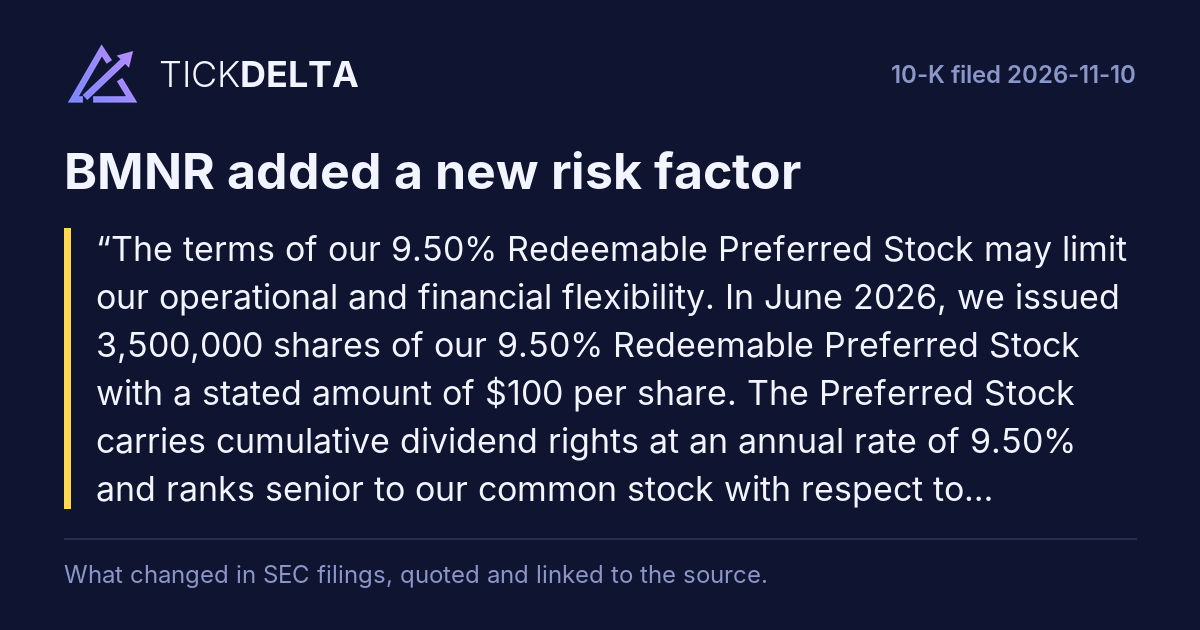
On June 4, 2026, the Company entered into an underwriting agreement with Moelis & Company, LLC and Cantor Fitzgerald & Co. in connection with an underwritten offering of 3,500,000 shares of the Company’s 9.50 % Series A Perpetual Preferred Stock (the "Series A Preferred Stock"), par value $ 0.0001 per share, at a public offering price of $ 80.00 per share. Net proceeds from the offering were $ 273.8 million after deducting underwriting discounts and offering expenses. The Series A Preferred Stock is listed on the New York Stock Exchange under the symbol “BMNP".
Read in the 10-Q ↗
The Company declared cash dividends on Series A Preferred Stock of $ 0.32 per share and $ 0.11 per share on June 12, 2026 and June 30, 2026, respectively. The dividends were paid on June 22, 2026 and July 10, 2026, respectively.
Read in the 10-Q ↗
Subsequent to May 31, 2026, we completed an underwritten public offering of our Series A Preferred Stock, generating net proceeds of $273.8 million. The offering further enhanced our liquidity and capital resources, and supports our digital asset treasury strategy, strategic investments and other general corporate purposes.
Read in the 10-Q ↗
• Revenue from self-mining. During the three months ended May 31, 2026, revenue from self-mining was $624, compared to $813 in the three months ended May 31, 2025. The Company is maintaining its small BTC mining operations. However, mining revenue declined due to the lower value of BTC for the three months ended May 31, 2026 compared to the prior year period.
Read in the 10-Q ↗
• Revenue from consulting. During the three months ended May 31, 2026, revenue from consulting was $168, as compared to $35 during the three months ended May 31, 2025. The increase in consulting revenue in 2026 was derived from one consulting agreement under which the Company is obligated to provide various operational, maintenance and consulting services, which saw more activity in 2026 as compared to the prior period.
Read in the 10-Q ↗
• Revenue from leasing. During the three months ended May 31, 2026, revenue from the leasing of miners was $0, as compared to $1,075 during the three months ended May 31, 2025. The machine lease agreements expired on December 31, 2025 and were not renewed. Thus, the revenue associated with this activity is no longer recognized.
Read in the 10-Q ↗
In addition, cost of sales as a percentage of revenue increased during the three months ended May 31, 2026 period primarily due to the acquisition of Pier Two and the resulting impact on the Company's staking and validation operations, affecting comparability to prior periods.
Read in the 10-Q ↗
• General and administrative expenses. General and administrative expenses were $37,270 in the three months ended May 31, 2026, compared to $744 in the three months ended May 31, 2025. The increase is primarily related to ETH custodian fees related to treasury operations and treasury management associated
Read in the 10-Q ↗
with the strategy to shift to staking revenue being the primary source of revenue. Further, this increase in general and administrative expenses was due to the increase in employee salaries and the increase in board of director monetary and stock-based compensation.
Read in the 10-Q ↗
• Revenue from self-mining. During the nine months ended May 31, 2026, revenue from self-mining was $845, compared to $2,814 in the nine months ended May 31, 2025. The Company is maintaining its small BTC mining operations. However, mining revenue declined partially due to the suspension of self-mining operations during relocation in the nine months ended May 31, 2026.
Read in the 10-Q ↗
• Revenue from leasing. During the nine months ended May 31, 2026, revenue from the leasing of miners was $1,536, as compared to $1,075 during the nine months ended May 31, 2025. This was due to more activity within its leasing contracts with KULR Technology Group, Inc. for the nine month period ended May 31, 2026.
Read in the 10-Q ↗
• General and administrative expenses. General and administrative expenses were $335,662 in the nine months ended May 31, 2026, compared to $2,667 in the nine months ended May 31, 2025. The increase is primarily related to treasury activity associated with the Company's ETH strategy. Due to the large purchases of ETH throughout the year, the Company incurred significantly more of these treasury expenses. Further, this increase in general and administrative expenses was due to the increase in employee salaries and the increase in board of director monetary and stock-based compensation.
Read in the 10-Q ↗
• Net loss on derivative contracts. During the nine months ended May 31, 2026, the Company recognized a net loss on derivative contracts of ($133,275), primarily attributable to losses on exercised option contracts of $79,278 and the net impact of option contracts that expired during the period of $54,512, partially offset by a $515 gain related to changes in the fair value of open option contracts. The Company had no derivative activity during the nine months ended May 31, 2025.
Read in the 10-Q ↗
• Issuance costs related to warrant offering. The Company incurred an issuance cost of ($9,381) during the nine months ended May 31, 2026. These costs were incurred in connection with the warrant offering completed during the period and did not exist in the prior year.
Read in the 10-Q ↗
During the nine months ended May 31, 2026, the Company recognized an income tax benefit of $92,295, primarily attributable to the reversal of the deferred tax liabilities associated with unrealized gains on digital assets recognized in prior periods that are now in a significant unrealized loss position. These unrealized losses resulted in the recognition of deferred tax assets, against which the Company recorded a 100% valuation allowance.
Read in the 10-Q ↗
(2) Represents a loss recorded during the period on the sale of property, plant and equipment that was the difference between the book carrying value and the sale price.
Read in the 10-Q ↗
(4) Represents the issuance cost incurred for the warrant offering for the nine months ended May 31, 2026 disclosed within "Note 8. Stockholders' Equity."
Read in the 10-Q ↗
(2) Represents a loss recorded during the period on the sale of property, plant and equipment that was the difference between the book carrying value and the sale price.
Read in the 10-Q ↗
(4) Represents the issuance cost incurred for the warrant offering for the nine months ended May 31, 2026 disclosed within "Note 8. Stockholders' Equity."
Read in the 10-Q ↗
The Company's primary sources of liquidity during the nine-months ended May 31, 2026, were proceeds from equity financing transactions, including the September 2025 issuance of common stock and warrants, and proceeds generated through its ATM equity program. During the period, the Company generated gross proceeds of $12,235,110 from equity financing transactions, consisting of (i) $11,869,870 in gross proceeds from the sale of 340,748,312 shares of common stock pursuant to the ATM Offering and (ii) $365,240 in gross proceeds from the September 2025 issuance of common stock and warrants.
Read in the 10-Q ↗
Subsequent to May 31, 2026, the Company completed an underwritten public offering of 3,500,000 shares of its Series A Preferred Stock at a public offering price of $80.00 per share, generating net proceeds of $273.8 million after deducting underwriting discounts and offering expenses. The Series A Preferred Stock is listed on the New York Stock Exchange under the symbol "BMNP."
Read in the 10-Q ↗
The Company intends to use available liquidity to support its digital asset treasury strategy, strategic investments, working capital requirements and general corporate purposes. Management continues to evaluate capital allocation opportunities, including direct digital asset acquisitions and investments in blockchain-related businesses and technologies that complement the Company's Ethereum-focused strategy.
Read in the 10-Q ↗
• ongoing revenue participation payments under the Management Services Agreement with Eth Tower, which are based on the level of staking activity and related revenues generated by MAVAN Holdings;
Read in the 10-Q ↗
• modest capital expenditures of approximately $1,500, primarily related to the for maintenance of existing technology platforms and infrastructure supporting the Company's operations;
Read in the 10-Q ↗
• working capital requirements for general operations, approximately $1,000 per month at current run-rate activity levels; and
Read in the 10-Q ↗
• public company costs, including audit and compliance, of approximately $4,000 annually.
Read in the 10-Q ↗
• dividend obligations associated with the Company's outstanding Series A Preferred Stock of approximately $33,250 annually.
Read in the 10-Q ↗
Business Combinations. Business combinations are recorded using the acquisition method of accounting in accordance with ASC 805, Business Combinations. Under this method, the purchase consideration is allocated to the tangible assets acquired, liabilities assumed, and identifiable intangible assets acquired based on their estimated fair values as of the acquisition date, with any excess recorded as goodwill.
Read in the 10-Q ↗
The determination of the fair value of assets acquired and liabilities assumed requires management to make significant estimates and assumptions. The most significant judgments relate to the identification and valuation of acquired intangible assets, including estimates of future cash flows, discount rates, customer attrition rates, technology obsolescence, and the determination of useful lives used to calculate amortization expense. Changes in these assumptions could materially affect the amounts assigned to identifiable intangible assets and goodwill, as well as future amortization and impairment expense. For significant acquisitions, the Company engages third-party valuation specialists to assist management in determining the fair value of acquired intangible assets and certain acquired assets and liabilities.
Read in the 10-Q ↗
Goodwill and Intangible Assets Impairment. The Company records goodwill and identifiable intangible assets in connection with business combinations. As of May 31, 2026, the Company recorded goodwill of $15.0 million and intangible assets, net, of $11.1 million, primarily related to the Pier Two acquisition. Goodwill is tested for impairment at least annually, or more frequently if events or circumstances indicate that impairment may exist, at the reporting unit level. Based on management’s assessment under ASC 280 and ASC 350, the Company has identified one reporting unit for purposes of goodwill impairment testing. Definite-lived intangible assets are amortized over
Read in the 10-Q ↗
their estimated useful lives and reviewed for impairment when indicators of impairment are present. These assessments require significant judgment, including estimates of future cash flows, discount rates, revenue growth, useful lives, and market participant assumptions. Management did not identify any impairment of goodwill or definite-lived intangible assets during the three and nine months ended May 31, 2026.
Read in the 10-Q ↗
Staking and validation services revenue recognition. The Company recognizes revenue from blockchain validation and staking services in accordance with ASC 606. Revenue is earned in the form of digital assets received for validating blockchain transactions and providing staking services. The Company recognizes revenue when its performance obligation is satisfied through the successful validation of blocks or transactions on the applicable blockchain network.
Read in the 10-Q ↗
Significant judgment is required in evaluating the application of ASC 606 to blockchain validation arrangements, including the identification of the customer and contract by analogy, determining when performance obligations are satisfied, and assessing whether the Company acts as principal or agent in generating staking rewards. The Company recognizes revenue on a gross basis when it controls the validation services provided to the blockchain network and is primarily responsible for fulfilling the related performance obligation. Changes in these judgments could materially affect the amount and timing of revenue recognized.
Read in the 10-Q ↗
Market risk
Certain quantitative and qualitative market risk disclosures are described in our Annual Report on Form 10-K for the year ended August 31, 2025. Through May 31, 2026, there have been no material changes in the quantitative and qualitative market risk disclosures described in such Annual Report.
Read in the 10-Q ↗
Risk Factors
The following risk factors supplement the Company’s existing Item 1A disclosures included in the Company’s previous filings with the SEC. These supplemental risk factors should be read in conjunction with the other information contained in this Report and the Company’s other filings with the SEC, including, but not limited to, the Company’s Rule 424(b)(5) prospectus supplement dated June 5, 2026 filed with the Securities and Exchange Commission.
Read in the 10-Q ↗
Staking yield volatility may materially and adversely affect our ability to pay dividends on the Series A Preferred Stock.
Read in the 10-Q ↗
A significant portion of our revenue is derived from staking rewards earned on our Ethereum holdings. Staking rewards are not fixed and are subject to substantial fluctuation based on a variety of factors, many of which are beyond our control. These factors include changes in the total amount of Ethereum staked across the network, modifications to the Ethereum protocol’s reward mechanisms through network upgrades or governance decisions, fluctuations in network transaction volume and associated priority fees, changes in the rate of new validator participation, and broader macroeconomic and cryptocurrency market conditions. As the total amount of Ethereum staked on the network increases, the per-validator reward rate generally decreases, which could result in a material reduction in the yield we earn on our staked assets over time.
Read in the 10-Q ↗
Because we rely on staking income as a primary source of cash generation, any sustained decline or period of heightened volatility in staking yields could materially impair our ability to meet our operating expenses, service any outstanding indebtedness, and maintain dividend payments on our Series A Preferred Stock at current or anticipated levels. Our board of directors retains discretion over the declaration and payment of dividends, and there can be no assurance that dividends will be declared or paid in any particular amount or at all. A reduction or suspension of
Read in the 10-Q ↗
dividends resulting from diminished staking yields could adversely affect the market price of our securities, including the Series A Preferred Stock, and may make our securities less attractive to income-oriented investors.
Read in the 10-Q ↗
In addition, the yield earned through Ethereum staking is denominated in ETH, the value of which is itself subject to significant price volatility. Even if staking yields remain stable in terms of the quantity of ETH earned, the fiat-currency equivalent of those rewards may fluctuate materially due to changes in the market price of ETH. A decline in the price of ETH concurrent with a decline in staking yield rates would compound the adverse impact on our cash flow and our ability to fund dividend payments on the Series A Preferred Stock. Conversely, even if ETH prices appreciate, a sufficient decline in staking yield rates could still result in reduced revenue in absolute terms if the rate of yield compression outpaces any price appreciation.
Read in the 10-Q ↗
Furthermore, the Ethereum network and its proof-of-stake consensus mechanism remain subject to ongoing development and potential protocol changes. Future upgrades to the Ethereum network, including changes to issuance schedules, reward distribution mechanisms, or the introduction of new staking paradigms, could alter the economics of staking in ways that are difficult to predict. Regulatory developments in the United States and abroad may also affect our ability to stake Ethereum or the economic terms on which staking is conducted, including the potential classification of staking activities or staking rewards as securities transactions, which could subject us to additional compliance obligations or restrict our staking operations. Any such changes could further reduce the yields available to us, which may have a material adverse effect on our ability to cover dividend payments on the Series A Preferred Stock. There can be no assurance that staking yields will remain at levels sufficient to support our current business model or dividend policy, and investors should not place undue reliance on historical staking yields as indicative of future performance.
Read in the 10-Q ↗
Ongoing issuance of new ETH may adversely affect the price of ETH and our ability to cover dividend payments on the Series A Preferred Stock.
Read in the 10-Q ↗
The rate at which new ETH are issued and put into circulation is expected to vary. Unlike bitcoin, which has a hard-coded maximum supply of 21 million coins, the Ethereum network has no formal cap on the total supply of ETH. New ETH is issued to validators as staking rewards on a continuing basis, and continued net issuance of ETH may introduce sustained downward pressure on the price of ETH, particularly if a meaningful portion of newly minted ETH is sold by validators. Sustained pressure on the price of ETH may have a material adverse effect on our ability to cover dividend payments on the Series A Preferred Stock.
Read in the 10-Q ↗
Our ETH holdings are less liquid than cash and cash equivalents and may not be able to serve as a source of liquidity to fund dividends on the Series A Preferred Stock.
Read in the 10-Q ↗
Historically, the ETH market has been characterized by significant volatility in price, limited liquidity and trading volumes compared to sovereign currencies markets, relative anonymity, a developing regulatory landscape, potential susceptibility to market abuse and manipulation, compliance and internal control failures at exchanges, and various other risks inherent in its entirely electronic, virtual form and decentralized network. Staked ETH may not be immediately available for withdrawal or sale. As part of the “activating” and “exiting” processes of staking, staked ETH will be inaccessible for a variable period of time determined by a range of factors, including network congestion. These delays may be unpredictable and could occur during periods of market stress or declining ETH prices, limiting our ability to use staked ETH as a source of liquidity to fund dividends on the Series A Preferred Stock.
Read in the 10-Q ↗
Further, during times of market instability, we may not be able to sell our ETH at favorable prices or at all. For example, a number of ETH trading venues temporarily halted deposits and withdrawals in 2022, although the Coinbase exchange (our principal market for ETH) has, to date, not done so. As a result, our ETH holdings may not be able to serve as a source of liquidity for us to the same extent as cash and cash equivalents.
Read in the 10-Q ↗
Further, ETH we hold with our custodians do not enjoy the same protections as are available to cash or securities deposited with or transacted by institutions subject to regulation by the Federal Deposit Insurance Corporation or the Securities Investor Protection Corporation. Additionally, we may be unable to enter into term loans or other capital raising transactions collateralized by our unencumbered ETH or otherwise generate funds using our ETH holdings, including during times of market instability or when the price of ETH has declined significantly. If we are unable to sell our ETH, enter into additional capital raising transactions, including capital raising transactions using ETH as collateral, or otherwise generate funds using our ETH holdings, or if we are forced to sell our ETH at a significant
Read in the 10-Q ↗
loss, in order to meet our working capital requirements, our business and financial condition could be negatively impacted and our ability to fund dividend payments on the Series A Preferred Stock could be materially impaired.
Read in the 10-Q ↗
Regulatory treatment of digital assets could cause us to be deemed an “investment company,” which could materially harm the trading price of the Series A Preferred Stock.
Read in the 10-Q ↗
There is a risk that changing regulatory treatment of ETH, other digital assets we hold, or activities in which we are engaged could cause us to be deemed to be an “investment company” within the meaning of the Investment Company Act of 1940, as amended, which would impose substantial regulatory burdens, restrict our ability to operate our business as currently conducted, and could require us to liquidate or restructure our holdings. If we were deemed to be an investment company, we could be required to register as such under the Investment Company Act, which would subject us to significant regulatory requirements and restrictions, including limitations on leverage, affiliate transactions, and our ability to pursue our current digital asset treasury strategy. The costs and administrative burden of compliance with the Investment Company Act could be substantial and could materially affect our profitability and operations. Adverse regulatory developments concerning the classification of digital assets and related activities under the Investment Company Act or other federal securities laws could materially harm our business and the trading prices of our securities, including the Series A Preferred Stock.
Read in the 10-Q ↗
Our option strategies and strategic investments expose us to additional volatility and counterparty risks that could impair our ability to cover dividend payments on the Series A Preferred Stock.
Read in the 10-Q ↗
We generate ETH option premium income from option strategies on our ETH holdings. These strategies expose us to mark-to-market volatility, counterparty risk, and the risk that ETH could be called away at unfavorable prices. We also hold strategic “moonshot” investments, including a stake in Beast Industries Co. valued at $186 million (recorded as an equity investment measured at cost) and a stake in Eightco Holdings Inc. valued at $93 million as of May 31, 2026 (recorded as an equity method investment measured at fair value), which are subject to substantial volatility, illiquidity, and concentration risks. If any of the foregoing risks were to materialize, it could reduce the yield generated from our ETH holdings and/or our future revenues, which could have a material adverse effect on our ability to cover dividend payments on the Series A Preferred Stock.
Read in the 10-Q ↗
We may be unable to access capital markets on acceptable terms, which could increase the cost of issuing parity or junior preferred stock and adversely affect our ability to maintain dividends on the Series A Preferred Stock.
Read in the 10-Q ↗
Our digital asset acquisition strategy depends on our continued ability to access capital markets, including through issuances of equity, preferred, and debt securities. Adverse capital markets conditions, regulatory developments, declines in the price of ETH or our common stock, or perceptions about our creditworthiness could limit our ability to raise capital and could increase our cost of capital, including our cost of issuing additional parity stock or junior stock. If we are unable to access the capital markets on acceptable terms, we may be unable to fund our digital asset treasury strategy, meet our operating obligations, or maintain dividend payments on the Series A Preferred Stock, any of which could have a material adverse effect on our business, financial condition, results of operations, and the trading price of our securities.
Read in the 10-Q ↗
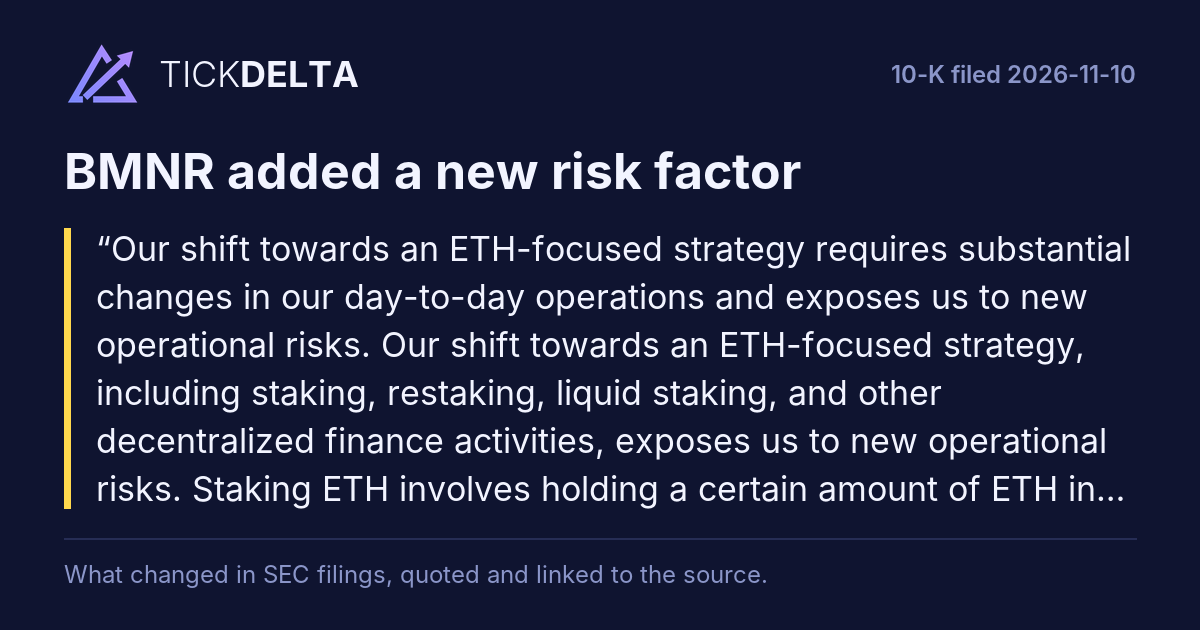
Our staking and validator operations conducted through MAVAN are subject to significant risks, including slashing, lock-up periods, smart contract vulnerabilities, liquidity constraints, counterparty exposure, and operational failures, any of which could result in a partial or total loss of staked ETH or a material reduction in staking revenue.
Read in the 10-Q ↗
We generate substantially all of our revenue from native ETH staking conducted through MAVAN. Staking requires continuous operational reliability, adherence to Ethereum protocol rules, and the maintenance of high-availability validator infrastructure. Validators that act maliciously, produce conflicting attestations, or suffer extended downtime may be “slashed” by the Ethereum network, resulting in an irrecoverable partial loss of staked principal. As of May 31, 2026, the Company held 5,416,945 ETH with a fair value of $10.9 billion, a substantial portion of which is staked through MAVAN, and any slashing event could result in a material loss of digital assets. In addition, staking involves unbonding or lock-up periods during which staked ETH cannot be withdrawn or sold; these periods may be unpredictable and may coincide with periods of market stress, reducing our ability to respond to adverse price movements or meet liquidity needs. Our staking operations also involve exposure to smart contract risk - the
Read in the 10-Q ↗
underlying protocols, liquid staking mechanisms, and restaking integrations on which MAVAN relies are governed by code that may contain undiscovered vulnerabilities exploitable by malicious actors. Where staking is conducted through or in conjunction with third-party custodians, infrastructure providers, or staking protocols, we face counterparty and operational risk that could result in delayed access to staked assets, loss of staking rewards, or in extreme cases, loss of principal. Any of the foregoing risks, if realized, could have a material adverse effect on our financial condition and results of operations.
Read in the 10-Q ↗
Our recent strategic transactions, including the acquisition of Pier Two and the launch of MAVAN, may not be successfully integrated or generate the anticipated benefits, and our projected staking revenue figures are based on assumptions that may prove incorrect.
Read in the 10-Q ↗
We completed the acquisition of Pier Two Holdings Pty Ltd in March 2026 for total preliminary consideration of $27.8 million and launched MAVAN later that month. The integration of Pier Two’s non-custodial staking infrastructure and personnel into MAVAN involves substantial execution risks, including risks related to the integration of technology systems and operational workflows, retention of key technical employees, regulatory compliance across multiple jurisdictions (including Australian and U.S. regulatory regimes), validator performance optimization, and our ability to attract and retain institutional staking customers. If we are unable to successfully integrate Pier Two’s operations or retain key personnel, we may not realize the anticipated benefits of the acquisition, which could impair the carrying value of the goodwill and intangible assets recognized in connection with the transaction. Furthermore, the annualized staking revenue figures and yield assumptions we have disclosed in connection with MAVAN’s operations are based on assumptions regarding staking yield rates, the proportion of our ETH holdings that are staked at any given time, validator uptime, and Ethereum network conditions - all of which are subject to change. Actual results may differ materially from these assumptions, and there can be no assurance that MAVAN will achieve the revenue levels or operational performance we anticipate.
Read in the 10-Q ↗
Our revenue is highly concentrated in ETH staking and validation operations conducted through MAVAN, and any disruption to those operations, decline in staking yields, or adverse protocol change would have a disproportionate impact on our results of operations and financial condition.
Read in the 10-Q ↗
For the three months ended May 31, 2026, revenue from staking and validation was $45.7 million, representing 98% of total revenue of $46.5 million for the quarter. For the nine months ended May 31, 2026, revenue from staking and validation was $56.9 million, representing 95% of total revenue of $59.9 million for the nine-month period. This extraordinary concentration of revenue in a single operating activity - Ethereum staking conducted principally through MAVAN - means that any disruption to MAVAN’s validator performance, any decline in Ethereum staking yield rates, or any adverse change to the Ethereum protocol’s reward mechanisms could result in a disproportionate and material decline in our total revenue, operating income, and cash flow from operations. Unlike a diversified revenue base, our reliance on a single yield-generation mechanism affords limited ability to offset declines in staking economics with revenue from other sources. In addition, because staking revenue is denominated in ETH, fluctuations in the market price of ETH directly affect the U.S. dollar-equivalent revenue recognized by the Company, compounding the impact of any reduction in yield rates. There can be no assurance that our revenue concentration in staking will decrease over time, and investors should consider that our results of operations are substantially dependent on the continued performance of MAVAN and favorable Ethereum staking economics.
Read in the 10-Q ↗
Regulatory uncertainty regarding the classification and treatment of staking activities and staking rewards in the United States and abroad may subject us to additional compliance obligations, restrict our staking operations, or require changes to MAVAN’s business model as it expands to serve institutional clients.
Read in the 10-Q ↗
The regulatory treatment of staking activities and staking rewards under U.S. federal and state securities laws, banking regulations, money transmission laws, and tax laws remains uncertain and continues to evolve. Regulators, including the Securities and Exchange Commission, the Commodity Futures Trading Commission, and various state regulators, have not provided definitive guidance on whether staking activities or staking rewards constitute securities transactions, commodity transactions, or money services business activities. If staking activities or staking rewards are classified as securities or are otherwise subject to registration, licensing, or reporting obligations, we could be required to register as a broker-dealer, investment adviser, money services business, or similar regulated entity, to modify MAVAN’s operations, or to curtail or cease certain staking activities. These risks are amplified as MAVAN expands beyond supporting our own ETH treasury to offering staking services to institutional investors, custodians, and ecosystem partners - an expansion that may subject the Company to additional or different regulatory regimes applicable to staking service providers, including fiduciary, custody, and consumer protection
Read in the 10-Q ↗
requirements not previously applicable to our operations. Regulatory developments in foreign jurisdictions, including Australia (where Pier Two is domiciled and operates), may similarly affect our ability to conduct staking operations or the economic terms on which staking is offered. Any adverse regulatory development could materially impair our staking revenue or require us to restructure MAVAN’s operations at significant cost.
Read in the 10-Q ↗
We rely on third-party infrastructure providers and key personnel, including Ethereum Tower LLC under a long-term Management Services Agreement, to operate MAVAN’s validator nodes, and any failure of performance, termination of arrangements, or loss of key personnel could materially disrupt our staking operations.
Read in the 10-Q ↗
MAVAN’s validator operations depend on the continued performance of third-party infrastructure providers and key personnel. Pursuant to a ten-year Management Services Agreement dated March 24, 2026, Ethereum Tower LLC provides management and operating services to MAVAN Holdings LLC in exchange for an irrevocable 2.00% membership interest in MAVAN Holdings LLC and a monthly fee calculated as a percentage of the Company’s native staking rewards attributable to ETH staked through MAVAN Holdings LLC. If Ethereum Tower LLC fails to perform its obligations, experiences operational failures, or is unable to retain qualified personnel, our validator operations could be disrupted, resulting in reduced staking rewards, increased risk of slashing events, or reputational harm. In addition, much of MAVAN’s technical expertise was obtained through the Pier Two acquisition, and there can be no assurance that we will be able to retain key technical and operational personnel acquired in that transaction, particularly given the competitive market for blockchain infrastructure talent. MAVAN also relies on third-party cloud computing, co-location, and network infrastructure providers for the hosting and connectivity of its validator nodes; any failure, security breach, or service interruption by such providers could result in extended validator downtime, slashing, or loss of staking rewards. We do not control the operations of these third parties and may have limited contractual remedies if they fail to perform.
Read in the 10-Q ↗
MAVAN’s planned expansion from an internally-focused staking platform to a commercial staking-services provider serving third-party institutional investors, custodians, and ecosystem partners introduces new customer acquisition, competitive, service-level, and reputational risks not previously applicable to the Company’s business.
Read in the 10-Q ↗
MAVAN was originally developed to support the Company’s own Ethereum treasury operations and has operated principally as an internal staking platform since its launch in March 2026. The Company has publicly disclosed its intention to expand MAVAN to serve institutional investors, custodians, and other ecosystem partners seeking institutional-grade staking infrastructure. This expansion introduces risks that were not previously applicable to the Company’s business, including the need to develop and maintain commercial-grade service-level agreements, manage customer onboarding and support, compete with established institutional staking service providers (including Coinbase Cloud, Figment, Kiln, and others), and protect the Company’s reputation in a market where validator downtime or slashing events affecting client assets could result in significant liability, loss of customer confidence, and competitive harm. The Company has limited operating history as a commercial staking-services provider, and there can be no assurance that MAVAN will successfully attract or retain institutional staking clients on terms favorable to the Company, or at all. Failure to successfully execute this expansion could limit the Company’s revenue diversification, impair the return on investment from the Pier Two acquisition, and adversely affect our competitive position in the rapidly evolving blockchain infrastructure services market.
Read in the 10-Q ↗
Share sales and buybacks
On March 24, 2026, in connection with the closing of the acquisition of Pier Two Holdings Pty Ltd (“Pier Two”), the Company issued 501,545 shares of its common stock, par value $0.0001 per share, to the sellers of Pier Two as partial consideration for the acquisition. The shares were issued at a price of $20.93 per share, for aggregate stock consideration of $10,500. The shares were issued in reliance upon the exemption from registration provided by Section 4(a)(2) of the Securities Act of 1933, as amended, and Rule 506(b) of Regulation D promulgated thereunder, based on the limited number of offerees and their status as sophisticated investors. The issuance was previously reported on the Company’s Current Report on Form 8-K filed with the SEC on March 30, 2026.
Read in the 10-Q ↗