Paragraph 53 · 50% changed
Every version of it
Screener
/
SEC EDGAR
/CIK 0001048477
/10-K filed Feb 26, 2026, compared with Feb 24, 2025
/Numbers from the XBRL of the 10-Ks
Nasdaq
Health care · Pharmaceuticals
Biomarin Pharmaceutical Inc BMRN
The 10-K against last year's
159 changes: 63 added, 12 removed, 82 reworded, 2 quiet changes
10-K Feb 26, 2026 vs Feb 24, 2025
Risk Factors
20.6%
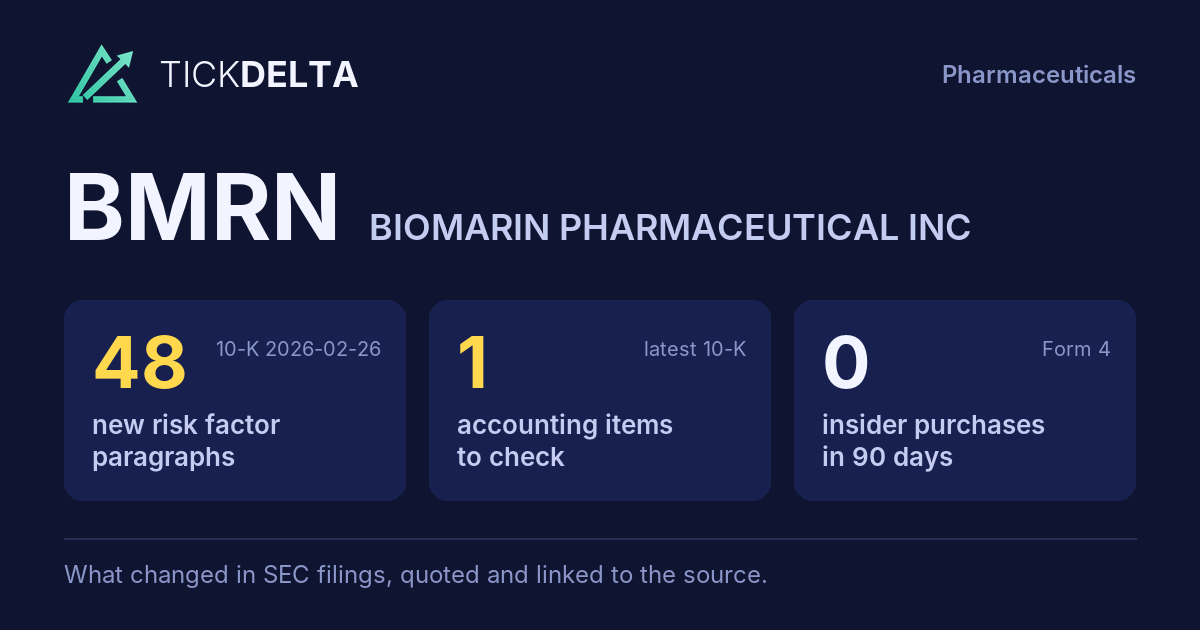
of the text changed · 29,824 words now · 48 new paragraphs, 7 gone
MD&A
28.1%
of the text changed · 5,560 words now · 15 new paragraphs, 5 gone
10-K 0001048477-26-000004 (Feb 26, 2026) vs 10-K 0001048477-25-000007 (Feb 24, 2025) Not compared: Legal Proceedings, Accounting Policies.
Every paragraph, and how much of it changed
One bar per paragraph, in the order of the 10-K. Height and colour show the share of its words not in the closest paragraph a year earlier; the tallest bars are new paragraphs.
Risk Factors
319 paragraphs · 48 new · 87 reworded · 7 gone · 10-K Feb 26, 2026 against Feb 24, 2025
New paragraph
Reworded (5% of its words or more)
Same or nearly
Paragraph 206 · 49% changed
Every version of it
Paragraph 284 · 49% changed
Every version of it
In the United States, federal, state, and local governments have enacted numerous data privacy and security laws, including data breach notification laws, personal data privacy laws, consumer protection laws (e.g., Section 5 of the Federal Trade Commission Act), and other similar laws (e.g., wiretapping laws). For example, HIPAA, as amended by HITECH, imposes specific requirements relating to the privacy, security, and transmission of individually identifiable health information. Additionally, numerous U.S. states have enacted comprehensive privacy laws that impose certain obligations on covered businesses, including providing specific disclosures in privacy notices and affording residents with certain rights concerning their personal data. As applicable, such rights may include the right to access, correct, or delete certain personal data, and to opt-out of certain data processing activities, such as targeted advertising, profiling, and automated decision-making. The exercise of these rights may impact our business and ability to provide our products and services. Certain states also impose stricter requirements for processing certain personal data, including sensitive information, such as conducting data privacy impact assessments. These state laws allow for statutory fines for noncompliance. For example, the California Consumer Privacy Act of 2018 (CCPA) requires businesses to provide specific disclosures in privacy notices and honor requests of California residents to exercise certain privacy rights. The CCPA provides for fines for intentional violations and allows private litigants affected by certain data breaches to recover significant statutory damages. Although some U.S. comprehensive privacy laws exempt some data processed in the context of clinical trials, these laws may increase compliance costs and potential liability with respect to other personal data we may maintain about California residents. Similar laws are being considered in several other states, as well as at the federal and local levels, and we expect more jurisdictions to pass similar laws in the future.
Paragraph 205 · 48% changed
Every version of it
We operate in a global economy, and our business depends on a global supply chain for the development, manufacturing, and distribution of our pharmaceutical products, and for the advancement of our preclinical and clinical development programs. There is inherent risk, based on the complex relationships among the United States and the countries in which we conduct our business, that political, diplomatic, and national security factors can lead to global trade restrictions and changes in trade policies and export regulations that may adversely affect our business and operations. The United States current international trade and other countries have imposed and may continue regulatory environment is subject to impose new trade restrictions and export regulations, have levied tariffs and taxes on certain goods, and could significantly increase tariffs on a broad array of goods. While pharmaceutical products have customarily been granted exemptions from tariffs, recent proposals do not contemplate such exemptions. Trade restrictions and export regulations, or increases in tariffs and additional taxes, including any retaliatory measures, can negatively impact demand, increase our supply chain complexity and our manufacturing costs, decrease margins, reduce the competitiveness of our products, or restrict our ability to sell products, provide services or purchase necessary equipment and supplies, any or all of which could have a material and adverse effect on our business, results of operations, or financial condition. significant ongoing uncertainty.
Paragraph 299 · 44% changed
Every version of it
In addition, our technology systems, including our cloud technologies, continue to increase in multitude and complexity, making them potentially vulnerable to breakdown, cyberattack and other disruptions. Potential problems or interruptions associated with the implementation of new or upgraded technology systems or with maintenance or adequate support of existing systems could disrupt or reduce, and has in the past disrupted or reduced, the efficiency of our operations and expose us to greater risk of security breaches. Cybersecurity incidents resulting in the failure of our ERP system, production management or other systems to operate effectively or to integrate with other systems, or a breach in security or other unauthorized access or unavailability of these systems or those of any third parties in our supply chain or on whom we otherwise depend, have occurred in the past and may affect our ability in the future to manage and maintain our operations, inventory and internal reports, and result in delays in product fulfillment and reduced efficiency of our operations. In particular, we have implemented certain modules of a new global ERP system and will continue to implement other components of the new system, which has replaced, and will continue to replace, legacy operating and financial systems. The preparation and implementation of a new ERP system has required, and will continue to require, significant investment of capital and human resources. Our results of operations could be adversely affected if we continue to experience delays or cost overruns during the implementation process, or if the ERP system or associated process changes do not give rise to the benefits that we expect. Potential failure or flaws in the new ERP system may pose risks to our ability to operate successfully and efficiently and failure to implement the appropriate internal controls with respect to the new ERP system may result in the system producing inaccurate or unreliable information. Any disruptions, delays or deficiencies in the design or implementation of the new ERP system or related internal controls, or in the performance of legacy information technology systems, could result in potentially much higher costs than we had incurred and adversely affect our ability to effectively fulfill contractual obligations, file related government reports in a timely manner, operate and manage our business or otherwise affect our controls environment. Any of these consequences could have an adverse effect on our results of operations and financial condition.
Paragraph 107 · 43% changed
Every version of it
Paragraph 270 · 43% changed
Every version of it
Moreover, changes in the tax laws of jurisdictions in which we conduct business could arise, including as a result of the base erosion and profit shifting (BEPS) project that is being led by the Organization for Economic Co-operation and Development (OECD), and other initiatives led by the OECD or the EC. For example, the OECD, which represents a coalition of member countries including the U.S. and other countries in which we have operations, is working on the implementation of proposals, commonly referred to as “BEPS 2.0”, which, which have made (and are expected to the extent implemented, would make continue to make) important changes to the international tax system. These proposals are based on two “pillars”, Pillar One focuses on include, among other measures, the allocation imposition of taxing rights in respect of certain profits of multinational enterprises with annual global revenue above 20 billion euros and profitability above 10% to the jurisdictions within which they carry on business (based on the thresholds, we currently expect to be outside the scope of the Pillar One proposals, but could fall within their scope in the future) and Pillar Two imposes a minimum effective tax rate of 15% on certain multinational enterprises that have consolidated revenues of at least 750 million euros in at least two out of the last four years (based on the thresholds, we currently expect that we are likely to fall within the scope of the Pillar Two proposals). years. A number of countries in which we conduct business have enacted, or are in the process of enacting, core elements of Pillar Two rules. rules (with further provisions expected to be enacted in the future). The OECD has issued (and is expected to continue to issue further) administrative guidance providing transition and safe harbor rules around in relation to the implementation of the Pillar Two. We continue to monitor developments and evaluate Two proposal. For example, on January 5, 2026, the potential impacts OECD published details of these new rules, including on our effective tax rates and our eligibility to qualify for these transition and safe harbor rules. It is not uncommon for taxing authorities in different countries to have conflicting views, for instance, with respect to, a proposed “side-by-side” arrangement providing for, among other things, the manner additional safe harbors for multinational groups headquartered in certain qualifying jurisdictions, which the arm’s length standard is applied for transfer pricing purposes, or with respect to the valuation of intellectual property. If tax authorities successfully challenge our transfer prices as not reflecting arm’s length transactions, they could require us to adjust our transfer prices and thereby reallocate our income to reflect these revised transfer prices, resulting in a higher tax liability. In addition, if a country from which income is reallocated does not agree with the reallocation, both that country and the other country to which the income was allocated could tax the same income, potentially resulting in double taxation. If tax authorities were to allocate income to a higher tax jurisdiction, subject our income to double taxation or assess interest and penalties, it would increase our consolidated tax liability, which could adversely affect our business, financial condition, results of operations and cash flows.
Paragraph 127 · 42% changed
Every version of it
Paragraph 53 · 50% changed
Every version of it
10-K Feb 24, 2025Government healthcare reform could increase our costs and adversely affect our revenues and results of operations.
10-K Feb 26, 2026
The pendency of the Amicus Acquisition could adversely affect our and/or Amicus’ businesses and operations.
Paragraph 206 · 49% changed
Every version of it
10-K Feb 24, 2025There is inherent risk, based on the complex relationships among the United States and the countries in which we conduct our business, that political, diplomatic, and national security factors can lead to global trade restrictions and changes in trade policies and export regulations that may adversely affect our business and operations. The United States and other countries have imposed and may continue to impose new trade restrictions and export regulations, have levied tariffs and taxes on certain goods, and could significantly increase tariffs on a broad array of goods. While pharmaceutical products have customarily been granted exemptions from tariffs, recent proposals do not contemplate such exemptions. Trade restrictions and export regulations, or increases in tariffs and additional taxes, including any retaliatory measures, can negatively impact demand, increase our supply chain complexity and our manufacturing costs, decrease margins, reduce the competitiveness of our products, or restrict our ability to sell products, provide services or purchase necessary equipment and supplies, any or all of which could have a material and adverse effect on our business, results of operations, or financial condition.
10-K Feb 26, 2026
The ongoing trade tensions between the United States and other jurisdictions have resulted in multiple rounds of tariffs and anticipated tariffs affecting pharmaceuticals and pharmaceutical ingredients, including finished drug products, manufacturing equipment, and related supplies. Such tariffs may significantly increase our costs for certain products. The Bureau of Industry and Security, U.S. Department of Commerce, has initiated an investigation to determine whether pharmaceutical ingredients, including finished drug product, manufactured outside the United States pose a national security risk and should be subject to additional tariffs. Unlike consumer goods, pharmaceuticals face unique regulatory constraints that make rapid supply chain adjustments particularly difficult and costly. Since we conduct manufacturing and packaging operations in Ireland for certain of our products and also engage contract manufacturers around the world, the import of our products into the United States is subject to tariffs. Notwithstanding the U.S. Supreme Court's recent decision invalidating tariffs imposed under the International Emergency Economic Powers Act, the magnitude and impact of tariffs are uncertain and are subject to a variety of factors, including the effective date and duration of additional tariffs, changes in the amount, scope and nature of tariffs in the future, including as a result of litigation or other challenges, any retaliatory tariffs that other countries may impose in response to tariffs levied by the United States and any mitigating actions that may become available. Trade restrictions and export regulations, or increases in tariffs and additional taxes, including any retaliatory measures, could negatively impact demand, increase our supply chain complexity and our manufacturing costs, decrease margins, reduce the competitiveness of our products, or restrict our ability to sell products, provide services or purchase necessary equipment and supplies, any or all of which could have a material and adverse effect on our business, results of operations, or financial condition. In addition, the dynamic and unpredictable tariff and trade landscape creates substantial uncertainty and significant planning challenges for our operations and complicates our long-term investment decisions regarding manufacturing facilities, supply chain optimization, and research and development locations.
Paragraph 284 · 49% changed
Every version of it
10-K Feb 24, 2025
In the United States, federal, state, and local governments have enacted numerous data privacy and security laws, including data breach notification laws, personal data privacy laws, consumer protection laws (e.g., Section 5 of the Federal Trade Commission Act), and other similar laws (e.g., wiretapping laws). For example, HIPAA, as amended by HITECH, imposes specific requirements relating to the privacy, security, and transmission of individually identifiable health information. Additionally, numerous U.S. states have enacted comprehensive privacy laws that impose certain obligations on covered businesses, including providing specific disclosures in privacy notices and affording residents with certain rights concerning their personal data. As applicable, such rights may include the right to access, correct, or delete certain personal data, and to opt-out of certain data processing activities, such as targeted advertising, profiling, and automated decision-making. The exercise of these rights may impact our business and ability to provide our products and services. Certain states also impose stricter requirements for processing certain personal data, including sensitive information, such as conducting data privacy impact assessments. These state laws allow for statutory fines for noncompliance. For example, the California Consumer Privacy Act of 2018 (CCPA) requires businesses to provide specific disclosures in privacy notices and honor requests of California residents to exercise certain privacy rights. The CCPA provides for fines for intentional violations and allows private litigants affected by certain data breaches to recover significant statutory damages. Although some U.S. comprehensive privacy laws exempt some data processed in the context of clinical trials, these laws may increase compliance costs and potential liability with respect to other personal data we may maintain about California residents. Similar laws are being considered in several other states, as well as at the federal and local levels, and we expect more jurisdictions to pass similar laws in the future.
10-K Feb 26, 2026
In the United States, federal, state, and local governments have enacted numerous data privacy and security laws, including data breach notification laws, personal data privacy laws, consumer protection laws (e.g., Section 5 of the Federal Trade Commission Act), and other similar laws (e.g., wiretapping laws). For example, HIPAA, as amended by HITECH, imposes specific requirements relating to the privacy, security, and transmission of individually identifiable health information. Additionally, numerous
Paragraph 205 · 48% changed
Every version of it
10-K Feb 24, 2025
There is inherent risk, based on the complex relationships among the United States and the countries in which we conduct our business, that political, diplomatic, and national security factors can lead to global trade restrictions and changes in trade policies and export regulations that may adversely affect our business and operations. The United States and other countries have imposed and may continue to impose new trade restrictions and export regulations, have levied tariffs and taxes on certain goods, and could significantly increase tariffs on a broad array of goods. While pharmaceutical products have customarily been granted exemptions from tariffs, recent proposals do not contemplate such exemptions. Trade restrictions and export regulations, or increases in tariffs and additional taxes, including any retaliatory measures, can negatively impact demand, increase our supply chain complexity and our manufacturing costs, decrease margins, reduce the competitiveness of our products, or restrict our ability to sell products, provide services or purchase necessary equipment and supplies, any or all of which could have a material and adverse effect on our business, results of operations, or financial condition.
10-K Feb 26, 2026
We operate in a global economy, and our business depends on a global supply chain for the development, manufacturing, and distribution of our pharmaceutical products, and for the advancement of our preclinical and clinical development programs. There is inherent risk, based on the complex relationships among the United States and the countries in which we conduct our business, that political, diplomatic, and national security factors can lead to global trade restrictions and changes in trade policies and export regulations that may adversely affect our business and operations. The current international trade and regulatory environment is subject to significant ongoing uncertainty.
Paragraph 299 · 44% changed
Every version of it
10-K Feb 24, 2025
In addition, our technology systems, including our cloud technologies, continue to increase in multitude and complexity, making them potentially vulnerable to breakdown, cyberattack and other disruptions. Potential problems or interruptions associated with the implementation of new or upgraded technology systems or with maintenance or adequate support of existing systems could disrupt or reduce, and has in the past disrupted or reduced, the efficiency of our operations and expose us to greater risk of security breaches. Cybersecurity incidents resulting in the failure of our ERP system, production management or other systems to operate effectively or to integrate with other systems, or a breach in security or other unauthorized access or unavailability of these systems or those of any third parties in our supply chain or on whom we otherwise depend, have occurred in the past and may affect our ability in the future to manage and maintain our operations, inventory and internal reports, and result in delays in product fulfillment and reduced efficiency of our operations. In particular, we have implemented certain modules of a new global ERP system and will continue to implement other components of the new system, which has replaced, and will continue to replace, legacy operating and financial systems. The preparation and implementation of a new ERP system has required, and will continue to require, significant investment of capital and human resources. Our results of operations could be adversely affected if we continue to experience delays or cost overruns during the implementation process, or if the ERP system or associated process changes do not give rise to the benefits that we expect. Potential failure or flaws in the new ERP system may pose risks to our ability to operate successfully and efficiently and failure to implement the appropriate internal controls with respect to the new ERP system may result in the system producing inaccurate or unreliable information. Any disruptions, delays or deficiencies in the design or implementation of the new ERP system or related internal controls, or in the performance of legacy information technology systems, could result in potentially much higher costs than we had incurred and adversely affect our ability to effectively fulfill contractual obligations, file related government reports in a timely manner, operate and manage our business or otherwise affect our controls environment. Any of these consequences could have an adverse effect on our results of operations and financial condition.
10-K Feb 26, 2026
In addition, our technology systems, including our cloud technologies, continue to increase in multitude and complexity, making them potentially vulnerable to breakdown, cyberattack and other disruptions. Potential problems or interruptions associated with the implementation of new or upgraded technology systems or with maintenance or adequate support of existing systems could disrupt or reduce, and has in the past disrupted or reduced, the efficiency of our operations and expose us to greater risk of security breaches. Cybersecurity incidents resulting in the failure of our ERP system, production management or other systems to operate effectively or to integrate with other systems, or a breach in security or other unauthorized access or unavailability of these
Paragraph 107 · 43% changed
Every version of it
10-K Feb 24, 2025Our industry is highly regulated and changes in law may adversely impact our business, operations or financial results. In the U.S., there have been and continue to be a number of legislative initiatives to contain healthcare costs. In the U.S., there have been several congressional inquiries, proposed and enacted federal and state legislation and executive action designed to, among other things, bring more transparency to drug pricing, review the relationship between pricing and manufacturer patient programs, reduce the cost of drugs under Medicare, and reform government program reimbursement methodologies for drug products. Any reduction in reimbursement from Medicare and other government programs may result in a similar reduction in payments from private payers. Several healthcare reform initiatives culminated in the enactment of the Inflation Reduction Act (IRA) in August 2022, which allows, among other things, U.S. Department of Health and Human Services (HHS) to negotiate the selling price of a statutorily specified number of drugs and biologics each year that the CMS reimburses under Medicare Part B and Part D. Only high-expenditure single-source drugs that have been approved for at least 7 years (11 years for biologics) can be selected by CMS for negotiation. The IRA permits the Secretary of HHS to implement many of these provisions through guidance, as opposed to regulation, for the initial years. HHS has and will continue to issue and update guidance as these programs are implemented. Manufacturers that fail to comply with the IRA may be subject to various penalties, including civil monetary penalties. The IRA's provisions began taking effect progressively starting in 2023, although they may be subject to legal challenges. Thus, while it is unclear how the IRA will be implemented, it will likely have a significant impact on the pharmaceutical industry.
10-K Feb 26, 2026
D inflation rebates. The IRA permits the Secretary of HHS to implement many of these provisions through guidance, as opposed to regulation, for the initial years. HHS has and will continue to issue and update guidance as these programs are implemented. Manufacturers that fail to comply with the IRA may be subject to various penalties, including civil monetary penalties. The IRA's provisions began taking effect progressively starting in 2023, although they may be subject to legal challenges. Thus, while it is unclear how the IRA will be implemented, it will likely have a significant impact on the pharmaceutical industry.
Paragraph 270 · 43% changed
Every version of it
10-K Feb 24, 2025
Moreover, changes in the tax laws of jurisdictions in which we conduct business could arise, including as a result of the base erosion and profit shifting (BEPS) project that is being led by the Organization for Economic Co-operation and Development (OECD), and other initiatives led by the OECD or the EC. For example, the OECD, which represents a coalition of member countries including the U.S. and other countries in which we have operations, is working on proposals, commonly referred to as “BEPS 2.0”, which, to the extent implemented, would make important changes to the international tax system. These proposals are based on two “pillars”, Pillar One focuses on the allocation of taxing rights in respect of certain profits of multinational enterprises with annual global revenue above 20 billion euros and profitability above 10% to the jurisdictions within which they carry on business (based on the thresholds, we currently expect to be outside the scope of the Pillar One proposals, but could fall within their scope in the future) and Pillar Two imposes a minimum effective tax rate of 15% on certain multinational enterprises that have consolidated revenues of at least 750 million euros in at least two out of the last four years (based on the thresholds, we currently expect that we are likely to fall within the scope of the Pillar Two proposals). A number of countries in which we conduct business have enacted, or are in the process of enacting, core elements of Pillar Two rules. The OECD has issued administrative guidance providing transition and safe harbor rules around the implementation of Pillar Two. We continue to monitor developments and evaluate the potential impacts of these new rules, including on our effective tax rates and our eligibility to qualify for these transition and safe harbor rules. It is not uncommon for taxing authorities in different countries to have conflicting views, for instance, with respect to, among other things, the manner in which the arm’s length standard is applied for transfer pricing purposes, or with respect to the valuation of intellectual property. If tax authorities successfully challenge our transfer prices as not reflecting arm’s length transactions, they could require us to adjust our transfer prices and thereby reallocate our income to reflect these revised transfer prices, resulting in a higher tax liability. In addition, if a country from which income is reallocated does not agree with the reallocation, both that country and the other country to which the income was allocated could tax the same income, potentially resulting in double taxation. If tax authorities were to allocate income to a higher tax jurisdiction, subject our income to double taxation or assess interest and penalties, it would increase our consolidated tax liability, which could adversely affect our business, financial condition, results of operations and cash flows.
10-K Feb 26, 2026
Moreover, changes in the tax laws of jurisdictions in which we conduct business could arise, including as a result of the base erosion and profit shifting (BEPS) project that is being led by the Organization for Economic Co-operation and Development (OECD), and other initiatives led by the OECD or the EC. For example, the OECD, which represents a coalition of member countries including the U.S. and other countries in which we have operations, is working on the implementation of proposals, commonly referred to as “BEPS 2.0”, which have made (and are expected to continue to make) important changes to the international tax system. These proposals include, among other measures, the imposition of a minimum effective tax rate of 15% on certain multinational enterprises that have consolidated revenues of at least 750 million euros in at least two out of the last four years. A number of countries in which we conduct business have enacted, or are in the process of enacting, core elements of Pillar Two rules (with further provisions expected to be enacted in the future). The OECD has issued (and is expected to continue to issue further) administrative guidance providing transition and safe harbor rules in relation to the implementation of the Pillar Two proposal. For example, on January 5, 2026, the OECD published details of a proposed “side-by-side” arrangement providing for, among other things, additional safe harbors for multinational groups headquartered in certain qualifying jurisdictions, which
Paragraph 127 · 42% changed
Every version of it
10-K Feb 24, 2025As of December 31, 2024, we had cash, cash equivalents and investments totaling $1.7 billion and debt obligations of $600.0 million (undiscounted), which consisted of our 1.25% senior subordinated convertible notes due in 2027 (the 2027 Notes). The 2027 Notes, if not converted, will be required to be repaid in cash at maturity in May 2027. We will need cash not only to pay the ongoing interest due on the 2027 Notes during their term, but also to repay the principal amount of the 2027 Notes if not converted.
10-K Feb 26, 2026
We will need cash not only to pay the ongoing interest due on the Notes during their term, but also to repay the principal amount of the 2027 Notes (if not converted) and the 2034 Notes.
MD&A
91 paragraphs · 15 new · 28 reworded · 5 gone · 10-K Feb 26, 2026 against Feb 24, 2025
New paragraph
Reworded (5% of its words or more)
Same or nearly
Paragraph 50 · 47% changed
Paragraph 57 · 46% changed
Paragraph 54 · 45% changed
Paragraph 26 · 45% changed
Paragraph 8 · 41% changed
Paragraph 64 · 41% changed
The increase in net cash provided by operating activities in 2024 2025 compared to 2023 2024 was primarily attributed to the improved operating performance increase in net income adjusted for non-cash items mainly related to inventory write-off and timing of cash receipts asset impairments for ROCTAVIAN and IPR&D charges from our customers, Inozyme acquisition, and partially offset by due to the timing of payments to vendors, increased personnel-related payments resulting vendors and cash receipts from our ongoing organizational redesign efforts and payments of income taxes. customers.
Paragraph 40 · 41% changed
R&D expense marginally increased in 2024 2025 compared to 2023 2024 primarily due to higher spend in on Later-stage clinical programs as a result of the $221.0 million In-Process Research and early pipeline related to pre-clinical activities Development (IPR&D) charge following the Inozyme acquisition and continued progression of VOXZOGO for new VOXZOGO indications and our prioritized pipeline. This increase was hypochondroplasia. These increases were partially offset by lower spend in Later-stage clinical on Research and early pipeline due to discontinued programs and lower spend on Marketed products mainly related to ROCTAVIAN, which was moved to Marketed products following Food and Drug Administration approval in the second quarter of 2023. ROCTAVIAN.
Paragraph 65 · 35% changed
The increase in net cash provided by investing activities in 2024 compared to net cash used in investing activities in 2023 2025 compared to 2024 was primarily attributable to $285.2 million net cash paid for the acquisition of Inozyme, lower net purchases maturities of investments, lower available-for-sale securities, and higher purchases of property, plant and equipment, and a $10.0 million milestone payment received in connection with the sale of previously sold intangible assets. equipment.
Paragraph 50 · 47% changed
10-K Feb 24, 2025The increase in Interest Income during 2024 compared to 2023 was primarily due to higher balances and higher yields on our cash equivalents and investment portfolio. We do not expect Interest Income to fluctuate significantly over the next 12 months due to anticipated interest rates and yields on our cash equivalents and investments.
10-K Feb 26, 2026
Interest Income during 2025 compared to 2024 was relatively flat. We expect Interest Income to decrease over the next 12 months due to lower cash and investment balances as the pending Amicus acquisition will be financed through a combination of cash on hand and non-convertible debt financing.
Paragraph 57 · 46% changed
10-K Feb 24, 2025Certain countries in which we have operations, including Ireland, have adopted Pillar Two rules, recently released from the Organisation for Economic Co-operation and Development (OECD), including a minimum tax rate of 15%. It is uncertain whether the United States will enact legislation to adopt the Pillar Two framework. The adoption of the Pillar Two framework did not have a material impact on our effective tax rate and we plan to continue evaluating additional guidance released by the OECD, along with the pending legislative adoption by additional individual countries.
10-K Feb 26, 2026
on our effective tax rate and we plan to continue evaluating additional guidance released by the OECD, along with the pending legislative adoption by additional individual countries.
Paragraph 54 · 45% changed
10-K Feb 24, 2025Provision for income taxes in 2024 increased compared to 2023, primarily due to taxes on higher earnings and foreign-source income taxed in the U.S. Tax expense in 2023 included additional benefits from a one-time valuation allowance release related to future royalty earnings and additional R&D credits generated. Our Provision for income taxes in 2024 and 2023 consisted of state, federal and foreign current tax expense which was offset by tax benefits related to stock option exercises, foreign tax credits, and deferred tax benefits from federal orphan drug credits and federal R&D credits. See Note 16 to our accompanying Consolidated Financial Statements for additional information.
10-K Feb 26, 2026
Our Provision for Income Taxes in 2025 and 2024 consisted of state, federal and foreign current tax expense which was offset by foreign tax credits, and deferred tax benefits from federal orphan drug credits and federal R&D credits. In July 2025, the One Big Beautiful Bill (OBBB Act) was signed into law in the U.S. This legislation includes a broad range of U.S. tax reforms provisions which become effective through 2027. Those effective in 2025 are reflected in our 2025 results. The Provision for Income Taxes in 2025 increased compared to 2024, primarily due to non-deductible acquired IPR&D related to the Inozyme acquisition, tax expense related to the expiration of unexercised options, partially offset by reduction in tax expense as a result of the OBBB Act.
Paragraph 26 · 45% changed
10-K Feb 24, 2025We face exposure to movements in foreign currency exchange rates, and use foreign currency exchange forward contracts to hedge a percentage of our foreign currency exposure, primarily the Euro. Certain currencies are not included in our hedging program, such as the Argentine Peso. With respect to the risks posed by fluctuations of both hedged and unhedged currencies against the USD, see the risk factor “Our international operations pose currency risks, which may adversely affect our operating results and net income” in “Risk Factors” included in Part I, Item 1A of this Annual Report for additional information. The following table shows our Net Product Revenues denominated in USD and foreign currencies:
10-K Feb 26, 2026
operating results and net income” in “Risk Factors” included in Part I, Item 1A of this Annual Report for additional information. The following table shows our Net Product Revenues denominated in USD and foreign currencies:
Paragraph 8 · 41% changed
10-K Feb 24, 2025We continued to grow our commercial business and advance our product candidate pipeline during 2024. We believe that the combination of our internal research programs and partnerships will allow us to continue to develop and commercialize innovative therapies for people with serious and life-threatening rare diseases and medical conditions.
10-K Feb 26, 2026
In 2025, we achieved $3.2 billion in total revenues, including a significant contribution from our ongoing expansion of VOXZOGO, and we continued to grow our commercial business and advance our product candidate pipeline. We believe that the combination of our internal research programs and partnerships and acquisitions of external assets will allow us to continue to develop and commercialize innovative therapies for people with serious and life-threatening rare diseases and medical conditions. We periodically conduct strategic portfolio assessment of research and development programs to determine which we believe have the strongest combination of scientific merit, opportunity for commercial success and potential value creation for stockholders. Based on such strategic portfolio assessments, certain programs that do not meet its threshold for further development and commercialization could be discontinued.
Paragraph 64 · 41% changed
10-K Feb 24, 2025
The increase in net cash provided by operating activities in 2024 compared to 2023 was primarily attributed to the improved operating performance and timing of cash receipts from our customers, partially offset by the timing of payments to vendors, increased personnel-related payments resulting from our ongoing organizational redesign efforts and payments of income taxes.
10-K Feb 26, 2026
The increase in net cash provided by operating activities in 2025 compared to 2024 was attributed to increase in net income adjusted for non-cash items mainly related to inventory write-off and asset impairments for ROCTAVIAN and IPR&D charges from Inozyme acquisition, and partially due to the timing of payments to vendors and cash receipts from our customers.
Paragraph 40 · 41% changed
10-K Feb 24, 2025
R&D expense marginally increased in 2024 compared to 2023 primarily due to higher spend in Research and early pipeline related to pre-clinical activities for new VOXZOGO indications and our prioritized pipeline. This increase was partially offset by lower spend in Later-stage clinical programs related to ROCTAVIAN, which was moved to Marketed products following Food and Drug Administration approval in the second quarter of 2023.
10-K Feb 26, 2026
R&D expense increased in 2025 compared to 2024 primarily due to higher spend on Later-stage clinical programs as a result of the $221.0 million In-Process Research and Development (IPR&D) charge following the Inozyme acquisition and continued progression of VOXZOGO for hypochondroplasia. These increases were partially offset by lower spend on Research and early pipeline due to discontinued programs and lower spend on Marketed products mainly related to ROCTAVIAN.
Paragraph 65 · 35% changed
10-K Feb 24, 2025
The increase in net cash provided by investing activities in 2024 compared to net cash used in investing activities in 2023 was primarily attributable to lower net purchases of investments, lower purchases of property, plant and equipment, and a $10.0 million milestone payment received in connection with the sale of previously sold intangible assets.
10-K Feb 26, 2026
The increase in net cash used in investing activities in 2025 compared to 2024 was primarily attributable to $285.2 million net cash paid for the acquisition of Inozyme, lower net maturities of available-for-sale securities, and higher purchases of property, plant and equipment.
A paragraph is matched with the one last year that shares the most of its words; under half in common makes it new. The paragraphs shown are the 8 reworded the most in each section.
The paragraph that changed most in each section
The redline
Marked against last year's 10-K: cut words struck through, new words highlighted.
Risk Factors363 words changed in this paragraph; it is 48% similar to last year's version.
Moreover, changes in the tax laws of jurisdictions in which we conduct business could arise, including as a result of the base erosion and profit shifting (BEPS) project that is being led by the Organization for Economic Co-operation and Development (OECD), and other initiatives led by the OECD or the EC. For example, the OECD, which represents a coalition of member countries including the U.S. and other countries in which we have operations, is working on the implementation of proposals, commonly referred to as “BEPS 2.0”, which, which have made (and are expected to the extent implemented, would make continue to make) important changes to the international tax system. These proposals are based on two “pillars”, Pillar One focuses on include, among other measures, the allocation imposition of taxing rights in respect of certain profits of multinational enterprises with annual global revenue above 20 billion euros and profitability above 10% to the jurisdictions within which they carry on business (based on the thresholds, we currently expect to be outside the scope of the Pillar One proposals, but could fall within their scope in the future) and Pillar Two imposes a minimum effective tax rate of 15% on certain multinational enterprises that have consolidated revenues of at least 750 million euros in at least two out of the last four years (based on the thresholds, we currently expect that we are likely to fall within the scope of the Pillar Two proposals). years. A number of countries in which we conduct business have enacted, or are in the process of enacting, core elements of Pillar Two rules. rules (with further provisions expected to be enacted in the future). The OECD has issued (and is expected to continue to issue further) administrative guidance providing transition and safe harbor rules around in relation to the implementation of the Pillar Two. We continue to monitor developments and evaluate Two proposal. For example, on January 5, 2026, the potential impacts OECD published details of these new rules, including on our effective tax rates and our eligibility to qualify for these transition and safe harbor rules. It is not uncommon for taxing authorities in different countries to have conflicting views, for instance, with respect to, a proposed “side-by-side” arrangement providing for, among other things, the manner additional safe harbors for multinational groups headquartered in certain qualifying jurisdictions, which the arm’s length standard is applied for transfer pricing purposes, or with respect to the valuation of intellectual property. If tax authorities successfully challenge our transfer prices as not reflecting arm’s length transactions, they could require us to adjust our transfer prices and thereby reallocate our income to reflect these revised transfer prices, resulting in a higher tax liability. In addition, if a country from which income is reallocated does not agree with the reallocation, both that country and the other country to which the income was allocated could tax the same income, potentially resulting in double taxation. If tax authorities were to allocate income to a higher tax jurisdiction, subject our income to double taxation or assess interest and penalties, it would increase our consolidated tax liability, which could adversely affect our business, financial condition, results of operations and cash flows.
Source: Item 1A, 10-K 0001048477-26-000004 vs Item 1A, 10-K 0001048477-25-000007
MD&A150 words changed in this paragraph; it is 35% similar to last year's version.
Source: Item 7, 10-K 0001048477-26-000004 vs Item 7, 10-K 0001048477-25-000007
Sentences and paragraphs added, removed or reworded
Every change, by type
Sentences and paragraphs of BMRN's Risk Factors and MD&A, 10-K Feb 26, 2026 against 10-K Feb 24, 2025. Each links to the text at sec.gov.
Quiet changes are sentences kept from last year with one to four words changed, at least one of them a hedge, a modal or a qualifier (may, could, will, not, significant, material…). A year or date rolling forward is not counted.
The full word list
adverse, adversely, all, although, anticipate, anticipates, any, approximately, believe, believes, can, cannot, certain, could, expect, expects, generally, however, if, intend, intends, largely, likely, many, material, materially, may, might, most, must, never, no, not, possible, primarily, probable, should, significant, significantly, some, substantial, substantially, unlikely, will, would
AddedRisk Factors
We have in the past and may in the future pursue acquisitions of other companies or businesses, which could divert our management’s attention, fail to achieve the anticipated benefits and/or expose us to other risks or difficulties.
Read it in 10-K Feb 26, 2026 at sec.gov
AddedRisk Factors
As part of our new corporate strategy, we have acquired, entered into agreements to acquire, and may continue to acquire, companies or businesses that we believe could complement, expand or enhance our product offerings. For example, in December 2025, we announced our proposed acquisition of Amicus to expand and diversify our rare disease product portfolio. In addition, in July 2025, we completed the acquisition of Inozyme to strengthen our Enzyme Therapies portfolio with BMN 401, which is currently being assessed for the treatment of ectonucleotide pyrophosphatase/phosphodiesterase 1 (ENPP1) deficiency. Our acquisition strategy may divert the attention of management and cause us to incur various expenses in identifying, investigating and pursuing suitable acquisitions, whether or not such acquisitions are consummated.
Read it in 10-K Feb 26, 2026 at sec.gov
AddedRisk Factors
In addition, once an acquisition is closed, integrating our business practices and operations with the acquired business’ so that we can fully realize the anticipated benefits of the acquisition could require us to devote significant management attention and resources. The success of current and future acquisitions will depend, in part, on our ability to realize the anticipated benefits from successfully combining our and the acquired businesses’ operations. We may face risks or experience difficulties successfully integrating acquired businesses, such as Inozyme or Amicus, with our operations. Such difficulties could result in the failure to achieve revenue that we anticipate, the loss of key employees that may be difficult to replace in the very competitive pharmaceutical field, the failure to harmonize both companies’ corporate cultures, the disruption of each company’s ongoing businesses or inconsistencies in standards, controls, procedures and policies that adversely affect our ability to maintain relationships with suppliers, collaboration partners, clinical trial investigators or managers of our clinical trials. See “—Risks Related to the Amicus Acquisition” in this section for additional risks related to the Amicus Acquisition.
Read it in 10-K Feb 26, 2026 at sec.gov
AddedRisk Factors
Acquisitions could also result in dilutive issuances of equity securities, the incurrence of debt, contingent liabilities, amortization expenses, impairment of goodwill and/or purchased long-lived assets, and restructuring charges, any of which could adversely affect our operating results and financial condition. For example, we have incurred, and plan to incur, significant indebtedness in connection with the Amicus Acquisition. In addition, acquired product candidates, such as BMN 401, may not result in regulatory approval, may not perform as expected, may not be successful, may require significantly greater resources and investments than originally anticipated or may not produce the revenues, earnings or business synergies that we anticipated. As a result, the anticipated benefits of an acquisition may not be realized fully within the expected timeframe or at all or may take longer to realize or cost more than expected, which could materially and adversely affect our business, financial condition, results of operations and growth prospects.
Read it in 10-K Feb 26, 2026 at sec.gov
AddedRisk Factors
For example, we faced significant uncertainty as to whether gene therapy would gain the acceptance of the public or the medical community. In October 2025, we announced our plan to pursue options to divest ROCTAVIAN, including exploring out-licensing opportunities. Subsequently in December 2025, we committed to a plan to voluntarily withdraw ROCTAVIAN from the market due to lower than previously anticipated commercial opportunities. In connection with this strategic decision, we recorded approximately $240.0 million of restructuring charges in 2025 comprised of an inventory write-off, impairment of long-lived assets, severance and other cost.
Read it in 10-K Feb 26, 2026 at sec.gov
AddedRisk Factors
In addition, if we do not accurately forecast demand or manufacture products at levels in alignment with actual demand due to the failure of our products to gain acceptance by the patients or the medical community or other factors, then we may experience product shortages, pay a fee to contract manufacturers with whom we have non-cancellable capacity reservation agreements, or build excess inventory that may need to be written off, all of which could adversely affect our operating results.
Read it in 10-K Feb 26, 2026 at sec.gov
AddedRisk Factors
The pending Amicus Acquisition may not be completed on the currently contemplated timeline or terms, or at all.
Read it in 10-K Feb 26, 2026 at sec.gov
AddedRisk Factors
The consummation of the Amicus Acquisition is subject to the satisfaction or waiver of certain conditions. Satisfaction of a number of the conditions is not within our control, and it is possible that such conditions may prevent or delay or otherwise materially adversely affect our ability to complete the Amicus Acquisition. These conditions include, but are not limited to, approval of the Amicus Acquisition by Amicus’ stockholders and the expiration or termination of the relevant waiting period (as it may be extended) under the Hart-Scott-Rodino Antitrust Improvements Act of 1976 and the rules and regulations promulgated thereunder. Neither we nor Amicus can provide assurance that the conditions to completing the Amicus Acquisition will be satisfied or waived, and accordingly, that the Amicus Acquisition will be completed on the timeline that the parties anticipate or at all. If any condition to the Acquisition is not satisfied, it could delay or prevent the Amicus Acquisition from occurring, which could negatively impact us and our growth prospects.
Read it in 10-K Feb 26, 2026 at sec.gov
Show the other 54
AddedRisk Factors
We may not realize the anticipated benefits from the pending Amicus Acquisition.
Read it in 10-K Feb 26, 2026 at sec.gov
AddedRisk Factors
The Amicus Acquisition involves the combination of two companies that currently operate as independent companies. While we and Amicus will continue to operate independently until the Amicus Acquisition is consummated, the success of the Amicus Acquisition will depend, in part, on our ability to realize the anticipated benefits from successfully combining our and Amicus’ businesses after closing. We plan on devoting substantial management attention and resources to integrating our and Amicus’ businesses so that we can fully realize the anticipated benefits of the Amicus Acquisition. This integration process may be disruptive to our and Amicus’ businesses, and, if implemented ineffectively, could restrict realization of the expected benefits of the Amicus Acquisition. In addition, the acquired Amicus business, including Galafold and Pombiliti + Opfolda, may not be successful,
Read it in 10-K Feb 26, 2026 at sec.gov
AddedRisk Factors
may require greater resources and investments than originally anticipated or may result in the assumption of unknown or contingent liabilities, which could have an adverse effect on us or our results of operations.
Read it in 10-K Feb 26, 2026 at sec.gov
AddedRisk Factors
Potential difficulties we may encounter following closing include the following:
Read it in 10-K Feb 26, 2026 at sec.gov
RemovedRisk Factors
RemovedRisk Factors
RemovedRisk Factors
RemovedRisk Factors
RemovedRisk Factors
RemovedRisk Factors
RemovedRisk Factors
RewordedRisk Factors
RewordedRisk Factors
Cybersecurity incidents resulting in the failure of our ERP system, production management or other systems to operate effectively or to integrate with other systems, or a breach in security or other unauthorized access or unavailability of these systems or those of any third parties in our supply chain or on whom we otherwise depend, have occurred in the past and may affect our ability in the future to manage and maintain our operations, inventory and internal reports, and result in delays in product fulfillment and reduced efficiency of our operations.
Read it in 10-K Feb 26, 2026 at sec.gov
RewordedRisk Factors
In addition, the existence of the 2027 Notes may encourage short selling by market participants because the conversion of the 2027 Notes could be used to satisfy short positions, or anticipated conversion of the 2027 Notes into shares of our common stock could depress the price of our common stock.
Read it in 10-K Feb 26, 2026 at sec.gov
RewordedRisk Factors
The terms of the 2027 Notes require us to offer to repurchase the 2027 Notes in the event of a fundamental change (as defined in the indenture governing the 2027 Notes) and the terms of the 2034 Notes require us to offer to repurchase the 2034 Notes in the event of a change of control (as defined in the indenture governing the 2034 Notes).
Read it in 10-K Feb 26, 2026 at sec.gov
RewordedRisk Factors
RewordedRisk Factors
In addition, the 2024 Credit Facility contains, and the indenture governing our 2034 Notes contain, and any future indebtedness that we may incur (including the new senior secured credit facilities expected to be entered into in connection with the Amicus Acquisition) may contain, financial and and/or other restrictive covenants that limit our ability to operate our business, raise capital or make payments under our other indebtedness.
Read it in 10-K Feb 26, 2026 at sec.gov
RewordedRisk Factors
Our marketed products have received regulatory approval to be commercially marketed and sold in the U.S., the EU, and certain other countries except ROCTAVIAN, which has received regulatory approval to be commercially marketed in the U.S. and conditional approval to be commercially marketed in the EU. countries.
Read it in 10-K Feb 26, 2026 at sec.gov
RewordedRisk Factors
RewordedRisk Factors
RewordedRisk Factors
RewordedRisk Factors
Our future growth and success will depend in large part on our continued ability to attract, retain, manage and motivate our employees. employees, as well as our ability to integrate employees who join us as the result of an acquisition or business combination.
Read it in 10-K Feb 26, 2026 at sec.gov
RewordedRisk Factors
Quiet changesRisk Factors
Trade restrictions and export regulations, or increases in tariffs and additional taxes, including any retaliatory measures, can could negatively impact demand, increase our supply chain complexity and our manufacturing costs, decrease margins, reduce the competitiveness of our products, or restrict our ability to sell products, provide services or purchase necessary equipment and supplies, any or all of which could have a material and adverse effect on our business, results of operations, or financial condition.
Read it in 10-K Feb 26, 2026 at sec.gov
AddedMD&A
In December 2025, we entered into a definitive agreement to acquire Amicus Therapeutics, Inc. (Amicus), a publicly traded, global, biotechnology company for $14.50 per share in an all-cash transaction for a total consideration of approximately $4.8 billion. The pending acquisition is expected to strengthen our commercial portfolio by adding two new therapies for the treatment of Fabry disease and late-onset Pompe disease. The transaction is expected to close in the second quarter of 2026, subject to regulatory clearances, approval by the stockholders of Amicus and other customary closing conditions. We intend to finance the transaction through a combination of cash on hand and approximately $3.7 billion of non-convertible debt financing.
Read it in 10-K Feb 26, 2026 at sec.gov
AddedMD&A
In December 2025, we entered into a debt financing commitment letter (the Commitment Letter) and related fee letter with certain lenders, pursuant to which the lenders have committed to provide us with debt financing up to approximately $3.7 billion (the Bridge Commitment) in the form of a 364-day senior secured bridge loan facility (Bridge Facility) for the pending acquisition of Amicus. No amounts had been drawn or were outstanding under the Bridge Commitment as of December 31, 2025. In February 2026, we issued $850.0 million in aggregate principal amount of 5.5% senior unsecured notes due 2034 (the 2034 Notes), and the proceeds from the issuance were deposited into an escrow account that will be used to finance the pending acquisition of Amicus. In connection with the issuance of the 2034 Notes, the Bridge Commitment was reduced from approximately $3.7 billion to $2.8 billion. In place of the Bridge Facility, we also expect to enter into a senior secured term loan facility for approximately $2.8 billion in aggregate principal and a new $600.0 million senior secured revolving credit facility in 2026 that will be executed prior to or concurrently with the closing of the pending Amicus acquisition. See "Financial Condition, Liquidity and Capital Resources" below for additional information.
Read it in 10-K Feb 26, 2026 at sec.gov
AddedMD&A
In October 2025, we announced our plan to pursue options to divest ROCTAVIAN, including exploring out-licensing opportunities. Subsequently in December 2025, we committed to a plan to voluntarily withdraw ROCTAVIAN from the market due to lower than previously anticipated commercial opportunities. In connection with this strategic decision, we recorded approximately $240.0 million of restructuring charges in 2025 comprised of an inventory write-off, impairment of long-lived assets, severance and other costs. See Note 19 to our accompanying Consolidated Financial Statements for additional details.
Read it in 10-K Feb 26, 2026 at sec.gov
AddedMD&A
In July 2025, we completed the acquisition of Inozyme Pharma, Inc. (Inozyme), a publicly traded clinical-stage biopharmaceutical company dedicated to developing innovative therapeutics. The acquisition is intended to strengthen our enzyme therapies portfolio by adding a late-stage enzyme replacement therapy, BMN 401 (formerly INZ-701), for the treatment of ectonucleotide pyrophosphatase/phosphodiesterase 1 (ENPP1) deficiency. We accounted for this transaction as an asset acquisition since the lead asset, BMN 401, represents substantially all of the fair value of the gross assets acquired. See Note 20 to our accompanying Consolidated Financial Statements for additional information related to Inozyme acquisition.
Read it in 10-K Feb 26, 2026 at sec.gov
AddedMD&A
Net Product Revenues include revenues generated from our commercial products. In the U.S., our commercial products, except for PALYNZIQ and ALDURAZYME, are generally sold to specialty pharmacies or end users, such as hospitals, which act as retailers. PALYNZIQ is distributed in the U.S. through certain certified specialty pharmacies under the PALYNZIQ Risk Evaluation and Mitigation Strategy program, and ALDURAZYME is marketed worldwide by Sanofi. Outside the U.S., our commercial products are sold to authorized distributors or directly to government purchasers or hospitals, which act as the end users.
Read it in 10-K Feb 26, 2026 at sec.gov
AddedMD&A
Cost of Sales increased in 2025 compared to 2024 primarily due to $119.2 million write-off of ROCTAVIAN inventory as a result of our strategic decision in the fourth quarter of 2025 to voluntarily withdraw ROCTAVIAN from the market. Gross margin decreased in 2025 compared to 2024 primarily due to ROCTAVIAN inventory write-off, partially offset by increased sales volume of higher-margin products within our Enzyme Therapies portfolio.
Read it in 10-K Feb 26, 2026 at sec.gov
AddedMD&A
The increase in G&A expense for 2025 compared to 2024 was primarily due to $118.5 million of restructuring charges related to impairment of long-lived assets as a result of our strategic decision in the fourth quarter of 2025 to voluntarily withdraw ROCTAVIAN from the market, and partially due to incremental administrative costs related to ongoing support of business initiatives during the year. These increases were partially offset by bad debt expense recorded in the fourth quarter of 2024 that did not recur in 2025.
Read it in 10-K Feb 26, 2026 at sec.gov
AddedMD&A
The increase in Other Income (Expense), Net, in 2025 compared to 2024 was primarily due to proceeds from insurance related to damaged goods.
Read it in 10-K Feb 26, 2026 at sec.gov
AddedMD&A
In December 2025, in connection with the pending acquisition of Amicus, we entered into the Commitment Letter and related fee letter with certain lenders, pursuant to which the lenders have committed to the Bridge Commitment, to provide us with debt financing in an aggregate principal amount of up to approximately $3.7 billion in the form of the 364-day senior secured Bridge Facility, subject to customary conditions and entry into definitive financing and ancillary documentation as set forth therein. No amounts had been drawn or were outstanding under the Bridge Commitment as of December 31, 2025.
Read it in 10-K Feb 26, 2026 at sec.gov
AddedMD&A
In February 2026, we issued $850.0 million in aggregate principal amount of the 2034 Notes, and the proceeds from the issuance were deposited into an escrow account that will be used to finance the pending acquisition of Amicus. In connection with the issuance of the 2034 Notes, the Bridge Commitment was reduced from approximately $3.7 billion to $2.8 billion. In the event that the acquisition is not completed on or prior to December 19, 2026, or upon the occurrence of certain other events, we will be required to redeem all of the 2034 Notes at par and pay any accrued and unpaid interest. In place of the Bridge Facility, we also expect to enter into a senior secured term loan facility for approximately $2.8 billion in aggregate principal and a new $600.0 million senior secured revolving credit facility in 2026 (the New Revolving Facility) that will be executed prior to or concurrently with the closing of the pending Amicus acquisition. Upon entry into the senior secured term loan facility, the remaining Bridge Commitment will be reduced to zero. Under the New Revolving Facility, we may also borrow up to $150 million to pay fees and expenses related to the pending acquisition of Amicus.
Read it in 10-K Feb 26, 2026 at sec.gov
AddedMD&A
We have acquired and continue to acquire intangible assets in connection with business combinations and asset acquisitions. These intangible assets consists primarily of IPR&D for product candidates. Discounted cash flow models are typically used to determine the fair value of acquired intangible assets for the purposes of allocating consideration paid to the net assets in an acquisition. These models require us to make certain judgments, which include:
Read it in 10-K Feb 26, 2026 at sec.gov
AddedMD&A
•developing appropriate probability of success rates for unapproved product candidates considering their stages of development;
Read it in 10-K Feb 26, 2026 at sec.gov
RemovedMD&A
RemovedMD&A
RemovedMD&A
RemovedMD&A
RemovedMD&A
RewordedMD&A
Our $600.0 million (undiscounted) of total convertible debt as of December 31, 2024 2025 consisting of our 1.25% senior subordinated convertible notes due in 2027 (the 2027 Notes), will impact our liquidity due to the semi-annual cash interest payments as well as the and repayment of the principal amount, amount in cash at maturity in May 2027 if not converted.
Read it in 10-K Feb 26, 2026 at sec.gov
RewordedMD&A
RewordedMD&A
RewordedMD&A
RewordedMD&A
We believe cash generated from sales of our commercial products, in addition to our cash, cash equivalents and short-term investments investments, including proceeds from the 2034 Notes and external financings, will be sufficient to satisfy our liquidity requirements for at least the next 12 months. months, including our agreement to acquire Amicus in an all-cash transaction.
Read it in 10-K Feb 26, 2026 at sec.gov
RewordedMD&A
We expect Interest Expense to decrease increase over the next 12 months due to financing related to the settlement of our 2024 Notes. pending Amicus acquisition, including the 2034 Notes issued on February 12, 2026.
Read it in 10-K Feb 26, 2026 at sec.gov
RewordedMD&A
With respect to the risks posed by fluctuations of both hedged and unhedged currencies against the USD, see the risk factor “Our international operations pose currency risks, which may adversely affect our operating results and net income” in “Risk Factors” included in Part I, Item 1A of this Annual Report for additional information.
Read it in 10-K Feb 26, 2026 at sec.gov
RewordedMD&A
The unfavorable impact of foreign currency exchange rates on USD reported results in 2024 2025 was primarily driven by the weakening of the Argentine Peso Peso, Brazilian Real and Japanese Yen. Mexican Peso, partially offset by strengthening of the Euro.
Read it in 10-K Feb 26, 2026 at sec.gov
RewordedMD&A
RewordedMD&A
Twelve Months Ended December 31, 2025 2024 2023 2022 2025 vs. 2024 2024 vs. 2023 2023 vs. 2022 Unfavorable impact of foreign currency exchange rates on product sales denominated in currencies other than USD $ (40.7) $ (107.8) $ (100.0) $ (59.0) $67.1 $ (7.8) $ (41.0)
Read it in 10-K Feb 26, 2026 at sec.gov
RewordedMD&A
Our Provision for income taxes Income Taxes in 2025 and 2024 and 2023 consisted of state, federal and foreign current tax expense which was offset by tax benefits related to stock option exercises, foreign tax credits, and deferred tax benefits from federal orphan drug credits and federal R&D credits.
Read it in 10-K Feb 26, 2026 at sec.gov
RewordedMD&A
Quiet changesMD&A
We continuously evaluate the recoverability of costs associated with pre-launch or pre-qualification manufacturing activities, if any, and capitalize the costs incurred related to those activities if we determine that recoverability is highly likely probable and therefore future revenues are expected.
Read it in 10-K Feb 26, 2026 at sec.gov
Sources
The two latest 10-Ks on EDGAR, section by section. Each change links to the text at sec.gov.
Also
New risk factors: paragraphs with nothing like them last year, quoted in full.
Work with it
Excel workbook · CSV. Google Sheet that stays up to date: paste =IMPORTDATA("https://tickdelta.com/company/BMRN/export.csv") into a cell.