Screener / SEC EDGAR /CIK 0001048477 /10-K filed Feb 26, 2026, compared with Feb 24, 2025 /Numbers from the XBRL of the 10-Ks
Nasdaq Health care · Pharmaceuticals

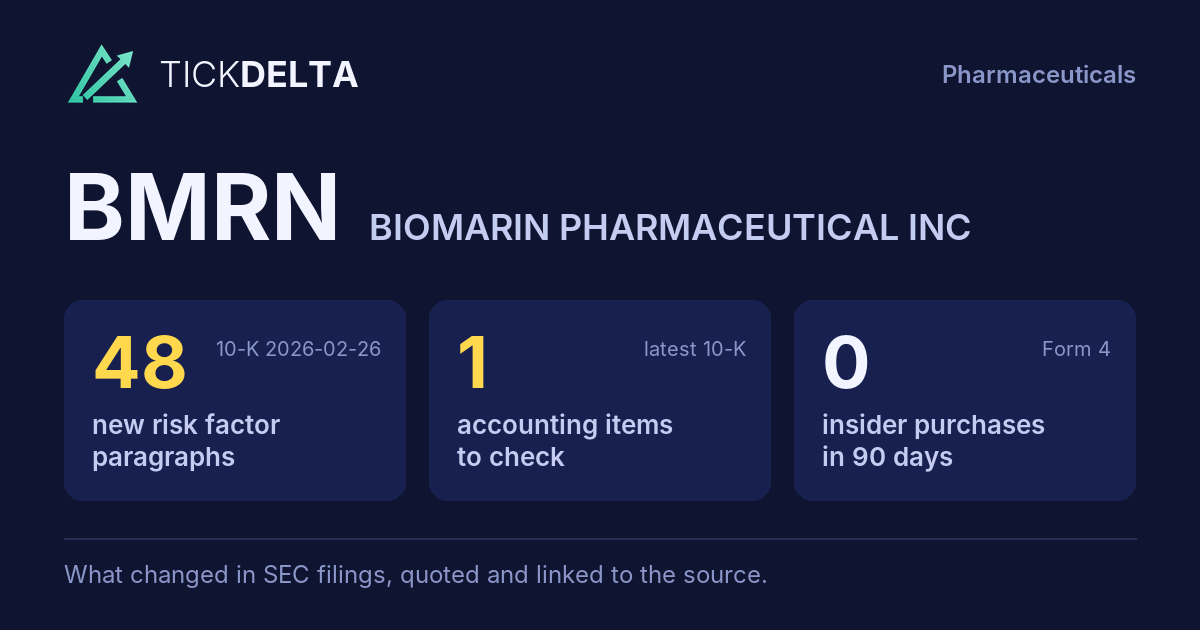
Biomarin Pharmaceutical Inc BMRN

Compare with peers Embed
SEC comment letters, last 20 years

4 reviews of BMRN's filings by SEC staff

UPLOAD and CORRESP
Reviews 4 latest letter Aug 31, 2024
Questions asked 5 each answered in the company's own letter
No closing letter 0 reviews without a letter saying the staff completed it

When the SEC's staff reviews a filing, it writes to the company with numbered questions, and the company answers each one in a letter. SEC publishes the exchange once the review is over, at least 20 business days later. A question is not an accusation; most reviews end with the company adding detail to its next filing.

How the reviews went

Every review on EDGAR, from the first staff letter to the letter that closes it

  1. 1. Staff letters 5 UPLOAD
  2. 2. Questions in them 5 numbered comments
  3. 3. Company replies 5 CORRESP
  4. 4. Reviews closed 4 of 4 closing letter

Half the closed reviews took 33 days or less from the first letter to the closing letter.

Form 10-K for the fiscal year ended December 31, 2023

2024-08-31 to 2024-10-03 · 1 question · 1 letter from the SEC, 1 from the company
Review closed 2024-10-03
SEC asked
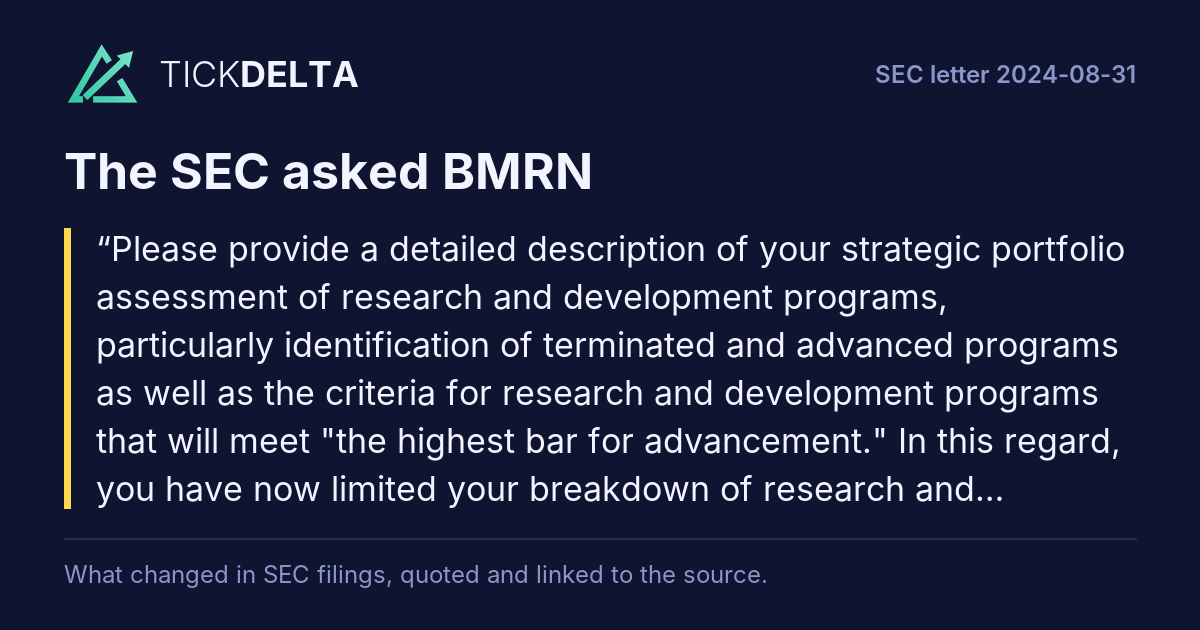
Please provide a detailed description of your strategic portfolio assessment of research and development programs, particularly identification of terminated and advanced programs as well as the criteria for research and development programs that will meet "the highest bar for advancement." In this regard, you have now limited your breakdown of research and development expense to three broad categories in lieu of a
Rest of the question

detailed projectby-project expense breakdown as last provided in your Form 10-Q for the nine months ended September 30, 2023. Explain your basis for removing this information as well as corresponding discussion in the Business section, given the apparent impact of the strategic portfolio assessment on your future research and development activities. Revise your disclosures accordingly.

BMRN answered
Please provide a detailed description of your strategic portfolio assessment of research and development programs, particularly identification of terminated and advanced programs as well as the criteria for research and development programs that will meet “the high bar for advancement.”

The Company periodically evaluates its research and development (R&D) portfolio to determine which programs the Company believes have the strongest combination of scientific merit, opportunity for

105 Digital Drive . Novato, CA 94949 . Tel 415.506.6700 . Fax 415.382.7889 .
Rest of the answer

www.BMRN.com commercial success and potential value creation for stockholders, based on the latest information available to the Company at the time of the assessment. Any programs determined not to have this same level of merit are considered for termination. The assessment is performed on both a program-by-program and overall portfolio basis using consistent financial and portfolio metrics to measure the merits of each asset individually and compare attributes across the portfolio. The financial and portfolio metrics include, but are not limited to:

•global market opportunities;

•competitive landscape and commercial potential;

•net present value and return on investment;

•probability of technical and regulatory success;

•unmet medical need;

•clinical development strategy, costs and timelines;

•manufacturing capabilities and required investment; and

•strategic fit.

The assessment results in recommendations regarding the business opportunity and scientific and technical feasibility for each program. An evaluation committee comprised of the Company’s senior executives and other internal key subject matter experts within the Company, uses the recommendations in a discussion of a program’s merits, risks and opportunities and final determination on continued development or program termination. As a result of their evaluation process, the committee decided to discontinue development of four programs: BMN 255; BMN 331; BMN 355; and BMN 365.

In this regard, you have now limited your breakdown of research and development expense to three broad categories in lieu of the detailed project-by-project expense breakdown provided in your Form 10-Q for the nine months ended September 30, 2023. Explain your basis for removing this information as well as corresponding discussion in the Business section, give the apparent impact of the strategic portfolio assessment on your future research and development activities.

The Company’s decision to revise the R&D expense disclosures within “Management’s Discussion and Analysis of Financial Conditions and Results of Operations” in the Annual Report, was not related to the strategic portfolio review, but rather a concerted effort to provide the readers of our financial statements with more meaningful information.

In preparing its Annual Report, the Company assessed the relative significance of its detailed development program disclosures given the Company’s transition to growing profitability driven by significant revenue growth, the composition of the existing R&D portfolio and evolving corporate strategic priorities. As a result of this assessment, the Company determined that none of its current R&D portfolio programs when considered individually was essential to its business as a whole, nor necessary to the execution of its business strategy and therefore, the presentation of R&D portfolio programs in the Business Section was revised to discuss its R&D portfolio as a whole to avoid projecting undue significance to any one of the programs.

Historically, the product-by-product detail provided the reader insight into our investment in each specific program, the Company recognized that there is not always a direct link between development activities, timing of expense recognition and program progression. As each phase of development carry different risks and value profiles the Company believes the revised presentation along with the related discussion is more meaningful to the reader as it provides a clearer picture of the status of the Company’s development pipeline and the progression of R&D programs through the various development phases in a single location, which the Company believes to be consistent with the disclosure requirements.

Revise your disclosures accordingly.

In response to the Staff’s comment, the Company plans to revise its disclosure in future filings, beginning with its quarterly report on Form 10-Q for the quarter ending September 30, 2024. Using the disclosure in the

Quarterly Report for illustrative purposes, the Company intends to replace its existing disclosure under “Management’s Discussion and Analysis of Financial Condition and Results of Operations —Overview — Recent Developments” with disclosure in substantially the following form:

We continued to grow our commercial business and advance our product candidate pipeline during the first half of 2024. We believe that the combination of our internal research programs and partnerships will allow us to continue to develop and commercialize innovative therapies for people with serious and life-threatening rare diseases and medical conditions.

In the first half of 2024, we focused on value creation through working to accelerate growth, optimize efficiencies and drive operational excellence, including progress in executing on key strategic priorities first outlined in January 2024 accelerating and maximizing VOXZOGO, establishing the ROCTAVIAN opportunity, and focusing R&D activities on the assets management believes will be the most productive and accelerate earnings per share through expanding margins. We also completed a strategic portfolio assessment of R&D programs to determine which we believe have the strongest combination of scientific merit, opportunity for commercial success and potential value creation for stockholders. have the most transformative potential for patients and value creation for shareholders and have shifted focus and resources to those R&D programs that met our highest bar for prioritized advancement. We determined that The programs, namely BMN 333, a long-acting C-type natriuretic peptide for multiple growth disorders, BMN 349, a potential best-in-class, oral therapeutic for liver disease associated with Alpha-1 Antitrypsin Deficiency, and BMN 351, our next generation oligonucleotide for Duchenne Muscular Dystrophy, all met the highest bar criteria for advancement. Based on such strategic portfolio assessment, certain programs have also been discontinued. Further In addition, we initiated the execution of our financial and operational strategy that improved operating results and is expected to continue to improve our results of operations going forward. In August 2024, we announced our ROCTAVIAN strategy, which includes focusing on the United States, Germany, and Italy, where ROCTAVIAN is approved and reimbursed, and reducing additional investments in development and manufacturing, which that we anticipate will enable ROCTAVIAN to contribute to our long-term profitability.

Additionally, in response to the Staff’s comment, the Company plans to revise its disclosure in future filings beginning with its quarterly report on Form 10-Q for the quarter ending September 30, 2024. Using the disclosure in our Quarterly Report for illustrative purposes, the Company intends to replace its existing disclosure under Part I, Item 1 “Notes to Condensed Consolidated Financial Statements (Unaudited) — (10) Restructuring” with disclosure in substantially the following form:

(10) RESTRUCTURING

During the first half of 2024, the Company completed a strategic portfolio assessment of its research and development programs to determine which have it believes have the strongest combination of scientific merit, opportunity for commercial success and the most transformative potential for patients and potential value creation for shareholders stockholders. With the combined focus on patient impact and commercial opportunity, certain programs that met the highest bar for advancement have been prioritized. As a result of the assessment, the Company discontinued certain programs. have been discontinued.

During the second quarter of 2024, in connection with the discontinuation of certain research and development programs and an organizational redesign effort centered around our strategic priorities, including the acceleration and maximization of VOXZOGO, establishing the ROCTAVIAN opportunity, and focusing R&D activities on the assets management believes will be the most productive and accelerate earnings per share through expanding margins, the Company committed to a plan to reduce its global workforce by approximately 170 employees (representing approximately 5% of the Company’s global workforce). Workforce reductions are expected to be substantially completed by end of 2024.

The restructuring plan includes severance and employee-related costs, asset impairments, and other costs. The asset impairment charges were for abandoned assets-in-progress and a Right-of-Use asset (ROU Asset) related to leased office space the Company decided to exit and sub-lease. The Company utilized the discounted cash flow approach to determine the fair value of the ROU Asset. The ROU Asset impairment is the difference between the existing lease terms and rates and the expected sub-lease terms and rates available in the market. The Other category includes restructuring-related costs, which are expensed as incurred, as well as other obligations related to the leased office space that will be satisfied over the remainder of the lease term.

The restructuring charges and adjustments were included in Selling, General, and Administrative in the Condensed Consolidated Statements of Comprehensive Income. Restructuring expenses consisted of the following:

Three Months Ended

June 30,

Six Months Ended

2024 2024

Severance and one-time employee benefits $ 23,837 $ 25,275

Asset Impairments 9,671 9,671

Other 5,519 7,519

$ 39,027 $ 42,465

The following unpaid balance as of June 30, 2024 was recorded to Accounts Payable and Accrued Liabilities on the Condensed Consolidated Balance Sheet:

Severance and related costs Other Total

Balance as of December 31, 2023

$ — $ — $ —

Charges and Adjustments 25,275 7,519 32,793

Payments (4,321) (2,000) (6,321)

Balance as of June 30, 2024

$ 20,954 $ 5,519 $ 26,472

The Company respectfully requests the Staff’s assistance in completing the review of this response letter at its earliest convenience. Please advise us if we can provide any further information or assistance to facilitate your review. Please direct any further comments or questions regarding this response to the undersigned or Brian R. Mueller, Chief Financial Officer at (415) 506-6700 or to Jodie Bourdet, Cooley LLP at (415) 693-2054 or Julia Boesch, Cooley LLP at (415) 693-2326.
Read in the reply

Also in this review: closing letter, 2024-10-03
Form 10-K for the Year Ended December 31, 2022

2023-03-30 to 2023-04-10 · 1 question · 1 letter from the SEC, 1 from the company
Review closed 2023-04-10
Non-GAAP measures
After reviewing your response to the comment, we may have additional comments. Exhibit 99.1 · Non-GAAP Information, page 11
SEC asked
Please tell us why you believe your Reconciliation of Certain GAAP Reported Information to Non-GAAP Information on page 11 is consistent with C&DI 102.10(a) through (c) or confirm how you will revise the presentation in future filings.
Rest of the question

In closing, we remind you that the company and its management are responsible for the accuracy and adequacy of their disclosures, notwithstanding any review, comments, action or absence of action by the staff.

BMRN answered
The Company acknowledges the Staff’s comment and confirms the Company will revise its Reconciliation of Certain GAAP Reported Information to Non-GAAP Information in future filings to comply with Question 102.10 of the Commission’s Non-GAAP Financial Measures Compliance and Disclosure Interpretations (C&DI).
Rest of the answer

We have historically provided the reconciliation of Non-GAAP financial measures in the form included on page 11 of the February Press Release because we believed it was useful to investors and did not violate the equal or greater prominence requirement, but we acknowledge the Staff’s comment with respect to the updated guidance published in December of 2022 and, in order to address the concerns raised by the Staff, in future earnings press releases the Company will replace in its entirety the current form of the table and reconciliation of Non-GAAP financial measures previously included on pages 10 and 11, respectively of the February Press Release with the reconciliation of Non-GAAP financial measures as substantially reflected in the attached Exhibit A.

Read in the reply
In its next report

First report after the company's reply of Apr 6, 2023: 10-Q filed Apr 28, 2023 ↗, against the 10-Q filed Oct 28, 2022 ↗.

Tickdelta does not hold the text of both reports, so they are not compared here.

Also in this review: closing letter, 2023-04-10

Form 10-K for the fiscal year ended December 31, 2020

2021-12-07 to 2022-03-29 · 2 questions · 2 letters from the SEC, 2 from the company
Review closed 2022-03-29
Results discussion (MD&A)RevenueIncome taxes
SEC asked
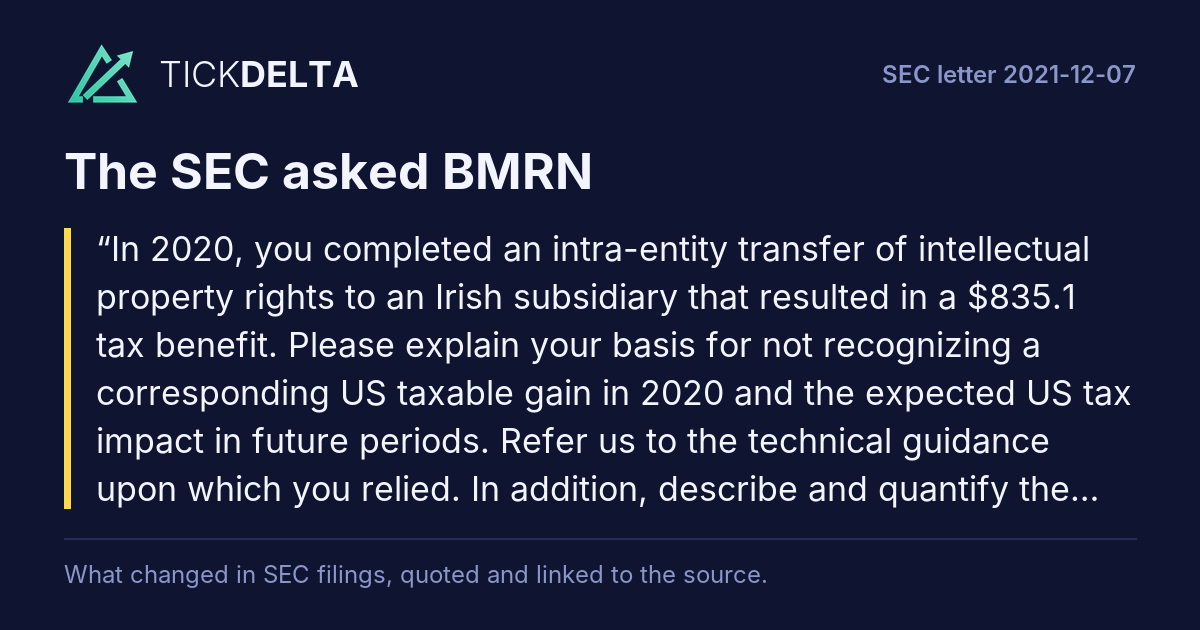
In 2020, you completed an intra-entity transfer of intellectual property rights to an Irish subsidiary that resulted in a $835.1 tax benefit. Please explain your basis for not recognizing a corresponding US taxable gain in 2020 and the expected US tax impact in future periods. Refer us to the technical guidance upon which you relied.
Rest of the question

In addition, describe and quantify the methods and key assumptions used to determine the fair value of these transferred intellectual property rights. Revise your disclosures accordingly.

BMRN answered
Please explain your basis for not recognizing a corresponding US taxable gain in 2020 and the expected US tax impact in future periods. Refer us to the technical guidance upon which you relied.

The transaction was an intra-entity transfer of intellectual property (IP) rights from a wholly owned foreign subsidiary to its wholly owned Irish subsidiary completed in the third quarter of 2020. The foreign subsidiary is a controlled foreign corporation (CFC) for United States (U.S.) corporate income tax purposes. The Irish subsidiary is a disregarded entity (DRE) for U.S.
Rest of the answer

corporate income tax purposes, and therefore its assets, liabilities, income and deductions are treated as belonging to its owner. As a result, the intra-entity IP transfer from the CFC to its Irish DRE is disregarded for U.S. tax purposes and as such, there was no taxable gain in 2020 and no tax basis in the IP for U.S. corporate income tax purposes.

Accordingly, the transaction has no impact on the Company’s U.S. taxes in future periods. For Irish corporate income tax purposes, the IP tax basis will give rise to amortization that will reduce the Irish subsidiary’s future Irish taxable income. This, in turn, will reduce the future amount of creditable foreign taxes, and therefore there is a potential indirect impact to the U.S. Global Intangible Low-taxed Income (GILTI) calculation resulting from the Irish tax deduction and corresponding foreign tax credit. As we have elected to treat GILTI as a period cost, there is no corresponding deferred tax impact to the U.S. federal income tax calculation.

105 Digital Drive . Novato, CA 94949 . Tel 415.506.6700 . Fax 415.382.7889 . www.BMRN.com

The guidance we relied upon is Accounting Standards Codification (ASC) 740-10-25-2, which provides that an entity must recognize deferred tax assets and deferred tax liabilities for taxable or deductible temporary difference unless an exception applies. ASC 740-10-20 defines a temporary difference as “a difference between the tax basis of an asset or liability computed pursuant to the requirements in Subtopic 740-10 for tax positions, and its reported amount in the financial statements that will result in taxable or deductible amounts in future years when the reported amount of the asset or liability is recovered or settled, respectively.” As this transaction relates to the transfer of IP and not inventory, the exception in ASC 740-10-25-3(e) does not apply. The IP transferred are internally developed intangible assets, with a cost basis of zero in the consolidated financial statements with a tax basis equal to the fair value at the time of the intra-entity transaction resulting in a deferred tax asset of $835.1 million. Therefore, we recorded a deferred tax asset pursuant to ASC 740-10-25-2. Additionally, ASC 740-10-30-5(e) requires that deferred tax assets be reduced “by a valuation allowance if, based on the weight of available evidence, it is more likely than not (a likelihood of more than 50 percent) that some portion or all of the deferred tax assets will not be realized.” Pursuant to ASC 740-10-30-23, the weight given to positive and negative evidence should be commensurate with the extent to which it can be objectively verified. Expected realization of deferred tax assets must meet the more-likely-than-not standard to be recorded in the financial statements without a valuation allowance. We determined that there was sufficient positive evidence that the Irish subsidiary would more-likely-than-not realize the benefit of the deferred tax asset associated with the IP, and therefore no valuation allowance was recorded.

In addition, describe and quantify the methods and key assumptions used to determine the fair value of these transferred intellectual property rights.

We engaged third party experts to assist the Company in determining the fair value of the transferred intellectual property rights using the income approach specified in the Organisation for Economic Co-operation and Development (OECD) Transfer Pricing Guidelines for Multinational Enterprises and Tax Administrations 2017. The key assumptions in the valuation included probability adjusted product-specific revenue projections, selection of appropriate discount rates, the determination of the terminal value for each product depending on molecule type, long term market potential, competitive factors and revenue and profit trends. The projections utilized in the valuation were also used for group planning purposes, including strategic planning, product pricing, tax and accounting purposes. We also considered comparable transactions in the marketplace to generate arm’s length royalty charges for existing license agreements. Given the various model parameters, the Company then selected the median value in that resulting interquartile range.

Revise your disclosures accordingly.

Additionally, in response to Staff’s comment, we propose to include the following disclosure in our notes to financial statements for our annual report on Form 10-K for the year ended December 31, 2021 expected to be filed with the SEC in February 2022.

“In the third quarter of 2020, the Company completed an intra-entity transfer of certain intellectual property rights from a wholly owned foreign corporation to its wholly owned Irish subsidiary. The rights were transferred to the Company’s Irish subsidiary where its ex-U.S. regional headquarters are located and has significant manufacturing and commercial operations, to better align ownership of intellectual property rights with how the business operates. The intra-entity transfer did not result in a taxable gain in 2020 in any jurisdiction including the U.S. as the transaction was disregarded for U.S. tax purposes. The transaction did create a step-up in the tax basis in the transferred intellectual property rights and the Company’s Irish subsidiary recognized a deferred tax asset for the book and tax basis difference of the transferred intellectual property rights. As a result, the Company recognized a deferred tax asset of $835.1 million and related tax benefit on its Consolidated Financial Statements based on the fair value of the transferred intellectual property rights. The fair value of the transferred intellectual property rights was determined utilizing the income approach which relied on projections of product-specific revenues and the inclusion or exclusion of a terminal value for each product.

The tax deductions related to the amortization of these transferred intellectual property rights will be recognized in the future and any amortization not deducted for tax purposes will be carried forward indefinitely under Irish tax laws. The Company expects to be able to realize the deferred tax asset resulting from this transaction and has not recorded a valuation allowance as of December 31, 2020.”

Read in the reply
SEC asked
We acknowledge the information provided in your response but continue to have difficulty in understanding the basis for your accounting treatment. Please provide us the following information. • Describe the nature of intellectual property rights transferred to your Irish subsidiary, the products and manufacturing processes that they support and the consideration paid by your Irish subsidiary for the transferred
Rest of the question

intellectual property. • Explain how these intellectual property rights now align with your manufacturing and commercial operations domiciled in Ireland and describe the specific benefits resulting from these rights subsequent to their transfer to your Irish subsidiary that were not previously available. • Describe legislative changes and effective dates for Irish tax law, governing the transfer of these rights and supporting your recognition of the $835.1 million tax benefit and your conclusion that a valuation allowance was not necessary. • Identify the "owner" of your Irish subsidiary, which is a Disregarded Entity for US tax purposes but also a wholly-owned subsidiary. Given this apparent inconsistency, explain your basis for disregarding this transfer of intellectual property for US tax reporting purposes. • Quantify the interquartile range for your valuation of intellectual property rights transferred to the Irish subsidiary. Include a description and quantification of key assumptions, including associated products, projected revenue and profit by product, number of years constituting "long term market potential," discount rates, competitive factors and royalty charges by license agreement.

BMRN answered
•

Describe the nature of intellectual property rights transferred to your Irish subsidiary, the products and manufacturing processes that they support, and the consideration paid by your Irish subsidiary for the transferred intellectual property.

On September 30, 2020, our Irish subsidiary, BioMarin International Ltd. (“BIL”) purchased from our subsidiary, BioMarin

Commercial Ltd.
Rest of the answer

(“BCL”), substantially all of the intellectual property (“IP”) rights associated with the research, development, manufacture and commercialization of five pharmaceutical products—Brineura, Kuvan, Palynziq,

Vimizim, and Voxzogo (fka vosoritide)—for a purchase price of $[***] billion. The consideration was based on the full fair market value of the IP on the date of transfer. The IP acquired essentially entitled BIL to control and enjoy the global benefits of the research and development, manufacturing and commercialization of the four approved pharmaceutical products plus Voxzogo which was subsequently approved in 2021. Such rights specifically included patents, patent applications and invention disclosures, trademarks, copyrights and copyrightable works in any technical information or data, research and development information, manufacturing and operating information, process characterization data, technical scientific and medical information, ideas, trade secrets, confidential information, proprietary techniques, business models, processes, methods, applications, disclosures, design rights, unpublished research and development information, manufacturing and operating information, technical data, process characterization data, technical scientific and medical information, knowledge, know-how, and inventions.

Explain how these intellectual property rights now align with your manufacturing and commercial operations domiciled in Ireland and describe the specific benefits resulting from these rights subsequent to their transfer to your Irish subsidiary that were not previously available.

We are a global biotechnology company that develops and commercializes innovative therapies for people with serious and life-threatening rare diseases and medical conditions. Our products help to address unmet medical needs around the world. Most of our global revenues are outside of the United States (“US”), led by sales in our European market. Therefore, it was natural to align our manufacturing and commercial operations to be in the same geographic regions and time zones as our customers and patients. A large component of this alignment was the purchase of a manufacturing facility in Ireland in 2011, which began commercial manufacturing in 2014. Our regional commercial office in Ireland opened in 2013 and houses substantial executive leadership and respective support operations. Prior to the purchase of the IP, BIL had licensed the manufacturing and distribution rights from BCL to the IP relating to the above five products. Under this structure, BIL was guaranteed a limited risk distribution margin pursuant to the license arrangement.

By 2020, BIL had the infrastructure and skills considered necessary to manage the economic risks associated with the monetization of IP and could maximize the future profits associated with these products. BIL had built a commercial team, fully staffed manufacturing facility, distribution channel and supply chain operation. The management team had become more experienced in the launch and commercialization of our products. With the alignment of the IP ownership BIL can earn higher margins commensurate with the additional risks it now bears. Further, by consolidating the IP into BIL, it created operational efficiencies by eliminating a separate management and control structure for BCL with respect to the five products for which the IP relates.

Describe the legislative changes and effective dates for Irish tax law, governing the transfer of these rights and supporting your recognition of the $835.1 million tax benefit and your conclusion that a valuation allowance was not necessary.

confidential information contained in this document, marked by bracketed asterisks, has been omitted and filed separately with the

Commission pursuant to 17 C.F.R. § 200.83.

At the time of the transaction, BCL was a company incorporated in Ireland but not subject to

Irish taxation because its management and control were located in the Bahamas. Instead of being subject to Irish taxation, BIL’s tax residency was in the Bahamas as a “non-resident” Irish corporation. Under the 2014 Ireland Finance Act, Ireland eliminated this “non-resident” structure with delayed effective dates described below, and provided that, upon the effective date of the change, a company incorporated in Ireland would be treated as resident in Ireland for tax purposes unless it is resident in a country with which Ireland has a double taxation treaty. For companies incorporated before January 1, 2015, the law included a grandfather period of five years with the effective date of the change January 1, 2021. Because BCL was incorporated prior to January 1, 2015 and Ireland does not have a double taxation agreement with the Bahamas, BCL was set to be treated as a resident Irish corporation beginning January 1, 2021. The Company transferred the IP in 2020 before the effective date of the law change. If BCL had not sold the IP to BIL, BCL would have been subject to Irish tax, or if the transaction had not occurred before January 1, 2021, the transaction would have been subject to Irish tax.

The law change did not create a deferred tax asset. BIL purchased the IP assets, thus creating amortizable tax basis in IP under existing and longstanding Irish tax law. The IP transferred were internally developed intangible assets, with a cost basis of zero in the consolidated financial statements of the Company and with a tax basis equal to the fair value at the time of the intra-entity transaction resulting in a deferred tax asset of $835.1 million. Therefore, we recorded a deferred tax asset pursuant to ASC 740-10-25-2 and

740-10-30-5(c). The transfer of the IP rights gave rise to tax basis equal to the value of the IP, $[***] billion, pursuant to

Irish tax law. The IP can be amortized over 15 years and the amortization is deductible. For Irish income tax purposes, net operating losses can be carried forward indefinitely.

ASC 740-10-30-5(e) requires that deferred tax assets be reduced “by a valuation allowance if, based on the weight of available evidence, it is more likely than not (a likelihood of more than 50 percent) that some portion or all of the deferred tax assets will not be realized.” The guidance requires an analysis of the positive and negative evidence and cumulative income is very strong positive evidence to support not setting up a valuation allowance. As of December 31, 2020, BIL was in a cumulative income position (we note that there is no discontinued operations and other comprehensive income or loss and immaterial permanent differences for the periods included in the analysis) of approximately $[***] million for the prior three-year period, or an average annual pretax income of approximately $[***] million. As discussed below, we have also provided BIL’s income combined with BCL’s income for the same period, as Pro-forma Adjusted

Income, which shows a cumulative income position of approximately $[***] million for the prior three-year period, or an average annual pretax income of $[***] million as follows:

YEAR

BIL Income

Pro-forma Adjusted

Income

2018

$[***]

2019

2020

Total

Average

BIL’s standalone cumulative income during this period was based on its limited risk distribution functions. This analysis is not complete because it does not reflect how BIL will operate in the future because the IP and its related income was not in BIL before the transfer. Accordingly, the Company believes that for the historical results to be representative of what the historical results would have been had the IP always been in BIL, pro-forma adjustments should be made to the historical amounts to include the earnings of the IP while it was held by BCL.

Based on the table above, the Company determined that BIL, on a standalone and adjusted basis, does not have a

“cumulative loss in recent years”. We also considered other examples of negative evidence included in ASC 740-10-30-21 and determined that none applies to BIL: a history of operating losses or tax credit carryforward expiring unused; losses expected in early future years; unsettled circumstances that, if unfavorably resolved, would adversely affect future operations and profit levels on a continuing basis in future years; and a carryback, carryforward period that is so brief that it would limit realization of tax benefits if a significant deductible temporary difference is expected to reverse in a single year or the entity operates in a traditionally cyclical business. Accordingly, we concluded that there was no negative evidence as related to BIL.

Because BIL has positive cumulative earnings, ASC 740-10-30-18 allows the use of future taxable income to support the deferred tax asset. The projected total average annual future profit of BIL was $[***] million based on the valuation report as of the purchase date on September 30, 2020. The projected annual future profit of $[***] million was larger than the Pro-forma Adjusted Income of $[***] million due to several factors. The Pro-forma Adjusted Income was more conservative because it did not fully account for future revenue and profit from Voxzogo, which had not yet been approved, or projected increasing revenue and profit from Vimizim,

Palynziq and Brineura. In particular, we had only recently launched Brineura and Palynziq and expected to launch Voxzogo, subsequently approved in 2021, which we believed would result in significant additional revenue in the future. For example, our largest product in the transfer, Vimizim, had a solid financial result since launch. It continued to grow annually, unfettered by competition in the niche MPS market, bolstered by a first mover advantage as well as complex manufacturing requirements that present high barriers to entry for any competitor. Brineura and Palynziq were recently launched large molecule products. As such, there was an anticipated ramp up period inherent for the products, and afterwards we anticipated [***] growth within the next five years. All three products are considered large molecules and we anticipated these products would enjoy a longer life cycle. In addition, we believed that Voxzogo, once approved, would enjoy a significant uplift of revenue and profit in the launch years. If this projection was used, then BIL would not have any net operating losses and the tax amortization of the IP would be realized as it was expected to reduce future income as the deductions are taken on the tax return.

However, we acknowledge that this projection still includes growth rates and other assumptions that were based on management’s judgment. See response to bullet number 5, “Quantify the interquartile range for your valuation of intellectual property rights transferred to the Irish subsidiary. Include a description and quantification of key assumptions, including associated products, projected revenue and profit by product, number of years constituting “long term market potential,” discount rates, competitive factors and royalty charges by license agreement.” for further discussion on molecule types and anticipated competition under the headings “Financial Projections” and

“Valuation Horizon and Competitive Factors.”

Based on above analysis, management concluded that a valuation allowance was not required for the Irish deferred tax asset related to the transferred IP as of December 31, 2020.

Identify the “owner” of your Irish subsidiary, which is a Disregarded Entity for US tax purposes but also a wholly owned subsidiary. Given this apparent inconsistency, explain your basis for disregarding this transfer of intellectual property for US tax reporting purposes.

BioMarin Pharmaceutical Inc. (“BPI”) is a US corporation, incorporated in Delaware. BPI owned 100% of the stock of BCL at the time of the transaction and continues to own 100% today. For US tax purposes, BCL is treated as a controlled foreign corporation. BCL owns 100% of the stock of BIL, an Irish corporation.

For US tax purposes, a corporation can make an election to treat certain foreign legal entities as “disregarded”, solely for US tax purposes. When an entity is disregarded for US tax purposes, its assets, liabilities, income and deductions are treated as belonging to its owner (i.e., intra-entity transactions are not taxable for US purposes under this election). BPI filed the election in 2011 for BIL to be disregarded for US income tax purposes. Accordingly, BIL is both wholly-owned and disregarded for tax purposes, whereby the assets and liabilities of BIL are treated as belonging to BCL and any transactions between BCL and BIL are disregarded for US income tax purposes. This is the reason why this transaction did not result in any tax consequences for US tax purposes. If the Company had not elected to treat BIL as a disregarded entity for US income tax purposes, the transfer of the IP from BCL to BIL would be regarded for US income tax purposes and any gain on the IP transfer would have been subject to US tax.

Quantify the interquartile range for your valuation of intellectual property rights transferred to the Irish subsidiary. Include a description and quantification of key assumptions, including associated products, projected revenue and profit by product, number of years constituting “long term market potential,” discount rates, competitive factors and royalty charges by license agreement.

I.

Interquartile range of IP Values

The interquartile range of aggregate IP values extends from $[***] billion to $[***] billion, with a median of $[***] billion. The Company selected the median value.

II.

Description and quantification of key assumptions

The key assumptions considered in the valuation were as follows:

Read in the reply

Also in this review: closing letter, 2022-03-29

Form 10-K

2017-04-28 to 2017-05-25 · 1 question · 1 letter from the SEC, 1 from the company
Review closed 2017-05-25
Results discussion (MD&A)Goodwill and impairmentAcquisitions
Management’s Discussion and Analysis of Financial Condition and Results of Operations · Impairment of Long-Lived Assets, page 61
SEC asked
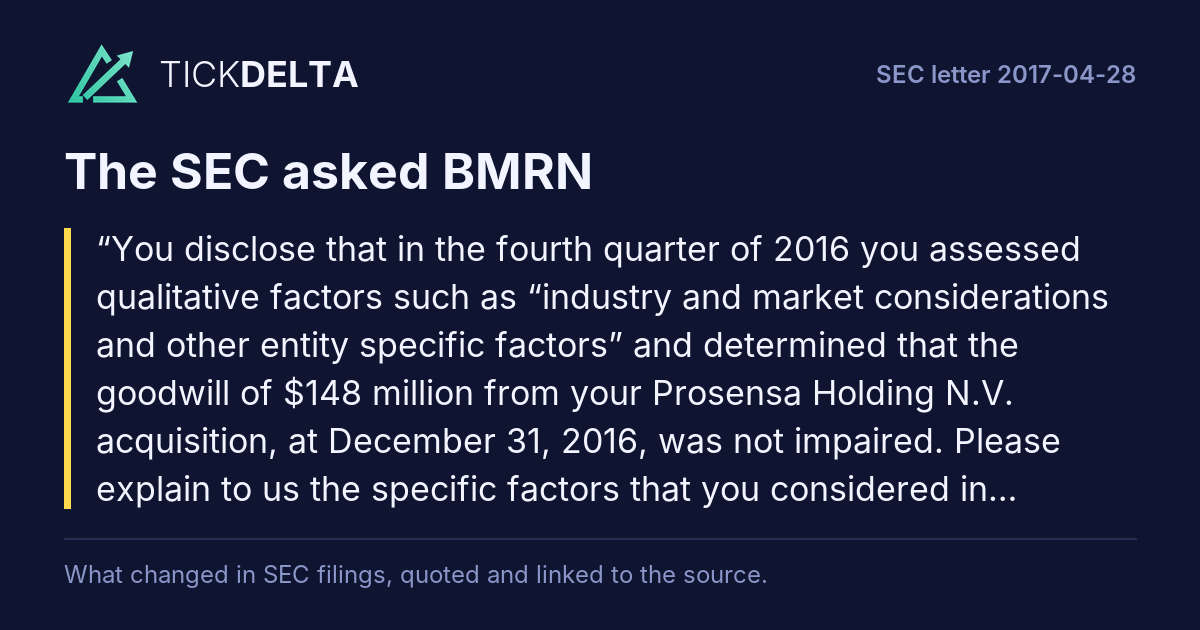
You disclose that in the fourth quarter of 2016 you assessed qualitative factors such as “industry and market considerations and other entity specific factors” and determined that the goodwill of $148 million from your Prosensa Holding N.V. acquisition, at December 31, 2016, was not impaired.
Rest of the question

Please explain to us the specific factors that you considered in reaching this conclusion and specifically how the $599.1 million impairment charge recognized in the 2nd Quarter 2016 related to IPR&D acquired with the Prosensa acquisition impacted your assessment. Further, please explain how you considered the guidance in ASC 350-20-35-33 through 35-38 in identifying only a single reporting unit for purposes of your goodwill impairment testing.

BMRN answered
The Company confirms to the Staff that it has a single reporting unit for the development and commercialization of innovative biopharmaceutical therapies. Upon an acquisition and related purchase price allocation, the Company records goodwill to its existing reporting unit. Our management team assesses whether our reporting unit should change if there are changes to the business and any internal or external reporting or management changes that result in discrete financial information being available and reviewed by the chief decision maker.

105 Digital Drive . Novato, CA 94949 .
Rest of the answer

Tel 415.506.6700 . Fax 415.382.7889 . www.BMRN.com

As further discussed below, we have identified one reporting unit consistent with the guidance of the Financial Accounting Standards Board’s Accounting Standards Codification (ASC) 350-20-35. Accordingly, in performing our annual impairment review, goodwill is analyzed as a whole at the entity level. Using that analysis, as discussed below, we determined that, based on the significant fair value of the Company’s market capitalization as compared to goodwill as of June 30, 2016 and December 31, 2016, goodwill was not impaired.

Single Reporting Unit Determination

In evaluating whether the Company has more than one reporting unit, our management team focused on the guidance in ASC 280-10-50-1a–c, which outlines the following characteristics of operating segments:

a.

It engages in business activities from which it may earn revenues and incur expenses;

b.

Its operating results are regularly reviewed by the Company’s chief operating decision maker to make decisions about the allocation of resources and to assess its performance;

c.

Its discrete financial information is available.

The Company’s sole business activities include the development and commercialization of innovative therapies for people with serious and life-threatening rare diseases and medical conditions, which primarily include revenues earned from the Company’s commercial products and expenses incurred to support the Company’s manufacturing, development and commercialization activities and general and administrative support. The allocation of resources results from the Company’s annual budgeting and periodic forecasting processes. Our management team generates budget drivers based on the Company’s overall corporate goals, milestones to achieve the goals and estimated time for completion. The budget drivers are used to estimate costs and create a consolidated budget that allocates resources to research and development activities, manufacturing, sales and marketing and general and administrative support for all of the Company’s business activities. Ultimately, the Company’s annual operating plan and budget for its single operating segment and reporting unit are approved by the Company’s Chief Executive Officer (CEO) and Board of Directors (Board). Once the Company’s annual operating plan is approved, performance targets are developed for the Company’s corporate bonus plan. The key performance targets typically include company–wide revenue and operating expense targets as well as potential regulatory milestones of the Company, such as the commencement of a clinical trial, the submission of filings to regulatory agencies or new product approvals. The corporate bonus plan is approved by the Company’s Board. In addition to participating in the corporate bonus plan, executive officers also may receive performance based equity awards which are earned based on achieving defined revenue targets for the Company’s commercial products.

Although the budget drivers for individual development programs and products are developed by various members of management, the Company’s CEO has the ultimate decision making power as to how the Company’s resources are allocated, and the CEO does this on the basis of a single consolidated business. The Company’s commercial, manufacturing, research and development and selling, general and administration operations all contribute to the Company’s commercial product and research and development programs and these functions are managed as a single operational unit for which resources are moved among these operating activities based on the Company’s goals. There is no review of discrete financial information, fiscal responsibility or decision authority at these lower functional management levels below the Company’s CEO.

The CEO receives financial results on a monthly basis consisting of comparative balance sheets, statements of operations, revenues by product and detailed operating expenses, all of which are prepared at the consolidated level. The CEO also receives financial results on a quarterly basis consisting of a quarterly financial results package and a forecast for the remainder of the fiscal year. The quarterly financial results package is also prepared at the consolidated level and includes highlights of significant development programs and commercial net products sales results, as well as key drivers of consolidated financial and operating performance. Based on the CEO’s review of the business and finances of the Company at the consolidated level, management has concluded that the CEO is the Company’s Chief Decision Maker. Resource allocations are not reviewed at a level lower than the Company’s global consolidated business.

No Goodwill Impairment at Operating Unit

Management’s reviews for impairment during 2016 were based on qualitative factors, including those described in ASC 350-20-35-3a through 35-3g, applied to goodwill at the entity level. Management identified no macroeconomic conditions or industry or market considerations, and no cost factors, financial performance or other entity specific events that indicated that our goodwill was impaired. Because the Company evaluates goodwill for impairment at its single consolidated entity level, the Company compares the carrying value of its single reporting unit, including goodwill, to the total fair value of the reporting unit, as evidenced by the Company’s market capitalization. The carrying value of our single reporting unit was $2.8 billion, compared to our market capitalization of $14.3 billion as of December 31, 2016. As of June 30, 2016, the Company’s market capitalization was $13.5 billion, compared to the carrying value of our single reporting unit of $1.9 billion, subsequent to when the acquired Prosensa Holding N.V. (Prosensa) intangible assets were fully impaired. Specifically considering the $599.1 million impairment of intangible assets recognized during the three months ended June 30, 2016, which included both the Prosensa intangible assets and the termination of the Company’s cerliponase alfa development program, the Company experienced a decrease in its market valuation resulting from the abandonment of those programs; however, based on the significant fair value of the Company’s market capitalization as compared to the carrying value of its single reporting unit as of June 30, 2016 and December 31, 2016, the Company determined that goodwill was not impaired.

The Company respectfully requests the Staff’s assistance in completing the review of this response letter at its earliest convenience. Please advise us if we can provide any further information or assistance to facilitate your review. Please direct any further comments or questions regarding this response to the undersigned at (415) 506-6700 or to Jodie Bourdet, Cooley LLP, (415) 693-2054.

Read in the reply
In its next report

First report after the company's reply of May 2, 2017: 10-Q filed May 4, 2017 ↗.

No earlier 10-Q before the SEC's letter is in Tickdelta, so there is nothing to compare with.

Also in this review: closing letter, 2017-05-25

Letters without questions

Other letters

UPLOAD and CORRESP
1 other letter: notices that a filing will not be reviewed, requests to declare a registration effective, and the like
  • Jun 13, 2025 · BMRN: letter to the SEC · BioMarin Pharmaceutical Inc. · Inozyme Pharma, Inc. · Schedule TO-T · Filed June 2,...

From the SEC's correspondence on EDGAR: staff letters (form UPLOAD) and company letters (form CORRESP), 15 letters filed since 2017-04-28. Questions and answers are matched by their numbers; topics come from words in each question. The reports are compared word for word (same form, before the first SEC letter against the first report after the company's reply). No AI.

Sources

The SEC's correspondence on EDGAR: staff letters (form UPLOAD) and company letters (form CORRESP), matched question by question. No AI.

Also

Filings: the letters in the filing list.

Work with it

Excel workbook · CSV. Google Sheet that stays up to date: paste =IMPORTDATA("https://tickdelta.com/company/BMRN/export.csv") into a cell.

Next in Owners and insiders:Insider trades
Esc

Type a ticker such as AAPL, a name, an investor such as Buffett, or a topic such as tariffs. ↑ ↓ to move, Enter to open.