Screener / SEC EDGAR /CIK 0001424182 /10-K filed Feb 19, 2026, compared with Feb 20, 2025 /Numbers from the XBRL of the 10-Ks
NYSE Real estate · REIT

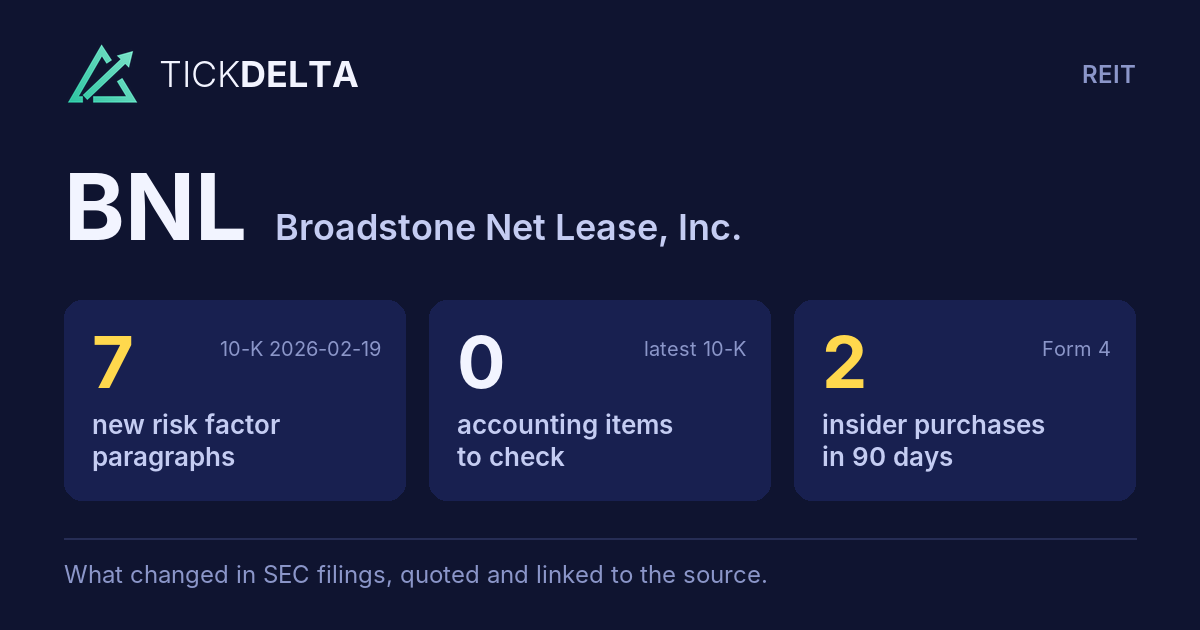
Broadstone Net Lease, Inc. BNL

Compare with peers Embed
SEC comment letters, last 20 years

4 reviews of BNL's filings by SEC staff

UPLOAD and CORRESP
Reviews 4 latest letter May 29, 2024
Questions asked 33 each answered in the company's own letter
No closing letter 1 reviews without a letter saying the staff completed it

When the SEC's staff reviews a filing, it writes to the company with numbered questions, and the company answers each one in a letter. SEC publishes the exchange once the review is over, at least 20 business days later. A question is not an accusation; most reviews end with the company adding detail to its next filing.

How the reviews went

Every review on EDGAR, from the first staff letter to the letter that closes it

  1. 1. Staff letters 5 UPLOAD
  2. 2. Questions in them 33 numbered comments
  3. 3. Company replies 4 CORRESP
  4. 4. Reviews closed 3 of 4 closing letter

Half the closed reviews took 22 days or less from the first letter to the closing letter.

Form 10-K for the year ended December 31, 2023

2024-05-29 to 2024-06-12 · 1 question · 1 letter from the SEC, 1 from the company
Review closed 2024-06-12
Results discussion (MD&A)Liquidity and cashLeases
Management's Discussion and Analysis of Financial Condition and Results of Operations, page
SEC asked
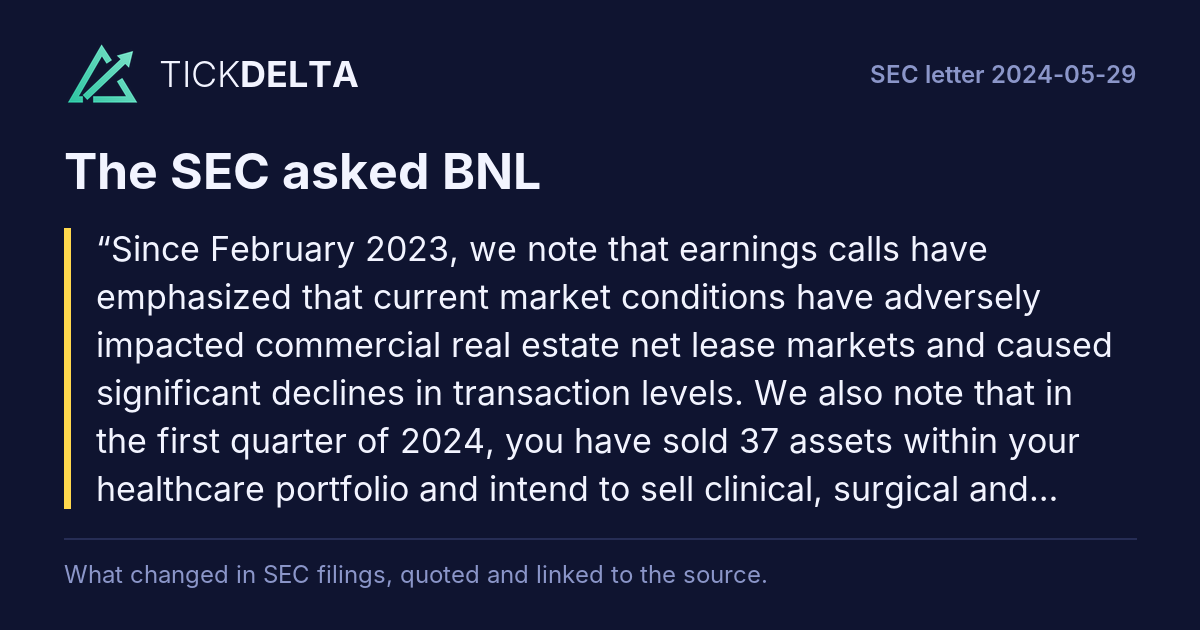
Since February 2023, we note that earnings calls have emphasized that current market conditions have adversely impacted commercial real estate net lease markets and caused significant declines in transaction levels.
Rest of the question

We also note that in the first quarter of 2024, you have sold 37 assets within your healthcare portfolio and intend to sell clinical, surgical and traditional medical office building properties, which has not always fit well within the traditional net lease framework, so that you can focus more intently on industrial space and your other core investment verticals of retail and restaurant assets. Please tell us and revise future disclosures to provide more robust discussion related to known trends or uncertainties that are reasonably likely to have a material impact on your cash flows, liquidity, capital resources, cash requirements, financial position, or results of operations related to conditions in the market or your specific strategies within your Management’s Discussion and Analysis of Financial Condition and Results of Operations. Reference is made to Item 303 of Regulation S-K.

BNL answered
to the Staff’s comment, we have provided the below disclosure that we intend to include in our Quarterly Report on Form 10-Q for the quarter ending June 30, 2024 and will undertake to include similar disclosure in future filings as appropriate.

Current Macroeconomic Conditions and Strategic Priorities

Over the last two fiscal years, challenging macroeconomic conditions directly impacted the broader commercial real estate market and, in particular, the net lease real estate market.
Rest of the answer

During the latter half of fiscal 2022, interest rates began to rise steadily and persisted through fiscal 2023, resulting in a challenging lending environment and a material increase in the cost of capital for commercial real estate buyers and lenders. The increase in interest rates accelerated at a more aggressive pace than commercial real estate capitalization rates, thereby compressing earnings on new investments.

More recently, market expectations about expansionary monetary policy resulted in net lease real estate sellers maintaining higher pricing expectations, which ultimately led to a significant decrease in transaction volumes during the latter half of

2023 and into 2024. These challenging macroeconomic conditions have limited and may continue to limit the ability of commercial real estate owners, including us, to complete real estate acquisitions at volume and accretion levels consistent with prior years, resulting in lower earnings growth rates compared to historical periods.

Notwithstanding the challenging macroeconomic conditions, we believe that our portfolio performance and strong liquidity profile position our company well for future opportunities. We expect to achieve short-term organic growth in revenues and earnings through rent escalations associated with existing in-place leases, together with growth in long-term value resulting from accretive property investments. In addition, as part of our prudent portfolio management, on

February 21, 2024, we announced the strategic decision to sell our clinically-oriented healthcare properties as part of our healthcare portfolio simplification strategy. Our decision to sell these assets was in part due to our review of our investment pipeline and expectation that we would fully redeploy the proceeds into our core investment verticals of industrial, retail, and restaurant assets without diluting our per share results. Since then, we have sold 38 healthcare properties for gross proceeds of $262.2 million, accounting for approximately 50% of the assets we have identified for disposition as part of our healthcare portfolio simplification strategy.

To date, we have successfully redeployed all of the proceeds from the dispositions of our clinically-oriented healthcare properties. As a result of actual and planned sales from our healthcare portfolio simplification strategy, we have recognized a $61.9 million gain on sale of real estate and incurred $56.2 million of impairment charges. Outside of gains on sale of real estate and impairments, we do not expect our healthcare portfolio simplification strategy to materially impact our results of operations or financial position.

Going forward, we will continue to actively monitor macroeconomic conditions as they evolve and evaluate different opportunities to achieve growth and maximize the performance of our portfolio in order to do what we believe is in the best interests of our shareholders.

Read in the reply
In its next report

First report after the company's reply of Jun 11, 2024: 10-Q filed Jul 31, 2024 ↗, against the 10-Q filed May 2, 2024 ↗.

Tickdelta does not hold the text of both reports, so they are not compared here.

Also in this review: closing letter, 2024-06-12

Form 10-K for the year ended December 31, 2020

2021-11-16 to 2021-12-08 · 2 questions · 1 letter from the SEC, 1 from the company
Review closed 2021-12-08
Non-GAAP measures
After reviewing your response to these comments, we may have additional comments. Exhibits
SEC asked (1)
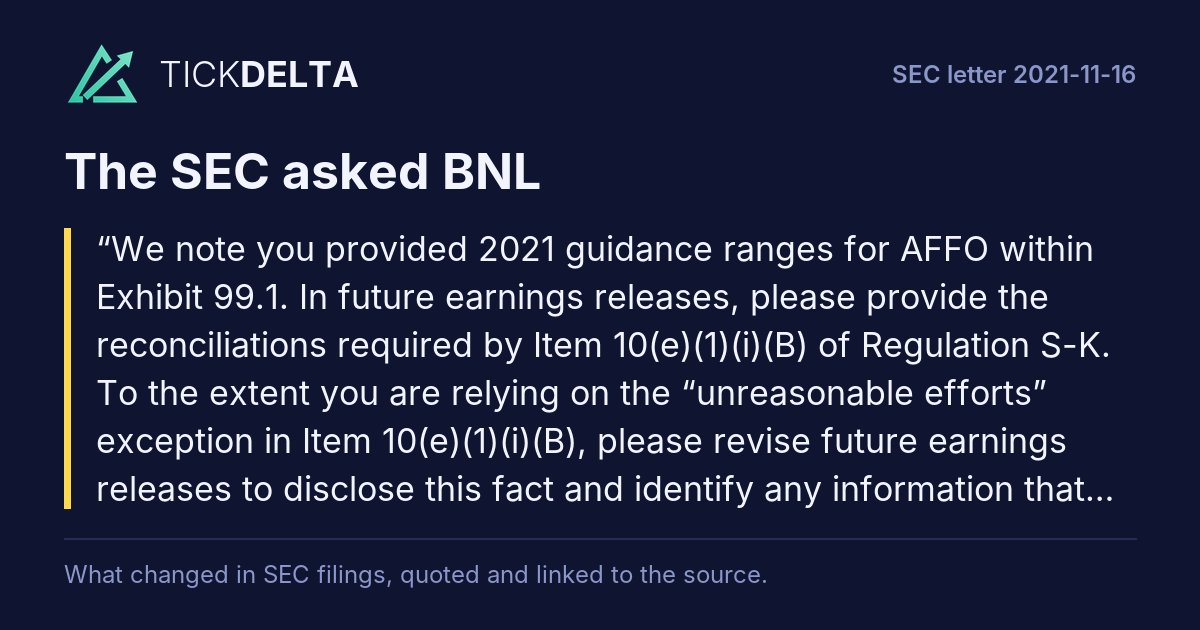
We note you provided 2021 guidance ranges for AFFO within Exhibit 99.1. In future earnings releases, please provide the reconciliations required by Item 10(e)(1)(i)(B) of Regulation S-K. To the extent you are relying on the “unreasonable efforts” exception in Item 10(e)(1)(i)(B), please revise future earnings releases to disclose this fact and identify any information that is unavailable and its probable
Rest of the question

significance. Reference is made to Question 102.10 of the Division’s Compliance and Disclosure Interpretations for Non- GAAP Financial Measures.

BNL answered

No numbered answer found in the reply. Read the reply ↗

In its next report

First report after the company's reply of Nov 29, 2021: 10-K filed Feb 23, 2022 ↗, against the 10-K filed Feb 25, 2021 ↗.

Tickdelta does not hold the text of both reports, so they are not compared here.

Notes to Consolidated Financial Statements
SEC asked (2)
Summary of Significant Accounting Policies Earnout Liability, page 87 2. You disclose that the earnout liability payable in common shares and OP Units were originally subject to a redemption rights agreement, and therefore were initially classified as liabilities. You further disclose that the redemption rights with respect to the common shares and OP Units terminated upon completion of the IPO.
Rest of the question

We note you reclassified the earnout liability to equity for the common shares and OP units associated with the third and fourth earnout tranches as of the date of the IPO. We further note you reclassified the earnout liability to equity for the common shares and OP units associated with the first and second earnout tranches on December 31, 2020. Please clarify for us how you determined it was unnecessary to reclassify the amounts related to the first and second earnout tranches as of the date of the IPO. Within your response, please reference the authoritative accounting literature management relied upon.

BNL answered
Upon the Company closing its IPO on

September 21, 2020, the first and second earnout tranches were payable based upon the achievement of either the 2020 AFFO targets (which remained in force for the remainder of 2020) or the 40-day VWAP per

REIT Share targets (which commenced with the closing of the IPO). In contrast, commencing with the closing of the IPO, the third and fourth earnout tranches were only subject to the 40-day VWAP per REIT Share targets.

To analyze the appropriate accounting treatment, the Company considered the guidance in both ASC 480-10-25-14 and ASC 815-40-15.
Rest of the answer

When applying this guidance, the Company concluded that the first and second earnout tranches represent one combined unit of account and that settlement was potentially variable based on the entity’s AFFO per share (with variable settlement amounts ranging from $0 for nonperformance,

$10 million if only the target in the first tranche was met, and $25 million if both the target in the first and second tranches were met). Based on these variable settlement provisions, the Company concluded that the AFFO targets represented variables that potentially impacted settlement outside of inputs used to price a fixed-for-fixed forward or option as outlined in ASC 815-40-15-7E and therefore precluded equity classification until the contractual AFFO provision expired at December 31, 2020. This accounting treatment is consistent with example 7 of ASC 815-40-55-31.

Read in the reply

Also in this review: closing letter, 2021-12-08

Form S-11

2020-02-03 to 2020-02-03 · 10 questions · 1 letter from the SEC, 0 from the company
No closing letter
Non-GAAP measuresRisk factorsLeasesLegal and contingenciesDerivatives and hedging
SEC letter of Feb 3, 2020 ↗ no reply letter on EDGAR (the company may have answered in an amended filing)
DRS S-11 Submitted January 10, 2020 · General
SEC asked (1)
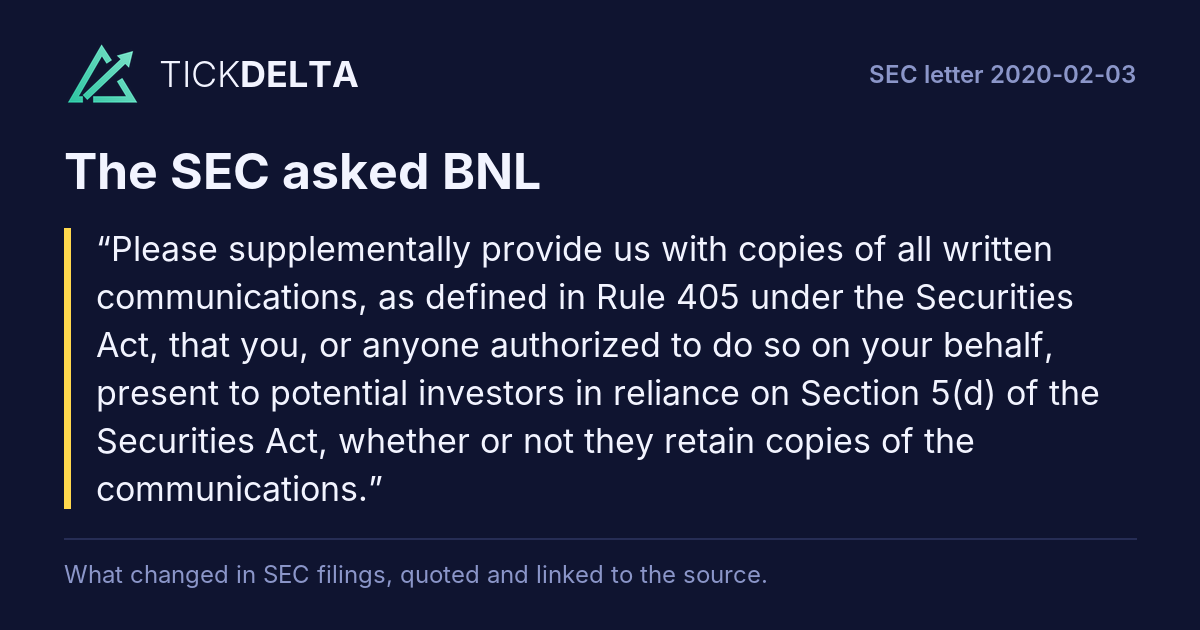
Please supplementally provide us with copies of all written communications, as defined in Rule 405 under the Securities Act, that you, or anyone authorized to do so on your behalf, present to potential investors in reliance on Section 5(d) of the Securities Act, whether or not they retain copies of the communications.
BNL answered

No reply letter found.

Prospectus Summary, page 1
SEC asked (2)
We note your disclosure on page 3 and elsewhere that your reputation, in-depth market knowledge, and extensive network of established relationships in the net lease industry will continue to provide you access to an ongoing pipeline of attractive investment opportunities.
Rest of the question

Please describe your criteria for determining a property is in your pipeline, how you have identified the targeted properties, your relationship to the seller, if any, and whether or not you have entered into negotiations for any of these properties. Risk Factors, page 26

BNL answered

No reply letter found.

Prospectus Summary, page 1
SEC asked (3)
We note the statement on page 47 that you believe you, the OP and most of the subsidiaries of the OP will not fall within the definition of investment company under Section 3(a)(1) of the Investment Company Act. Please clarify whether any of the subsidiaries of the OP will fall within the definition of investment company.
BNL answered

No reply letter found.

Non-GAAP Financial Measures, page 91
SEC asked (4)
Please tell us how you determined it was appropriate to exclude Asset management fees, Property management fees and General and Administrative Expenses from your calculation of the non-GAAP measure Adjusted Net Operating Income. It appears these are normal, recurring, cash operating expenses necessary to operate your business. Refer to Question 100.01 of the C&DI Non-GAAP Financial Measures.
BNL answered

No reply letter found.

Non-GAAP Financial Measures, page 91
SEC asked (5)
Please revise your disclosure of the calculation of the measure Adjusted EBITDAre to provide a detailed explanation of the adjustment for current quarter investment and disposition activity. Please clarify what this measure represents, and provide a detail of the components and calculation of this adjustment.
BNL answered

No reply letter found.

Certain Relationships and Related Transactions, page 154
SEC asked (6)
Please revise the disclosure regarding the asset management agreement and the property management agreement to provide the full time period required by Item 404 of Regulation S-K. See Instruction 1 to Item 404. In addition, please disclose the legal services referenced on page F-68.
Rest of the question

Lastly, please reconcile the disclosure in this section with the table on page F-28, which reflects total management fees under the two agreements for the nine months ended September 30, 2019 at $34.9 million.

BNL answered

No reply letter found.

Forum for Certain Litigation, page 185
SEC asked (7)
We note that your forum selection provision identifies a state court located within the State of Maryland (or, if that court does not have jurisdiction, the federal district court for the District of Maryland) as the exclusive forum for certain litigation, including any “derivative action.” Please disclose whether this provision applies to actions arising under the Securities Act or Exchange Act.
Rest of the question

If so, please also state that there is uncertainty as to whether a court would enforce such provision. If the provision applies to Securities Act claims, please also state that investors cannot waive compliance with the federal securities laws and the rules and regulations thereunder. In that regard, we note that Section 22 of the Securities Act creates concurrent jurisdiction for federal and state courts over all suits brought to enforce any duty or liability created by the Securities Act or the rules and regulations thereunder.

BNL answered

No reply letter found.

Item 33. Recent Sales of Unregistered Securities, page II-1
SEC asked (8)
Please identify the class of persons to whom the securities were sold and disclose the facts supporting your reliance upon the exemption from registration. See Item 701(b) and (d) of Regulation S-K.
BNL answered

No reply letter found.

Undertakings, page II-7
SEC asked (9)
Please provide the undertakings as required by Item 512(a)(5)(ii) and Item 512(a)(6) of Regulation S-K. Item 512(a)(5)(ii) is required for any prospectus filed in reliance on Rule 430C and Item 512(a)(6) is required for any offering that involves an initial distribution of securities pursuant to Rule 159A. For guidance, refer to Securities Act Rules Compliance and Disclosure Interpretation, Question 229.01.
BNL answered

No reply letter found.

Exhibits
SEC asked (10)
We note on page 143 the employment agreements entered into on November 11, 2019 with executive officers that will go into effect upon closing of the Internalization. Please file these agreements as exhibits.
BNL answered

No reply letter found.

Form 10-12G

2017-05-22 to 2017-07-21 · 20 questions · 2 letters from the SEC, 2 from the company
Review closed 2017-07-21
LeasesAcquisitionsResults discussion (MD&A)Critical estimatesRisk factorsLiquidity and cashNon-GAAP measuresRevenue
General
SEC asked (1)
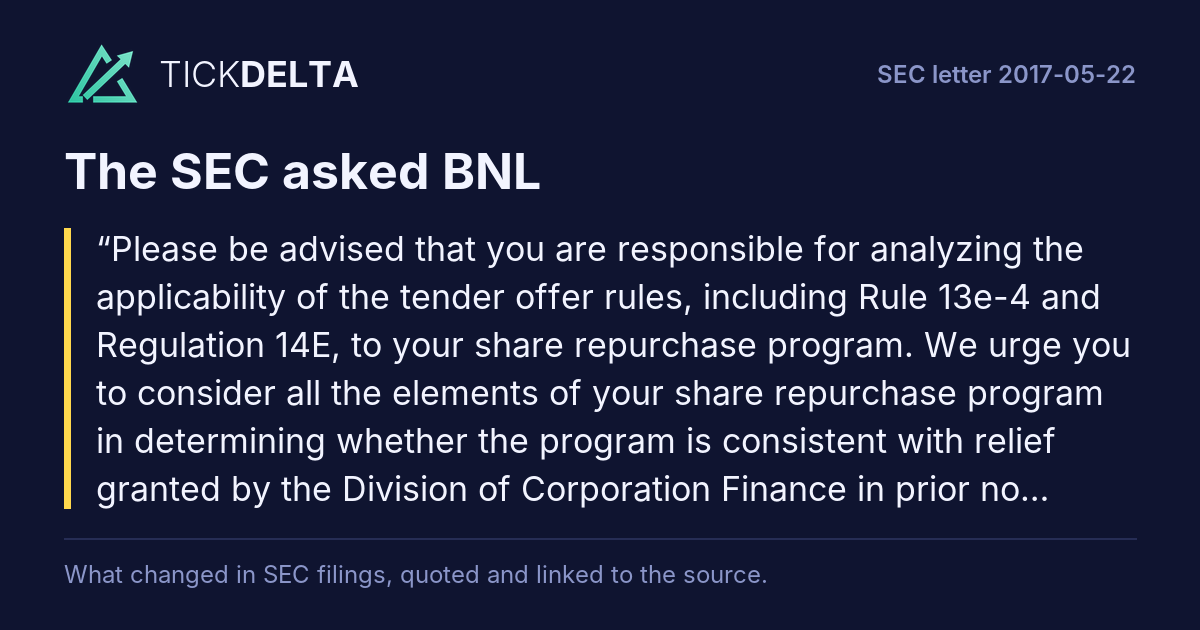
Please be advised that you are responsible for analyzing the applicability of the tender offer rules, including Rule 13e-4 and Regulation 14E, to your share repurchase program. We urge you to consider all the elements of your share repurchase program in determining whether the program is consistent with relief granted by the Division of Corporation Finance in prior no action letters. See, for example, T REIT Inc.
Rest of the question

(Letter dated June 4, 2001) and Wells Real Estate Investment Trust II, Inc. (Letter dated December 3, 2003). To the extent you have questions as to whether the program is entirely consistent with the relief previously granted by the Division of Corporation Finance, you may contact the Division’s Office of Mergers and Acquisitions at 202-551- 3440.

BNL answered
The Issuer has analyzed the applicability of the tender offer rules, including Rule 13e-4 and Regulation 14E, to its share repurchase program and has determined that the elements of its share repurchase program are consistent with the relief granted by the Division of

Corporation Finance in prior no action letters.
Read in the reply
General
SEC asked (2)
Please be advised that you are responsible for analyzing the applicability of Regulation M to your share repurchase program. We urge you to consider all the elements of your share repurchase program in determining whether the program is consistent with the class relief granted by the Division of Market Regulation in the class exemptive letter granted Alston & Bird LLP dated October 22, 2007.
Rest of the question

To the extent you have questions as to whether the program is entirely consistent with that class exemption you may contact the Division of Trading and Markets at 202-551-5777.

BNL answered
The Issuer has analyzed the applicability of Regulation M to its share repurchase program and has determined that the elements of its share repurchase program are consistent with the class relief granted by the Division of Market Regulation.
Read in the reply
Item 1. Business, page 1
SEC asked (3)
We note your disclosure on page 2 regarding your total pre-tax return of 11.2% and approximate 6.3% annualized yield on the current Determined Share Value. Please explain to us how you calculate these return amounts, including whether these amounts include any return of capital, and how you determined it was appropriate to include these return amounts.
BNL answered
The Issuer has removed the disclosure from Amendment No. 1 regarding total pre-tax return and annualized yields.
Read in the reply
Item 1. Business, page 1
SEC asked (4)
Although we note your disclosure on page 6, please revise your disclosure to include a schedule of lease expirations for each of the ten years starting with the current year and which states the number of tenants whose leases will expire, the total area in square feet covered by the leases, the annual rent represented by the leases and the percentage of gross annual rent represented by the leases.
BNL answered
The Issuer has revised the disclosure on page 7 to include a ten year lease expiration schedule in response to the Staff’s comment.
Read in the reply
Our Properties and Investment Objectives · Underwriting Criteria, page 8
SEC asked (5)
We note your disclosure regarding your procedures for evaluating tenant creditworthiness. Please revise to disclose in greater detail how you monitor the creditworthiness of your net lease tenants on an ongoing basis and identify any material changes in tenant credit quality.
BNL answered
The Issuer has revised the disclosure on page 9 to disclose in greater detail how it monitors the creditworthiness of its net lease tenants on an ongoing basis and identify any material changes in tenant credit quality in response to the Staff’s comment.
Read in the reply
Determined Share Value, page 11
SEC asked (6)
We note your disclosure that your Determined Share Value is $79.00. Please provide us an analysis regarding your calculation of NAV and the Determined Share Value, including:  the process by which the value estimate was determined, including the role of each of the parties involved in the process, the person(s) making the ultimate determination, the primary and secondary valuation methods used, any conflicts with
Rest of the question

third party advisors, and whether or not the final determination was consistent with the range of values provided by any third party advisor;  a breakdown of the value assigned to each major asset type (e.g. properties, securities, cash), the liabilities, and the share number used to calculate the per share amount, along with a comparable breakdown for any prior period value estimate;  the key assumptions used in the primary valuation method, including the weighted average for each key assumption broken out by material property type, cautionary language regarding the sensitivity of assumptions, and a quantitative example of the sensitivity of the estimate to changes in assumptions;  the relationship between the aggregate purchase price of your properties (as adjusted for related capital expenditures) and the value assigned to your properties;  a list of any prior period value estimates and the approximate date on which the next value estimate will be provided; and  a list of any adjustments made to NAV as determined using valuation definitions and methodologies prescribed by ASC Topic to arrive at the Determined Share Value. Your response should include the amount of any adjustment made by management and an explanation as to why management felt the adjustment was necessary.

BNL answered
The Issuer has revised the disclosure on pages 12 through 14 to provide an analysis regarding its calculation of NAV and the Determined Share Value, including the items noted in the Staff’s comment, in response to the Staff’s comment.
Read in the reply
Share Redemptions, page 12
SEC asked (7)
We note your share redemption disclosure on pages 12 and 88. Please disclose the source of cash used to fund redemption requests.
BNL answered
The Issuer has revised the disclosure on pages 15 and 100 to disclose the source of cash used to fund redemption requests in response to the Staff’s comment.
Read in the reply
Item 1A. Risk Factors · Risks Related To Conflicts of Interest, page 23
SEC asked (8)
We note your disclosure in this section and beginning on page 76 regarding conflicts arising out of allocation of personnel time to your activities and allocation of investment opportunities between you and investment vehicles affiliated with your Manager or Asset Manager.
Rest of the question

Please revise your disclosure to discuss any other real estate programs in which your Manager or Asset Manager, their affiliates, and/or your executive officers are involved, including the size of the competing programs.

BNL answered
The Issuer has revised the disclosure on pages 26 and 87 to discuss the other real estate program that our Manager and Asset Manager sponsor and manage in response to the Staff’s comment.
Read in the reply
Item 2. Financial Information · Management’s Discussion and Analysis of Financial Condition and Results of Operations, page
SEC asked (9)
Please include a more detailed discussion of leasing activity during the periods presented, including the amount of new leases and renewed leases executed, the amount of leases that were not renewed, and leasing costs, including tenant improvement costs and leasing commissions, as applicable.
BNL answered
The Issuer has revised the disclosure on pages 46 through 50 to include discussion of leasing activity during the periods presented in response to the Staff’s comment. For the information of the Staff, due to the fact that all of the Issuer’s properties are leased to single tenants under long-term triple-net leases, the

Issuer is not currently required to perform significant ongoing leasing activities on its properties.
Rest of the answer

During the years ended December 31, 2016, 2015, and 2014, and the three months ended March 31, 2017 and 2016, none of the Issuer’s leases expired, and all of the Issuer’s leasing activity related to its real estate acquisitions.

Read in the reply
Item 2. Financial Information · Management’s Discussion and Analysis of Financial Condition and Results of Operations, page
SEC asked (10)
Please revise to discuss the relationship between distributions paid, including any amounts reinvested through the DRIP, and cash flow from operations for the reporting period and last fiscal year and the relationship between the total distributions paid since inception, including any amounts reinvested through the DRIP, and cumulative earnings or cash flow from operations.
Rest of the question

In addition, please disclose the source of any shortfall. Alternatively, tell us why you believe this disclosure is not material.

BNL answered
The Issuer has revised the disclosure on pages 90 and 91 to summarize its distributions paid during the three months ended

March 31, 2017, and for the year ended December 31, 2016, including the source of distributions and a comparison against cash flow from operations and Funds From Operations in response to the Staff’s comment.
Read in the reply
Contractual Obligations, page 42
SEC asked (11)
Please adjust your table to include total amounts for each maturity period presented. Reference is made to Item 303(a)(5) of Regulation S-K.
BNL answered
The Issuer has revised the table on page 45 to include total amounts for each maturity period presented in response to the

Staff’s comment.
Read in the reply
Net Income and Non-GAAP Measures (FFO, AFFO, and O-AFFO), page 48
SEC asked (12)
In calculating O-AFFO, we note that you deduct amounts for amortization of lease intangibles. Please revise your definition of O-AFFO to clarify that your reference to “transaction costs associated with acquiring real estate subject to existing leases” includes the amortization of lease intangibles.
BNL answered
The Issuer has revised the disclosures on page 55 in reference to

“transaction costs associated with acquiring real estate subject to existing leases” to clarify that it includes the amortization of lease intangibles. In addition, the Issuer has revised the disclosure throughout Amendment No. 1 to reflect the fact that Issuer will no longer disclose O-AFFO and going forward will disclose adjusted funds from operations, or AFFO.
Read in the reply
Item 7. Certain Relationships and Related Transactions and Director Independence · Our Relationship with the Asset Manager, page 71
SEC asked (13)
We note your disclosure on page 73 that you will reimburse your Asset Manager for certain expenses. Please briefly clarify the types of expenses that you will reimburse and whether these reimbursements include personnel costs of the Asset Manager or Manager.
BNL answered
The Issuer has revised the disclosure on page 83 to remove reference to expenses reimbursed by the Issuer to the Asset Manager and Manager. The Issuer only reimburses the Asset Manager and Manager for certain immaterial expenses, such as postage. The Manager bears all personnel costs, which the Issuer does not reimburse.
Read in the reply
Item 15. Financial Statements and Exhibits, page 98
SEC asked (14)
We note that certain of the material agreements filed pursuant to Item 601(b)(10) of Regulation S-K have omitted schedules and exhibits. For example, exhibits 10.5, 10.12 and 10.17 reference a number of schedules and exhibits that are not included. Please file the complete agreements as required by Item 601(b)(10) or tell us why you believe the omitted schedules and exhibits are not required to be filed.
BNL answered
The Issuer has refiled exhibits 10.5, 10.6, 10.12 and 10.17 with Amendment No. 1 to include all previously omitted schedules and exhibits.
Read in the reply
Financial Statements · Acquisitions, page F-21
SEC asked (15)
Please tell us whether any of the properties acquired in 2016 or 2015 are significant at the 10% or higher level in accordance with Rule 3-14 of Regulation S-X. In your response, please clarify for us whether any of the property acquisitions shown in the tables on page F-21 and F-22 would be considered related for purposes of applying the significance test under Rule 3-14.
BNL answered
The Issuer has reviewed the financial reporting requirements of Rule 3-14 of

Regulation S-X as it would relate to the Issuer’s acquisition activity and has determined that none of the properties acquired in 2016 or 2015 are significant at the 10% or higher level in accordance with

Rule 3-14 of Regulation S-X.

Substantially all of the

Issuer’s properties are leased to single-tenant occupants on a triple-net basis, where the tenant is responsible for property taxes, insurance, and maintenance expenses of the property.
Rest of the answer

A majority of the

Issuer’s real estate acquisitions have taken the form of sale-leaseback transactions on single-tenant commercial properties. The Issuer also acquires properties subject to existing single-tenant triple-net leases.

The Issuer considered the Division of Corporation Finance Financial Reporting Manual (the

“Financial Reporting Manual”), Section 2330.10 (Real Estate Operations – Required Financial Statements – Exception for Properties with No or Nominal Leasing History) which indicates that “where a registrant acquires a property that does not have a leasing history, such as a previously owner-occupied or newly constructed property, financial statements of the property are not required.” Accordingly, the Issuer has excluded from its significance test properties that do not have a leasing history, such as sale-leaseback transactions with previous owner-occupants.

When an acquisition included a portfolio of individual assets, the Issuer evaluated significance based on the aggregation of all properties included in the portfolio acquisition. When assessing significance, the Issuer’s analysis also considered whether any property acquisitions were “related,” as defined by Note 2 to Section 2310.1 of the Financial Reporting Manual. There were no acquisitions that were deemed related during 2016 and 2015.

Lastly, the Issuer reviewed Section 2320 of the Financial Reporting Manual (“Real Estate Operations – Individually

Insignificant Acquisitions”) to determine if the aggregate of all individually insignificant real estate properties described in Section 2320.2 that have been acquired, or are probable of acquisition, subsequent to the end of its most recently completed fiscal year, exceeded 10% of its total assets. The analysis showed that no individually insignificant properties, when aggregated, exceeded 10% of the Issuer’s total assets as of the balance sheet date preceding the acquisition.

As a result, the Issuer believes that it has complied with the requirements of Rule

3-14 and related Staff interpretations for all of its acquisitions and has determined that none of the properties acquired in 2016 or 2015 are significant at the 10% or higher level in accordance with Rule 3-14 of Regulation S-X.

Read in the reply
General
SEC asked (1)
We note your response to prior comment 1 and we reissue it. Please provide us with your analysis of how your share redemption program is similar to the programs described in the letters referenced in our prior comment or in the letters granted to Blackstone Real Estate Income Trust, Inc. (Letter dated September 12, 2016), Rich Uncles NNN REIT, Inc. (Letter dated December 21, 2016), or Hines Global REIT II, Inc.
Rest of the question

(Letter dated April 26, 2017). Please note that we will refer your response to the Office of Mergers and Acquisitions for further review.

BNL answered
Pursuant to discussions with the staff of the Office of Mergers and Acquisitions, the Issuer’s board of directors has revised the terms of the Issuer’s share redemption program (the “Program”), effective as of June 28, 2017. The revised terms of the Program are set forth in Amendment No. 2. The Program is now consistent with the share redemption programs described in the letters referenced in the Staff’s prior comment.

Alston & Bird LLP www.alston.com

Atlanta | Beijing | Brussels | Charlotte | Dallas | Los Angeles | New York | Research Triangle | San Francisco | Silicon Valley |
Rest of the answer

Washington,

D.C.

Read in the reply
General
SEC asked (2)
We note your description of repurchases of shares between March 31, 2017 and the present. Please provide us your detailed legal analysis of whether those purchases constituted a tender offer and, thus, were subject to Regulation 14E.
BNL answered
The

Redemption Program Has Not Constituted an Issuer Tender Offer

Pursuant to Regulation 14E under the Exchange Act (“Regulation

14E”), any tender offer is required to comply with certain procedural and antifraud provisions.1

The Issuer’s share redemption program (the “Redemption Program”), since its inception (on December 31, 2009) to date, has not constituted a tender offer by the Issuer subject to Regulation 14E. The Issuer reaches this conclusion based on an analysis of the factors expressed in Wellman v. Dickinson, 475 F. Supp. 783 (S.D.N.Y.
Rest of the answer

1979), and applied in subsequent cases by the Commission and the Staff in determining what constitutes an issuer tender offer.2 Because the Redemption Program has not constituted a tender offer by the Issuer, the structural protections generally afforded to stockholders in a tender offer under the tender offer rules have not been necessary for the protection of the Issuer’s investors to date.

Analysis of the Wellman Factors

An analysis of the Wellman factors demonstrates that the Redemption Program should not be viewed as a tender offer.3 Set forth below is an application of the Wellman factors to the Redemption Program.

(i) Active and widespread solicitation of public stockholders for the shares of an issuer. The Issuer lacks “public stockholders.” Regardless, the Issuer has not engaged in an active and widespread solicitation for the redemption of its shares of common stock (“Shares”). The

Redemption Program has been described in the private placement memorandum (as amended and supplemented, the “PPM”) with respect to the Issuer’s private offering of Shares (the “Offering”) and any material changes to the Redemption Program have been communicated through amendments or supplements to the PPM and the quarterly reports delivered to the Issuer’s stockholders. However, such disclosure has been provided solely to make stockholders aware of the Redemption Program’s existence and terms. The Issuer has not made any other significant communications about the Redemption Program except as contained in or related to the PPM, other materials used in connection with the Offering, the providing of quarterly reports to the Issuer’s stockholders and communications with stockholders as have been required by the Redemption Program itself. Stockholders desiring to request redemption of all or a portion of their Shares have been permitted to do so of their own volition and not at the behest, invitation or encouragement of the Issuer. The Issuer has not solicited or encouraged stockholders to request redemption of Shares. The role of the Issuer in effectuating redemptions under the Redemption Program has been ministerial and has merely facilitated redemptions requested by stockholders.

(ii) The offer to purchase is made at a premium over the prevailing market price. There is no established regular trading market for the Shares, and thus there is no prevailing market price for the Shares. However, no premium has been paid over the Offering price by the Issuer for the

Shares repurchased pursuant to the Redemption Program. Both the price of Shares sold in the Offering and Shares redeemed under the Redemption

The tender offer rules found in Rule 13e-4 promulgated under the Exchange Act did not apply to the Issuer prior to June 23, 2017.

The term “tender offer” is not defined in Regulation 14E or Rule 13e-4 promulgated under the Exchange Act.

The absence of one particular factor does not necessarily mean the non-existence of an issuer tender offer and depending upon the circumstances involved in the particular case, one or more of the factors may be found more compelling and determinative than the others. See

Wellman, 475 F. Supp. at 824.

Program have been equal to 100% the Issuer’s determined share value (“DSV”) in effect as of the time of the applicable sale or redemption; provided, that Shares held for more than 12 months but less than 5 years are redeemed at 95% of the applicable DSV.

Due to the fact that there is no established trading market for the Shares and the redemption price for Shares redeemed pursuant to the Redemption Program has been either equal to or at a discount to the Offering price, this factor does not apply.

(iii) The solicitation is made for a substantial percentage of the issuer’s stock. As noted above, the Issuer has not actively solicited redemptions under the Redemption Program. The Redemption Program has always limited Share redemptions pursuant to the Redemption Program. The Redemption Program has provided that the total number of Shares redeemed in any one calendar quarter pursuant to the Redemption Program may not exceed (a) 1% of the total number of Shares outstanding at the beginning of that calendar year, plus (b) 50% of the total number of any additional Shares issued during the prior calendar quarter under the Issuer’s distribution reinvestment plan, plus (c) any additional number of Shares the Issuer’s independent directors committee

(“Committee”) decides to redeem in its sole and absolute discretion. Other than the “five per centum” threshold contained in Section 14(d)(1) of the Exchange Act, the Issuer is not aware of any authority that defines what constitutes a “substantial percentage” of an issuer’s stock. However, the Issuer believes that whether the Redemption Program, as operated to date, has constituted a tender offer subject to Regulation 14E does not hinge on the presence of a 5% limitation on the number of Shares that could have been repurchased over a 12-month period.

The Issuer notes that the operation of the Redemption Program to date has not, either during any calendar year or in the aggregate over the course of the operation of the Redemption Program, had the effect of the Issuer redeeming a substantial percentage of the Shares. As of March 31, 2017, the Issuer has redeemed an aggregate of 201,886 shares, which is equal to approximately

1.24% of the total Shares issued and outstanding as of March 31, 2017. Further, the Issuer notes that the relatively insignificant number of aggregate Shares redeemed pursuant to the Redemption Program over the course of its operation is the result of the Issuer honoring 100% of the redemption requests received by the Issuer.

Rather than facilitating the Issuer’s purchase of a substantial portion of the Shares, the Redemption Program has simply provided the Issuer’s stockholders with a means of liquidity, subject to certain conditions, with respect to their investments. The Redemption Program was not created and has not been utilized for the same reasons that issuers typically conduct tender offers. The Issuer has, and intends to continue to, continuously raise capital through its ongoing Offering and to invest the net proceeds thereof in real properties and real estate-related securities. Redeeming Shares decreases the funds available for such investments and reduces the Issuer’s net asset value, which has always created a disincentive for the Issuer to repurchase Shares.

(iv) The terms of the offer are firm, rather than negotiable. The terms of the Redemption Program have been firm with respect to the process by which stockholders may request redemptions. While the redemption price under the Redemption Program is not negotiable, the price has not been fixed at the same amount for the duration of the Redemption Program, and instead has been equal to the DSV (subject to the applicable discounts thereto). The pressure on stockholders that Rule 13e-4, which has not been applicable to the

Issuer prior to June 23, 2017 but which is referred to here for purposes of this analysis, attempts to eliminate is that which is caused by “a high premium with a threat that the offer will disappear within a certain time.”4 Where these factors exist, firmness of the terms of the offer may have the effect of exacerbating the pressure. This concern, however, is not present with respect to the Redemption Program. As previously discussed, the Redemption Program has not offered stockholders a premium for their Shares and the Issuer has always intended for the Redemption Program to exist indefinitely (subject to the discretion of the Issuer’s board of directors in its reasonable discretion to suspend or amend the Redemption Program).

See Brascan Ltd. v. Edper Equities, 477 F. Supp. 773, 792 (S.D.N.Y. 1979).

Additionally, the Issuer believes that setting the redemption price based upon the quarterly

DSV has had the effect of mitigating pressure on the Issuer’s stockholders because stockholders have been aware that they could request to have their Shares redeemed by the Issuer at the end of any quarter, at no less than 95% of the DSV per

Share (depending upon how long the Shares have been held). In a typical tender offer, the offeror conceivably has both an incentive and the ability to set the offer price at a level that will maximize the chances of obtaining the desired volume of tenders, while minimizing the overall premium paid. Conversely, the Issuer has redeemed Shares at a price based upon the DSV per share, and has had no discretion in the determination of the redemption price.

(v) The offer is contingent on the tender of a fixed number of shares. The

Redemption Program has never been contingent on a fixed number of Shares being redeemed. Stockholders have had the choice to request the Issuer to repurchase none, all or a portion of their Shares on a quarterly basis.

(vi) The offer is open only for a limited period of time. The Redemption Program has always been open for an indefinite period. The risk of manipulation and pressure to sell typically associated with tender offers have not been present with respect to the Redemption Program. For each quarter, a redemption request could be delivered at any time up until 10 days prior to the last business day of the quarter. Stockholders have also had the opportunity to withdraw their repurchase request, provided that such withdrawal was received at least 10 business days prior to the end of the applicable quarter.

(vii) The offeree is subjected to pressure to sell. As noted above, the Issuer has not encouraged, invited, solicited or in any way pressured stockholders to participate in the Redemption Program and has not offered to repurchase Shares at a premium. The role of the

Issuer in effectuating repurchases under the Redemption Program has been purely ministerial. As a result of the fact that the Redemption Program has had no set termination date, stockholders should not have felt rushed to make decisions regarding participation in the Redemption Program. The Redemption Program has provided that if the Issuer was unable to repurchase all Shares that have been requested to be redeemed in any particular quarter, redemptions under the Redemption Program for such quarter will be made first, pro rata among any Shares which were subject to a redemption request in a prior quarter and were not redeemed in such prior quarter, and second, pro rata among all Shares tendered for redemption for the first time. In addition, the Issuer believes that the combination of (a) disclosure of the Redemption Program as an integral element of the Offering at the time of each stockholder’s original investment decision, (b) the quarterly regularity of redemptions and (c) the DSV-based pricing of the redemption price (together with the Issuer’s established policies and procedures for determining DSV), should have collectively acted to decrease pressure on stockholders.

(viii) A public announcement of an acquisition program prior to the accumulation of stock by a purchaser, followed by a rapid accumulation of a large amount of securities.5 The intent of the Redemption Program has always been to provide the Issuer’s stockholders with a degree of ongoing liquidity, not for the Issuer to continuously re-acquire Shares. It is possible that the Issuer, subject to the Redemption Program’s limits, could have been requested to repurchase a significant number of Shares over a short period of time depending on stockholders’ decisions to exit their investments (although in actuality the Issuer has never been required to do so).

The PPM has contained a comprehensive description of the terms, conditions and features of the Redemption Program and has been updated, when required, to reflect any material modifications made during the Offering. The Issuer has also provided the DSV, upon which the redemption price for Shares redeemed pursuant to the Redemption Program is based, to stockholders. The Issuer believes, however, that the Redemption Program has not been characteristic of a publicly-announced acquisition plan which is followed by a rapid accumulation of a large amount of stock. Though disclosure of the Redemption Program as described above constitutes an announcement of its existence and preceded redemptions, the Issuer believes that any redemption

The Wellman case did not include the eighth factor but acknowledged the Commission had listed an eighth factor in Hoover v. Fuqua Industries, Inc. See Wellman, 475 F. Supp. at 824.

of Shares that occurred were not driven by pressure exerted by the Issuer, as the Redemption Program imposed no deadline and offered no premium. Rather, any such accumulation occurred solely as a result of stockholders opting to exit from the investment of their own volition without pressure or prompting by the Issuer, which is not the type of untoward pressure the tender offer rules were designed to prohibit. Several courts have agreed that offers without a deadline or premium are not tender offers, as stockholders are not subjected to the pressure the tender offer rules were designed to mitigate.6

Based on analysis of the eight factors discussed above, the Issuer believes that redemptions of Shares pursuant to the Redemption Program to date has not implicated the concerns that the tender offer rules were intended to address.

The Redemption Program Withstands a

“Totality of Circumstances” Analysis

The Issuer notes that some courts have rejected a rigid application of the

Wellman test and have, instead, applied what the Issuer considers a reasonable “totality of circumstances” analysis.7 This analysis looks to all the circumstances surrounding the transaction to determine whether the chief objectives of the tender offer rules and regulations are being met, specifically, to remove the element of secrecy and undue pressure associated with such transaction and to provide stockholders with adequate information to make an informed investment decision in connection therewith.8

The Issuer believes that the Repurchase Program to date withstands such a “totality of circumstances” analysis due to the terms of the Redemption Program discussed above and disclosed to the Issuer’s investors. The Company believes that the protections afforded to stockholders by the tender offer rules have not been needed for stockholders who participated in the

Repurchase Program. The Issuer does not believe that redemptions under the Redemption Program to date posed the risk of “substantial risk of ill-considered sales” made “by ill-informed shareholders.”9
Read in the reply
Item 1. Business, page 1
SEC asked (3)
We note your response to comment 4 and your revised disclosure on page 7. Please revise to clarify what you mean by “potential contractual rental revenue” and how it is different, if at all, from the annual rent represented by the leases.
BNL answered
The Issuer has revised the disclosure on page 7, including other references on pages 4-6, 8, 29, and 38, to remove references to “potential contractual rental revenue” and replace them with “contractual rental revenue over the next twelve months (“NTM Rent”)” or

“NTM Rent,” as applicable, in response to the Staff’s comment. The Issuer has clarified that NTM Rent does not include late payments, non-payments, or other unscheduled payments. The Issuer has also clarified that NTM Rent includes the impact of contractual rent escalations.

See Panter v.
Rest of the answer

Marshall Field & Co., 646 F.2d 271, 286 (7th Cir. 1981) (ruling that where no deadline and no premium existed, stockholders “were simply not subjected to the proscribed pressures the Williams Act was designed to alleviate”); Brascan, 477 F. Supp. at 792 (ruling that without high premium and threat that the offer will disappear, large purchases in short time do not represent the kind of pressure the

Williams Act was designed to prevent); Kennecott Copper Corp. v. Curtiss-Wright Corp., 449 F. Supp. 951, 961 (S.D.N.Y. 1978) (ruling that where no deadline and no premium existed, there was no pressure, other than normal pressure of the marketplace, exerted on the stockholders), aff’d in relevant part, rev’d in part, 584 F.2d 1195, 1207 (2d Cir. 1978).

See Hanson Trust PLC v. SCM Corp., 774 F.2d 47 (2d. Cir. 1985); see also Pin v. Texaco Inc., 793 F.2d 1448, 145455 (5th Cir. 1986) (applying same analysis to issuer tender offer case).

See, e.g., Wellman, 475 F. Supp. at 821-23; Pin, 793 F. Supp. at 1454; Hanson Trust, 774 F.2d at 54-56.

See Hanson Trust, 774 F.2d at 58.

Read in the reply
Determined Share Value, page 12
SEC asked (4)
We note your response to comment 6 and your revised disclosure on pages 12-14. Please revise your disclosure to describe more specifically who ultimately determines NAV. Financial Statements 4. Acquisitions, page F-46
BNL answered
The Issuer has revised the disclosure on page 12 to clearly indicate that the members of our senior executive, portfolio management, accounting, and finance teams are responsible for determining the NAV in response to the Staff’s comment. The Issuer has also revised the disclosure to indicate that the third-party valuation specialist is not responsible for determining the NAV.

Financial Statements

4. Acquisitions, page F-46
Read in the reply
Determined Share Value, page 12
SEC asked (5)
We have considered your response to comment 15. In your response, it appears that you determined that financial statements would not be required for acquired properties that are leased back to the seller and do not have a leasing history. Please clarify for us whether your significance analysis contemplated the need for financial statements of the tenant in sale-leaseback transactions.
BNL answered
The Issuer’s significance analysis contemplated whether any of the tenants represented significant concentrations of lessees that necessitated tenant financial statements. This significance analysis was performed in accordance with Section 2340 of the Financial Reporting Manual

(“Properties Subject to Triple Net Lease—Financial Statements of Significant Lessees”), noting that an asset concentration is generally considered “significant” if it exceeds 20% of the registrant’s assets as of its most recent balance sheet.
Rest of the answer

Accordingly, the Issuer reviewed its portfolio for any tenant concentrations equal to or greater than 20% of its total assets as of December 31, 2016 and 2015, its most recent balance sheet dates, noting that no tenants were deemed significant (the largest tenant represented less than 5% of the Issuer’s total assets). As such, the Issuer determined that tenant financial statements were not required for any of the applicable periods.

Read in the reply

Also in this review: closing letter, 2017-07-21

Letters without questions

Other letters

UPLOAD and CORRESP
3 other letters: notices that a filing will not be reviewed, requests to declare a registration effective, and the like

From the SEC's correspondence on EDGAR: staff letters (form UPLOAD) and company letters (form CORRESP), 15 letters filed since 2017-05-23. Questions and answers are matched by their numbers; topics come from words in each question. The reports are compared word for word (same form, before the first SEC letter against the first report after the company's reply). No AI.

Sources

The SEC's correspondence on EDGAR: staff letters (form UPLOAD) and company letters (form CORRESP), matched question by question. No AI.

Also

Filings: the letters in the filing list.

Work with it

Excel workbook · CSV. Google Sheet that stays up to date: paste =IMPORTDATA("https://tickdelta.com/company/BNL/export.csv") into a cell.

Next in Owners and insiders:Insider trades
Esc

Type a ticker such as AAPL, a name, an investor such as Buffett, or a topic such as tariffs. ↑ ↓ to move, Enter to open.