Added10-Q Oct 28, 2026 vs 10-K Feb 19, 2026
Item 2. Unregistered Sales of Equity Securities and Use of Proceeds from Registered Securities.
Each branch is a paragraph in Risk Factors with nothing like it in the 10-K filed Feb 20, 2025. A box jumps to the paragraph as filed, below.
7 paragraphs in Risk Factors of the 10-K filed Feb 19, 2026 with nothing like them in the 10-K filed Feb 20, 2025. Quoted exactly. Paragraphs that were only edited are under 10-K change.
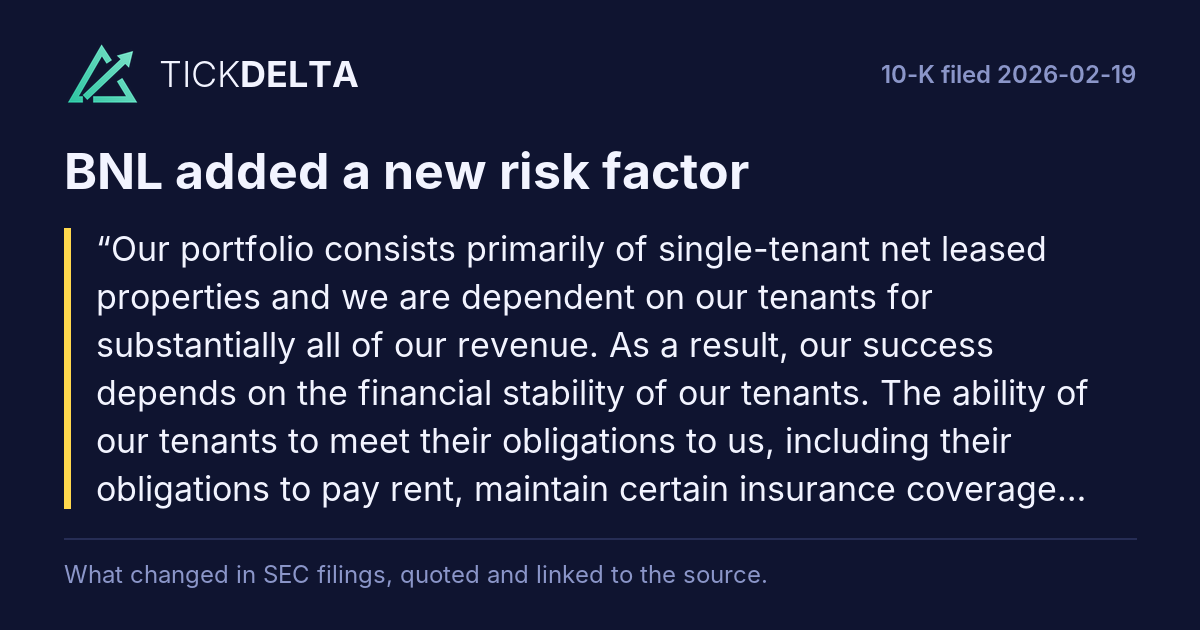
Our portfolio consists primarily of single-tenant net leased properties and we are dependent on our tenants for substantially all of our revenue. As a result, our success depends on the financial stability of our tenants. The ability of our tenants to meet their obligations to us, including their obligations to pay rent, maintain certain insurance coverage, pay real estate
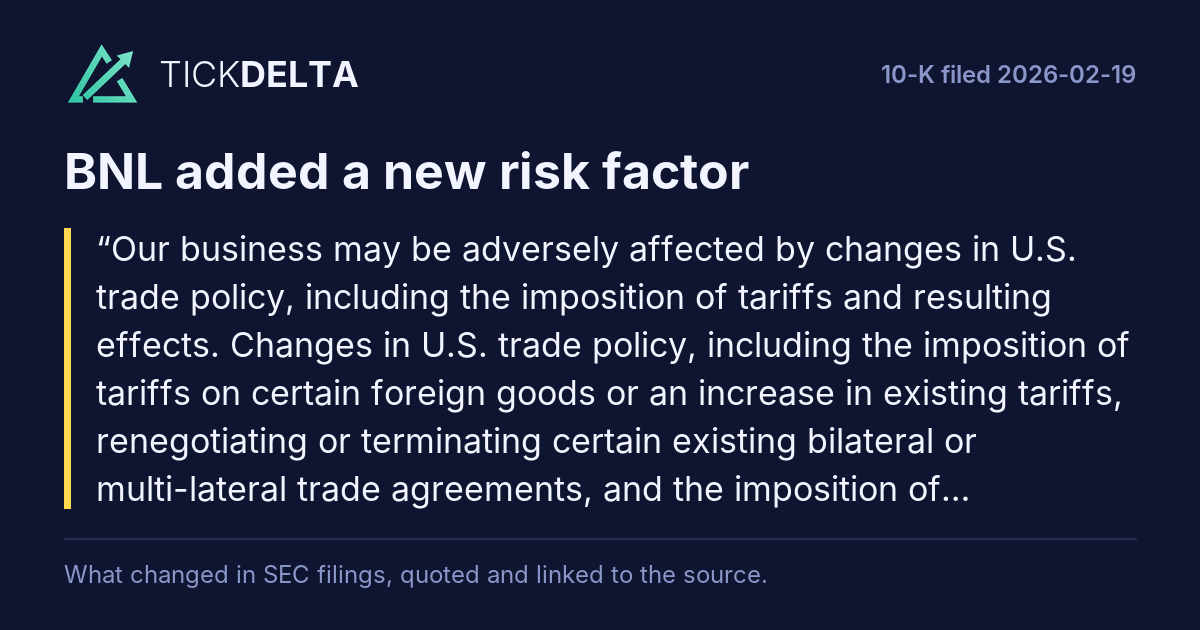
Our business may be adversely affected by changes in U.S. trade policy, including the imposition of tariffs and resulting effects.
Changes in U.S. trade policy, including the imposition of tariffs on certain foreign goods or an increase in existing tariffs, renegotiating or terminating certain existing bilateral or multi-lateral trade agreements, and the imposition of additional trade restrictions, may have an adverse impact on our business and results of operations resulting from potential negative effects on the operations of our tenants and/or our ability to successfully execute on build-to-suit development projects and expansion opportunities. While these developments should not directly affect the Company because of the nature of our operations, they could negatively impact the operations of our tenants to the extent they import or export goods in connection with the operation of their respective businesses, which could in turn negatively impact the ability of our tenants to fulfill their contractual obligations pursuant to our leases, including the payment of rent. Further, if, as a result of existing or future tariffs, current or future tenants or development partners are forced to increase prices of their goods or services, incur additional expenses for inputs or construction materials, modify business operations, or forego business opportunities, it may lead to the delay, abandonment, or cancellation of our existing and future build-to-suit development projects and expansion opportunities, which may adversely affect our results of operations.
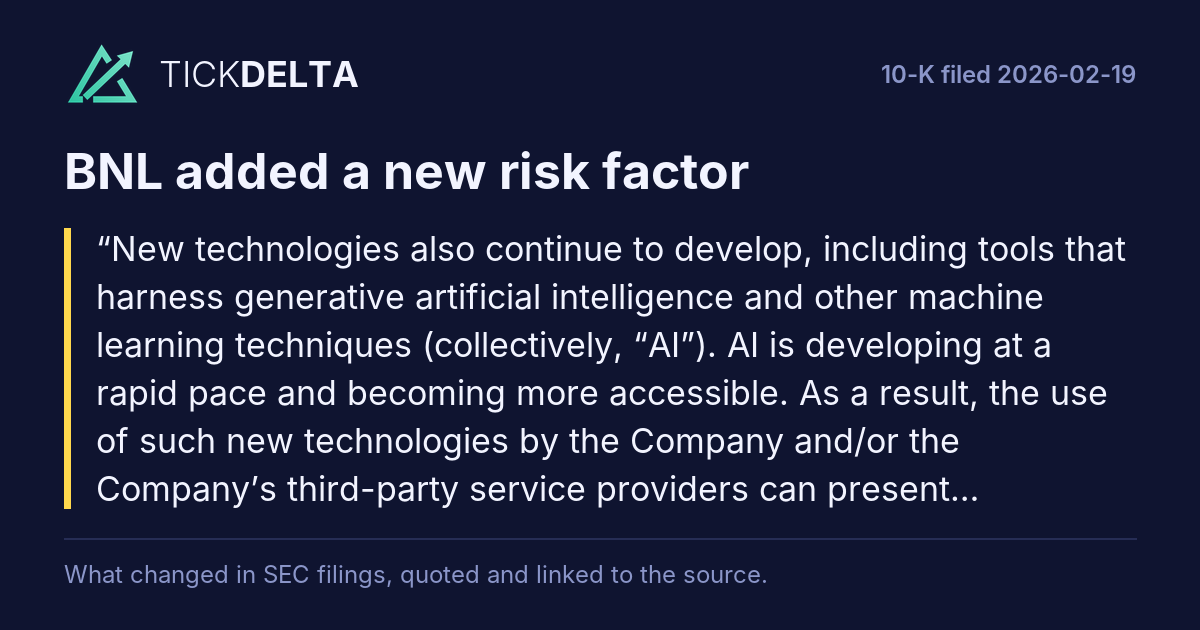
New technologies also continue to develop, including tools that harness generative artificial intelligence and other machine learning techniques (collectively, “AI”). AI is developing at a rapid pace and becoming more accessible. As a result, the use of such new technologies by the Company and/or the Company’s third-party service providers can present additional known and unknown risks, including, among others, the risk that confidential information may be stolen, misappropriated, or disclosed and the risk that the Company and/or its third-party service providers may rely on incorrect, unclear, or biased outputs generated by such evolving technologies, any of which could have an adverse impact on the Company and its business.
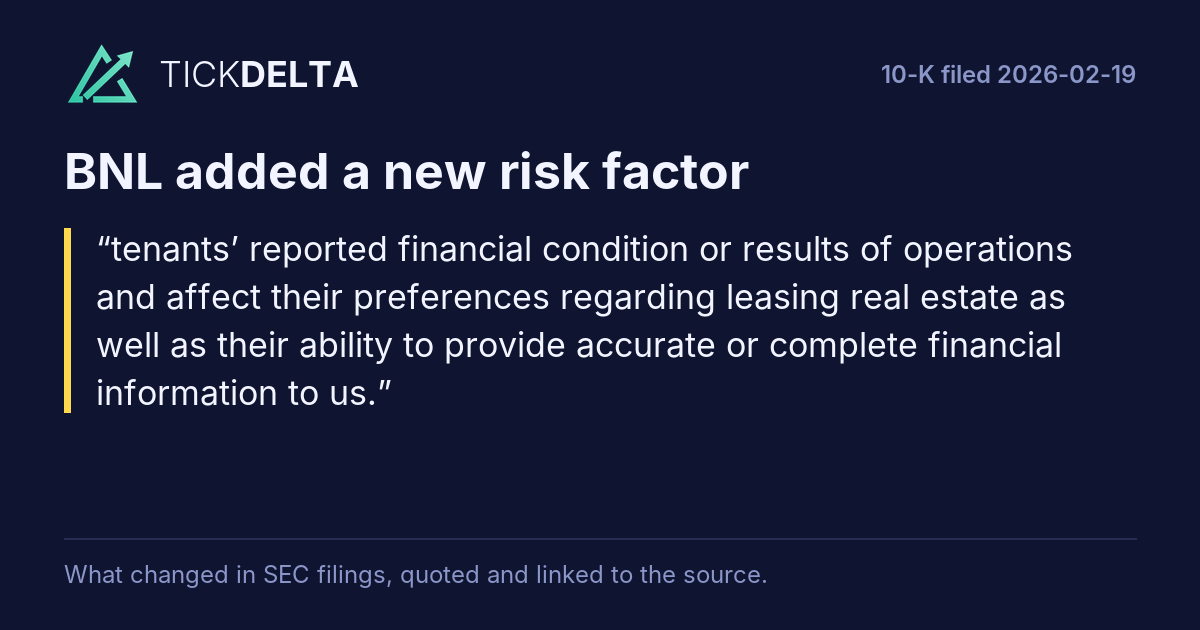
tenants’ reported financial condition or results of operations and affect their preferences regarding leasing real estate as well as their ability to provide accurate or complete financial information to us.
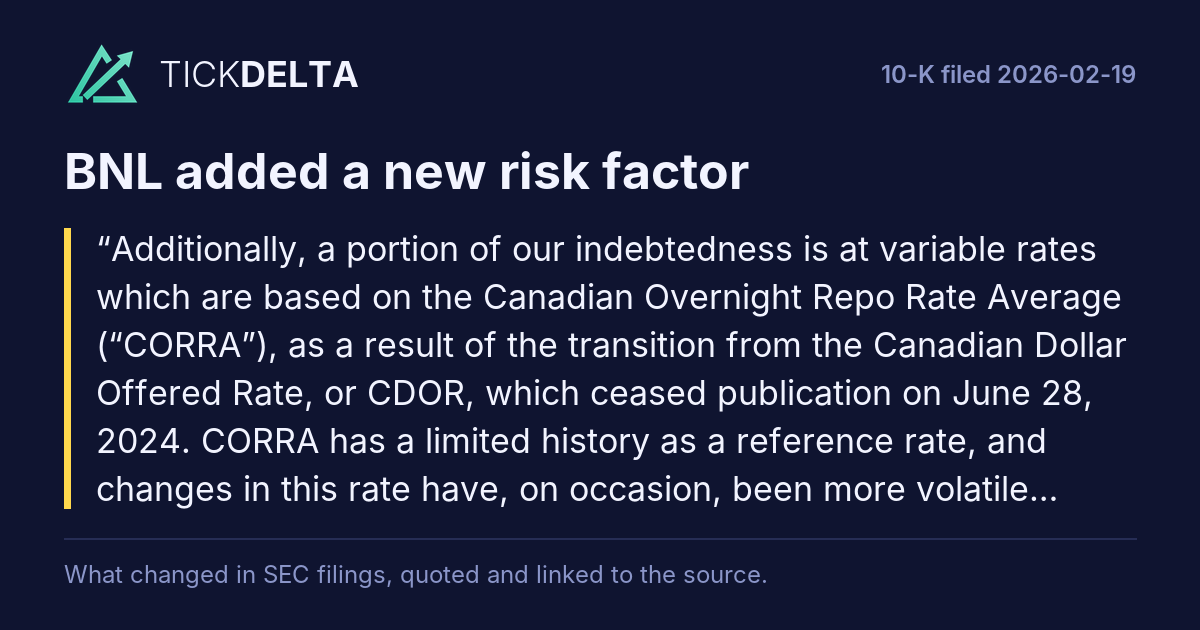
Additionally, a portion of our indebtedness is at variable rates which are based on the Canadian Overnight Repo Rate Average (“CORRA”), as a result of the transition from the Canadian Dollar Offered Rate, or CDOR, which ceased publication on June 28, 2024. CORRA has a limited history as a reference rate, and changes in this rate have, on occasion, been more volatile than changes in other benchmark or market rates. The liquidity of the CORRA loan markets could result in higher borrowing costs for us. There could be unanticipated difficulties, disruptions or methodological or other changes with the calculation and publication of these rates, which in turn could trigger another benchmark transition or otherwise cause a reliance on an alternate base rate. This could also result in increased borrowing costs for us and thereby adversely affect our financial condition and earnings.
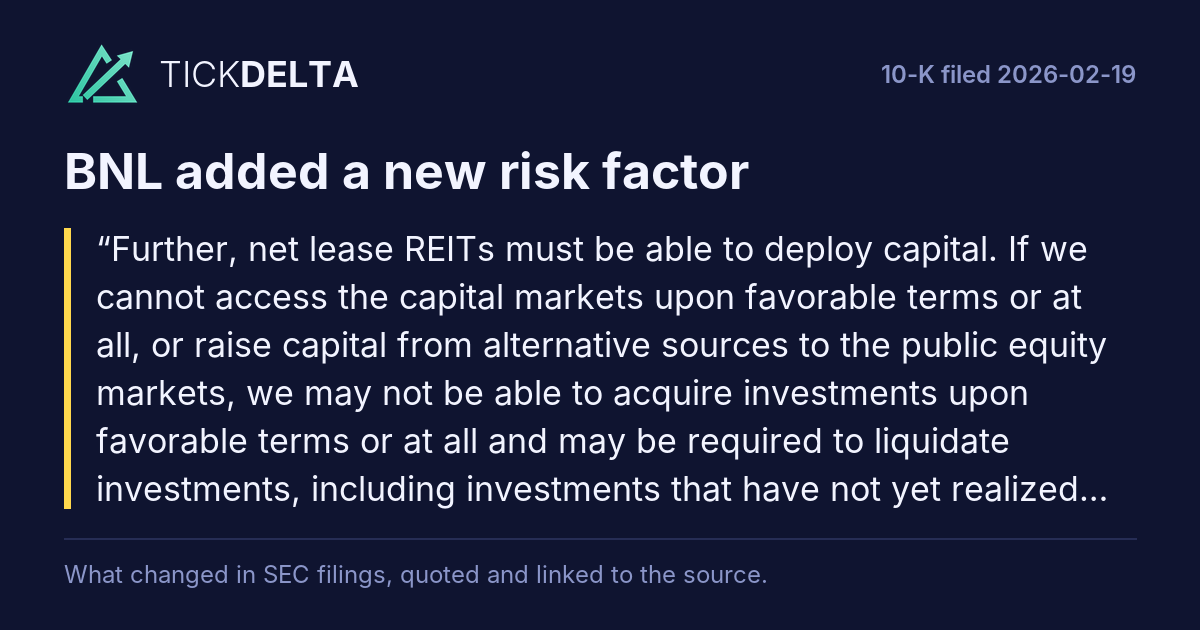
Further, net lease REITs must be able to deploy capital. If we cannot access the capital markets upon favorable terms or at all, or raise capital from alternative sources to the public equity markets, we may not be able to acquire investments upon favorable terms or at all and may be required to liquidate investments, including investments that have not yet realized maximum return, which could result in adverse tax consequences and/or adversely affect our ability to meet cash flow and other operational needs. Turmoil in the capital markets could lead to decreased consumer confidence and widespread reduction of business activity, adversely impacting our tenants and us.
New in the latest 10-Q
26 paragraphs in the 10-Q filed Oct 28, 2026 with nothing like them in the 10-Q filed Jul 29, 2026 (at least half the words must differ; new numbers alone do not count). Quoted exactly, grouped by the item heading above them. This is text that changed, not a judgement of how serious it is.
For the three and nine months ended September 30, 2026, depreciation expense includes $ 8.5 million and $ 15.0 million, respectively, of accelerated depreciation resulting from a change in the useful lives of buildings and improvements at two properties being redeveloped. There was no accelerated depreciation for the three and nine months ended September 30, 2025.
Read in the 10-Q
On July 28, 2026, the Company amended the unsecured revolving credit agreement, which also governs the 2028 Unsecured Term Loan, to provide a new $ 300.0 million senior unsecured delayed draw term loan maturing on January 30, 2030 (the “2030 Unsecured Term Loan”). The 2030 Unsecured Term Loan is available to be drawn during the twelve month period following the effective date of the amendment. In September 2026, the Company drew $ 100.0 million, and $ 200.0 million remained available to be drawn at September 30, 2026. Borrowings are subject to interest only payments at variable rates equal to one-month SOFR plus a margin based on the Company's credit rating, ranging between 0.750 % and
Read in the 10-Q
1.550 % per annum. Based on the Company’s current credit rating, the applicable margin was 0.900 % as of September 30, 2026. The Company expects to use proceeds from the 2030 Unsecured Term Loan for investment activity and general corporate purposes. The amendment also reduced the applicable SOFR-based margin on the 2028 Unsecured Term Loan to 0.900 % from 0.950 %, and on borrowings under the unsecured revolving credit facility to 0.800 % from 0.850 %, based on the Company’s current credit rating. The Company may issue letters of credit up to $ 50.0 million under the unsecured revolving credit facility (increased from $ 20.0 million by the July 28, 2026 amendment). At September 30, 2026, the Company had $ 15.7 million of standby letters of credit outstanding, which reduce the borrowing capacity under the facility. The letters of credit primarily support the Company's build-to-suit transactions. No draws were outstanding on the standby letters of credit as of September 30, 2026.
Read in the 10-Q
For each separate debt instrument, on a lender by lender basis, in accordance with ASC 470-50, Debt Modifications and Extinguishment, the Company performed an assessment of whether the transaction was deemed to be new debt, a modification of existing debt, or an extinguishment of existing debt. Debt issuance costs are either deferred and amortized over the term of the associated debt or expensed as incurred. The 2030 Unsecured Term Loan was deemed to be new debt. The 2026 amendments to the unsecured revolving credit agreement and term loan credit agreement were deemed to be modifications of existing debt.
Read in the 10-Q
During the three and nine months ended September 30, 2026, the Company incurred debt issuance costs of $ 2.2 million, associated with the 2030 Unsecured Term Loan. These costs were initially recorded in Prepaid expenses and other assets and are not amortized until the related borrowings are drawn. Upon the $ 100.0 million draw, $ 0.7 million of these costs, proportionate to the amount drawn, were reclassified as a reduction of the carrying amount of the debt and is being amortized over the term of the 2030 Unsecured Term Loan. The remaining $ 1.5 million is included in Prepaid expenses and other assets and will be reclassified as the remaining commitments are drawn.
Read in the 10-Q
In connection with the issuance of the 2032 Senior Unsecured Public Notes in September 2025 and repayment of outstanding borrowings of variable rate debt indexed to the daily simple SOFR rate, the Company terminated interest rate swap agreements with an aggregate termination value of $ 6.7 million. The Company determined it is not probable the hedged forecasted transactions will occur during the original periods, and therefore the $ 6.1 million of accumulated losses held in other comprehensive income (loss) were reclassified to interest expense during the three and nine months ended September 30, 2025. Additionally, in September 2025, the Company entered into interest rate swap agreements indexed to the 7-year U.S. Treasury for an aggregate notional amount of $ 300.0 million in connection with the issuance of the 2032 Senior Unsecured Public Notes. These interest rate swaps were terminated upon issuance of the 2032 Senior Unsecured Public Notes. The Company determined it is probable the hedged forecasted transaction will occur during the original
Read in the 10-Q
periods, and therefore $ 0.6 million of accumulated losses held in other comprehensive income (loss) are being amortized over the original term of the swap agreement, which ends in August 2032.
Read in the 10-Q
In August 2026, the Company completed a public offering to sell 11,000,000 shares of common stock at a price of $ 20.50 per share, subject to certain adjustments, in connection with forward sale agreements. The underwriters exercised in full their option to purchase an additional 1,650,000 shares, for an aggregate of 12,650,000 shares. The Company expects to settle the forward sale agreements by the September 2027 maturity date. As of September 30, 2026, the Company anticipates the forward sale agreements will provide net proceeds of approximately $ 247.7 million. The Company has not settled any part of the forward sale agreements as of September 30, 2026.
Read in the 10-Q
Inclusive of the forward equity offering, the total outstanding net proceeds from forward sale agreements, if settled as of September 30, 2026, are approximately $ 409.3 million.
Read in the 10-Q
In July 2026, the Board of Directors amended the Company’s Non-Employee Director Compensation Policy to permit each non-employee director to elect to receive all or a portion of their annual cash retainers in the form of fully vested shares of the Company’s common stock, in lieu of cash, issued under the Company’s equity incentive plan. Retainers are paid quarterly in arrears, and share settlements will begin with the third quarter 2026 retainers, which will be paid in the fourth quarter of 2026. No shares had been issued under the policy as of September 30, 2026.
Read in the 10-Q
(c) Represents the weighted average effects of 8,343,398 shares of common stock issuable upon settlement of forward sale agreements outstanding under the Company’s ATM Program at September 30, 2026, determined using the treasury stock method.
Read in the 10-Q
(d) Represents the weighted average effects of 12,650,000 shares of common stock issuable upon settlement of forward sale agreements outstanding under the Company’s August 2026 Forward Equity Offering at September 30, 2026, determined using the treasury stock method.
Read in the 10-Q
In July 2026, in connection with our option to purchase land to be developed (see Note 3), the Company entered into a corporate guaranty of the project entity’s payment obligations in support of the project’s development with a maximum potential future payment of $ 28.8 million plus enforcement costs. The Company would be required to perform upon the project entity’s failure to pay, retains recourse against the project entity for any amounts paid, and has recognized no liability under the guaranty as of September 30, 2026.
Read in the 10-Q
Subsequent to September 30, 2026, the Company invested $ 12.2 million in twelve developments.
Read in the 10-Q
Three Months Ended September 30, 2026 Compared to Three Months Ended June 30, 2026
Read in the 10-Q
Nine Months Ended September 30, 2026 Compared to Nine Months Ended September 30, 2025
Read in the 10-Q
expense during the nine months ended September 30, 2025. Interest income from sales-type leases increased $1.1 million over the comparable period resulting from the timing of a lease that was classified as sales-type in the third quarter of 2025.
Read in the 10-Q
The increase in lease revenues, net was partially due to an increase in interest income from sales-type leases compared to the nine months ended September 30, 2025.
Read in the 10-Q
In August 2026, we completed a public offering to sell an aggregate of 12,650,000 shares of common stock at a price of $20.50 per share, subject to certain adjustments, in connection with forward sale agreements. We expect to settle the forward sale agreements by the September 2027 maturity date. As of September 30, 2026, we anticipate the forward sale agreements will provide net proceeds of approximately $247.7 million.
Read in the 10-Q
On July 28, 2026, we entered into a new $300.0 million senior unsecured delayed draw term loan maturing January 30, 2030 (the “2030 Unsecured Term Loan”). The facility includes a twelve-month availability period during which we may draw on the commitments. Borrowings bear interest at adjusted SOFR plus a margin ranging from 0.750% to 1.550% per annum based on our credit rating; the applicable margin was 0.900% as of September 30, 2026. Concurrently, amendments to our existing unsecured credit agreements reduced the applicable SOFR-based margins on our existing unsecured term loans to 0.900% from 0.950% per annum and on our Revolving Credit Facility to 0.800% from 0.850% per annum. We intend to use proceeds from the 2030 Unsecured Term Loan for investment activity and general corporate purposes.
Read in the 10-Q
(a) Amount includes $0.3 million associated with the return of funds held in escrow for property work not completed, $0.2 million associated with end of lease activities, and $0.2 million from lease assignment activities, all of which are not core to our business operations for the three and nine months ended September 30, 2026.
Read in the 10-Q
(d) Amount includes $0.3 million associated with the return of funds held in escrow for property work not completed, $0.2 million associated with end of lease activities, and $0.2 million from lease assignment activities, all of which are not core to our business operations for the three months ended September 30, 2026.
Read in the 10-Q
On October 28, 2026, the Company entered into an amended and restated employment agreement with Chief Executive Officer John Moragne, an amended and restated employment agreement with Chief Operating Officer Ryan Albano, and an employment agreement with Chief Financial Officer Kevin Fennell (each, an “Employment Agreement”). The Employment Agreements take effect January 1, 2027 and have a term ending December 31, 2029. In each case, the Employment Agreement replaces an employment agreement, as amended in 2023, or severance protection agreement between the executive and the Company, as applicable, that was set to expire on December 31, 2026. Aside from the new term described above and certain administrative and technical updates, the provisions of the Employment Agreements with Mr. Moragne and Mr. Albano are substantially consistent with those in their current employment agreements, as amended, and previously described in the Company’s annual meeting proxy statement, filed with the Securities and Exchange Commission on Form DEF 14A on March 20, 2026 (the “2026 Annual Meeting Proxy Statement”) (available here). For Mr. Fennell, the Employment Agreement provides additional terms and conditions regarding Mr. Fennell’s employment with the Company in a manner similar to the Employment Agreements for Mr. Moragne and Mr. Albano, but was not previously covered by his existing severance protection agreement. The terms and conditions of his severance rights are substantially consistent with those of his prior agreement, as described in the 2026 Annual Meeting Proxy Statement.
Read in the 10-Q
Effective as of January 1, 2027, the Company also amended its Change in Control Severance Protection Policy (the “CIC Severance Policy”), in which all employees of the Company who are not party to an individual employment agreement participate, including named executive officers Michael Caruso (SVP, Real Estate Operations) and Jennie O’Brien (SVP, Chief Accounting Officer). The CIC Severance Policy sets forth the Company’s policy on the provision of severance payments and benefits under specified “qualifying termination” conditions in connection with and following a Change in Control (as defined in the amended CIC Severance Policy). The terms and conditions of the amended CIC Severance Policy remain substantially consistent with those of the prior policy, as described in the 2026 Annual Meeting Proxy Statement, except that the applicable time period for the post-transaction portion of the “Change in Control Protection Period” was increased from 12 to 24 months for all participants, and the time periods of the “Severance Period” were increased to a minimum of 12 months for all participants, including an increase from 12 to 24 months for participants at the level of Senior Vice President.
Read in the 10-Q
The foregoing descriptions of the updates reflected in the Employment Agreement for each of Mr. Moragne, Mr. Albano and Mr. Fennell and the amended CIC Severance Policy are summaries and are qualified in their entirety by reference to
Read in the 10-Q
the full terms of each Employment Agreement and the amended CIC Severance Policy, which are attached hereto as Exhibits 10.4, 10.5, 10.6, and 10.7, respectively, and are incorporated by reference herein.
Read in the 10-Q
Item 1A of the 10-Q filed Oct 28, 2026 against Item 1A of the 10-K filed Feb 19, 2026.
A 10-Q repeats only the risks that changed, so a 10-K paragraph that is missing from it is not counted as removed.
Added is a paragraph with nothing like it in the 10-K, Reworded a sentence that is in both with several words changed,
Quiet changes a sentence in both where one to four words changed and one is a hedge or a modal
(cut words struck through, new words highlighted).
Text on the page, not a score; each links to the filing at sec.gov.
What the 10-Q itself says about its risk factors:Please refer to the risk factors disclosed in Part I, Item 1A, “Risk Factors” of our Annual Report on Form 10-K for the year ended December 31, 2025, filed with the SEC on February 19, 2026. There have been no further material changes.
Read in the 10-Q
Two-word phrases in Risk Factors of the 10-K filed Feb 19, 2026 that are in none of the 1 earlier 10-Ks stored, back to Feb 20, 2025
Used at least twice, small words left out. Counted, not picked: a phrase can be new because the company renamed something.
7 paragraphs of last year's Risk Factors with nothing like them now. The longest are quoted.
Item 1A of each 10-K and 10-Q on EDGAR, quoted exactly. Each paragraph links to the filing at sec.gov.
10-K change: what was reworded or cut, section by section.
Excel workbook · CSV. Google Sheet that stays up to date: paste =IMPORTDATA("https://tickdelta.com/company/BNL/export.csv") into a cell.