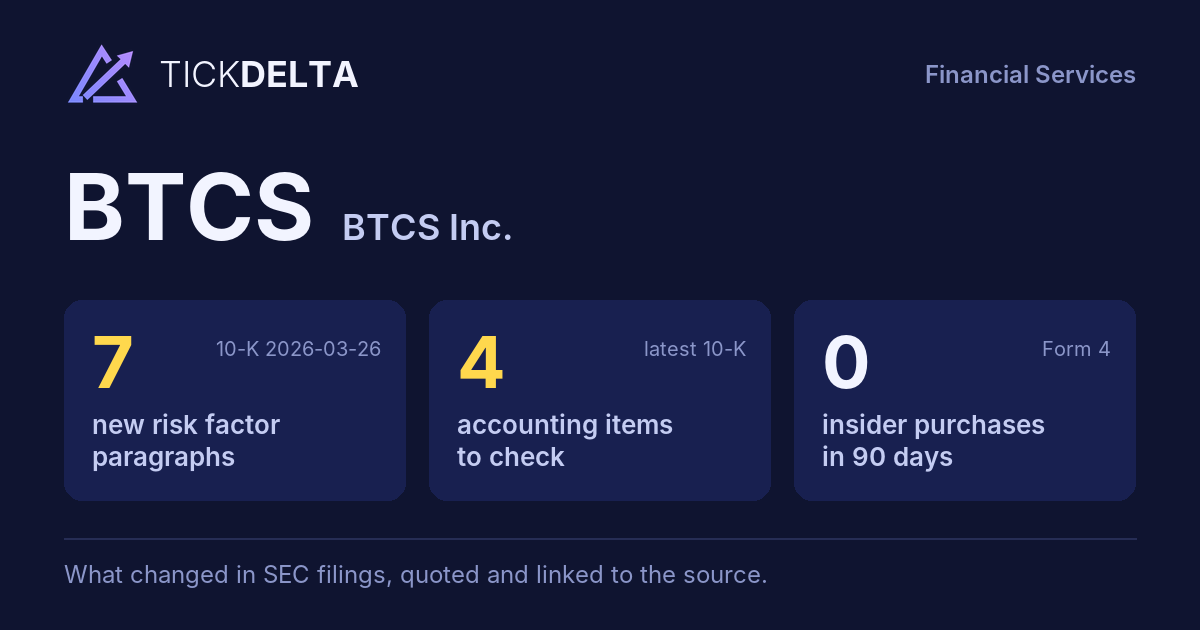
Sentences and paragraphs of BTCS's Risk Factors and MD&A, 10-K 2026-03-26 against 10-K 2025-03-20.
Each links to the text at sec.gov.
AddedRisk Factors
We conduct periodic cybersecurity risk assessments to identify reasonably foreseeable internal and external cybersecurity threats, including assessments conducted in connection with material changes to our business operations, systems, or third-party relationships. These risk assessments evaluate, among other things, the potential likelihood and magnitude of harm from such risks, including potential impacts on our operations, financial condition, reputation, digital assets, and business strategy, as well as the effectiveness of existing controls and safeguards.
Read it in 10-K 2026-03-26 at sec.gov ↗
AddedRisk Factors
Risk assessments consider information from internal stakeholders, known security vulnerabilities, threat intelligence, reported incidents affecting other companies in our industry, and information obtained from third parties and external advisors, as appropriate. The results of these assessments are used to inform enhancements to our cybersecurity controls, operational processes, and broader Company-wide risk management activities, which are periodically reported to management and the Audit Committee.
Read it in 10-K 2026-03-26 at sec.gov ↗
AddedRisk Factors
We maintain a cybersecurity incident response and recovery plan designed to guide our response to cybersecurity incidents. The plan provides a structured framework for incident identification, containment, investigation, remediation, and recovery, and includes defined escalation and communication protocols. In the event of a cybersecurity incident, management evaluates the incident to determine its severity and potential impact, including whether the incident is reasonably likely to be material, based on both quantitative and qualitative factors.
Read it in 10-K 2026-03-26 at sec.gov ↗
AddedRisk Factors
We maintain a vendor risk management program designed to identify and mitigate cybersecurity risks associated with third-party service providers. Third-party providers are subject to cybersecurity risk assessments during onboarding, contract renewal, and upon the identification of elevated risk. These assessments may include questionnaires, management discussions, third-party intelligence, and review of available SOC reports or similar assurances. Cybersecurity incidents affecting third-party providers are evaluated for potential impact to the Company, as appropriate.
Read it in 10-K 2026-03-26 at sec.gov ↗
AddedRisk Factors
In the event of a cybersecurity incident, management evaluates the incident and, as appropriate, escalates matters to the Audit Committee and the Board. The Audit Committee receives periodic updates regarding cybersecurity risks, program effectiveness, and any material cybersecurity incidents. The Audit Committee also meets regularly with the Company’s independent registered public accounting firm and discusses cybersecurity risks relevant to financial reporting and internal controls, as appropriate.
Read it in 10-K 2026-03-26 at sec.gov ↗
AddedMD&A
BTCS Inc. is a blockchain technology company focused on revenue generation through blockchain infrastructure and decentralized finance (“DeFi”) activities, primarily on the Ethereum network. During 2025, the Company continued to execute a strategic repositioning toward Ethereum-native operations designed to generate recurring on-chain revenues, improve capital efficiency, and actively deploy digital assets in support of long-term growth.
Read it in 10-K 2026-03-26 at sec.gov ↗
Show the other 11
AddedMD&A
The Company’s business model is centered on participating directly in core components of the Ethereum ecosystem, including validator node operations as a validator (“Validator”), block-building activities as a block builder (“Builder”), and DeFi asset deployment. While BTCS holds significant Ethereum (“ETH”) assets, they are primarily maintained as operating assets that support the Company’s revenue-generating activities, infrastructure participation, and DeFi activities.
Read it in 10-K 2026-03-26 at sec.gov ↗
AddedMD&A
During 2025, BTCS completed a strategic realignment of its operations and capital allocation to focus primarily on Ethereum-based activities. As part of this transition, the Company discontinued validator node operations on non-Ethereum blockchains and liquidated the majority of its non-Ethereum digital asset holdings. The Company also discontinued the development and operation of legacy technology platforms, including StakeSeeker in 2024 and ChainQ in 2025, in order to concentrate resources on scalable, revenue-generating infrastructure and DeFi initiatives.
Read it in 10-K 2026-03-26 at sec.gov ↗
AddedMD&A
This repositioning reflects management’s assessment that Ethereum provides the most compelling long-term opportunity for infrastructure participation, transaction execution, and DeFi activity, given its network scale, liquidity, and ecosystem maturity.
Read it in 10-K 2026-03-26 at sec.gov ↗
AddedMD&A
Blockchain infrastructure activities, consisting primarily of validator node operations (NodeOps) and block building (Builder+), represent a core driver of the Company’s revenues. Validator operations provide recurring ETH-denominated revenues through protocol-defined incentives and transaction fees, while Builder+ has emerged as a higher-growth, technology-driven revenue opportunity.
Read it in 10-K 2026-03-26 at sec.gov ↗
AddedMD&A
Builder+ participates in Ethereum’s transaction execution ecosystem by constructing and submitting optimized transaction blocks. During 2025, the Company continued to scale Builder+ operations by expanding private order flow integrations, enhancing infrastructure efficiency, and increasing participation across Ethereum blockspace markets. As a result, block building became an increasingly significant contributor to the Company’s revenue mix, reflecting both increased transaction activity and improved execution performance.
Read it in 10-K 2026-03-26 at sec.gov ↗
AddedMD&A
Management believes that block building represents a scalable opportunity, driven by technology, infrastructure optimization, and access to transaction flow rather than asset lock-up requirements.
Read it in 10-K 2026-03-26 at sec.gov ↗
AddedMD&A
In 2025, BTCS launched Imperium, a DeFi-focused operating segment designed to deploy digital assets into decentralized protocols as a liquidity provider and market participant. Imperium enables the Company to allocate assets across DeFi protocols that facilitate lending, borrowing, liquidity provision, and other on-chain financial activities.
Read it in 10-K 2026-03-26 at sec.gov ↗
AddedMD&A
In contrast to traditional staking, which is subject to protocol-defined reward structures and lock-up mechanics, DeFi participation allows for more dynamic capital allocation based on market conditions, liquidity needs, and risk considerations. Revenues generated through Imperium are variable and dependent on protocol utilization and prevailing market conditions.
Read it in 10-K 2026-03-26 at sec.gov ↗
AddedMD&A
Management expects Imperium to represent an increasingly important component of the Company’s operations and believes that DeFi activities provide opportunities to enhance risk-adjusted returns, improve capital flexibility, and complement the Company’s blockchain infrastructure operations, although there can be no assurance that these objectives will be achieved. BTCS plans to further expand asset deployments into DeFi protocols and pursue additional integrations to broaden its on-chain activities, subject to market conditions, available capital, regulatory developments, and risk management considerations.
Read it in 10-K 2026-03-26 at sec.gov ↗
AddedMD&A
A central element of BTCS’s operating model is its integrated capital strategy, which combines decentralized finance mechanisms with traditional capital markets activities. During 2025, the Company utilized a combination of at-the-market equity (“ATM”) offerings, structured convertible notes, and ETH-backed DeFi borrowing to fund operations, scale infrastructure, and deploy digital assets.
Read it in 10-K 2026-03-26 at sec.gov ↗
AddedMD&A
This approach is designed to support growth while managing liquidity and minimizing reliance on equity issuance alone. Management actively evaluates capital allocation across validator operations, block-building support, and DeFi deployments based on expected returns, risk profiles, and market conditions.
Read it in 10-K 2026-03-26 at sec.gov ↗