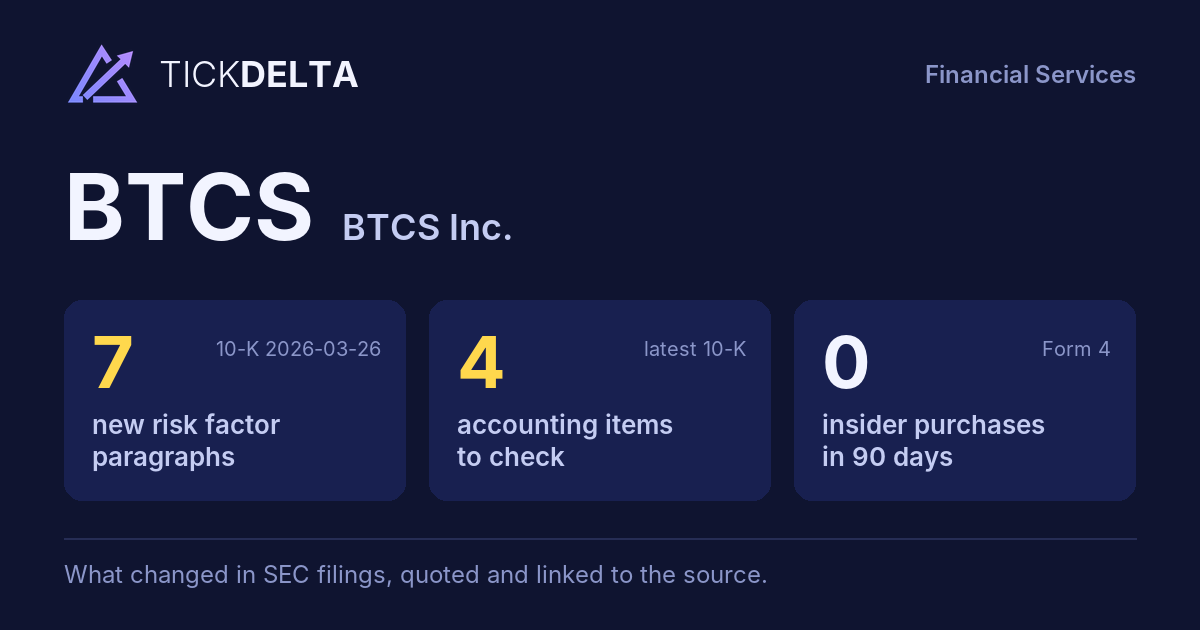
10-K 0001493152-26-012916 (2026-03-26) vs 10-K 0001493152-25-010973 (2025-03-20)
| Section | Compared text | Words now | Changed |
|---|
| Risk Factors | Item 1A | 1,065 |
54.5% |
| MD&A | Item 7 | 14,484 |
94.4% |
| Legal Proceedings | Item 3 | 46 |
not compared |
| Accounting Policies | 10-K text (note not found) | 0 |
not compared |
The redline: what was cut and what was added
In each section, the paragraph that changed most, marked against last year's 10-K:
cut words struck through, new words highlighted and underlined.
Risk Factors 157 words changed in this paragraph; it is 32% similar to last year's version.
Risk Assessment: We conduct risk assessments to identify cybersecurity threats, as well as assessments in the event of a material change in our business practices that may affect information systems that are vulnerable to such cybersecurity threats. These risk assessments are designed to identify reasonably foreseeable internal and external material cybersecurity risks to our critical systems, information, products, services, and our broader Company-wide IT environment, the likelihood and potential damage that could result from such risks, and the sufficiency of existing policies, procedures, systems, and safeguards in place to manage such risks. Risk assessments take into account consider information from internal stakeholders, known information security vulnerabilities, threat intelligence, reported incidents affecting other companies in our industry, and information obtained from external sources, including reported security incidents that have impacted other companies, industry trends, and evaluations by third parties and consultants external advisors, as needed. appropriate. The results of our these assessments are used to develop initiatives inform enhancements to enhance our security cybersecurity controls, make recommendations to improve operational processes, and inform a broader Company-wide risk assessment that is then management activities, which are periodically reported to our Board management and the Audit Committee.
Source: Item 1A, 10-K 0001493152-26-012916 vs Item 1A, 10-K 0001493152-25-010973
MD&A 96 words changed in this paragraph; it is 38% similar to last year's version.
Cost of revenues for Fiscal 2025 increased during compared Fiscal 2024, primarily due to higher Validator Payments validator payments (“Validator Payments”) made for purchasing to external parties to secure block space as part of our Ethereum Builder+ block-building activities under Builder+. Validator Payments totaled approximately $2,766,000 in 2024. activities. The increase also reflects higher blockchain infrastructure and network operation costs associated with the expansion of block-building and DeFi activities. These increased higher costs were partially offset by efficiency improvements in web service efficiencies realized within our validating infrastructure, including lower hosting fees related to NodeOps, which were and reduced from approximately $325,000 in 2023 to approximately $142,000 in 2024. Cloud and server hosting costs related to Builder+ totaled approximately $125,000 in 2024. reliance on third-party service providers.
Source: Item 7, 10-K 0001493152-26-012916 vs Item 7, 10-K 0001493152-25-010973
Every change, by type
Sentences and paragraphs of BTCS's Risk Factors and MD&A, 10-K 2026-03-26 against 10-K 2025-03-20.
Each links to the text at sec.gov.
Quiet changes are sentences kept from last year with one to four words changed, at least one of them a hedge, a modal or a qualifier
(may, could, will, not, significant, material…). A year or date rolling forward is not counted.
The full word list
adverse, adversely, all, although, anticipate, anticipates, any, approximately, believe, believes, can, cannot, certain, could, expect, expects, generally, however, if, intend, intends, largely, likely, many, material, materially, may, might, most, must, never, no, not, possible, primarily, probable, should, significant, significantly, some, substantial, substantially, unlikely, will, would
AddedRisk Factors
We conduct periodic cybersecurity risk assessments to identify reasonably foreseeable internal and external cybersecurity threats, including assessments conducted in connection with material changes to our business operations, systems, or third-party relationships. These risk assessments evaluate, among other things, the potential likelihood and magnitude of harm from such risks, including potential impacts on our operations, financial condition, reputation, digital assets, and business strategy, as well as the effectiveness of existing controls and safeguards.
Read it in 10-K 2026-03-26 at sec.gov ↗
AddedRisk Factors
Risk assessments consider information from internal stakeholders, known security vulnerabilities, threat intelligence, reported incidents affecting other companies in our industry, and information obtained from third parties and external advisors, as appropriate. The results of these assessments are used to inform enhancements to our cybersecurity controls, operational processes, and broader Company-wide risk management activities, which are periodically reported to management and the Audit Committee.
Read it in 10-K 2026-03-26 at sec.gov ↗
AddedRisk Factors
We maintain a cybersecurity incident response and recovery plan designed to guide our response to cybersecurity incidents. The plan provides a structured framework for incident identification, containment, investigation, remediation, and recovery, and includes defined escalation and communication protocols. In the event of a cybersecurity incident, management evaluates the incident to determine its severity and potential impact, including whether the incident is reasonably likely to be material, based on both quantitative and qualitative factors.
Read it in 10-K 2026-03-26 at sec.gov ↗
AddedRisk Factors
We maintain a vendor risk management program designed to identify and mitigate cybersecurity risks associated with third-party service providers. Third-party providers are subject to cybersecurity risk assessments during onboarding, contract renewal, and upon the identification of elevated risk. These assessments may include questionnaires, management discussions, third-party intelligence, and review of available SOC reports or similar assurances. Cybersecurity incidents affecting third-party providers are evaluated for potential impact to the Company, as appropriate.
Read it in 10-K 2026-03-26 at sec.gov ↗
AddedRisk Factors
Our policies require employees and relevant third-party contractors to contribute to our cybersecurity efforts. We provide periodic cybersecurity and data protection awareness training and require the prompt reporting of suspicious activity or potential cybersecurity incidents to management.
Read it in 10-K 2026-03-26 at sec.gov ↗
AddedRisk Factors
Our Board retains ultimate oversight responsibility for cybersecurity risk. The Board has delegated primary oversight of cybersecurity and information technology risks to the Audit Committee as part of its risk oversight function.
Read it in 10-K 2026-03-26 at sec.gov ↗
AddedRisk Factors
In the event of a cybersecurity incident, management evaluates the incident and, as appropriate, escalates matters to the Audit Committee and the Board. The Audit Committee receives periodic updates regarding cybersecurity risks, program effectiveness, and any material cybersecurity incidents. The Audit Committee also meets regularly with the Company’s independent registered public accounting firm and discusses cybersecurity risks relevant to financial reporting and internal controls, as appropriate.
Read it in 10-K 2026-03-26 at sec.gov ↗
RemovedRisk Factors
Risk Assessment: We conduct risk assessments to identify cybersecurity threats, as well as assessments in the event of a material change in our business practices that may affect information systems that are vulnerable to such cybersecurity threats. These risk assessments are designed to identify reasonably foreseeable internal and external material cybersecurity risks to our critical systems, information, products, services, and our broader Company-wide IT environment, the likelihood and potential damage that could result from such risks, and the sufficiency of existing policies, procedures, systems, and safeguards in place to manage such risks. Risk assessments take into account information from internal stakeholders, known information security vulnerabilities, and information from external sources, including reported security incidents that have impacted other companies, industry trends, and evaluations by third parties and consultants as needed. The results of our assessments are used to develop initiatives to enhance our security controls, make recommendations to improve processes, and inform a broader Company-wide risk assessment that is then periodically reported to our Board and Audit Committee.
Read it in 10-K 2025-03-20 at sec.gov ↗
RemovedRisk Factors
Incident Response and Recovery Planning: We have established a comprehensive incident response and recovery plan that guides our response in the event of a cybersecurity incident.
Read it in 10-K 2025-03-20 at sec.gov ↗
RemovedRisk Factors
Vendor Risk Management: We have implemented a robust vendor risk management program, which is designed to identify and mitigate cybersecurity threats associated with our use of third-party service providers. Such providers are subject to security risk assessments at the time of onboarding, contract renewal, and upon detection of an increase in risk profile. We use a variety of inputs in such risk assessments, including information supplied by providers in response to questionnaires and meetings as well as information from third parties. In addition, we require our providers to meet appropriate security requirements, controls and responsibilities, and investigate security incidents that have impacted our third-party providers, as appropriate. We also obtain and review Systems and Organization Control (“SOC”) reports from several of our key service providers.
Read it in 10-K 2025-03-20 at sec.gov ↗
RemovedRisk Factors
Education and Awareness: Our policies require each of our employees to contribute to our data security efforts. We regularly remind employees and third-party contractors of the importance of handling and protecting data, including through privacy and security training to enhance employee awareness of how to detect and respond to cybersecurity threats. All employees and third-party contractors are directed to report to our senior management any irregular or suspicious activity that could indicate a cybersecurity threat or incident.
Read it in 10-K 2025-03-20 at sec.gov ↗
RemovedRisk Factors
Our Audit Committee considers cybersecurity risks and other information technology risks as part of its risk oversight function and evaluates our risk assessment and management policies, including periodic discussions with our senior officers. In addition, management updates the Board of Directors, as necessary, regarding any material cybersecurity incidents, as well as any incidents with lesser impact potential. Our Audit Committee also meets at least quarterly with our independent registered accounting firm and communicates with them regarding any cybersecurity-related risks.
Read it in 10-K 2025-03-20 at sec.gov ↗
RewordedRisk Factors
Our management team Management supervises efforts to prevent, detect, mitigate, and remediate cybersecurity risks and incidents through various means, which may include briefings from internal or external security personnel; personnel, threat intelligence, reports generated by security tools, and other information obtained from governmental, public, or private sources, including external consultants engaged by us; and alerts and reports produced by security tools deployed in the IT environment. sources.
Read it in 10-K 2026-03-26 at sec.gov ↗
RewordedRisk Factors
The key objectives for the Company’s cybersecurity program of our Cybersecurity Program are to implement and sustain effective security controls designed to stop intrusion attempts prevent unauthorized access to digital assets, systems and data, and to maintain and continuously improve its our ability to detect, respond to attacks to, and recover from cybersecurity incidents.
Read it in 10-K 2026-03-26 at sec.gov ↗
RewordedRisk Factors
While we cannot guarantee complete effectiveness of our cybersecurity measures despite our best efforts and continuous monitoring, we believe that the Company’s sustained investment in people people, processes, and technologies has contributed to a culture of continuous improvement that has put the Company in a position positions us to protect against identify, assess, and respond to potential compromises. cybersecurity threats.
Read it in 10-K 2026-03-26 at sec.gov ↗
RewordedRisk Factors
We have devoted financial and personnel resources to implement and maintain security measures designed to meet regulatory requirements address cybersecurity risks in a manner consistent with our size, operational complexity, and stakeholder expectations, risk profile, and we intend to continue to make investments as may be required to maintain the security of our data and cybersecurity infrastructure.
Read it in 10-K 2026-03-26 at sec.gov ↗
RewordedRisk Factors
Success in achieving these objectives relies upon using quality appropriate technology solutions, cultivating and maintaining a team of skilled professionals, personnel (including external specialists, as appropriate), and continuously improving processes. policies and procedures.
Read it in 10-K 2026-03-26 at sec.gov ↗
RewordedRisk Factors
Such These safeguards are regularly evaluated and improved updated based on vulnerability assessments, cybersecurity threat intelligence, and lessons learned from cybersecurity events and incident response experience. activities.
Read it in 10-K 2026-03-26 at sec.gov ↗
RewordedRisk Factors
This alignment allows us to proactively evaluate and prioritize cybersecurity risks in the context of broader organizational objectives and resilience planning, ensuring a comprehensive approach to safeguarding the Company’s infrastructure and stakeholders. planning.
Read it in 10-K 2026-03-26 at sec.gov ↗
RewordedRisk Factors
Our senior management team, led by our Chief Financial Officer and Chief Operating Technology Officer, is responsible for assessing and managing our material risks from cybersecurity threats. threats and for implementing the Company’s Cybersecurity Program.
Read it in 10-K 2026-03-26 at sec.gov ↗
RewordedRisk Factors
Our cybersecurity program Cybersecurity Program is an integral part of our broader Enterprise Risk Management (ERM) ERM framework and business continuity efforts.
Read it in 10-K 2026-03-26 at sec.gov ↗
RewordedRisk Factors
We are subject to various cyber and other security threats, including attempts to gain unauthorized access to sensitive information and networks; virtual and cyber threats to our directors, officers, and employees; and threats to the security of our infrastructure infrastructure, digital assets, and assets. operational systems.
Read it in 10-K 2026-03-26 at sec.gov ↗
RewordedRisk Factors
We regularly assess and deploy technical safeguards designed to protect our information systems systems, infrastructure, and digital assets from cybersecurity threats.
Read it in 10-K 2026-03-26 at sec.gov ↗
AddedMD&A
BTCS Inc. is a blockchain technology company focused on revenue generation through blockchain infrastructure and decentralized finance (“DeFi”) activities, primarily on the Ethereum network. During 2025, the Company continued to execute a strategic repositioning toward Ethereum-native operations designed to generate recurring on-chain revenues, improve capital efficiency, and actively deploy digital assets in support of long-term growth.
Read it in 10-K 2026-03-26 at sec.gov ↗
AddedMD&A
The Company’s business model is centered on participating directly in core components of the Ethereum ecosystem, including validator node operations as a validator (“Validator”), block-building activities as a block builder (“Builder”), and DeFi asset deployment. While BTCS holds significant Ethereum (“ETH”) assets, they are primarily maintained as operating assets that support the Company’s revenue-generating activities, infrastructure participation, and DeFi activities.
Read it in 10-K 2026-03-26 at sec.gov ↗
AddedMD&A
During 2025, BTCS completed a strategic realignment of its operations and capital allocation to focus primarily on Ethereum-based activities. As part of this transition, the Company discontinued validator node operations on non-Ethereum blockchains and liquidated the majority of its non-Ethereum digital asset holdings. The Company also discontinued the development and operation of legacy technology platforms, including StakeSeeker in 2024 and ChainQ in 2025, in order to concentrate resources on scalable, revenue-generating infrastructure and DeFi initiatives.
Read it in 10-K 2026-03-26 at sec.gov ↗
AddedMD&A
This repositioning reflects management’s assessment that Ethereum provides the most compelling long-term opportunity for infrastructure participation, transaction execution, and DeFi activity, given its network scale, liquidity, and ecosystem maturity.
Read it in 10-K 2026-03-26 at sec.gov ↗
AddedMD&A
Blockchain infrastructure activities, consisting primarily of validator node operations (NodeOps) and block building (Builder+), represent a core driver of the Company’s revenues. Validator operations provide recurring ETH-denominated revenues through protocol-defined incentives and transaction fees, while Builder+ has emerged as a higher-growth, technology-driven revenue opportunity.
Read it in 10-K 2026-03-26 at sec.gov ↗
AddedMD&A
Builder+ participates in Ethereum’s transaction execution ecosystem by constructing and submitting optimized transaction blocks. During 2025, the Company continued to scale Builder+ operations by expanding private order flow integrations, enhancing infrastructure efficiency, and increasing participation across Ethereum blockspace markets. As a result, block building became an increasingly significant contributor to the Company’s revenue mix, reflecting both increased transaction activity and improved execution performance.
Read it in 10-K 2026-03-26 at sec.gov ↗
AddedMD&A
Management believes that block building represents a scalable opportunity, driven by technology, infrastructure optimization, and access to transaction flow rather than asset lock-up requirements.
Read it in 10-K 2026-03-26 at sec.gov ↗
AddedMD&A
In 2025, BTCS launched Imperium, a DeFi-focused operating segment designed to deploy digital assets into decentralized protocols as a liquidity provider and market participant. Imperium enables the Company to allocate assets across DeFi protocols that facilitate lending, borrowing, liquidity provision, and other on-chain financial activities.
Read it in 10-K 2026-03-26 at sec.gov ↗
AddedMD&A
In contrast to traditional staking, which is subject to protocol-defined reward structures and lock-up mechanics, DeFi participation allows for more dynamic capital allocation based on market conditions, liquidity needs, and risk considerations. Revenues generated through Imperium are variable and dependent on protocol utilization and prevailing market conditions.
Read it in 10-K 2026-03-26 at sec.gov ↗
AddedMD&A
Management expects Imperium to represent an increasingly important component of the Company’s operations and believes that DeFi activities provide opportunities to enhance risk-adjusted returns, improve capital flexibility, and complement the Company’s blockchain infrastructure operations, although there can be no assurance that these objectives will be achieved. BTCS plans to further expand asset deployments into DeFi protocols and pursue additional integrations to broaden its on-chain activities, subject to market conditions, available capital, regulatory developments, and risk management considerations.
Read it in 10-K 2026-03-26 at sec.gov ↗
AddedMD&A
A central element of BTCS’s operating model is its integrated capital strategy, which combines decentralized finance mechanisms with traditional capital markets activities. During 2025, the Company utilized a combination of at-the-market equity (“ATM”) offerings, structured convertible notes, and ETH-backed DeFi borrowing to fund operations, scale infrastructure, and deploy digital assets.
Read it in 10-K 2026-03-26 at sec.gov ↗
AddedMD&A
This approach is designed to support growth while managing liquidity and minimizing reliance on equity issuance alone. Management actively evaluates capital allocation across validator operations, block-building support, and DeFi deployments based on expected returns, risk profiles, and market conditions.
Read it in 10-K 2026-03-26 at sec.gov ↗
RemovedMD&A
BTCS Inc., a Nasdaq-listed U.S.-based blockchain technology company, focuses on advancing blockchain infrastructure. With a primary emphasis on the Ethereum network, BTCS drives scalable growth through block-building and validator node operations, leveraging advanced technology and robust operational expertise.
Read it in 10-K 2025-03-20 at sec.gov ↗
RemovedMD&A
BTCS’s blockchain infrastructure center on supporting the validation of transactions and securing proof-of-stake (“PoS”) and delegated proof-of-stake (“dPoS”) blockchain networks. The Company manages a network of cloud-based validator nodes that perform essential network functions, including transaction validation (“attestation”) activities and proposing new blocks. Through these activities, BTCS earns native token rewards by staking its own crypto assets on validator nodes operated by BTCS and third parties.
Read it in 10-K 2025-03-20 at sec.gov ↗
RemovedMD&A
Our evaluation of blockchain networks involves comprehensive due diligence procedures, including assessments of blockchain quality, reward potential, and the technical challenges associated with running validator nodes. Criteria for assessing blockchain quality encompass factors such as i) market and on-chain statistics, ii) liquidity, iii) potential blockchain utility, iv) history and milestones, v) growth and development roadmap, vi) use cases, vii) community interest, viii) quality of documentation, ix) decentralization, and x) any other publicly available information. This process ensures BTCS focuses on high-potential blockchain networks while mitigating technical and operational risks.
Read it in 10-K 2025-03-20 at sec.gov ↗
RemovedMD&A
A central focus of BTCS’s current operations is its Ethereum block-building initiatives under Builder+, which commenced operations in 2024. Through Builder+ we purchase block space and leverage advanced algorithmic processes to construct blocks for on-chain validation. The goal of Builder+ is to maximize gas fee revenue by optimizing the contents and structure of each block. The Company aims to maximize the value of gas fees earned by increasing the number of blocks we purchase while minimizing the payments to validators required for purchasing block space.
Read it in 10-K 2025-03-20 at sec.gov ↗
RemovedMD&A
Builder+ has rapidly become a key driver of BTCS’s revenue growth, leveraging its scalable and efficient technology to expand its operational footprint within the Ethereum ecosystem. While Builder+ currently operates exclusively on Ethereum, its flexible design enables potential adaptation to other blockchain networks, aligning with BTCS’s vision to diversify its infrastructure operations over time.
Read it in 10-K 2025-03-20 at sec.gov ↗
RemovedMD&A
BTCS operates a non-custodial Staking-as-a-Service (“StaaS”) business model that enables crypto asset holders to participate in network consensus mechanisms by staking and delegating to BTCS-operated validator nodes. As a non-custodial validator operator, the Company receives a percentage of a crypto asset holders’ staking rewards generated as a validator node fee, for our ministerial role in hosting the validator node. This creates an opportunity for scalable revenue and business growth with limited additional costs. The Company’s StaaS strategy provides a more accessible and cost-effective alternative for crypto asset holders to participate in blockchain networks’ consensus mechanisms, promoting the growth and adoption of blockchain technology.
Read it in 10-K 2025-03-20 at sec.gov ↗
RemovedMD&A
A StaaS provider maintains a ministerial role in validating transactions on a given dPoS network on behalf of its Delegators by (1) using open-source software to stake the relevant crypto assets; (2) monitoring and maintaining the nodes it is operating to ensure the computers remain online to validate transactions; and (3) verifying transactions on the network when required.
Read it in 10-K 2025-03-20 at sec.gov ↗
RemovedMD&A
As a non-custodial StaaS provider, we do not hold or take possession of any Delegator funds, crypto assets, or crypto asset rewards at any point during the staking or delegation process. Delegation does not involve the transfer of crypto asset ownership to a Validator. During the process of staking, delegated crypto assets remain in the Delegator’s digital wallets. The blockchain network calculates rewards earned, which are then distributed directly to the Delegator’s wallet. The blockchain network does not distribute any of the Delegator’s earned crypto rewards to BTCS. At no point does the Validator gain access, control, or custody of the original staked crypto assets or the earned crypto rewards through staking to its node. Therefore, the Company does not have any exposure to the custodial risks that a crypto exchange would have related to excessive redemptions or withdrawals of crypto assets, suspension of redemptions, or withdrawals. Further, we do not issue or hold crypto assets on behalf of third parties and have no exposure to the risks an exchange would have with respect to loans, rehypothecation, or margin.
Read it in 10-K 2025-03-20 at sec.gov ↗
RemovedMD&A
The following table details the blockchain networks on which BTCS operates nodes that support third-party delegations as part of our staking-as-a-service operations, including the amount of third-party crypto assets delegated to our non-custodial validator nodes, as of December 31, 2024.
Read it in 10-K 2025-03-20 at sec.gov ↗
RemovedMD&A
Blockchain Validator Delegated Delegated Network Fee Crypto Crypto Percentage % Assets (Native Assets ($USD) Tokens) Cosmos 5% 94,000 $580,248 ATOM Akash 5% 172,000 AKT $479,121 Kava 5% 20,000 KAVA $8,947 Avalanche 5% 300 $10,665 AVAX Total $1,078,981
Read it in 10-K 2025-03-20 at sec.gov ↗
RemovedMD&A
To complement our core blockchain infrastructure, BTCS has developed “ChainQ,” an AI-powered blockchain data and analytics platform designed to increase accessibility and transparency within the blockchain ecosystem. Currently in beta, ChainQ simplifies on-chain data access and analysis for cryptocurrency holders, delivering deeper insights into blockchain activity. By indexing public data from our blockchain infrastructure operations, ChainQ provides an intuitive platform for exploring on-chain data.
Read it in 10-K 2025-03-20 at sec.gov ↗
RemovedMD&A
As of December 27, 2024, BTCS has discontinued its StakeSeeker platform to focus on Builder+ and NodeOps, reflecting the Company’s strategic emphasis on scalable blockchain infrastructure.
Read it in 10-K 2025-03-20 at sec.gov ↗
RewordedMD&A
The Company believes that its existing cash and liquid crypto digital assets, in addition together with the proceeds from recent convertible note financings and access to the funds available to the Company from the issuance of additional stock capital through the its ATM Agreement, provide sufficient liquidity to meet working capital requirements, anticipated capital expenditures expenditures, strategic initiatives, and contractual obligations for at least the next twelve months from the filing date of this report.
Read it in 10-K 2026-03-26 at sec.gov ↗
RewordedMD&A
The market trading price of our Common Stock is likely to common stock may be highly volatile and could fluctuate widely in price in response to various influenced by a number of factors, many of which are beyond our control, including the following: including:
Read it in 10-K 2026-03-26 at sec.gov ↗
RewordedMD&A
Cost of revenues for Fiscal 2025 increased during compared Fiscal 2024, primarily due to higher Validator Payments validator payments (“Validator Payments”) made for purchasing to external parties to secure block space as part of our Ethereum Builder+ block-building activities under Builder+. activities.
Read it in 10-K 2026-03-26 at sec.gov ↗
RewordedMD&A
It requires the The Company to assume determines fair value using observable market prices and assumes that its crypto digital assets are sold in their principal market or, in the absence of a principal market, the most advantageous market. market to which it has access.
Read it in 10-K 2026-03-26 at sec.gov ↗
RewordedMD&A
From the period September 14, 2021 through March 17, 2025, 22, 2026, the Company sold a total of 6,401,461 32,762,523 shares of Common Stock common stock under the ATM Agreement for aggregate total gross proceeds of approximately $24,230,000 $163,597,000 at an average selling price of $3.79 $4.99 per share, resulting in net proceeds of approximately $23,445,000 $158,539,000 after deducting commissions and other transaction costs.
Read it in 10-K 2026-03-26 at sec.gov ↗
RewordedMD&A
When we refer to the “Fiscal 2025”, 2025” and “Fiscal 2024” and the “Fiscal 2023” 2024”, we are referring to the years ended December 31, 2025, December 31, 2024 2025 and December 31, 2023, 2024, respectively.
Read it in 10-K 2026-03-26 at sec.gov ↗
RewordedMD&A
Cash Net cash used in investing activities was approximately $2,632,000 for $197,497,000 during Fiscal 2024, 2025, compared to net cash provided by investing activities of $186,000 approximately $2,632,000 in the Fiscal 2023. 2024.
Read it in 10-K 2026-03-26 at sec.gov ↗
RewordedMD&A
If any of these the risks actually described below occur, our business, financial condition or condition, results of operations may operations, cash flows, and prospects could be materially adversely affected.
Read it in 10-K 2026-03-26 at sec.gov ↗
RewordedMD&A
Cash provided by financing activities was approximately $6,682,000 for $206,830,000 during Fiscal 2024 2025, compared to approximately $2,688,000 for Fiscal 2023. $6,682,000 in the 2024 Period.
Read it in 10-K 2026-03-26 at sec.gov ↗
RewordedMD&A
Additional risks and uncertainties not presently known to us or that we currently deem immaterial may also materially adversely affect impair our business. business, financial condition, results of operations, cash flows, and prospects.
Read it in 10-K 2026-03-26 at sec.gov ↗
RewordedMD&A
In such case, that event, the trading price of our Common Stock common stock could decline substantially decline, and investors you could lose all or part of their your investment.
Read it in 10-K 2026-03-26 at sec.gov ↗
RewordedMD&A
As of March 17, 2025, 22, 2026, the Company had approximately $261,000 $7,498,000 of cash and cash equivalents stablecoins and the fair market value of the Company’s liquid crypto digital assets was approximately $21,440,000. $118,951,000.
Read it in 10-K 2026-03-26 at sec.gov ↗