Rest of the answer
Unlike
Coinbase and Kraken, BTCS does not take custody and pool customer crypto assets or customer crypto rewards; rewards are sent directly to customers by the respective blockchain network and are never in BTCS’s possession. Similarly, BTCS, unlike Coinbase and Kraken, only offers StaaS for delegated proof of stake blockchains, not proof of stake blockchains like Ethereum. While BTCS does stake Ethereum which is a proof of stake blockchain it only does so with its own crypto assets. The key differentiating factor is that BTCS does not take possession of users’ private “keys” or “crypto” as further detailed herein.
Securities and Exchange Commission
October 16, 2023
StaaS providers are operators of computer infrastructure and validation software that allow them and their delegators (collectively, the “Delegators” and each, a “Delegator” or as may be referred to herein as “clients”, “customers” or “users”), to stake certain blockchain-based digital assets native to blockchain networks (“native digital assets”) utilizing a delegated
Proof of Stake (“dPoS”) consensus protocol. dPoS protocols provide for the validation of transactions on the related network as well as a “sybil resistance” mechanism to help secure the network.
The nodes comprising a blockchain network use a protocol (or set of rules) to reach an agreement as to whether a given transaction proposed by a user of the network is valid under the rules of the protocol and should be added to the ledger (such agreement being referred to as “consensus”). Protocols typically group transactions into blocks that can only be added to the common ledger when validated by a sufficient percentage of a dispersed network of unrelated computers or servers called “nodes” in the network. A complete record (or “blockchain”) is maintained on the ledger by adding these groups (or “blocks”) of transactions to the chain, and the nodes constantly automatically monitor the blocks to ensure record accuracy.
dPoS networks rely on validators who own native digital assets and operate nodes for the network to confirm the validity of the transactions comprising each block to be added to the network ledger. The dPoS protocol software run by the relevant network nodes generally determines the validator node for each block at random, though each blockchain may have differing selection criteria. To be eligible to validate transactions and to mint new blocks to the chain, validators are required to “stake” the relevant native digital assets whereby validators commit value (in the form of the native digital asset) to the underlying network and lock their native digital assets, preventing them from otherwise transacting with those native digital assets while they are staked. The dPoS mechanism is a sybil-resistance tool
(fights against attacks on nodes) that incentivizes validators to confirm transactions that conform to the rules of the protocol at the risk of losing their staked assets (“slashing”). Validators utilizing their native digital assets to participate in dPoS protocols secure the relevant network and receive staking rewards for doing so.
Validators in a dPoS network collect newly minted native digital assets and sometimes receive other transaction fees for the blocks they validate.
These “rewards” in the dPoS network encourage validators to participate in the network and thereby help to secure and decentralize the network.
A
StaaS provider maintains a ministerial role in validating transactions on a given dPoS network on behalf of its delegators by (1) arranging transactions using open-source software to stake the relevant digital assets; (2) monitoring the nodes it is operating to ensure the computers remain online to validate transactions; and (3) verifying transactions on the network when required.
Depending on the dPoS network, a holder of native digital assets can generally participate in staking in three different ways: (1) act as principal, staking their own digital assets as collateral ; (2) delegate their ability to participate in transaction validation to a third-party
StaaS provider, such as BTCS, allowing the provider to validate new transaction blocks on the underlying network; or (3) give custody of their digital assets to a provider (e.g., Coinbase or Kraken), who then acts as principal to stake the assets and validate transactions on the owner’s behalf.
does not take custody of native digital assets on behalf of clients in connection with providing StaaS and all delegated assets are subject to the rules of the respective blockchain.
Law Analysis
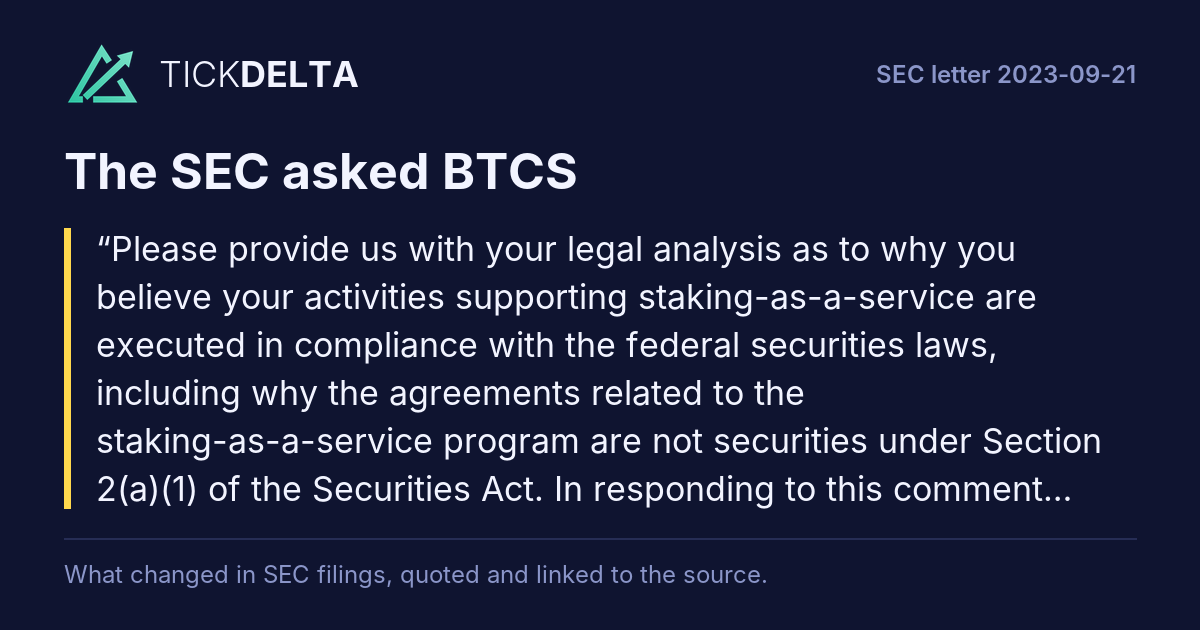
From a securities law perspective, the key question is whether a StaaS scheme or arrangement constitutes a “security.” The federal securities laws define the term security to include a variety of different assets.1 For purposes of an analysis of whether the non-custodial staking business of BTCS involves the sale or purchase of a security, the key statutory phrase is “investment contract.” Digital assets, or transactions involving digital assets, that are not plainly one of the other types of securities enumerated in Section 2(a)(1) of the Securities Act or Section 3(a)(10) of the Exchange Act may still be deemed to constitute part of an “investment contract” and, therefore, be considered securities by the SEC.2 test to determine whether a particular scheme would be considered an “investment contract” was established in SEC. v.
W.J. Howey Co., 328 U.S. 294 (1946), and has come to be known as the “Howey test”.3 The Howey test looks at whether the scheme involves:
(1) an investment of money;
(2) in a common enterprise;
(3) with the reasonable expectation of profits; and
(4) solely from the efforts of others. This last prong of the Howey test has been modified by subsequent case law to require an expectation of profits derived from the essential managerial efforts of others.4
Securities Act of 1933 (“Securities Act”), 15 U.S.C. § 77b(a)(1) (2023); Securities Exchange Act of 1934 (the
“Exchange Act”), 15 U.S.C. § 78c(10) (2023) (defining “security” and listing a variety of assets that are considered securities including an “investment contract”).
See SEC v. Edwards, 540 U.S. 389, 393 (2004) (defining an investment contract as a definition that “embodies a flexible rather than a static principle, one that is capable of adaptation to meet the countless and variable schemes devised by those who seek the use of the money of others on the promise of profits” (quoting SEC v. W.J. Howey Co., 328 U.S. 293, 299 (1946)).
SEC v. W.J. Howey Co., 328 U.S. 293, 301 (1946); see also SEC. v. Edwards, 540 U.S. 389, 393 (2004).
SEC v. Glenn W. Turner Enters., Inc., 474 F.2d 476, 482 (9th Cir. 1973).
All four elements of the Howey test must be present for a scheme to be considered an “investment contract” under this test. As detailed below the economic reality of BTCS’s non-custodial StaaS program does not meet any of the four elements of the
Howey test and does not create an investment contract.
I. Investment of Money
BTCS’s
StaaS service is non-custodial meaning BTCS never takes possession or has control of either a delegator’s staked crypto assets
(private keys) or the reward earned for staking their crypto assets so therefore does not involve an investment of money. In November
2022 BTCS submitted an inquiry to the SEC’s Strategic Hub for Innovation and Financial Technology (“FinHub”) which outlines three methods in which staking can be performed. See Schedule 1. The SEC was unable to provide guidance that having staking rewards “flow through” BTCS to delegators would not inadvertently create a security under the Howey test. As such
BTCS elected to implement non-custodial staking (aka Native staking) which clearly does not create a security under the Howey test.
While delegators use the assets they own, and give up alternative uses of those assets during the time they are staked, the opportunity cost of staking is not an investment. Unlike stakers in custodial platforms, those who use BTCS’s non-custodial StaaS retain full ownership and control over their crypto assets at all times, which means, by definition, there cannot be an investment. By contrast, in Howey, the investors had no custody of the orange grove they invested in. Instead the passive investors entered into a services contract with
W. J. Howey Co., and the primary risk they faced was not a breach of contract, but the financial risk of a failed enterprise. If the company failed in its management of the enterprise, or if other risks such as poor weather or a depressed orange market intervened, there would be insufficient oranges to sell to make up the investors’ losses. The investors were betting on the ability of the company to successfully grow and sell oranges at a profit meaning the company could perform every promised action and yet the investors could still face a loss. This analog does not exist with BTCS’s non-custodial StaaS model. Delegators are not betting on the success of BTCS or its StaaS platform as an enterprise. Delegators are using existing staking protocols to reap a benefit, which they could do directly or through a service provider as a convenience. While there is a risk that the service could fail to achieve the promised capabilities, that failure would be a breach of contract, not a failed investment.
Any rewards the users receive are not investment gains. Reward payouts are paid by the blockchain network directly to a delegator’s wallet and are simply the result of the successful performance of compliant validation in which the delegator participates, which is dictated by the blockchain protocol, not BTCS. There is neither the risk that the service provider will fail to make good choices about staking, nor that the provider failed to accurately predict and adjust for market events. There is only the risk that the provider did or did not comply with a prescribed set of rules. That is simple contractual risk—no different than the risk a company faces when hosting its website on Amazon Web Services, or what a car owner faces when trusting a vehicle to a mechanic, or what a homeowner faces in trusting the completion of renovations to a contractor. Such a simple contractual risk is not the type of risk the securities laws were intended to address.
Whether an investment of cash or other assets, the courts have agreed that there must be risk of financial loss. The “investment of money” prong narrows the types of financial risk that securities laws and regulations concern itself with. The risk of financial loss must be the type of loss that accompanies an investment and not the risk that every party to a contract faces when depending on the other party to perform its obligations under the contract. The risk of financial loss is simply absent from the use of BTCS StaaS validator nodes, and therefore only a contract for services exists. BTCS delegators can delegate and withdraw their supported native digital assets as they see fit, subject to the rules of the particular blockchain protocol. Because delegators always retain custody and control over their supported native digital assets (both staked and rewards) and can withdraw them from the BTCS StaaS arrangement at will there is no “investment of money.” Finally, in the event a BTCS creditor were to attempt to seize delegated assets, the creditor would only be successful in seizing BTCS’s own assets) because BTCS does not have custody of delegated assets. Moreover, creditors would not have a valid legal claim to delegated assets.
II. Common
Enterprise
There is no common enterprise among Delegators or between Delegators and BTCS with its StaaS service regardless of whether the definition of vertical or horizontal commonality is used.5
Investors in a common enterprise need the protections of the federal securities laws because the fate of their investment is tied to the fate of the enterprise—either through the seller, promoter, or third party. In many ways this analysis of vertical commonality is similar to the fourth prong of Howey described infra in Section IV below. This vulnerability is categorically different from the kind of routine counterparty risk that can be mitigated by ordinary commercial due diligence, and that is entirely independent of the counterparty risk faced by other customers of a provider. In the context of BTCS StaaS, BTCS does not take custody of delegator assets, meaning they are not joined together in the context of the Howey test, there is no horizontal commonalty, and therefore no “common enterprise.”
Users of native staking or non-custodial staking retain full authority over their assets, with the ability to unstake them, sell, hypothecate, vote, pledge, or otherwise dispose of them independently from the service provider and its other delegators. Since the assets belong to the user throughout, the failure of the entire staking service provider such as BTCS StaaS has no effect on the user’s property rights. The user would only need to find a new provider, or create the necessary set-up to engage in staking as an individual.
See Brodt v. Bache & Co., Inc., 595 F.2d 459, 461 (9th Cir. 1978) (noting that “vertical commonality requires that the investor and the promoter be involved in some common venture without mandating that other investors also be involved in that venture”); Revak v. SEC Realty Corp., 18 F.3d 81, 87 (2d Cir. 1994) (noting that horizontal commonalty involves “the tying of each individual investor’s fortunes to the fortunes of the other investors by the pooling of assets, usually combined with the pro-rata distribution of profits”).
rewards that delegators of BTCS StaaS receive are the same whether the delegators are using BTCS’s StaaS, another validator node, or staking on their own, and are unrelated to the performance of the service provider. The rewards are consideration for the performance of validation tasks and are generated and earned based on the blockchain protocol’s rules once a validator node successfully completes its validation task. Thus, users holding identical assets can expect similar staking rewards from the network because the protocol sets the rewards rates, as such those who individually stake can expect the same rewards from the protocol. Staking through a service provider like BTCS StaaS only increases convenience, not the rewards allocated by the blockchain protocol. Protocol-imposed reward rates do not change whether assets are pooled together, nor does it change whether a validator node is operated by a user or a service like BTCS.
Likewise, the amount of assets staked by a particular node does not increase the reward rate per asset—i.e., the protocol does not pay escalating rewards for staking more assets. Moreover, there is no pooling of rewards even for a brief time so investors are not exposed to risk of reward loss due to BTCS misappropriating the assets or risk from a BTCS creditor.
III. Expectation of Profits expectation of profits prong of the Howey test is met when there is either capital appreciation resulting from the development of the initial investment or a participation in earnings resulting from the use of investors’ funds.
Howey test’s definition of “profits” was initially limited to capital appreciation resulting from a purely monetary investment.6 The Supreme Court’s decision in Tcherepnin however modified the definition to include the expectation of profits through the receipt of dividends.7 In Tcherepnin, the Court determined that the expectation of profit prong of the Howey test was satisfied by the fact that the holders of capital shares in a savings and loan association were paid dividends “tied directly to the amount of profits [the savings and loan] makes from year to year.”8 Because these dividends were an apportionment of the profits made by the venture in which the individuals had invested, the dividends were considered profits for purposes of the Howey test.9 non-custodial StaaS fails the “expectation of profit” prong because the rewards the delegators receive are just payment for ministerial services rendered. Unlike the dividends in Tcherepnin there is no investment of money (value) into capital stock or a common enterprise so there can be no prorated right to any payments on profits. Payment for services is not an expectation of profits.
The Howey decision closely tracked the only analogous precedent existing at the time, SEC v. C.M. Joiner Leasing Corp.,
320 U.S. 344 (1943). There, the Court determined that the profits anticipated by purchasers of fractional interests in oil leases were to come from capital appreciation, resulting from the development of the individuals’ initial capital investment. See, C.M.
Joiner Leasing Corp., 320 U.S. at 351.
Tcherepnin v. Knight, 389 U.S. 332, 339 (1967).
Id.
Id. But see, United Hous. Found., Inc. v. Forman, 421 U.S. 837, 858 (1975) (finding that the “stock” held by individuals in a housing cooperative failed to satisfy expectation of profits prong of the Howey test because individuals were attracted to purchase it by the prospect of acquiring a place to live, rather than the prospect of receiving a financial return on their investment, thus, the Court held that federal securities laws do not apply when investors purchase investment contracts with the expectation of personally consuming or using the interest acquired).
As previously described, the purpose of staking is to provide a validation mechanism for a blockchain network or protocol. The rewards are consideration paid for the validation services the asset owner provides by staking those assets. Those rewards are not returns on investment;
instead, they are service fees, set by the blockchain protocol, and remain the same regardless of whether the customer stakes on their own or through a service. With BTCS’s non-custodial staking, the consideration a delegator receives directly from the blockchain network is for services provided, which is not a reasonable expectation of a return on investment, but a fee paid for performing a job.
Financial risk is one of the reasons that “expectation of profit” is one of the prongs of the Howey test. An investor in a security needs information about the issuer and the planned enterprise to know whether that enterprise is likely to succeed and produce a profit.
The investor takes a risk on the enterprise, preferably an informed one, based on mandatory disclosures. Delegators of BTCS’s non-custodial staking model take no such enterprise risk. There is no need to evaluate the likely success or failure of BTCS’s business plan or its StaaS platform. Thus, staking rewards are paid directly by the blockchain network to each delegator and are not the “profits” envisioned by the Howey test.
IV. Efforts of Others native non-custodial StaaS entails ministerial efforts and not the managerial efforts of others or BTCS. To satisfy this prong of the
Howey test investors must rely on the “efforts of others” and, as later courts have held, those efforts must be characterized as “undeniably significant ones, those essential managerial efforts which affect the failure or success of the enterprise.”10
Those that are merely ministerial or administrative do not rise to the level required to satisfy this prong.11 example, in SEC v. Life Partners., Inc., the SEC contended that Life Partners, Inc. (“Life Partners”) violated the
Securities Act and the Exchange Act by selling viatical settlement contracts without complying with registration rules under both Acts.12
The court concluded that the contracts were not securities under the Howey test, specifically under the fourth prong: that the profits be generated from the efforts of others.13 While Life Partners had the ability to substitute itself as the beneficiary of the viatical settlement contract after the policy was purchased, the court determined that no efforts by Life Partners could affect an investor’s rate of return because the “exclusive determinant” of an investor’s rate of return was how long the insured lived.14 Ergo, Life Partners could only affect an investor’s profits if it misappropriated funds or failed to perform post-purchase ministerial functions such as “holding the policy, monitoring the insured’s health, paying premiums, converting a group policy into an individual policy where required, filing the death claim, collecting and distributing the death benefit
(if requested), and assisting an investor who might wish to resell his interest,” all of which Life Partners described as “clerical and routine” functions.15 Notably, all of the above-described functions could be done by the investors individually without Life Partners’ involvement.16 Thus, the court determined that the ministerial functions Life Partners performed for investors could not be actions that have an influence on an investor’s profits under the Howey test.17
Framework for “Investment Contract” Analysis of Digital Assets, Strat.
Hub for Innovation & Fin. Tech. of the SEC, https://www.sec.gov/corpfin/framework-investment-contract-analysis-digital-assets
(last visited Oct. 3, 2023) (stating that the analysis of whether purchasers of digital assets rely on the “efforts of others” hinges on whether the efforts are “essential managerial efforts which affect the failure or success of the enterprise” not ones that are “ministerial in nature”); see also SEC v. Life Partners, Inc., 87 F.3d 536, 545 (D.C. Cir. 1996) (noting that “purely ministerial” functions do not meet the threshold for managerial efforts under the Howey test, and “[i]ndeed, quite the opposite is true”).
SEC v. Life Partners, Inc., 87 F.3d 536, 537-38 (D.C. Cir. 1996).
Id. at 538.
Id. at 545.
Id. at 545-46.
Id. at 548.
Native non-custodial staking service providers such as BTCS exert no discretion and have no authority to deviate from the terms of the service.
There is no obligation or discretion for the service provider to seek out the best opportunities and there is no need to build trust through disclosures mandated by securities laws. There is therefore no need for the types of disclosures securities laws require for an investor to understand how discretion would be used, such as the key people making the decisions, their backgrounds, the result of their decisions thus far, and their plans for the future. This type of information, designed to help investors decide whether to trust individuals to make good use of their money and generate profit, is not relevant in the context of BTCS native non-custodial staking services. Any protections consumers may need, such as clear terms of service and recourse under contract law if the terms are violated, fall outside the SEC’s authority and outside the scope of securities laws.
Lastly, we recognize and note to the Staff that other companies have used the same “staking-as-a-service” terminology to describe their custodial staking activities which is muddying the waters and doing a disservice to companies like BTCS, the crypto industry, the general public, and regulators. On June 6, 202318 we addressed our concern in a press release which we encourage the Staff to review as a supplement to our responses herein to better understand the critical differences in the business models.