Form 10-K for the Fiscal Year Ended December 31, 2022
Please provide us with your legal analysis as to why you believe your activities supporting staking-as-a-service are executed in compliance with the federal securities laws, including why the agreements related to the staking-as-a-service program are not securities under Section 2(a)(1) of the Securities Act. In responding to this comment, please include a materially complete description of the program.
Staking as a Service Program Overview uses its blockchain infrastructure to operate validator nodes on various proof of stake-based blockchain networks. In connection with the validation of transactions occurring on those blockchain networks, BTCS stakes digital assets native to those blockchains in order to earn staking rewards. BTCS also uses its blockchain infrastructure to validate and sign transactions on behalf of customers that delegate their validation to BTCS-operated validator nodes (referred to as “Staking as a Service” or “StaaS”).Read in the reply ↗Rest of the answer
Unlike
Coinbase and Kraken, BTCS does not take custody and pool customer crypto assets or customer crypto rewards; rewards are sent directly to customers by the respective blockchain network and are never in BTCS’s possession. Similarly, BTCS, unlike Coinbase and Kraken, only offers StaaS for delegated proof of stake blockchains, not proof of stake blockchains like Ethereum. While BTCS does stake Ethereum which is a proof of stake blockchain it only does so with its own crypto assets. The key differentiating factor is that BTCS does not take possession of users’ private “keys” or “crypto” as further detailed herein.
Securities and Exchange Commission
October 16, 2023
StaaS providers are operators of computer infrastructure and validation software that allow them and their delegators (collectively, the “Delegators” and each, a “Delegator” or as may be referred to herein as “clients”, “customers” or “users”), to stake certain blockchain-based digital assets native to blockchain networks (“native digital assets”) utilizing a delegated
Proof of Stake (“dPoS”) consensus protocol. dPoS protocols provide for the validation of transactions on the related network as well as a “sybil resistance” mechanism to help secure the network.
The nodes comprising a blockchain network use a protocol (or set of rules) to reach an agreement as to whether a given transaction proposed by a user of the network is valid under the rules of the protocol and should be added to the ledger (such agreement being referred to as “consensus”). Protocols typically group transactions into blocks that can only be added to the common ledger when validated by a sufficient percentage of a dispersed network of unrelated computers or servers called “nodes” in the network. A complete record (or “blockchain”) is maintained on the ledger by adding these groups (or “blocks”) of transactions to the chain, and the nodes constantly automatically monitor the blocks to ensure record accuracy.
dPoS networks rely on validators who own native digital assets and operate nodes for the network to confirm the validity of the transactions comprising each block to be added to the network ledger. The dPoS protocol software run by the relevant network nodes generally determines the validator node for each block at random, though each blockchain may have differing selection criteria. To be eligible to validate transactions and to mint new blocks to the chain, validators are required to “stake” the relevant native digital assets whereby validators commit value (in the form of the native digital asset) to the underlying network and lock their native digital assets, preventing them from otherwise transacting with those native digital assets while they are staked. The dPoS mechanism is a sybil-resistance tool
(fights against attacks on nodes) that incentivizes validators to confirm transactions that conform to the rules of the protocol at the risk of losing their staked assets (“slashing”). Validators utilizing their native digital assets to participate in dPoS protocols secure the relevant network and receive staking rewards for doing so.
Validators in a dPoS network collect newly minted native digital assets and sometimes receive other transaction fees for the blocks they validate.
These “rewards” in the dPoS network encourage validators to participate in the network and thereby help to secure and decentralize the network.
A
StaaS provider maintains a ministerial role in validating transactions on a given dPoS network on behalf of its delegators by (1) arranging transactions using open-source software to stake the relevant digital assets; (2) monitoring the nodes it is operating to ensure the computers remain online to validate transactions; and (3) verifying transactions on the network when required.
Depending on the dPoS network, a holder of native digital assets can generally participate in staking in three different ways: (1) act as principal, staking their own digital assets as collateral ; (2) delegate their ability to participate in transaction validation to a third-party
StaaS provider, such as BTCS, allowing the provider to validate new transaction blocks on the underlying network; or (3) give custody of their digital assets to a provider (e.g., Coinbase or Kraken), who then acts as principal to stake the assets and validate transactions on the owner’s behalf.
does not take custody of native digital assets on behalf of clients in connection with providing StaaS and all delegated assets are subject to the rules of the respective blockchain.
Law Analysis
From a securities law perspective, the key question is whether a StaaS scheme or arrangement constitutes a “security.” The federal securities laws define the term security to include a variety of different assets.1 For purposes of an analysis of whether the non-custodial staking business of BTCS involves the sale or purchase of a security, the key statutory phrase is “investment contract.” Digital assets, or transactions involving digital assets, that are not plainly one of the other types of securities enumerated in Section 2(a)(1) of the Securities Act or Section 3(a)(10) of the Exchange Act may still be deemed to constitute part of an “investment contract” and, therefore, be considered securities by the SEC.2 test to determine whether a particular scheme would be considered an “investment contract” was established in SEC. v.
W.J. Howey Co., 328 U.S. 294 (1946), and has come to be known as the “Howey test”.3 The Howey test looks at whether the scheme involves:
(1) an investment of money;
(2) in a common enterprise;
(3) with the reasonable expectation of profits; and
(4) solely from the efforts of others. This last prong of the Howey test has been modified by subsequent case law to require an expectation of profits derived from the essential managerial efforts of others.4
Securities Act of 1933 (“Securities Act”), 15 U.S.C. § 77b(a)(1) (2023); Securities Exchange Act of 1934 (the
“Exchange Act”), 15 U.S.C. § 78c(10) (2023) (defining “security” and listing a variety of assets that are considered securities including an “investment contract”).
See SEC v. Edwards, 540 U.S. 389, 393 (2004) (defining an investment contract as a definition that “embodies a flexible rather than a static principle, one that is capable of adaptation to meet the countless and variable schemes devised by those who seek the use of the money of others on the promise of profits” (quoting SEC v. W.J. Howey Co., 328 U.S. 293, 299 (1946)).
SEC v. W.J. Howey Co., 328 U.S. 293, 301 (1946); see also SEC. v. Edwards, 540 U.S. 389, 393 (2004).
SEC v. Glenn W. Turner Enters., Inc., 474 F.2d 476, 482 (9th Cir. 1973).
All four elements of the Howey test must be present for a scheme to be considered an “investment contract” under this test. As detailed below the economic reality of BTCS’s non-custodial StaaS program does not meet any of the four elements of the
Howey test and does not create an investment contract.
I. Investment of Money
BTCS’s
StaaS service is non-custodial meaning BTCS never takes possession or has control of either a delegator’s staked crypto assets
(private keys) or the reward earned for staking their crypto assets so therefore does not involve an investment of money. In November
2022 BTCS submitted an inquiry to the SEC’s Strategic Hub for Innovation and Financial Technology (“FinHub”) which outlines three methods in which staking can be performed. See Schedule 1. The SEC was unable to provide guidance that having staking rewards “flow through” BTCS to delegators would not inadvertently create a security under the Howey test. As such
BTCS elected to implement non-custodial staking (aka Native staking) which clearly does not create a security under the Howey test.
While delegators use the assets they own, and give up alternative uses of those assets during the time they are staked, the opportunity cost of staking is not an investment. Unlike stakers in custodial platforms, those who use BTCS’s non-custodial StaaS retain full ownership and control over their crypto assets at all times, which means, by definition, there cannot be an investment. By contrast, in Howey, the investors had no custody of the orange grove they invested in. Instead the passive investors entered into a services contract with
W. J. Howey Co., and the primary risk they faced was not a breach of contract, but the financial risk of a failed enterprise. If the company failed in its management of the enterprise, or if other risks such as poor weather or a depressed orange market intervened, there would be insufficient oranges to sell to make up the investors’ losses. The investors were betting on the ability of the company to successfully grow and sell oranges at a profit meaning the company could perform every promised action and yet the investors could still face a loss. This analog does not exist with BTCS’s non-custodial StaaS model. Delegators are not betting on the success of BTCS or its StaaS platform as an enterprise. Delegators are using existing staking protocols to reap a benefit, which they could do directly or through a service provider as a convenience. While there is a risk that the service could fail to achieve the promised capabilities, that failure would be a breach of contract, not a failed investment.
Any rewards the users receive are not investment gains. Reward payouts are paid by the blockchain network directly to a delegator’s wallet and are simply the result of the successful performance of compliant validation in which the delegator participates, which is dictated by the blockchain protocol, not BTCS. There is neither the risk that the service provider will fail to make good choices about staking, nor that the provider failed to accurately predict and adjust for market events. There is only the risk that the provider did or did not comply with a prescribed set of rules. That is simple contractual risk—no different than the risk a company faces when hosting its website on Amazon Web Services, or what a car owner faces when trusting a vehicle to a mechanic, or what a homeowner faces in trusting the completion of renovations to a contractor. Such a simple contractual risk is not the type of risk the securities laws were intended to address.
Whether an investment of cash or other assets, the courts have agreed that there must be risk of financial loss. The “investment of money” prong narrows the types of financial risk that securities laws and regulations concern itself with. The risk of financial loss must be the type of loss that accompanies an investment and not the risk that every party to a contract faces when depending on the other party to perform its obligations under the contract. The risk of financial loss is simply absent from the use of BTCS StaaS validator nodes, and therefore only a contract for services exists. BTCS delegators can delegate and withdraw their supported native digital assets as they see fit, subject to the rules of the particular blockchain protocol. Because delegators always retain custody and control over their supported native digital assets (both staked and rewards) and can withdraw them from the BTCS StaaS arrangement at will there is no “investment of money.” Finally, in the event a BTCS creditor were to attempt to seize delegated assets, the creditor would only be successful in seizing BTCS’s own assets) because BTCS does not have custody of delegated assets. Moreover, creditors would not have a valid legal claim to delegated assets.
II. Common
Enterprise
There is no common enterprise among Delegators or between Delegators and BTCS with its StaaS service regardless of whether the definition of vertical or horizontal commonality is used.5
Investors in a common enterprise need the protections of the federal securities laws because the fate of their investment is tied to the fate of the enterprise—either through the seller, promoter, or third party. In many ways this analysis of vertical commonality is similar to the fourth prong of Howey described infra in Section IV below. This vulnerability is categorically different from the kind of routine counterparty risk that can be mitigated by ordinary commercial due diligence, and that is entirely independent of the counterparty risk faced by other customers of a provider. In the context of BTCS StaaS, BTCS does not take custody of delegator assets, meaning they are not joined together in the context of the Howey test, there is no horizontal commonalty, and therefore no “common enterprise.”
Users of native staking or non-custodial staking retain full authority over their assets, with the ability to unstake them, sell, hypothecate, vote, pledge, or otherwise dispose of them independently from the service provider and its other delegators. Since the assets belong to the user throughout, the failure of the entire staking service provider such as BTCS StaaS has no effect on the user’s property rights. The user would only need to find a new provider, or create the necessary set-up to engage in staking as an individual.
See Brodt v. Bache & Co., Inc., 595 F.2d 459, 461 (9th Cir. 1978) (noting that “vertical commonality requires that the investor and the promoter be involved in some common venture without mandating that other investors also be involved in that venture”); Revak v. SEC Realty Corp., 18 F.3d 81, 87 (2d Cir. 1994) (noting that horizontal commonalty involves “the tying of each individual investor’s fortunes to the fortunes of the other investors by the pooling of assets, usually combined with the pro-rata distribution of profits”).
rewards that delegators of BTCS StaaS receive are the same whether the delegators are using BTCS’s StaaS, another validator node, or staking on their own, and are unrelated to the performance of the service provider. The rewards are consideration for the performance of validation tasks and are generated and earned based on the blockchain protocol’s rules once a validator node successfully completes its validation task. Thus, users holding identical assets can expect similar staking rewards from the network because the protocol sets the rewards rates, as such those who individually stake can expect the same rewards from the protocol. Staking through a service provider like BTCS StaaS only increases convenience, not the rewards allocated by the blockchain protocol. Protocol-imposed reward rates do not change whether assets are pooled together, nor does it change whether a validator node is operated by a user or a service like BTCS.
Likewise, the amount of assets staked by a particular node does not increase the reward rate per asset—i.e., the protocol does not pay escalating rewards for staking more assets. Moreover, there is no pooling of rewards even for a brief time so investors are not exposed to risk of reward loss due to BTCS misappropriating the assets or risk from a BTCS creditor.
III. Expectation of Profits expectation of profits prong of the Howey test is met when there is either capital appreciation resulting from the development of the initial investment or a participation in earnings resulting from the use of investors’ funds.
Howey test’s definition of “profits” was initially limited to capital appreciation resulting from a purely monetary investment.6 The Supreme Court’s decision in Tcherepnin however modified the definition to include the expectation of profits through the receipt of dividends.7 In Tcherepnin, the Court determined that the expectation of profit prong of the Howey test was satisfied by the fact that the holders of capital shares in a savings and loan association were paid dividends “tied directly to the amount of profits [the savings and loan] makes from year to year.”8 Because these dividends were an apportionment of the profits made by the venture in which the individuals had invested, the dividends were considered profits for purposes of the Howey test.9 non-custodial StaaS fails the “expectation of profit” prong because the rewards the delegators receive are just payment for ministerial services rendered. Unlike the dividends in Tcherepnin there is no investment of money (value) into capital stock or a common enterprise so there can be no prorated right to any payments on profits. Payment for services is not an expectation of profits.
The Howey decision closely tracked the only analogous precedent existing at the time, SEC v. C.M. Joiner Leasing Corp.,
320 U.S. 344 (1943). There, the Court determined that the profits anticipated by purchasers of fractional interests in oil leases were to come from capital appreciation, resulting from the development of the individuals’ initial capital investment. See, C.M.
Joiner Leasing Corp., 320 U.S. at 351.
Tcherepnin v. Knight, 389 U.S. 332, 339 (1967).
Id.
Id. But see, United Hous. Found., Inc. v. Forman, 421 U.S. 837, 858 (1975) (finding that the “stock” held by individuals in a housing cooperative failed to satisfy expectation of profits prong of the Howey test because individuals were attracted to purchase it by the prospect of acquiring a place to live, rather than the prospect of receiving a financial return on their investment, thus, the Court held that federal securities laws do not apply when investors purchase investment contracts with the expectation of personally consuming or using the interest acquired).
As previously described, the purpose of staking is to provide a validation mechanism for a blockchain network or protocol. The rewards are consideration paid for the validation services the asset owner provides by staking those assets. Those rewards are not returns on investment;
instead, they are service fees, set by the blockchain protocol, and remain the same regardless of whether the customer stakes on their own or through a service. With BTCS’s non-custodial staking, the consideration a delegator receives directly from the blockchain network is for services provided, which is not a reasonable expectation of a return on investment, but a fee paid for performing a job.
Financial risk is one of the reasons that “expectation of profit” is one of the prongs of the Howey test. An investor in a security needs information about the issuer and the planned enterprise to know whether that enterprise is likely to succeed and produce a profit.
The investor takes a risk on the enterprise, preferably an informed one, based on mandatory disclosures. Delegators of BTCS’s non-custodial staking model take no such enterprise risk. There is no need to evaluate the likely success or failure of BTCS’s business plan or its StaaS platform. Thus, staking rewards are paid directly by the blockchain network to each delegator and are not the “profits” envisioned by the Howey test.
IV. Efforts of Others native non-custodial StaaS entails ministerial efforts and not the managerial efforts of others or BTCS. To satisfy this prong of the
Howey test investors must rely on the “efforts of others” and, as later courts have held, those efforts must be characterized as “undeniably significant ones, those essential managerial efforts which affect the failure or success of the enterprise.”10
Those that are merely ministerial or administrative do not rise to the level required to satisfy this prong.11 example, in SEC v. Life Partners., Inc., the SEC contended that Life Partners, Inc. (“Life Partners”) violated the
Securities Act and the Exchange Act by selling viatical settlement contracts without complying with registration rules under both Acts.12
The court concluded that the contracts were not securities under the Howey test, specifically under the fourth prong: that the profits be generated from the efforts of others.13 While Life Partners had the ability to substitute itself as the beneficiary of the viatical settlement contract after the policy was purchased, the court determined that no efforts by Life Partners could affect an investor’s rate of return because the “exclusive determinant” of an investor’s rate of return was how long the insured lived.14 Ergo, Life Partners could only affect an investor’s profits if it misappropriated funds or failed to perform post-purchase ministerial functions such as “holding the policy, monitoring the insured’s health, paying premiums, converting a group policy into an individual policy where required, filing the death claim, collecting and distributing the death benefit
(if requested), and assisting an investor who might wish to resell his interest,” all of which Life Partners described as “clerical and routine” functions.15 Notably, all of the above-described functions could be done by the investors individually without Life Partners’ involvement.16 Thus, the court determined that the ministerial functions Life Partners performed for investors could not be actions that have an influence on an investor’s profits under the Howey test.17
Framework for “Investment Contract” Analysis of Digital Assets, Strat.
Hub for Innovation & Fin. Tech. of the SEC, https://www.sec.gov/corpfin/framework-investment-contract-analysis-digital-assets
(last visited Oct. 3, 2023) (stating that the analysis of whether purchasers of digital assets rely on the “efforts of others” hinges on whether the efforts are “essential managerial efforts which affect the failure or success of the enterprise” not ones that are “ministerial in nature”); see also SEC v. Life Partners, Inc., 87 F.3d 536, 545 (D.C. Cir. 1996) (noting that “purely ministerial” functions do not meet the threshold for managerial efforts under the Howey test, and “[i]ndeed, quite the opposite is true”).
SEC v. Life Partners, Inc., 87 F.3d 536, 537-38 (D.C. Cir. 1996).
Id. at 538.
Id. at 545.
Id. at 545-46.
Id. at 548.
Native non-custodial staking service providers such as BTCS exert no discretion and have no authority to deviate from the terms of the service.
There is no obligation or discretion for the service provider to seek out the best opportunities and there is no need to build trust through disclosures mandated by securities laws. There is therefore no need for the types of disclosures securities laws require for an investor to understand how discretion would be used, such as the key people making the decisions, their backgrounds, the result of their decisions thus far, and their plans for the future. This type of information, designed to help investors decide whether to trust individuals to make good use of their money and generate profit, is not relevant in the context of BTCS native non-custodial staking services. Any protections consumers may need, such as clear terms of service and recourse under contract law if the terms are violated, fall outside the SEC’s authority and outside the scope of securities laws.
Lastly, we recognize and note to the Staff that other companies have used the same “staking-as-a-service” terminology to describe their custodial staking activities which is muddying the waters and doing a disservice to companies like BTCS, the crypto industry, the general public, and regulators. On June 6, 202318 we addressed our concern in a press release which we encourage the Staff to review as a supplement to our responses herein to better understand the critical differences in the business models.
We note that in separate SEC complaints, the SEC identified Cardano, Tezos, Solana, Cosmos, Polygon, Axie Infinity, and NEAR Protocol crypto assets as securities. In future filings, please include a detailed discussion regarding the impact this may have on your business, financial condition and results of operation.
In future filings, we will include the following disclosure substantially in the form below:
“We note that in separate SEC complaints, the SEC has alleged several crypto assets we hold, specifically Cardano, Tezos, Solana, Cosmos,
Polygon, Axie Infinity, and NEAR Protocol are securities. The Company has conducted a detailed legal analysis which has led us to determine that certain crypto assets that are identified as securities by the SEC would not impact our business, financial condition, and results of operations.”Read in the reply ↗Rest of the answer
https://www.globenewswire.com/news-release/2023/06/06/2683119/0/en/BTCS-Addresses-Recent-SEC-Action-Against-Coinbase-and-Clarifies-its-Non-Custodial-Staking-Operations.html following analysis has led us to determine that certain crypto assets that are identified by the SEC as securities would not impact our business, financial condition, and results of operations as noted above in the form of future disclosure.
Law Identification of Certain Digital Assets and Impacts to Our Business the SEC views many, if not all, digital assets as securities19 as noted in a letter from the SEC’s Investor Advisory
Committee (“IAC”) to chairman Gary Gensler dated April 6, 2023, “We believe that virtually all, if not all, crypto tokens are securities and that they, as well as the platforms and custodians dealing with them, are subject to regulation under the federal securities laws to protect investors.”20 This analysis focuses on the activities the Company engages or may engage in with respect to certain digital assets (Cardano, Tezos, Solana, Cosmos, Polygon, Axie Infinity, and NEAR Protocol) that the SEC has alleged are securities.
Company through its validator node operations does not take custody of delegators’ staked assets. Accordingly, the laws and rules that relate to the custody of securities would not be implicated by the operation of non-custodial validator nodes even if the underlying assets being staked are deemed securities by a U.S. regulator or court. In addition, the laws and rules imposing securities custody obligations generally only apply to specific types of securities intermediaries and are designed to ensure that customer assets are protected in the event that such an intermediary fails.21 The Company’s operations do not involve custody and do not involve a participant that meets the definition of a broker-dealer or any other type of securities intermediary.
broker is defined as “any person engaged in the business of effecting transactions in securities for the account of others.”22
The definition of a broker is comprised of three components, all of which must be met in order to meet the definition: engaged in the business, effecting transactions, in securities.23 We assume for this analysis that a U.S. regulator has identified the supported digital asset as a security, and such alleged identification has not been overturned by the courts, therefore we focus on the first two elements of the broker definition.
See Gary Gensler, Remarks Before the Aspen Security Form (Aug. 3, 2021), available at https://www.sec.gov/news/public-statement/gensler-aspen-security-forum-2021-08-03;
See also Jay Clayton, Testimony United States Senate Committee on Banking, Housing, And Urban Affairs, “Virtual Currencies:
The Oversight Role of the U.S. Securities and Exchange Commission and the U.S. Commodity Futures Trading Commission” (Feb. 6, 2018), available at https://www.banking.senate.gov/hearings/virtual-currencies-the-oversight-role-of-the-us-securities-and-exchange-commission-and-the-us-commodity-futures-trading-commission https://www.sec.gov/files/20230406-iac-letter-cryptocurrency.pdf
See the Customer Protection Rule, Rule 15c3-3 under the Securities Exchange Act of 1934, with respect to broker-dealer custody obligations, the Custody Rule, Rule 206(4)-2 under the Investment Advisors Act of 1940 with respect to investment adviser custody obligations, and Section 17(f) of the Investment Company Act with respect to custody obligations of registered investment companies.
15 U.S.C. § 78c(a)(4).
person who engages in regular activity involving securities transactions and who receives transaction-based compensation or who holds themselves out as a broker-dealer or as someone who will assist others with securities transactions might be deemed to be “engaged in the business.”24 There are a number of factors relevant to this analysis, which include: (i) the number of transactions and clients that are serviced, (ii) the total dollar value of securities transacted, (iii) the level of compensation associated with those transactions, and (iv) whether securities transactions were solicited.25 One of the key components to this analysis is the receipt of transaction-based compensation.
person involved in key points in the chain of distribution may be deemed to be “effecting transactions.”26 The focus is on the activities of the person or entity in the chain of distribution. The SEC and Federal courts have identified a variety of factors relevant to the analysis which include whether the person was: (i) actively soliciting or finding investors, (ii) providing advice regarding the merits of an investment, (iii) handling customer funds or securities, (iv) participating in the order taking or order routing process, (v) an employee of the issuer, (vi) paid commissions for the sale of securities rather than a salary, and (vii) involved in the negotiations between issuer and investor.27 transactions in supported native digital assets occurring in connection with rewards do not resemble the types of transactions in securities generally expected to be captured by the broker-dealer definition. They are not purchases or sales of securities from one securities holder to another. Instead, they are allocations of assets that occur programmatically by design whereby a protocol emits the asset and sends it to a pre-designated blockchain address. These transfers of assets occur in connection with the performance of a service to the relevant blockchain network and not because there has been a purchase or sale transaction. Accordingly, to treat native validator node operations as someone engaged in the business of effecting transaction in securities would be a significant expansion of the definition of broker as it is currently understood.
We note BTCS does not do any of the following: (i) provide advice regarding the merits of an investment, (ii) handle customer funds or securities,
(iii) participate in the order-taking or order-routing process, (iv) be an employee of the issuer, and (v) be involved in negotiations between issuer and investor. In addition, as described above the potential transactions at issue are programmatic transfers of digital assets that will happen without the involvement of the Company.
See, e.g., Cornhusker Energy Lexington, LLC v. Prospect St. Ventures, 2006 U.S. Dist. LEXIS 68959, 2006 WL 2620985, *6 (D.
Neb. 2006).
See, e.g., S.E.C. v. Hansen, 1984 U.S. Dist. LEXIS 17835, 1984 WL 2413, *10 (S.D.N.Y. 1984),
See, e.g., S.E.C. v. Bravata, 2009 U.S. Dist. LEXIS 64609, 2009 WL 2245649, *2 (E.D. Mich. 2009).
See, e.g., BondGlobe, Inc., 2001 SEC No-Act. Lexis 140 (Feb. 6, 2001) and SEC v. Collyard, 154 F. Supp. 3d 781, 787-90
(D. Minn. 2015).
Thus, we fail to see how the service BTCS provided involves “effecting transactions.” Further, Company validator nodes do not allow for the exchange or trading of any digital assets. Accordingly, even if one or more supported digital assets are deemed to be securities by a U.S. regulator or more importantly by the courts, the Company would not be obligated to register as a national securities exchange, or come within an exemption to such registration, nor would it be obligated to register as a transfer agent or clearing agency. BTCS’s role is more akin to that of a service provider that supplies computer hardware or software used in the securities transaction process.
Except as noted in response to comments #8 and #9 we do not believe that the identification of digital assets as securities will have any impact on our business.
Law Identification of Certain Digital Assets Effects on our Financial Condition.
will enhance our disclosure substantially in the form below to reflect that the SEC identifying certain digital assets as securities may impact the market price of those digital assets which could result in a decrease in the fair market value of such assets.
“The
SEC identifying certain crypto assets as securities may impact the market price of those crypto assets which could result in a decrease in the fair market value of such crypto assets. To the extent we hold crypto assets allegedly identified as securities by the SEC, it could have a material adverse effect on our business and our stock price.”
Law Identification of Certain Digital Assets Effects on our Results of Operations.
Even if a digital asset is identified as a security by the SEC the accounting for such digital asset for the purpose of financial reporting would be based on the definition of a security provided by FASB under its Accounting Standards Codification master glossary (“ASC”).
Provided, however, such codification would take into consideration SEC staff interpretations or Staff Accounting Bulletins, though we are currently unaware of any such SEC staff guidance with respect to utilizing fair market accounting for digital assets that are alleged to be securities. The ASC defines a security as follows (definition 2 is relevant to this analysis):
Company considered the characteristics listed above which admittedly are directed towards the traditional securities such as equities and bonds. The Company believes that certain of the characteristics may be present at the onset of certain digital asset initial coin offerings because the digital assets are more closely linked to the entity or small group of entities supporting the blockchain. However, over time, the goal is for the blockchain to be decentralized and, as a result, would not be linked to the profits of a single entity or small group of entities but rather the overall performance of the blockchain and its participants. As noted above, the Howey Test actually anticipates that the digital asset being tested may in fact start out as a security under the SEC regulations but then subsequently no longer meet the definition of a security under those same rules. For example, if the promoter in Howey sold the orange grove to a real estate developer three years after offering the securities, it obviously was not engaged in the sale of a security.
Company believes that the definition of a security used by the SEC is intended to determine what regulations are applicable (that is, what type of risk factors are present for disclosure and the appropriate level of sophistication of a potential buyer) rather than conclude upon the appropriate accounting for the digital asset. As a result, the Company believes that a conclusion that a digital asset meets the definition of a security pursuant to SEC identification does not automatically lead to a conclusion that the digital asset is a security pursuant to U.S. GAAP. Further, the Company believes that the determination of whether a digital asset meets the definition of a security under U.S. GAAP should take into account whether the digital asset will meet the definition of a security throughout the life of the digital asset. Said differently, a digital asset would only be considered a security under U.S. GAAP if it was determined that the digital asset will meet the definition over the life of the digital asset. In contrast, debt securities are considered securities until they are extinguished, mature, or are modified. Equity securities remain securities until they are redeemed or repurchased by the issuing entity. The notion that a digital asset will become less like a security as time passes and the blockchain decentralizes is not consistent with how instruments that meet the definition of a security behave. Usually, there is a specific event (maturity, modification, redemption, etc.) that leads to a change or reconsideration though in most instances the change is the expiration or replacement of the security.
Consequently, the Company believes that the fact that a digital asset may eventually not represent a participation in property or an entity (and actually is designed to become decentralized) is not consistent with the definition of a security pursuant to U.S. GAAP.
The Company believes that integral to meeting the definition of a security is the notion that the interest being analyzed will always meet the definition over its life.
additional support for this position, the Company considered a situation where a conclusion was reached where the digital assets meet the definition of a security pursuant to U.S. GAAP. Since these digital assets are not obligations, the digital assets would be considered some form of equity-like ownership and presumably would be carried at fair value with changes in fair value recorded in earnings. Based on this fact pattern, the Company notes the following:
● The accounting for an equity security does not contemplate instances where an equity security may no longer be an equity security. Generally, any features that are not consistent with an equity instrument are addressed at the inception of an equity security and accounted for accordingly. Consequently, a subsequent conclusion that an equity security no longer meets the definition of a security would appear to be an error (that is, the Company did not apply the appropriate accounting at the inception of the instrument) and, to the extent material, would result in a restatement. Accounting for the digital asset as an indefinite-lived intangible using the lower of cost or market measurement approach is more representationally faithful of the nature of the digital asset, until such time as FASB’s new guidance is adopted.
● Generally, the only time that digital assets are measured at fair value with changes in fair value recorded in earnings is when the reporting entity applies specialized industry accounting (that is, the reporting entity is either (a) a broker-dealer subject to the AICPA Broker Dealer Guide, or (b) meets the definition of an investment company). The Company is not subject to specialized industry accounting and does not meet the definition of an investment company as noted herein.
Company concluded that despite certain digital assets being identified as securities by the SEC they do not meet the definition of a security under U.S. GAAP pursuant to ASC because the decentralization of the blockchains will result in the participation of the digital assets no longer being linked to participation in property or an entity. As a result, and absent definitive guidance, the Company has taken a conservative approach of accounting for alleged digital asset securities consistent with its accounting for other digital assets
– indefinite-lived intangible assets recorded at the lower of cost or market subject to impairment testing.
We note your current report filed on Form 8-K on June 29, 2023 indicating that on June 29, 2023, you listed your Series V Preferred Stock on Upstream. Please tell us whether U.S. investors are able to buy or sell these shares on Upstream. In that regard we note that your current report includes instructions for U.S. based Preferred Stock holders to deposit and trade their shares with Upstream. If U.S.Rest of the question
investors are not permitted to buy and sell your Series V Preferred Stock on Upstream please explain to us, in sufficient detail, how U.S. investors are prevented from buying or selling on Upstream, and also explain how such prohibition is consistent with the above-noted instructions in your current report.
Upstream/MERJ
Exchange Ltd. (“MERJ Exchange”) has indicated to us that they do not solicit U.S. customers and do not allow U.S. customers to open securities trading accounts without being introduced by a licensed U.S. broker-dealer that has a direct contractual relationship with MERJ Exchange relating to the introduction of customers.Read in the reply ↗Rest of the answer
They have further indicated to us that Boustead Securities, LLC (“Boustead
Securities”) has an introducing agreement with MERJ Exchange whereby customers of Boustead Securities are directly introduced to
MERJ Exchange and Boustead Securities acts as an agent for such customers. In our current report filed on Form 8-K on June 29, 2023 we indicate that “3. U.S. based Preferred Stock holders must also create an account with Boustead Securities (https://www.boustead1828.com/upstream) to deposit and trade their shares with Upstream.” Because we clearly indicate that a U.S. investor must create an account with
Boutstead Securities, a licensed broker-dealer, we believe our instructions are consistent with the restrictions.
We note that Upstream prohibits U.S. investors from depositing, buying, or selling securities on Upstream unless they are introduced by a licensed broker-dealer. We also note that Upstream identifies Boustead Securities as an introducing broker. Please clarify the relationship between the introducing broker and Upstream and the functions expected to be performed by the introducing broker when it “introduces” U.S.Rest of the question
investors to Upstream. For example, will the introducing broker transmit orders to Upstream on behalf of U.S. investors or will U.S. investors access Upstream directly after being referred to Upstream by the introducing broker? Further, will Upstream (or MERJ Depository or MERJ Exchange) carry customer accounts on behalf of the introducing broker?
MERJ
Exchange has indicated the following to us. Customers that have been onboarded by an introducing broker, such as Boustead Securities,
(i) must satisfy the introducing broker’s KYC, AML, and CIP policies, (ii) must have given the introducing broker prior approval to be introduced to MERJ Exchange, and (iii) are granted access to open and activate the trading account on Upstream directly from the introducing broker.Read in the reply ↗Rest of the answer
Customers onboarded through an introducing broker may conduct trades directly on Upstream; however, all activities, including, but not limited to, deposits and withdrawals of cash and securities, orders entered, executed and not filled will be reviewed and monitored by the introducing broker. Securities deposited with Upstream (i.e. via MERJ Depository) are digitally reflected as MERJ
Depository Interests (“MDIs”) pursuant to the MERJ Rules. All MDIs held by each shareholder will be held in a segregated account of the shareholder which is linked to and administered through the Upstream application (“app”).
Please explain why you believe MERJ Depository and MERJ Exchange are not required to register with the Commission as a broker or dealer, national securities exchange and/or clearing agency.
believe MERJ is not required to register with the Commission as a broker or dealer, national securities exchange and/or clearing agency based on the following representations they have made to us including that MERJ Exchange Ltd. is (i) an affiliate of the World
Federation of Exchanges (“WFE”), (ii) recognized by HM Revenue and Customs UK as a ‘Recognised Stock Exchange’,
(iii) a full member of the Association of National Numbering Agencies (“ANNA”) where MERJ Depository is responsible for assigning and registering ISIN and CFI identifiers to users, (iv) a Qualifying Foreign Exchange forRead in the reply ↗Rest of the answer
OTC Markets in the United States, and (iv) a member of the Sustainable Stock Exchanges Initiative. MERJ Depository and MERJ Exchange are regulated in the Seychelles by the
Seychelles Financial Services Authority (https://fsaseychelles.sc/), an associate member of the International Association of Securities Commissions (IOSCO). In addition, the Seychelles is a full member of, and in good standing with, the Eastern and
Southern African Anti-Money Laundering Group (“ESAAMLG”), and is a participating jurisdiction recognized by the United States
Department of the Treasury under the Foreign Account Tax Compliance Act. Further, MERJ is a dealer of securities in its jurisdiction.
Rule 15a-6 allows certain foreign dealers to be exempt from registration with the Commission as a broker or dealer, national securities exchange and/or clearing agency. Specifically, Rule 15a-6 states that:
foreign broker or dealer shall be exempt from the registration requirements of sections 15(a)(1) or 15B(a)(1) of the Act to the extent that the foreign broker or dealer:
Effects transactions in securities with or for persons that have not been solicited by the foreign broker or dealer; or
Effects transactions in securities with or for, or induces or attempts to induce the purchase or sale of any security by:
(i)
A registered broker or dealer, whether the registered broker or dealer is acting as principal for its own account or as agent for others, or a bank acting pursuant to an exception or exemption from the definition of “broker” or “dealer” in sections 3(a)(4)(B), 3(a)(4)(E), or 3(a)(5)(C) of the Act (15 U.S.C.
78c(a)(4)(B), 15 U.S.C. 78c(a)(4)(E), or 15 U.S.C. 78c(a)(5)(C)) or the rules thereunder;
Exchange Ltd. is exempt from registration with the Commission as it: (i) complies with Rule 15a-6 (as MERJ is a dealer of securities),
(ii) does not solicit U.S. customers and (iii) does not allow U.S. customers to open securities trading accounts without being introduced by a registered U.S. broker-dealer that has a direct contractual relationship with MERJ Exchange Ltd. that acts as an agent for others.
We note that you indicate that you “do not hold or take possession of any Delegator funds, crypto assets, or crypto asset rewards at any point during the Staking process,” but also note that you currently hold substantial amounts of “staked crypto tokens” on your balance sheet.Rest of the question
Please clarify whether the “staked crypto tokens” held on your balance sheet are assets held for the benefit of your customers, or if such “staked crypto tokens” are digital assets staked for your own benefit.
“staked crypto assets” presented on our balance sheet reflect the carrying value of BTCS owned crypto assets held in BTCS owned digital wallets. There are no components of our blockchain infrastructure or staking-as-a-service strategies (including the operation of the StakeSeeker platform), whereby we take possession or custody, even temporarily, or hold any delegator funds, crypto assets, or crypto asset rewards. In our analysis of SAB No.Read in the reply ↗Rest of the answer
121, we confirm that BTCS does not hold, or engage other parties to hold on our Company’s behalf, any cryptocurrency assets for any customers, third parties, related parties, or entities. We therefore have determined that there are no third-party assets required to be included in our financial statements in accordance with SAB No. 121.
Please provide a detailed legal analysis regarding whether the Company and its subsidiaries meet the definition of an “investment company” under Section 3(a)(1)(A) of the Investment Company Act. In your response, please address, in detail, each of the factors outlined in Tonapah Mining Company of Nevada, 26 SEC 426 (1947) and provide legal and factual support for your analysis of each such factor.
the Company’s business model has shifted over time it has not changed materially since late 2014 with respect to whether it meets the definition of an “investment company”. As a supplement to the analysis provided herein, we encourage the Staff, to review the SEC Staff comment letters and responses previously submitted and noted below. We believe there has been no relevant case law to render our prior responses or conclusions invalid and such prior responses are incorporated by reference.
On
November 29, 2017, the Company responded to a Staff comment letter (File No.Read in the reply ↗Rest of the answer
333-219893)28 specifically comment #3 in which the Company addressed why it wasn’t an investment Company pursuant to Section 3(a)(1)(A) and Section 3(a)(1)(C).
January 18, 2018, the Company responded to the second comment letter29 addressing additional investment company concerns.
In response to comment #1, we included our analysis as to why certain crypto assets including Ethereum were not securities which ties directly to our response to comment #2 which is focused on the 40% threshold to be an investment company.
March 13, 2018, the Company responded to the third comment letter30 in which we expanded our responses to whether Ethereum was a security (comment #1) and the 40% test (comment #2).
May 16, 2018, the Company responded to the fourth comment letter (“2018 Staff Comment Letter #4”)31 (comment
#4) where we further expanded on why the Company is not an investment company pursuant to ASC 946.
July 25, 2018, the Company responded to the fifth comment letter32 (comment #6) where we further expanded on why the Company is not an investment company pursuant to ASC 946-10-15-6.
has no subsidiaries and is not an “investment company” within the meaning of Section 3 of the Investment Company Act of 1940, as amended (the “Act”). Section 3 of the Act provides two definitions of “investment company” that could potentially relate to BTCS. The first, Section 3(a)(1)(A), a subjective test, applies to those issuers that intend to be investment companies and that are, or hold themselves out as being, primarily engaged in the business of investing in securities. This definition does not apply to BTCS because BTCS is not and does not hold itself out as primarily engaged in the business of investing in securities.
https://www.sec.gov/Archives/edgar/data/1436229/000149315217013960/filename1.htm https://www.sec.gov/Archives/edgar/data/1436229/000149315218000708/filename1.htm https://www.sec.gov/Archives/edgar/data/1436229/000149315218003326/filename1.htm https://www.sec.gov/Archives/edgar/data/1436229/000149315218007267/filename1.htm https://www.sec.gov/Archives/edgar/data/1436229/000149315218010432/filename1.htm determining whether an issuer is engaged primarily in investing in securities, the SEC generally has analyzed the company using the five-factor test enunciated in Tonopah Mining Company of Nevada, 26 SEC 426 (1947) (the “Tonopah Test”). The five factors of the Tonopah
Test are: (i) the company’s historical development, (ii) its public representations of policy, (iii) the activities of its officers and directors, (iv) the nature of its present assets, and (v) the sources of its present income. Before we address the Staff’s request to address each of the factors outlined in Tonopah Mining Company of Nevada, 26 SEC 426 (1947) (“Tonopah”), which is readily distinguishable, we start our analysis with the seminal and only appellate case, SEC v National Presto Industries,
Inc., 486 F.3d 305 (7ht Cir. 2007) (“Presto”). Judge Easterbrook’s unanimous opinion gave each factor equal weight but more importantly stated that “the Commission thought in Tonopah that what principally matters is the beliefs the company is likely to induce in investors. Will its portfolio and activities lead investors to treat a firm as an investment vehicle or as an operating enterprise?” Id. at 316. The Court continued: Reasonable investors would treat Presto as an operating company rather than a competitor with a closed-end mutual fund.” Id.
this letter examines each of the five factors, it becomes quite clear that based upon the Company’s public filings and its website, reasonable investors must conclude the Company is an operating company actively engaged in the blockchain infrastructure business.
The Company has set forth below its analysis of each of the factors outlined in the Tonopah Test as follows:
i) Historical
Development. The Company is and has historically and consistently described itself in its public filings as a blockchain infrastructure focused company. As set forth in BTCS’s Form 10-K for the year ended December 31, 202233 (“2022 10-K”),
BTCS describes itself as “… an early entrant in the crypto asset (also referred to “cryptocurrencies”, “crypto”, or “tokens”) market and one of the first U.S. publicly-traded companies with a primary focus on blockchain infrastructure and staking.” Blockchain infrastructure refers to the systems supporting a blockchain network’s operations, determined by its consensus mechanism. Bitcoin’s blockchain utilizes Proof-of-Work, where miners (previously referred to by BTCS in its SEC filings as transaction verification services which is a more accurate description of the process despite not being widely adopted) use specialized ASIC hardware to solve cryptographic puzzles, ensuring network security through vast computational effort. Conversely, other blockchains use mechanisms like Proof-of-Stake or Delegated Proof-of-Stake, where validators, chosen based on specific blockchain protocol criteria, confirm transactions and create blocks. In BTCS’s Form 10-K for the year ended December 31, 201434 (“2014
10-K”), BTCS business description states “We currently operate a beta ecommerce marketplace which already accepts a variety of digital currencies, have designed a beta secure digital currency storage solution BTCS Wallet, and have been expanding our transaction verification services business, recently adding servers capable of generating bitcoins (i.e. bitcoin mining). In the short term, we believe our transaction verification services business will be a growing source of revenue for us.” Although the Company’s businesses shifted to securing blockchains other than Bitcoin’s blockchain; our activities have consistently had a core focus on blockchain infrastructure as disclosed in substantially all our SEC filings including substantially all our Form 10-K’s beginning with the 2014 10-K and through the 2022 10-K as well as 25 registration statements (including amendments) filed with the SEC between
2015 and 2021. The history of the Company demonstrates the Company has had significant and continuous business operations other than trading and investing in securities.
ii) Public
Representations of Policy. The Company has never represented that it is involved in trading and investing in securities or any other business that would result in it being an “investment company”. The Company has consistently stated in its filings with the SEC, press releases, other public statements, website, and advertising and marketing materials that its business is primarily focused on blockchain infrastructure and data analytics. For example, the Company’s
StakeSeeker website states “StakeSeeker is an innovative cryptocurrency dashboard and non-custodial staking-as-a-service platform that empowers crypto holders to manage and grow their digital assets through APIs and staking. The platform provides a unique solution for users to easily track and analyze the performance of their entire portfolio, regardless of where their crypto holdings are stored.” Stakeseeker is personal finance software albeit geared at crypto asset holders with a dashboard and data analytics tools. Therefore, it is important to distinguish between the functionalities of personal finance software and the activities associated with registered investment advisors or investment management (collectively
“Investment Management”). The following analysis details key factors of BTCS’s operations:
1. Definition
& Purpose:
○ Personal
Finance Software: This type of software primarily aids individuals in budgeting, tracking expenses, managing debts, evaluating their portfolio of assets (whether crypto or traditional), and providing a holistic view of their financial situation. Examples include Quicken, Mint, and YNAB.
○ Investment
Management: Involves the professional management of securities and assets to meet specific investment goals. Activities include deciding what securities to purchase or sell, analyzing market trends, and implementing trading strategies.
https://www.sec.gov/ix?doc=/Archives/edgar/data/1436229/000149315223010331/form10-k.htm https://www.sec.gov/Archives/edgar/data/1436229/000141588915001341/btcs10k_dec312014.htm
2. No
Discretionary Authority: Personal finance software doesn’t make actual decisions about buying or selling securities. It might provide users with information or historical trends and summaries, but the ultimate decision rests with the user. In contrast, a registered investment adviser under the SEC often has discretionary authority over client funds.
3. No
Advisory Recommendations: While personal finance software may offer generic financial information, historical trends, and summaries, or insights, it doesn’t typically provide personalized investment advice or recommendations based on an individual’s specific financial situation, objectives, risk profile, age, earnings, and goals.
4. Passive
Functionality: Personal finance software usually operates in a passive mode where it consolidates and displays information without proactively making investment decisions. This is different from active management where decisions about which securities to buy or sell are made regularly.
5. No
Fiduciary Duty: Investment managers owe a fiduciary duty to their clients, which means they must act in the best interests of their clients. Personal finance software, being a tool, doesn’t have such duties or responsibilities.
6. Generic
Analysis Tools: Some personal finance software may provide generic investment analysis tools, such as asset allocation visualizers or retirement calculators. However, these tools are based on broad assumptions and do not consider an individual’s specific financial situation, goals, or risk tolerance.
7. No
Direct Handling of Assets: Personal finance software simply aggregates and displays data.
It doesn’t handle, manage, or hold client assets or funds, which is a central activity of investment management.
Please provide a detailed legal analysis regarding whether the Company or any of its subsidiaries meet the definition of an “investment company” under Section 3(a)(1)(C) of the Investment Company Act. In your response, please include all relevant calculations under Section 3(a)(1)(C), identifying each constituent part of the numerators and denominators, with values as of your most recent fiscal quarter ended.Rest of the question
Please also describe and discuss their proposed treatment for purposes of section 3(a)(1)(C), as well as any other substantive determinations and/or characterizations of assets that are material to your calculations.
Model vs. Asset-Based Fees: Personal finance software typically operates on a subscription model where users pay for access to the software. In contrast, many investment managers charge fees based on a percentage of assets under management. Read in the reply ↗
Please provide us with a comprehensive accounting analysis addressing the impact of Staff Accounting Bulletin (“SAB”) No. 121 on your financial statements. Ensure your analysis addresses the applicability of the SAB to your business, your conclusion on treatment, how the impacted items are reflected in the financial statements and identify the specific line items including quantification of the amounts of theRest of the question
impact. In your response, clarify whether you hold, or engage other parties to hold on your behalf, any cryptocurrency assets for any customers, third parties, related parties or entities that are not included in the consolidated financial statements.
Control: Users retain full control over their financial data and decision-making when using personal finance software. There is no delegation of authority, which is a hallmark of Investment Management relationships. Read in the reply ↗
In future filings, please provide disclosure of any significant crypto asset market developments material to understanding or assessing your business, financial condition and results of operations, or share price since your last reporting period, including any material impact from the price volatility of crypto assets.
second definition of an “investment company” under the Act is Section 3(a)(1)(C), which is an objective test and applies to any issuer that is engaged in the business of investing, reinvesting, owning, holding or trading securities, and owns or proposes to acquire “investment securities” having a value in excess of 40% of the issuer’s total assets.Read in the reply ↗Rest of the answer
For purposes of Section
3(a)(1)(C), the term “investment securities” includes “all securities except (A) Government securities, (B) securities issued by employees’ securities companies, and (C) securities issued by majority-owned subsidiaries of the owner which (i) are not investment companies, and (ii) are not relying on the exception from the definition of investment company in paragraph (1) or (7) of subsection (c).”
Company does not meet this portion of the definition as its assets are predominantly Ethereum which the Company and the blockchain community does not believe is a security. Further, Ethereum has been the second largest crypto asset for almost ten years and the
SEC has had ample time to identify it as a security to the extent it believes such. We note that On May 16, 2018 in Staff comment #1 of the 2018 Staff Comment Letter #4 the Staff stated “Please be advised that, at this time, we are unable to conclude that ether is not a security. With respect to ether and any new digital asset that you acquire or intend to acquire, we expect you will continue to monitor the value of your eligible assets to maintain appropriate amounts of your digital assets so that you are not required to register as an investment company or that you will promptly register as an investment company if your digital asset holdings exceed a permitted value.” The Company has complied with the Staff’s 2018 request to monitor its digital assets holdings and has maintained appropriate amounts of digital assets as noted in the calculations below, as such we are not required to register as an investment company.
further note that on April 19,2023, SEC Chair Gary Gensler testified before the House Financial Services Committee and when asked by
Committee Chairman Patrick McHenry (R-N.C.)35 “...is ether a commodity or a security?” Chair Gensler declined to provide a clear and direct answer. This further supports and supplements our response to comment #31 where the Staff notes “…the
Commission and staff have issued reports, orders, and statements that provide guidance on when a crypto asset may be a security for purposes of the U.S. federal securities laws.”. We also note that on June 14, 2018, William Hinman made the following remarks “And putting aside the fundraising that accompanied the creation of Ether, based on my understanding of the present state of Ether, the Ethereum network and its decentralized structure, current offers and sales of Ether are not securities transactions.”36
Five years later the question still remains, does the Staff believe Ethereum is a security? This leads directly to the question of regulatory clarity and our disclosure around it as noted in our responses herein. If Ethereum is a security the SEC should take an official position so we may appropriately update our disclosure.
https://www.coindesk.com/policy/2023/04/19/sec-chair-gensler-declines-to-say-if-ether-is-a-security-in-contentious-congressional-hearing/ https://www.sec.gov/news/speech/speech-hinman-061418 of June 30, 2023, the Company had total assets (excluding cash and government securities) of $8,470,266 (with crypto assets carried at their lowest value “book value”). As a result, to qualify as an “investment company” pursuant to Section 3(a)(1)(C), the Company would need to own investment securities exceeding $3,388,106. The book value of Cardano, Tezos, Solana, Cosmos, Polygon,
Axie Infinity, and NEAR Protocol which the SEC has identified as securities (though those alleged identifications may be challenged and potentially negated if brought to the courts) totaled $2,298,240 or approximately 27% ($2.3 million / $8.47 million) of total assets so the Company does not qualify as an “investment company”. Further, the book value of the Company’s Ethereum was approximately
$5.17 million or 61.1% of the Company’s total assets (excluding cash and government securities) as such to the extent the SEC identified all crypto assets held by the Company (excluding Ethereum which is clearly not a security) the Company would still not meet the definition of an “investment company” under Section 3(a)(1)(C).
9. Please provide us with a comprehensive accounting analysis addressing the impact of Staff Accounting
Bulletin (“SAB”) No. 121 on your financial statements. Ensure your analysis addresses the applicability of the SAB to your business, your conclusion on treatment, how the impacted items are reflected in the financial statements and identify the specific line items including quantification of the amounts of the impact. In your response, clarify whether you hold, or engage other parties to hold on your behalf, any cryptocurrency assets for any customers, third parties, related parties or entities that are not included in the consolidated financial statements.
Response:
have included below our Technical Accounting Analysis in Response to SAB No. 121 applicability to BTCS Inc.
Introduction:
technical accounting analysis is conducted in response to SAB No. 121, with the purpose of determining whether the requirements of SAB
No. 121 are applicable to BTCS. We have thoroughly examined the guidance provided by SAB No. 121 and assessed our staking-as-a-service
(“StaaS”) model to ascertain its relevance to our operations.
I.
Scope of SAB No. 121:
SAB
No. 121 primarily concerns itself with the accounting treatment of an entity’s obligations related to safeguarding crypto assets for another party. These obligations are most relevant to custodial platforms and digital wallet providers that assume responsibility for the safekeeping of crypto assets.
II.
BTCS’s Staking-as-a-Service Model:
operates a non-custodial StaaS model, where individuals holding digital assets native to specific blockchain networks delegate their rights to validate transactions and participate in network governance to validator nodes maintained by BTCS. It is important to note the key characteristics of our StaaS model:
a. Non-Custodial
Nature: BTCS’s StaaS model is inherently non-custodial, meaning that individuals
(Delegators) maintain full custody and control over their digital assets throughout the delegation process. At no point during the delegation process, including the distribution of staking rewards, does ownership or custody of digital assets transfer to BTCS.
b. Native
Delegation (Native Staking): Most Proof-of-Stake (PoS) networks, which our StaaS supports, have native delegation capabilities embedded within the blockchain’s algorithmic logic. This means that delegation is facilitated directly by the blockchain network itself, eliminating the need for a third party like BTCS to take custody of assets.
c. Distribution of Rewards: The blockchain network manages the distribution of staking rewards to Delegators, bypassing the need for BTCS to be an intermediary in this process. Rewards are calculated and distributed by the blockchain network, ensuring transparency and security.
d. Absence of Formal “Customer” Relationship: Notably, a formal “customer” relationship between Delegators and BTCS is never established. BTCS does not receive any transfer of funds as part of the delegation process, and no funds are ever distributed by
BTCS to Delegators.
III.
BTCS’s StakeSeeker Platform:
addition to our StaaS model, BTCS operates the StakeSeeker platform, which is currently a free-to-use personal finance software and informational website. The StakeSeeker platform is designed solely as a cloud-based personal finance software for informational purposes and does not support any custodial functions. It serves as a proprietary crypto asset analytics and Staking-as-a-Service platform, providing users with information on our StaaS supported blockchains and offering instructions on how platform users can delegate their digital assets to BTCS-run validator nodes.
IV.
Conclusion:
Based on the characteristics outlined above and in consideration of the requirements of SAB No. 121, we conclude that the provisions and financial reporting obligations of SAB No. 121 are not applicable to BTCS. Our non-custodial StaaS model ensures that we do not undertake the responsibilities or obligations related to safeguarding crypto assets for others, which is the primary focus of SAB No. 121. We maintain our role solely as a ministerial entity in the delegation process.
Page
10. future filings, please provide disclosure of any significant crypto asset market developments material to understanding or assessing your business, financial condition and results of operations, or share price since your last reporting period, including any material impact from the price volatility of crypto assets.
Response:
Company acknowledges the Staff’s comment and in future filings will continue to include disclosures surrounding significant developments in the crypto asset market and their implications for our business and financial statements. Previously, we have incorporated various such disclosures, including those found in the “Government Oversight” section where we discussed the potential impact of recent SEC and other regulatory actions. Additionally, we outlined several risk factors under the section titled “Risks Related to Crypto Assets.” These risk factors were grouped under this section to specifically address both current and future matters related to crypto assets and their influence on our business. We plan to continue to provide our assessment through these disclosures and will update and enhance them as necessary to ensure a comprehensive understanding for our readers of the financial statements.
In future filings, please include a more detailed description of the nature of your staking services, including the specifics of how the staking process operates on your StakeSeeker platform, how the arrangements with the users of your platform are structured and whether your platform only allows users to stake or delegate their crypto assets to your validator nodes or if it allows users to stake to third-partyRest of the question
validators. In addition, please disclose the number of native tokens earned from staking your own crypto assets and disclose any revenues earned from fees in connection with your StakeSeeker service, separately discussing any revenue from users of your platform staking and delegating their crypto assets to your validator nodes, and, as applicable, to third-party validators.
have included a more detailed description of our staking operations in response to comment #17 below which will be included in our future filings. Additionally, in future filings, the Company will include the number of native tokens earned on each respective blockchain from staking our own crypto assets. We currently do not charge fees to delegators who stake to our non-custodial validator nodes, however, when we do, and to the extent material we will report such fees as a separate revenue line item.Read in the reply ↗Rest of the answer
Lastly, the Company does not earn any rewards or fees from users who delegate their crypto assets to third-party validators.
First report after the company's reply of 2023-10-16: 10-Q filed 2023-11-09 ↗, against the 10-Q filed 2023-08-11 ↗.
Tickdelta does not hold the text of both reports, so they are not compared here.
We note your disclosure that "bad behavior" can be penalized by "slashing" the validator's holdings and/or rewards. In future filings, please revise to briefly describe what you mean by "bad behavior" and "slashing." In addition, please disclose what will happen to the users of your platform that have staked their crypto assets to one of your validator nodes if you are penalized for "bad behavior," and, to theRest of the question
extent that the platform allows users to stake their crypto assets to other validators, what will happen if the third-party validators are penalized for "bad behavior."
plan to enhance our disclosure around slashing in future filings in consideration of your comments. We note that we have included additional information on slashing penalties in the Risk Factor - We may suffer losses due to staking, delegating, and other related services.
Related clarifying language in the referenced “OUR BUSINESS” section of our Form 10-K filing may include disclosure substantially in the form below:
“Many
PoS blockchain networks dictate requirements for participation in the relevant decentralized governance activity, and may impose penalties, or “slashing,” if theRead in the reply ↗Rest of the answer
relevant activities are not performed correctly, such as if the node operator acts maliciously on the network, “double signs” any transactions, or experience extended downtimes. Slashing penalties can apply due to prolonged inactivity on a blockchain network and inadvertent errors such as computing or hardware issues, as well as more serious behavior such as intentional malfeasance. In the event on of our validator nodes are slashed by an underlying blockchain network, a portion of any crypto assets staked or delegated to our validator nodes at the time of the slashing, may be confiscated, withdrawn, or burnt by the network, resulting in permanent losses. Any penalties or slashing events could damage our brand and reputation, cause us to suffer financial losses, and adversely impact our business.”
First report after the company's reply of 2023-10-16: 10-Q filed 2023-11-09 ↗, against the 10-Q filed 2023-08-11 ↗.
Tickdelta does not hold the text of both reports, so they are not compared here.
In future filings, please disclose whether you intend to hold or monetize your earned crypto assets, and disclose your policies related to the uses of the earned crypto assets. In addition, disclose how you monetize your crypto assets, including the exchanges you use and whether you have any agreements with any exchanges.
plan to enhance our disclosure around our strategies regarding earned crypto assets in future filings in consideration of your comments.
Our enhanced disclosure will include disclosure substantially in the form below.
primarily earn crypto assets through the operation of our non-custodial validator nodes, with the intention of enhancing our production of crypto assets in various blockchain networks.Read in the reply ↗Rest of the answer
While we have no formal policy our primary objective is to hold and restake these earned crypto assets for network security and additional production opportunities, we may, on occasion, sell a portion for cash to meet operational needs. Our primary cryptocurrency exchange is Kraken; however, we also have basic accounts with multiple alternative cryptocurrency exchanges and OTC desks. As of the reporting date, we have no exclusive agreements with any cryptocurrency exchanges nor do we maintain margin or other type accounts which could create additional liability for the Company. Our approach to crypto asset management remains adaptable to evolving market conditions and operational requirements.”
First report after the company's reply of 2023-10-16: 10-Q filed 2023-11-09 ↗, against the 10-Q filed 2023-08-11 ↗.
Tickdelta does not hold the text of both reports, so they are not compared here.
In future filings, please disclose your custody procedures and arrangements by identifying your third-party custodians and describing the material terms of the agreements, including: • what portion of your crypto assets are held in hot wallets and cold wallets; • the geographic location where crypto assets are held in cold wallets; • whether any persons (e.g., auditors, etc.) are responsible for verifying theRest of the question
existence for the crypto assets held by the third-party custodian(s); and • a description of your custodian's insurance and the degree to which such policies provide coverage for the loss of your crypto assets.
plan to enhance our disclosure around our custody procedures regarding our crypto assets in future filings in consideration of the Staff’s comments. Our enhanced disclosure will supplement previous disclosure and will include disclosure substantially in the form below:
“BTCS prioritizes the secure storage of its crypto assets in cold digital wallets, with the goal of typically maintaining less than 0.1% of its crypto assets on crypto exchanges at any given time, except during necessary transfers between wallets and exchanges for sales or purchases.Read in the reply ↗Rest of the answer
Occasionally, we may use hot wallets or move crypto assets to exchanges for operational or transactional requirements. Additionally, we regularly transfer crypto assets to more secure cold wallets when possible. Our cold wallet private keys are protected through a variety of methods, including key sharding, key encryption, and offline encrypted key storage in safety deposit boxes situated across multiple geographic locations. This multi-layered approach ensures the utmost security for our crypto assets.” amount of crypto assets at custodians (i.e. cryptocurrency exchanges) is immaterial and therefore disclosure on insurance and loss protection is not necessary. We include risks of self-custody in our Risk Factors. Additionally, we do not find it appropriate to explicitly disclose the role of the auditor in the various aspects of their audit procedures that must be performed in accordance with PCAOB and AICPA standards, which would include verification of the existence of reported assets, regardless of the nature of the assets. We do not anticipate including disclosure that our auditors are responsible for verifying the existence of crypto assets held by third-party custodians and in digital wallets, as this is assumed as a key component of any audit.
First report after the company's reply of 2023-10-16: 10-Q filed 2023-11-09 ↗, against the 10-Q filed 2023-08-11 ↗.
Tickdelta does not hold the text of both reports, so they are not compared here.
In future filings, please revise to include a comprehensive breakeven analysis for your validator operations that compares the cost to earn one crypto asset with the value of the crypto asset.
blockchain infrastructure strategy centers on proof-of-stake (“PoS”) blockchains. It is important to note that the consensus mechanism for PoS blockchains significantly differs from that of proof-of-work (“PoW”) blockchains such as bitcoin’s blockchain. Particularly, PoW blockchains such as bitcoin require extremely large capital expenditures to purchase bitcoin miners and large data center and electricity expenses to run the bitcoin miners. Whereas PoS infrastructure doesn’t require the substantial capital expenses and operating costs associated with PoW mining.Read in the reply ↗Rest of the answer
BTCS predominantly uses cloud-based infrastructure and can scale its operations with minimal additional operating costs.
contract, bitcoin miners invest millions of dollars on bitcoin mining machines and face ongoing expenses, including high electricity costs, with these machines being depreciating assets with short useful lives. Public bitcoin mining companies typically disclose the depreciation of their mining machines as a line item in the cost of revenue. It’s critical for investors in bitcoin mining companies to understand both the return on invested capital (which is not currently required to be disclosed) and the production cost per crypto asset, which most typically disclose. However, for BTCS our crypto assets are significantly different than bitcoin miners as an asset, they are not depreciating assets; instead, they are currently classified as indefinite-life intangible assets. Moreover, they will transition to being carried at fair market value with FASB’s proposed rule changes.
Given this contrast, we believe that providing a detailed analysis of the cost to generate a single cryptocurrency from our staking operations is not pertinent to the readers of our financial statement disclosures. Instead, we disclose the expenses related to operating validators, which are accounted for in our Statement of Operations. Therefore, when assessing the costs associated with generating staking reward revenues, we believe the calculation of gross profit serves as a more suitable and relevant measure.
summary, we regard the metric to be of limited relevance, such much so that we do not internally monitor it and do not perceive it to be a particularly useful indicator or offer substantial value to the investing public or our operations. Additionally, its calculation presents challenges due to the structure of our cloud service hosting expenses, which are determined by the compute services we employ rather than being blockchain-specific. There would be substantial cost and burden to reconfigure our infrastructure to calculate and disclose a metric that provides no insight or value to the Company or the investing public. Such activity would not be in the public interest or for the protection of investors.
First report after the company's reply of 2023-10-16: 10-Q filed 2023-11-09 ↗, against the 10-Q filed 2023-08-11 ↗.
Tickdelta does not hold the text of both reports, so they are not compared here.
We note your disclosure on page 3 that "[t]he growth of both StakeSeeker's user base as well as the number and size of staked crypto assets by Delegators to company-run validator nodes is critical to [your] strategy and success." In future filings, please revise to disclose the size of your user base and the number and size of staked crypto assets.
Company acknowledges the Staff’s comment and in future filings will include disclosure substantially in the form below.
“As of October 6, 2023, there were 1,390 registered users on StakeSeeker. The following table sets forth the number of delegators and delegated tokens for our non-custodial validator nodes that have delegations:
Blockchain
Number of Delegators
Delegated
Crypto Assets
Cosmos
692
97,048
ATOM
Avalanche
523
48,698
AVAX
NearRead in the reply ↗Rest of the answer
protocol
167
294,096
NEAR
Oasis
848,434
ROSE
Kava
28,427
KAVA
Akash
102
140,314
AKT
Tezos
128
XTZ
Kusama
700
KSM
Total
1,630 previously noted, customers can delegate to the Company’s non-custodial validator nodes without creating a StakeSeeker account or use StakeSeeker without delegating to our validator nodes.”
First report after the company's reply of 2023-10-16: 10-Q filed 2023-11-09 ↗, against the 10-Q filed 2023-08-11 ↗.
Tickdelta does not hold the text of both reports, so they are not compared here.
In future filings, please provide greater details regarding your users and describe the use of digital engagement practices in connection with your platform, including, as examples, only, behavior prompts, differential marketing, game-like features and other design elements or features designed to engage with retail investors.Rest of the question
Please also address the following, without limitation: • Specifically describe the analytical and technological tools and methods you use in connection with such practices and your use of technology to develop and provide investment education tools; • Clarify whether any of such practices encourage retail investors to invest in different products or change investment strategies; • Clarify whether you use any optimization functions (e.g., to increase platform revenues, data collection and customer engagement); • To the extent your use of any optimization functions may lead to potential conflicts between your platform and investors, please add related risk factor disclosure; and • Describe in greater detail your data collection practices or those of your third-party service providers. Please include a separate risk factor discussing the current and potential future regulatory risks associated with your use of digital engagement practices. In that regard, please consider the SEC's request for information and public comment on matters related to the use of such practices made on August 27, 2021.
Company acknowledges the Staff’s comment and in future filings will include the expanded disclosure to Item I “Our Business” substantially in the form below. We will also update our risk factors as appropriate.
“StakeSeeker is a personal finance software and education center with a comprehensive crypto dashboard for crypto asset holders to connect, monitor, track, and analyze their crypto portfolios across exchanges and wallets in a single analytics platform.Read in the reply ↗Rest of the answer
The internally-developed dashboard reads user data from digital wallets and utilizes application programming interfaces (APIs) to read data from crypto exchanges and does not allow for the trading or custody of crypto assets. StakeSeeker’s Stake hub is an education center for users to learn how to earn crypto rewards by delegating to our non-custodial validator nodes. Crypto asset holders are able to delegate to our validator nodes without signing up for the StakeSeeker platform; conversely, crypto asset holders can delegate to validator nodes not operated by the
Company and sign up for StakeSeeker to utilize our software. The Company is not a broker-dealer or an investment advisor and does not provide any such related services.”
Company does not use behavior prompts, differential marketing, game-like features, other design elements or features designed to engage with retail investors nor do we take custody of customer funds or provide any investment advice, whether advice relates to securities or arrangements that are not securities. We provide directions on how to connect unaffiliated 3rd party wallets to our dashboard to monitor crypto assets and directions on how to delegate to our validator nodes. We disclose the estimated network staking reward for certain blockchains which are both determined and paid by the network, not the Company, and disclose the fee our validator nodes will receive for providing the ministerial service.
do not encourage retail investors to invest in different products or change investment strategies or give investment advice; we do not use any optimization functions (e.g., to increase platform revenues, data collection, and customer engagement). Our validator nodes are non-custodial and we have no conflicts of interest with customers. Customers retain custody of their assets and can re-delegate to non-Company validator nodes as they see fit. Upon opening an account with StakeSeeker we collect from users basic identifying information (e.g. name and email). For those who delegate to our non-custodial validator nodes but do not open an account with StakeSeeker we only have access to their public blockchain wallet address.
note that the SEC’s request for information and public comment on matters related to the use of such practices made on August 27,
2021, is directed toward “broker-dealer and investment adviser use of digital engagement practices”37. The Company is not a broker-dealer or an investment advisor and therefore it is not relevant to include a risk factor that does not apply to the business of personal finance software. Please refer to our response to comment #2 with respect to how our operations would be effective if certain crypto assets are securities and refer to our response to comment #7 for further analysis of the difference between personal finance software and Investment Management.
First report after the company's reply of 2023-10-16: 10-Q filed 2023-11-09 ↗, against the 10-Q filed 2023-08-11 ↗.
Tickdelta does not hold the text of both reports, so they are not compared here.
In future filings, to the extent material, please discuss how the bankruptcies of companies in the crypto asset market and the downstream effects of those bankruptcies have impacted or may impact your business, financial condition, customers, and counterparties, either directly or indirectly.Rest of the question
Clarify here whether you have material assets that may not be recovered due to the bankruptcies or may otherwise be lost or misappropriated.
have previously addressed the impact of recent bankruptcies of companies in the crypto asset market on our business, including our exposure to such counterparties, on page 3 of our Form 10-K for year-ended December 31, 2022, under the section headed “OUR BUSINESS”.
The following disclosure language was included in our filing:
https://www.sec.gov/news/public-statement/gensler-dep-request-comment self-custody of crypto assets by Delegators is a critical aspect of our non-custodial staking model.Read in the reply ↗Rest of the answer
Recent headlines of bankruptcies, fraud, risk management failures, and misappropriation of customer assets in the crypto industry have raised concerns about the security of custodial exchanges and similar platforms. BTCS prioritizes the secure storage of its crypto assets in cold digital wallets, with the goal of typically maintaining less than 0.1% of its crypto assets on crypto exchanges at any given time, except during necessary transfers between wallets and exchanges for sales or purchases. Our exposure to companies such as FTX, Blockfi, and Celsius is limited to the negative impact these platforms had on the value of our assets in the crypto markets.” will consider your comments when enhancing our disclosures in future filings.
First report after the company's reply of 2023-10-16: 10-Q filed 2023-11-09 ↗, against the 10-Q filed 2023-08-11 ↗.
Tickdelta does not hold the text of both reports, so they are not compared here.
In future filings, if material to an understanding of your business, please describe any direct or indirect exposures to other counterparties, customers, custodians, or other participants in crypto asset markets known to: • Have filed for bankruptcy, been decreed insolvent or bankrupt, made any assignment for the benefit of creditors, or have had a receiver appointed for them; • Have experienced excessiveRest of the question
redemptions or suspended redemptions or withdrawals of crypto assets; • Have the crypto assets of their customers unaccounted for; and • Have experienced material corporate compliance failures.
refer to our response to comment #18 above detailing our previous disclosure of exposure to such referenced counterparties. If material to understanding our business we will consider your comments when enhancing our disclosures in future filings. Read in the reply ↗
First report after the company's reply of 2023-10-16: 10-Q filed 2023-11-09 ↗, against the 10-Q filed 2023-08-11 ↗.
Tickdelta does not hold the text of both reports, so they are not compared here.
We note your disclosure on page 3 that "BTCS plans to expand its PoS operations to secure other disruptive blockchain protocols that allow for Delegating." In future filings, please disclose how you select blockchain networks.
plan to enhance our disclosure regarding our selection of crypto assets for future procurement in consideration of your comments. Our enhanced disclosure in future filings will include the expanded disclosure substantially in the form below:
evaluate blockchain networks through various due diligence procedures, including consideration of blockchain quality, reward potential, and technical difficulty of running a validator node.Read in the reply ↗Rest of the answer
Considerations of the quality of a blockchain include inspection of i) market and on-chain statistics, ii) liquidity, iii) potential blockchain utility, iv) history and milestones, v) growth and development roadmap, vi) use cases, vii) community interest, vii) quality of documentation, viii) decentralization, and ix) any other publicly available information.”
First report after the company's reply of 2023-10-16: 10-Q filed 2023-11-09 ↗, against the 10-Q filed 2023-08-11 ↗.
Tickdelta does not hold the text of both reports, so they are not compared here.
We note that you stake crypto assets on your own validator nodes and on nodes run by third-party operators both directly or through crypto asset exchanges. In future filings, please disclose the material terms of your agreements with the third-party operators and identify both the third-party operators and the crypto asset exchanges on which you stake your crypto assets.Rest of the question
In addition, please describe any material risks to you, either direct or indirect, due to excessive redemptions, withdrawals, or a suspension of redemptions or withdrawals of crypto assets on the exchanges that you use, and identify any material concentrations of risk and quantify any material exposures.
previously staked a negligible amount of crypto assets on Kraken’s exchange. However, over several reporting periods, we have completely divested from staking on any cryptocurrency exchanges. Consequently, we will no longer include the phrase “or through crypto asset exchanges” in our disclosures. Given that we consistently maintain less than 0.1% of our crypto assets on exchanges, this amount is considered immaterial.Read in the reply ↗Rest of the answer
Consequently, we deem it unnecessary to provide additional disclosure regarding risks associated with crypto asset exchanges beyond what is already outlined in our Risk Factors.
Regarding the crypto assets we delegate to third-party operated nodes, it’s important to note that we do not enter into formal agreements or contracts with these third parties as part of the staking process. Similar to the non-custodial validator nodes we operate we simply delegate our crypto assets to third-party nodes, we retain full custody of our crypto assets in our digital cryptocurrency wallets. Therefore, our primary risk pertains to the security of our digital wallets and remains unaffected by third-party involvement.
noted in our other responses the delegation process is non-custodial, enabling us to earn rewards as a result of our participation in a blockchain consensus mechanism by locking our crypto assets on a respected network during the delegation period, without handing over custody (i.e. crypto private keys). Just like customers who delegate to our nodes we have the flexibility to delegate our crypto assets to any active validator node on a network and can adjust our delegation between nodes as needed. Since we retain our crypto asset (private keys) we have no risk with respect to excessive redemptions, withdrawals, or a suspension of redemptions or withdrawals of crypto assets from those nodes, or bankruptcy of the third-party party node operators.
believe disclosing the names or addresses of the third-party validator nodes to which we delegate our crypto assets would not provide meaningful value to readers of our financial statements, investors, or the general investing public, and would have no bearing on the assessment of our financial position and associated risks. Further, to the extent we seek to run validator nodes for blockchains where we currently delegate to third-parties bringing attention to our future competitors is a form of “free marketing” for them and is not in the best interest of the Company or its shareholders.
First report after the company's reply of 2023-10-16: 10-Q filed 2023-11-09 ↗, against the 10-Q filed 2023-08-11 ↗.
Tickdelta does not hold the text of both reports, so they are not compared here.
We note your disclosure that your crypto asset platform is still in beta form. In future filings, please disclose its current functionality, your plans for future phases of the crypto asset platform, including a timeline and the estimated costs of developing the crypto asset platform.Rest of the question
In this regard, we note your disclosure on page 6 that you intend to acquire additional crypto assets and to continue to develop and expand upon your crypto asset platform to enable it to offer a wider range of functions and availability for use with a greater variety of crypto assets. Please revise to disclose the functions you plan to add to your crypto asset platform, and how you intend to add these functions and services in compliance with the federal securities laws. In addition, please disclose the policies and procedures for compliance with the federal securities laws, related to the decision to add functions and crypto assets to your crypto asset platform.
plan to enhance our disclosure regarding the current functionality of our crypto asset platform in consideration of your comments. Our enhanced disclosure in future filings will include the disclosure substantially in the form below:
Company has addressed most of the open items with respect to its StaaS Platform and anticipates taking it out of beta on or prior to the end of the first quarter of 2024. The current functionality allows for crypto asset holders to connect, monitor, track, and analyze their crypto portfolios across exchanges and wallets in a single analytics platform.Read in the reply ↗Rest of the answer
In the future we may add support for additional blockchains and provide other analytic tools, we anticipate the costs associated to doing so would be in line with our historic research and development costs.” refer the Staff to our response to comment #2 under the heading “Securities Law Identification of Certain Digital Assets and
Impacts to Our Business” where we clarify that even if crypto assets are securities there would be no effect on our operations.
With respect to how we intend to add functions and services to comply with federal securities law we refer the Staff to the form of revised disclosure in comment #14 which we plan to include in future filings and to our analysis with respect to personal finance software in comment #7 under the heading “ii) Public Representations of Policy.” As noted in our response to numerous comments herein the Company does not plan to operate its business in such a way that results in it being either an “investment company” or engaged in Investment Management as defined herein.
First report after the company's reply of 2023-10-16: 10-Q filed 2023-11-09 ↗, against the 10-Q filed 2023-08-11 ↗.
Tickdelta does not hold the text of both reports, so they are not compared here.
In future filings, please disclose whether you have experienced excessive removal of staked crypto assets, and, if so, explain the potential effects on your financial condition.
Company acknowledges the Staff’s comment, however, since we do not take custody of customer’s staked crypto assets the disclosure is not currently applicable to our financial condition. If customers choose not to delegate to our validator nodes there would not be any drop in our revenue since we currently do not charge any fees to delegators or earn any revenue from delegated assets. To the extent, that we charged fees and earned revenue from customers, and lost those customers we would also lose the related revenue.Read in the reply ↗Rest of the answer
A “removal” or unstaking of Company-owned and staked crypto assets would reduce revenue related to those staked crypto assets and to the extent such crypto assets are sold the Company would more likely than not book a gain on such sales as crypto assets are currently carried at the lowest possible value.
future filings, the Company will include a risk factor in its disclosure substantially in the form below.
“To the extent the Company successfully executes on its business plan and earns material revenue from customers who delegate their crypto assets to the Company’s validator nodes and subsequently experiences excessive removal of customer staked crypto assets from its validator nodes (i.e. a loss of customers) the Company would lose the related revenue which may have a material adverse impact on the
First report after the company's reply of 2023-10-16: 10-Q filed 2023-11-09 ↗, against the 10-Q filed 2023-08-11 ↗.
Tickdelta does not hold the text of both reports, so they are not compared here.
We note that you own crypto assets. In future filings, to the extent material, please explain whether these crypto assets serve as collateral for any loan, margin, rehypothecation, or other similar activities to which you or your affiliates are a party.Rest of the question
If so, identify and quantify the crypto assets used in these financing arrangements and disclose the nature of your relationship for loans with parties other than third-parties. State whether there are any encumbrances on the collateral. Discuss whether the current crypto asset market disruption has affected the value of the underlying collateral.
previously included an explicit disclosure in the “Management’s Discussion and Analysis” section on page 10 of our
Form 10-K for year-ended December 31, 2022. The following disclosure language was included in our filing: “Further, we do not issue or hold crypto assets on behalf of the third parties and have no exposure to the risks an exchange would have with respect to loans, rehypothecation and margin.” This statement remains accurate to date and the Company has no intention of using its crypto assets for such purposes.Read in the reply ↗Rest of the answer
We will consider the Staff’s comments when enhancing our disclosures in future filings to the extent applicable.
First report after the company's reply of 2023-10-16: 10-Q filed 2023-11-09 ↗, against the 10-Q filed 2023-08-11 ↗.
Tickdelta does not hold the text of both reports, so they are not compared here.
Please enhance future filings to further disaggregate general and administrative, research and development, compensation and related expenses, and marketing expense to provide investors with a quantified understanding of significant underlying components of these line items that are material to your operations.Rest of the question
Your current disclosures only provide explanation of the year-over-year change and the nature of and drivers of current year activity are unclear. Further, enhance your disclosures to clarify the impact of material changes on future operating trends. Refer to Item 303(b)(2) of Regulation S-K and Section III.D of SEC Release No. 33-6835.
will enhance our discussion and disclosure in future filings surrounding the Results of Operations by including a further disaggregation of expense lines and expanded assessment of drivers in line with the Staff’s comments. Read in the reply ↗
First report after the company's reply of 2023-10-16: 10-Q filed 2023-11-09 ↗, against the 10-Q filed 2023-08-11 ↗.
Tickdelta does not hold the text of both reports, so they are not compared here.
You disclose validator revenue as your only revenue item. However, you also disclose on page 15 that you generate revenue from staking transactions using your own validator nodes as well as staking on third party nodes, and that you also purchase crypto assets for non-staking activities. Further, your internally developed software disclosure on page F10 includes software that is sold, leased or marketed.Rest of the question
Please provide us the following: • Clarify for us the quantified components of your revenue between validator transaction revenue, software revenue and any other revenues, for all periods presented. Include how much of each item includes any staking activity; • As the nature of your operations reflect significant variability and material changes from period to period, please tell us how you considered providing separate line items for revenue streams that are material to total revenue and or net (loss) income as required by Rule 5-03(b) of Regulation S-X; and • For each period presented, please tell us the amount of staking awards received, the amount of rewards passed through to users and the net amount that you have recognized. Also, tell us where amounts are presented in the statements of operations. Cash Flows, page 14
Company’s revenue is exclusively derived from staking activities, a consistent source of income throughout all reporting periods.
It is important to note that we have not generated any revenue from the StakeSeeker platform through subscriptions or marketing efforts, as full access is provided freely to all registered users. There are no advertising or marketing efforts made on the platform and we do not have any arrangement for the sale of user information.Read in the reply ↗Rest of the answer
We acknowledge that any future revenue stemming from StakeSeeker will necessitate separate line items in accordance with Rule 5-03(b) of Regulation S-X.
that our revenue stream is currently limited to rewards from staking, whether on nodes operated by BTCS or third parties, there is no practical need to report separate line items in our financial statements. The nature of staking rewards is fundamentally similar, with differences primarily revolving around the logistical delegation process to a specific node.
It is important to highlight that tracking the rewards earned by third-party delegators staking with our nodes is not a relevant aspect to our business or our financial reporting because third-party rewards do not pass through us. As the node operator, we have no control over the determination or distribution of rewards, which are executed directly by the blockchain networks to the validator’s wallets.
Our nodes fulfill a ministerial role by facilitating the connection of delegated assets to the respective blockchain networks.
requested by the Staff the below table provides the production detail for each blockchain including both the rewards earned (native tokens) and total revenues recognized for each reporting period.
Token Rewards Production
FY 2021
FY 2022
Token
Token Rewards
USD Revenue
Ethereum (ETH)
406
$ 1,203,935
390
$ 768,992
Cardano (ADA)
-
First report after the company's reply of 2023-10-16: 10-Q filed 2023-11-09 ↗, against the 10-Q filed 2023-08-11 ↗.
Tickdelta does not hold the text of both reports, so they are not compared here.
Your disclosure of cash provided by and/used in operating, investing and financing activities appears to repeat information already provided in the statement of cash flows. Please provide us with a quantitative and qualitative analysis of the drivers of the change in cash flows between periods and impact to future trends to provide a sufficient basis to understand changes in cash between periods.Rest of the question
Refer to Item 303(b)(1) of Regulation S-K and sections 1.B. and IV.B. of Release No. 33-8350 and Release No. 33-10890 for guidance.
Company acknowledges the Staff’s comment and in future filings will enhance our discussion of drivers and trends in our cash flow analysis. Suggested additions to enhance our 2022 discussion of Cash Flows as part of the “Liquidity and Capital Resources” section are underlined in the following disclosure. We will evaluate future drivers and trends in future filings.
Flows used in operating activities was $0.8 million during Fiscal 2022 compared to $4.9 million during Fiscal 2021.Read in the reply ↗Rest of the answer
Operating cash inflows were generated from the sale of non-productive crypto assets of $2.6 million in Fiscal 2022 and $4.3 million in Fiscal 2021, contributing primarily to realized gains on crypto asset transactions of $0.5 million and $3.1 million in respective years. These sales are primarily of our remaining Bitcoin holdings by the end of 2022. Therefore, we do not anticipate any future material cash inflows from the sale of non-productive assets, as our blockchain infrastructure strategy focuses primarily on acquiring and staking productive proof-of-stake blockchain networks. Additional non-cash adjustments to our operating cash flows consisted of $14.9 million equity-based contingent bonuses granted to employees and our non-employee directors during Fiscal 2021 for the achievement of performance milestones compared to only $2.6 million equity-based compensation in Fiscal 2022. This is partially offset by the $13.3 million impairment loss on crypto assets in Fiscal 2022, compared to only $3.8 million Crypto Asset Impairment in Fiscal 2021. We anticipate similar levels of equity-based compensation in future years as reported in Fiscal 2022. Impairment charges are based on volatility in the crypto asset market and cannot be accurately predicted, however, we anticipate our impairment losses in Fiscal 2023 to be less than Fiscal 2022, given the acquisition activity and subsequent market declines that occurred in 2022.
used in investing activities was $9.0 million during Fiscal 2022 compared to $9.5 million for Fiscal 2021. Net cash outflow for investing activities was used primarily for the purchase of crypto assets for blockchain infrastructure operations. We anticipate purchase activity to decrease in 2023 as we focus our strategies on technical developments. Fiscal 2022 and Fiscal 2021 included large purchases of productive crypto assets to build our blockchain infrastructure operations.
provided by financing activities was $10.5 million during Fiscal 2022 compared to $15.2 million for Fiscal 2021. The cash inflows from financing activities in Fiscal 2022 were primarily from $11.1 million of proceeds from sale of Common Stock pursuant to the ATM Agreement compared to $2.8 million in Fiscal 2021. This was partially offset by a one-time return of capital distribution of $631,000 made to record holders as of March 17, 2022. The Company has plans to continue to raise proceeds from the sale of Common
Stock to fund operations as needed.
First report after the company's reply of 2023-10-16: 10-Q filed 2023-11-09 ↗, against the 10-Q filed 2023-08-11 ↗.
Tickdelta does not hold the text of both reports, so they are not compared here.
Tell us what market(s) you use to value the cryptocurrencies you are entitled to receive for each individual cryptocurrency. Tell us whether this market is your principal market or exchange, or in the absence of a principal market, the most advantageous market under ASC 820-10-35-5. If so, tell us how you made the determination(s). If not, tell us why not.
Pricing
Sources - We derive market prices for all our cryptocurrencies from coinmarketcap.com. Our choice of coinmarketcap.com is based on a thorough due diligence process, which established it as the most reliable source for timely and accurate crypto token price data across our entire token holdings. Unlike traditional asset pricing sources such as Yahoo Finance, Google Finance, and Bloomberg, coinmarketcap.com consistently offers daily coverage for all the assets we require. This includes real-time API pricing feeds, which are essential for our internal monitoring processes.Read in the reply ↗Rest of the answer
Notably, coinmarketcap.com real-time pricing is materially aligned with the bid/ask quotes we see listed on our primary exchange, Kraken.
Principal market – Kraken serves as our primary cryptocurrency exchange for both purchasing and selling cryptocurrencies. The Company has also previously executed transactions through a variety of secondary exchanges. Our intention is to continue using Kraken as our primary exchange due to its reliability and capabilities. Nevertheless, we retain the flexibility to conduct cryptocurrency transactions on all exchanges where we have accounts and may also evaluate alternate exchanges when and if necessary.
First report after the company's reply of 2023-10-16: 10-Q filed 2023-11-09 ↗, against the 10-Q filed 2023-08-11 ↗.
Tickdelta does not hold the text of both reports, so they are not compared here.
We note your disclosures on pages 15, F-9 and F-14 that you record impairment losses when fair value falls below the carrying value of the crypto assets at any time during the period, as determined using the lowest U.S. dollar spot price of the related crypto asset subsequent to its acquisition. Please clarify if this is the lowest intraday price that you are using.
Company confirms that we utilize the lowest intraday price for recording of impairment loss. Our disclosure of “Significant Accounting
Policies” will be updated to be more specific to include the word “intraday” as follows:
Company will record impairment losses as the fair value falls below the carrying value of the crypto assets at any time during the period, as determined using the lowest intraday U.S. dollar spot price of the related crypto asset subsequent to its acquisition.” Read in the reply ↗
First report after the company's reply of 2023-10-16: 10-Q filed 2023-11-09 ↗, against the 10-Q filed 2023-08-11 ↗.
Tickdelta does not hold the text of both reports, so they are not compared here.
In future filings, to the extent material, please describe any gaps your board or management have identified with respect to risk management processes and policies in light of current crypto asset market conditions as well as any changes they have made to address those gaps.
future filings, to the extent material, we will address any material gaps with respect to risk management processes and policies in light of current crypto asset market conditions that have not been previously disclosed. We will continue to monitor the crypto market for events which may result in the need for additional disclosure. Read in the reply ↗
First report after the company's reply of 2023-10-16: 10-Q filed 2023-11-09 ↗, against the 10-Q filed 2023-08-11 ↗.
Tickdelta does not hold the text of both reports, so they are not compared here.
We note your risk factor disclosure that the legal test for determining whether a particular crypto asset is a security "evolves over time," and that the "SEC's views in this area have evolved over time." In future filings, please remove these statements as the legal tests are well-established by the U.S.Rest of the question
Supreme case law and the Commission and staff have issued reports, orders, and statements that provide guidance on when a crypto asset may be a security for purposes of the U.S. federal securities laws. In addition, we note your disclosure that "[t]he SEC generally does not provide advance guidance or confirmation on the status of any particular crypto asset as a security." In future filings, please remove or revise this statement in light of the fact that the Commission has identified numerous crypto assets as securities. Because crypto assets may be determined to be Digital Securities, we may inadvertently violate the 1940 Act, page 20
plan to enhance our disclosure of risk of the potential that certain crypto assets may be determined to be securities in future filings in consideration of your comments. Our enhanced disclosure will include disclosure substantially in the form below and update for additional advancements during the reporting period.
SEC and its staff have taken the position that certain crypto assets fall within the definition of a “security” under the
U.S. federal securities laws.Read in the reply ↗Rest of the answer
The process of determining whether a specific crypto asset qualifies as a security involves a nuanced analysis open to interpretation, making the outcome uncertain and challenging to predict. Despite regulatory developments in this field, some ambiguity persists, as the identification of crypto assets as securities or otherwise can be a complex matter.
Moreover, based upon decided federal court cases, it appears that the federal courts of appeals and possibly the U.S. Supreme Court may ultimately settle what some see as murky legal issues.
Notably, the SEC has designated certain crypto assets as securities in the context of ongoing legal actions, such as those involving Ripple, Coinbase, and Binance. While there have been instances where the SEC has issued guidance, reports, and statements addressing this issue, the resolutions of ongoing enforcement actions and legal proceedings are pending, potentially leaving room for further clarification to be sought regarding the regulatory treatment of specific crypto assets.
Furthermore, the SEC’s Enforcement Division has recently demonstrated a readiness and commitment to pursue enforcement actions against businesses with a focus on crypto assets. These actions include allegations of failure to register transactions involving crypto assets under the federal securities laws, with the contention that such crypto assets should be considered securities.” note that while the SEC may identify certain crypto assets as securities the courts may inevitably hold a different view. By way of example, we note the recent court decision in which Ripple was deemed not to be a security following the initial distribution. We will continue to monitor court actions and revise our disclosure accordingly.
Because crypto assets may be determined to be Digital Securities, we may inadvertently violate the 1940 Act, page 20
First report after the company's reply of 2023-10-16: 10-Q filed 2023-11-09 ↗, against the 10-Q filed 2023-08-11 ↗.
Tickdelta does not hold the text of both reports, so they are not compared here.
In future filings please revise this risk factor and the Government Oversight section on page 6 given that in separate SEC complaints, the SEC identified Cardano, Tezos, Solana, Cosmos, Polygon, Axie Infinity, and NEAR Protocol crypto assets as securities. Our obligations to comply with the laws, rules, regulations, and policies, page 27
Company acknowledges the Staff’s comment and in future filings will include the revised disclosure in substantially the form below
(with additions to the previous disclosure underlined):
Company intends to acquire additional crypto assets and to continue to develop and expand upon its Digital Asset Platform to enable it to offer a wider range of functions and availability for use with a greater variety of crypto assets.Read in the reply ↗Rest of the answer
The Company currently owns and plans to expand its crypto asset holdings, both through staking its existing crypto asset holdings on PoS blockchain networks and potentially through other means. In order to avoid being classified as an inadvertent investment company under the 1940 Act, we actively focus, in consultation with legal counsel, on ensuring that our ownership of assets that are not considered securities under the Act always exceeds
60% of our total assets, excluding cash items. In separate SEC complaints, the SEC identified Cardano, Tezos, Solana, Cosmos, Polygon,
Axie Infinity, and NEAR Protocol crypto assets as securities. As a matter of practice the Company typically targets keeping in excess of 60% of the Company’s total assets (excluding cash and government securities) in Ethereum. Therefore, to the extent the SEC identified all crypto assets held by the Company excluding Ethereum as securities, the Company would still not meet the definition of an “investment company” under Section 3(a)(1)(C) of the 1940 Act. By doing so, we can avoid being subject to the regulatory requirements and oversight that apply to investment companies. The ownership of crypto assets including Digital Securities may change based on the definition of a security under the Securities Act of 1933 (the “Securities Act”) and applicable court decisions. The key definition is the term “investment contract” and what constitutes an investment contract.” obligations to comply with the laws, rules, regulations, and policies, page 27
First report after the company's reply of 2023-10-16: 10-Q filed 2023-11-09 ↗, against the 10-Q filed 2023-08-11 ↗.
Tickdelta does not hold the text of both reports, so they are not compared here.
We note your disclosure on page 27 that "StakeSeeker utilizes geo-blocking in an effort to prevent its use by persons located in sanctioned jurisdictions, [and] if notwithstanding these efforts [y]our current or planned activities are found to constitute 'facilitating' or assisting the actions of non-U.S. persons that would be prohibited for U.S. persons to perform directly due to U.S. sanctions, . . .Rest of the question
it could result in material negative consequences for us [you], including costs related to government investigations, harsh financial penalties, and harm to your reputation." In future filings, please identify the jurisdictions in which you offer your services and products, and the jurisdictions in which you use geo-blocking and any other steps to restrict access to your platform, services and products.
Company acknowledges the Staff’s comment and in future filings will enhance disclosure to include language substantially in the form below.
employs third-party software, Cloudflare, to automatically identify and restrict log-in attempts to the StakeSeeker platform from specific countries and jurisdictions, including Cuba, Iran, North Korea, the Russian Federation, Syria, and Venezuela. Any users detected from these regions will be redirected to a page informing them that their access has been restricted.Read in the reply ↗Rest of the answer
We actively monitor sanctioned jurisdictions to ensure that appropriate restrictions are maintained.”
First report after the company's reply of 2023-10-16: 10-Q filed 2023-11-09 ↗, against the 10-Q filed 2023-08-11 ↗.
Tickdelta does not hold the text of both reports, so they are not compared here.
We note your risk factor disclosure that there has been "limited precedence" set for financial accounting of crypto assets, and "it is unclear" how we will be required to account for crypto asset transactions in the future. Please revise for the appropriateness of your statements regarding official guidance for the accounting for crypto assets.Rest of the question
We observe that the FASB codification is the source of authoritative generally accepted accounting principles and that there is codification guidance whose scope applies to your transactions.
Company acknowledges the Staff’s comment and will remove the following Risk Factor from future filings: “Since there has been limited precedence set for financial accounting of crypto assets, it is unclear how we will be required to account for crypto asset transactions in the future.” The Company is aware of FASB’s recent guidance pertaining to the accounting treatment of crypto assets, and our accounting policies align with current and will be updated for pending guidance appropriately. Read in the reply ↗
First report after the company's reply of 2023-10-16: 10-Q filed 2023-11-09 ↗, against the 10-Q filed 2023-08-11 ↗.
Tickdelta does not hold the text of both reports, so they are not compared here.
We note your disclosures on page F-9 of the various items that comprise your cost of revenue, including production costs for validation transactions on the network, rent and utilities for server node housing, hosting costs for cloud-based servers, and third-party fees for software maintenance and node operations.Rest of the question
Please provide us the following: • Tell us why your statements of operations only disclose validator expense as your cost of revenue; and • Provide us a quantified disaggregation of these costs for the periods presented. including which activities include staking and quantification of such by item.
our Significant Accounting Policies note, we provide details concerning the components contributing to “Cost of revenues.”
These components are collectively summarized as “Validator expenses” in the Statement of Operations. These costs encompass the expenses associated with setting up, running, and upkeeping our validator nodes central to our blockchain infrastructure staking operations.Read in the reply ↗Rest of the answer
While transaction fees incurred as part of our digital asset transactions are included within our Costs of revenues, their magnitude is not significant enough to necessitate a separate line-item disclosure in the Statement of Operations. For enhanced transparency, we have presented a breakdown of the cost drivers associated with node monitoring, maintenance, and support in the table below, which we subsequently consolidate under “Validator expenses.”
Cost of revenues - drivers
2022
2021
Node server hosting costs
$ 258,704
$ 143,479
Third-party node maintenance fees
$ 156,031
$ 121,287
Crypto transaction fees
$ 11,705
$ 3,580
Total cost of revenue
$ 426,440
$ 268,346 do not believe that providing a detailed disaggregation of the cost of revenue is pertinent to the readers of our financial statements.
For PoW bitcoin miners the disaggregation of the cost of revenue is pertinent and absolutely necessary due to the relevance of the depreciation of bitcoin mining machines and electricity costs. However, as further detailed in our response to comment #15 these material cost components do not exist with PoS validation.
First report after the company's reply of 2023-10-16: 10-Q filed 2023-11-09 ↗, against the 10-Q filed 2023-08-11 ↗.
Tickdelta does not hold the text of both reports, so they are not compared here.
We note your accounting policy for intangible assets and impairment under ASC 350 on pages F-9 and 15. Please tell us, and revise future filings as necessary, to address the following: • Confirm our understanding that the cryptocurrencies on your December 31, 2022 balance sheets are used in your staking transactions ("productive"), or held for investment ("non-productive"); • Tell us who has custody and control ofRest of the question
your crypto assets; and • Provide us a roll-forward of your productive crypto assets to ensure that, for all years presented, all purchases, sales, impairments and other items are fully disclosed and explained from January 1 to December 31. Please provide a separate roll-forward for each individually significant crypto asset held in the periods presented.
our note titled “Crypto Assets Translations and Remeasurements” on page F-9, located within Note 3 - Summary of Significant
Accounting Policies, we distinguish between productive vs. non-productive crypto assets as follows: “The presentation of purchases and sales of crypto assets on the Statement of Cash Flows is determined by the nature of the crypto assets, which can be characterized as productive (i.e. purchased for purposes of staking) or non-productive.Read in the reply ↗Rest of the answer
The purchase of non-productive crypto assets and currencies are included as an operating activity, whereas the purchase of productive crypto assets and currencies are included as investing activities in accordance with ASC 230-10-20 Investing activities. Productive crypto assets that are staked with a lock-up period of less than 12 months are presented on the Balance Sheet as current assets. Staked crypto assets with remaining lock-up periods of greater than 12 months are presented as long-term other assets on the Balance Sheet.” of December 31, 2022, our balance sheet includes three line items related to crypto assets:
i.
assets – This category represents non-productive crypto assets that were acquired for purposes other than staking as well as
PoS crypto assets considered productive in nature but are not currently staked, such as rewards earned. Historically, our larger non-productive crypto asset balance primarily consisted of Bitcoin holdings.
ii.
Staked crypto assets (current assets) – This category includes productive crypto assets that are actively staked, earned as rewards from staking, or purchased for the purpose of staking, as part of our blockchain infrastructure strategy. These assets have a lock-up period of less than one year (typically no longer than one month on any respective blockchain network) and are classified as current iii.
crypto assets (other assets) – This category represents our staked Ethereum and rewards earned from our validator nodes. As of December 31, 2022, the liquidity for Ethereum rewards and staked Ethereum was not yet determined but was subsequently unlocked as part of Ethereum’s Shanghai upgrade in April 2023. We have since reclassified these assets as current assets due to their newfound liquidity.
Below, you will find a roll-forward of our crypto assets, which includes roll forwards of activity in both native tokens and USD.
Crypto Asset Activity (Native Tokens)
12/31/2020
Purchases
Rewards
Sales
12/31/2021
12/31/2022
Bitcoin (BTC)
Non-productive
111
(88 )
(90 )
Productive
2,674
5,017
8,098
(34 )
8,454
257,757
262,860
374
5,295
6,493
24,022
24,504
45,362
73,486
4,779
2,186
7,371
8,032
30,068
(33,810 )
7,280
3,584
(3,645 )
3,067
3,072
78,046
96,318
67,114
382,316
480,825
2,010
2,073
14,054
17,178
50,584
51,103
(51,201 )
24,637
42,030
Livepeer (LPT)
9,111
(9,111 )
241,219
290,909
992
69,857
74,177
349,850
359,607
101,030
107,405
73,732
74,702
Crypto Asset Activity (Book Value)
FY
Classification
Book Value
Realized
Gain (Loss)
Impairment
Bitcoin
(BTC)
$ 506,925
5,761,550
(4,274,491 )
3,054,418
(2,447,976 )
$ 2,600,426
(2,547,325 )
398,446
(451,547 )
Ethereum
(ETH)
$ 488,726
7,994,887
1,203,935
(1,044,565 )
$ 8,642,983
768,992
(42,944 )
11,446
(3,671,852 )
$ 5,708,624
Cardano
(ADA)
398,179
(139,652 )
$ 258,527
3,038
(198,387 )
$ 63,178
(KSM)
124,900
(43,604 )
$ 81,296
1,188,346
73,138
(1,200,537 )
$ 142,243
(XTZ)
84,722
2,501
(24,571 )
$ 62,651
154,533
7,048
(172,581 )
$ 51,651
Solana
(SOL)
303,769
(55,072 )
$ 248,697
198,916
20,428
(408,030 )
$ 60,011
Polkadot
(DOT)
200,000
(17,430 )
$ 182,570
669,999
35,658
(217,459 )
23,910
(663,818 )
$ 30,859
Terra
(Luna)
100,000
(19,032 )
$ 80,968
5,401
(86,369 )
(Atom)
50,000
171
(3,997 )
$ 46,174
2,674,664
214,217
(2,366,696 )
$ 568,359
Polygon
(Matic)
(31,638 )
$ 68,362
700,000
27,826
(634,895 )
$ 161,293
(Avax)
55,823
5,749
(11,381 )
$ 50,190
1,027,801
30,791
(925,818 )
$ 182,964
Algorand
(Algo)
928
(6,979 )
$ 43,948
115
(15,041 )
1,845
(30,867 )
Axie
Infinity (AXS)
1,401,197
385,101
(1,540,855 )
$ 245,443
Livepeer
(LPT)
249,220
(310,150 )
71,110
(10,180 )
(KAVA)
930,153
114,603
(879,330 )
$ 165,426
Band
Protocol (BAND)
1,500
(518 )
$ 982
Mina
(MINA)
49,986
2,594
(20,578 )
$ 32,002
Network (ROSE)
18,172
533
(6,660 )
$ 12,045
(AKT)
34,888
1,459
(18,354 )
$ 17,993
Protocol (NEAR)
152,330
1,512
(61,002 )
$ 92,840
Evmos
(EVMOS)
$ 995,651
$ 15,223,829
$ 1,213,283
$ (4,274,491 )
$ 3,054,418
$ (3,845,899 )
$ 12,366,792
$ 9,451,703
$ (3,132,919 )
$ 506,757
$ (13,348,874 )
$ 7,535,913 our custody procedures, please refer to our response to comment #14 for detailed information. We emphasize that our core principle in these procedures is as follows:
prioritizes the secure storage of its crypto assets in cold digital wallets, with the goal of typically maintaining less than 0.1% of its crypto assets on crypto exchanges at any given time, except during necessary transfers between wallets and exchanges for sales or purchases.”
First report after the company's reply of 2023-10-16: 10-Q filed 2023-11-09 ↗, against the 10-Q filed 2023-08-11 ↗.
Tickdelta does not hold the text of both reports, so they are not compared here.
We note you have crypto assets that are not staked and appear to be classified as nonproductive. Please tell us, and revise future filings as appropriate, to address the following regarding these assets: • Are all crypto assets including in the line item "crypto assets" on your balance sheet not staked and classified as non-productive; • What is the business purpose for holding crypto assets.Rest of the question
Specifically provide whether they are held for sale in the ordinary course of business and the typical holding period for these assets; • Provide a roll-forward of your non-productive crypto assets to ensure that, for all years presented, all purchases, sales, impairments and other items are fully disclosed and explained from January 1 to December 31. Please provide a separate roll-forward for each individually significant non-productive crypto asset held in the periods presented; and • We note you disclose on page 14 that cash outflows from investing activities was "primarily for the purchase of crypto assets for blockchain infrastructure operations." Tell us how much of this outflow is for non-staking uses and provide quantification.
highlighted in our response to comment #36, our financial disclosures distinguish between staked (productive) assets and non-staked (non-productive) assets on the Balance Sheet. Specifically, we categorize staked assets as “Staked crypto assets” and assets that are not staked as “Crypto assets.” It is worth noting that historically, a significant portion of our non-productive crypto asset balance comprised our Bitcoin holdings.Read in the reply ↗Rest of the answer
Previously, we held Bitcoins as part of our “digital asset treasury” strategy, where both Bitcoins and Ethereum were acquired and held for sale in our ordinary course of business. However, in 2021, we had sufficient capital to resume our blockchain infrastructure efforts with a focus on PoS blockchains and consequently liquidated our Bitcoin holdings.
our Statement of Cash Flows, we categorize the “Purchase of non-productive crypto assets” as an operating activity. Only purchases of productive crypto assets for validating purposes are classified as investing activities. This presentation aligns with the conclusions drawn from a consultation we conducted in 2022 with the Staff of the Office of the Chief Accountant of the SEC (the “OCA”).
This consultation aimed to confirm the Staff’s views regarding specific aspects of our accounting treatment, including revenue recognition from digital asset staking activities, as well as the appropriate classification of cryptocurrency transactions within our
Statements of Cash Flows. These matters were addressed with the Staff as detailed in our confirming letters with the OCA dated April
28, 2021, and September 13, 2022, attached hereto as Schedule 2 and Schedule 3, respectively.
refer to the roll-forward of our crypto assets provided in response to comment #36, which includes roll forwards of activity in both native tokens and USD for all blockchain tokens, labeled respectively as “productive” or “non-productive”.
First report after the company's reply of 2023-10-16: 10-Q filed 2023-11-09 ↗, against the 10-Q filed 2023-08-11 ↗.
Tickdelta does not hold the text of both reports, so they are not compared here.
We note your disclosure on page F-10 regarding your internally developed software accounting policy that addresses treatment of your software costs for software sold, leased or otherwise marketed under ASC 985-20 and your software costs for internally used software under ASC 350.Rest of the question
We also note your disclosure on page 2 that in January 2023 you launched a beta version of StakeSeeker, your internally developed Digital Asset Platform. Please provide the following: • Tell us the total costs of developing this novel software, and any other material software developed; and • Provide us with how much of those costs were capitalized or expensed in each period presented, and how you determined each component.
StakeSeeker platform is currently still in a beta phase, during which BTCS’s development team is primarily focused on the finalization of underlying APIs and front-end integration of digital wallet activity and holdings data as well as numerous performance charts being integrated as a core components of the analytics platform.Read in the reply ↗Rest of the answer
The staking-as-a-service features are included in the beta, but the API driven reporting and user experience integration is still under development, seeking feedback from testing and private beta users.
Management has evaluated the development progress of its proprietary Digital Asset Platform and determined that the Platform has not reached the technological feasibility milestone, as the Company has not completed a version of Platform that contains essentially all the functionality and features of the final version and has not fully tested the version to ensure that it works as expected. As such, current development charges are being booked as a Research and Development (“R&D”) Expense on the Statement of Operations and are not capitalized.
associated R&D costs primarily consist of:
Pro-rated salary costs based on percentages of our employees time during each quarter, primarily our CTO and COO;
External developers utilized as contractors to work on front-end and back-end development of platform; and
Software costs associated with research and feature development on the platform.
scope of ASC 985-20 excludes software developed or obtained for internal use. The software being developed by BTCS will be and is used by third parties only through a hosted environment. The user will not have the contractual right to take possession of the software at any time during the hosting period. As such, based on the above guidance, the Company has applied the Internal Use model to account for developing its proprietary software.
Should the staff have any additional questions or comments after reviewing this response letter, we would appreciate an opportunity to discuss these comments or questions with the staff prior to the distribution of another comment letter. Please direct any questions concerning this response letter to Brian S. Bernstein, Esq. or Michael D. Harris, Esq. of Nason Yeager Gerson Harris & Fumero, P.A., the Company’s legal counsel, at 561-686-3307, bbernstein@nasonyeager.com and mharris@nasonyeager.com.
First report after the company's reply of 2023-10-16: 10-Q filed 2023-11-09 ↗, against the 10-Q filed 2023-08-11 ↗.
Tickdelta does not hold the text of both reports, so they are not compared here.
We note your response to prior comment 1. We continue to consider your response and may have further comments.
Understood. Read in the reply ↗
Refer to your response to prior comment 2. In your response letter, you state that your business should be viewed as "more akin to that of a service provider that supplies computer hardware or software," and that you, therefore, do not engage with the crypto assets in such a way that the identification of crypto assets as securities will impact your business, financial condition and results of operations.Rest of the question
Further, you state that you have determined that how you account for the crypto assets you hold will not change as you believe that, "despite certain crypto assets being identified as securities by the SEC, they do not meet the definition of a security under U.S. GAAP pursuant to ASC because the decentralization of the blockchains will result in the participation of the digital assets no longer being linked to participation in property or an entity." In future filings, please add risk factor disclosure addressing the risks and limitations of your determinations, including that they are risk-based judgments and not a legal standard or determination binding on any regulatory body or court. Also address the risks to your business, financial condition and results of operations if a regulatory body or court finds that your conclusions are incorrect.
The
Company acknowledges the Staff’s comment and in future filings will include an expanded disclosure and risk factor substantially in the form below.
Securities and Exchange Commission
Division of Corporation Finance
Office of Crypto Assets
January 31, 2024
“We note that in separate SEC complaints, the SEC has alleged several crypto assets we hold, specifically Cardano, Tezos, Solana, Cosmos,
Polygon, Axie Infinity, and NEAR Protocol are securities.Read in the reply ↗Rest of the answer
The Company has conducted a detailed legal analysis which has led us to determine that certain crypto assets that are identified as securities by the SEC should not impact our business, financial condition, and results of operations. Provided, however, if over 40% of our assets are considered securities excluding cash we may be considered a 1940 act company (see the risk factor on page 20 of our Annual Report on Form 10-K). Further, the aforementioned assessment is risk-based judgments and not a legal standard or determination binding on any regulatory body or court. To the extent a regulatory body or court finds that our conclusions are incorrect, we may seek to cease certain of our operations. Any such action may adversely affect an investment in us.”
We note your response to prior comment 8 and reissue in part. In your response, please (i) include your calculation under section 3(a)(1)(C) of the Investment Company Act, identifying each constituent part of the numerator and denominator and (ii) identify the assets that you treat as “cash items” for purposes of your analysis. Business
table below details, as of June 30, 2023, the crypto asset holdings supporting our response to prior comment 8, utilizing the impaired book value of our crypto assets (as opposed to the fair market value). The cash items excluded from the “Total Assets” figure consists only of USD cash deposits held in Company checking accounts. Upon request we can provide additional calculations for other periods but note that the results are similar.
Crypto
Asset
Book
Value
% of Total Assets (excl.Read in the reply ↗Rest of the answer
Cash)
Ethereum
(ETH)
5,176,274
61 %
Cardano
(ADA)
60,686
1 %
(a)
Kusama
(KSM)
140,203
2 %
Tezos
(XTZ)
17,533
0 %
Solana
(SOL)
62,569
Polkadot
(DOT)
33,442
Cosmos
(ATOM)
1,665,976
20 %
Polygon
(MATIC)
165,870
Avalanche
(AVAX)
187,050
Axie
Infinity (AXS)
236,126
3 %
Kava
(KAVA)
167,948
Band
Protocol (BAND)
948
Mina
(MINA)
30,562
Oasis
Network (ROSE)
105,908
Akash
(AKT)
19,573
NEAR
Protocol (NEAR)
89,480
Evmos
(EVMOS)
25,888
Total
8,186,036
97 %
Assets (excluding Cash)
$ 8,470,266
(b)
Threshold:
Total assets x 40% test
$ 3,388,106
- Assets identified as securities by SEC
Refer to your response to prior comment 11. In future filings, please include a more detailed description of the nature of your staking services, including the specifics of how the staking process operates on StateSeeker's Stake Hub.Rest of the question
In this regard, we note your disclosure on page 3 that "StakeSeeker’s Stake Hub is central to BTCS’s growth strategy, allowing users to Delegate their crypto assets to the Company’s validator nodes." Disclose how the arrangements with users of the platform are structured, and clarify whether your platform only allows users to stake or delegate their crypto assets to your validator nodes or if the platform allows users to stake to third-party validators using Stake Hub. In this regard, we note your response to comment 17 in which you say that "crypto asset holders can delegate to validator nodes not operated by the Company and sign up for StakeSeeker to utilize [y]our software." Also, in future filings, please include the Token Rewards Production table you include in response to comment 26. To the extent that you do not earn revenues from certain users or for certain services, so state in future filings. In this regard, we note your response to comment 9 that "BTCS operates the StakeSeeker platform, which is currently a free-to-use personal finance software and informational website."
Company acknowledges the Staff’s comment and in future filings will include the expanded disclosure to substantially in the form below.
“The
Company’s internally-developed “StakeSeeker” platform is a personal finance software and education center with a comprehensive crypto dashboard for crypto asset holders to connect, monitor, track, and analyze their crypto portfolios across exchanges and wallets in a single analytics platform.Read in the reply ↗Rest of the answer
The StakeSeeker dashboard reads user data from digital wallets and utilizes application programming interfaces
(APIs) to read data from crypto exchanges and does not allow for the trading or custody of crypto assets. StakeSeeker’s Stake Hub functions as an educational center, offering users guidance on the delegation of their crypto assets to our non-custodial validator nodes, along with the ability to monitor such delegation activities through data analysis. StakeSeeker does not provide or facilitate direct, asset delegation or transaction execution on our platform. Stake Hub’s primary role is to offer instructional support and tracking capabilities. There is no active process for asset delegation through the Stake Hub dashboard; it is primarily a monitoring tool. Crypto asset holders are able to delegate to our validator nodes without signing up for the StakeSeeker platform; conversely, crypto asset holders can delegate to validator nodes not operated by the Company and sign up for StakeSeeker to utilize our software. The StakeSeeker platform is currently free-to-use for registered users, and as such does not currently generate any revenue. The Company is not a broker-dealer or an investment advisor and does not provide any such related services.”
Refer to tables presented in response to Comments #12 and #13 for details of the Token Rewards Production table which we plan to incorporate in future filings under the “Company Overview” section of MD&A.
First report after the company's reply of 2024-01-31: 10-K filed 2024-03-21 ↗, against the 10-K filed 2023-03-31 ↗.
Tickdelta does not hold the text of both reports, so they are not compared here.
Refer to your response to prior comment 14. In future filings, please clarify that you selfcustody your crypto assets, disclose what portion of your crypto assets you hold in hot wallets and cold wallets, whether you hold your private keys in cold storage and whether you have insurance that covers the loss of your crypto assets. In this regard, we note the first and second risk factors on page 28.
We plan to enhance our disclosure around our custody procedures regarding our crypto assets in future filings in consideration of the Staff’s comments. Our enhanced disclosure will supplement previous disclosure and will include disclosure substantially in the form below:
“BTCS prioritizes self-custody of its crypto assets through secure storage of the majority of its crypto assets in cold digital wallets, with the goal of typically maintaining less than 0.1% of its crypto assets on crypto exchanges at any given time, except during necessary transfers between wallets and exchanges for salesRead in the reply ↗Rest of the answer
or purchases. Occasionally, we may use hot wallets or move crypto assets to exchanges for operational or transactional requirements. Additionally, we regularly transfer crypto assets to more secure cold wallets when possible.
As of December 31, 2023, [●]% of BTCS’s crypto assets were held in cold storage wallets and [●]% of crypto assets were held in other storage wallets.
Company currently does not maintain any insurance policies that provide coverage for potential losses of crypto assets in cases of theft, lost keys, or any other events that might lead to the loss of private keys or crypto assets held within our secure digital wallets.
cold wallet private keys are protected through a variety of methods, including key sharding, key encryption, and offline encrypted key storage in safety deposit boxes situated across multiple geographic locations. This multi-layered approach ensures the utmost security for our crypto assets.”
First report after the company's reply of 2024-01-31: 10-K filed 2024-03-21 ↗, against the 10-K filed 2023-03-31 ↗.
Tickdelta does not hold the text of both reports, so they are not compared here.
Refer to your response to prior comment 17. In future filings, please disclose how you calculate the estimated staking rewards that you include on your platform.
Company acknowledges the Staff’s comment and in future filings will include the expanded disclosure substantially in the form below.
estimated staking rewards, expressed as the Annual Percentage Reward (APR), as displayed on StakeSeeker’s Stake Hub and our StakeSeeker website (www.stakeseeker.com), are determined using the most recent network data obtained through API data pulls from www.stakingrewards.com, a reputable and leading third-party blockchain data provider.Read in the reply ↗Rest of the answer
To ensure accuracy and consistency, BTCS conducts periodic checks to validate the APR data obtained against the data reported on each respective blockchain network’s blockchain explorer. Footnotes on StakeSeeker’s
Stake Hub and website state that the APR presented is not guaranteed and does not include StakeSeeker’s validator fee. The figures are provided for informational purposes and are subject to change based on the dynamics of the underlying blockchain networks.”
First report after the company's reply of 2024-01-31: 10-K filed 2024-03-21 ↗, against the 10-K filed 2023-03-31 ↗.
Tickdelta does not hold the text of both reports, so they are not compared here.
Refer to your response to prior comment 22. Please revise to disclose the functionality of Stake Hub on your Stateseeker platform. In addition please describe your policies and procedures for ensuring that your business operations are in compliance with the federal securities laws related to the decision to add functions, services and crypto assets to your crypto asset platform.
to enhanced disclosures surrounding StakeSeeker in responses to comment #4 and #6 above. We would like to draw your attention specifically to the disclosure language that states, “StakeSeeker does not provide or facilitate direct, asset delegation or transaction execution on our platform. Stake Hub’s primary role is to offer instructional support and tracking capabilities.Read in the reply ↗Rest of the answer
There is no active process for asset delegation through the Stake Hub dashboard; it is primarily a monitoring tool.” believe that our disclosures effectively convey that StakeSeeker is a free-to-use dashboard designed exclusively for monitoring crypto asset holdings and transactions. Therefore, the additional monitoring capabilities for crypto assets do not inherently raise compliance concerns, irrespective of the regulatory classification of securities. For further insights, we invite you to review our response to the previous comment #7, where we elaborated on our analysis regarding personal finance software.”
First report after the company's reply of 2024-01-31: 10-K filed 2024-03-21 ↗, against the 10-K filed 2023-03-31 ↗.
Tickdelta does not hold the text of both reports, so they are not compared here.
Refer to your response to prior comment 31. In future filings, please revise to balance the proposed disclosure by, for example, disclosing that the legal tests to determine whether a crypto asset is a security has been established by the U.S.Rest of the question
Supreme Court case law and that the Commission and staff have issued reports, orders, and statements that provide guidance on when a crypto asset may be a security for purposes of the U.S. federal securities laws. In addition, please explain what you mean by the statement that refers to "murky legal issues."
In consideration of your comment, we have updated our enhanced disclosure for future filings to be more balanced by removing perspective and being factual. Specifically, the following language was removed “what some see as murky legal issues” is being replaced with a clearer and factual statement of “unresolved legal issues.” Our enhanced disclosure will consist of information substantially in the form presented below, and will be updated to reflect additional advancements made during the reporting period.
SEC and its staff have taken the position that certain crypto assets fall within theRead in the reply ↗Rest of the answer
definition of a “security” under the
U.S. federal securities laws. Legal tests to determine whether a crypto asset is a security have been established by the U.S. Supreme
Court case law and the SEC has issued reports, orders, and statements that provide guidance on when a crypto asset may be a security for purposes of the U.S. federal securities laws. The process of determining whether a specific crypto asset qualifies as a security involves a nuanced analysis open to interpretation, making the outcome uncertain and challenging to predict.
Despite regulatory developments in this field, some ambiguity persists, as the identification of crypto assets as securities or otherwise can be a complex matter. Notably, the SEC has identified certain crypto assets as securities in the context of ongoing legal actions, such as those involving Ripple, Coinbase, and Binance. The resolutions of ongoing enforcement actions and legal proceedings are still pending, potentially leaving room for further clarification to be sought regarding the regulatory treatment of specific crypto assets.
Moreover, based upon decided federal court cases, it appears that the federal courts of appeals, and possibly the U.S. Supreme Court, may ultimately settle unresolved legal issues with respect to the identification of certain crypto assets as securities.”
Note
3. Summary of Significant Accounting Policies
First report after the company's reply of 2024-01-31: 10-K filed 2024-03-21 ↗, against the 10-K filed 2023-03-31 ↗.
Tickdelta does not hold the text of both reports, so they are not compared here.
We note your response to prior comment 37. Please tell us, and revise future filings as requested, to address the following: • Quantify rewards earned for productive assets included in "crypto assets" and "staked crypto assets;" and • Your accounting for all three of your crypto line items, including your accounting for them as productive/non-productive characterizations, staked/non-staked, and their relevantRest of the question
lock-up periods.
plan to enhance our disclosure regarding Accounting Treatment of Crypto Assets a in future filings in consideration of the Staff’s comments. Our enhanced disclosure will supplement previous disclosure and will include disclosure substantially in the form below:
“In our Balance Sheets, we classify crypto assets as either ‘Staked Crypto Assets’ or ‘Crypto Assets’ to distinguish their nature within the respective balances. Staked crypto assets are presented as current assets if their lock-up periods are less than
12 months, and as long-term other assets if the lock-up extends beyond one year.Read in the reply ↗Rest of the answer
The majority of our crypto assets are staked, typically with lock-up periods of less than 21 days.
classification of purchases and sales in the Statement of Cash Flows is determined based on the nature of the crypto assets, which can be categorized as ‘productive’ (i.e. acquired for purposes of staking) or ‘non-productive’ (e.g. bitcoin). Acquisitions of non-productive crypto assets are treated as operating activities, while acquisitions of productive crypto assets are classified as investing activities in accordance with ASC 230-10-20 Investing activities. Productive crypto assets staked with lock-up periods of less than 12 months are listed as current assets in the ‘Staked Crypto Assets’ line item on the Balance Sheet. Staked crypto assets with lock-up periods exceeding 12 months are categorized as long-term other assets. Non-productive crypto assets are included in the
‘Crypto Assets’ line item on the Balance Sheet.”
Based on the distinguishment between the different crypto asset line items, it is inherent to understand that staking rewards are only earned on “productive” “Staked crypto assets”. We believe our enhanced disclosures of staking rewards, as detailed in our responses to comments #12 and #13, provide sufficient disclosure quantifying staking reward activity.
First report after the company's reply of 2024-01-31: 10-K filed 2024-03-21 ↗, against the 10-K filed 2023-03-31 ↗.
Tickdelta does not hold the text of both reports, so they are not compared here.
We note your response to prior comment 37 and your disclosures on page 14 in your December 31, 2022 Form 10-K and page 27 in your September 30, 2023 Form 10-Q that you view your crypto as long-term holding that is not held for regular trading, and that the Company’s cash position and liquid crypto assets are sufficient to support its daily operations over the next twelve months.Rest of the question
As most of your crypto assets are recorded as current assets on your Balance Sheet, please reconcile these disclosures for us and tell us how your classification of cryptocurrencies as current assets is consistent with the definition of current assets in ASC 210-10-20.
sentence in question is: “We view our crypto assets as long-term holdings and we do not plan to engage in regular trading of crypto assets other than for meeting operational cash needs.” This sentence has been included in our filings to emphasize that we do not actively trade crypto assets as part of our strategy. In our “Liquidity” section, we make it clear that our crypto assets may have short lock-up periods, which could make them temporarily unavailable for immediate cash needs.Read in the reply ↗Rest of the answer
However, we believe that, overall, these assets can be liquidated in an orderly fashion within a reasonable timeframe.
plan to update our disclosure substantially in the form below:
“Certain of our staked crypto assets may be locked up for varying durations, depending on a the specific blockchain protocol, and we may be unable to unstake them in a timely manner in order to liquidate to the extent desired. Lock-up periods for our staked crypto assets range from several hours to six months.”
It’s important to note that only one of our crypto assets, Avalanche, has a self-designated lock-up period of six months. All other assets typically have lock-up periods of a maximum of 21 days.
Since our crypto assets are productive inputs into our operations they typically have infrequent turnover, however, despite holding them for the long term we believe they still meet the definition of current assets under ASC 210-10-20 due to their short lock-up periods and available liquidity. This classification supports them as a current source of liquid assets for the Company.
First report after the company's reply of 2024-01-31: 10-K filed 2024-03-21 ↗, against the 10-K filed 2023-03-31 ↗.
Tickdelta does not hold the text of both reports, so they are not compared here.
We note your disclosure on page 9 that you hold stablecoin, but the accounting for it is unclear. Please tell us, and revise future filings, to address the following: • Quantify stablecoins that are USDT (Tether) and USDC (USD Coin); • Clarify your accounting for USDT and USDC specifically whether you believe each coin is an indefinite-lived intangible asset under ASC 350 or financial asset under ASC 825; and • TellRest of the question
us whether you have a Circle Mint account and whether you can redeem USDC for US fiat.
entire “Stablecoins” balance reported on our balance sheet as of 9/30/2023 is composed of USDT (Tether). The balance as of
9/30/2023 was approximately $30,000, and we have never held, nor intend to hold, a material balance of USDT or any other stablecoin at any point in time. During the year, we purchased immaterial amounts of USDC on Kraken’s exchange to pay one of our developers for a short duration of time.
will clarify in our disclosure that we account for our stablecoins as indefinite-lived intangible assets in accordance with ASC 350,
Intangibles –Goodwill and Other.Read in the reply ↗Rest of the answer
However, given the consistent peg to $1.00 USD, we do not assess our immaterial USDT holdings for impairment each reporting period.
do not have a Circle Mint account. As noted above, the small amount of USDC we purchased during 2023 was used to pay invoices for one of our developers.
First report after the company's reply of 2024-01-31: 10-K filed 2024-03-21 ↗, against the 10-K filed 2023-03-31 ↗.
Tickdelta does not hold the text of both reports, so they are not compared here.
Please tell us, and revise future filings, to quantify revenue from running your own crypto asset validator nodes as well as revenue by staking crypto assets on nodes run by thirdparty operators. Please quantify in all periods presented. Please also tell us whether and to what extent you have generated any revenue from your Staking-as-a-service business.
plan to incorporate in our future filings, the following table detailing year-over-year comparison of total tokens and total USD revenue earned for each token in the current and prior year presented in our comparative financial statements. The tables distinguish between:
1) tokens we earn from staking to BTCS run validator nodes, and 2) tokens we earn from staking to unaffiliated third-party validator nodes.
Annual
Revenue Comparison
Earned from staking to BTCS validator nodes
FY
2022
2023
Token
Rewards
($USD)
390
$ 768,992
[ ]
$
(Atom)
15,200
$ 214,217
$ [ ]
49,690
$Read in the reply ↗Rest of the answer
114,603
824
$ 73,138
4,320
$ 2,594
-
$ -
6,376
$ 1,459
(Avax)
1,051
$ 30,791
970
$ 1,512
9,758
$ 533
3,620
$ 7,048
Terra
(Luna)
$ 5,401
Algorand
(Algo)
$ 115 earned from staking to BTCS validator nodes
$ 1,220,403 from staking to third-party validator nodes
17,392
$ 385,101
(Matic)
31,395
$ 27,826
407
$ 20,428
2,989
$ 35,658
5,102
$ 3,038 earned from staking to third-party validator nodes
$ 472,051
$ 1,692,454
ITEM
2. Managements Discussion and Analysis of Financial Condition and Results of Operations
First report after the company's reply of 2024-01-31: 10-K filed 2024-03-21 ↗, against the 10-K filed 2023-03-31 ↗.
Tickdelta does not hold the text of both reports, so they are not compared here.
Please revise your quarterly crypto asset tables to disaggregrate revenue by the coin on which it is earned.
plan to incorporate the following tables in our future filings:
2023Q1
2023Q2
2023Q3
2023Q4
$ 108
5,980
$ 10,662
13,312
13,008
$ 10,394
12,500
$ [
]
273
$ 180
300
5,760
$ 1,440
2,880
$ 32,236
27,271
2,807
$ 2,851
2,671
$ 646
20,364
$ 30,287
26,321
1,022
$ 1,665
1,606
1,179
$ 435
385 tokens earned from staking to BTCS validator nodes
50,492
90,903
87,332
4,452
4,474
4,629
5,981
6,158
6,276
246
356
402
121
128
131
433
1,458 tokens earned from staking to third-party validator nodes
10,801
11,549
12,896
61,292
102,453
100,228
154,634
$Read in the reply ↗Rest of the answer
201,121
151,699
75,469
$ 109,787
106,982
11,735
$ 9,351
9,523
9,412
$ 4,960
6,416
3,837
$ 1,070
1,234
$ 5,862
2,016
1,045
$ 1,159
2,263
$ 8,403
1,196
$ 1,735
1,183
2,111
$ 2,841
2,050
1,269
$ 432
287
$ 260,708
$ 346,721
$ 283,654
40,028
29,313
23,755
6,737
5,057
3,676
2,531
2,581
2,860
1,503
1,957
1,898
124
399
$ 50,800
$ 39,032
$ 32,588
$ 311,508
$ 385,753
$ 316,242
Should the staff have any additional questions or comments after reviewing this response letter, we would appreciate an opportunity to discuss these comments or questions with the staff prior to the distribution of another comment letter. Please direct any questions concerning this response letter to Brian S. Bernstein, Esq. or Michael D. Harris, Esq. of Nason Yeager Gerson Harris & Fumero, P.A., the Company’s legal counsel, at 561-686-3307, bbernstein@nasonyeager.com and mharris@nasonyeager.com.
First report after the company's reply of 2024-01-31: 10-K filed 2024-03-21 ↗, against the 10-K filed 2023-03-31 ↗.
Tickdelta does not hold the text of both reports, so they are not compared here.
Refer to your response to prior comment 4. In future filings, please clarify what you mean by your disclosure on page 3 that "StakeSeeker’s Stake Hub is central to BTCS’s growth strategy, allowing users to delegate their crypto assets to the Company’s validator nodes" by disclosing how it is central to your growth strategy.Rest of the question
Also, your response that StakeSeeker does not provide or facilitate crypto asset transactions, including the ability to delegate crypto assets to your validator nodes appears to be inconsistent with your disclosure on page 3 that StakeSeeker's Stake Hub allows users to delegate their crypto assets to your validator nodes. We also note that your website describes StakeSeeker as a secure non-custodial staking-as-a-service platform. Please advise. Additionally, if StakeSeeker does not provide or facilitate direct, asset delegation or transaction execution on your platform, please disclose the actual means by which users delegate crypto assets to your validator nodes.
We plan to include the following enhanced disclosure describing StakeSeeker, which we believe more explicitly clarifies its core features and functionalities as a non-custodial and non-transactional monitoring dashboard, in our upcoming Form 10-K, as well as in future filings, in consideration of the Staff’s comments:
“The
Company’s internally developed “StakeSeeker” platform is a personal finance software and education center with a comprehensive crypto dashboard for crypto asset holders to connect, monitor, track, and analyze their crypto portfolios across exchanges and wallets in aRead in the reply ↗Rest of the answer
single analytics platform. The StakeSeeker dashboard reads user data from digital wallets and utilizes application programming interfaces
(APIs) to read data from crypto exchanges and is non-custodial, meaning it does not allow for the trading or custody of crypto assets.
StakeSeeker’s Stake Hub functions as an educational center, offering users guidance on how to delegate their crypto assets to our non-custodial validator nodes, along with the ability to monitor such delegation activities through data analysis. StakeSeeker does not provide or facilitate direct, crypto asset delegation through its StakeHub, nor does it facilitate transaction execution on our platform.
Stake Hub’s primary role is to offer instructional support and monitoring capabilities. Crypto asset holders are able to delegate to our validator nodes without signing up for our StakeSeeker platform; conversely, crypto asset holders can delegate to validator nodes not operated by the Company and utilize our StakeSeeker software and data analytics. The StakeSeeker platform is currently free-to-use for registered users so is not currently generating revenue. The Company is not a broker-dealer or an investment advisor and does not provide any such related services. StakeSeeker operates exclusively as an informational and educational resource for the monitoring and analysis of crypto assets, with its non-custodial and non-transactional approach ensuring compliance with federal securities laws, thereby precluding any regulatory concerns as the platform continues to develop.” have removed the language cited in the Staff’s comment regarding StakeSeeker’s role in BTCS’s growth strategy, and replaced it with the following language in our upcoming Form 10-K:
“StakeSeeker provides a valuable analytical platform to crypto enthusiasts and strategically seeks to entice users with its features. One underlying strategic objective of the platform is to drive the expansion of Delegators to our validator nodes. The growth of the size of delegations is central to the scalability of BTCS’s StaaS business strategy.” further elaborate StakeSeeker’s role in BTCS’s “Growth Strategy” in the same named section under Item 1 –
Business of our upcoming Form 10-K as follows:
“Growth of Delegator Base and Assets: A critical component of our growth strategy is to increase the number of Delegators and crypto assets delegated to our validator nodes including our own. We plan to achieve this by: 1) acquiring more crypto assets and staking them to our nodes, and 2) enhancing the StakeSeeker platform’s capabilities as an educational center and analytical tool. We believe that leveraging
StakeSeeker’s capabilities to provide insights and guidance will foster trust and confidence among potential Delegators.”
In our upcoming Form 10-K, we’ve refined our business description by distinctly separating ‘Staking-as-a-Service’ from
‘StakeSeeker.’ This distinction clarifies our validator node operations and differentiates them from the StakeSeeker monitoring dashboard, emphasizing that these elements operate independently. Our validator nodes, central to our staking-as-a-service strategy, allow for third-party crypto asset delegation as part of our broader blockchain infrastructure. Conversely, StakeSeeker serves primarily as an informational and educational platform, offering insights into the asset delegation process. It provides guides to users on how they may delegate crypto assets from their private wallets, highlighting that such actions occur outside the StakeSeeker platform.
believe that our disclosures regarding StakeSeeker and our staking-as-a-service operations effectively convey the non-custodial nature of our business. Further, we believe that the information included on our Company website (www.btcs.com) as well as www.stakeseeker.com is consistent with the information disclosed in our SEC filings, including Form 10-K.
First report after the company's reply of 2024-03-15: 10-K filed 2024-03-21 ↗, against the 10-K filed 2023-03-31 ↗.
Tickdelta does not hold the text of both reports, so they are not compared here.
Refer to your response to prior comment 5. In future filings, please disclose whether you hold the private keys in hot or cold storage, and disclose the percentage held in each.
plan to include the following enhanced disclosure around our custody procedures regarding our crypto assets in our upcoming Form 10-K, as well as in future filings, in consideration of the Staff’s comments:
“BTCS prioritizes self-custody of its crypto assets through secure storage of the majority of its crypto assets in cold digital wallets, with the goal of typically maintaining less than 0.1% of its crypto assets on crypto exchanges at any given time, except during necessary transfers between wallets and exchanges for sales or purchases.Read in the reply ↗Rest of the answer
Occasionally, we may use hot wallets or move crypto assets to exchanges for operational or transactional requirements. Additionally, we regularly transfer crypto assets to more secure cold wallets when possible.
As of December 31, 2023, [●]% of BTCS’s crypto assets were held in cold storage wallets and [●]% of crypto assets were held in other storage wallets, including hot wallets.”
First report after the company's reply of 2024-03-15: 10-K filed 2024-03-21 ↗, against the 10-K filed 2023-03-31 ↗.
Tickdelta does not hold the text of both reports, so they are not compared here.
Refer to your response to prior comment 6. We note that you obtain the data used to calculate the Annual Percentage Reward (APR) from www.stakingrewards.com. In future filings, please disclose how you use the data to calculate the APR. In addition, please disclose how frequently you conduct periodic checks to validate the data used to calculate the APR.
plan to include the following enhanced disclosure in our upcoming Form 10-K, as well as in future filings, in consideration of the Staff’s comments:
estimated staking rewards, expressed as the Annual Percentage Reward (APR), as displayed on StakeSeeker’s Stake Hub and our StakeSeeker website (www.stakeseeker.com), are determined using the most recent network data obtained through API data pulls from www.stakingrewards.com, a third-party blockchain data provider.Read in the reply ↗Rest of the answer
To ensure accuracy and consistency, BTCS conducts periodic checks to validate the APR data obtained against the data reported on each respective blockchain network’s blockchain explorer. Disclosure on StakeSeeker’s website clearly states that the APR presented is not guaranteed and does not include StakeSeeker’s validator fee. The APR figures are provided for informational purposes and are subject to change based on the dynamics of the underlying blockchain networks.”
First report after the company's reply of 2024-03-15: 10-K filed 2024-03-21 ↗, against the 10-K filed 2023-03-31 ↗.
Tickdelta does not hold the text of both reports, so they are not compared here.
Refer to your response to prior comment 7. Please revise to describe your policies and procedures for ensuring that your business operations are in compliance with federal securities laws related to decisions to add functions and to add services and to determine the type and amount of crypto assets you hold.
refer you to our planned enhanced disclosure describing StakeSeeker that we have included in our response to Comment 1 above, which we believe more explicitly clarifies its core functionalities in our upcoming Form 10-K, as well as in future filings, in consideration of the Staff’s comments. Specifically, in consideration of the Staff’s comment 4, we highlight the following language excerpt from the disclosure language:
Company is not a broker-dealer or an investment advisor and does not provide any such related services.Read in the reply ↗Rest of the answer
StakeSeeker operates exclusively as an informational and educational resource for the monitoring and analysis of crypto assets, with its non-custodial and non-transactional approach ensuring compliance with federal securities laws, thereby precluding any regulatory concerns as the platform continues to develop.” believe that our disclosures effectively convey that StakeSeeker is a free-to-use dashboard designed exclusively for monitoring crypto asset holdings and transactions. Therefore, the additional monitoring capabilities for crypto assets do not inherently raise compliance concerns, irrespective of the regulatory classification of securities.
Separate from StakeSeeker, we address, in multiple areas of our Form 10-K our risks, and considerations surrounding the crypto assets that we hold being potentially considered securities pursuant to federal securities laws. Below we have included excerpts from one such example of disclosures included in our Risk Factors in our upcoming Form 10-K:
“Because crypto assets may be determined to be Digital Securities, we may inadvertently violate the 1940 Act and incur large losses as a result and potentially be required to register as an investment company. This would have a material adverse effect on an investment in us.
“In order to limit our acquisition of Digital Securities to stay within the 40% threshold, we will examine the manner in which a crypto asset was initially marketed to determine if it may be deemed a Digital Security and subject to federal and state securities laws. Even if we conclude that a particular crypto asset is not a security under the 1940 Act, certain states take a stricter view which means the crypto asset may have violated applicable state securities laws.
Should the total value of securities which we hold exceed more than 40% of our assets (exclusive of cash) SEC Rule 3a-2 under the 1940 Act allows an issuer to prevent itself from being deemed an investment company if it reduces its holdings of securities to less than 40% of its assets (exclusive of cash) and does not go above the 40% threshold more than once every three years. Accordingly, if changes in the classification of crypto assets causes us to exceed the 40% threshold, we may experience large losses when we liquidate Digital Securities as a result of continued volatility.
The
40% requirement may limit our ability to make certain investments or enter into joint ventures that could otherwise have a positive impact on our earnings. In any event, we do not intend to become an investment company engaged in the business of investing and trading securities.
To the extent that crypto assets held by us are deemed by the SEC or a state legislator to fall within the definition of a security, we may be required to register and comply with additional regulation under the Investment Company Act, including additional periodic reporting and disclosure standards and requirements and the registration of our Company as an investment company.”
First report after the company's reply of 2024-03-15: 10-K filed 2024-03-21 ↗, against the 10-K filed 2023-03-31 ↗.
Tickdelta does not hold the text of both reports, so they are not compared here.
In future filings please include a separate risk factor specifically addressing the risks to your business if your staking program were determined to involve the offer and sale of securities.
plan to include the following new Risk Factor disclosure in our upcoming Form 10-K, as well as in future filings, in consideration of the Staff’s comments:
If the SEC concludes that our non-custodial staking business involves the offer and sale of a security in violation of Section 5 of the
Securities Act of 1933 and the courts conclude the SEC is correct, we will be required to cease our staking as a service business and seek another business opportunity and may be subject to monetary and other penalties.
SEC has been successful in litigating against certain companies and individuals whoRead in the reply ↗Rest of the answer
have offered and sold various cryptocurrencies in violation of the registration provisions of the Securities Act of 1933 (the “Securities Act”) and the anti-fraud provisions of the Securities Act and the Securities Exchange Act of 1934 (the “Exchange Act”). While we believe that our non-custodial staking business does not involve the offer or sale of a security, we do not know if the SEC will agree or whether if we seek relief from the courts, we will be successful. If we are also found to have offered and sold securities in violation of the Securities Act and the Exchange Act, the SEC could sue us for acting as an unregistered dealer. Further, as discussed in the risk factor noted above, we may inadvertently violate the 1940 Act.
Whether we voluntarily cease our current business or litigate and lose, we would be required to find another business opportunity whether through an acquisition or otherwise. We may also have to pay a civil monetary penalty if the SEC sues us and is successful or as a condition of any settlement.
have no plans with regard to another business opportunity and our shareholders may not have any opportunity to vote on any new business, unless our common stock remains listed on the Nasdaq Capital Market and its rules require it.
Note
3. Summary of Significant Accounting Policies
First report after the company's reply of 2024-03-15: 10-K filed 2024-03-21 ↗, against the 10-K filed 2023-03-31 ↗.
Tickdelta does not hold the text of both reports, so they are not compared here.
We acknowledge your response to our prior comment 10. Please revise your digital assets accounting policy to include a discussion of how your policy of classifying digital assets as current is consistent with the definition of current assets in ASC Topic 210-10-20.Rest of the question
Specifically, please revise your accounting policy to state, if true, that digital assets are classified as current assets because you have a reasonable expectation that they will be realized in cash or sold or consumed during the normal operating cycle of your business. Form 10-Q for the quarterly period ended September 30, 2023 filed November 9, 2023
plan to include the following enhanced disclosure to our Accounting Policies in our upcoming Form 10-k, as well as in future filings,
“Crypto assets are measured at their fair respective fair market values at each reporting period end on the balance sheets and classified as either ‘Staked Crypto Assets’ or ‘Crypto Assets’ to distinguish their nature within the respective balances.
Staked crypto assets are presented as current assets if their lock-up periods are less than 12 months, and as long-term other assets if the lock-up extends beyond one year.Read in the reply ↗Rest of the answer
The majority of our crypto assets are staked, typically with lock-up periods of less than 21 days, and are considered current assets in accordance with ASC 210-10-20, Balance Sheet, as we have a reasonable expectation that they will be realized in cash or sold or consumed during the normal operating cycle of our business.”
First report after the company's reply of 2024-03-15: 10-K filed 2024-03-21 ↗, against the 10-K filed 2023-03-31 ↗.
Tickdelta does not hold the text of both reports, so they are not compared here.
We acknowledge your response to prior comment 12 and reissue it in part. Please address the following: • Quantification of rewards and revenue earned for 2021; and • Tell us whether you have generated any revenue from your Staking-as-a-service business, and quantify in the periods presented.
Please find below table detailing quantification of rewards and revenue earned for 2021 in similar tabular format of the same details provided for fiscal years 2023 and 2022 in our upcoming Form 10-K, as previously communicated in our response to prior comment 12.
assets earned from staking to BTCS validator nodes
FY
2021
Asset
Token
Rewards
($USD)
Ethereum
(ETH)
406
$ 1,203,935
Avalanche
(AVAX)
5,749
Tezos
(XTZ)
482
2,501
Algorand
(ALGO)
519
928
Cosmos
(ATOM)
171
Total earned from staking to BTCS validator nodes
$ 1,213,284
From the inception of ourRead in the reply ↗Rest of the answer
staking-as-a-service operations, we have maintained our Validator Fee percentage at 0% or the minimum mandated by each blockchain network’s protocol, a strategic decision aimed at attracting delegators and enhancing our brand visibility. We earned an immaterial amount of validator fee rewards on three different blockchain networks for which we operate validator nodes in 2023, as detailed in the table below. We did not earn any such validator fee rewards in 2022. Due to the immateriality of these 2023 rewards, they have been aggregated with our regular staking rewards under Validator Revenue in the Statement of Operations. Consequently, we chose not to itemize these validator fee rewards in our 2023 Form 10-K, considering their immateriality. However, as these rewards become more significant, we intend to provide detailed disclosures in future reports.
Name
Validator
Fee %
Rewards Earned as Validator Fee
Fee Revenue ($USD)
Akash
5 %
394
$ 964
Kava
284
$ 248
Evmos
2,420
$ 150
$ 1,362 the Staff have any additional questions or comments after reviewing this response letter, we would appreciate an opportunity to discuss these comments or questions with the Staff prior to the distribution of another comment letter. Please direct any questions concerning this response letter to Brian S. Bernstein, Esq. or Michael D. Harris, Esq. of Nason Yeager Gerson Harris & Fumero, P.A., the Company’s legal counsel, at 561-686-3307, bbernstein@nasonyeager.com and mharris@nasonyeager.com.
First report after the company's reply of 2024-03-15: 10-K filed 2024-03-21 ↗, against the 10-K filed 2023-03-31 ↗.
Tickdelta does not hold the text of both reports, so they are not compared here.
Refer to your response to our prior comment 1. Your disclosure on page 4 that "StakeSeeker . . . strategically seeks to entice users with its features" and that "[o]ne underlying strategic objective of the platform is to drive the expansion of Delegators to [y]our validator nodes" appears to be inconsistent with your response to comment 17 of our September 21, 2023 letter in which you state that you "[do] not useRest of the question
behavior prompts, differential marketing, game-like features, other design elements or features designed to engage with retail investors," that you "do not encourage retail investors to invest in different products or change investment strategies or give investment advice," and that you "do not use any optimization functions (e.g., to increase platform revenues, data collection, and customer engagement)." Please advise, and, in future filings, please clarify the role of your StakeSeeker platform.
In response to the SEC’s comment, it is crucial to delineate the distinct roles and functionalities of the StakeSeeker platform as a cryptocurrency educational website versus the regulated activities typically associated with an investment advisor providing investment advice.
It is also important to understand that the “features” referenced in our disclosure language that “seeks to entice users
….Read in the reply ↗Rest of the answer
To drive the expansion of Delegators” is clarified to mean the Platform’s unique functionalities as a cryptocurrency tracking tool.
an effort to avoid any further confusion in future filings, we will remove the following language from page 4 of our 2023 Form-10K: “One underlying strategic objective of the platform is to drive the expansion of Delegators to our validator nodes.”, we will further revise the following language on page 10 of our 2023 Form-10K: “We believe that leveraging StakeSeeker’s capabilities to provide insights and guidance will foster trust and confidence. among potential Delegators.
As further elaborated below, the platform does not utilize additional specialized features aimed to collect data on or engage with investors.
1. Definition and Purpose of StakeSeeker as a Crypto Educational Website: StakeSeeker is designed primarily as a platform to provide information and education on blockchain technology and cryptocurrency investments. The platform’s features, including strategic enticements and expansion objectives mentioned on page 4 of the 2023 Form 10-K, are focused on enhancing user engagement and education and increasing registered users. These features aim to facilitate user understanding and familiarity with blockchain ecosystems, rather than making investment recommendations.
Refer to your response to our prior comment 1 and prior comment 11 of our September 21, 2023 letter. Please advise regarding the nature of your staking services, including a description of the specifics of how an investor delegates its crypto assets.Rest of the question
In this regard, we note your disclosure on page 4 that "StakeSeeker does not provide or facilitate direct, crypto asset delegation or transaction execution on [y]our platform" and that you anticipate "taking the StaaS Platform out of beta prior to the end of 2024." We also note that your website seems to allow investors to delegate crypto assets from the StakeSeeker platform. Please advise as this appears to be inconsistent with your disclosure. Also, we note your disclosure on page 16 that "[c]rypto asset holders are able to delegate to [y]our validator nodes without signing up for our StakeSeeker platform" but that, in the instructions on how to delegate crypto assets on your website, you indicate that investors should register on StakeSeeker. Please advise as this appears to be inconsistent with your disclosure, and to the extent that disclosure should be revised to reconcile these inconsistencies, please do so in future filings.
Absence of Investment Advice: Consistent with our response to previous comment 17, StakeSeeker does not provide personalized investment advice, recommend investment products, or advocate for particular investment strategies. The platform does not employ behavioral prompts, differential marketing, game-like features, or other engagement mechanisms that are tailored to influence investment decisions. Our platform provides educational resources on blockchain networks and staking, which users can choose to leverage at their discretion.Read in the reply ↗Rest of the answer
It’s crucial to highlight that users accessing our platform must already possess crypto assets in order for the platform’s monitoring capabilities and educational resources to be meaningful.
This distinction is critical as it underlines that while the platform engages users and encourages exploration within the site, it does not steer them towards investments or trading behaviors.
Refer to your response to prior comment 15 of our September 21, 2023 letter. In future filings, please disclose the number of delegators you had as of the financial periods covered. In this regard, we note your disclosure on page 10 that "[a] critical component of [y]our growth strategy is to increase the number of Delegators and crypto assets delegated to [y]our validator nodes including [y]our own" and your tableRest of the question
on page 16 that shows the number of crypto assets delegated as of December 31, 2023 but not the number of Delegators.
Clarification on Strategic Objectives and Features: The strategic objective of driving the expansion of Delegators to validator nodes, as referenced in the disclosure, is a broad business goal related to growth in user base and market presence. This does not translate into financial advice or encouragement for users to alter their investment portfolios.Read in the reply ↗Rest of the answer
Instead, it relates to increasing awareness and understanding of how blockchain networks operate, including the roles and functions of nodes and delegators within these networks, as well as sharing publicly available information on various blockchains that our infrastructure supports.
In future filings please disclose, if what you state in your response letter continues to be true, that since the inception of your staking-as-a-service operations you have maintained your Validator Fee percentage at 0% or the minimum mandated by each blockchain network’s protocol, a strategic decision aimed at attracting delegators and enhancing your brand visibility.
Compliance with Regulatory Standards: We believe StakeSeeker operates within the boundaries set forth by regulatory authorities for financial education platforms. Unlike registered investment advisors, who are subject to specific fiduciary duties and regulations regarding the provision of investment advice, StakeSeeker maintains its role as an educational resource without crossing into the advisory domain.Read in the reply ↗Rest of the answer
This ensures that while the platform seeks to enhance user engagement and platform utility, it remains clear of activities that would require registration and regulation as an investment advisor.
We note that page F-2 of your audit report refers to the consolidated financial statements, while neither the opinion paragraph nor financial statements include "consolidated." Please revise future filings, if true, to clarify that your financial statements are consolidated, or have your auditor remove the reference to "consolidated financial statements."
Below we outline responses to the Staff’s comments on 1) the process of non-custodial staking, 2) information included on our website, and 3) information included in our staking instructions. We believe the information we have provided in response to the Staff’s comment supports the accuracy and consistency of the disclosures we have made in our Form 10-Ks and in other public materials.
Non-custodial
Staking Process
The following outline details the typical process involved in non-custodial staking, highlighting key steps and considerations.Read in the reply ↗Rest of the answer
Each blockchain and digital wallet may have its nuances, so crypto asset holders are encouraged to familiarize themselves with specific guidelines and rules pertinent to their a specific blockchains, wallets and assets.
1. Crypto
Asset Custody: Investors must hold their crypto assets in digital wallets that support staking. These assets cannot be held on crypto exchanges as staking requires self-custody through compatible digital wallets. BTCS does not offer or sell crypto assets or recommend to users of the Stakeseeker platform any crypto assets.
2. Wallet
Access: Owners access their digital wallets using their private keys or mnemonic phrases, which are critical for maintaining the security and access to their assets. BTCS never takes possession or control of StakeSeeker’s user’s private keys or mnemonics, nor do we offer a wallet. We provide educational information on the site regarding some wallets that are compatible with certain blockchains but do not endorse any specific wallet.
3. Navigating
Staking Features: Investors can navigate to the staking options available within their digital wallet interface. This allows users to engage with the staking functionalities that the wallet supports. BTCS has no control over the features or functionality of 3rd party wallets that users may utilize, and as noted above, we do not endorse any specific wallet.
4. Selecting a Validator Node: From the 3rd party wallet staking interface, users can browse or search through a list of active validators. BTCS validator nodes are public and users can select our node or any other node.
5. Setting the Stake Amount: Once a validator is selected in their 3rd party wallet, the user can specify the amount of native tokens they wish to stake to a particular node, which may or may not be a BTCS validator. BTCS has no control or visibility into the users actions as they do not occur on our platform. Our platform aggregates publicly available information in a convenient manner to provide users with educational resources about the staking process. This information and educational resources do not provide any investment advice. Additionally, any actions made by users may be made independent of our platform.
First report after the company's reply of 2024-05-07: 10-Q filed 2024-05-14 ↗, against the 10-Q filed 2023-08-11 ↗.
Tickdelta does not hold the text of both reports, so they are not compared here.
We note your disclosure of 14,567,829 Series V Preferred Shares issued and outstanding at $2,563,938 at December 31, 2023, and that in June 2023 the Series V was listed to trade on Upstream under the ticker symbol BTCSP. We also note your disclosure on page 14 that in November 2023 Upstream stopped providing U.S. individuals the ability to trade so all the related U.S.Rest of the question
investor Series V shares were returned to the transfer agent. Please tell us the following: • How many of the issued shares were returned to the transfer agent; and • Your accounting for preferred stock and related dividends issued that are subsequently returned during 2023, including reference to the accounting guidance supporting your determination.
Confirming the Delegation: To finalize the delegation, the user must confirm and sign the transaction.
This action securely delegates the specified amount of tokens to the chosen validator node, which may or may not be a BTCS validator node. Read in the reply ↗
First report after the company's reply of 2024-05-07: 10-Q filed 2024-05-14 ↗, against the 10-Q filed 2023-08-11 ↗.
Tickdelta does not hold the text of both reports, so they are not compared here.
We note that you early adopted ASU 2023-08 effective January 1, 2023 and updated your disclosures for this material change in accounting principle. Please revise future filings to disclose the method used to determine your cost basis for computing gains and losses (for example: first-in first-out, specific identification, average cost, or another method used) as required by ASC 350-60-50-2a.
Node Interaction: After the stake is confirmed, the validator node facilitates the bonding of these tokens to the blockchain network. This bonded stake allows the holder to participate in the network’s consensus mechanism, potentially earning rewards in the form of native tokens. BTCS never has access to the user’s tokens at any time during the process including any rewards that may be earned. Read in the reply ↗
First report after the company's reply of 2024-05-07: 10-Q filed 2024-05-14 ↗, against the 10-Q filed 2023-08-11 ↗.
Tickdelta does not hold the text of both reports, so they are not compared here.
We note your disclosure that Kraken is your primary exchange and principal market but CoinMarketCap is your principal pricing source. In this regard, we note that CoinMarketCap does not appear to be a market where bitcoin can be sold, and therefore does not appear to be an appropriate selection for your principal market.Rest of the question
Tell us the following: • why you have a separate principal market and principal pricing source; • how you have overcome the presumption in ASC 820-10-35-5A that a principal market is presumed to be the market where you would normally transact; • revise your policy in future filings to use the exchanges you would normally transact as your principal market and principal pricing source; and • provide us with your SAB 99 materiality analysis for each period presented, by digital asset, of the aggregate price from your principal market versus the price from CoinMarketCap utilized in valuing your digital assets held.
During Staking: Throughout the staking period, the custody of the crypto assets remains with the delegator in their digital wallet. The assets are effectively ‘locked’ in the staking process but not transferred out of the wallet. While staked, these assets cannot be used for other purposes like trading or borrowing. Again, BTCS never has access to these tokens. Read in the reply ↗
First report after the company's reply of 2024-05-07: 10-Q filed 2024-05-14 ↗, against the 10-Q filed 2023-08-11 ↗.
Tickdelta does not hold the text of both reports, so they are not compared here.
Please confirm your understanding that: • Our decision not to issue additional comments should not be interpreted to mean that we either agree or disagree with your disclosure or responses, or, with respect to your business operations, any conclusions you have made, positions you have taken, or practices you have engaged in or may engage in.Rest of the question
• Completing our review of the filing does not foreclose the Commission from taking any action or advancing any position with respect to the filing, the company, or the company’s practices.
The
Company hereby confirms its understanding that:
● The
Staff’s decision not to issue additional comments should not be interpreted to mean that the Staff either agrees or disagrees with the Company’s disclosure or responses, or, with respect to the Company’s business operations, any conclusions the Company has made, positions the Company has taken, or practices the Company has engaged in or may engage in.
the review of the filing does not foreclose the Commission from taking any action or advancing any position with respect to the filing, the Company, or the Company’sRead in the reply ↗Rest of the answer
practices.
Should the Staff have any additional questions or comments after reviewing this response letter, we would appreciate an opportunity to discuss these comments or questions with the Staff prior to the distribution of another comment letter. Please direct any questions concerning this response letter to Brian S. Bernstein, Esq. or Michael D. Harris, Esq. of Nason Yeager Gerson Harris & Fumero, P.A., the Company’s legal counsel, at 561-686-3307, bbernstein@nasonyeager.com and mharris@nasonyeager.com.
First report after the company's reply of 2024-09-19: 10-Q filed 2024-11-13 ↗, against the 10-Q filed 2023-08-11 ↗.
Tickdelta does not hold the text of both reports, so they are not compared here.
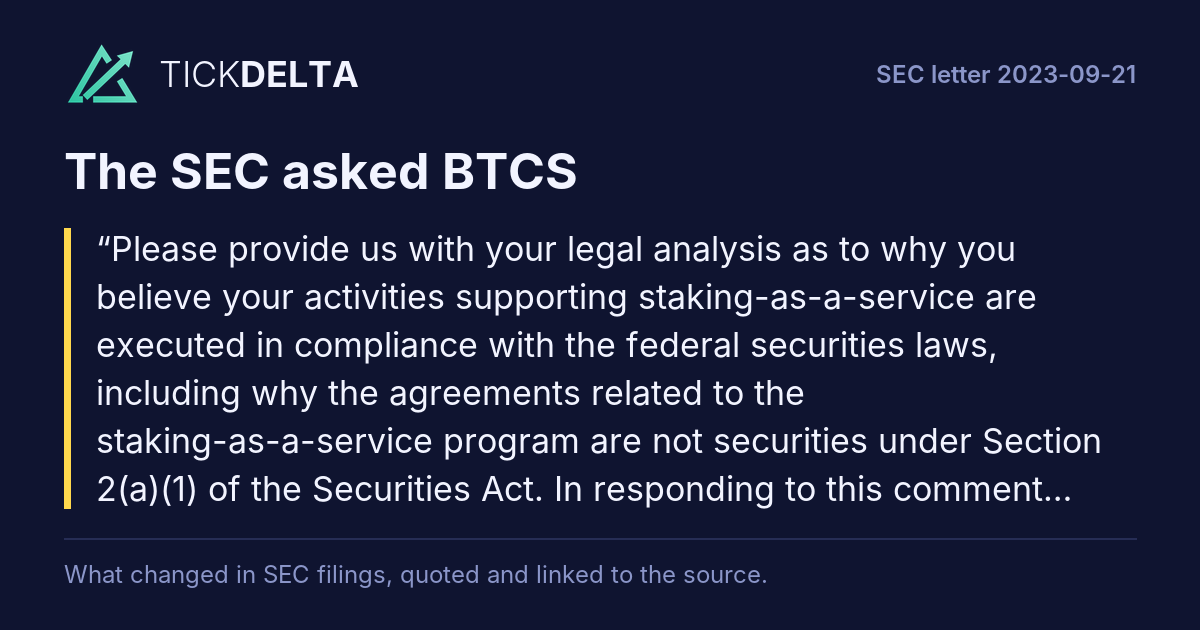
Also in this review: closing letter, 2024-09-20